CATEGORY
CATEGORY
Regulation
Regulation
Regulation
EU End-of-Waste Criteria for Plastics in 2026: What Non-EU Recyclers Will Have to Prove
EU End-of-Waste Criteria for Plastics in 2026: What Non-EU Recyclers Will Have to Prove
EU End-of-Waste Criteria for Plastics in 2026: What Non-EU Recyclers Will Have to Prove

Most EU recycled-plastics rules answer the question "how much recycled content must this contain?" The draft end-of-waste criteria answer the question that comes before it: is the material in the bag a product at all, or is it still waste? For a pellet produced outside the EU, that answer decides which legal regime it travels under — and the draft puts part of the test on the recycler, not only on the importer.
On 23 December 2025 the European Commission published, for public feedback, a draft Commission Implementing Regulation laying down criteria for when plastic waste ceases to be waste under Directive 2008/98/EC, the Waste Framework Directive. Feedback closed on 26 January 2026, and the text was notified to the World Trade Organization's Technical Barriers to Trade Committee on 6 August 2026 as G/TBT/N/EU/1229, with comments open until 20 September 2026. AGRINFO's tracking entry states adoption is likely in October 2026. This article is written from the notified text and its annexes, which differ from the December version in one respect noted below.
Until now, whether a recycled plastic had stopped being waste was decided member state by member state. The draft would replace that with one EU-wide test. For buyers sourcing recycled polyolefins from outside the EU, the provision to read first is not the quality threshold — it is Article 5, which sets out what a recycler established outside the Union must have in place before its output can enter the EU as a product, and what happens when it does not.
What the draft covers
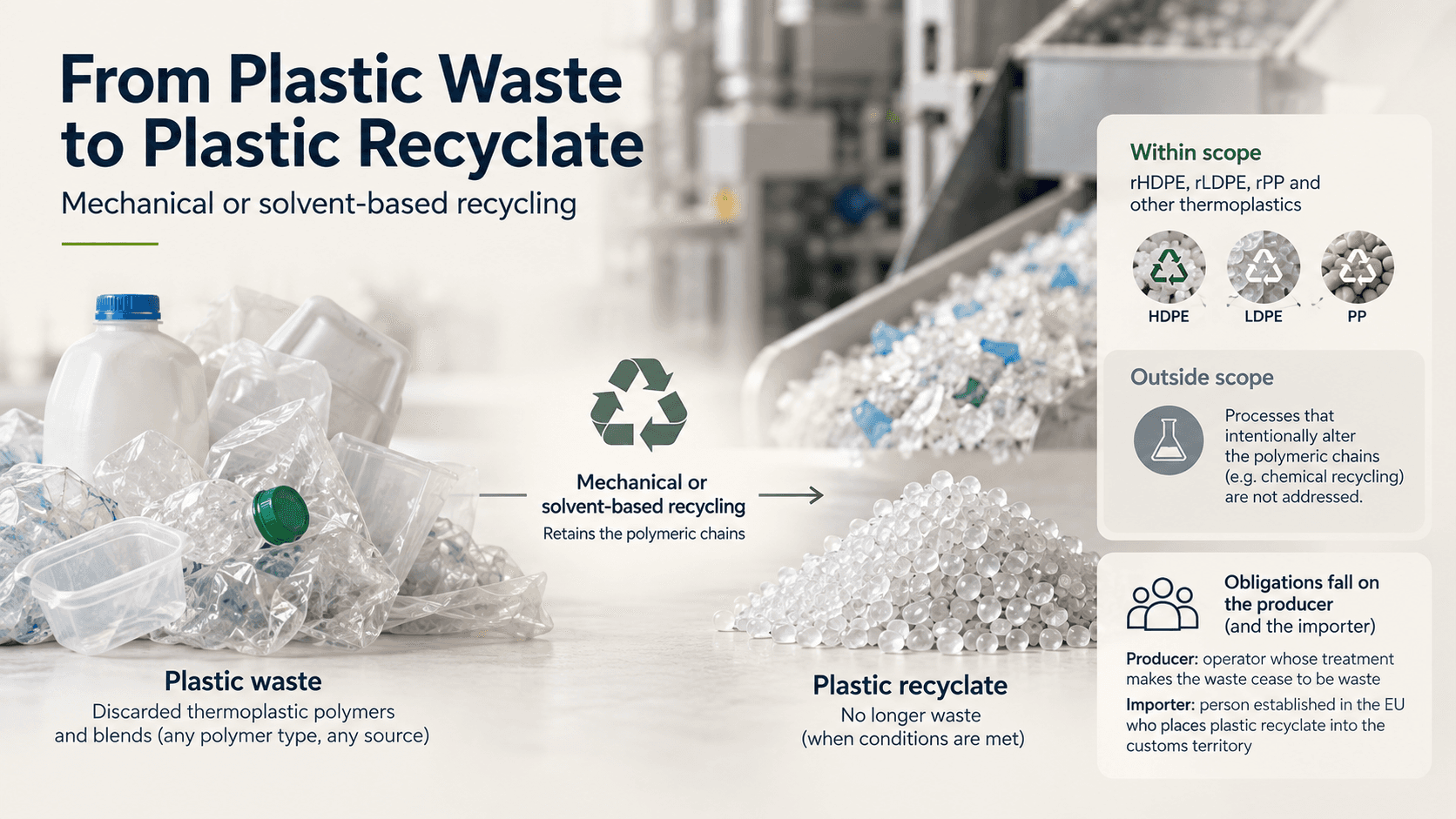
Article 2(2) defines plastic waste as "waste containing discarded thermoplastic polymers and blends of thermoplastic polymers, regardless of the polymer type and source of the waste." It is not a PET-specific instrument: rHDPE, rLDPE and rPP sit inside the scope on the same terms as anything else thermoplastic.
Article 1 limits it to plastic waste used as input for mechanical or solvent-based recycling — operations that retain the polymeric chains. Processes that intentionally alter those chains are outside the draft, so chemical recycling is not addressed. Where the conditions are met, the output is termed plastic recyclate and is no longer waste. The obligations fall on the producer, the operator whose treatment makes the waste cease to be waste, and on the importer, a person established in the Union who places plastic recyclate into the customs territory.
Five conditions, and all five have to hold
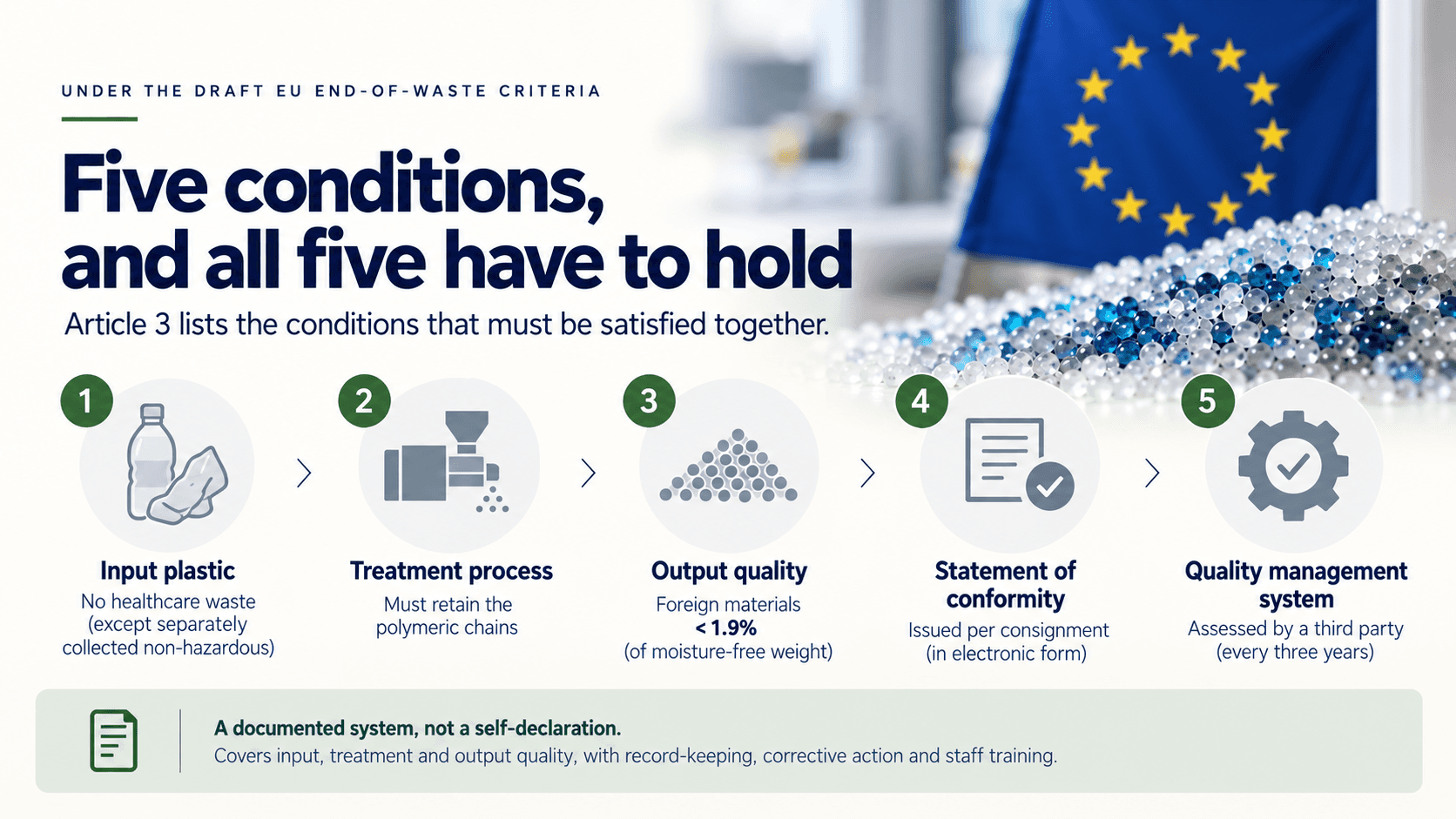
Article 3 lists the conditions that must be satisfied together. Three point to Annex I; two are free-standing articles.
Condition | Where it sits | What it requires |
|---|---|---|
Input plastic | Annex I, Section 1 | Healthcare waste is excluded, except separately collected non-hazardous plastic; used absorbent hygiene products are excluded unless decontaminated. Input containing persistent organic pollutants (POPs) above the limit values requires pre-treatment. Visual inspection on receipt, plus documented origin, supplier and reasons for rejection |
Treatment process | Annex I, Section 2 | The recycling must retain the polymeric chains, with only minor changes in molecular weight; eligible input must be stored separately from non-eligible input |
Output quality | Annex I, Section 3 | Foreign materials must be less than 1.9% of moisture-free weight, measured gravimetrically; monitoring at least once every six months, adjusted on risk; output not classified as hazardous, and compliant with REACH and POPs rules |
Statement of conformity | Article 4 | Issued per consignment on the Annex II model, in electronic form, transmitted to the next operator, retained at least five years |
Quality management system | Article 5 | Documented system, assessed by a conformity assessment body or an environmental verifier, verified every three years |
The quality management system is the heaviest of the five in practice: documented procedures for monitoring input, treatment and output quality, plus record-keeping, customer feedback, corrective action and staff training. It cannot be self-declared. Article 5(6) allows an environmental verifier to perform the assessment only where its accreditation covers NACE code 20, 22 or 38 — chemicals, rubber and plastic products, or waste collection and treatment — and Article 5(7) requires the producer to give enforcement authorities access to the system and keep records electronically available for at least five years.
Article 5 is the part that reaches outside the EU
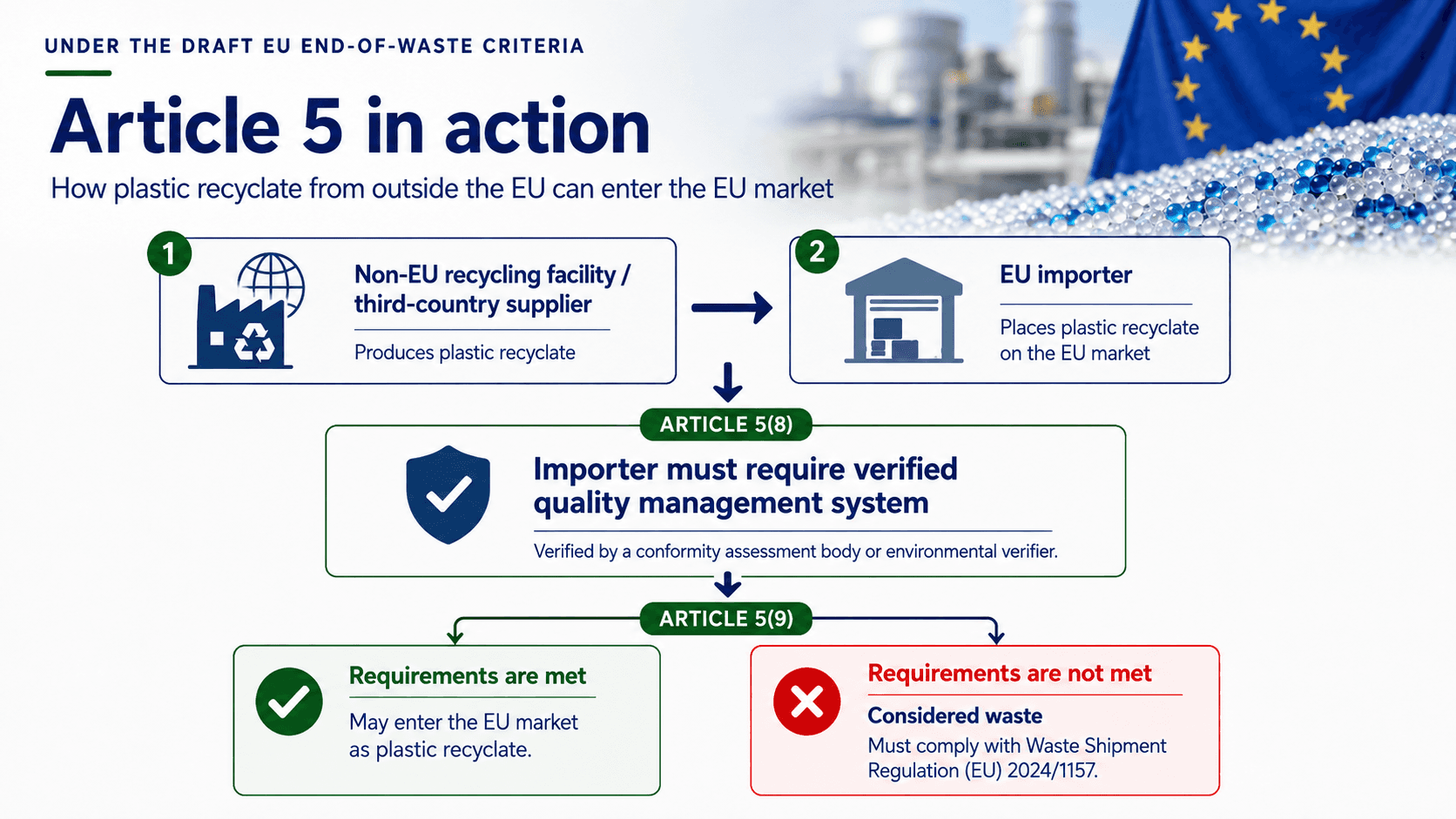
The WTO notification states that operators outside the EU may meet these criteria if they wish to supply the Union market under a non-waste classification, by reference to Article 5.
The mechanism runs through the importer. Article 5(8) provides that an importer bringing plastic recyclate from a recycling facility located in a third country must require that supplier to implement a quality management system, verified by one of the bodies referred to in Article 5(4) — a conformity assessment body or an environmental verifier.
Article 5(9) states the consequence: if the importer fails to meet the requirements in paragraph 8, the output plastic to be imported is considered waste and must comply with Regulation (EU) 2024/1157, the Waste Shipment Regulation. That is the same regime we covered in our post on EU waste shipment rules and the PCR supply chain — prior written notification and consent, permitted facilities, and the restrictions that attach to waste status, rather than an ordinary purchase of a product.
And because verification is done by external bodies rather than self-declared, the supply base able to obtain it will not be the whole supply base.
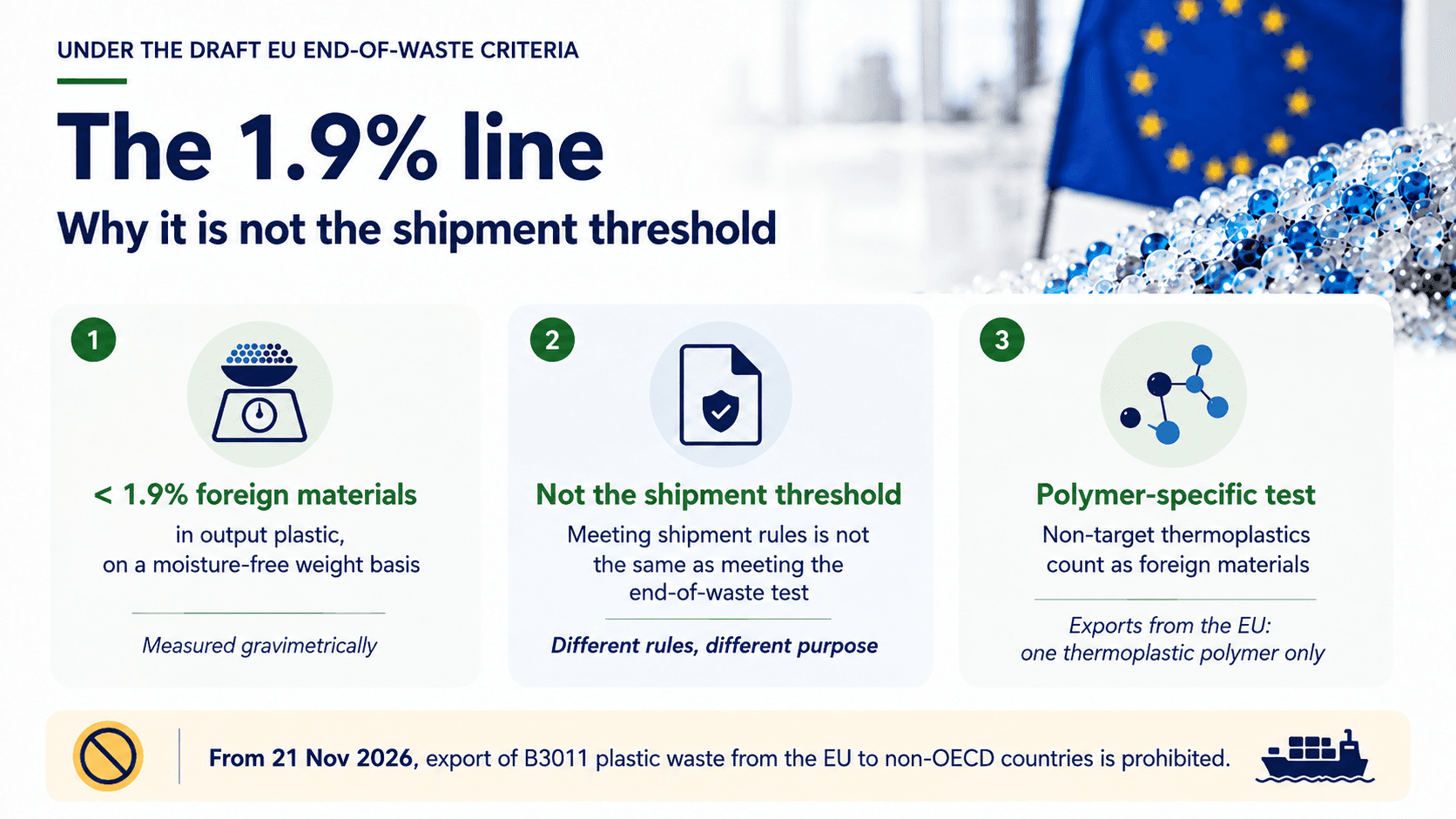
The 1.9% line, and why it is deliberately not the shipment threshold
Annex I, Section 3 sets the number: foreign materials in the output plastic must be less than 1.9% of moisture-free weight, measured gravimetrically. Article 2 defines foreign materials as polymers other than thermoplastics, thermoplastics not intentionally targeted by the recycling, and non-plastic materials.
The reasoning matters more than the number. Recital 9 records that Regulation (EU) 2024/1157 already requires prior written notification and consent for shipments of B3011 plastic waste outside the Union, and that from 21 November 2026 it also prohibits the export of that waste to non-OECD countries. Recital 10 then states that the contamination threshold under B3011 and the foreign-materials threshold for end-of-waste should not sit at the same level, so the two regimes remain distinguishable in enforcement. Clearing the shipment threshold is therefore not the same as clearing this one. And because non-target thermoplastics count as foreign materials, the test is polymer-specific: a mixed polyolefin output is measured against the polymer the operation actually targeted, not against plastics in general.
One further criterion in the same section runs the other way, toward output leaving the EU: recyclate intended for export outside the EU must consist of one thermoplastic polymer. The December consultation version carried an exception for mixtures of polyethylene (PE), polypropylene (PP) and/or polyethylene terephthalate (PET); that exception does not appear in the notified annex, so anyone moving recyclate back out of the Union should check the adopted text on this point.
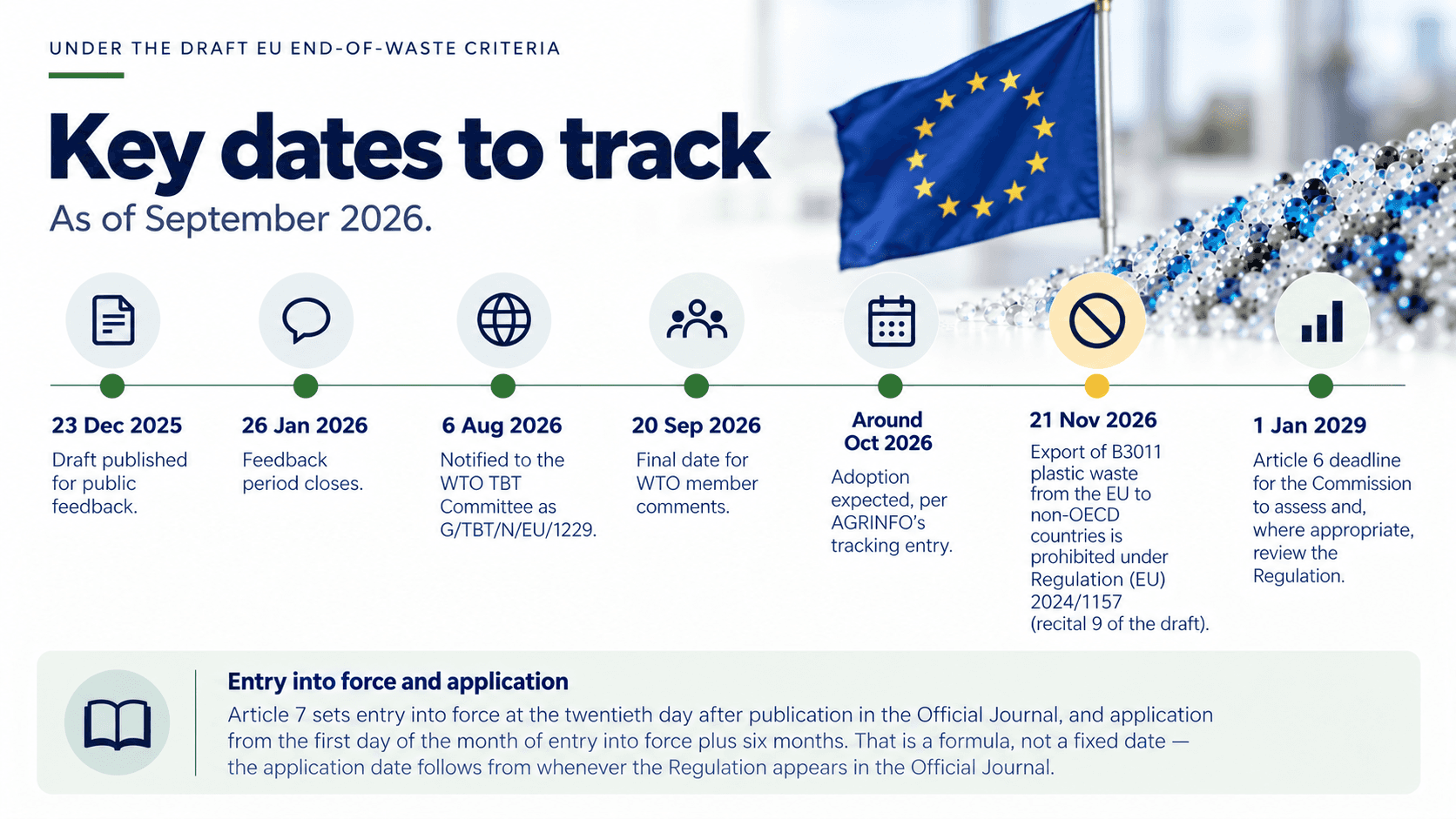
Key dates to track
As of September 2026:
23 December 2025 — Draft published for public feedback.
26 January 2026 — Feedback period closes.
6 August 2026 — Notified to the WTO TBT Committee as G/TBT/N/EU/1229.
20 September 2026 — Final date for WTO member comments.
Around October 2026 — Adoption expected, per AGRINFO's tracking entry.
21 November 2026 — Export of B3011 plastic waste from the EU to non-OECD countries is prohibited under Regulation (EU) 2024/1157 (recital 9 of the draft).
1 January 2029 — Article 6 deadline for the Commission to assess and, where appropriate, review the Regulation.
Article 7 sets entry into force at the twentieth day after publication in the Official Journal, and application from the first day of the month of entry into force plus six months. That is a formula, not a fixed date — the application date follows from whenever the Regulation appears in the Official Journal.
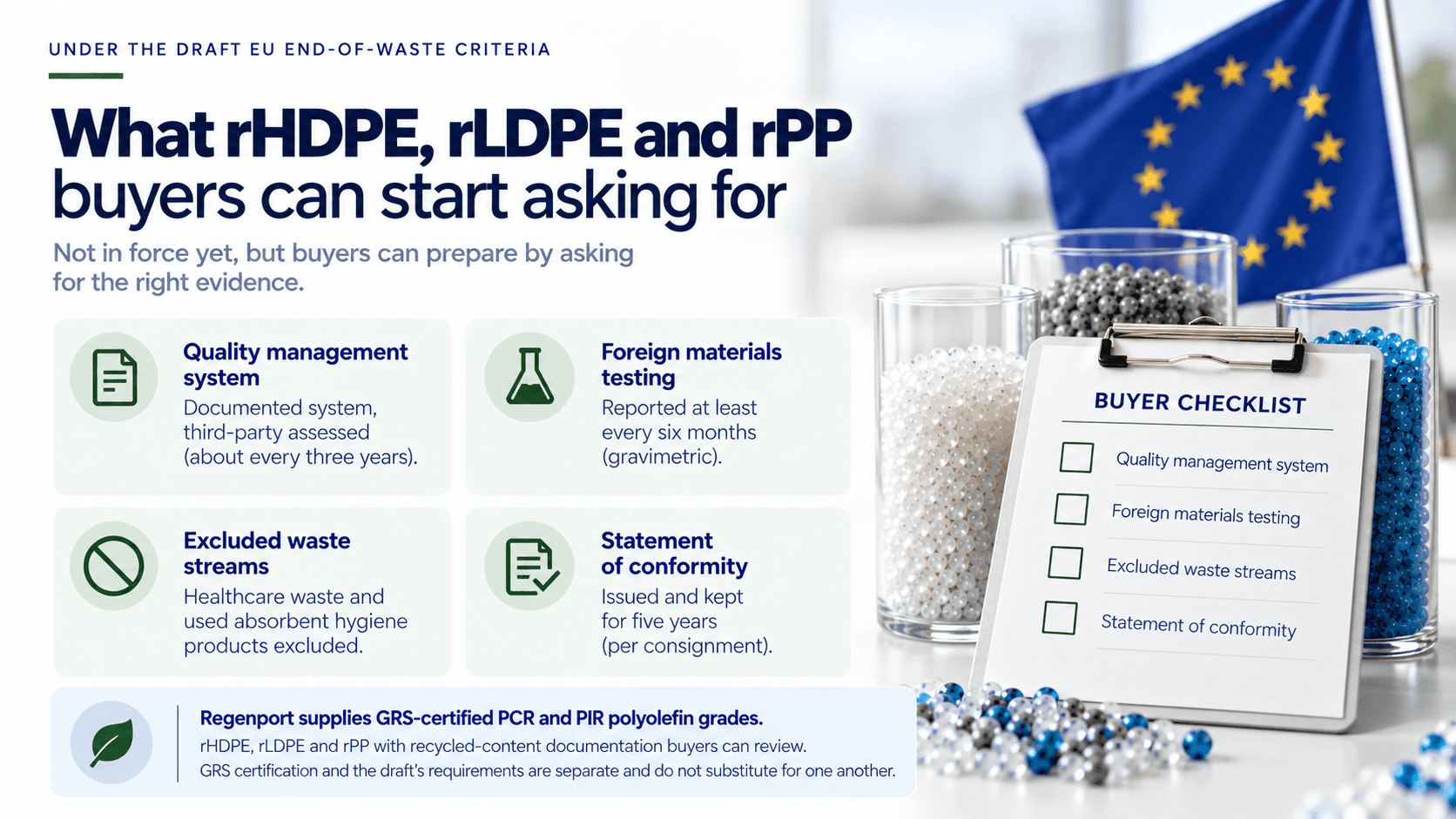
What rHDPE, rLDPE and rPP buyers can start asking for
Nothing here is in force yet, and the text can still change before adoption. What is stable enough to act on is the shape of the evidence, because it is the shape the EU has been converging on elsewhere — the recycled-content verification work under the Packaging and Packaging Waste Regulation and the substantiation rules for recycled claims both ask for records rather than assertions.
Questions that map directly onto the notified draft, for any non-EU grade intended for the EU market:
Does the recycler run a documented quality management system covering input, treatment and output monitoring — and has it been assessed by a conformity assessment body or an environmental verifier on a three-yearly cycle, with NACE 20, 22 or 38 accreditation where a verifier is used?
Can the recycler report foreign materials against the draft's definition and method — gravimetric, on moisture-free weight, counting non-target thermoplastics — at least every six months?
Are healthcare waste and used absorbent hygiene products excluded from the input stream, and is POPs pre-treatment documented where relevant?
Is there a process to issue and retain a per-consignment statement of conformity for five years, once the Annex II model is fixed?
Regenport supplies GRS-certified PCR and PIR recycled polyolefin grades — rHDPE, rLDPE and rPP — with recycled-content documentation and feedstock descriptions buyers can review. GRS certification and this draft's quality management requirements are separate instruments and do not substitute for one another.
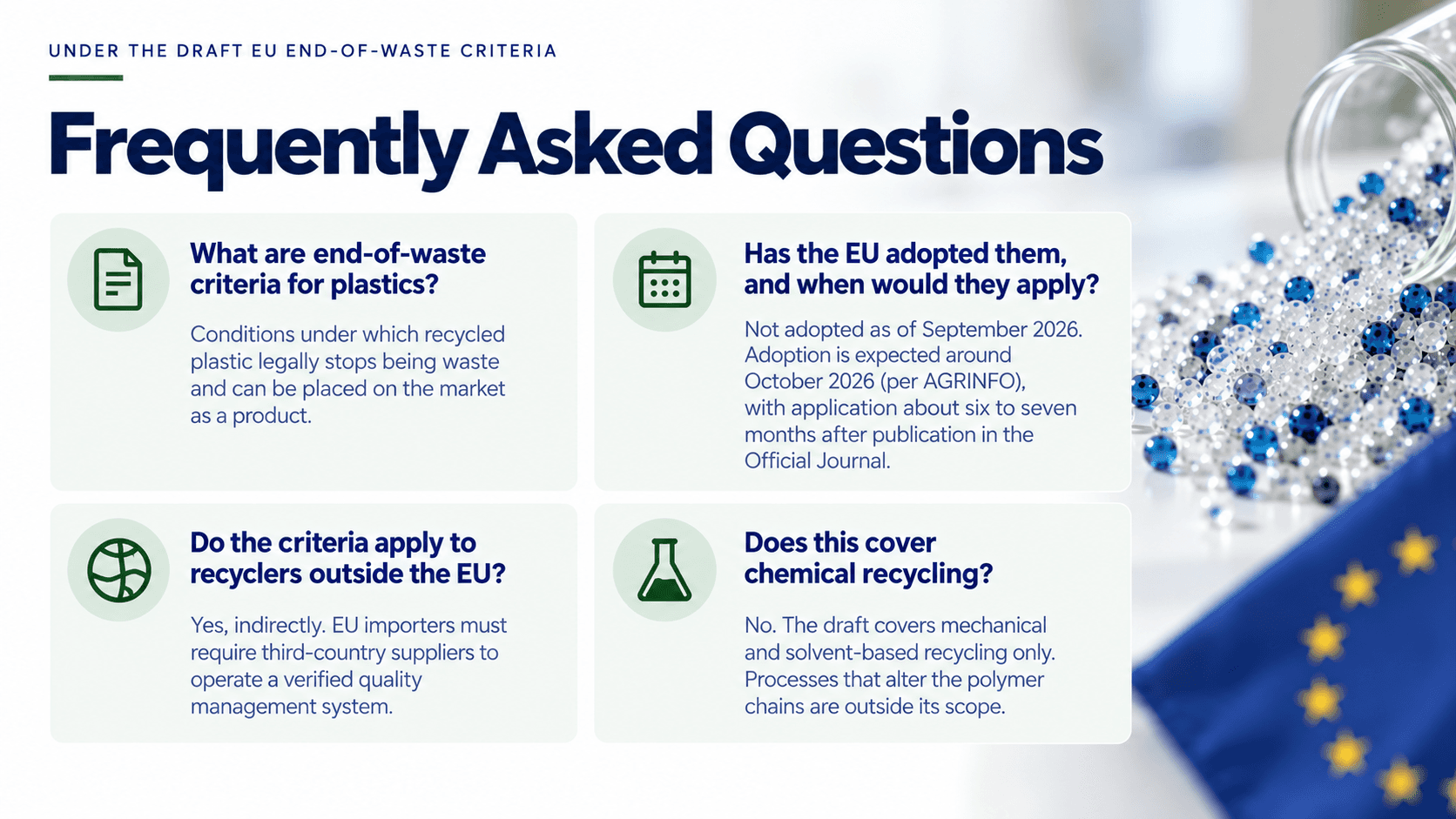
Frequently Asked Questions
What are end-of-waste criteria for plastics? They are the conditions under which recycled plastic legally stops being waste and can be placed on the market as a product. The European Commission's draft Implementing Regulation under Directive 2008/98/EC would set a single EU-wide test in place of the current member-state-by-member-state approach, and calls the resulting product "plastic recyclate".
Has the EU adopted them, and when would they apply? Not adopted as of September 2026. The draft was consulted between 23 December 2025 and 26 January 2026 and notified to the WTO on 6 August 2026 as G/TBT/N/EU/1229, with comments open until 20 September 2026; AGRINFO's tracking entry states adoption is likely in October 2026. Article 7 sets entry into force at the twentieth day after publication in the Official Journal and application from the first day of the month of entry into force plus six months, so the application date follows from the publication date rather than a fixed calendar date.
Do the criteria apply to recyclers outside the EU? Indirectly but substantively. Article 5(8) requires an EU importer of plastic recyclate from a third-country recycling facility to require its suppliers to operate a quality management system verified by a conformity assessment body or an environmental verifier. Article 5(9) provides that if the importer fails to meet that requirement, the output plastic to be imported is considered waste and must comply with Regulation (EU) 2024/1157.
Does this cover chemical recycling? No. The draft covers mechanical and solvent-based recycling — operations that retain the polymeric chains. Processes that intentionally alter the polymer chains are outside its scope.
About this guide. Current as of September 2026, for general information only — not legal advice. The instrument described is an unadopted draft whose provisions, numbering and dates may change before publication in the Official Journal; verify current requirements with the European Commission or qualified regulatory counsel.
Image generated with ChatGPT
Sources
European Commission, "Draft Commission Implementing Regulation laying down rules for the application of Directive 2008/98/EC as regards criteria for when plastic waste ceases to be waste" — text as notified to the WTO, 6 August 2026 → Read the Source
European Commission, Annexes I and II to the draft Implementing Regulation, as notified 6 August 2026 → Read the Source
European Commission, TBT notification G/TBT/N/EU/1229 → Read the Source
AGRINFO, "Criteria defining when waste legislation stops applying to plastic waste" → Read the Source
On 23 December 2025 the European Commission published, for public feedback, a draft Commission Implementing Regulation laying down criteria for when plastic waste ceases to be waste under Directive 2008/98/EC, the Waste Framework Directive. Feedback closed on 26 January 2026, and the text was notified to the World Trade Organization's Technical Barriers to Trade Committee on 6 August 2026 as G/TBT/N/EU/1229, with comments open until 20 September 2026. AGRINFO's tracking entry states adoption is likely in October 2026. This article is written from the notified text and its annexes, which differ from the December version in one respect noted below.
Until now, whether a recycled plastic had stopped being waste was decided member state by member state. The draft would replace that with one EU-wide test. For buyers sourcing recycled polyolefins from outside the EU, the provision to read first is not the quality threshold — it is Article 5, which sets out what a recycler established outside the Union must have in place before its output can enter the EU as a product, and what happens when it does not.
What the draft covers
Article 2(2) defines plastic waste as "waste containing discarded thermoplastic polymers and blends of thermoplastic polymers, regardless of the polymer type and source of the waste." It is not a PET-specific instrument: rHDPE, rLDPE and rPP sit inside the scope on the same terms as anything else thermoplastic.
Article 1 limits it to plastic waste used as input for mechanical or solvent-based recycling — operations that retain the polymeric chains. Processes that intentionally alter those chains are outside the draft, so chemical recycling is not addressed. Where the conditions are met, the output is termed plastic recyclate and is no longer waste. The obligations fall on the producer, the operator whose treatment makes the waste cease to be waste, and on the importer, a person established in the Union who places plastic recyclate into the customs territory.
Five conditions, and all five have to hold
Article 3 lists the conditions that must be satisfied together. Three point to Annex I; two are free-standing articles.
Condition | Where it sits | What it requires |
|---|---|---|
Input plastic | Annex I, Section 1 | Healthcare waste is excluded, except separately collected non-hazardous plastic; used absorbent hygiene products are excluded unless decontaminated. Input containing persistent organic pollutants (POPs) above the limit values requires pre-treatment. Visual inspection on receipt, plus documented origin, supplier and reasons for rejection |
Treatment process | Annex I, Section 2 | The recycling must retain the polymeric chains, with only minor changes in molecular weight; eligible input must be stored separately from non-eligible input |
Output quality | Annex I, Section 3 | Foreign materials must be less than 1.9% of moisture-free weight, measured gravimetrically; monitoring at least once every six months, adjusted on risk; output not classified as hazardous, and compliant with REACH and POPs rules |
Statement of conformity | Article 4 | Issued per consignment on the Annex II model, in electronic form, transmitted to the next operator, retained at least five years |
Quality management system | Article 5 | Documented system, assessed by a conformity assessment body or an environmental verifier, verified every three years |
The quality management system is the heaviest of the five in practice: documented procedures for monitoring input, treatment and output quality, plus record-keeping, customer feedback, corrective action and staff training. It cannot be self-declared. Article 5(6) allows an environmental verifier to perform the assessment only where its accreditation covers NACE code 20, 22 or 38 — chemicals, rubber and plastic products, or waste collection and treatment — and Article 5(7) requires the producer to give enforcement authorities access to the system and keep records electronically available for at least five years.
Article 5 is the part that reaches outside the EU
The WTO notification states that operators outside the EU may meet these criteria if they wish to supply the Union market under a non-waste classification, by reference to Article 5.
The mechanism runs through the importer. Article 5(8) provides that an importer bringing plastic recyclate from a recycling facility located in a third country must require that supplier to implement a quality management system, verified by one of the bodies referred to in Article 5(4) — a conformity assessment body or an environmental verifier.
Article 5(9) states the consequence: if the importer fails to meet the requirements in paragraph 8, the output plastic to be imported is considered waste and must comply with Regulation (EU) 2024/1157, the Waste Shipment Regulation. That is the same regime we covered in our post on EU waste shipment rules and the PCR supply chain — prior written notification and consent, permitted facilities, and the restrictions that attach to waste status, rather than an ordinary purchase of a product.
And because verification is done by external bodies rather than self-declared, the supply base able to obtain it will not be the whole supply base.
The 1.9% line, and why it is deliberately not the shipment threshold
Annex I, Section 3 sets the number: foreign materials in the output plastic must be less than 1.9% of moisture-free weight, measured gravimetrically. Article 2 defines foreign materials as polymers other than thermoplastics, thermoplastics not intentionally targeted by the recycling, and non-plastic materials.
The reasoning matters more than the number. Recital 9 records that Regulation (EU) 2024/1157 already requires prior written notification and consent for shipments of B3011 plastic waste outside the Union, and that from 21 November 2026 it also prohibits the export of that waste to non-OECD countries. Recital 10 then states that the contamination threshold under B3011 and the foreign-materials threshold for end-of-waste should not sit at the same level, so the two regimes remain distinguishable in enforcement. Clearing the shipment threshold is therefore not the same as clearing this one. And because non-target thermoplastics count as foreign materials, the test is polymer-specific: a mixed polyolefin output is measured against the polymer the operation actually targeted, not against plastics in general.
One further criterion in the same section runs the other way, toward output leaving the EU: recyclate intended for export outside the EU must consist of one thermoplastic polymer. The December consultation version carried an exception for mixtures of polyethylene (PE), polypropylene (PP) and/or polyethylene terephthalate (PET); that exception does not appear in the notified annex, so anyone moving recyclate back out of the Union should check the adopted text on this point.
Key dates to track
As of September 2026:
23 December 2025 — Draft published for public feedback.
26 January 2026 — Feedback period closes.
6 August 2026 — Notified to the WTO TBT Committee as G/TBT/N/EU/1229.
20 September 2026 — Final date for WTO member comments.
Around October 2026 — Adoption expected, per AGRINFO's tracking entry.
21 November 2026 — Export of B3011 plastic waste from the EU to non-OECD countries is prohibited under Regulation (EU) 2024/1157 (recital 9 of the draft).
1 January 2029 — Article 6 deadline for the Commission to assess and, where appropriate, review the Regulation.
Article 7 sets entry into force at the twentieth day after publication in the Official Journal, and application from the first day of the month of entry into force plus six months. That is a formula, not a fixed date — the application date follows from whenever the Regulation appears in the Official Journal.
What rHDPE, rLDPE and rPP buyers can start asking for
Nothing here is in force yet, and the text can still change before adoption. What is stable enough to act on is the shape of the evidence, because it is the shape the EU has been converging on elsewhere — the recycled-content verification work under the Packaging and Packaging Waste Regulation and the substantiation rules for recycled claims both ask for records rather than assertions.
Questions that map directly onto the notified draft, for any non-EU grade intended for the EU market:
Does the recycler run a documented quality management system covering input, treatment and output monitoring — and has it been assessed by a conformity assessment body or an environmental verifier on a three-yearly cycle, with NACE 20, 22 or 38 accreditation where a verifier is used?
Can the recycler report foreign materials against the draft's definition and method — gravimetric, on moisture-free weight, counting non-target thermoplastics — at least every six months?
Are healthcare waste and used absorbent hygiene products excluded from the input stream, and is POPs pre-treatment documented where relevant?
Is there a process to issue and retain a per-consignment statement of conformity for five years, once the Annex II model is fixed?
Regenport supplies GRS-certified PCR and PIR recycled polyolefin grades — rHDPE, rLDPE and rPP — with recycled-content documentation and feedstock descriptions buyers can review. GRS certification and this draft's quality management requirements are separate instruments and do not substitute for one another.
Frequently Asked Questions
What are end-of-waste criteria for plastics? They are the conditions under which recycled plastic legally stops being waste and can be placed on the market as a product. The European Commission's draft Implementing Regulation under Directive 2008/98/EC would set a single EU-wide test in place of the current member-state-by-member-state approach, and calls the resulting product "plastic recyclate".
Has the EU adopted them, and when would they apply? Not adopted as of September 2026. The draft was consulted between 23 December 2025 and 26 January 2026 and notified to the WTO on 6 August 2026 as G/TBT/N/EU/1229, with comments open until 20 September 2026; AGRINFO's tracking entry states adoption is likely in October 2026. Article 7 sets entry into force at the twentieth day after publication in the Official Journal and application from the first day of the month of entry into force plus six months, so the application date follows from the publication date rather than a fixed calendar date.
Do the criteria apply to recyclers outside the EU? Indirectly but substantively. Article 5(8) requires an EU importer of plastic recyclate from a third-country recycling facility to require its suppliers to operate a quality management system verified by a conformity assessment body or an environmental verifier. Article 5(9) provides that if the importer fails to meet that requirement, the output plastic to be imported is considered waste and must comply with Regulation (EU) 2024/1157.
Does this cover chemical recycling? No. The draft covers mechanical and solvent-based recycling — operations that retain the polymeric chains. Processes that intentionally alter the polymer chains are outside its scope.
About this guide. Current as of September 2026, for general information only — not legal advice. The instrument described is an unadopted draft whose provisions, numbering and dates may change before publication in the Official Journal; verify current requirements with the European Commission or qualified regulatory counsel.
Image generated with ChatGPT
Sources
European Commission, "Draft Commission Implementing Regulation laying down rules for the application of Directive 2008/98/EC as regards criteria for when plastic waste ceases to be waste" — text as notified to the WTO, 6 August 2026 → Read the Source
European Commission, Annexes I and II to the draft Implementing Regulation, as notified 6 August 2026 → Read the Source
European Commission, TBT notification G/TBT/N/EU/1229 → Read the Source
AGRINFO, "Criteria defining when waste legislation stops applying to plastic waste" → Read the Source
Sourcing Under End-of-Waste
Grades • Specs • Availability
Browse rHDPE →
Sourcing Under End-of-Waste
Sourcing Under End-of-Waste
Compare rHDPE grades by feedstock, properties, certification, stock and MOQ.
Compare rHDPE grades by feedstock, properties, certification, stock and MOQ.
Browse rHDPE →
Browse rHDPE →
Looking for samples or ready to source? Submit your request for pricing, availability, and technical information.
Looking for samples or ready to source? Submit your request for pricing, availability, and technical information.
Request a Quote →
Request a Quote →
Posted by REGENPORT
REGENPORT is a global platform connecting buyers and suppliers in the recycled materials and sustainable packaging industries.