CATEGORY
CATEGORY
Regulation
Regulation
Regulation
Washington State's Recycled-Content Law: Already Enforced, Already Climbing Toward 20% for Trash Bags in 2027
Washington State's Recycled-Content Law: Already Enforced, Already Climbing Toward 20% for Trash Bags in 2027
Washington State's Recycled-Content Law: Already Enforced, Already Climbing Toward 20% for Trash Bags in 2027

Washington state has already fined 35 companies $416,554 for missing its postconsumer recycled-content minimums. Plastic trash bags are partway through a phased climb — 10% in 2023, 15% now, 20% on January 1, 2027 — and the state is still auditing for unregistered producers.
Washington state didn't wait for a future deadline to start enforcing its recycled-content law. It has already fined 35 companies a combined $416,554 for falling short — and the requirement for plastic trash bags is still climbing, toward a final 20% postconsumer recycled content on January 1, 2027.
Washington's postconsumer recycled content law, codified at RCW 70A.245 and enacted through SB 5022 (signed by Governor Jay Inslee in 2021), is not a proposal under consultation. It is in force, it has deadlines that have already passed, and it has already produced penalties.
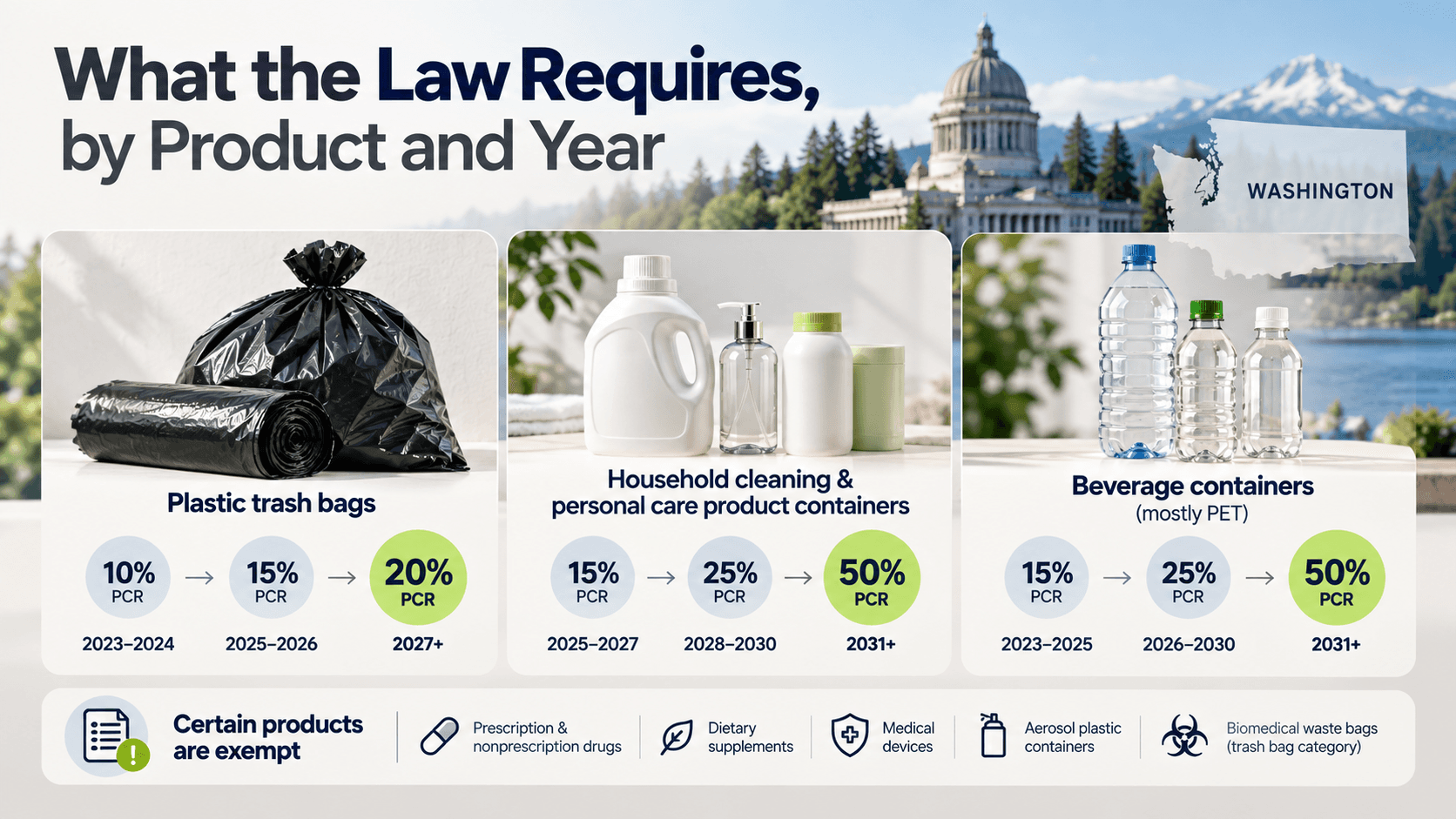
What the law requires, by product and year
The statute sets separate phase-in schedules for different plastic product categories. For a polyolefin supplier, two matter most.
Plastic trash bags:
January 1, 2023 – December 31, 2024: at least 10% postconsumer recycled (PCR) content by weight
January 1, 2025 – December 31, 2026: at least 15%
On and after January 1, 2027: at least 20%
Household cleaning and personal care product containers:
January 1, 2025 – December 31, 2027: at least 15%
January 1, 2028 – December 31, 2030: at least 25%
On and after January 1, 2031: at least 50%
Beverage containers (mostly PET, outside Regenport's core grades, included here because the law treats it as one system) step from 15% up to 25% on January 1, 2026, and to 50% in 2031. Wine in 187 mL containers and dairy milk containers follow a later, separate schedule starting in 2028–2029.
Certain products are fully exempt regardless of category: prescription and nonprescription drugs, dietary supplements, medical devices, aerosol plastic containers, and — specifically for the trash bag category — bags used for biomedical waste.

This is already being enforced
Washington's Department of Ecology began auditing producer compliance in August 2024 and issued its first set of penalties that October. Thirty-five companies were fined a combined $416,554, with individual penalties ranging from $39 to $67,196 — Clorox received the largest single fine. Of the 128 producers required to meet the recycled-content requirements, 93 met or exceeded them; two others (Admiral Beverage Corp. and Lassonde Pappas) received corrective action plans with penalties suspended pending compliance. (Ecology's own registration count is larger still — about 310 producers in total — the 128 figure is the subset actually subject to a content minimum that cycle.)
A second enforcement action followed in March 2025: Napco Bag and Film was fined $30,000 for failing to register and report at all, a separate failure from missing a percentage target. Ecology has said it believes hundreds of additional plastic producers subject to the law have not yet registered, and has continued auditing to find them. Ecology states that continued noncompliance after an initial violation notice can result in civil penalties of up to $1,000 per day.
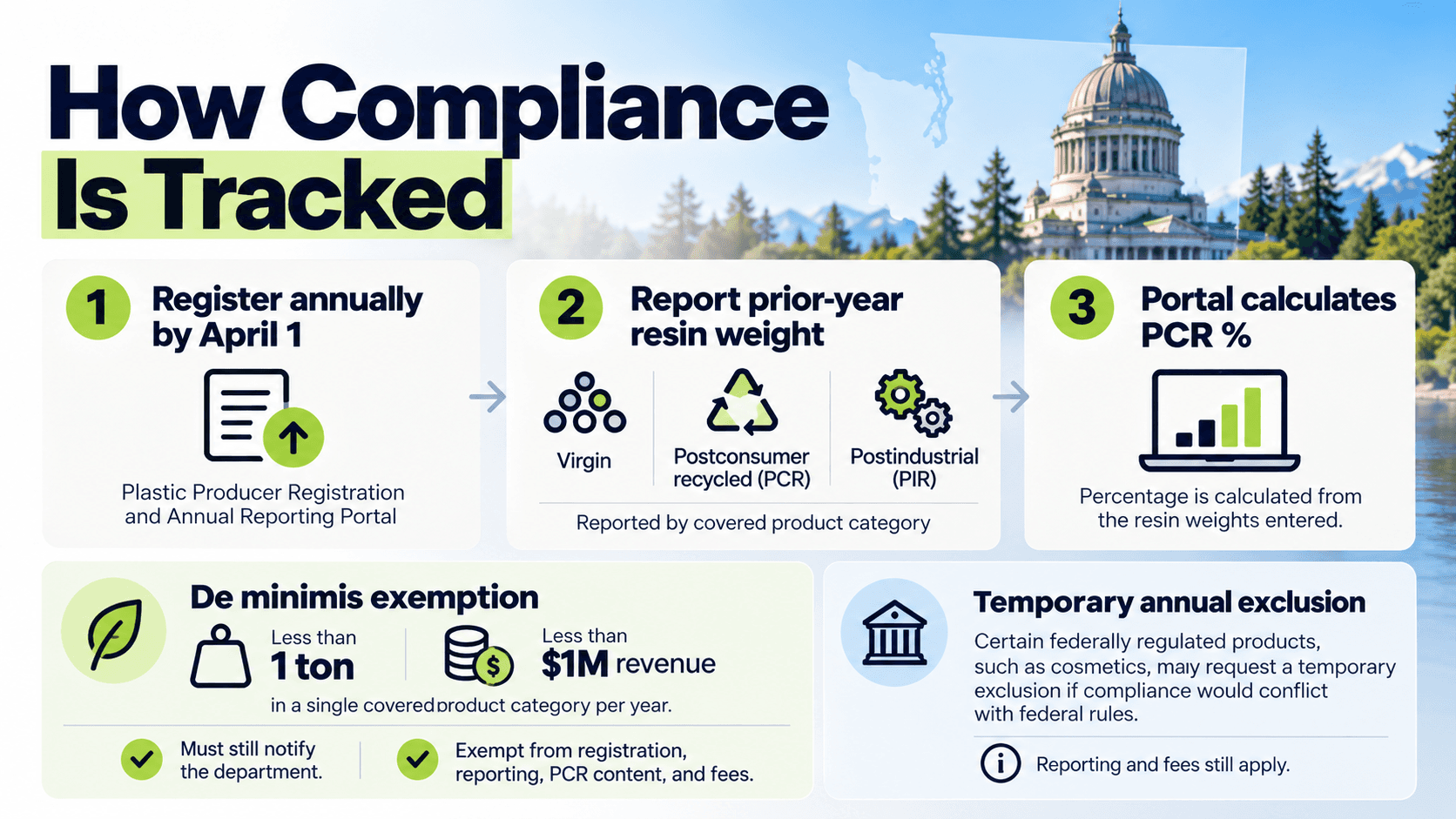
How compliance is tracked
Producers of covered plastic products sold into Washington must register annually by April 1 through the state's Plastic Producer Registration and Annual Reporting Portal, reporting the prior year's resin weight by type and source — virgin, postconsumer recycled, and postindustrial — for each covered product category. The portal calculates the postconsumer recycled content percentage directly from the resin weights entered.
A de minimis exemption applies to producers selling less than one ton, or generating less than $1 million in revenue, in a single covered product category per year — those producers must still notify the department of their status but are excused from registration, reporting, PCR content, and fee requirements. Producers of federally regulated products such as cosmetics may request a temporary annual exclusion if meeting the recycled-content requirement would conflict with federal rules, though they still owe reporting and fees.

What this means for a supplier of recycled polyolefin resin
A Washington-registered trash bag producer has to show, every year, what fraction of the resin behind its products by weight is postconsumer recycled — by category, not as a single blended company-wide number. That reporting traces back to the resin itself: a converter cannot report a PCR percentage it cannot verify from its supplier.
What a Washington-market trash bag producer is likely to need from a resin supplier:
Resin weight documentation broken out by source (postconsumer recycled vs. postindustrial vs. virgin), matching how the state's portal itself categorizes resin
A feedstock description specific enough to support the "postconsumer" classification, not a blended or ambiguous origin
Chain-of-custody certification such as GRS or RCS, where applicable to the grade
Enough lead time to secure supply before January 1, 2027 — a producer caught short at the final step has no further phase-in to fall back on
Regenport lists GRS-certified recycled LDPE and LLDPE grades with resin-source documentation buyers can review before requesting a sample.

Frequently Asked Questions
What percentage of recycled content do Washington trash bags need, and by when? 10% from 2023, 15% from 2025, and 20% from January 1, 2027 onward — the law's final step for this product category.
Has anyone actually been penalized under this law? Yes. Washington's Department of Ecology fined 35 companies a combined $416,554 in its first enforcement round in October 2024, covering beverage container and trash bag producers. Continued noncompliance carries civil penalties of up to $1,000 per day.
Are any trash bags exempt? Bags specifically sold for biomedical waste are fully exempt. A de minimis exemption also applies to producers selling less than one ton, or under $1 million in revenue, in a covered category per year.
How is the percentage calculated? By weight, per product category, through the state's Plastic Producer Registration and Annual Reporting Portal — producers report resin weight broken down by virgin, postconsumer recycled, and postindustrial content, and the system calculates the percentage.
Does this law apply to resin suppliers outside Washington, including overseas suppliers? Not directly. The registration, reporting, and compliance obligations fall on the producer placing the covered product into Washington's market. A resin supplier's relevance is indirect, through the documentation that producer needs to report accurately.
About this guide.
Current as of October 2026, for general information only — not legal advice. Specific compliance determinations should be verified against RCW 70A.245, WAC 173-925, and current Department of Ecology guidance.
Image generated with ChatGPT
Sources
Washington State Legislature, RCW 70A.245.020, "Postconsumer recycled content" — full statutory text, phase-in percentages and dates by product category → Read the Source
Washington State Department of Ecology, "Recycled content minimums" program guidance — product category summary, upcoming deadlines → Read the Source
Washington State Department of Ecology, "Guidance for post-consumer recycled content law RCW 70A.245 / WAC 173-925" — registration and reporting process, exemptions, de minimis thresholds → Read the Source
Packaging Dive, "Washington state fines 35 companies violating recycled plastic law" — enforcement figures, penalty amounts, department statements → Read the Source
Washington state didn't wait for a future deadline to start enforcing its recycled-content law. It has already fined 35 companies a combined $416,554 for falling short — and the requirement for plastic trash bags is still climbing, toward a final 20% postconsumer recycled content on January 1, 2027.
Washington's postconsumer recycled content law, codified at RCW 70A.245 and enacted through SB 5022 (signed by Governor Jay Inslee in 2021), is not a proposal under consultation. It is in force, it has deadlines that have already passed, and it has already produced penalties.
What the law requires, by product and year
The statute sets separate phase-in schedules for different plastic product categories. For a polyolefin supplier, two matter most.
Plastic trash bags:
January 1, 2023 – December 31, 2024: at least 10% postconsumer recycled (PCR) content by weight
January 1, 2025 – December 31, 2026: at least 15%
On and after January 1, 2027: at least 20%
Household cleaning and personal care product containers:
January 1, 2025 – December 31, 2027: at least 15%
January 1, 2028 – December 31, 2030: at least 25%
On and after January 1, 2031: at least 50%
Beverage containers (mostly PET, outside Regenport's core grades, included here because the law treats it as one system) step from 15% up to 25% on January 1, 2026, and to 50% in 2031. Wine in 187 mL containers and dairy milk containers follow a later, separate schedule starting in 2028–2029.
Certain products are fully exempt regardless of category: prescription and nonprescription drugs, dietary supplements, medical devices, aerosol plastic containers, and — specifically for the trash bag category — bags used for biomedical waste.
This is already being enforced
Washington's Department of Ecology began auditing producer compliance in August 2024 and issued its first set of penalties that October. Thirty-five companies were fined a combined $416,554, with individual penalties ranging from $39 to $67,196 — Clorox received the largest single fine. Of the 128 producers required to meet the recycled-content requirements, 93 met or exceeded them; two others (Admiral Beverage Corp. and Lassonde Pappas) received corrective action plans with penalties suspended pending compliance. (Ecology's own registration count is larger still — about 310 producers in total — the 128 figure is the subset actually subject to a content minimum that cycle.)
A second enforcement action followed in March 2025: Napco Bag and Film was fined $30,000 for failing to register and report at all, a separate failure from missing a percentage target. Ecology has said it believes hundreds of additional plastic producers subject to the law have not yet registered, and has continued auditing to find them. Ecology states that continued noncompliance after an initial violation notice can result in civil penalties of up to $1,000 per day.
How compliance is tracked
Producers of covered plastic products sold into Washington must register annually by April 1 through the state's Plastic Producer Registration and Annual Reporting Portal, reporting the prior year's resin weight by type and source — virgin, postconsumer recycled, and postindustrial — for each covered product category. The portal calculates the postconsumer recycled content percentage directly from the resin weights entered.
A de minimis exemption applies to producers selling less than one ton, or generating less than $1 million in revenue, in a single covered product category per year — those producers must still notify the department of their status but are excused from registration, reporting, PCR content, and fee requirements. Producers of federally regulated products such as cosmetics may request a temporary annual exclusion if meeting the recycled-content requirement would conflict with federal rules, though they still owe reporting and fees.
What this means for a supplier of recycled polyolefin resin
A Washington-registered trash bag producer has to show, every year, what fraction of the resin behind its products by weight is postconsumer recycled — by category, not as a single blended company-wide number. That reporting traces back to the resin itself: a converter cannot report a PCR percentage it cannot verify from its supplier.
What a Washington-market trash bag producer is likely to need from a resin supplier:
Resin weight documentation broken out by source (postconsumer recycled vs. postindustrial vs. virgin), matching how the state's portal itself categorizes resin
A feedstock description specific enough to support the "postconsumer" classification, not a blended or ambiguous origin
Chain-of-custody certification such as GRS or RCS, where applicable to the grade
Enough lead time to secure supply before January 1, 2027 — a producer caught short at the final step has no further phase-in to fall back on
Regenport lists GRS-certified recycled LDPE and LLDPE grades with resin-source documentation buyers can review before requesting a sample.
Frequently Asked Questions
What percentage of recycled content do Washington trash bags need, and by when? 10% from 2023, 15% from 2025, and 20% from January 1, 2027 onward — the law's final step for this product category.
Has anyone actually been penalized under this law? Yes. Washington's Department of Ecology fined 35 companies a combined $416,554 in its first enforcement round in October 2024, covering beverage container and trash bag producers. Continued noncompliance carries civil penalties of up to $1,000 per day.
Are any trash bags exempt? Bags specifically sold for biomedical waste are fully exempt. A de minimis exemption also applies to producers selling less than one ton, or under $1 million in revenue, in a covered category per year.
How is the percentage calculated? By weight, per product category, through the state's Plastic Producer Registration and Annual Reporting Portal — producers report resin weight broken down by virgin, postconsumer recycled, and postindustrial content, and the system calculates the percentage.
Does this law apply to resin suppliers outside Washington, including overseas suppliers? Not directly. The registration, reporting, and compliance obligations fall on the producer placing the covered product into Washington's market. A resin supplier's relevance is indirect, through the documentation that producer needs to report accurately.
About this guide.
Current as of October 2026, for general information only — not legal advice. Specific compliance determinations should be verified against RCW 70A.245, WAC 173-925, and current Department of Ecology guidance.
Image generated with ChatGPT
Sources
Washington State Legislature, RCW 70A.245.020, "Postconsumer recycled content" — full statutory text, phase-in percentages and dates by product category → Read the Source
Washington State Department of Ecology, "Recycled content minimums" program guidance — product category summary, upcoming deadlines → Read the Source
Washington State Department of Ecology, "Guidance for post-consumer recycled content law RCW 70A.245 / WAC 173-925" — registration and reporting process, exemptions, de minimis thresholds → Read the Source
Packaging Dive, "Washington state fines 35 companies violating recycled plastic law" — enforcement figures, penalty amounts, department statements → Read the Source
Explore Related Materials
Grades • Specs • Availability
Browse rLDPE →
Explore Related Materials
Explore Related Materials
GRS-certified rLDPE and rLLDPE grades with resin-source documentation for review.
GRS-certified rLDPE and rLLDPE grades with resin-source documentation for review.
Browse rLDPE →
Browse rLDPE →
Looking for samples or ready to source? Submit your request for pricing, availability, and technical information.
Looking for samples or ready to source? Submit your request for pricing, availability, and technical information.
Request a Quote →
Request a Quote →
Posted by REGENPORT
REGENPORT is a global platform connecting buyers and suppliers in the recycled materials and sustainable packaging industries.