CATEGORY
CATEGORY
Regulation
Regulation
Regulation
EU Greenwashing Rules in 2026: What the EmpCo Directive Means for "Recycled" Claims
EU Greenwashing Rules in 2026: What the EmpCo Directive Means for "Recycled" Claims
EU Greenwashing Rules in 2026: What the EmpCo Directive Means for "Recycled" Claims

Everyone was watching the EU Green Claims Directive — then it was withdrawn in 2025. A different law, the EmpCo Directive, quietly took its place, and it applies across the EU from 27 September 2026. For anyone who prints "recycled" on a label, the wording rules change first.
Buyers of recycled plastic have spent the past year tracking Extended Producer Responsibility (EPR) rules and recycled-content mandates — how much recycled material a product must contain. The EmpCo Directive works from the other direction: it governs how you are allowed to say something is recycled. This guide complements our earlier post on the EU Packaging and Packaging Waste Regulation (PPWR), and the two now sit side by side. Because the enforcement mechanism is consumer-protection law rather than packaging policy, EmpCo governs business-to-consumer (B2C) communications — advertising and commercial practices directed at end consumers — so it lands on any recycled claim that reaches a shelf, not only on internal sustainability reporting.
What Changed: From the Green Claims Directive to EmpCo
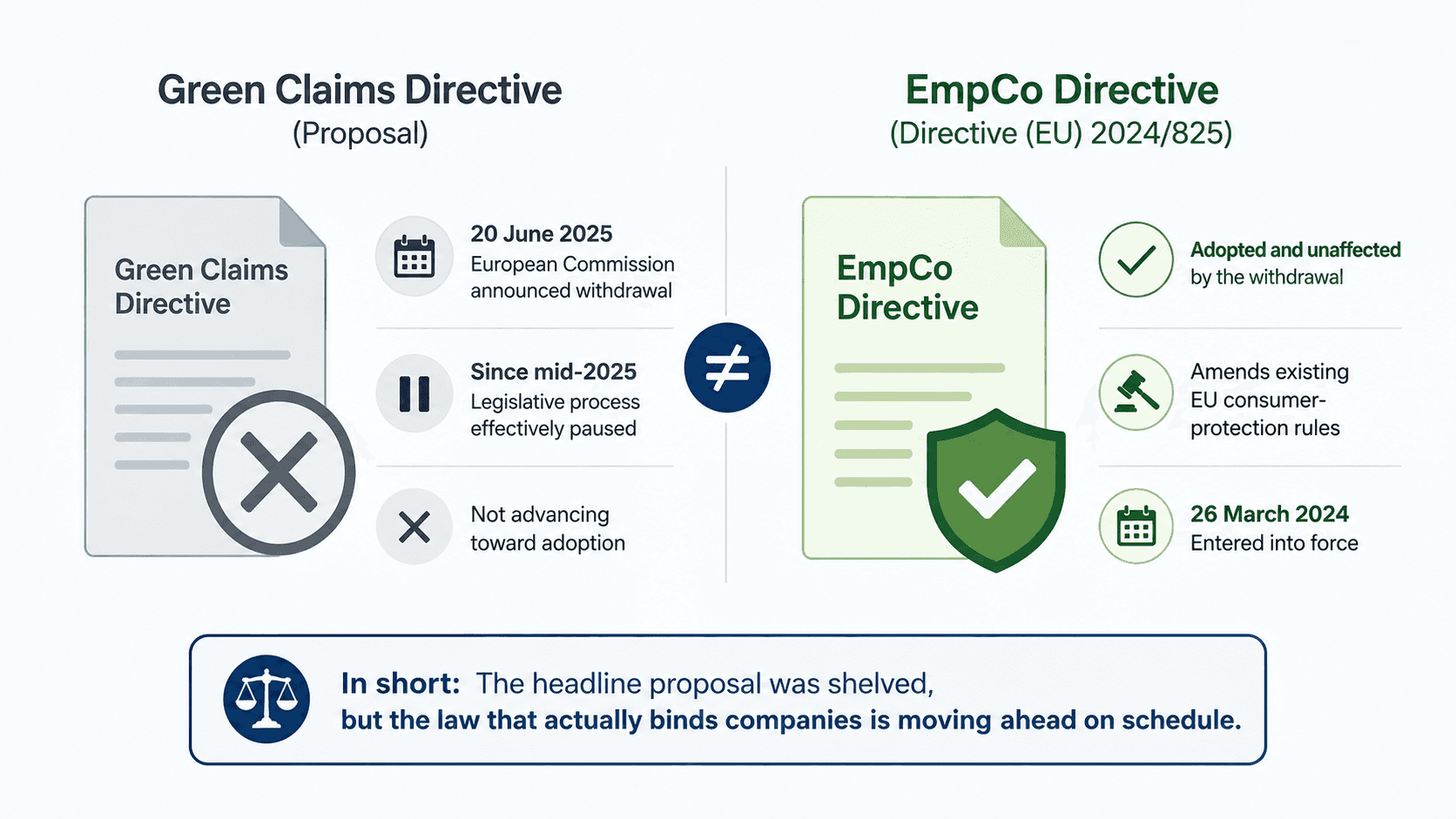
Two separate EU measures are often confused. The Green Claims Directive was a proposal specifically about substantiating environmental claims; on 20 June 2025 the European Commission announced its intention to withdraw it. While a formal withdrawal was still being finalised, the legislative process has been effectively paused since mid-2025 and the proposal is not advancing toward adoption. The EmpCo Directive — formally the "Empowering Consumers for the Green Transition" Directive, Directive (EU) 2024/825 — is separate, already adopted, and unaffected by that withdrawal. It amends existing EU consumer-protection rules and entered into force on 26 March 2024. In short: the headline proposal was shelved, but the law that actually binds companies is moving ahead on schedule.

How EmpCo Treats "Recycled" Claims
Under EmpCo, generic environmental terms such as "eco-friendly," "green," or "climate friendly" are prohibited unless the specific claim is substantiated on the same medium. For recycled content, the directive text points toward claims that are specific and clearly scoped — for example, stating a figure such as "90% recycled PET," and separating packaging from product where they differ (for instance, "packaging from recycled material, product from virgin material").
A vague label such as "made from recycled material" can be treated as misleading where it implies the whole product is recycled when, in fact, only the packaging is. The practical reading is that claims should be verifiable against evidence a buyer can produce on request — a point procurement teams will want to confirm with their own counsel.
Self-Made Eco-Labels Are Out; Third-Party Verification Is In
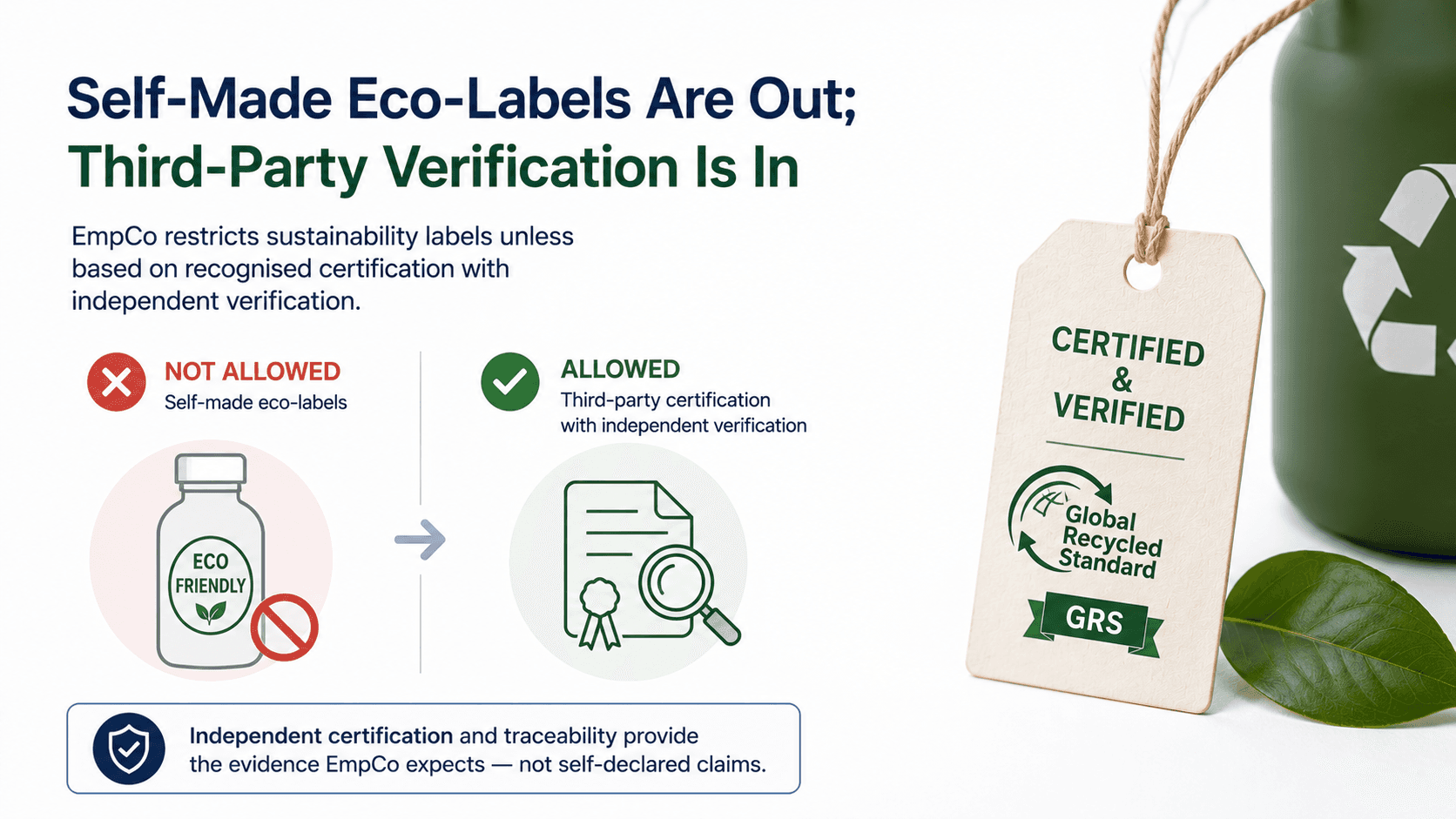
EmpCo also restricts sustainability labels. A company generally may not display its own self-created seal implying sustainability unless it rests on a recognised certification scheme or public-authority backing. Certification schemes are expected to involve independent verification — a scheme owner and a separate verifying body — with standards such as ISO 17065 cited as reference points for how that verification should work.
This is where sourcing and claims meet. EmpCo specifically restricts displaying a sustainability label that is not based on a recognised certification scheme or established by public authorities. A recycled-content chain-of-custody standard — the Global Recycled Standard (GRS) is one example — is built around independent verification and traceability of recycled content through the supply chain. Certification does not by itself make any particular marketing claim compliant, and buyers should confirm specific wording against their obligations. But the documentation and traceability that come with independent certification are the kind of evidence EmpCo pushes companies toward, rather than self-declared figures.
Why This Matters for Recycled-Plastic Buyers
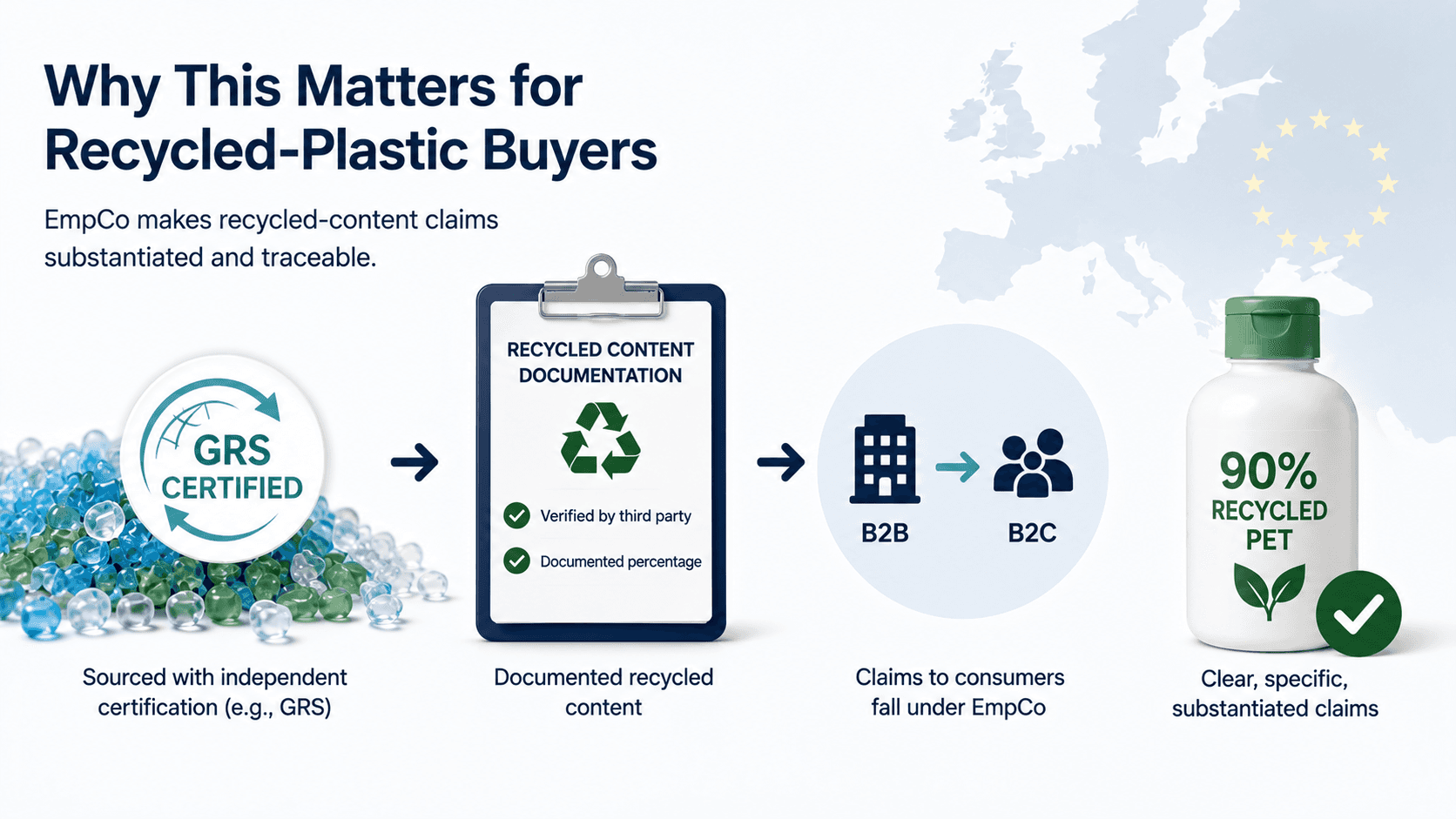
For buyers, the shift moves recycled-content documentation from "nice to have" toward part of the claim itself — especially for B2C-facing marketing and packaging. Even where a buyer trades only B2B, its customers' claims to end consumers fall under EmpCo, so substantiation has to travel down the supply chain. Sourcing material that carries independent certification (such as GRS) and a documented recycled-content percentage gives a company a paper trail it can evaluate against its own claims. Regenport supplies GRS-certified PCR and PIR grades with recycled-content documentation that buyers can review as part of their own substantiation process; whether that evidence supports any given on-pack statement is for the buyer and their legal team to verify.
Key Dates to Track
As of August 2026:
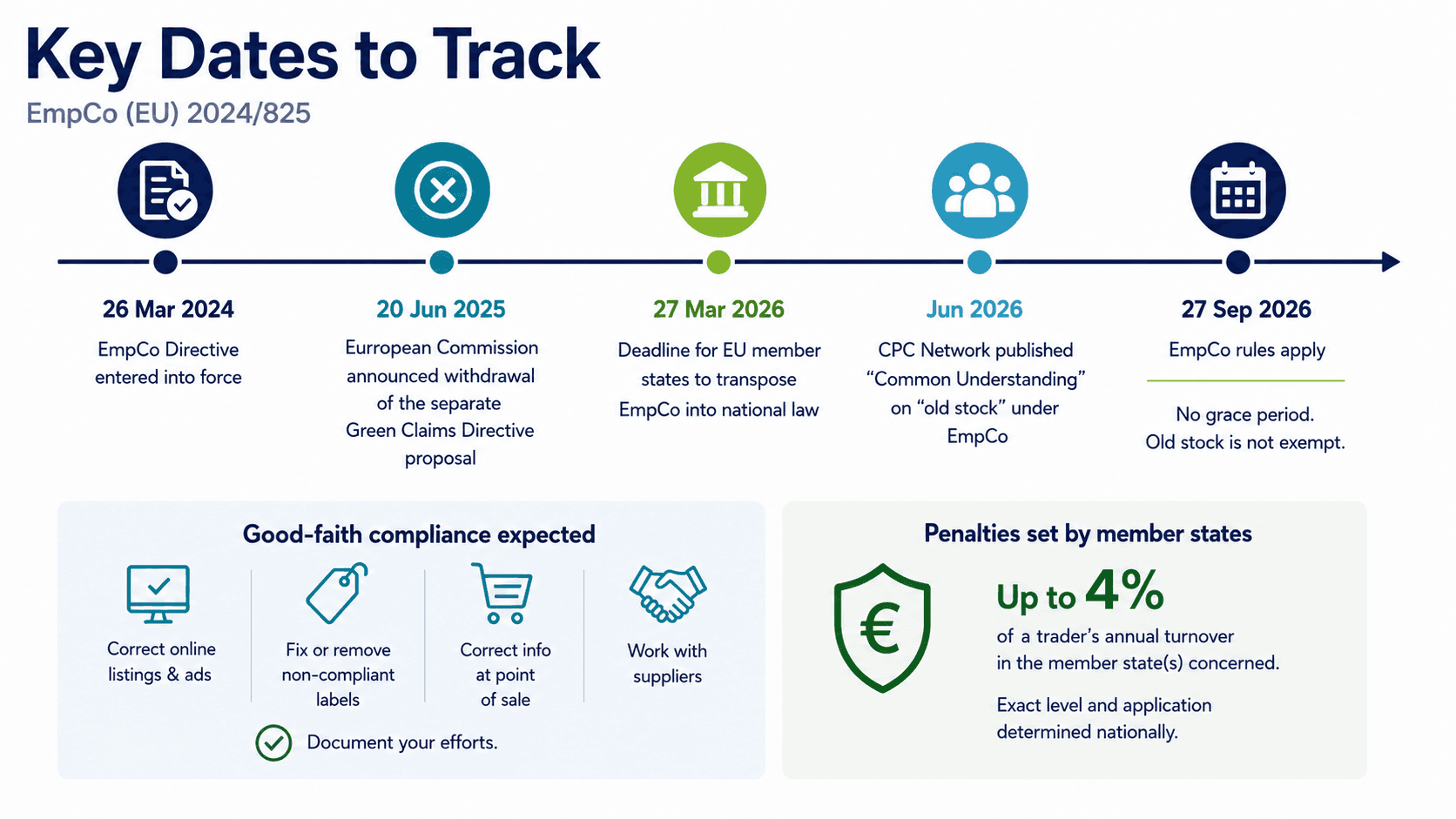
26 March 2024 — EmpCo Directive (EU) 2024/825 entered into force.
20 June 2025 — European Commission announced withdrawal of the separate Green Claims Directive proposal.
27 March 2026 — deadline for EU member states to transpose EmpCo into national law.
June 2026 — the EU Consumer Protection Cooperation (CPC) Network published a "Common Understanding" on "old stock" situations under EmpCo.
27 September 2026 — EmpCo rules apply.
There is no formal grace period, and old stock is not exempt. In its June 2026 Common Understanding, however, the CPC Network set out that traders are expected to make reasonable and proportionate efforts toward compliance — such as correcting environmental claims in online listings and advertising, applying stickers or removing non-compliant labelling, displaying corrective information at the point of sale, and coordinating with suppliers — and to document those good-faith efforts. The stated approach is compliance-oriented before sanction-oriented for genuine transitional cases, rather than immediate recall or destruction.
Penalties are set by each member state under national consumer-protection law. For certain widespread, cross-border infringements, the EU's consumer-protection framework provides for maximum fines that can reach at least 4% of a trader's annual turnover in the member state(s) concerned — but the exact level, and how it is applied, is determined nationally.
Frequently Asked Questions
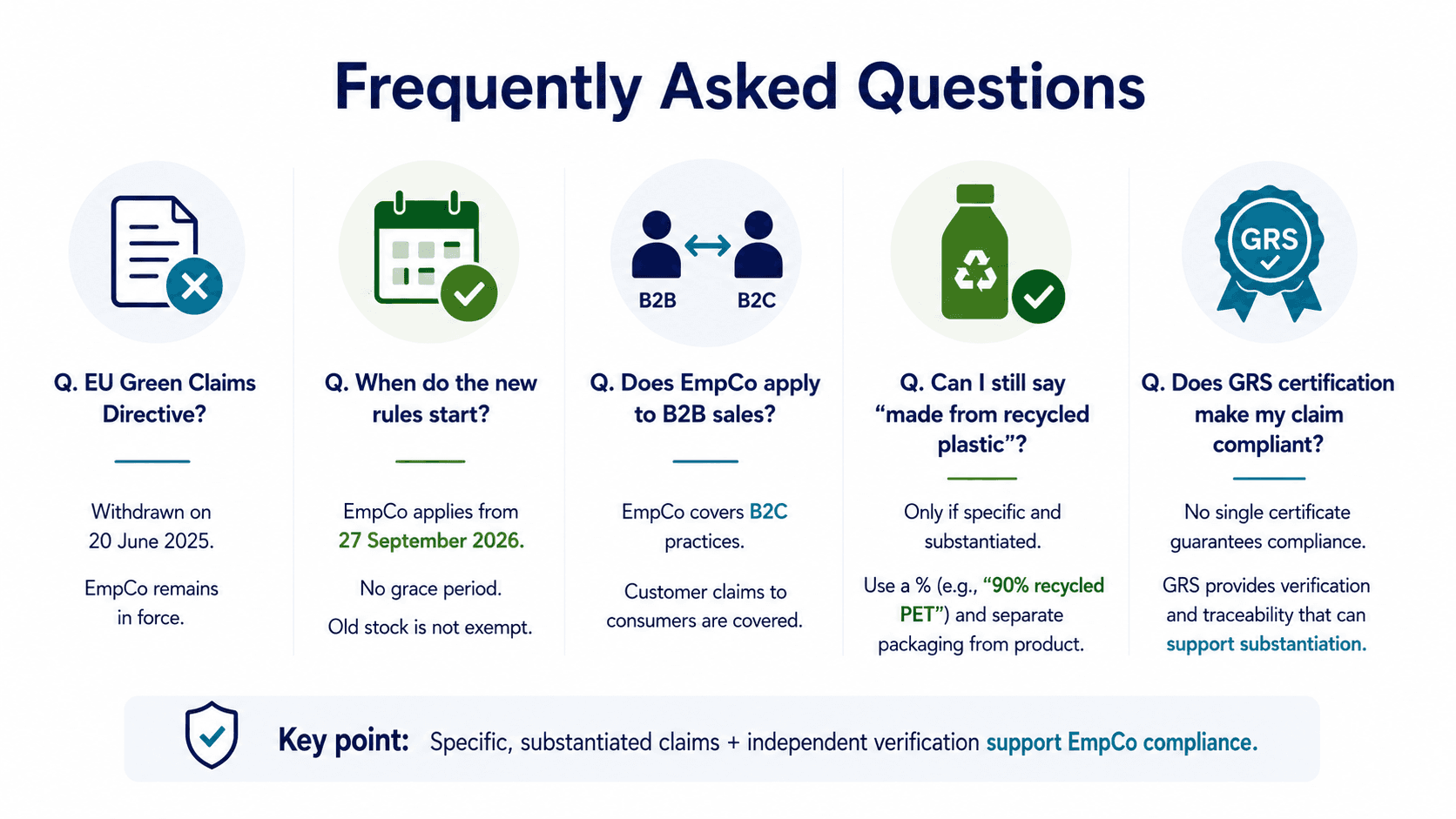
Is the EU Green Claims Directive still happening? No. The European Commission announced its withdrawal on 20 June 2025, and it is not advancing toward adoption. The EmpCo Directive is a separate measure and remains in force.
When do the new rules start applying? EmpCo applies from 27 September 2026, with no formal grace period. Old stock is not exempt, but the CPC Network's June 2026 "Common Understanding" expects traders to take reasonable, proportionate steps toward compliance — such as correcting online claims and advertising — and to document those efforts.
Does EmpCo apply to B2B sales? EmpCo governs business-to-consumer (B2C) commercial practices, as it amends the Unfair Commercial Practices Directive. It does not directly regulate B2B contracts, but claims your customers make to end consumers are covered — so recycled-content evidence still needs to travel up and down the supply chain.
Can I still say "made from recycled plastic"? Only where the claim is specific and substantiated. A figure such as "90% recycled PET" and a clear separation of packaging from product are the kind of wording the directive points toward; a blanket "made from recycled material" can mislead if only part of the item is recycled.
Does GRS certification make my claim compliant? No single certificate guarantees compliance. Independent third-party certification such as GRS provides verification and traceability that can support substantiation, but the specific claim should be checked against your obligations.

About This Guide
This guide is current as of August 2026 and is provided for general information only. It is not legal advice. Regulatory status, dates, and enforcement can change, and requirements vary by member state — confirm specifics with qualified legal counsel before relying on them.
Buyers of recycled plastic have spent the past year tracking Extended Producer Responsibility (EPR) rules and recycled-content mandates — how much recycled material a product must contain. The EmpCo Directive works from the other direction: it governs how you are allowed to say something is recycled. This guide complements our earlier post on the EU Packaging and Packaging Waste Regulation (PPWR), and the two now sit side by side. Because the enforcement mechanism is consumer-protection law rather than packaging policy, EmpCo governs business-to-consumer (B2C) communications — advertising and commercial practices directed at end consumers — so it lands on any recycled claim that reaches a shelf, not only on internal sustainability reporting.
What Changed: From the Green Claims Directive to EmpCo
Two separate EU measures are often confused. The Green Claims Directive was a proposal specifically about substantiating environmental claims; on 20 June 2025 the European Commission announced its intention to withdraw it. While a formal withdrawal was still being finalised, the legislative process has been effectively paused since mid-2025 and the proposal is not advancing toward adoption. The EmpCo Directive — formally the "Empowering Consumers for the Green Transition" Directive, Directive (EU) 2024/825 — is separate, already adopted, and unaffected by that withdrawal. It amends existing EU consumer-protection rules and entered into force on 26 March 2024. In short: the headline proposal was shelved, but the law that actually binds companies is moving ahead on schedule.
How EmpCo Treats "Recycled" Claims
Under EmpCo, generic environmental terms such as "eco-friendly," "green," or "climate friendly" are prohibited unless the specific claim is substantiated on the same medium. For recycled content, the directive text points toward claims that are specific and clearly scoped — for example, stating a figure such as "90% recycled PET," and separating packaging from product where they differ (for instance, "packaging from recycled material, product from virgin material").
A vague label such as "made from recycled material" can be treated as misleading where it implies the whole product is recycled when, in fact, only the packaging is. The practical reading is that claims should be verifiable against evidence a buyer can produce on request — a point procurement teams will want to confirm with their own counsel.
Self-Made Eco-Labels Are Out; Third-Party Verification Is In
EmpCo also restricts sustainability labels. A company generally may not display its own self-created seal implying sustainability unless it rests on a recognised certification scheme or public-authority backing. Certification schemes are expected to involve independent verification — a scheme owner and a separate verifying body — with standards such as ISO 17065 cited as reference points for how that verification should work.
This is where sourcing and claims meet. EmpCo specifically restricts displaying a sustainability label that is not based on a recognised certification scheme or established by public authorities. A recycled-content chain-of-custody standard — the Global Recycled Standard (GRS) is one example — is built around independent verification and traceability of recycled content through the supply chain. Certification does not by itself make any particular marketing claim compliant, and buyers should confirm specific wording against their obligations. But the documentation and traceability that come with independent certification are the kind of evidence EmpCo pushes companies toward, rather than self-declared figures.
Why This Matters for Recycled-Plastic Buyers
For buyers, the shift moves recycled-content documentation from "nice to have" toward part of the claim itself — especially for B2C-facing marketing and packaging. Even where a buyer trades only B2B, its customers' claims to end consumers fall under EmpCo, so substantiation has to travel down the supply chain. Sourcing material that carries independent certification (such as GRS) and a documented recycled-content percentage gives a company a paper trail it can evaluate against its own claims. Regenport supplies GRS-certified PCR and PIR grades with recycled-content documentation that buyers can review as part of their own substantiation process; whether that evidence supports any given on-pack statement is for the buyer and their legal team to verify.
Key Dates to Track
As of August 2026:
26 March 2024 — EmpCo Directive (EU) 2024/825 entered into force.
20 June 2025 — European Commission announced withdrawal of the separate Green Claims Directive proposal.
27 March 2026 — deadline for EU member states to transpose EmpCo into national law.
June 2026 — the EU Consumer Protection Cooperation (CPC) Network published a "Common Understanding" on "old stock" situations under EmpCo.
27 September 2026 — EmpCo rules apply.
There is no formal grace period, and old stock is not exempt. In its June 2026 Common Understanding, however, the CPC Network set out that traders are expected to make reasonable and proportionate efforts toward compliance — such as correcting environmental claims in online listings and advertising, applying stickers or removing non-compliant labelling, displaying corrective information at the point of sale, and coordinating with suppliers — and to document those good-faith efforts. The stated approach is compliance-oriented before sanction-oriented for genuine transitional cases, rather than immediate recall or destruction.
Penalties are set by each member state under national consumer-protection law. For certain widespread, cross-border infringements, the EU's consumer-protection framework provides for maximum fines that can reach at least 4% of a trader's annual turnover in the member state(s) concerned — but the exact level, and how it is applied, is determined nationally.
Frequently Asked Questions
Is the EU Green Claims Directive still happening? No. The European Commission announced its withdrawal on 20 June 2025, and it is not advancing toward adoption. The EmpCo Directive is a separate measure and remains in force.
When do the new rules start applying? EmpCo applies from 27 September 2026, with no formal grace period. Old stock is not exempt, but the CPC Network's June 2026 "Common Understanding" expects traders to take reasonable, proportionate steps toward compliance — such as correcting online claims and advertising — and to document those efforts.
Does EmpCo apply to B2B sales? EmpCo governs business-to-consumer (B2C) commercial practices, as it amends the Unfair Commercial Practices Directive. It does not directly regulate B2B contracts, but claims your customers make to end consumers are covered — so recycled-content evidence still needs to travel up and down the supply chain.
Can I still say "made from recycled plastic"? Only where the claim is specific and substantiated. A figure such as "90% recycled PET" and a clear separation of packaging from product are the kind of wording the directive points toward; a blanket "made from recycled material" can mislead if only part of the item is recycled.
Does GRS certification make my claim compliant? No single certificate guarantees compliance. Independent third-party certification such as GRS provides verification and traceability that can support substantiation, but the specific claim should be checked against your obligations.
About This Guide
This guide is current as of August 2026 and is provided for general information only. It is not legal advice. Regulatory status, dates, and enforcement can change, and requirements vary by member state — confirm specifics with qualified legal counsel before relying on them.
Backing Up Recycled Claims
Grades • Specs • Availability
Browse rHDPE →
Backing Up Recycled Claims
Backing Up Recycled Claims
Review rHDPE grades and the certification documents available for each.
Review rHDPE grades and the certification documents available for each.
Browse rHDPE →
Browse rHDPE →
Looking for samples or ready to source? Submit your request for pricing, availability, and technical information.
Looking for samples or ready to source? Submit your request for pricing, availability, and technical information.
Request a Quote →
Request a Quote →
Posted by REGENPORT
REGENPORT is a global platform connecting buyers and suppliers in the recycled materials and sustainable packaging industries.