CATEGORY
CATEGORY
Regulation
Regulation
Regulation
Not All Recycled Material Certifications Are Equal: A Practical Guide for Procurement Teams
Not All Recycled Material Certifications Are Equal: A Practical Guide for Procurement Teams
Not All Recycled Material Certifications Are Equal: A Practical Guide for Procurement Teams
Not all recycled material certifications verify the same thing. Learn the key differences between GRS, RCS, ISCC PLUS, RecyClass, and Food Contact Compliance — and how to choose the right one for your sourcing needs.
Introduction
When sourcing recycled materials, a certification label alone is not enough. Different certifications verify different things — some confirm recycled content, others ensure full supply chain traceability, and still others evaluate whether packaging can actually be recycled in practice.
Choosing the wrong certification — or misreading what a certificate actually guarantees — can expose your company to regulatory penalties, ESG reporting errors, or product recalls.
This guide breaks down five key certifications used in the recycled materials industry, explains what each one covers, and helps you identify which applies to your situation.
Why Certifications Matter
Before comparing individual standards, it's worth understanding why certification is a non-negotiable part of responsible procurement today.
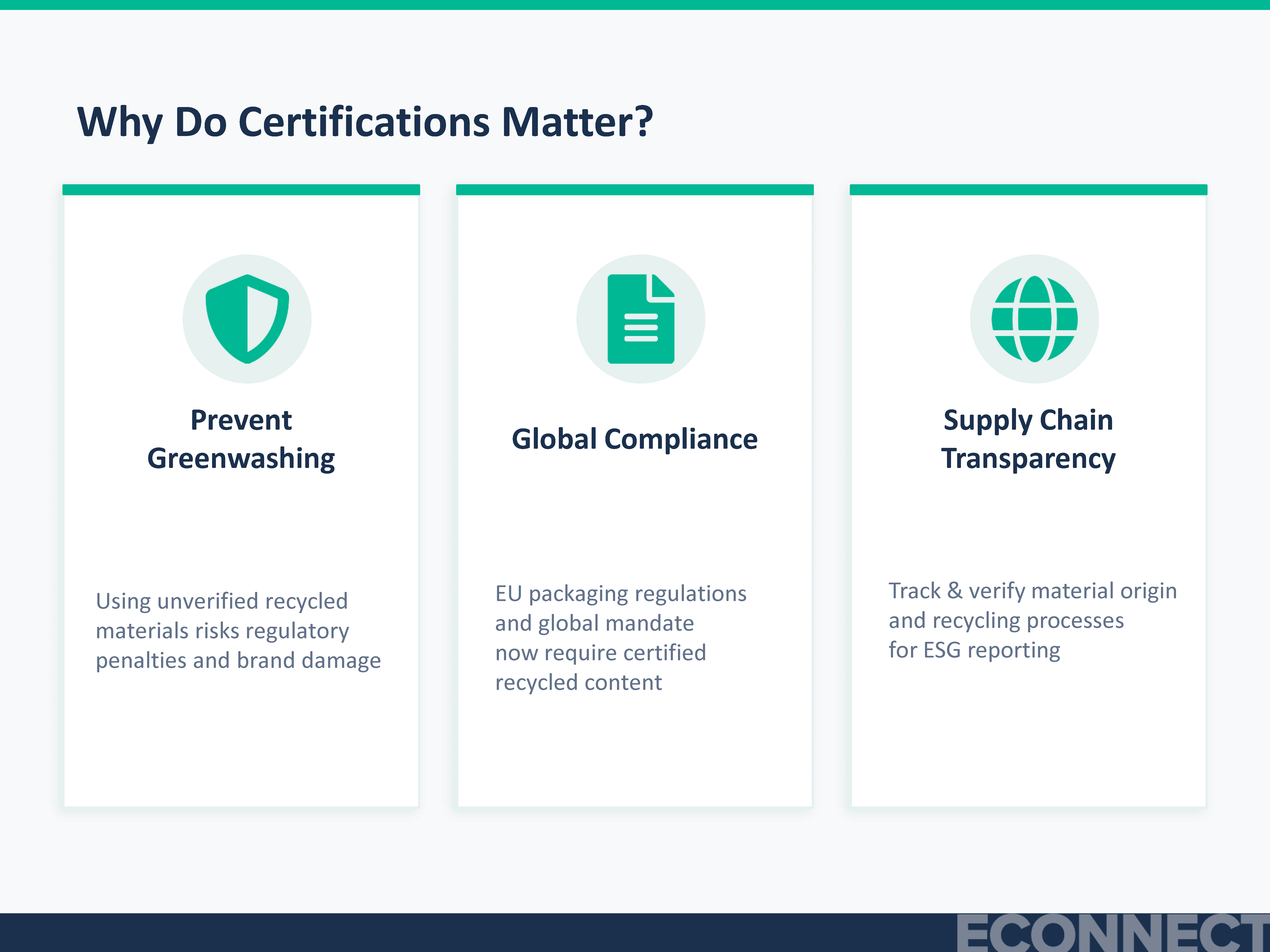
1. Preventing Greenwashing : Regulatory pressure on environmental claims is increasing globally. Using unverified recycled materials — even unintentionally — risks brand damage, regulatory penalties, and loss of customer trust.
2. Global Compliance : EU packaging regulations and other international mandates now require documented, certified recycled content. Certification is no longer optional for companies operating in regulated markets.
3. Supply Chain Transparency : Certifications provide a documented, auditable trail of material origin and recycling processes — essential for accurate ESG reporting and due diligence.
The 5 Key Certifications
01. GRS — Global Recycled Standard
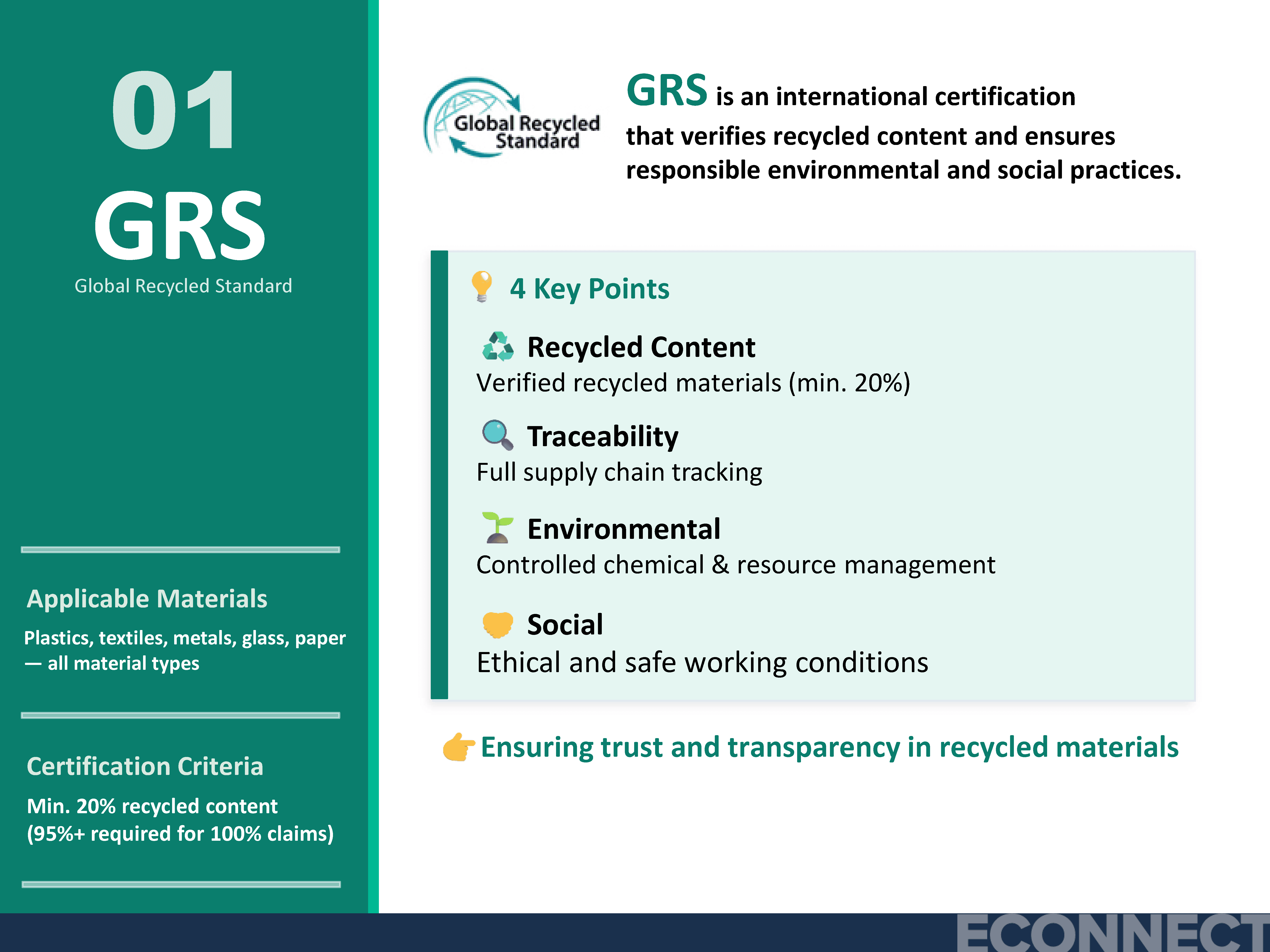
What it is: GRS is an international certification that verifies recycled content and ensures responsible environmental and social practices throughout the supply chain.
Applicable materials: All material types — plastics, textiles, metals, glass, paper
Minimum threshold: 20% recycled content (95%+ required to make a "100% recycled" claim)
4 Core Requirements:
Recycled Content — Verified minimum of 20% recycled input materials
Traceability — Full supply chain tracking from source to final product
Environmental — Controlled chemical and resource management
Social — Ethical and safe working conditions
GRS is the most comprehensive international standard for recycled materials. It is the certification of choice for global brand suppliers who need to demonstrate both recycled content and responsible sourcing practices.
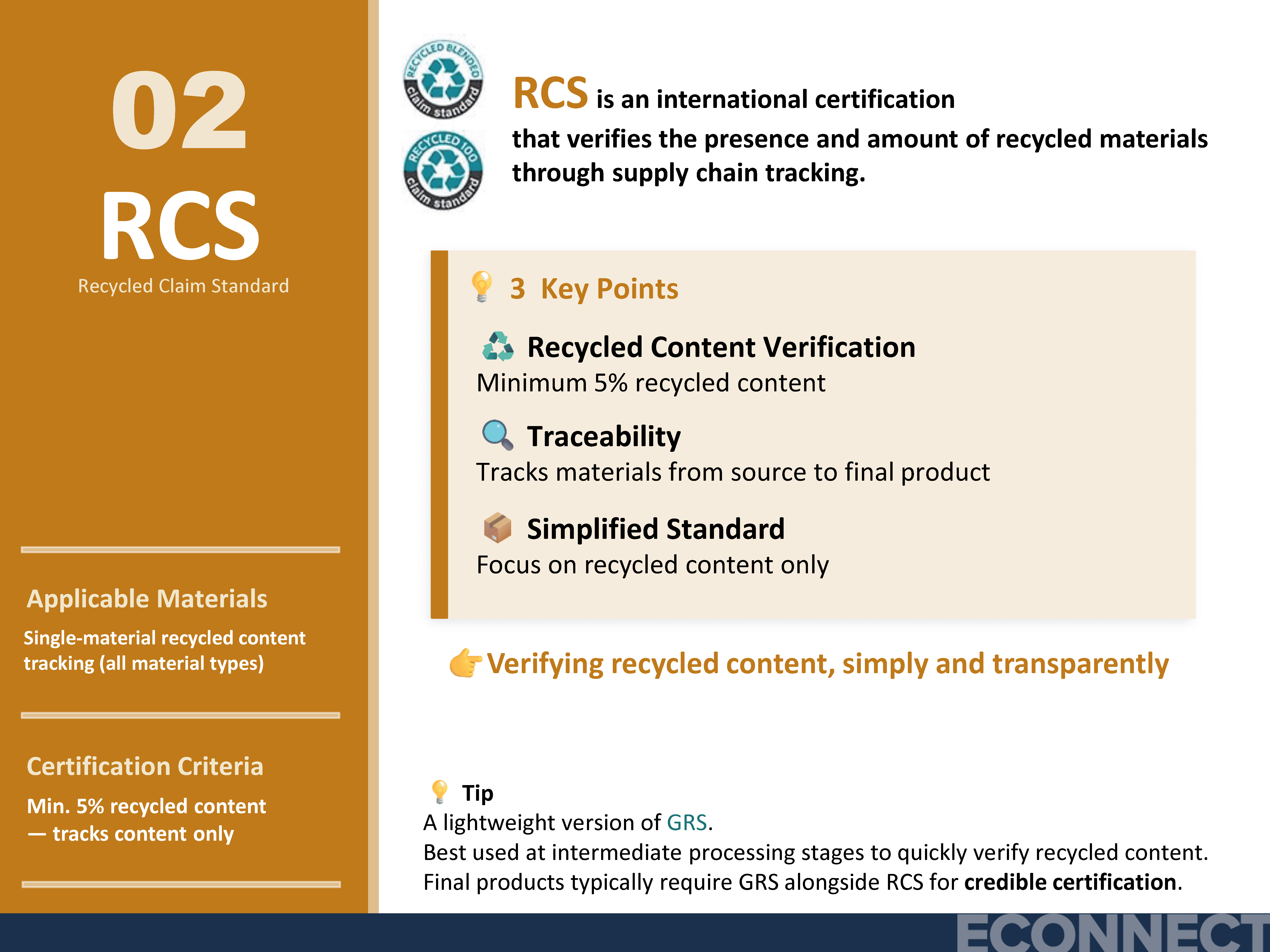
02. RCS — Recycled Claim Standard
What it is: RCS is an international certification that verifies the presence and proportion of recycled materials through supply chain tracking.
Applicable materials: Single-material recycled content tracking across all material types
Minimum threshold: 5% recycled content
3 Core Requirements:
Recycled Content Verification — Confirms minimum 5% recycled input
Traceability — Tracks materials from source to final product
Simplified Scope — Focused exclusively on recycled content, without broader social or environmental criteria
RCS functions as a lightweight version of GRS. It is best suited for intermediate processing stages where quick, straightforward verification of recycled content is needed. Note: for final products, GRS is typically required alongside RCS for credible market claims.
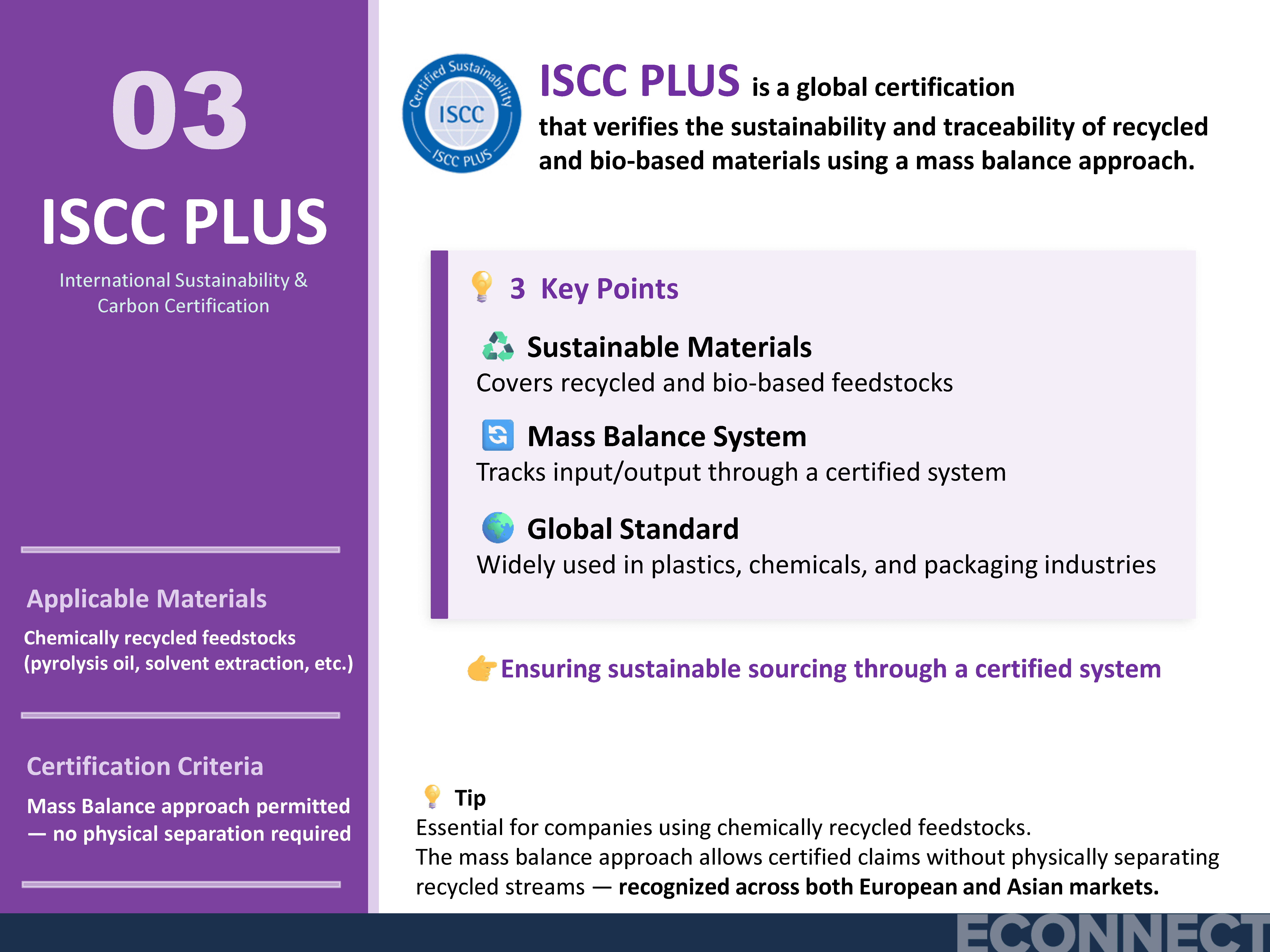
03. ISCC PLUS — International Sustainability & Carbon Certification
What it is: ISCC PLUS is a global certification that verifies the sustainability and traceability of recycled and bio-based materials using a mass balance accounting approach.
Applicable materials: Chemically recycled feedstocks (pyrolysis oil, solvent extraction, etc.)
Certification approach: Mass balance — physical separation of recycled streams is not required
3 Core Requirements:
Sustainable Materials — Covers both recycled and bio-based feedstocks
Mass Balance System — Tracks certified inputs and outputs through an auditable accounting system
Global Standard — Widely recognized in plastics, chemicals, and packaging industries
ISCC PLUS is essential for companies working with chemically recycled feedstocks. The mass balance approach allows certified sustainability claims without requiring physical separation of recycled streams — a practical solution for complex industrial processes. It is recognized across both European and Asian markets.
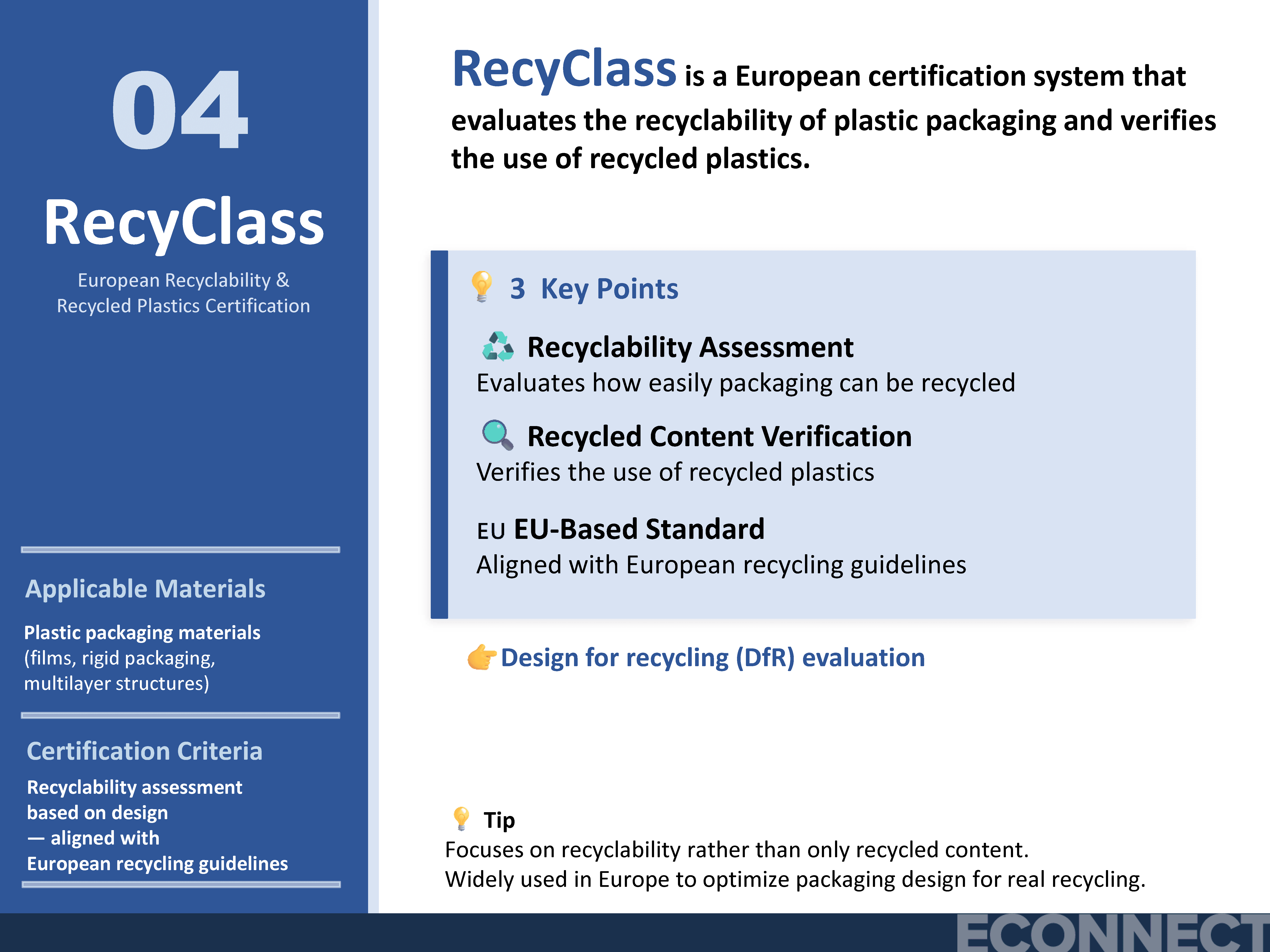
04. RecyClass — European Recyclability & Recycled Plastics Certification
What it is: RecyClass is a European certification system that evaluates the recyclability of plastic packaging and verifies the use of recycled plastics.
Applicable materials: Plastic packaging — films, rigid packaging, multilayer structures
Certification approach: Recyclability assessment based on design, aligned with European recycling guidelines
3 Core Requirements:
Recyclability Assessment — Evaluates how easily packaging can be sorted and recycled in practice
Recycled Content Verification — Verifies the use of recycled plastics in packaging
EU-Based Standard — Aligned with European recycling infrastructure and guidelines
Unlike GRS or RCS, RecyClass focuses on whether packaging is designed to be recyclable, not just whether it contains recycled content. This makes it particularly relevant for packaging manufacturers and brand owners targeting European markets who need to optimize packaging for real-world recyclability.
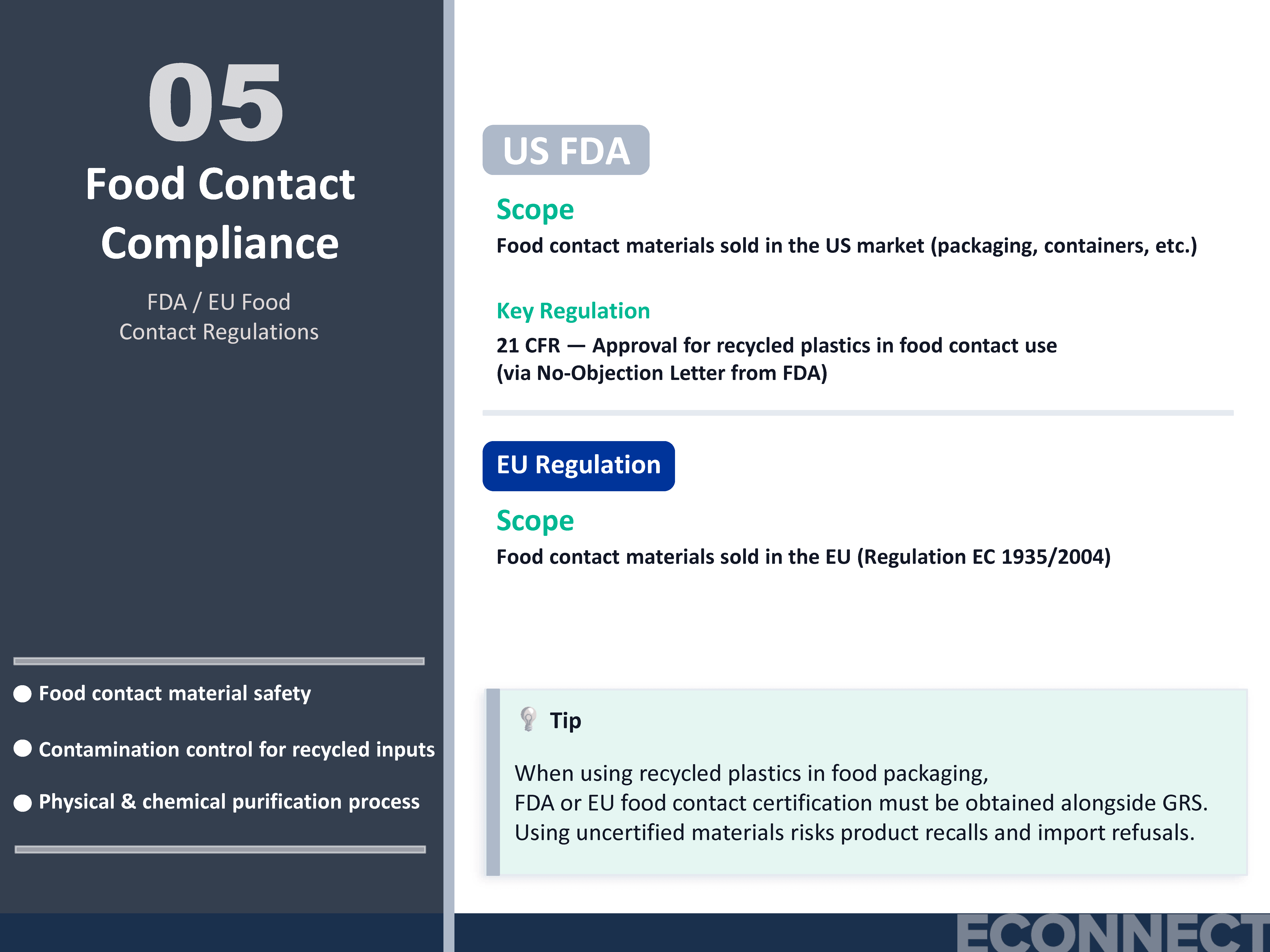
05. Food Contact Compliance — FDA / EU Food Contact Regulations
What it is: Food Contact Compliance is not a single certification, but a regulatory requirement that must be met when using recycled plastics in direct food contact applications.
Applicable materials: Food contact materials — packaging, containers, and similar applications
Two key regulatory frameworks:
US FDA (21 CFR)
Covers food contact materials sold in the US market
Recycled plastics require an FDA No-Objection Letter for food contact use
Key concerns: food contact material safety, contamination control for recycled inputs, physical and chemical purification process validation
EU Regulation (EC 1935/2004)
Covers food contact materials sold in the EU market
Establishes safety requirements for materials in contact with food
When using recycled plastics in food packaging, obtaining FDA or EU food contact approval alongside GRS certification is mandatory. Failure to comply risks product recalls and import refusals.
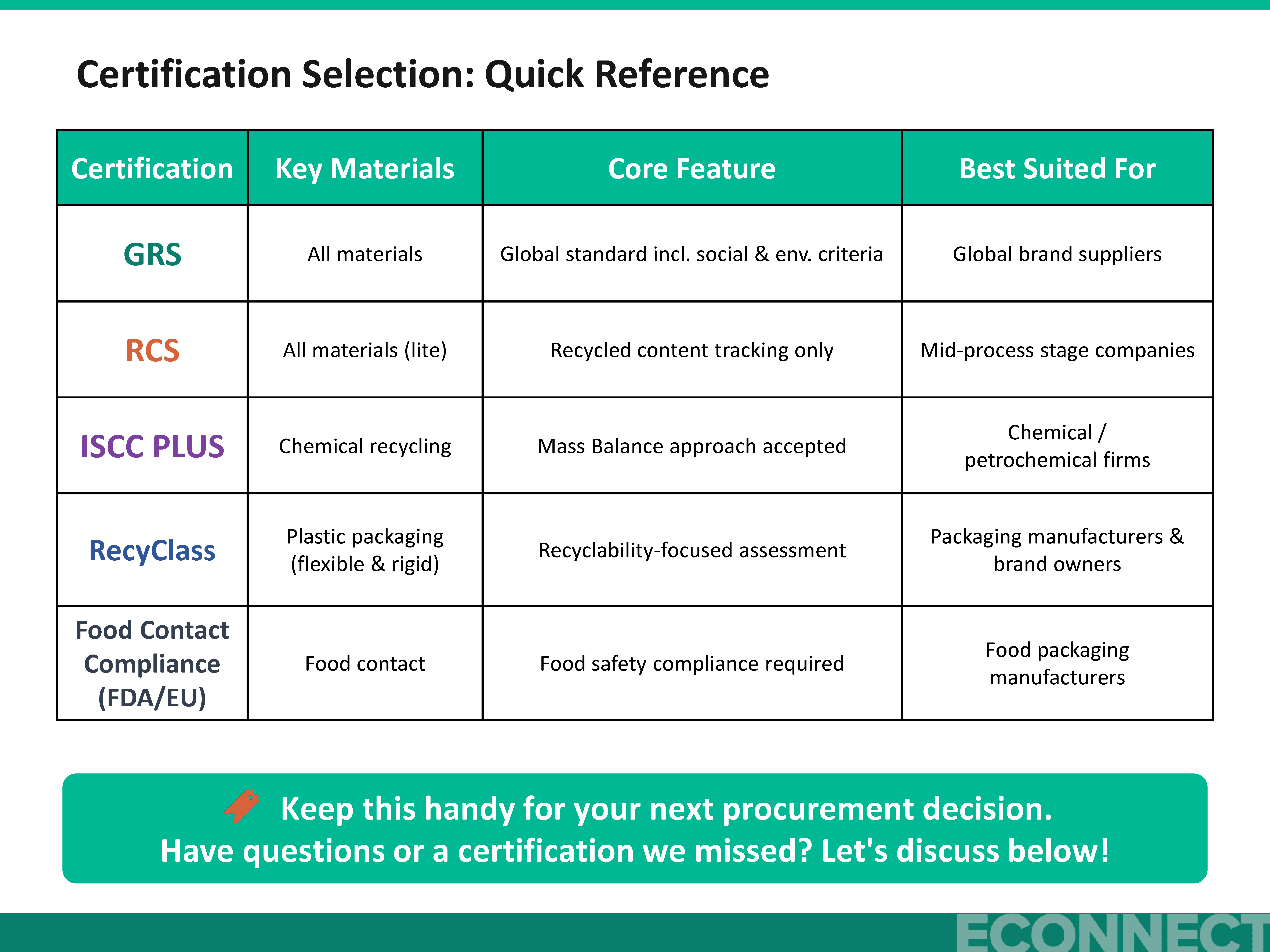
Quick Reference: Choosing the Right Certification
Certification | Key Materials | Core Feature | Best Suited For |
|---|---|---|---|
GRS | All materials | Global standard incl. social & environmental criteria | Global brand suppliers |
RCS | All materials (lite) | Recycled content tracking only | Mid-process stage companies |
ISCC PLUS | Chemical recycling | Mass balance approach accepted | Chemical / petrochemical firms |
RecyClass | Plastic packaging | Recyclability-focused assessment | Packaging manufacturers & brand owners |
Food Contact Compliance (FDA/EU) | Food contact materials | Food safety compliance | Food packaging manufacturers |
Key Takeaways
GRS is the most comprehensive standard and is typically required for final product claims in global markets.
RCS is a simpler, lower-threshold option for intermediate supply chain stages, but is usually paired with GRS for final product certification.
ISCC PLUS is the standard of choice for chemically recycled materials and bio-based feedstocks, particularly where mass balance accounting is needed.
RecyClass addresses a different question — not just what's in the material, but whether the packaging itself can actually be recycled.
Food Contact Compliance is a regulatory baseline requirement, not optional, for any recycled plastic used in food packaging applications.
Understanding which certification applies to your materials, your position in the supply chain, and your target markets is the foundation of reliable, compliant recycled material sourcing.
Image generated with Claude
Introduction
When sourcing recycled materials, a certification label alone is not enough. Different certifications verify different things — some confirm recycled content, others ensure full supply chain traceability, and still others evaluate whether packaging can actually be recycled in practice.
Choosing the wrong certification — or misreading what a certificate actually guarantees — can expose your company to regulatory penalties, ESG reporting errors, or product recalls.
This guide breaks down five key certifications used in the recycled materials industry, explains what each one covers, and helps you identify which applies to your situation.
Why Certifications Matter
Before comparing individual standards, it's worth understanding why certification is a non-negotiable part of responsible procurement today.
1. Preventing Greenwashing : Regulatory pressure on environmental claims is increasing globally. Using unverified recycled materials — even unintentionally — risks brand damage, regulatory penalties, and loss of customer trust.
2. Global Compliance : EU packaging regulations and other international mandates now require documented, certified recycled content. Certification is no longer optional for companies operating in regulated markets.
3. Supply Chain Transparency : Certifications provide a documented, auditable trail of material origin and recycling processes — essential for accurate ESG reporting and due diligence.
The 5 Key Certifications
01. GRS — Global Recycled Standard
What it is: GRS is an international certification that verifies recycled content and ensures responsible environmental and social practices throughout the supply chain.
Applicable materials: All material types — plastics, textiles, metals, glass, paper
Minimum threshold: 20% recycled content (95%+ required to make a "100% recycled" claim)
4 Core Requirements:
Recycled Content — Verified minimum of 20% recycled input materials
Traceability — Full supply chain tracking from source to final product
Environmental — Controlled chemical and resource management
Social — Ethical and safe working conditions
GRS is the most comprehensive international standard for recycled materials. It is the certification of choice for global brand suppliers who need to demonstrate both recycled content and responsible sourcing practices.
02. RCS — Recycled Claim Standard
What it is: RCS is an international certification that verifies the presence and proportion of recycled materials through supply chain tracking.
Applicable materials: Single-material recycled content tracking across all material types
Minimum threshold: 5% recycled content
3 Core Requirements:
Recycled Content Verification — Confirms minimum 5% recycled input
Traceability — Tracks materials from source to final product
Simplified Scope — Focused exclusively on recycled content, without broader social or environmental criteria
RCS functions as a lightweight version of GRS. It is best suited for intermediate processing stages where quick, straightforward verification of recycled content is needed. Note: for final products, GRS is typically required alongside RCS for credible market claims.
03. ISCC PLUS — International Sustainability & Carbon Certification
What it is: ISCC PLUS is a global certification that verifies the sustainability and traceability of recycled and bio-based materials using a mass balance accounting approach.
Applicable materials: Chemically recycled feedstocks (pyrolysis oil, solvent extraction, etc.)
Certification approach: Mass balance — physical separation of recycled streams is not required
3 Core Requirements:
Sustainable Materials — Covers both recycled and bio-based feedstocks
Mass Balance System — Tracks certified inputs and outputs through an auditable accounting system
Global Standard — Widely recognized in plastics, chemicals, and packaging industries
ISCC PLUS is essential for companies working with chemically recycled feedstocks. The mass balance approach allows certified sustainability claims without requiring physical separation of recycled streams — a practical solution for complex industrial processes. It is recognized across both European and Asian markets.
04. RecyClass — European Recyclability & Recycled Plastics Certification
What it is: RecyClass is a European certification system that evaluates the recyclability of plastic packaging and verifies the use of recycled plastics.
Applicable materials: Plastic packaging — films, rigid packaging, multilayer structures
Certification approach: Recyclability assessment based on design, aligned with European recycling guidelines
3 Core Requirements:
Recyclability Assessment — Evaluates how easily packaging can be sorted and recycled in practice
Recycled Content Verification — Verifies the use of recycled plastics in packaging
EU-Based Standard — Aligned with European recycling infrastructure and guidelines
Unlike GRS or RCS, RecyClass focuses on whether packaging is designed to be recyclable, not just whether it contains recycled content. This makes it particularly relevant for packaging manufacturers and brand owners targeting European markets who need to optimize packaging for real-world recyclability.
05. Food Contact Compliance — FDA / EU Food Contact Regulations
What it is: Food Contact Compliance is not a single certification, but a regulatory requirement that must be met when using recycled plastics in direct food contact applications.
Applicable materials: Food contact materials — packaging, containers, and similar applications
Two key regulatory frameworks:
US FDA (21 CFR)
Covers food contact materials sold in the US market
Recycled plastics require an FDA No-Objection Letter for food contact use
Key concerns: food contact material safety, contamination control for recycled inputs, physical and chemical purification process validation
EU Regulation (EC 1935/2004)
Covers food contact materials sold in the EU market
Establishes safety requirements for materials in contact with food
When using recycled plastics in food packaging, obtaining FDA or EU food contact approval alongside GRS certification is mandatory. Failure to comply risks product recalls and import refusals.
Quick Reference: Choosing the Right Certification
Certification | Key Materials | Core Feature | Best Suited For |
|---|---|---|---|
GRS | All materials | Global standard incl. social & environmental criteria | Global brand suppliers |
RCS | All materials (lite) | Recycled content tracking only | Mid-process stage companies |
ISCC PLUS | Chemical recycling | Mass balance approach accepted | Chemical / petrochemical firms |
RecyClass | Plastic packaging | Recyclability-focused assessment | Packaging manufacturers & brand owners |
Food Contact Compliance (FDA/EU) | Food contact materials | Food safety compliance | Food packaging manufacturers |
Key Takeaways
GRS is the most comprehensive standard and is typically required for final product claims in global markets.
RCS is a simpler, lower-threshold option for intermediate supply chain stages, but is usually paired with GRS for final product certification.
ISCC PLUS is the standard of choice for chemically recycled materials and bio-based feedstocks, particularly where mass balance accounting is needed.
RecyClass addresses a different question — not just what's in the material, but whether the packaging itself can actually be recycled.
Food Contact Compliance is a regulatory baseline requirement, not optional, for any recycled plastic used in food packaging applications.
Understanding which certification applies to your materials, your position in the supply chain, and your target markets is the foundation of reliable, compliant recycled material sourcing.
Image generated with Claude
Certified rHDPE Grades
Grades • Specs • Availability
Browse rHDPE →
Certified rHDPE Grades
Certified rHDPE Grades
Review rHDPE grades and the GRS or GR documents available for each.
Review rHDPE grades and the GRS or GR documents available for each.
Browse rHDPE →
Browse rHDPE →
Looking for samples or ready to source? Submit your request for pricing, availability, and technical information.
Looking for samples or ready to source? Submit your request for pricing, availability, and technical information.
Request a Quote →
Request a Quote →
Posted by REGENPORT
REGENPORT is a global platform connecting buyers and suppliers in the recycled materials and sustainable packaging industries.