CATEGORY
CATEGORY
Regulation
Regulation
Regulation
South Korea's 95% Vehicle Recycling Target: What It Actually Means for Recycled ABS and PC Buyers
South Korea's 95% Vehicle Recycling Target: What It Actually Means for Recycled ABS and PC Buyers
South Korea's 95% Vehicle Recycling Target: What It Actually Means for Recycled ABS and PC Buyers
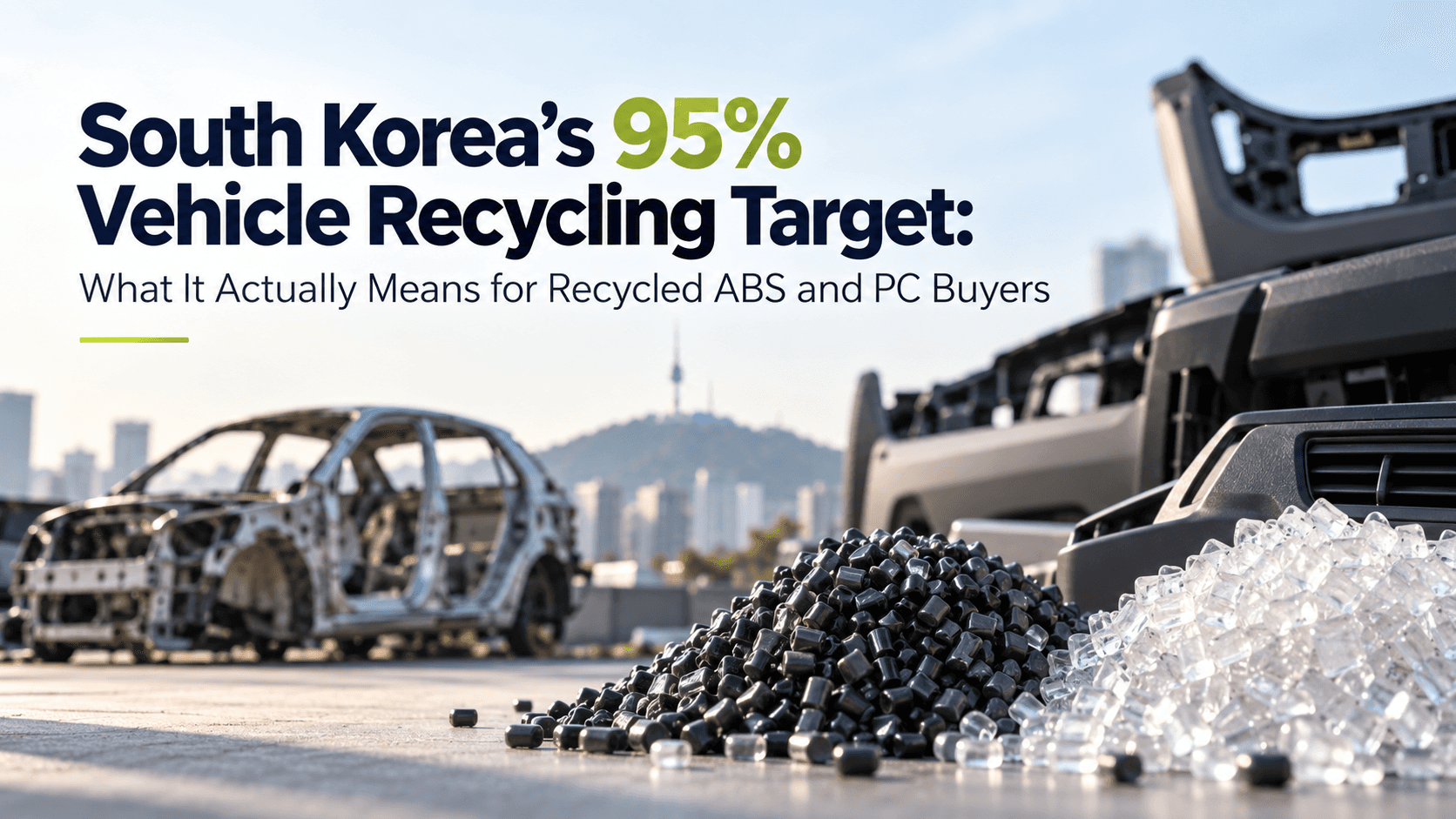
Korea requires vehicle makers to hit a 95% recyclability rate under the EEEV Act — but the rate is calculated across the whole car, and it is delegated to a Presidential Decree the Act itself never states. Peer-reviewed 2025 data on Korea's actual end-of-life vehicle stream shows why that matters for plastics specifically: only 51.7% of the plastic that reaches a recycling company is actually recycled.
A 95% vehicle recyclability target sounds like a number a buyer could rely on. It is not the number that describes what happens to the plastic.
South Korea's Act on Resource Circulation of Electrical and Electronic Equipment and Vehicles (the EEEV Act) requires covered vehicle manufacturers and importers to meet an annual recyclability rate. But the Act itself never states that rate. Article 10, paragraph 2 requires manufacturers and importers to meet the "annual rates of recyclability prescribed by Presidential Decree." The assessment method is handled separately, in Article 10, paragraph 6, which authorizes the Minister of Climate, Energy and Environment and the Minister of Trade, Industry and Energy to jointly establish and notify that method. So the rate itself sits one legal layer below the Act, and the method for calculating it sits below that.
For a buyer specifying recycled ABS or PC into automotive parts, that structure matters more than the headline percentage. Because the rate is calculated across the whole vehicle by weight, high-volume recovery of metals and other well-established material streams can outweigh weaker recovery performance in smaller, more fragmented plastic flows. What happens to the plastic specifically is a separate question, and it now has a peer-reviewed answer.

The Target Is 95%. It Was Not Always — and Different Obligated Parties Hit It on Different Schedules.
The Enforcement Decree sets this figure in two separate provisions, for two obligations that apply at different points in a vehicle's life:
Design stage (Article 10(2) of the Act): vehicle manufacturers and importers must meet 85% (up to 5 percentage points of which may be energy recovery) before 1 January 2010, then 95% (up to 10 points energy recovery) from that date.
End-of-life stage (Article 25(1) of the Act): a broader set of obligated parties — manufacturers and importers themselves, automotive dismantlers, automotive shredder residue (ASR) recyclers, and waste-gas treatment operators — must meet 85% (5 points energy recovery) from 2009 through 2014, then 95% (10 points energy recovery) from 1 January 2015.
Both provisions use the same 95% headline figure. But they apply at different stages, to different obligated parties, and in both cases up to 10 percentage points of that 95% may still be energy recovery rather than material recycling.
In short, the design-stage target reached 95% five years before the end-of-life target did. Jang et al. (2022)'s reference to "beginning of 2015" points to the end-of-life step-up, not the design-stage one — and neither date appears in the Act's own text; both are set at the decree level. (The plastic-flow estimate below measures something different again — see the FAQ.)

What the Plastic Fraction Actually Looks Like
A 2025 material-flow study of Korea's ELV stream (Lee et al., Resources, Conservation and Recycling) puts a hard number on the gap between the legal target and plastic-specific performance: Korea generates roughly 22,600 tons a year of end-of-life-vehicle plastic (ELVP) through dismantling, of which about 22,000 tons is sent on to recycling companies. The study estimated that 51.7% of the ELV plastic reaching recycling companies was recycled under its material-flow accounting; the remainder was directed mainly to energy recovery and incineration rather than material recycling.

Why the Headline Rate and the Plastic Rate Diverge
A vehicle's 95% target is a weight-based average across the whole car. The Article 10 figure is about design-stage recyclability; the Article 25 figure is about actual recycling performance at the end-of-life stage. Both are whole-vehicle, weight-based numbers, just measured at different points in the vehicle's life. Because metals make up a large share of vehicle mass and are commonly handled through established recovery routes, whole-vehicle percentages can stay high even when plastic-specific outcomes are much weaker. Plastics are a small, fragmented slice of that weight — distributed across many part types with different polymers, colors, additives, and contamination profiles — and they are also the fraction where energy recovery and incineration can account for a substantial share of what does not enter material recycling.
That means a vehicle recycler, a parts remanufacturer, or a resin buyer can each be looking at a different number depending on which fraction they ask about. "95% recyclability" describes the vehicle. It does not show what share of the resin in that vehicle's bumper or interior trim is converted into new resin rather than directed to energy recovery or disposal.

What This Means for rABS and rPC Sourcing
Picture the bumper from the section above. The vehicle it came from may have "met" Korea's 95% target — and that tells you nothing about whether the resin in that bumper was actually recycled. Articles 10 and 25 of the EEEV Act regulate the whole vehicle, not the recycled content of the resin inside it. And the 51.7% figure above has the same limitation from the other direction: it, too, is a national average across Korea's whole ELV stream, not a measurement of any single supplier's feedstock. A stream that meets the 95% legal target could be performing well above or well below that 51.7% average — neither number, on its own, tells you which. (Korea does regulate recycled content directly in some other product categories, such as PET beverage bottles, under rules outside this Act — but not here.)
What actually tells you where a specific stream falls is documentation the supplier can provide directly:
What share of this resin is independently verified as post-consumer, ELV-derived recycled content — for example through independent recycled-content chain-of-custody certification — rather than blended with other recycled or virgin material.
Which vehicle part types the feedstock is drawn from, since bumpers, seat foam, and synthetic-resin housings carry different contamination and additive profiles.
Whether shredder residue or post-shred separation was involved, given the hazardous-substance findings associated with that stage.
A buyer evaluating rABS or rPC from this stream should ask for these supplier-level numbers before requesting a sample — that is the only way to tell whether "meets Korea's target" also means "was actually recycled."
Frequently Asked Questions
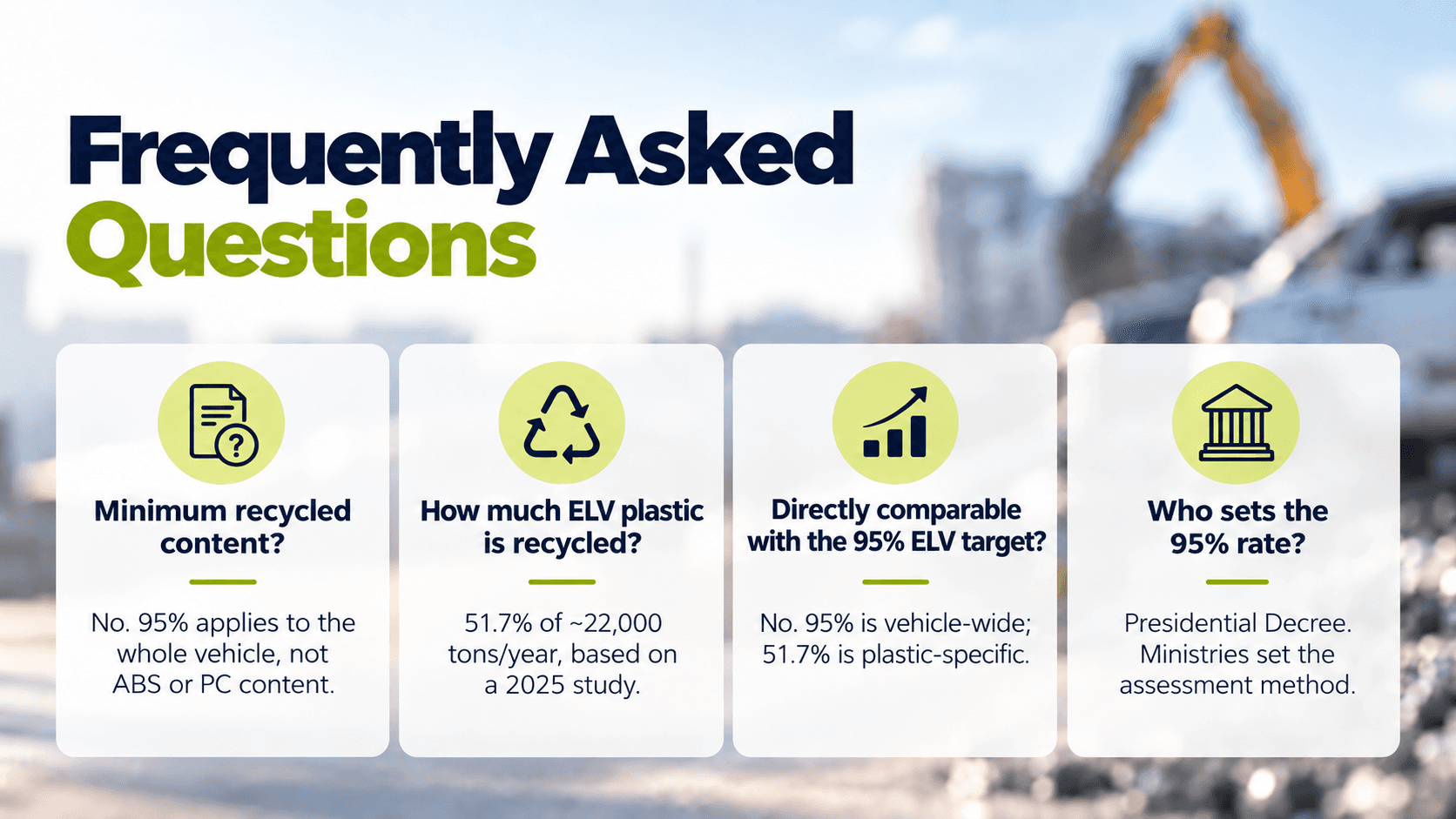
Does Korea require a minimum recycled-content percentage for vehicle plastics? The vehicle-recyclability provisions of the EEEV Act (Articles 10 and 25) do not establish a minimum recycled-content percentage for ABS, PC, or other vehicle plastics — they set a whole-vehicle recyclability/recycling rate (95%, up to 10 points of which may be energy recovery) instead. (Korea does regulate recycled content separately for some other product categories, such as PET beverage bottles, under rules outside this Act.) The vehicle rate itself is set by Presidential Decree; the method used to assess it is set by joint ministerial notice — neither is stated in the Act's own text.
What percentage of Korea's end-of-life vehicle plastic is actually recycled? A 2025 peer-reviewed material-flow study (Lee et al.) estimated that of the roughly 22,000 tons of end-of-life vehicle plastic sent to recycling companies each year, 51.7% was recycled under the study's accounting; the remainder was directed mainly to energy recovery and incineration rather than material recycling.
Is Korea's plastic recycling performance directly comparable with the 95% ELV target? No. The 95% target is a whole-vehicle, weight-based figure, while the 51.7% figure is a plastic-specific research estimate. The two measure different things, although the gap helps show why a high whole-vehicle rate does not describe plastic-specific material recycling.
Which ministries set the actual recyclability percentage? Neither ministry sets the percentage. Article 10, paragraph 2 of the EEEV Act requires vehicle manufacturers and importers to meet an annual recyclability rate set by Presidential Decree. The assessment method is handled separately, in Article 10, paragraph 6, which authorizes the Minister of Climate, Energy and Environment and the Minister of Trade, Industry and Energy to jointly establish and notify only the method used to assess that rate — not the rate itself.
About this guide
Current as of September 2026, based on the sources cited below, for general information only — not legal advice. The recyclability rate, its effective dates and its calculation method should be verified against the current, consolidated Presidential Decree and joint ministerial notice before being relied on for compliance purposes.
Image generated with ChatGPT
Sources
Republic of Korea, Act on Resource Circulation of Electrical and Electronic Equipment and Vehicles, Article 10 (recyclability rate for vehicles), Article 25 (end-of-life vehicle recycling rate) → Read the Source
Republic of Korea, Enforcement Decree of the Act on Resource Circulation of Electrical and Electronic Equipment and Vehicles, Article 10 (annual recyclability rate) and Article 23 (recycling ratio of end-of-life vehicles) — source for the 95%/85% figures and 2010/2015 effective dates → Read the Source
Lee, S.-J.; Cho, N.-H.; Yoon, Y.-S.; Jeon, T.-W.; Cho, W.; Lee, S.; Kang, Y.-Y. "End-of-life vehicle plastic management in Republic of Korea: Material flow analysis and hazardous substance analysis." Resources, Conservation and Recycling, vol. 215 (April 2025), 108133 — open access, Creative Commons BY-NC-ND 4.0 → Read the Source
Jang, Y.-C.; Choi, K.; Jeong, J.-h.; Kim, H.; Kim, J.-G. "Recycling and Material-Flow Analysis of End-of-Life Vehicles towards Resource Circulation in South Korea." Sustainability, 14(3) (2022), 1270 → Read the Source
A 95% vehicle recyclability target sounds like a number a buyer could rely on. It is not the number that describes what happens to the plastic.
South Korea's Act on Resource Circulation of Electrical and Electronic Equipment and Vehicles (the EEEV Act) requires covered vehicle manufacturers and importers to meet an annual recyclability rate. But the Act itself never states that rate. Article 10, paragraph 2 requires manufacturers and importers to meet the "annual rates of recyclability prescribed by Presidential Decree." The assessment method is handled separately, in Article 10, paragraph 6, which authorizes the Minister of Climate, Energy and Environment and the Minister of Trade, Industry and Energy to jointly establish and notify that method. So the rate itself sits one legal layer below the Act, and the method for calculating it sits below that.
For a buyer specifying recycled ABS or PC into automotive parts, that structure matters more than the headline percentage. Because the rate is calculated across the whole vehicle by weight, high-volume recovery of metals and other well-established material streams can outweigh weaker recovery performance in smaller, more fragmented plastic flows. What happens to the plastic specifically is a separate question, and it now has a peer-reviewed answer.
The Target Is 95%. It Was Not Always — and Different Obligated Parties Hit It on Different Schedules.
The Enforcement Decree sets this figure in two separate provisions, for two obligations that apply at different points in a vehicle's life:
Design stage (Article 10(2) of the Act): vehicle manufacturers and importers must meet 85% (up to 5 percentage points of which may be energy recovery) before 1 January 2010, then 95% (up to 10 points energy recovery) from that date.
End-of-life stage (Article 25(1) of the Act): a broader set of obligated parties — manufacturers and importers themselves, automotive dismantlers, automotive shredder residue (ASR) recyclers, and waste-gas treatment operators — must meet 85% (5 points energy recovery) from 2009 through 2014, then 95% (10 points energy recovery) from 1 January 2015.
Both provisions use the same 95% headline figure. But they apply at different stages, to different obligated parties, and in both cases up to 10 percentage points of that 95% may still be energy recovery rather than material recycling.
In short, the design-stage target reached 95% five years before the end-of-life target did. Jang et al. (2022)'s reference to "beginning of 2015" points to the end-of-life step-up, not the design-stage one — and neither date appears in the Act's own text; both are set at the decree level. (The plastic-flow estimate below measures something different again — see the FAQ.)
What the Plastic Fraction Actually Looks Like
A 2025 material-flow study of Korea's ELV stream (Lee et al., Resources, Conservation and Recycling) puts a hard number on the gap between the legal target and plastic-specific performance: Korea generates roughly 22,600 tons a year of end-of-life-vehicle plastic (ELVP) through dismantling, of which about 22,000 tons is sent on to recycling companies. The study estimated that 51.7% of the ELV plastic reaching recycling companies was recycled under its material-flow accounting; the remainder was directed mainly to energy recovery and incineration rather than material recycling.
Why the Headline Rate and the Plastic Rate Diverge
A vehicle's 95% target is a weight-based average across the whole car. The Article 10 figure is about design-stage recyclability; the Article 25 figure is about actual recycling performance at the end-of-life stage. Both are whole-vehicle, weight-based numbers, just measured at different points in the vehicle's life. Because metals make up a large share of vehicle mass and are commonly handled through established recovery routes, whole-vehicle percentages can stay high even when plastic-specific outcomes are much weaker. Plastics are a small, fragmented slice of that weight — distributed across many part types with different polymers, colors, additives, and contamination profiles — and they are also the fraction where energy recovery and incineration can account for a substantial share of what does not enter material recycling.
That means a vehicle recycler, a parts remanufacturer, or a resin buyer can each be looking at a different number depending on which fraction they ask about. "95% recyclability" describes the vehicle. It does not show what share of the resin in that vehicle's bumper or interior trim is converted into new resin rather than directed to energy recovery or disposal.
What This Means for rABS and rPC Sourcing
Picture the bumper from the section above. The vehicle it came from may have "met" Korea's 95% target — and that tells you nothing about whether the resin in that bumper was actually recycled. Articles 10 and 25 of the EEEV Act regulate the whole vehicle, not the recycled content of the resin inside it. And the 51.7% figure above has the same limitation from the other direction: it, too, is a national average across Korea's whole ELV stream, not a measurement of any single supplier's feedstock. A stream that meets the 95% legal target could be performing well above or well below that 51.7% average — neither number, on its own, tells you which. (Korea does regulate recycled content directly in some other product categories, such as PET beverage bottles, under rules outside this Act — but not here.)
What actually tells you where a specific stream falls is documentation the supplier can provide directly:
What share of this resin is independently verified as post-consumer, ELV-derived recycled content — for example through independent recycled-content chain-of-custody certification — rather than blended with other recycled or virgin material.
Which vehicle part types the feedstock is drawn from, since bumpers, seat foam, and synthetic-resin housings carry different contamination and additive profiles.
Whether shredder residue or post-shred separation was involved, given the hazardous-substance findings associated with that stage.
A buyer evaluating rABS or rPC from this stream should ask for these supplier-level numbers before requesting a sample — that is the only way to tell whether "meets Korea's target" also means "was actually recycled."
Frequently Asked Questions
Does Korea require a minimum recycled-content percentage for vehicle plastics? The vehicle-recyclability provisions of the EEEV Act (Articles 10 and 25) do not establish a minimum recycled-content percentage for ABS, PC, or other vehicle plastics — they set a whole-vehicle recyclability/recycling rate (95%, up to 10 points of which may be energy recovery) instead. (Korea does regulate recycled content separately for some other product categories, such as PET beverage bottles, under rules outside this Act.) The vehicle rate itself is set by Presidential Decree; the method used to assess it is set by joint ministerial notice — neither is stated in the Act's own text.
What percentage of Korea's end-of-life vehicle plastic is actually recycled? A 2025 peer-reviewed material-flow study (Lee et al.) estimated that of the roughly 22,000 tons of end-of-life vehicle plastic sent to recycling companies each year, 51.7% was recycled under the study's accounting; the remainder was directed mainly to energy recovery and incineration rather than material recycling.
Is Korea's plastic recycling performance directly comparable with the 95% ELV target? No. The 95% target is a whole-vehicle, weight-based figure, while the 51.7% figure is a plastic-specific research estimate. The two measure different things, although the gap helps show why a high whole-vehicle rate does not describe plastic-specific material recycling.
Which ministries set the actual recyclability percentage? Neither ministry sets the percentage. Article 10, paragraph 2 of the EEEV Act requires vehicle manufacturers and importers to meet an annual recyclability rate set by Presidential Decree. The assessment method is handled separately, in Article 10, paragraph 6, which authorizes the Minister of Climate, Energy and Environment and the Minister of Trade, Industry and Energy to jointly establish and notify only the method used to assess that rate — not the rate itself.
About this guide
Current as of September 2026, based on the sources cited below, for general information only — not legal advice. The recyclability rate, its effective dates and its calculation method should be verified against the current, consolidated Presidential Decree and joint ministerial notice before being relied on for compliance purposes.
Image generated with ChatGPT
Sources
Republic of Korea, Act on Resource Circulation of Electrical and Electronic Equipment and Vehicles, Article 10 (recyclability rate for vehicles), Article 25 (end-of-life vehicle recycling rate) → Read the Source
Republic of Korea, Enforcement Decree of the Act on Resource Circulation of Electrical and Electronic Equipment and Vehicles, Article 10 (annual recyclability rate) and Article 23 (recycling ratio of end-of-life vehicles) — source for the 95%/85% figures and 2010/2015 effective dates → Read the Source
Lee, S.-J.; Cho, N.-H.; Yoon, Y.-S.; Jeon, T.-W.; Cho, W.; Lee, S.; Kang, Y.-Y. "End-of-life vehicle plastic management in Republic of Korea: Material flow analysis and hazardous substance analysis." Resources, Conservation and Recycling, vol. 215 (April 2025), 108133 — open access, Creative Commons BY-NC-ND 4.0 → Read the Source
Jang, Y.-C.; Choi, K.; Jeong, J.-h.; Kim, H.; Kim, J.-G. "Recycling and Material-Flow Analysis of End-of-Life Vehicles towards Resource Circulation in South Korea." Sustainability, 14(3) (2022), 1270 → Read the Source
Explore Related Materials
Grades • Specs • Availability
Browse rABS →
Explore Related Materials
Explore Related Materials
Recycled ABS (rABS) grades with recycled-content documentation and feedstock descriptions for review.
Recycled ABS (rABS) grades with recycled-content documentation and feedstock descriptions for review.
Browse rABS →
Browse rABS →
Looking for samples or ready to source? Submit your request for pricing, availability, and technical information.
Looking for samples or ready to source? Submit your request for pricing, availability, and technical information.
Request a Quote →
Request a Quote →
Posted by REGENPORT
REGENPORT is a global platform connecting buyers and suppliers in the recycled materials and sustainable packaging industries.