CATEGORY
CATEGORY
Regulation
Regulation
Regulation
Brazil's Plastic Packaging Decree in 2026: What Your Brazilian Buyer Has to Prove About Your Resin
Brazil's Plastic Packaging Decree in 2026: What Your Brazilian Buyer Has to Prove About Your Resin
Brazil's Plastic Packaging Decree in 2026: What Your Brazilian Buyer Has to Prove About Your Resin
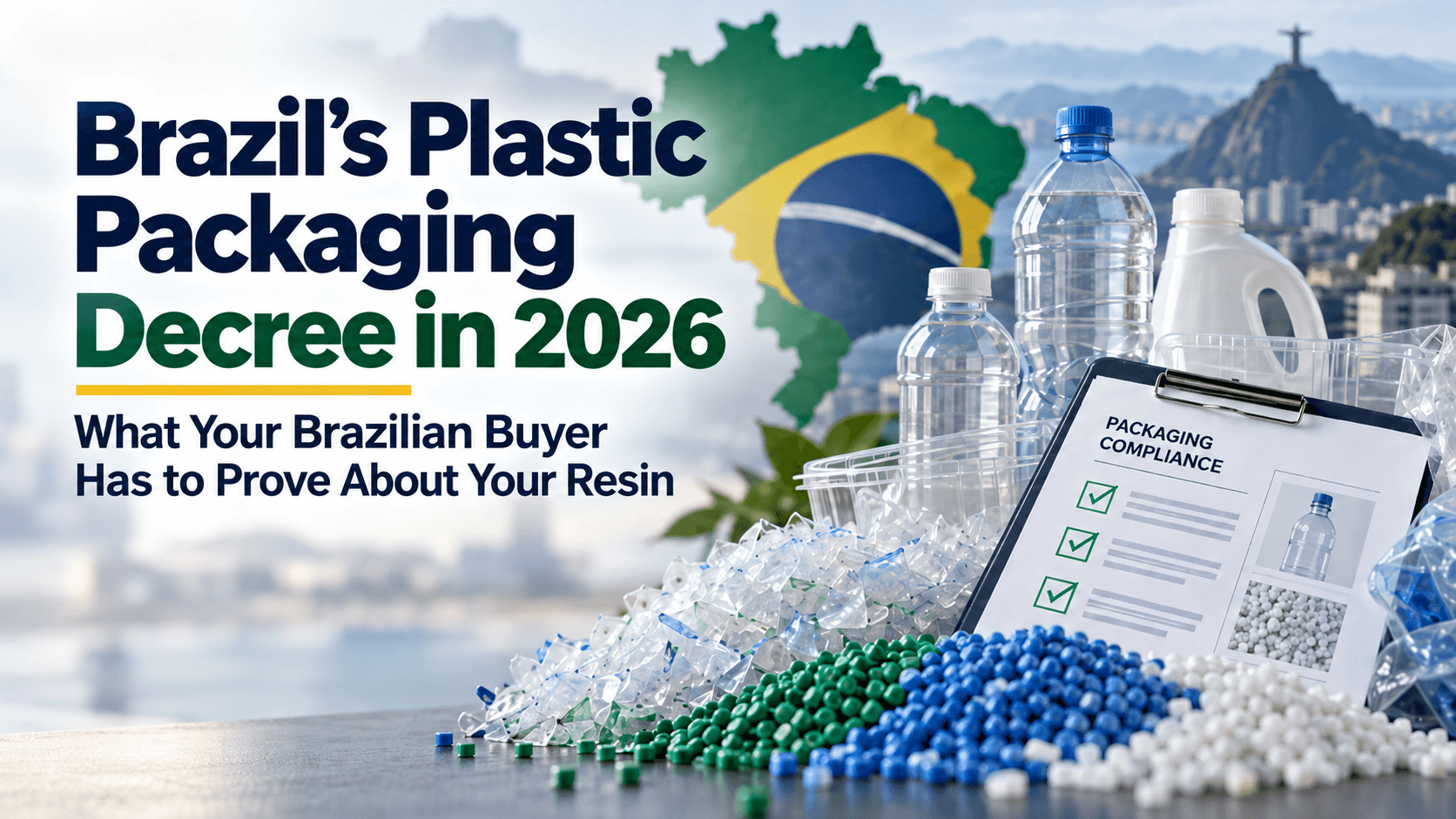
Brazil's new recycled-content law doesn't carve out an exception for imported resin, a single polymer type, or a single packaging format. Since large companies became subject to it in January 2026, any plastic packaging placed on the Brazilian market has had to clear a recycled-content floor — now 22%, on a fixed annual climb to 40% by 2040 — and the obligation falls on importers exactly as it falls on domestic manufacturers.
Federal Decree No. 12,688, signed by President Luiz Inácio Lula da Silva on October 21, 2025, regulates reverse logistics and recycled content for plastic packaging under Brazil's National Solid Waste Policy (Política Nacional de Resíduos Sólidos). It is not a consultation draft: large companies have been subject to its recycled-content and recovery targets since January 2026, and small and medium-sized enterprises follow from July 2026.

A 22% floor that climbs every year to 2040
The decree's Anexo II sets a national minimum recycled-content percentage for plastic packaging, rising on a fixed annual schedule:
Year | Minimum recycled content |
|---|---|
2026 | 22% |
2030 | 30% |
2035 | 35% |
2040 | 40% |
The schedule moves two percentage points a year through 2030 (22→24→26→28→30%), then one point a year from 2031 through 2040 (31% up to 40%) — large steps up front, a longer tail afterward. The full year-by-year table is available in Anexo II of the decree.
Alongside recycled content, the decree sets a separate reverse logistics recovery index: 32% nationally in 2026, rising to 50% by 2040, with lower regional sub-targets reflecting Brazil's uneven recycling infrastructure (the Southeast carries the largest regional share; the North the smallest).
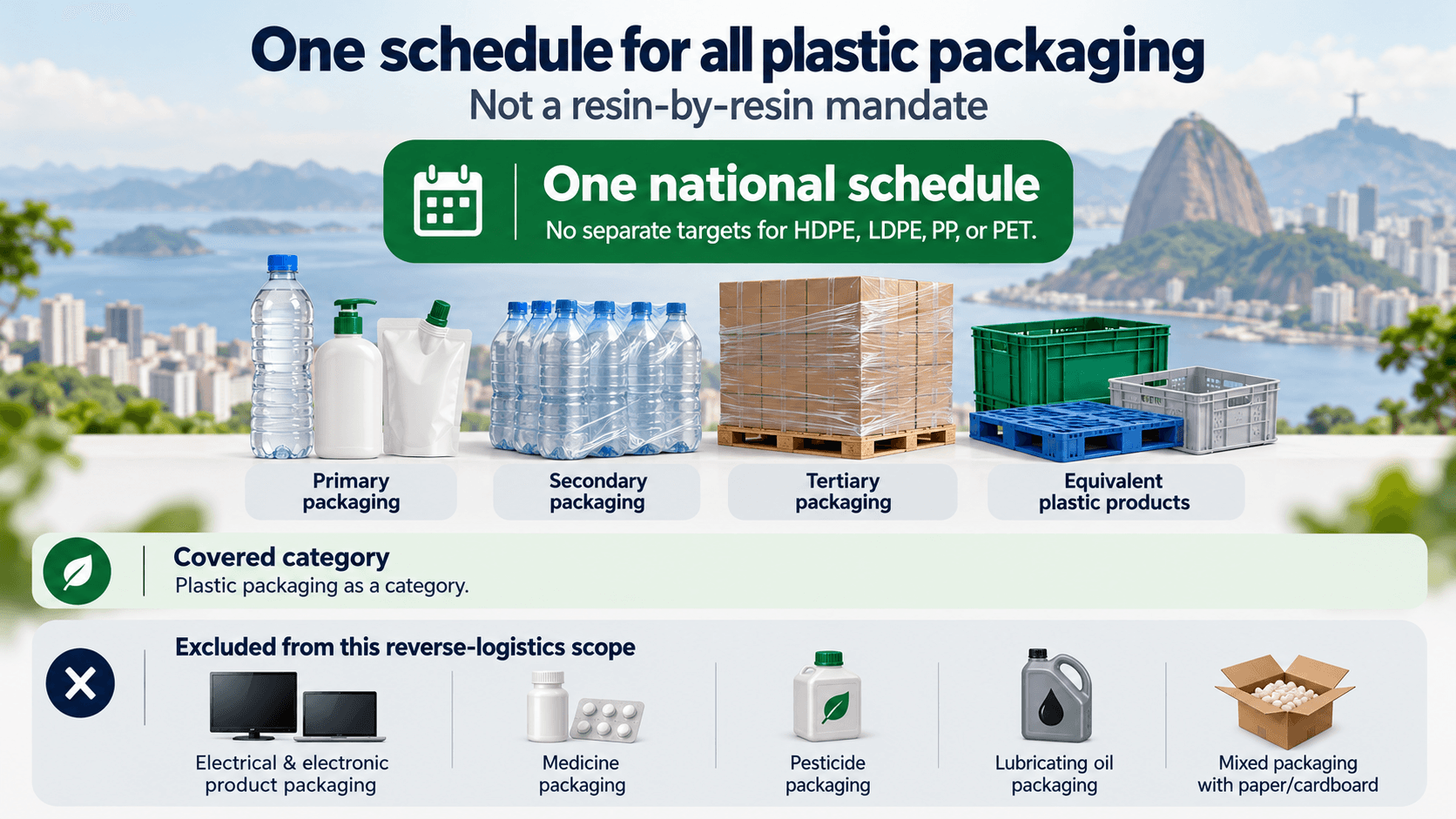
One schedule for all plastic packaging — not a resin-by-resin mandate
Unlike the South Korean approach that opened food-contact recycling resin by resin, or the U.S. state laws that set separate percentages by product category, Brazil's decree applies the same escalating percentage to "plastic packaging" as a category — primary, secondary, and tertiary packaging, plus equivalent plastic products placed on the market. The targets are not split out by HDPE, LDPE, PP, or PET.
Several categories are explicitly carved out of the decree's reverse-logistics scope: packaging for household electrical and electronic products (already covered under Decree 10,240/2020), for medicines (Decree 10,388/2020), for pesticides, and for lubricating oils — each with its own existing reverse-logistics system — plus mixed packaging that contains paper or cardboard in its composition.
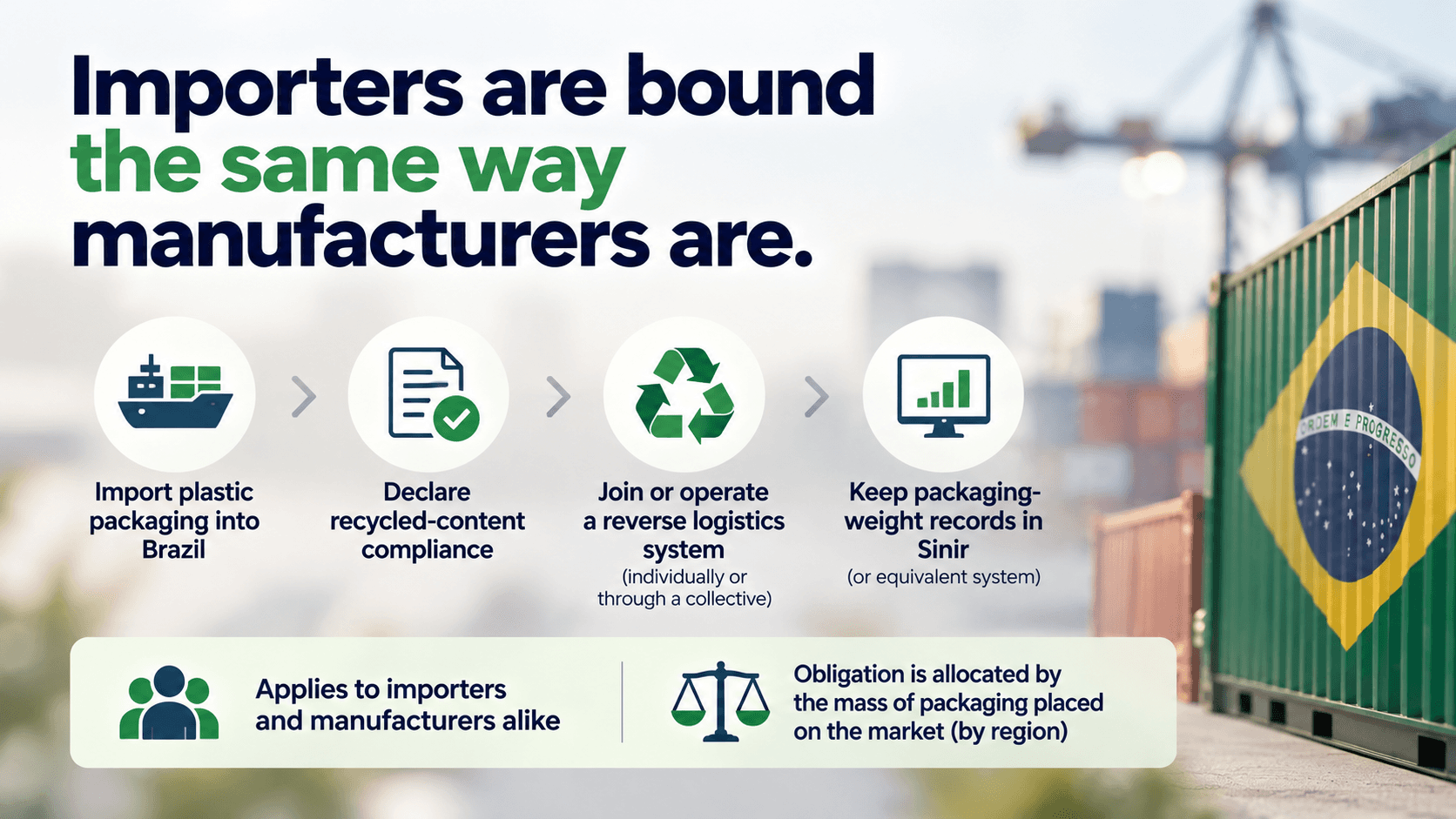
Importers are bound the same way manufacturers are
This is the point that sets Brazil apart from several recycled-content regimes published here before. Washington State's law and Canada's federal registry both place their core reporting duty on the domestic producer or manufacturer, leaving an overseas resin supplier's role indirect. Brazil's decree names importers directly: a company importing plastic packaging into Brazil must declare compliance with the recycled-content target, and must structure, join, or operate a reverse logistics system — individually or through a collective management entity — as a condition of legally placing that packaging on the market. Importers outside the collective model face prior verification of their recycled-content compliance before import, and all obligated parties must keep packaging-weight records current through Brazil's National Solid Waste Management Information System (Sinir) or an equivalent tracking system.
In practice, a manufacturer or importer can meet the reverse-logistics duty either on its own or by joining a collective management structure, but the obligation itself doesn't disappear either way — it's allocated to each company in proportion to the mass of plastic packaging it placed on the market, broken out by region. The duty to dispose of sorting residue also stays with the manufacturer or importer specifically: it cannot be passed to a cooperative or other reverse-logistics operator unless a specific contract provides for it. Brazil's Ministry of Environment and Climate Change has 90 days from the decree's effective date to set the technical requirements for that residue removal. None of this changes the recycled-content percentage itself, but it is the mass-balance mechanism behind it — and mass-balance reporting is what makes resin-source documentation matter in the first place.

What this means for a supplier of recycled polyolefin resin
For a marketplace like Regenport, which lists GRS-certified recycled resin to buyers across the Americas and beyond, this decree changes what a Brazilian buyer conversation looks like. Recycled content stops being a sustainability talking point and becomes a compliance input — something that buyer now has to document, not just prefer.
Whether your Brazilian buyer manufactures packaging domestically or imports it as a finished product, Decree 12,688/2025 makes that buyer the obligated party — and the obligation traces straight back to the resin behind the packaging.
What a Brazil-market packaging producer or importer is likely to need from a resin supplier:
Recycled-content documentation specific enough to support the percentage declared for that packaging line, not a blended company-wide estimate
Chain-of-custody certification such as GRS or RCS, where applicable to the grade
Consistent supply as the floor climbs two points a year through 2030 — a buyer qualifying resin against this year's 22% has limited room before next year's step
If your buyer's packaging is food-contact, confirm whether their product falls under this decree's targets or under Brazil's separate, pre-existing sectoral agreement for beverage packaging — industry coverage of the decree splits on this point, and the answer changes what documentation they'll actually ask for
Regenport lists GRS-certified recycled HDPE grades with resin-source documentation buyers can review before requesting a sample.

Frequently Asked Questions
What recycled-content percentage does Brazil require for plastic packaging, and when does it reach its ceiling? 22% from 2026, rising in annual steps to a final 40% in 2040, under Federal Decree 12,688/2025.
Is this decree already in force, or still under consultation? It is in force. Large companies have been subject to the recycled-content and reverse-logistics targets since January 2026; small and medium-sized enterprises follow from July 2026.
Does the percentage apply to one resin, or to plastic packaging broadly? Broadly. The decree sets one national schedule for plastic packaging as a category, without splitting targets by resin type such as HDPE, LDPE, PP, or PET.
Are importers of plastic packaging into Brazil covered, or only domestic manufacturers? Both. Importers must declare recycled-content compliance and operate or join a reverse logistics system as a condition of legally placing packaging on the Brazilian market — the decree treats this as a mandatory precondition for import, not an optional best practice.
Does this decree apply directly to resin suppliers outside Brazil? Not directly. The decree's registered obligation falls on whoever places the covered plastic packaging on Brazil's market — the domestic manufacturer or the importer — whether that packaging was made domestically or imported as a finished product. A resin supplier's relevance is indirect, through the recycled-content documentation that manufacturer or importer needs to make its declaration.
About this guide
Current as of October 2026, for general information only — not legal advice. Specific compliance determinations should be verified against Federal Decree 12,688/2025 and current guidance from Brazil's Ministry of Environment and Climate Change (Ministério do Meio Ambiente e Mudança do Clima).
Image generated with ChatGPT
Sources
Baker McKenzie, "Brazil: Implications of the New Plastics Decree" — decree number, signing date, recycled-content and recovery schedules, large/SME deadlines → Read the Source
Packaging Europe, "Brazil mandates reverse logistics system for plastic packaging from 2026" — food/beverage sectoral-exclusion framing → Read the Source
Mayer Brown, "Brazil Publishes Federal Decree Establishing Reverse Logistics System for Plastic Packaging" — individual/collective system mechanics, mass-based regional allocation, sorting-residue responsibility, 90-day technical-requirement deadline → Read the Source
amec Positive Industry, "Brazil establishes plastic recycling targets for importers" — importer-specific obligations, Sinir reporting, prior-verification requirement → Read the Source
Federal Decree No. 12,688, signed by President Luiz Inácio Lula da Silva on October 21, 2025, regulates reverse logistics and recycled content for plastic packaging under Brazil's National Solid Waste Policy (Política Nacional de Resíduos Sólidos). It is not a consultation draft: large companies have been subject to its recycled-content and recovery targets since January 2026, and small and medium-sized enterprises follow from July 2026.
A 22% floor that climbs every year to 2040
The decree's Anexo II sets a national minimum recycled-content percentage for plastic packaging, rising on a fixed annual schedule:
Year | Minimum recycled content |
|---|---|
2026 | 22% |
2030 | 30% |
2035 | 35% |
2040 | 40% |
The schedule moves two percentage points a year through 2030 (22→24→26→28→30%), then one point a year from 2031 through 2040 (31% up to 40%) — large steps up front, a longer tail afterward. The full year-by-year table is available in Anexo II of the decree.
Alongside recycled content, the decree sets a separate reverse logistics recovery index: 32% nationally in 2026, rising to 50% by 2040, with lower regional sub-targets reflecting Brazil's uneven recycling infrastructure (the Southeast carries the largest regional share; the North the smallest).
One schedule for all plastic packaging — not a resin-by-resin mandate
Unlike the South Korean approach that opened food-contact recycling resin by resin, or the U.S. state laws that set separate percentages by product category, Brazil's decree applies the same escalating percentage to "plastic packaging" as a category — primary, secondary, and tertiary packaging, plus equivalent plastic products placed on the market. The targets are not split out by HDPE, LDPE, PP, or PET.
Several categories are explicitly carved out of the decree's reverse-logistics scope: packaging for household electrical and electronic products (already covered under Decree 10,240/2020), for medicines (Decree 10,388/2020), for pesticides, and for lubricating oils — each with its own existing reverse-logistics system — plus mixed packaging that contains paper or cardboard in its composition.
Importers are bound the same way manufacturers are
This is the point that sets Brazil apart from several recycled-content regimes published here before. Washington State's law and Canada's federal registry both place their core reporting duty on the domestic producer or manufacturer, leaving an overseas resin supplier's role indirect. Brazil's decree names importers directly: a company importing plastic packaging into Brazil must declare compliance with the recycled-content target, and must structure, join, or operate a reverse logistics system — individually or through a collective management entity — as a condition of legally placing that packaging on the market. Importers outside the collective model face prior verification of their recycled-content compliance before import, and all obligated parties must keep packaging-weight records current through Brazil's National Solid Waste Management Information System (Sinir) or an equivalent tracking system.
In practice, a manufacturer or importer can meet the reverse-logistics duty either on its own or by joining a collective management structure, but the obligation itself doesn't disappear either way — it's allocated to each company in proportion to the mass of plastic packaging it placed on the market, broken out by region. The duty to dispose of sorting residue also stays with the manufacturer or importer specifically: it cannot be passed to a cooperative or other reverse-logistics operator unless a specific contract provides for it. Brazil's Ministry of Environment and Climate Change has 90 days from the decree's effective date to set the technical requirements for that residue removal. None of this changes the recycled-content percentage itself, but it is the mass-balance mechanism behind it — and mass-balance reporting is what makes resin-source documentation matter in the first place.
What this means for a supplier of recycled polyolefin resin
For a marketplace like Regenport, which lists GRS-certified recycled resin to buyers across the Americas and beyond, this decree changes what a Brazilian buyer conversation looks like. Recycled content stops being a sustainability talking point and becomes a compliance input — something that buyer now has to document, not just prefer.
Whether your Brazilian buyer manufactures packaging domestically or imports it as a finished product, Decree 12,688/2025 makes that buyer the obligated party — and the obligation traces straight back to the resin behind the packaging.
What a Brazil-market packaging producer or importer is likely to need from a resin supplier:
Recycled-content documentation specific enough to support the percentage declared for that packaging line, not a blended company-wide estimate
Chain-of-custody certification such as GRS or RCS, where applicable to the grade
Consistent supply as the floor climbs two points a year through 2030 — a buyer qualifying resin against this year's 22% has limited room before next year's step
If your buyer's packaging is food-contact, confirm whether their product falls under this decree's targets or under Brazil's separate, pre-existing sectoral agreement for beverage packaging — industry coverage of the decree splits on this point, and the answer changes what documentation they'll actually ask for
Regenport lists GRS-certified recycled HDPE grades with resin-source documentation buyers can review before requesting a sample.
Frequently Asked Questions
What recycled-content percentage does Brazil require for plastic packaging, and when does it reach its ceiling? 22% from 2026, rising in annual steps to a final 40% in 2040, under Federal Decree 12,688/2025.
Is this decree already in force, or still under consultation? It is in force. Large companies have been subject to the recycled-content and reverse-logistics targets since January 2026; small and medium-sized enterprises follow from July 2026.
Does the percentage apply to one resin, or to plastic packaging broadly? Broadly. The decree sets one national schedule for plastic packaging as a category, without splitting targets by resin type such as HDPE, LDPE, PP, or PET.
Are importers of plastic packaging into Brazil covered, or only domestic manufacturers? Both. Importers must declare recycled-content compliance and operate or join a reverse logistics system as a condition of legally placing packaging on the Brazilian market — the decree treats this as a mandatory precondition for import, not an optional best practice.
Does this decree apply directly to resin suppliers outside Brazil? Not directly. The decree's registered obligation falls on whoever places the covered plastic packaging on Brazil's market — the domestic manufacturer or the importer — whether that packaging was made domestically or imported as a finished product. A resin supplier's relevance is indirect, through the recycled-content documentation that manufacturer or importer needs to make its declaration.
About this guide
Current as of October 2026, for general information only — not legal advice. Specific compliance determinations should be verified against Federal Decree 12,688/2025 and current guidance from Brazil's Ministry of Environment and Climate Change (Ministério do Meio Ambiente e Mudança do Clima).
Image generated with ChatGPT
Sources
Baker McKenzie, "Brazil: Implications of the New Plastics Decree" — decree number, signing date, recycled-content and recovery schedules, large/SME deadlines → Read the Source
Packaging Europe, "Brazil mandates reverse logistics system for plastic packaging from 2026" — food/beverage sectoral-exclusion framing → Read the Source
Mayer Brown, "Brazil Publishes Federal Decree Establishing Reverse Logistics System for Plastic Packaging" — individual/collective system mechanics, mass-based regional allocation, sorting-residue responsibility, 90-day technical-requirement deadline → Read the Source
amec Positive Industry, "Brazil establishes plastic recycling targets for importers" — importer-specific obligations, Sinir reporting, prior-verification requirement → Read the Source
Explore Related Materials
Grades • Specs • Availability
Browse rHDPE →
Explore Related Materials
Explore Related Materials
GRS-certified rHDPE grades with recycled-content documentation for review.
GRS-certified rHDPE grades with recycled-content documentation for review.
Browse rHDPE →
Browse rHDPE →
Looking for samples or ready to source? Submit your request for pricing, availability, and technical information.
Looking for samples or ready to source? Submit your request for pricing, availability, and technical information.
Request a Quote →
Request a Quote →
Posted by REGENPORT
REGENPORT is a global platform connecting buyers and suppliers in the recycled materials and sustainable packaging industries.