CATEGORY
CATEGORY
Our Materials
Our Materials
Our Materials
Natural rHDPE PCR Pellet for Electrical Conduit: What to Verify Before Qualification
Natural rHDPE PCR Pellet for Electrical Conduit: What to Verify Before Qualification
Natural rHDPE PCR Pellet for Electrical Conduit: What to Verify Before Qualification

Natural rHDPE PCR pellet from household HDPE, jerrycan and shampoo bottle waste — listed at MFI 0.5 g/10 min and density 0.95 g/cm³, GRS and GR on the spec sheet, up to 45 MT/month from South Korea, offered for evaluation in conduit and construction products.
The supplier listing identifies household HDPE, jerrycans and shampoo bottles as the feedstock for this natural-colored PCR rHDPE pellet, extrusion and injection as processing routes, and conduit pipe — the tubing that protects electrical cable in buildings and underground — and public-procurement construction products as target applications.
An MFI of 0.5 g/10 min is generally considered a low-flow range for HDPE, and density is listed at 0.95 g/cm³. Low flow may indicate relatively high molecular weight and can be favorable for melt strength, but molecular weight, melt strength and environmental stress crack resistance (ESCR) should be confirmed through separate test data. No test condition is stated for the flow figure: HDPE melt flow rate is commonly reported at 190°C under a 2.16 kg load, though other loads are used for certain grades, so the ASTM D1238 or ISO 1133 condition should be stated before comparing it with another datasheet.
Processing Performance and Application Potential
Two processing routes are listed, and the same flow figure reads differently on each. In extrusion, a low-flow grade is generally chosen for the melt strength that holds a profile's shape between die and calibration. For injection molding, it may be better suited to thick-section or relatively short-flow structural parts than to thin-wall, long-flow-path geometries; mold-filling trials and the supplier's processing recommendations should be confirmed before specification.
For long-service applications such as conduit pipe and construction products, ESCR and oxidative induction time (OIT) are important qualification data to request. The listed MFI and density do not establish long-term durability on their own, and lot-to-lot MFI variation is worth asking about alongside the headline figure.
The feedstock also carries what packaging carries: labels, adhesives, closures that may be polypropylene, and product residue. Ash content, moisture and the melt-filtration specification describe how completely those were removed — in a conduit pipe wall or a load-bearing part, an unmelted particle is a weak point rather than a cosmetic issue.
Because the pellet is natural-colored, a converter may set color and outdoor-weathering performance through a suitable masterbatch or stabilizer package, subject to the applicable product specification. The base pellet's UV performance should not be assumed without test data.
Material Data
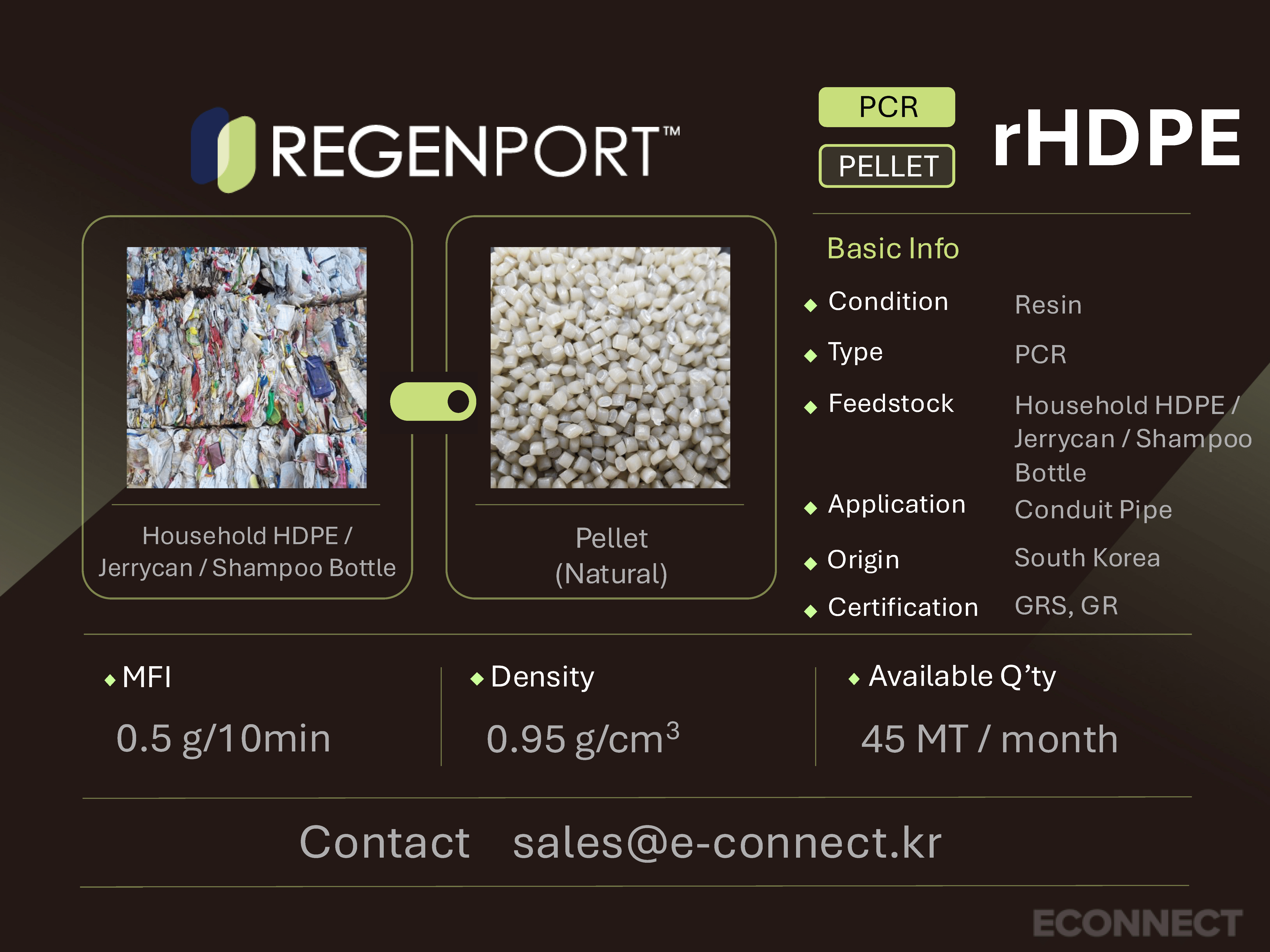
rHDPE (Regenport material catalog #15) | |
|---|---|
CONDITION : | TYPE : |
FEEDSTOCK : | APPLICATION : |
MFI : | DENSITY : |
Supply from South Korea and Two Certification Entries
The listing indicates an available quantity of up to 45 MT per month from South Korea. Actual allocation, lead time and shipment quantity should be reconfirmed at the time of inquiry.
Two certifications appear, and they do different jobs. The Global Recycled Standard (GRS) covers recycled content and chain of custody alongside social, environmental and chemical criteria. A Scope Certificate should show that the certified site and relevant product scope are covered, while a valid Transaction Certificate is the shipment-level document used to substantiate the GRS status of purchased material; the spec-sheet entry alone is not shipment-specific evidence.
GR is Korea's Good Recycled Product quality certification, which evaluates qualifying recycled products manufactured in Korea through testing and assessment against applicable quality criteria. Whether a GR certificate covers a resin or a finished product made from it is set by the certificate, so the certificate number and certified product name are what to check — and for publicly procured work, which certification a tender recognizes should be confirmed before the material is specified.
A PCR Grade to Qualify for Conduit Pipe and Construction Products
A natural post-consumer rHDPE pellet listed at MFI 0.5 g/10 min and 0.95 g/cm³, with extrusion and injection as listed routes, GRS and GR on the spec sheet, and up to 45 MT per month. The listing identifies conduit pipe and public-procurement construction products as target applications; final suitability should be confirmed against the applicable product standard, design requirements and trial results.
For qualification inquiries, tell us the intended process, part design and expected volume. We will confirm the MFR test condition, current lot data, certificate scope, lead time and the availability of trial material.
Frequently Asked Questions
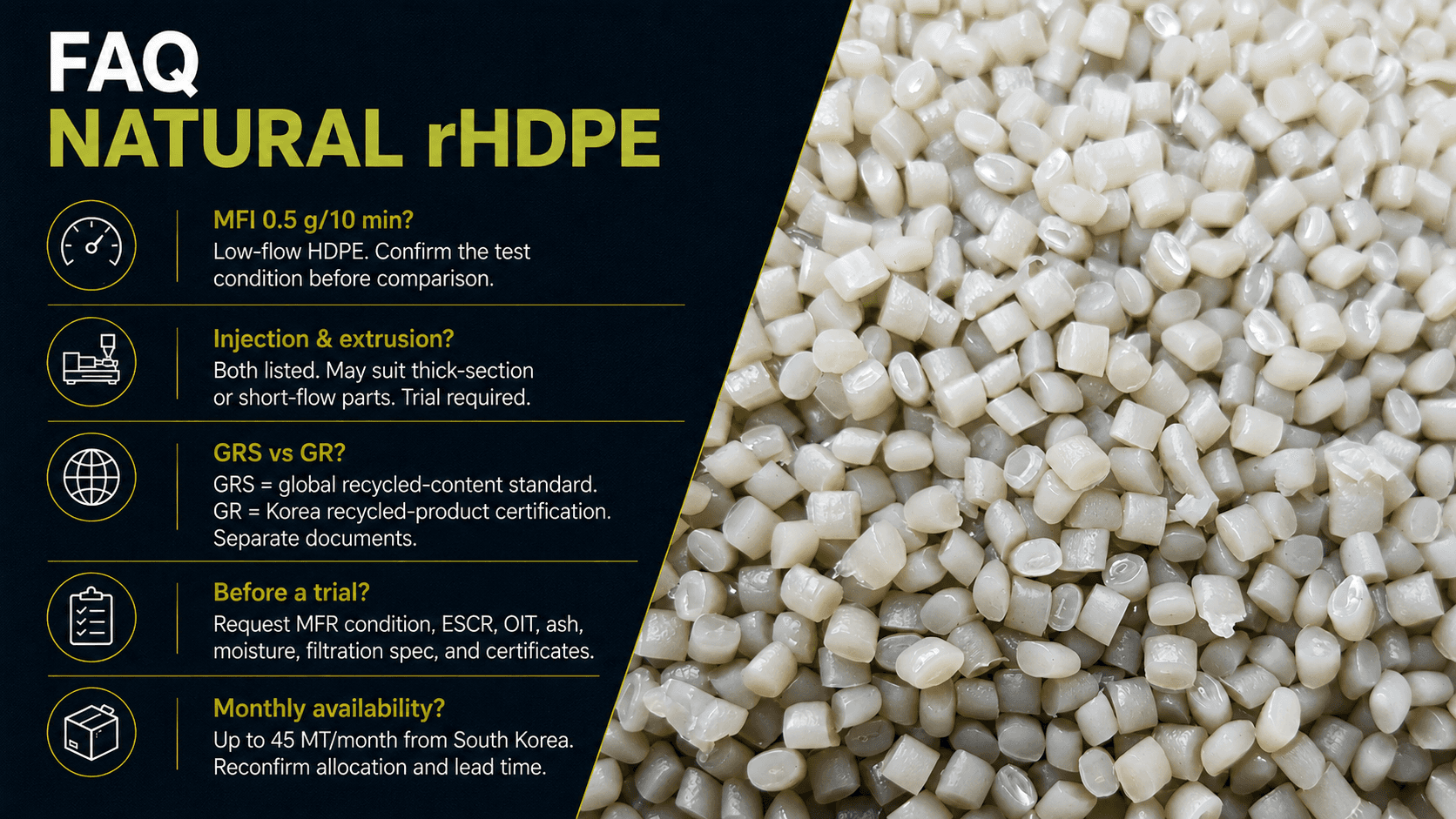
What does an MFI of 0.5 g/10 min indicate, and why does the test condition matter? It is generally considered a low-flow range for HDPE and may indicate relatively high molecular weight, which can be favorable for melt strength — but molecular weight, melt strength and ESCR are not established by a flow figure and should be confirmed through separate test data. HDPE MFR is commonly reported at 190°C/2.16 kg, though some grades are tested under different loads, so the condition should be confirmed before the figure is compared with another datasheet.
Can it be injection molded as well as extruded? Both routes are listed. At this flow level, injection may be better suited to thick-section or relatively short-flow structural parts than to thin-wall, long-flow-path geometries, and mold-filling trials together with the supplier's processing recommendations should be confirmed before specification.
What is the difference between the GRS and GR entries? GRS is the Global Recycled Standard, an international standard for recycled content and chain of custody: a Scope Certificate shows the certified site and product scope, and a Transaction Certificate is the shipment-level document used to substantiate the GRS status of purchased material. GR is Korea's Good Recycled Product quality certification for qualifying recycled products manufactured in Korea. They are separate certifications with separate documents, and the scope of each — including whether it covers a resin or a finished product — should be checked against the certificate.
What should be requested before a trial? The MFR test condition, lot-to-lot MFI variation, ESCR, OIT, ash content, moisture, the melt-filtration specification, and the certificate documents above.
How much is available per month? The listing indicates up to 45 MT per month from South Korea. Actual allocation, lead time and shipment quantity should be reconfirmed at the time of inquiry.
The supplier listing identifies household HDPE, jerrycans and shampoo bottles as the feedstock for this natural-colored PCR rHDPE pellet, extrusion and injection as processing routes, and conduit pipe — the tubing that protects electrical cable in buildings and underground — and public-procurement construction products as target applications.
An MFI of 0.5 g/10 min is generally considered a low-flow range for HDPE, and density is listed at 0.95 g/cm³. Low flow may indicate relatively high molecular weight and can be favorable for melt strength, but molecular weight, melt strength and environmental stress crack resistance (ESCR) should be confirmed through separate test data. No test condition is stated for the flow figure: HDPE melt flow rate is commonly reported at 190°C under a 2.16 kg load, though other loads are used for certain grades, so the ASTM D1238 or ISO 1133 condition should be stated before comparing it with another datasheet.
Processing Performance and Application Potential
Two processing routes are listed, and the same flow figure reads differently on each. In extrusion, a low-flow grade is generally chosen for the melt strength that holds a profile's shape between die and calibration. For injection molding, it may be better suited to thick-section or relatively short-flow structural parts than to thin-wall, long-flow-path geometries; mold-filling trials and the supplier's processing recommendations should be confirmed before specification.
For long-service applications such as conduit pipe and construction products, ESCR and oxidative induction time (OIT) are important qualification data to request. The listed MFI and density do not establish long-term durability on their own, and lot-to-lot MFI variation is worth asking about alongside the headline figure.
The feedstock also carries what packaging carries: labels, adhesives, closures that may be polypropylene, and product residue. Ash content, moisture and the melt-filtration specification describe how completely those were removed — in a conduit pipe wall or a load-bearing part, an unmelted particle is a weak point rather than a cosmetic issue.
Because the pellet is natural-colored, a converter may set color and outdoor-weathering performance through a suitable masterbatch or stabilizer package, subject to the applicable product specification. The base pellet's UV performance should not be assumed without test data.
Material Data
rHDPE (Regenport material catalog #15) | |
|---|---|
CONDITION : | TYPE : |
FEEDSTOCK : | APPLICATION : |
MFI : | DENSITY : |
Supply from South Korea and Two Certification Entries
The listing indicates an available quantity of up to 45 MT per month from South Korea. Actual allocation, lead time and shipment quantity should be reconfirmed at the time of inquiry.
Two certifications appear, and they do different jobs. The Global Recycled Standard (GRS) covers recycled content and chain of custody alongside social, environmental and chemical criteria. A Scope Certificate should show that the certified site and relevant product scope are covered, while a valid Transaction Certificate is the shipment-level document used to substantiate the GRS status of purchased material; the spec-sheet entry alone is not shipment-specific evidence.
GR is Korea's Good Recycled Product quality certification, which evaluates qualifying recycled products manufactured in Korea through testing and assessment against applicable quality criteria. Whether a GR certificate covers a resin or a finished product made from it is set by the certificate, so the certificate number and certified product name are what to check — and for publicly procured work, which certification a tender recognizes should be confirmed before the material is specified.
A PCR Grade to Qualify for Conduit Pipe and Construction Products
A natural post-consumer rHDPE pellet listed at MFI 0.5 g/10 min and 0.95 g/cm³, with extrusion and injection as listed routes, GRS and GR on the spec sheet, and up to 45 MT per month. The listing identifies conduit pipe and public-procurement construction products as target applications; final suitability should be confirmed against the applicable product standard, design requirements and trial results.
For qualification inquiries, tell us the intended process, part design and expected volume. We will confirm the MFR test condition, current lot data, certificate scope, lead time and the availability of trial material.
Frequently Asked Questions
What does an MFI of 0.5 g/10 min indicate, and why does the test condition matter? It is generally considered a low-flow range for HDPE and may indicate relatively high molecular weight, which can be favorable for melt strength — but molecular weight, melt strength and ESCR are not established by a flow figure and should be confirmed through separate test data. HDPE MFR is commonly reported at 190°C/2.16 kg, though some grades are tested under different loads, so the condition should be confirmed before the figure is compared with another datasheet.
Can it be injection molded as well as extruded? Both routes are listed. At this flow level, injection may be better suited to thick-section or relatively short-flow structural parts than to thin-wall, long-flow-path geometries, and mold-filling trials together with the supplier's processing recommendations should be confirmed before specification.
What is the difference between the GRS and GR entries? GRS is the Global Recycled Standard, an international standard for recycled content and chain of custody: a Scope Certificate shows the certified site and product scope, and a Transaction Certificate is the shipment-level document used to substantiate the GRS status of purchased material. GR is Korea's Good Recycled Product quality certification for qualifying recycled products manufactured in Korea. They are separate certifications with separate documents, and the scope of each — including whether it covers a resin or a finished product — should be checked against the certificate.
What should be requested before a trial? The MFR test condition, lot-to-lot MFI variation, ESCR, OIT, ash content, moisture, the melt-filtration specification, and the certificate documents above.
How much is available per month? The listing indicates up to 45 MT per month from South Korea. Actual allocation, lead time and shipment quantity should be reconfirmed at the time of inquiry.
Natural rHDPE
Natural rHDPE
Looking for samples or ready to source? Submit your request for pricing, availability, and technical information.
Looking for samples or ready to source? Submit your request for pricing, availability, and technical information.
Request a Quote →
Request a Quote →
Posted by REGENPORT
REGENPORT is a global platform connecting buyers and suppliers in the recycled materials and sustainable packaging industries.