CATEGORY
CATEGORY
Trend
Trend
Trend
EU's Nov. 21 Export Ban Lifts European Bales as Virgin PET Overtakes Recycled – Week 2, October 2026
EU's Nov. 21 Export Ban Lifts European Bales as Virgin PET Overtakes Recycled – Week 2, October 2026
EU's Nov. 21 Export Ban Lifts European Bales as Virgin PET Overtakes Recycled – Week 2, October 2026

European LDPE bale prices jumped ahead of the EU's Nov. 21 export ban, while pellet prices fell. In the US, virgin PET overtook recycled PET for the first time in months on Middle East-linked risk. UK, Turkish, Indian and Brazilian trade actions added to a week driven by deadlines and policy.
This week's market split along an unusual line: bales versus pellets, and virgin versus recycled, rather than region versus region. The EU export ban is pulling bale demand forward before it even takes effect, while pellet buyers showed no matching urgency. Separately, a firmer virgin complex — linked to Middle East supply risk rather than recycled-specific demand — pushed into territory recycled grades have not had to compete with in a while. Both threads point to the same conclusion: price direction this week was set by calendars and geopolitics more than by converter demand.

Three Factors Shaping This Week's Market
1. The EU's Nov. 21 non-OECD export ban is pulling bale demand forward, not pellet demand European LDPE bale prices rose as buyers — reported to be concentrated in Asia — moved to secure material before the ban on plastic-waste exports to non-OECD countries takes effect. LDPE pellet prices moved in the opposite direction, which suggests the rush is specific to bales rather than a broader signal of stronger recycled demand.
2. Virgin resin strength tied to Middle East shipping and supply risks is narrowing recycled premiums across regions Brent crude gained and shipping transits through the Strait of Hormuz were reported lower after a new round of attacks on vessels, and that risk premium fed through to virgin PE, PP and PET. The result was a narrower recycled-over-virgin spread in Europe, Asia and Latin America, and in the US, virgin PET moved above recycled PET on price for the first time in several months.
3. A cluster of national trade and regulatory actions is adding region-specific uncertainty on top of the ban and oil story A UK safeguard investigation into PET imports, an existing Turkish safeguard duty on PET, an Indian anti-dumping recommendation on PET film, and a paused Brazilian market ahead of an Oct. 25 presidential runoff are each shaping local trade flows independently of the EU ban and virgin-price moves — a reminder that several distinct policy threads are in motion at once this quarter.
Key Grade Performance: rLDPE, rPP, Styrenics and the Virgin-Recycled PET Gap

rLDPE Market — Bales firm on the export-ban rush; pellets move the other way European LDPE bale prices rose this week on what market sources describe as a last wave of buying concentrated among Asian countries ahead of the Nov. 21 ban. Natural and colored pellet prices, by contrast, both declined, and the discount of natural rLDPE pellets to virgin is reported to have widened to more than €100/MT. Why it matters: a bale rally driven by a looming export deadline is a timing effect, not necessarily a demand signal. Once the ban takes effect, a larger share of the scrap that previously went to non-OECD destinations is expected to remain in Europe or be redirected to other markets, though the actual split will depend on domestic recycling capacity and export flows to OECD countries — so this week's bale strength could prove temporary. Buyers evaluating rLDPE pellet cover may want to treat the widening discount to virgin as a separate, pellet-specific data point rather than reading it off the bale market.
rPP Market — Premium over virgin narrows as recyclers draw down stock European natural rPP pellet prices fell this week as recyclers were reported to be working through existing stock ahead of year-end, while virgin PP firmed on the same Middle East shipping and supply risk premium affecting other virgin grades. The combination narrowed rPP's usual premium over virgin. Why it matters: a narrowing premium here is a virgin-side story as much as a recycled one — it reflects virgin PP catching up in price rather than any change in rPP supply or demand fundamentals.

Styrenics (rPS/rABS) — rPS rises, rABS holds largely stable on a firmer virgin cost base European rPS prices rose this week, while rABS was reported mostly stable even as virgin pricing increased on the back of higher styrene monomer costs. Why it matters: styrenics pricing is tracking virgin feedstock cost more closely than recycled-specific demand at the moment, which is worth factoring in when comparing week-to-week moves across rPS and rABS.
Virgin-Recycled PET Gap — US virgin PET overtakes recycled PET for the first time in months US virgin PET prices rose above recycled PET prices this week, a reversal of the usual spread, while the recycled-over-virgin premium also narrowed in Europe, Asia and Latin America. Despite the parity, no meaningful switching from recycled to virgin PET has been reported so far, since requalifying a different material for an existing application takes time. Why it matters: price parity alone does not appear to be enough to move buyers off recycled PET in the near term — the requalification lag is worth keeping in mind before reading this week's price crossover as an early signal of a lasting shift in demand.
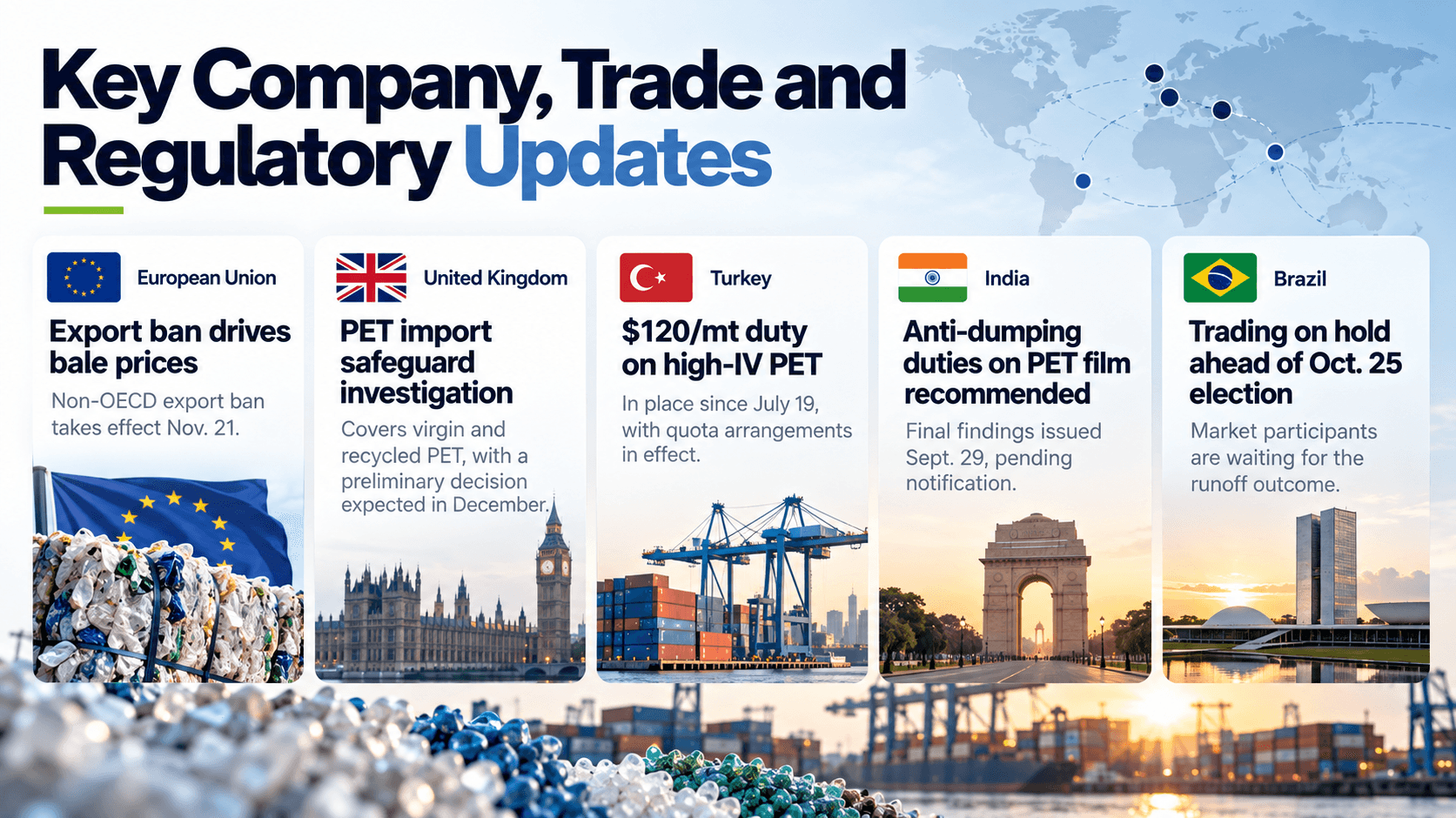
Key Company, Trade and Regulatory Updates
European Union — Nov. 21 non-OECD export ban is actively moving bale prices; PPWR has not yet driven spot demand. The ban on plastic-waste exports to non-OECD countries takes effect Nov. 21 and is reported to be the direct driver behind this week's bale buying. The EU's Packaging and Packaging Waste Regulation (PPWR), whose core recycled-content obligations largely begin later this decade, is not yet reported to be generating sustained spot demand.
United Kingdom — Ongoing safeguard investigation into PET imports, covering both virgin and recycled PET, has buyers reviewing supply chains ahead of a possible preliminary determination in December. The investigation is supporting UK prices, and some buyers are reported to be re-evaluating their supply chains ahead of that preliminary determination, although any actual duty would depend on a separate, later decision in the investigation.
Turkey — A $120/mt safeguard duty on imports of high-intrinsic-viscosity PET resin has been in place since July 19, but quota-linked import arrangements and, according to market sources, more competitive Vietnamese offers continue to pressure the domestic market.
India — The Directorate General of Trade Remedies (DGTR) recommended definitive anti-dumping duties on PET film imports from China, Thailand and Bangladesh, in final findings dated Sept. 29. The duties would take effect only upon notification by India's Ministry of Finance.
Brazil — Trading is largely on hold ahead of the Oct. 25 presidential runoff. Market participants are reported to be waiting for the outcome before committing to new positions.

Market Takeaway
The EU's Nov. 21 export ban is now a visible price driver, and so far it is favoring bales over pellets — exporters and buyers are reported to be accelerating shipments of lower-grade material out of Europe before the deadline. Once the ban takes effect, a larger share of the plastic scrap that previously went to non-OECD destinations is expected to remain in Europe or be redirected to other markets, though the actual outcome will depend on domestic recycling capacity and export flows to OECD countries — so this week's bale strength may prove to be a deadline effect rather than a lasting shift. The US and Southeast Asia, which have historically relied on European scrap, may need to adjust sourcing if that flow narrows. Separately, virgin prices are moving faster than recycled prices on Middle East shipping and supply risks, and the US PET price crossover illustrates the point: recycled and virgin are now roughly matched on price, yet no meaningful switching has been reported so far, since requalification takes time. Into next week, the items worth watching are the Brazilian runoff on Oct. 25, the pace of the post-Golden Week restart in Asian trading, any further movement in the UK and Turkish PET cases, and how durable this week's bale strength proves once the Nov. 21 deadline passes. Regenport will continue monitoring market conditions and sharing updates as the picture develops.

Frequently Asked Questions
Why did European LDPE bale prices rise this week while pellet prices fell? The two are responding to different drivers. Bale prices rose as buyers, reported to be concentrated in Asian countries, moved to secure material ahead of the EU's Nov. 21 ban on plastic-waste exports to non-OECD countries. Pellet prices moved the other way, with both natural and colored grades declining, which suggests the bale rally is a deadline-driven timing effect specific to bales rather than a broader pellet demand signal.
Why did virgin PET overtake recycled PET in the US, and does that mean buyers are switching? Virgin PET prices in the US rose above recycled PET prices this week for the first time in several months, driven by a Middle East shipping and supply risk premium feeding through virgin markets generally. Despite the price crossover, no meaningful switching from recycled to virgin PET has been reported so far, since qualifying a different material for an existing application takes time — price parity on its own has not been enough to move volumes.
Image generated with ChatGPT
This week's market split along an unusual line: bales versus pellets, and virgin versus recycled, rather than region versus region. The EU export ban is pulling bale demand forward before it even takes effect, while pellet buyers showed no matching urgency. Separately, a firmer virgin complex — linked to Middle East supply risk rather than recycled-specific demand — pushed into territory recycled grades have not had to compete with in a while. Both threads point to the same conclusion: price direction this week was set by calendars and geopolitics more than by converter demand.
Three Factors Shaping This Week's Market
1. The EU's Nov. 21 non-OECD export ban is pulling bale demand forward, not pellet demand European LDPE bale prices rose as buyers — reported to be concentrated in Asia — moved to secure material before the ban on plastic-waste exports to non-OECD countries takes effect. LDPE pellet prices moved in the opposite direction, which suggests the rush is specific to bales rather than a broader signal of stronger recycled demand.
2. Virgin resin strength tied to Middle East shipping and supply risks is narrowing recycled premiums across regions Brent crude gained and shipping transits through the Strait of Hormuz were reported lower after a new round of attacks on vessels, and that risk premium fed through to virgin PE, PP and PET. The result was a narrower recycled-over-virgin spread in Europe, Asia and Latin America, and in the US, virgin PET moved above recycled PET on price for the first time in several months.
3. A cluster of national trade and regulatory actions is adding region-specific uncertainty on top of the ban and oil story A UK safeguard investigation into PET imports, an existing Turkish safeguard duty on PET, an Indian anti-dumping recommendation on PET film, and a paused Brazilian market ahead of an Oct. 25 presidential runoff are each shaping local trade flows independently of the EU ban and virgin-price moves — a reminder that several distinct policy threads are in motion at once this quarter.
Key Grade Performance: rLDPE, rPP, Styrenics and the Virgin-Recycled PET Gap
rLDPE Market — Bales firm on the export-ban rush; pellets move the other way European LDPE bale prices rose this week on what market sources describe as a last wave of buying concentrated among Asian countries ahead of the Nov. 21 ban. Natural and colored pellet prices, by contrast, both declined, and the discount of natural rLDPE pellets to virgin is reported to have widened to more than €100/MT. Why it matters: a bale rally driven by a looming export deadline is a timing effect, not necessarily a demand signal. Once the ban takes effect, a larger share of the scrap that previously went to non-OECD destinations is expected to remain in Europe or be redirected to other markets, though the actual split will depend on domestic recycling capacity and export flows to OECD countries — so this week's bale strength could prove temporary. Buyers evaluating rLDPE pellet cover may want to treat the widening discount to virgin as a separate, pellet-specific data point rather than reading it off the bale market.
rPP Market — Premium over virgin narrows as recyclers draw down stock European natural rPP pellet prices fell this week as recyclers were reported to be working through existing stock ahead of year-end, while virgin PP firmed on the same Middle East shipping and supply risk premium affecting other virgin grades. The combination narrowed rPP's usual premium over virgin. Why it matters: a narrowing premium here is a virgin-side story as much as a recycled one — it reflects virgin PP catching up in price rather than any change in rPP supply or demand fundamentals.
Styrenics (rPS/rABS) — rPS rises, rABS holds largely stable on a firmer virgin cost base European rPS prices rose this week, while rABS was reported mostly stable even as virgin pricing increased on the back of higher styrene monomer costs. Why it matters: styrenics pricing is tracking virgin feedstock cost more closely than recycled-specific demand at the moment, which is worth factoring in when comparing week-to-week moves across rPS and rABS.
Virgin-Recycled PET Gap — US virgin PET overtakes recycled PET for the first time in months US virgin PET prices rose above recycled PET prices this week, a reversal of the usual spread, while the recycled-over-virgin premium also narrowed in Europe, Asia and Latin America. Despite the parity, no meaningful switching from recycled to virgin PET has been reported so far, since requalifying a different material for an existing application takes time. Why it matters: price parity alone does not appear to be enough to move buyers off recycled PET in the near term — the requalification lag is worth keeping in mind before reading this week's price crossover as an early signal of a lasting shift in demand.
Key Company, Trade and Regulatory Updates
European Union — Nov. 21 non-OECD export ban is actively moving bale prices; PPWR has not yet driven spot demand. The ban on plastic-waste exports to non-OECD countries takes effect Nov. 21 and is reported to be the direct driver behind this week's bale buying. The EU's Packaging and Packaging Waste Regulation (PPWR), whose core recycled-content obligations largely begin later this decade, is not yet reported to be generating sustained spot demand.
United Kingdom — Ongoing safeguard investigation into PET imports, covering both virgin and recycled PET, has buyers reviewing supply chains ahead of a possible preliminary determination in December. The investigation is supporting UK prices, and some buyers are reported to be re-evaluating their supply chains ahead of that preliminary determination, although any actual duty would depend on a separate, later decision in the investigation.
Turkey — A $120/mt safeguard duty on imports of high-intrinsic-viscosity PET resin has been in place since July 19, but quota-linked import arrangements and, according to market sources, more competitive Vietnamese offers continue to pressure the domestic market.
India — The Directorate General of Trade Remedies (DGTR) recommended definitive anti-dumping duties on PET film imports from China, Thailand and Bangladesh, in final findings dated Sept. 29. The duties would take effect only upon notification by India's Ministry of Finance.
Brazil — Trading is largely on hold ahead of the Oct. 25 presidential runoff. Market participants are reported to be waiting for the outcome before committing to new positions.
Market Takeaway
The EU's Nov. 21 export ban is now a visible price driver, and so far it is favoring bales over pellets — exporters and buyers are reported to be accelerating shipments of lower-grade material out of Europe before the deadline. Once the ban takes effect, a larger share of the plastic scrap that previously went to non-OECD destinations is expected to remain in Europe or be redirected to other markets, though the actual outcome will depend on domestic recycling capacity and export flows to OECD countries — so this week's bale strength may prove to be a deadline effect rather than a lasting shift. The US and Southeast Asia, which have historically relied on European scrap, may need to adjust sourcing if that flow narrows. Separately, virgin prices are moving faster than recycled prices on Middle East shipping and supply risks, and the US PET price crossover illustrates the point: recycled and virgin are now roughly matched on price, yet no meaningful switching has been reported so far, since requalification takes time. Into next week, the items worth watching are the Brazilian runoff on Oct. 25, the pace of the post-Golden Week restart in Asian trading, any further movement in the UK and Turkish PET cases, and how durable this week's bale strength proves once the Nov. 21 deadline passes. Regenport will continue monitoring market conditions and sharing updates as the picture develops.
Frequently Asked Questions
Why did European LDPE bale prices rise this week while pellet prices fell? The two are responding to different drivers. Bale prices rose as buyers, reported to be concentrated in Asian countries, moved to secure material ahead of the EU's Nov. 21 ban on plastic-waste exports to non-OECD countries. Pellet prices moved the other way, with both natural and colored grades declining, which suggests the bale rally is a deadline-driven timing effect specific to bales rather than a broader pellet demand signal.
Why did virgin PET overtake recycled PET in the US, and does that mean buyers are switching? Virgin PET prices in the US rose above recycled PET prices this week for the first time in several months, driven by a Middle East shipping and supply risk premium feeding through virgin markets generally. Despite the price crossover, no meaningful switching from recycled to virgin PET has been reported so far, since qualifying a different material for an existing application takes time — price parity on its own has not been enough to move volumes.
Image generated with ChatGPT
Where rLDPE Stands This Week
Grades • Specs • Availability
Browse rLDPE →
Where rLDPE Stands This Week
Where rLDPE Stands This Week
Check rLDPE grades by feedstock, MFI, stock and MOQ.
Check rLDPE grades by feedstock, MFI, stock and MOQ.
Browse rLDPE →
Browse rLDPE →
Looking for samples or ready to source? Submit your request for pricing, availability, and technical information.
Looking for samples or ready to source? Submit your request for pricing, availability, and technical information.
Request a Quote →
Request a Quote →
Posted by REGENPORT
REGENPORT is a global platform connecting buyers and suppliers in the recycled materials and sustainable packaging industries.