CATEGORY
CATEGORY
Trend
Trend
Trend
Crude Tops $95 but Recycled Polyolefins Stay Unmoved – Week 2, September 2026
Crude Tops $95 but Recycled Polyolefins Stay Unmoved – Week 2, September 2026
Crude Tops $95 but Recycled Polyolefins Stay Unmoved – Week 2, September 2026
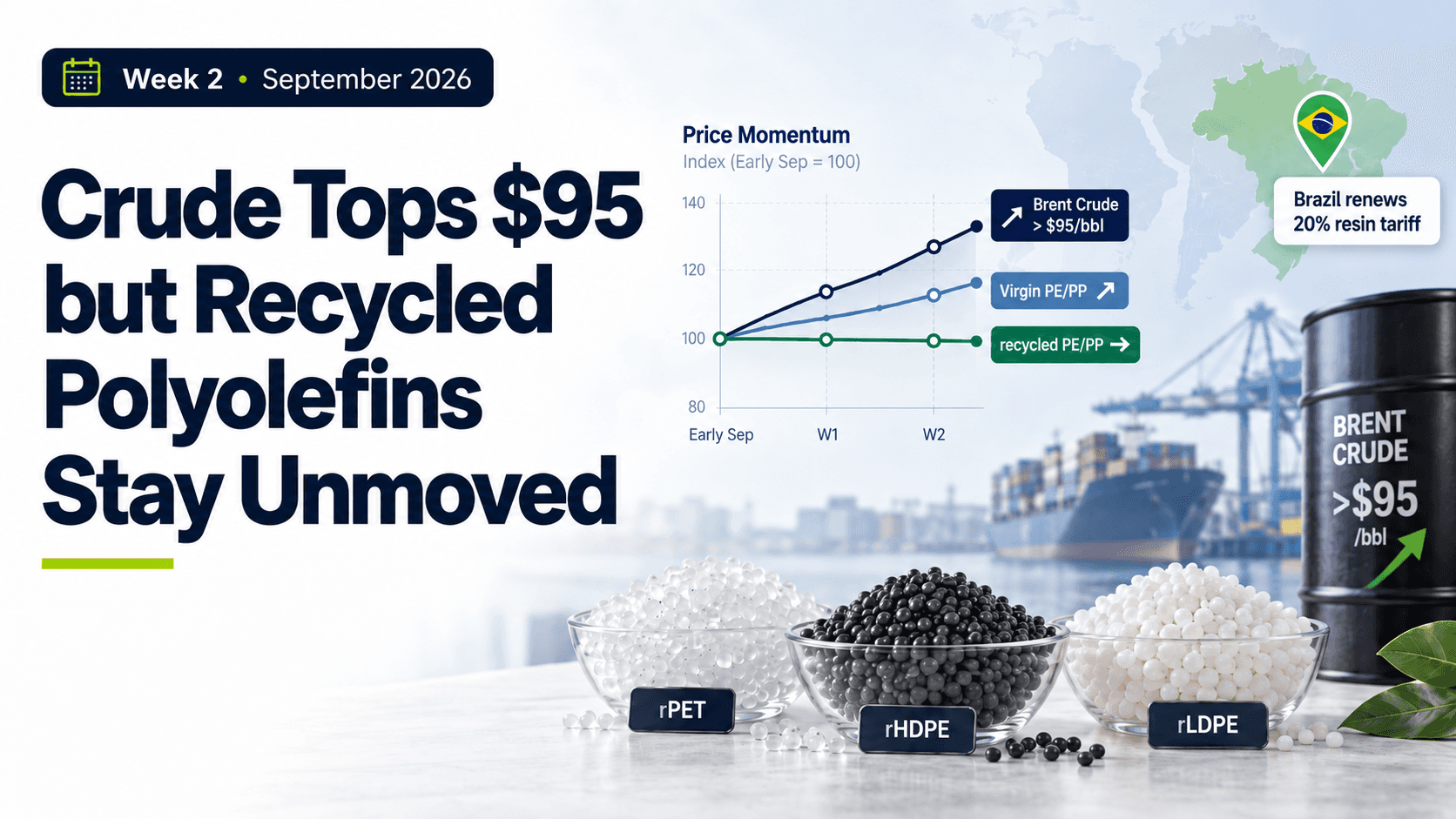
A genuine energy shock hit the virgin polymer complex this week — Brent moved above $95/bbl on US-Iran strikes escalated near the Strait of Hormuz and Asian PE and PP followed — while recycled grades in the US, Mexico and Brazil did not move at all. Brazil's trade authority granted one of Braskem's two requests on Aug. 27 and shelved the other.
Recycled polymer markets in the Americas held still for a second consecutive week while the virgin complex moved sharply. Brent crude traded above $95 per barrel on Sept. 2, 2026 as US-Iran strikes escalated near the Strait of Hormuz, and reached roughly $97 per barrel by Sept. 7 — approaching the $97.93 peak recorded on July 24, 2026. Asian ethylene firmed and virgin polyethylene (PE) and polypropylene (PP) rallied across the region. Recycled PET (R-PET), recycled HDPE (R-HDPE) and recycled LDPE (R-LDPE) in the US, Mexico and Brazil showed no comparable movement. Separately, Brazil's Chamber of Foreign Trade renewed a 20% import tariff on PE and PP resins for another 12 months on Aug. 27, 2026, while shelving Braskem's request to raise the anti-dumping duty on US-origin PE — the item left open in last week's report. Price observations in this report cover the Americas and are as of Sept. 8, 2026.
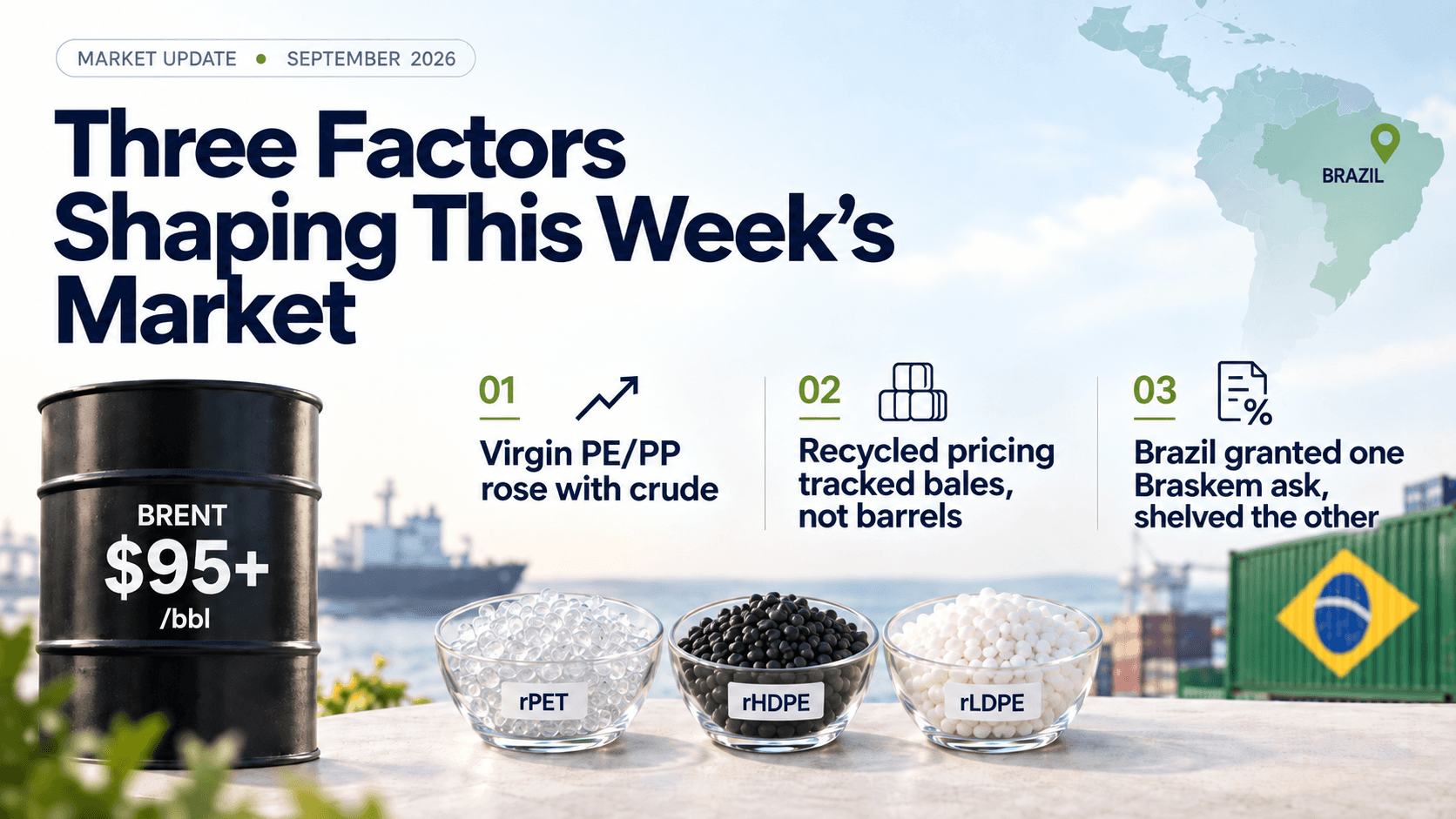
Three Factors Shaping This Week's Market
1. A real energy shock moved virgin polymers and left recycled untouched Crude gained roughly 9% over five days and about 19% over the month to Sept. 7, 2026, and the move fed through to Asian ethylene and then to virgin PE and PP offers. Recycled grades in the Americas registered no equivalent reaction in either direction. For buyers, the week is a clean test case: the same macro event produced a broad virgin rally and a flat recycled market.
2. Recycled pricing in the Americas is tracking bales, not barrels US recycled grades are responding to domestic bale supply and demand rather than to the naphtha and ethylene chain that sets Asian polyolefin direction. This is now a pattern repeated over roughly a month rather than a single-week divergence, which may suggest that recycled offers in the region should be assessed against collection and bale conditions rather than indexed to virgin movements.
3. Braskem received one of the two trade measures it had asked Brazil for Both of Brazil's Aug. 27, 2026 decisions trace back to the same petitioner. Braskem — the Latin American producer that filed for extrajudicial reorganization covering $10.9 billion in debt in August — had sought two forms of protection. The Executive Management Committee of the Foreign Trade Chamber (Gecex-Camex) granted one, renewing the elevated 20% import tariff on PE, PP and other chemical products for 12 months, and shelved the other, suspending the request to reanalyze the anti-dumping duty on US-origin PE. The tariff applies to imports of the listed products regardless of who is importing, so what buyers price is the measure itself rather than the petitioner behind it.
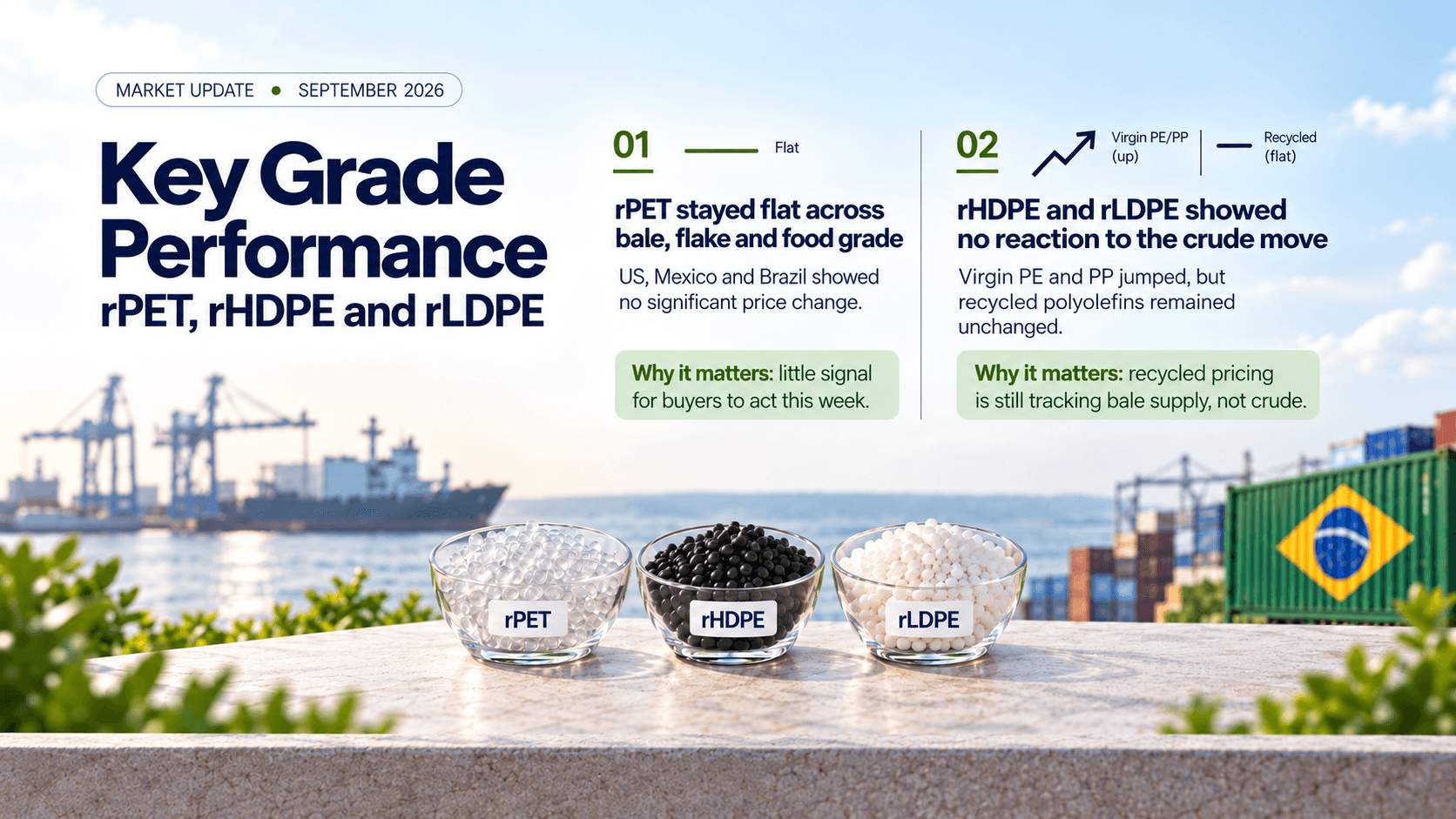
Key Grade Performance: rPET, rHDPE and rLDPE
rPET Market — unchanged across bale, flake and food grade Prices for rPET in major US cities showed no significant change across any form of the material — bale, flake or food grade. Mexico and Brazil followed the same unchanged trend. Why it matters: when all three form factors hold together, neither collection cost at the front of the chain nor converter demand at the back appears to be moving. Buyers timing rPET purchases have little signal to act on from this week alone.
rHDPE and rLDPE Markets — no reaction to the crude move Virgin PE and PP feedstock costs spiked sharply this week on the Middle East escalation. Recycled polyolefins showed no reaction — a pattern seen repeatedly over the past month. The main regional difference is that where Asian polyolefins are ethylene-driven, US recycled grades are tracking domestic bale supply and demand. Why it matters: offers that reference virgin or crude movements may not reflect what the recycled market is actually doing. Buyers may want to verify how a supplier's rHDPE or rLDPE quote was built before accepting an escalation tied to the virgin complex.
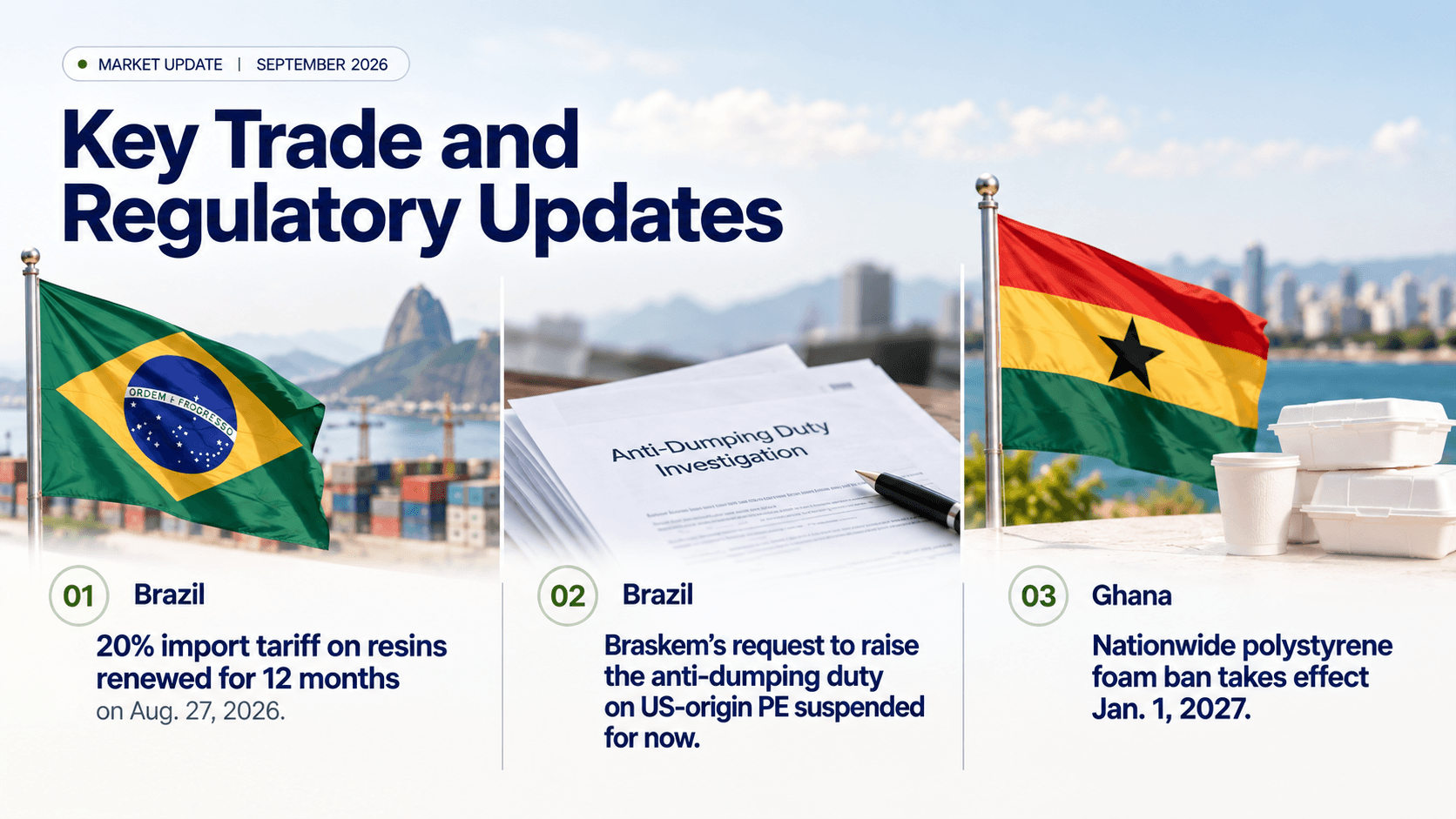
Key Trade and Regulatory Updates
Brazil — 20% import tariff on resins renewed for 12 months on Aug. 27, 2026. The Executive Management Committee of the Foreign Trade Chamber approved a 12-month renewal of the elevated 20% import tariff on various resins and chemicals, including PE and PP, up from the 12.6% base rate. The measure was first implemented in October 2024 and has been extended since. Countries with bilateral trade agreements — Egypt, Israel, Colombia and Mercosur members — remain exempt. Braskem and the chemical industry association Abiquim argued that global oversupply, particularly redirected Chinese export volume, justified the renewal; the plastics processors' association Abiplast opposed it on the grounds that it raises input costs for converters.
Brazil — Braskem's request to raise the anti-dumping duty on US-origin PE suspended. As reported in last week's update, Gecex-Camex was due to consider Braskem's request to raise the anti-dumping duty on US-origin polyethylene from $199.04/mt to more than $700/mt. The government suspended the request to reanalyze the current duty, leaving the existing rate in place for now. Buyers with exposure to US-origin PE moving into Brazil should verify the duty level currently in effect before pricing cargoes, as the published resolution text is the governing reference.
Ghana — nationwide polystyrene foam ban takes effect Jan. 1, 2027. Ghana's Environmental Protection Authority (EPA) has announced a ban covering the production, importation, distribution, sale and use of polystyrene foam products from Jan. 1, 2027. The scope includes expanded polystyrene (EPS) food-contact items such as takeaway containers, disposable cups and plates, as well as insulation, mattress and cushioning applications. Products for medical, scientific, laboratory and diagnostic use are exempt. The measure continued to draw attention across African markets this week.
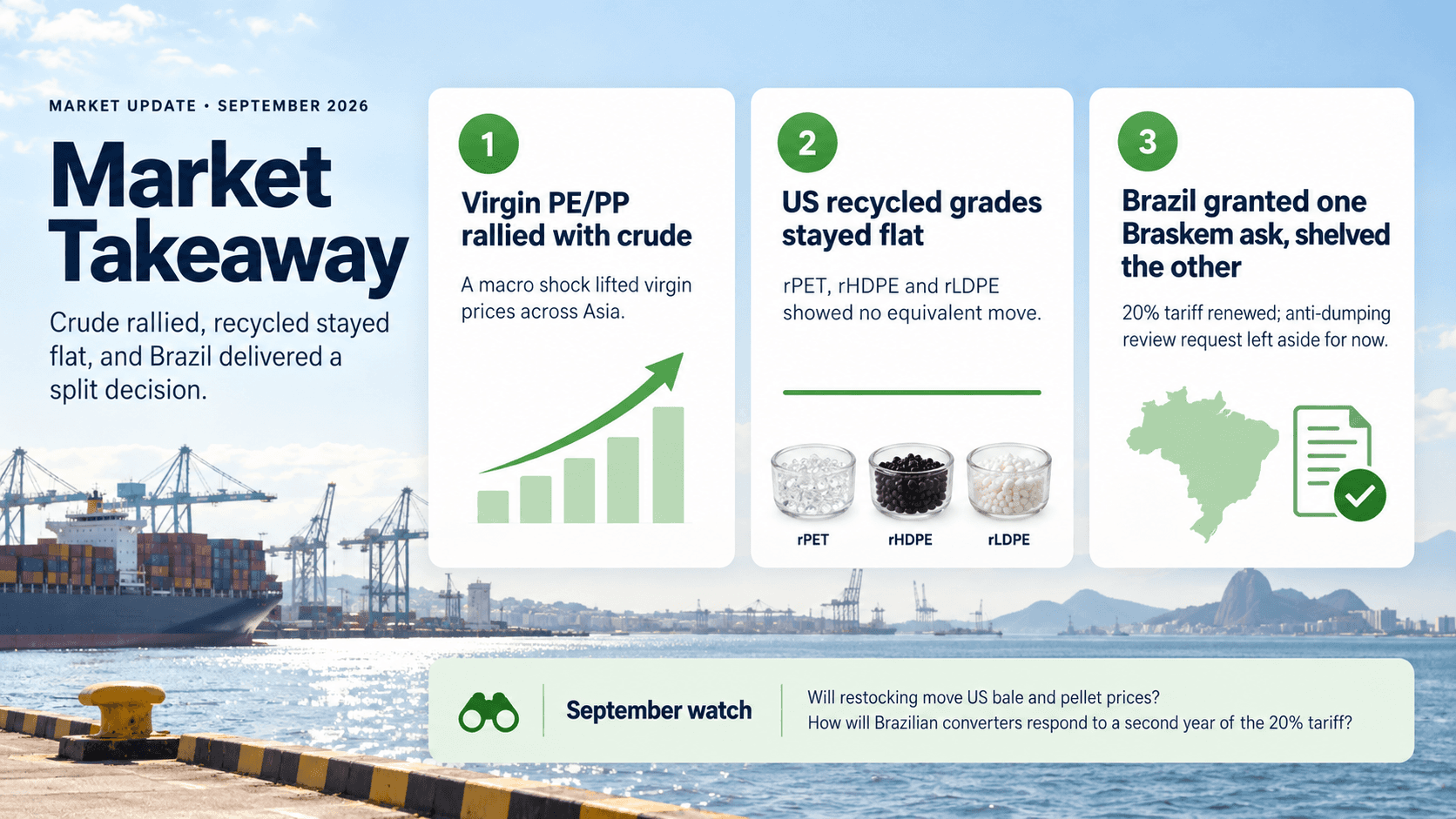
Market Takeaway
This week is a clean illustration of how differently virgin and recycled polymer markets are currently responding to macro shocks. A genuine geopolitical escalation pushed crude to its highest levels in months and triggered a sharp, broad-based virgin PE and PP rally across Asia, while US recycled grades did not move in either direction. Brazil's outcome was a split decision on Braskem's own two requests: the tariff renewal protects domestic and Mercosur-adjacent suppliers, while the shelved anti-dumping review removes a tail risk that US exporters had been pricing against. A producer restructuring $10.9 billion in debt secured the import barrier it wanted and not the duty increase. Buyers often treat September as a restocking month, so the coming weeks should show whether returning demand is enough to move recycled grades that a crude rally could not.
September watch: whether restocking demand moves US recycled bale and pellet prices, and how Brazilian converters respond to a second year of the 20% resin tariff granted at Braskem's request.
Regenport will continue monitoring market conditions and sharing updates as the picture develops.

Frequently Asked Questions
Did the September 2026 crude oil rally raise recycled plastic prices? No. Brent crude moved above $95 per barrel on Sept. 2, 2026 and reached roughly $97 per barrel by Sept. 7, and Asian virgin PE and PP rallied with it, but rPET, rHDPE and rLDPE prices in the US, Mexico and Brazil were unchanged. US recycled grades are tracking domestic bale supply and demand rather than the ethylene chain that drives Asian virgin polyolefin pricing, a pattern that has held over roughly the past month.
What changed in Brazil's resin import rules in August 2026? On Aug. 27, 2026, Brazil's Executive Management Committee of the Foreign Trade Chamber (Gecex-Camex) renewed the elevated 20% import tariff on PE, PP and other resins and chemicals for a further 12 months, up from the 12.6% base rate. The tariff was first implemented in October 2024. Egypt, Israel, Colombia and Mercosur members remain exempt under bilateral trade agreements. At the same meeting the government suspended Braskem's request to reanalyze the anti-dumping duty on US-origin polyethylene, leaving the current duty of $199.04/mt in place for now rather than raising it above $700/mt as Braskem had requested. Both decisions responded to requests filed by Braskem.
When does Ghana's polystyrene ban take effect and what does it cover? Ghana's Environmental Protection Authority (EPA) ban takes effect on Jan. 1, 2027 and covers the production, importation, distribution, sale and use of polystyrene foam products. It applies to expanded polystyrene (EPS) food-contact applications including takeaway containers, disposable cups and plates, and extends to insulation, mattress and cushioning uses. Medical, scientific, laboratory and diagnostic products are exempt.
Image generated with ChatGPT
Recycled polymer markets in the Americas held still for a second consecutive week while the virgin complex moved sharply. Brent crude traded above $95 per barrel on Sept. 2, 2026 as US-Iran strikes escalated near the Strait of Hormuz, and reached roughly $97 per barrel by Sept. 7 — approaching the $97.93 peak recorded on July 24, 2026. Asian ethylene firmed and virgin polyethylene (PE) and polypropylene (PP) rallied across the region. Recycled PET (R-PET), recycled HDPE (R-HDPE) and recycled LDPE (R-LDPE) in the US, Mexico and Brazil showed no comparable movement. Separately, Brazil's Chamber of Foreign Trade renewed a 20% import tariff on PE and PP resins for another 12 months on Aug. 27, 2026, while shelving Braskem's request to raise the anti-dumping duty on US-origin PE — the item left open in last week's report. Price observations in this report cover the Americas and are as of Sept. 8, 2026.
Three Factors Shaping This Week's Market
1. A real energy shock moved virgin polymers and left recycled untouched Crude gained roughly 9% over five days and about 19% over the month to Sept. 7, 2026, and the move fed through to Asian ethylene and then to virgin PE and PP offers. Recycled grades in the Americas registered no equivalent reaction in either direction. For buyers, the week is a clean test case: the same macro event produced a broad virgin rally and a flat recycled market.
2. Recycled pricing in the Americas is tracking bales, not barrels US recycled grades are responding to domestic bale supply and demand rather than to the naphtha and ethylene chain that sets Asian polyolefin direction. This is now a pattern repeated over roughly a month rather than a single-week divergence, which may suggest that recycled offers in the region should be assessed against collection and bale conditions rather than indexed to virgin movements.
3. Braskem received one of the two trade measures it had asked Brazil for Both of Brazil's Aug. 27, 2026 decisions trace back to the same petitioner. Braskem — the Latin American producer that filed for extrajudicial reorganization covering $10.9 billion in debt in August — had sought two forms of protection. The Executive Management Committee of the Foreign Trade Chamber (Gecex-Camex) granted one, renewing the elevated 20% import tariff on PE, PP and other chemical products for 12 months, and shelved the other, suspending the request to reanalyze the anti-dumping duty on US-origin PE. The tariff applies to imports of the listed products regardless of who is importing, so what buyers price is the measure itself rather than the petitioner behind it.
Key Grade Performance: rPET, rHDPE and rLDPE
rPET Market — unchanged across bale, flake and food grade Prices for rPET in major US cities showed no significant change across any form of the material — bale, flake or food grade. Mexico and Brazil followed the same unchanged trend. Why it matters: when all three form factors hold together, neither collection cost at the front of the chain nor converter demand at the back appears to be moving. Buyers timing rPET purchases have little signal to act on from this week alone.
rHDPE and rLDPE Markets — no reaction to the crude move Virgin PE and PP feedstock costs spiked sharply this week on the Middle East escalation. Recycled polyolefins showed no reaction — a pattern seen repeatedly over the past month. The main regional difference is that where Asian polyolefins are ethylene-driven, US recycled grades are tracking domestic bale supply and demand. Why it matters: offers that reference virgin or crude movements may not reflect what the recycled market is actually doing. Buyers may want to verify how a supplier's rHDPE or rLDPE quote was built before accepting an escalation tied to the virgin complex.
Key Trade and Regulatory Updates
Brazil — 20% import tariff on resins renewed for 12 months on Aug. 27, 2026. The Executive Management Committee of the Foreign Trade Chamber approved a 12-month renewal of the elevated 20% import tariff on various resins and chemicals, including PE and PP, up from the 12.6% base rate. The measure was first implemented in October 2024 and has been extended since. Countries with bilateral trade agreements — Egypt, Israel, Colombia and Mercosur members — remain exempt. Braskem and the chemical industry association Abiquim argued that global oversupply, particularly redirected Chinese export volume, justified the renewal; the plastics processors' association Abiplast opposed it on the grounds that it raises input costs for converters.
Brazil — Braskem's request to raise the anti-dumping duty on US-origin PE suspended. As reported in last week's update, Gecex-Camex was due to consider Braskem's request to raise the anti-dumping duty on US-origin polyethylene from $199.04/mt to more than $700/mt. The government suspended the request to reanalyze the current duty, leaving the existing rate in place for now. Buyers with exposure to US-origin PE moving into Brazil should verify the duty level currently in effect before pricing cargoes, as the published resolution text is the governing reference.
Ghana — nationwide polystyrene foam ban takes effect Jan. 1, 2027. Ghana's Environmental Protection Authority (EPA) has announced a ban covering the production, importation, distribution, sale and use of polystyrene foam products from Jan. 1, 2027. The scope includes expanded polystyrene (EPS) food-contact items such as takeaway containers, disposable cups and plates, as well as insulation, mattress and cushioning applications. Products for medical, scientific, laboratory and diagnostic use are exempt. The measure continued to draw attention across African markets this week.
Market Takeaway
This week is a clean illustration of how differently virgin and recycled polymer markets are currently responding to macro shocks. A genuine geopolitical escalation pushed crude to its highest levels in months and triggered a sharp, broad-based virgin PE and PP rally across Asia, while US recycled grades did not move in either direction. Brazil's outcome was a split decision on Braskem's own two requests: the tariff renewal protects domestic and Mercosur-adjacent suppliers, while the shelved anti-dumping review removes a tail risk that US exporters had been pricing against. A producer restructuring $10.9 billion in debt secured the import barrier it wanted and not the duty increase. Buyers often treat September as a restocking month, so the coming weeks should show whether returning demand is enough to move recycled grades that a crude rally could not.
September watch: whether restocking demand moves US recycled bale and pellet prices, and how Brazilian converters respond to a second year of the 20% resin tariff granted at Braskem's request.
Regenport will continue monitoring market conditions and sharing updates as the picture develops.
Frequently Asked Questions
Did the September 2026 crude oil rally raise recycled plastic prices? No. Brent crude moved above $95 per barrel on Sept. 2, 2026 and reached roughly $97 per barrel by Sept. 7, and Asian virgin PE and PP rallied with it, but rPET, rHDPE and rLDPE prices in the US, Mexico and Brazil were unchanged. US recycled grades are tracking domestic bale supply and demand rather than the ethylene chain that drives Asian virgin polyolefin pricing, a pattern that has held over roughly the past month.
What changed in Brazil's resin import rules in August 2026? On Aug. 27, 2026, Brazil's Executive Management Committee of the Foreign Trade Chamber (Gecex-Camex) renewed the elevated 20% import tariff on PE, PP and other resins and chemicals for a further 12 months, up from the 12.6% base rate. The tariff was first implemented in October 2024. Egypt, Israel, Colombia and Mercosur members remain exempt under bilateral trade agreements. At the same meeting the government suspended Braskem's request to reanalyze the anti-dumping duty on US-origin polyethylene, leaving the current duty of $199.04/mt in place for now rather than raising it above $700/mt as Braskem had requested. Both decisions responded to requests filed by Braskem.
When does Ghana's polystyrene ban take effect and what does it cover? Ghana's Environmental Protection Authority (EPA) ban takes effect on Jan. 1, 2027 and covers the production, importation, distribution, sale and use of polystyrene foam products. It applies to expanded polystyrene (EPS) food-contact applications including takeaway containers, disposable cups and plates, and extends to insulation, mattress and cushioning uses. Medical, scientific, laboratory and diagnostic products are exempt.
Image generated with ChatGPT
rHDPE Held Flat This Week
Grades • Specs • Availability
Browse rHDPE →
rHDPE Held Flat This Week
rHDPE Held Flat This Week
Check rHDPE grades by feedstock, MFI, stock and MOQ.
Check rHDPE grades by feedstock, MFI, stock and MOQ.
Browse rHDPE →
Browse rHDPE →
Looking for samples or ready to source? Submit your request for pricing, availability, and technical information.
Looking for samples or ready to source? Submit your request for pricing, availability, and technical information.
Request a Quote →
Request a Quote →
Posted by REGENPORT
REGENPORT is a global platform connecting buyers and suppliers in the recycled materials and sustainable packaging industries.