CATEGORY
CATEGORY
News
News
News
EU Tightens Plastic Waste Export Rules: What Will Happen to Europe's PCR Supply Chain?
EU Tightens Plastic Waste Export Rules: What Will Happen to Europe's PCR Supply Chain?
EU Tightens Plastic Waste Export Rules: What Will Happen to Europe's PCR Supply Chain?

The EU's revised Waste Shipment Regulation is restricting plastic waste exports to non-OECD countries. Here's what it means for PCR feedstock supply, compliance requirements, and the global recycled plastics trade.
Europe's plastic waste export rules are changing, and this is more than a technical adjustment to shipping procedures. The EU's revised Waste Shipment Regulation is reshaping how plastic waste moves across borders, and that shift could have a real impact on the structure of Europe's PCR supply chain.
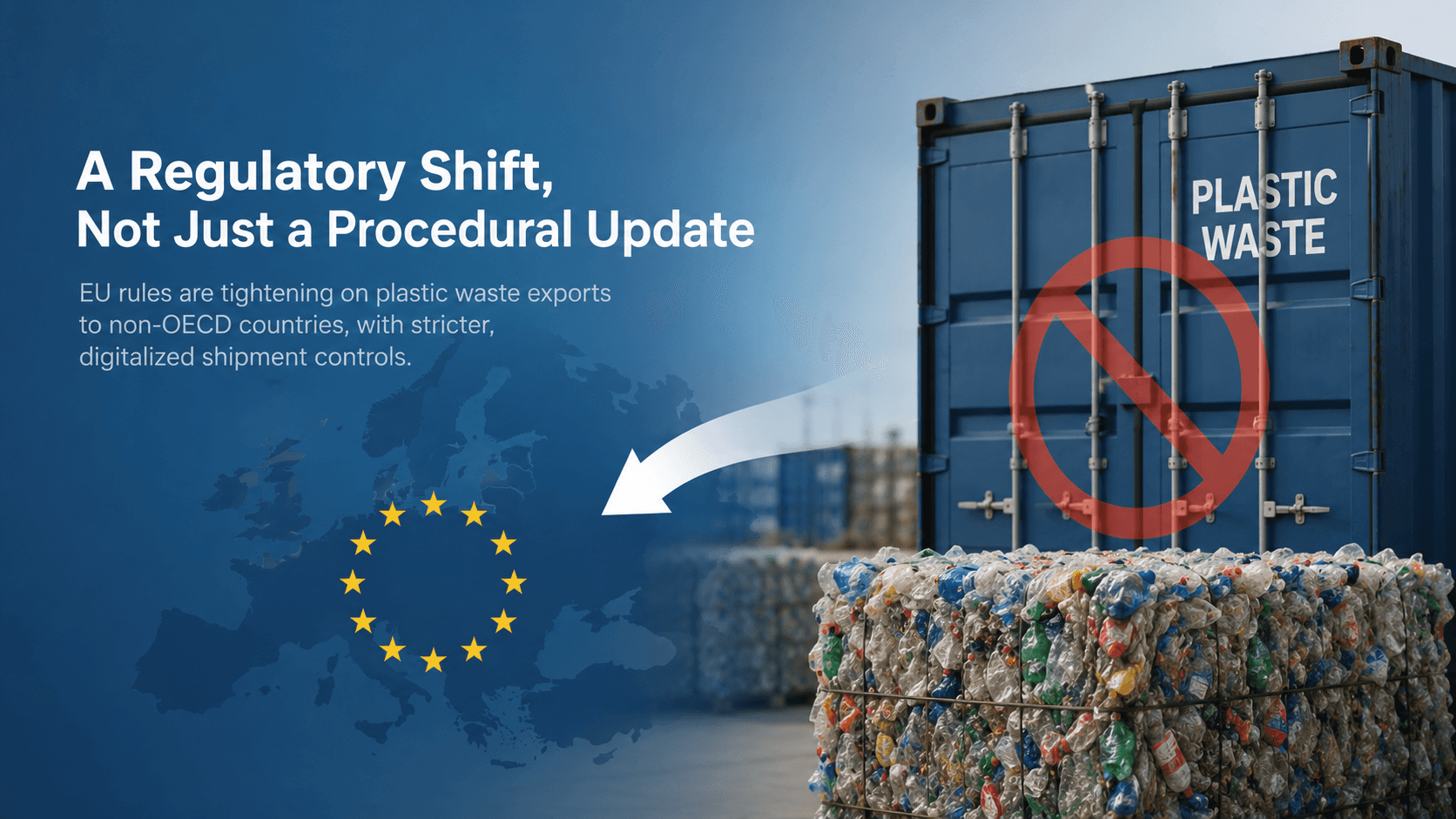
A Regulatory Shift, Not Just a Procedural Update
According to the European Commission, exports of plastic waste to non-OECD countries are being restricted, while shipment procedures are becoming more tightly controlled and increasingly digitalized.
This should not be seen as a simple administrative update. For years, part of Europe's plastic waste stream has moved beyond its borders for treatment or recycling. As the new rules tighten, a larger share of that material may remain inside the region, increasing the pressure on local sorting, recycling, and quality control capacity.
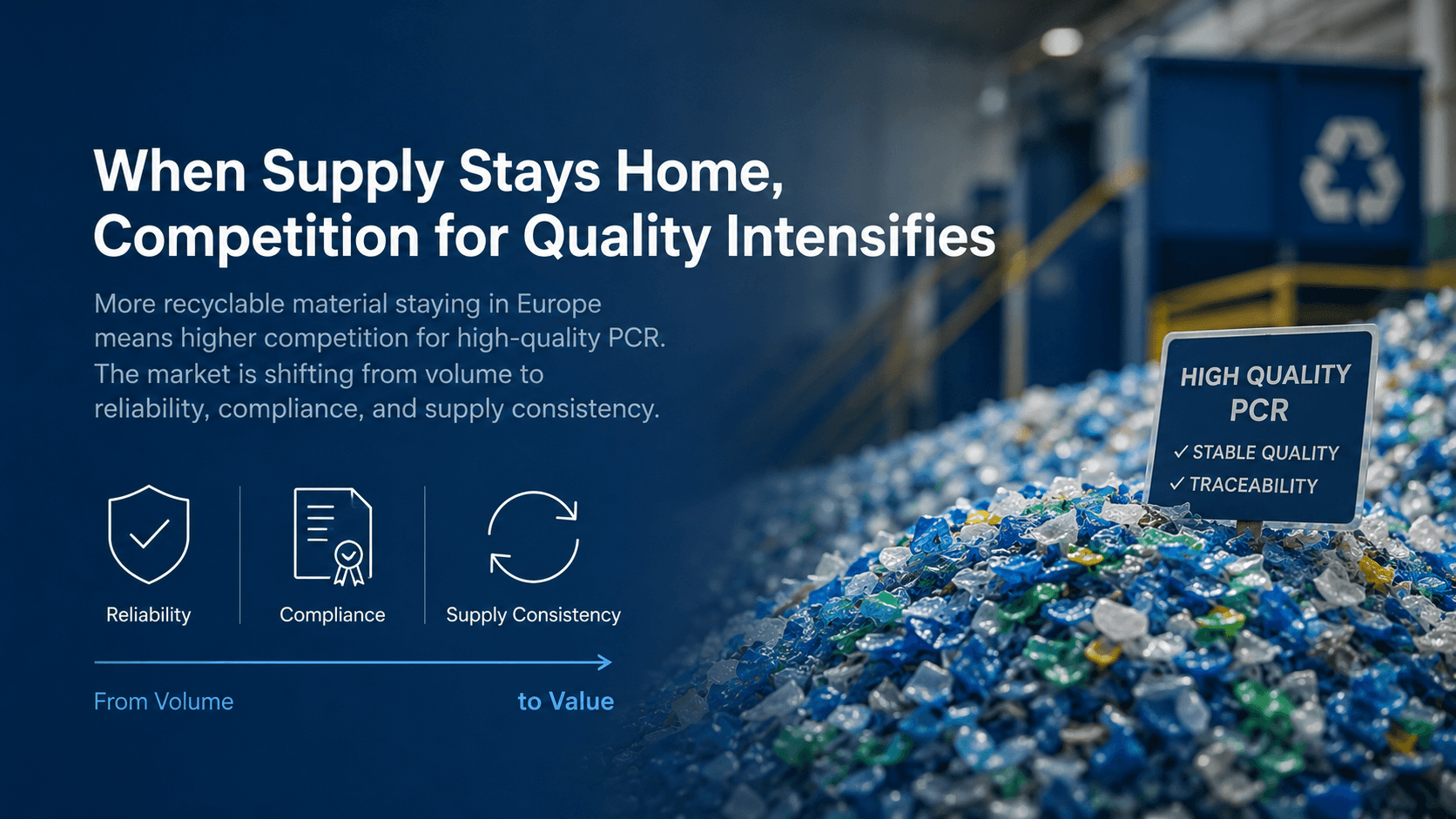
When Supply Stays Home, Competition for Quality Intensifies
That is where the PCR market comes in. If more recyclable material stays in Europe, competition for high-quality PCR feedstock is likely to intensify. In particular, materials with stable quality and clear traceability may become more valuable. In other words, the market may gradually shift from a volume-driven model to one that rewards reliability, compliance, and supply consistency.
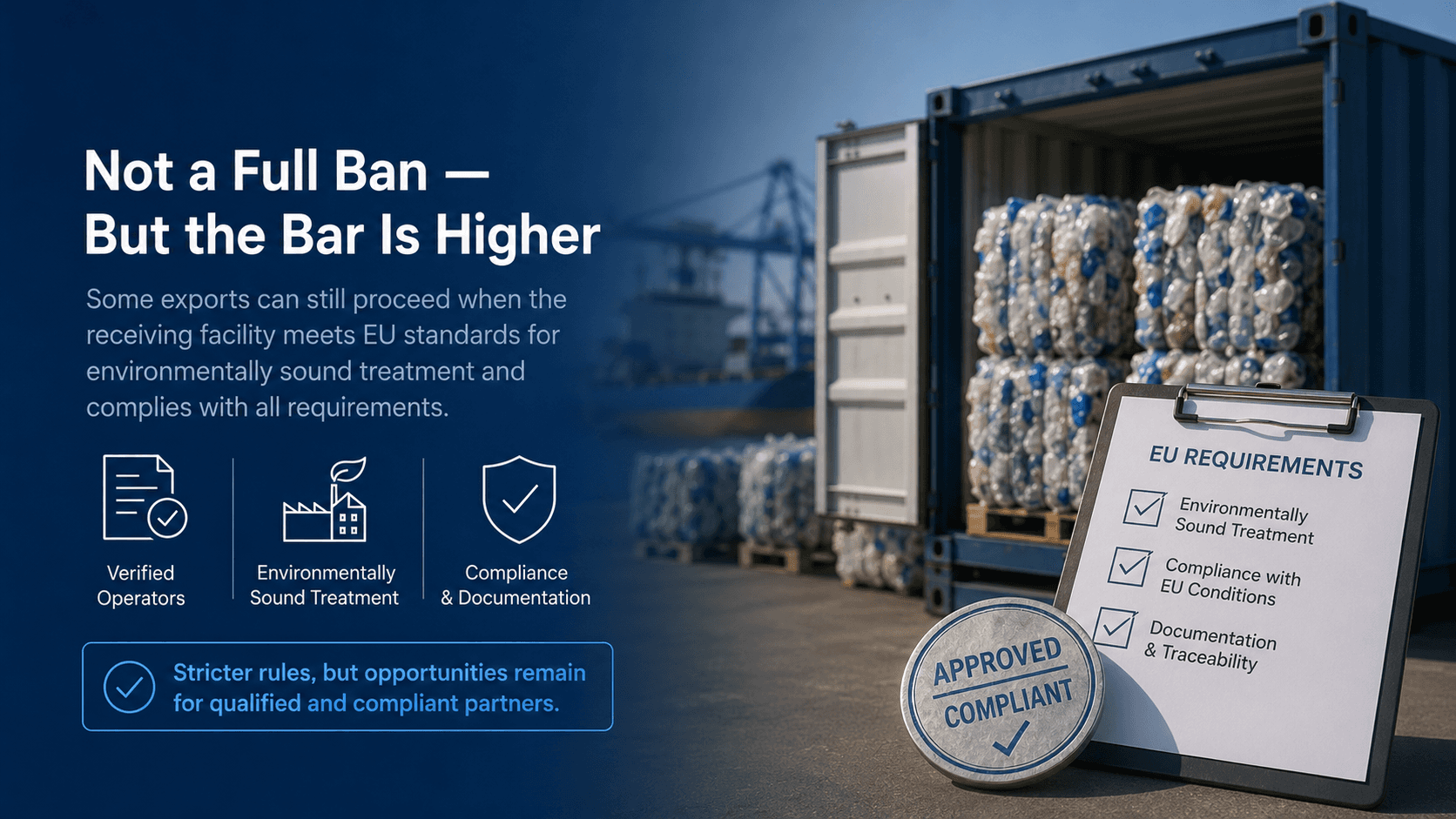
Not a Full Ban — But the Bar Is Higher
At the same time, the new framework does not mean that all exports are blocked. Official EU materials indicate that some transactions may still be possible when the receiving facility can demonstrate environmentally sound treatment capacity and meet the required conditions. That means the regulation is stricter, but it still leaves room for verified operators with documented systems.

Compliance as a Competitive Advantage
From an operational perspective, this places greater responsibility on waste handlers, recyclers, and traders. Audit readiness, facility verification, recordkeeping, and traceability are no longer secondary concerns. They are becoming core requirements that can determine whether a transaction moves forward at all. As regulation becomes more complex, companies that can prove process integrity are likely to gain an advantage.
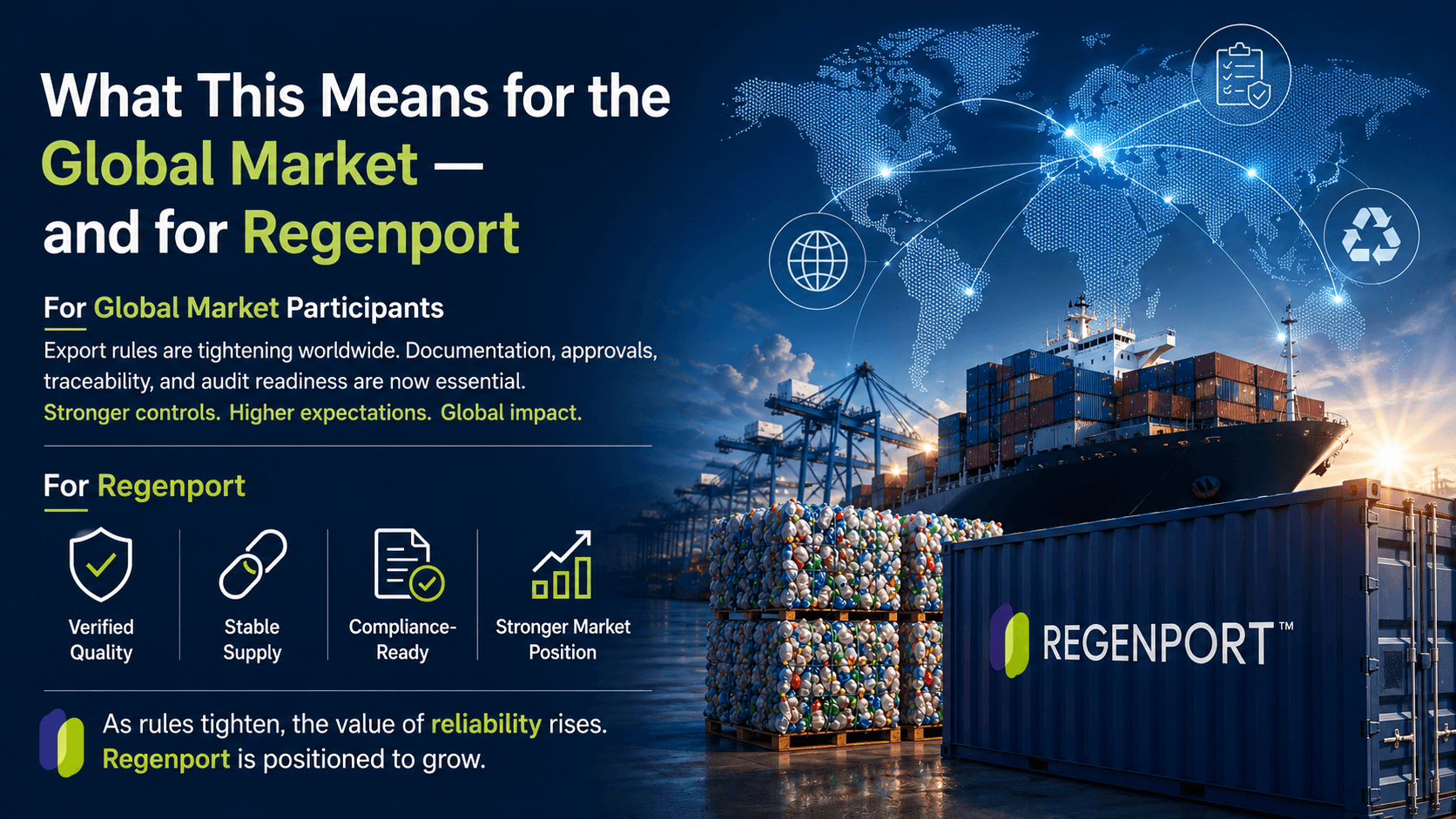
What This Means for the Global Market — and for Regenport
For global market participants, the impact is indirect but increasingly significant. While OECD countries are not subject to outright export bans, the requirements around documentation, approval procedures, audit readiness, and traceability are becoming more stringent across the board. As a result, companies involved in sourcing, importing, or distributing recycled feedstock will need stronger internal controls and more rigorous supplier verification processes. The shift is not limited to a single region — it reflects a broader move toward tighter oversight and higher expectations for transparency in the global recycled plastics trade.
For Regenport, this regulatory shift may create more opportunity than risk. As Europe's export rules tighten, the value of verified quality, stable supply, and compliance-ready recycled materials is likely to rise. The market is becoming more localized and more demanding, and companies with reliable supply chains may be better positioned to grow.
Image generated with ChatGPT
Source
EUROPEN, "Info Note on the Waste Shipment Regulation" → Read the Source
Europe's plastic waste export rules are changing, and this is more than a technical adjustment to shipping procedures. The EU's revised Waste Shipment Regulation is reshaping how plastic waste moves across borders, and that shift could have a real impact on the structure of Europe's PCR supply chain.
A Regulatory Shift, Not Just a Procedural Update
According to the European Commission, exports of plastic waste to non-OECD countries are being restricted, while shipment procedures are becoming more tightly controlled and increasingly digitalized.
This should not be seen as a simple administrative update. For years, part of Europe's plastic waste stream has moved beyond its borders for treatment or recycling. As the new rules tighten, a larger share of that material may remain inside the region, increasing the pressure on local sorting, recycling, and quality control capacity.
When Supply Stays Home, Competition for Quality Intensifies
That is where the PCR market comes in. If more recyclable material stays in Europe, competition for high-quality PCR feedstock is likely to intensify. In particular, materials with stable quality and clear traceability may become more valuable. In other words, the market may gradually shift from a volume-driven model to one that rewards reliability, compliance, and supply consistency.
Not a Full Ban — But the Bar Is Higher
At the same time, the new framework does not mean that all exports are blocked. Official EU materials indicate that some transactions may still be possible when the receiving facility can demonstrate environmentally sound treatment capacity and meet the required conditions. That means the regulation is stricter, but it still leaves room for verified operators with documented systems.
Compliance as a Competitive Advantage
From an operational perspective, this places greater responsibility on waste handlers, recyclers, and traders. Audit readiness, facility verification, recordkeeping, and traceability are no longer secondary concerns. They are becoming core requirements that can determine whether a transaction moves forward at all. As regulation becomes more complex, companies that can prove process integrity are likely to gain an advantage.
What This Means for the Global Market — and for Regenport
For global market participants, the impact is indirect but increasingly significant. While OECD countries are not subject to outright export bans, the requirements around documentation, approval procedures, audit readiness, and traceability are becoming more stringent across the board. As a result, companies involved in sourcing, importing, or distributing recycled feedstock will need stronger internal controls and more rigorous supplier verification processes. The shift is not limited to a single region — it reflects a broader move toward tighter oversight and higher expectations for transparency in the global recycled plastics trade.
For Regenport, this regulatory shift may create more opportunity than risk. As Europe's export rules tighten, the value of verified quality, stable supply, and compliance-ready recycled materials is likely to rise. The market is becoming more localized and more demanding, and companies with reliable supply chains may be better positioned to grow.
Image generated with ChatGPT
Source
EUROPEN, "Info Note on the Waste Shipment Regulation" → Read the Source
Sourcing Beyond Export Limits
Grades • Specs • Availability
Browse rLDPE →
Sourcing Beyond Export Limits
Sourcing Beyond Export Limits
Check rLDPE grades sourced outside the EU, by feedstock, MFI and density.
Check rLDPE grades sourced outside the EU, by feedstock, MFI and density.
Browse rLDPE →
Browse rLDPE →
Looking for samples or ready to source? Submit your request for pricing, availability, and technical information.
Looking for samples or ready to source? Submit your request for pricing, availability, and technical information.
Request a Quote →
Request a Quote →
Posted by REGENPORT
REGENPORT is a global platform connecting buyers and suppliers in the recycled materials and sustainable packaging industries.