CATEGORY
CATEGORY
Regulation
Regulation
Regulation
Mexico's Circular Economy Law Is in Force — Its Recycled-Content Rules Aren't Written Yet
Mexico's Circular Economy Law Is in Force — Its Recycled-Content Rules Aren't Written Yet
Mexico's Circular Economy Law Is in Force — Its Recycled-Content Rules Aren't Written Yet

Mexico's General Law of the Circular Economy has been in force since January 20, 2026. It names importers as obligated parties on equal footing with domestic manufacturers. But the implementing regulation due within 180 days is already three months overdue — and the sector-specific agreements that could set actual recycled-content percentages haven't been published for packaging either.
A law can be fully in force. And it can still tell a supplier almost nothing about what percentage of recycled material to use. That's Mexico's situation right now.
Mexico's General Law of the Circular Economy (Ley General de Economía Circular, or LGEC) has bound producers and importers since January 20, 2026. Two of its articles address recycled content directly. A third links it to circular design. But none of them sets an actual number.
The regulation meant to turn that principle into enforceable detail was due within 180 days. That deadline passed in mid-July — three months before this was written. The agreements that could set real targets for specific products have no fixed deadline at all. And none covering packaging has been published either.
Mexico published the LGEC in the Diario Oficial de la Federación (DOF) on January 19, 2026. The law took effect the next day, per its own transitory articles. This is not a draft under consultation. It is binding law, and has been for nine months.
What's missing is the secondary regulation, called the Reglamento. Transitorio Segundo requires the federal executive to issue it "within 180 natural days" of entry into force. That deadline fell around July 19, 2026. As of the most recent reporting available (late August 2026), the regulation was still described as "in the process of being drafted."

What the law actually requires today
Two provisions in the LGEC address recycled content directly. A third links the subject to circular design instead. This reading comes from the law's own text, hosted by Mexico's Chamber of Deputies — not from summaries of it. None of the three sets a number:
Article 4(B)(VII)(b) sets a general goal: products should incorporate recycled or recyclable materials.
Article 21, fracción XII, inciso e) requires the National Circular Economy Programme to set gradual implementation steps and targets for "the incorporation of recycled materials in products." This is an instruction for a future national program to follow — not a percentage the article itself fixes.
Article 36 doesn't mention recycled content at all. It requires productive sectors to develop Circular Design instead, tied to Extended Producer Responsibility — but only "where that is environmentally, technically, and economically viable" (cuando ello resulte ambiental, técnica y económicamente viable). It's a related obligation, not a third mention of recycled content.
None of these articles names a percentage, a resin, a packaging category, or a compliance date. The law sets the principle. Two other things were meant to supply the actual numbers: the regulation, and the sector-specific implementation agreements (AGIs) that Article 12 requires for each product category. Nine months in, neither exists in public form — not for packaging, and not for anything else.

Importers and domestic producers, treated the same — once the mechanism switches on
The law is specific about one thing: Extended Producer Responsibility. Article 3(XXV) defines "Producción" to cover both manufacturing and importing — one term for both.
But the mechanism matters more than the definition. Here's how it works:
Article 10 ties producer and importer obligations to "acuerdos generales de implementación de la REP" — AGIs, for short. These are sector- or product-specific agreements. SEMARNAT must publish each one in the DOF before the obligations it covers take concrete form.
Article 12 explains what happens once that publication happens. SEMARNAT publishes an AGI for a sector or product. Every producer and importer it names must then prepare a Gestión Circular — a circular management plan — and register it. The deadline for that registration is whatever the AGI itself sets.
Producers and importers are swept into the same AGI, the same filing requirement, and the same deadline. The law draws no distinction between them.
What hasn't happened yet is the trigger itself. No AGI covering plastic packaging has been published. So no packaging producer or importer has had to register a Gestión Circular under this law — not yet.

Two more duties — and how this compares to Brazil
Article 37 adds a separate, broader duty. Productive sectors and importers must organize, promote, and — where applicable — finance circular-economy schemes for what they place on the Mexican market. The law describes this as complementary to Mexico's existing shared-responsibility obligations under its general waste law (LGPGIR) — not a replacement for them.
Article 47 lets SEMARNAT set gradual, differentiated compliance timelines within an AGI, for each producer or importer. It pays particular attention to micro, small, and medium enterprises. This is a mechanism for phasing compliance in generally. It is not a separate, lighter track reserved for imports — nothing in the text gives imported goods an easier path than domestically made ones, once an AGI covers them.
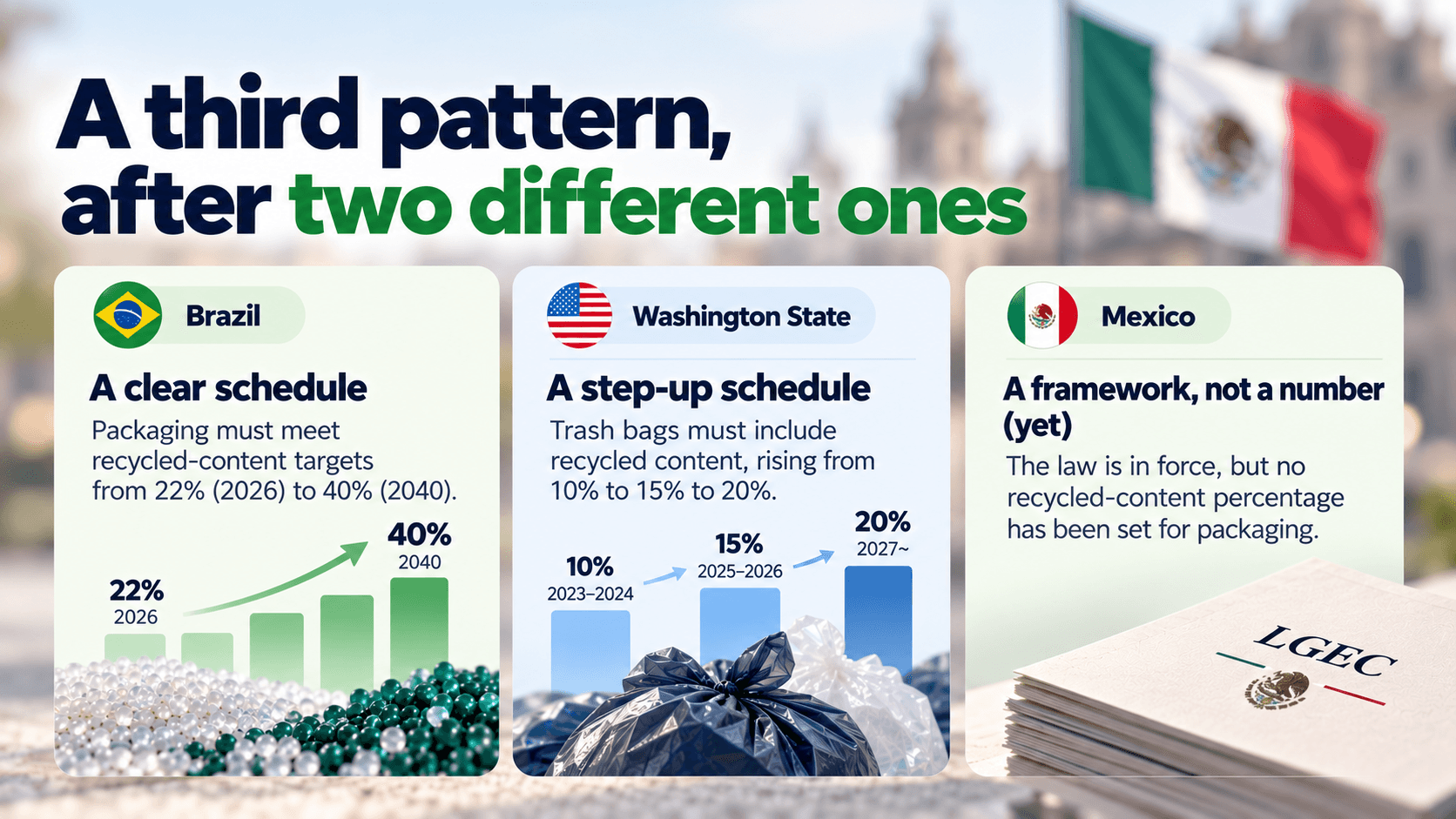
This puts Mexico in a similar position to Brazil's Decree 12,688/2025, covered here previously. Both name importers as obligated parties on equal footing with domestic producers, within their own compliance mechanisms. The difference: Brazil's decree pairs that obligation with a schedule already running — 22% in 2026, rising to 40% by 2040. Mexico pairs it with a mechanism that, for packaging, hasn't been switched on yet. And with a regulation that was supposed to arrive first, and hasn't.
A third pattern, after two different ones
The recycled-content stories covered on this blog so far have mostly asked one of two questions. "How high, and by when" — that's Brazil's climbing packaging floor, and Washington State's trash-bag schedule. Or "what gets reported, not required" — that's Canada's federal plastics registry.
Mexico is a third pattern. It's a framework law already in force. Its own promised timeline for turning principle into percentage has already slipped by several months, with no publicly confirmed new date. And its EPR mechanism names importers and producers as equal parties — before that mechanism has even been switched on for packaging.
For a supplier, the absence of a number isn't the same as the absence of exposure. Mexican civil-society groups, including Greenpeace, publicly raised concerns in August 2026 about what the draft regulation does and doesn't cover. That's evidence the regulation is being actively worked on, not shelved.
When the regulation lands, its recycled-content thresholds and certification requirements will apply within a Gestión Circular framework. That framework already treats importers and domestic producers identically. It switches on for packaging the moment SEMARNAT publishes the relevant AGI. Documentation built now doesn't need to wait for either one to exist.

What this means for a supplier of recycled polyolefin resin
Regenport lists GRS-certified recycled HDPE, LDPE, and PP to buyers across the Americas and beyond. For a marketplace like this, Mexico is a case where the regulatory signal arrives before the regulatory detail.
A buyer manufacturing in Mexico, or importing finished packaging into it, won't face a live Gestión Circular filing deadline yet. That deadline only starts once SEMARNAT publishes an AGI covering their sector or product — and no packaging-specific AGI has been published as of this writing.
But the law already fixes what happens next: once that AGI exists, importers and domestic producers get swept in on identical terms. No lighter path for imports.
What a supplier can't yet do is point to a specific percentage or resin-level standard, the way Brazil's decree allows. In the meantime, a Mexican buyer is more likely to ask a supplier for:
Documented recycled-content share and feedstock traceability — at the level of detail a future Gestión Circular filing would need, even before a specific minimum is codified or an AGI is published
Chain-of-custody certification (GRS, RCS, or equivalent) that would satisfy whatever verification standard the eventual Reglamento or a packaging-specific AGI adopts. Building this documentation now is easier than retrofitting it later.
Confirmation of whether a given resin or packaging category is likely to fall under an early sector-specific AGI. Tires are commonly cited as an example of the kind of product an early agreement could cover — but no packaging-specific agreement or recycled-content threshold has been published yet.
Regenport lists GRS-certified recycled PP grades with feedstock and processing documentation buyers can review ahead of specific regulatory thresholds being set.

Frequently Asked Questions
Is Mexico's General Law of the Circular Economy already in effect, or still a proposal? It's already in effect. It was published in the Diario Oficial de la Federación on January 19, 2026. It took effect the next day, January 20, 2026.
Does the law set a specific recycled-content percentage for packaging? No. Two provisions address recycled-material incorporation directly. A third links it to Circular Design. None of them sets a percentage, resin, or deadline. Those specifics were delegated to an implementing regulation (Reglamento) — not yet published — and potentially to sector-specific implementation agreements (AGIs). None covering packaging has been published either.
When was that regulation supposed to be issued, and has it been? The law gave the federal executive 180 natural days from entry into force — a deadline around July 19, 2026. As of the most recent available reporting (late August 2026), it still hadn't been published. It was described as still being drafted.
Does the law apply differently to importers than to domestic manufacturers? No. The law treats producers and importers alike. Once SEMARNAT publishes a sector- or product-specific REP implementation agreement (AGI), both must prepare and register a Gestión Circular — within the deadline that agreement sets. The only phase-in difference the text allows is gradual compliance timelines, with particular attention to micro, small, and medium enterprises. There's no separate or lighter track for imports.
About this guide
This is current as of October 2026. It's based on direct review of the LGEC's published text, plus law-firm and press reporting on its implementation status — for general information only, not legal advice. Mexico's implementing regulation hadn't been published at the time of writing. No sector-specific implementation agreement (AGI) covering packaging had been published either. Specific compliance thresholds should be confirmed directly against SEMARNAT's published Reglamento and the applicable AGI, once they're issued.
Image generated with ChatGPT
Sources
Cámara de Diputados (Mexico's Chamber of Deputies, official government hosting), Ley General de Economía Circular — full text, cover page confirming DOF publication date, Transitorios Primero and Segundo → Read the Source (archived copy if the government site is slow or unreachable)
Hogan Lovells (HLC), "México expide Ley de Economía Circular: Responsabilidad Extendida del Productor y Diseño" — entry-into-force date, EPR and Diseño Circular obligations → Read the Source
Basham, Ringe y Correa, "Economía circular: entrada en vigor" — 180-day regulation deadline, local-legislation alignment period → Read the Source
Expansión Política, "Reglamento de economía circular, bajo la lupa por riesgo de contaminación" (August 30, 2026) — confirmation the regulation remained unpublished and in drafting as of late August 2026, civil-society concerns → Read the Source
A law can be fully in force. And it can still tell a supplier almost nothing about what percentage of recycled material to use. That's Mexico's situation right now.
Mexico's General Law of the Circular Economy (Ley General de Economía Circular, or LGEC) has bound producers and importers since January 20, 2026. Two of its articles address recycled content directly. A third links it to circular design. But none of them sets an actual number.
The regulation meant to turn that principle into enforceable detail was due within 180 days. That deadline passed in mid-July — three months before this was written. The agreements that could set real targets for specific products have no fixed deadline at all. And none covering packaging has been published either.
Mexico published the LGEC in the Diario Oficial de la Federación (DOF) on January 19, 2026. The law took effect the next day, per its own transitory articles. This is not a draft under consultation. It is binding law, and has been for nine months.
What's missing is the secondary regulation, called the Reglamento. Transitorio Segundo requires the federal executive to issue it "within 180 natural days" of entry into force. That deadline fell around July 19, 2026. As of the most recent reporting available (late August 2026), the regulation was still described as "in the process of being drafted."
What the law actually requires today
Two provisions in the LGEC address recycled content directly. A third links the subject to circular design instead. This reading comes from the law's own text, hosted by Mexico's Chamber of Deputies — not from summaries of it. None of the three sets a number:
Article 4(B)(VII)(b) sets a general goal: products should incorporate recycled or recyclable materials.
Article 21, fracción XII, inciso e) requires the National Circular Economy Programme to set gradual implementation steps and targets for "the incorporation of recycled materials in products." This is an instruction for a future national program to follow — not a percentage the article itself fixes.
Article 36 doesn't mention recycled content at all. It requires productive sectors to develop Circular Design instead, tied to Extended Producer Responsibility — but only "where that is environmentally, technically, and economically viable" (cuando ello resulte ambiental, técnica y económicamente viable). It's a related obligation, not a third mention of recycled content.
None of these articles names a percentage, a resin, a packaging category, or a compliance date. The law sets the principle. Two other things were meant to supply the actual numbers: the regulation, and the sector-specific implementation agreements (AGIs) that Article 12 requires for each product category. Nine months in, neither exists in public form — not for packaging, and not for anything else.
Importers and domestic producers, treated the same — once the mechanism switches on
The law is specific about one thing: Extended Producer Responsibility. Article 3(XXV) defines "Producción" to cover both manufacturing and importing — one term for both.
But the mechanism matters more than the definition. Here's how it works:
Article 10 ties producer and importer obligations to "acuerdos generales de implementación de la REP" — AGIs, for short. These are sector- or product-specific agreements. SEMARNAT must publish each one in the DOF before the obligations it covers take concrete form.
Article 12 explains what happens once that publication happens. SEMARNAT publishes an AGI for a sector or product. Every producer and importer it names must then prepare a Gestión Circular — a circular management plan — and register it. The deadline for that registration is whatever the AGI itself sets.
Producers and importers are swept into the same AGI, the same filing requirement, and the same deadline. The law draws no distinction between them.
What hasn't happened yet is the trigger itself. No AGI covering plastic packaging has been published. So no packaging producer or importer has had to register a Gestión Circular under this law — not yet.
Two more duties — and how this compares to Brazil
Article 37 adds a separate, broader duty. Productive sectors and importers must organize, promote, and — where applicable — finance circular-economy schemes for what they place on the Mexican market. The law describes this as complementary to Mexico's existing shared-responsibility obligations under its general waste law (LGPGIR) — not a replacement for them.
Article 47 lets SEMARNAT set gradual, differentiated compliance timelines within an AGI, for each producer or importer. It pays particular attention to micro, small, and medium enterprises. This is a mechanism for phasing compliance in generally. It is not a separate, lighter track reserved for imports — nothing in the text gives imported goods an easier path than domestically made ones, once an AGI covers them.
This puts Mexico in a similar position to Brazil's Decree 12,688/2025, covered here previously. Both name importers as obligated parties on equal footing with domestic producers, within their own compliance mechanisms. The difference: Brazil's decree pairs that obligation with a schedule already running — 22% in 2026, rising to 40% by 2040. Mexico pairs it with a mechanism that, for packaging, hasn't been switched on yet. And with a regulation that was supposed to arrive first, and hasn't.
A third pattern, after two different ones
The recycled-content stories covered on this blog so far have mostly asked one of two questions. "How high, and by when" — that's Brazil's climbing packaging floor, and Washington State's trash-bag schedule. Or "what gets reported, not required" — that's Canada's federal plastics registry.
Mexico is a third pattern. It's a framework law already in force. Its own promised timeline for turning principle into percentage has already slipped by several months, with no publicly confirmed new date. And its EPR mechanism names importers and producers as equal parties — before that mechanism has even been switched on for packaging.
For a supplier, the absence of a number isn't the same as the absence of exposure. Mexican civil-society groups, including Greenpeace, publicly raised concerns in August 2026 about what the draft regulation does and doesn't cover. That's evidence the regulation is being actively worked on, not shelved.
When the regulation lands, its recycled-content thresholds and certification requirements will apply within a Gestión Circular framework. That framework already treats importers and domestic producers identically. It switches on for packaging the moment SEMARNAT publishes the relevant AGI. Documentation built now doesn't need to wait for either one to exist.
What this means for a supplier of recycled polyolefin resin
Regenport lists GRS-certified recycled HDPE, LDPE, and PP to buyers across the Americas and beyond. For a marketplace like this, Mexico is a case where the regulatory signal arrives before the regulatory detail.
A buyer manufacturing in Mexico, or importing finished packaging into it, won't face a live Gestión Circular filing deadline yet. That deadline only starts once SEMARNAT publishes an AGI covering their sector or product — and no packaging-specific AGI has been published as of this writing.
But the law already fixes what happens next: once that AGI exists, importers and domestic producers get swept in on identical terms. No lighter path for imports.
What a supplier can't yet do is point to a specific percentage or resin-level standard, the way Brazil's decree allows. In the meantime, a Mexican buyer is more likely to ask a supplier for:
Documented recycled-content share and feedstock traceability — at the level of detail a future Gestión Circular filing would need, even before a specific minimum is codified or an AGI is published
Chain-of-custody certification (GRS, RCS, or equivalent) that would satisfy whatever verification standard the eventual Reglamento or a packaging-specific AGI adopts. Building this documentation now is easier than retrofitting it later.
Confirmation of whether a given resin or packaging category is likely to fall under an early sector-specific AGI. Tires are commonly cited as an example of the kind of product an early agreement could cover — but no packaging-specific agreement or recycled-content threshold has been published yet.
Regenport lists GRS-certified recycled PP grades with feedstock and processing documentation buyers can review ahead of specific regulatory thresholds being set.
Frequently Asked Questions
Is Mexico's General Law of the Circular Economy already in effect, or still a proposal? It's already in effect. It was published in the Diario Oficial de la Federación on January 19, 2026. It took effect the next day, January 20, 2026.
Does the law set a specific recycled-content percentage for packaging? No. Two provisions address recycled-material incorporation directly. A third links it to Circular Design. None of them sets a percentage, resin, or deadline. Those specifics were delegated to an implementing regulation (Reglamento) — not yet published — and potentially to sector-specific implementation agreements (AGIs). None covering packaging has been published either.
When was that regulation supposed to be issued, and has it been? The law gave the federal executive 180 natural days from entry into force — a deadline around July 19, 2026. As of the most recent available reporting (late August 2026), it still hadn't been published. It was described as still being drafted.
Does the law apply differently to importers than to domestic manufacturers? No. The law treats producers and importers alike. Once SEMARNAT publishes a sector- or product-specific REP implementation agreement (AGI), both must prepare and register a Gestión Circular — within the deadline that agreement sets. The only phase-in difference the text allows is gradual compliance timelines, with particular attention to micro, small, and medium enterprises. There's no separate or lighter track for imports.
About this guide
This is current as of October 2026. It's based on direct review of the LGEC's published text, plus law-firm and press reporting on its implementation status — for general information only, not legal advice. Mexico's implementing regulation hadn't been published at the time of writing. No sector-specific implementation agreement (AGI) covering packaging had been published either. Specific compliance thresholds should be confirmed directly against SEMARNAT's published Reglamento and the applicable AGI, once they're issued.
Image generated with ChatGPT
Sources
Cámara de Diputados (Mexico's Chamber of Deputies, official government hosting), Ley General de Economía Circular — full text, cover page confirming DOF publication date, Transitorios Primero and Segundo → Read the Source (archived copy if the government site is slow or unreachable)
Hogan Lovells (HLC), "México expide Ley de Economía Circular: Responsabilidad Extendida del Productor y Diseño" — entry-into-force date, EPR and Diseño Circular obligations → Read the Source
Basham, Ringe y Correa, "Economía circular: entrada en vigor" — 180-day regulation deadline, local-legislation alignment period → Read the Source
Expansión Política, "Reglamento de economía circular, bajo la lupa por riesgo de contaminación" (August 30, 2026) — confirmation the regulation remained unpublished and in drafting as of late August 2026, civil-society concerns → Read the Source
Explore Related Materials
Grades • Specs • Availability
Browse rPP →
Explore Related Materials
Explore Related Materials
GRS-certified rPP grades with feedstock and processing documentation for review.
GRS-certified rPP grades with feedstock and processing documentation for review.
Browse rPP →
Browse rPP →
Looking for samples or ready to source? Submit your request for pricing, availability, and technical information.
Looking for samples or ready to source? Submit your request for pricing, availability, and technical information.
Request a Quote →
Request a Quote →
Posted by REGENPORT
REGENPORT is a global platform connecting buyers and suppliers in the recycled materials and sustainable packaging industries.