CATEGORY
CATEGORY
News
News
News
Plastic Waste Trade Is Regionalizing in 2026: What the OECD Line Changes
Plastic Waste Trade Is Regionalizing in 2026: What the OECD Line Changes
Plastic Waste Trade Is Regionalizing in 2026: What the OECD Line Changes
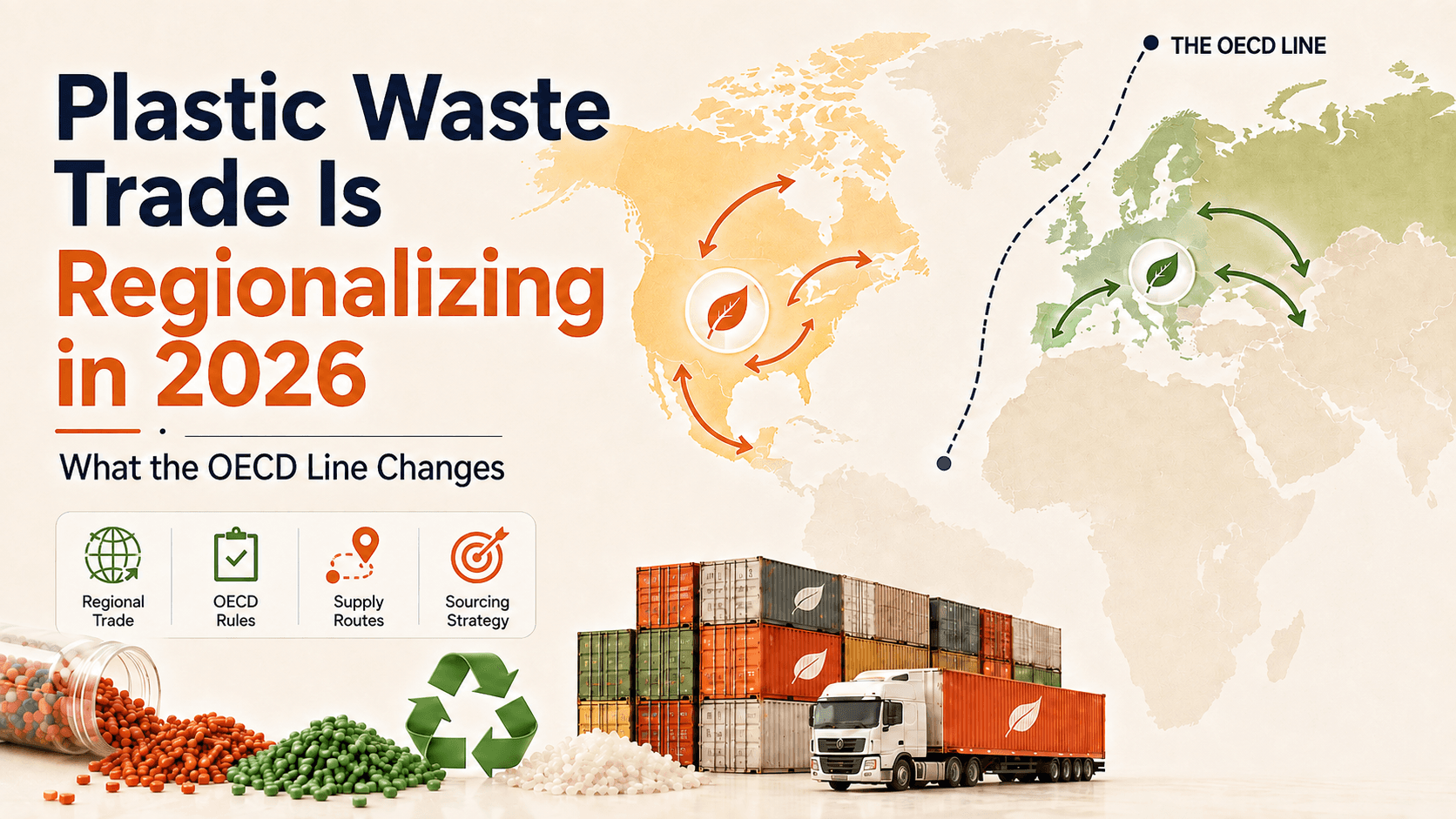
Trade rules rarely make a story on their own. But two sets of numbers published this year — one out of Brussels, one out of Washington — point the same way: the distance recycled plastic feedstock travels is getting shorter, and the line that will decide much of it is dated November 21, 2026.
The EU Waste Shipment Rules Set Four Dates for Plastic Waste Exports
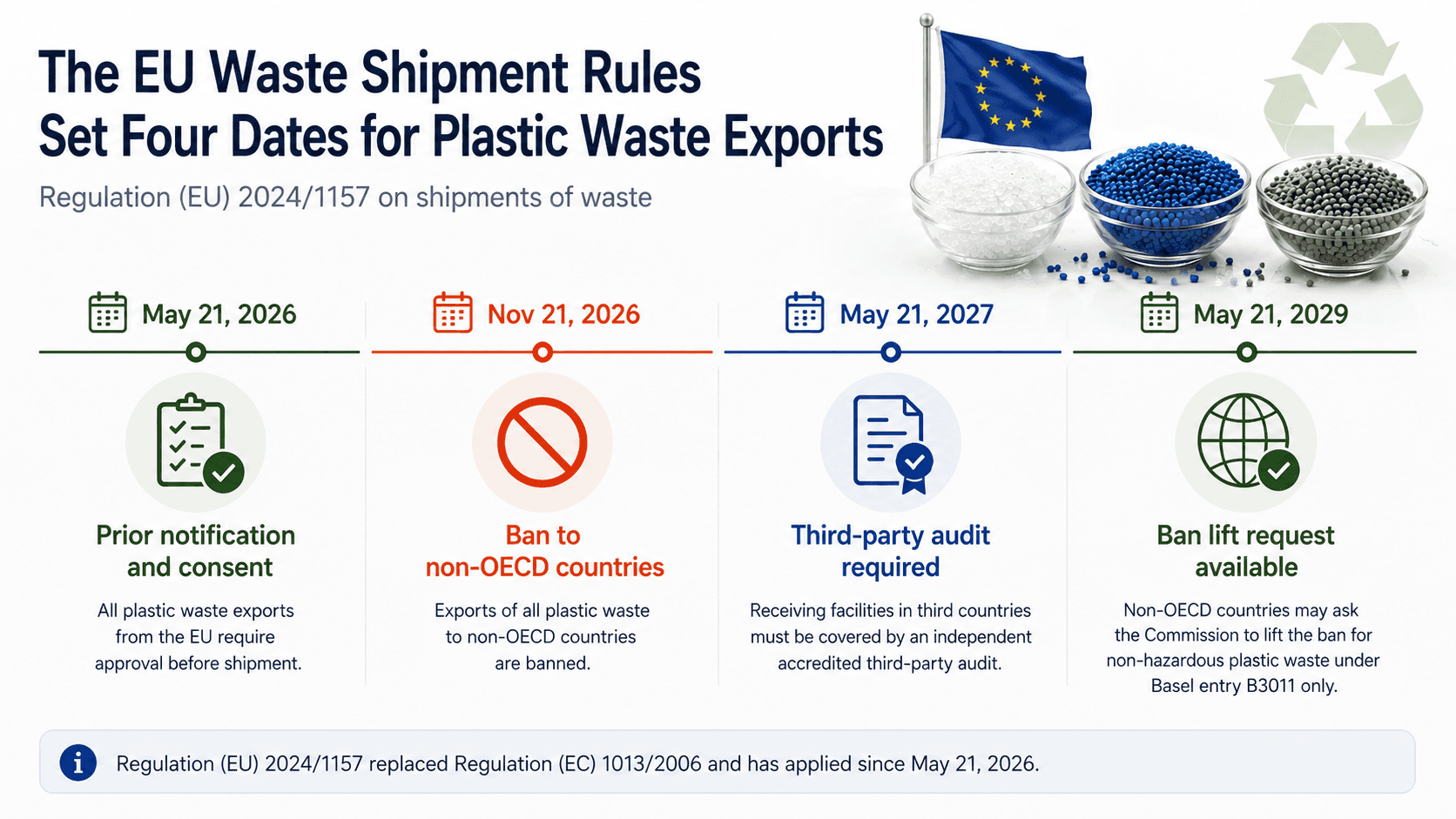
Regulation (EU) 2024/1157 on shipments of waste — adopted April 11, 2024 and published at OJ L, 2024/1157 — replaced Regulation (EC) 1013/2006 and has applied since May 21, 2026. Per the European Commission, the schedule for plastic waste runs in four steps. Since May 21, 2026, all plastic waste exports from the EU are subject to the prior notification and consent procedure, meaning a shipment needs approval before it moves. From November 21, 2026, exports of all plastic waste to non-OECD countries are banned. From May 21, 2027, exporters must be able to show that receiving facilities in third countries manage the waste in an environmentally sound manner, evidenced by an independent accredited third-party audit. And from May 21, 2029, a non-OECD country may ask the Commission to lift the ban for its own imports, for non-hazardous plastic waste under Basel entry B3011 only.
US Recyclable Plastics Trade Data Points the Same Way
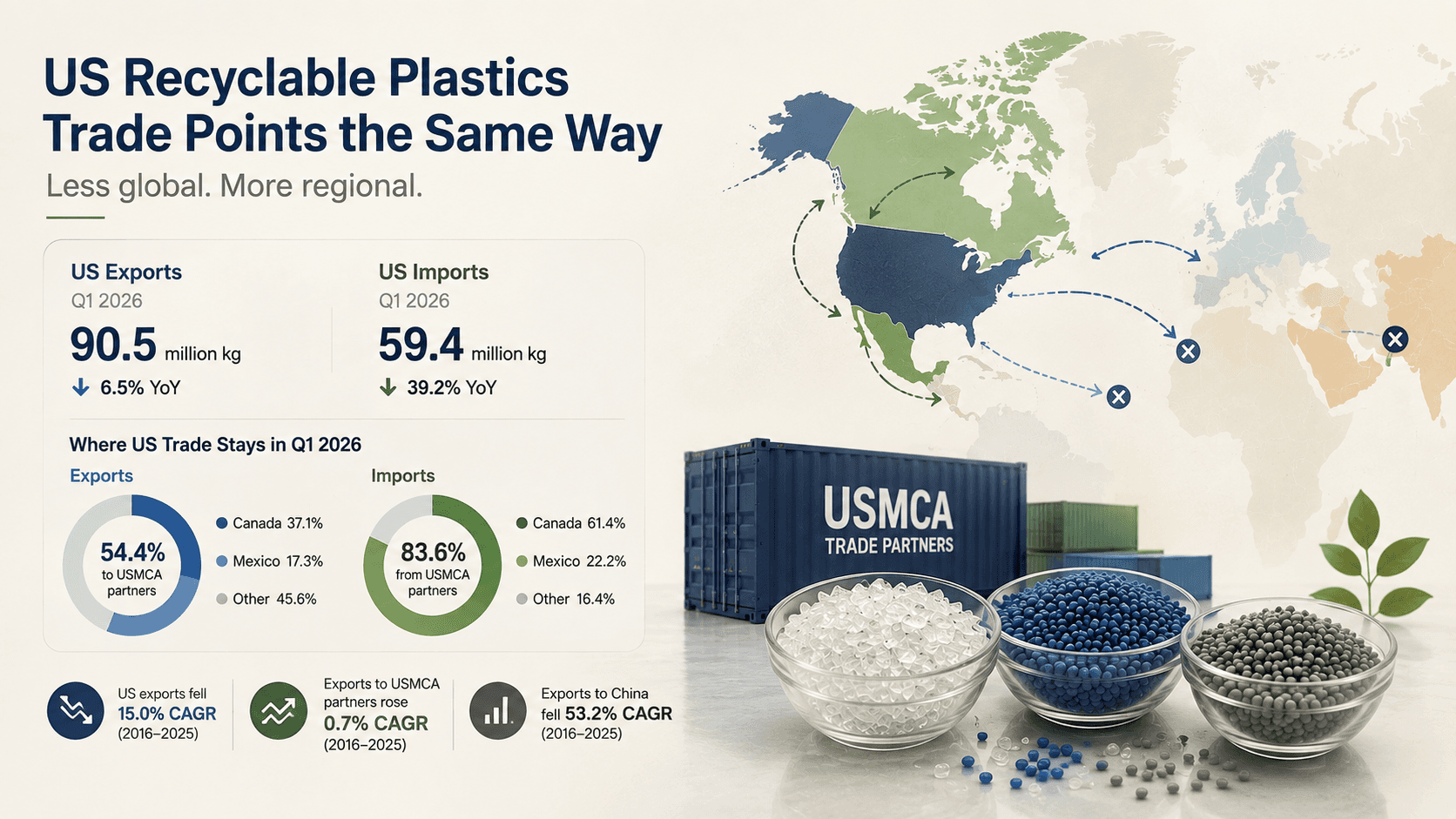
The United States numbers were not produced by policy, and they moved the same way. Per PlasticsToday's June 2, 2026 report on the Plastics Industry Association's economic analysis, first-quarter 2026 US exports of recyclable plastics materials were 90.5 million kilograms, down 7.7 percent from the previous quarter and 6.5 percent year on year, while US imports of recyclable plastics materials were 59.4 million kilograms, up 3.5 percent quarter on quarter but down 39.2 percent year on year. Over the longer run, US exports fell at a 15.0 percent compound annual growth rate between 2016 and 2025, while exports to USMCA partners rose at a 0.7 percent CAGR over the same period. In the first quarter of 2026, Canada took 37.1 percent and Mexico 17.3 percent of US exports — 54.4 percent combined — and the same two countries supplied 61.4 percent and 22.2 percent of US imports, or 83.6 percent together. Exports to China declined at a 53.2 percent CAGR from 2016 to 2025, with Q1 2026 imports from China at 1.3 million kilograms.
The EU figure set is a compliance timetable. The US figure set is the residue of demand: domestic recycled-content commitments pulling material into domestic processing, on top of the export channels that closed after China's 2018 import restrictions. Different mechanisms, same outcome — a shorter trade radius, with a large share of what still crosses a border staying inside a regional bloc.
It is worth being precise about what these numbers do not say. Neither dataset indicates that less plastic is being recycled. They describe where the material is processed, not how much of it there is. For a buyer, that distinction is the whole point: supply is not disappearing, it is relocating, and a sourcing map drawn three years ago may now be pointing at channels that are closed or about to be.
The Line Is OECD Membership, Not Distance
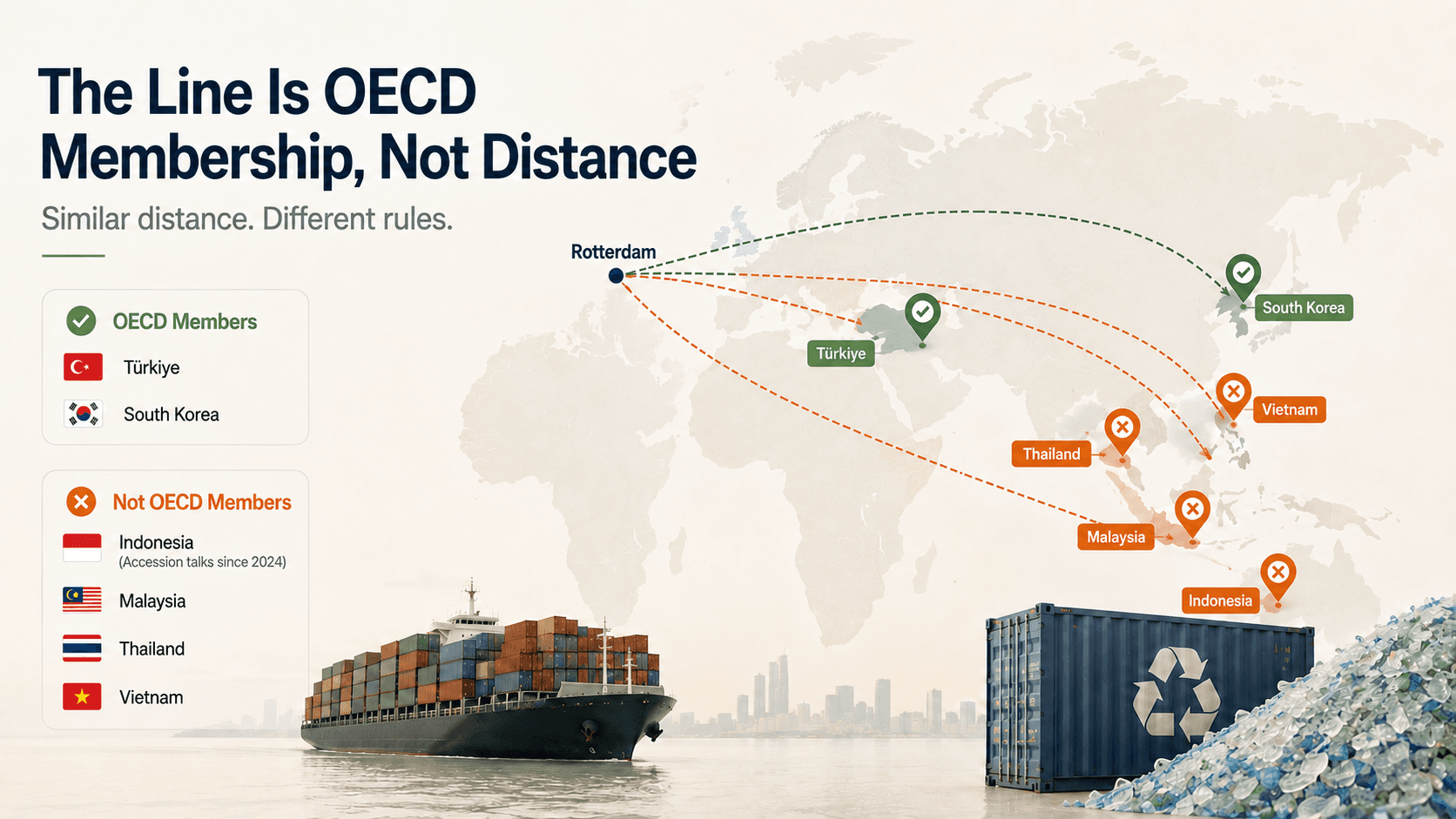
After November 21, 2026, the first question about any EU plastic waste export destination is a membership question. Türkiye is an OECD member. Indonesia opened OECD accession talks in 2024 and is not yet a member; Malaysia, Thailand and Vietnam are not members either. South Korea is a member. Two destinations a similar distance from Rotterdam can therefore end up on opposite sides of the same rule, and a route that has run for years can close on a date rather than on a price.
What volume actually redirects, and where, is an empirical question that the next few quarters of trade data will answer rather than something that can be read off the regulation. The direction of the constraint, though, is already fixed by the calendar.
What Sourcing Desks Should Confirm Before November 21
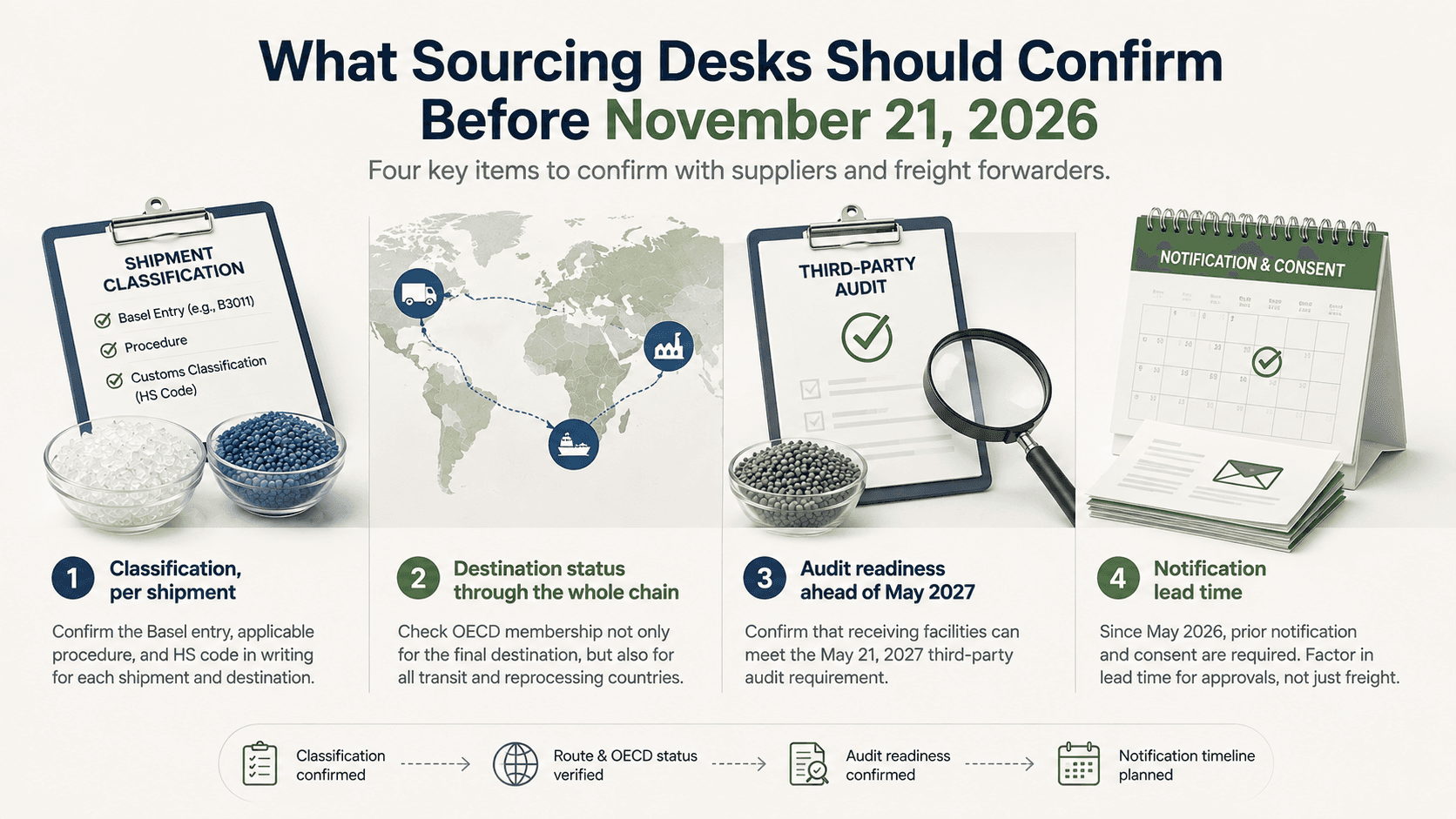
Four items are worth raising with suppliers and freight forwarders before the November date rather than after it.
Classification, per shipment. The Regulation governs shipments of waste, so whether a given consignment falls inside it turns on how that consignment is classified. Ask for three things in writing per shipment and per destination: the waste entry the material is being moved under, such as Basel entry B3011 for non-hazardous plastic waste; which procedure therefore applies to that shipment; and, separately, the customs classification — an HS code is a customs determination and does not settle the waste classification. A material's status on a previous route should not be assumed to carry over.
Destination status through the whole chain. OECD membership needs checking not only for the final destination but for any country where the material is transited or reprocessed on the way.
Audit readiness ahead of May 2027. The third-party audit requirement for receiving facilities is dated May 21, 2027, which makes it a question to put to facilities now, while alternatives can still be qualified.
Notification lead time. Since May 2026 plastic waste exports run through prior notification and consent, so the timing question is no longer freight alone — it is how long notification and consent take before a shipment can move. That sits on the schedule rather than the price, and contracts written on pre-2026 lead times may need revisiting — the same documentation pressure we covered in our August 12 post on the Tracking Plastic Act, arriving here through logistics instead of labeling.
Market Takeaway
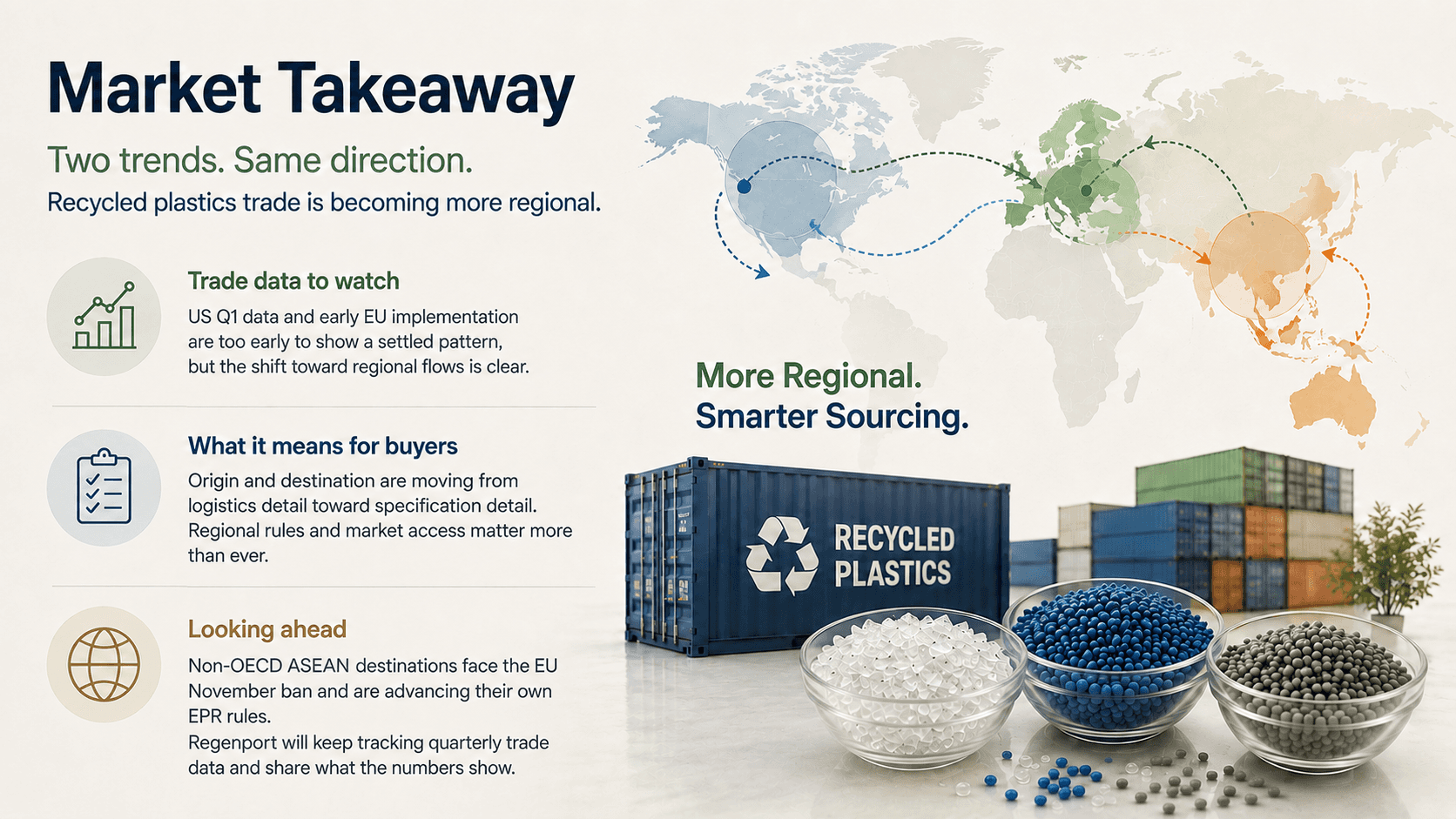
As of August 2026, the trade data available covers the first quarter for the US and the first weeks of the new procedure for the EU, which is too early to describe a settled pattern. What is already visible is that two of the largest sources of internationally traded recycled plastic feedstock are becoming more regional, for unrelated reasons, at the same time.
For procurement teams, the practical consequence is that origin and destination are moving from logistics detail toward specification detail. Several of the ASEAN destinations affected by the November ban are also the markets building out their own producer-responsibility rules, which we covered in our August 25 post on ASEAN EPR harmonization — the same countries appear in both stories from opposite ends. Regenport will keep tracking the quarterly trade data as it is published and share what the numbers show.
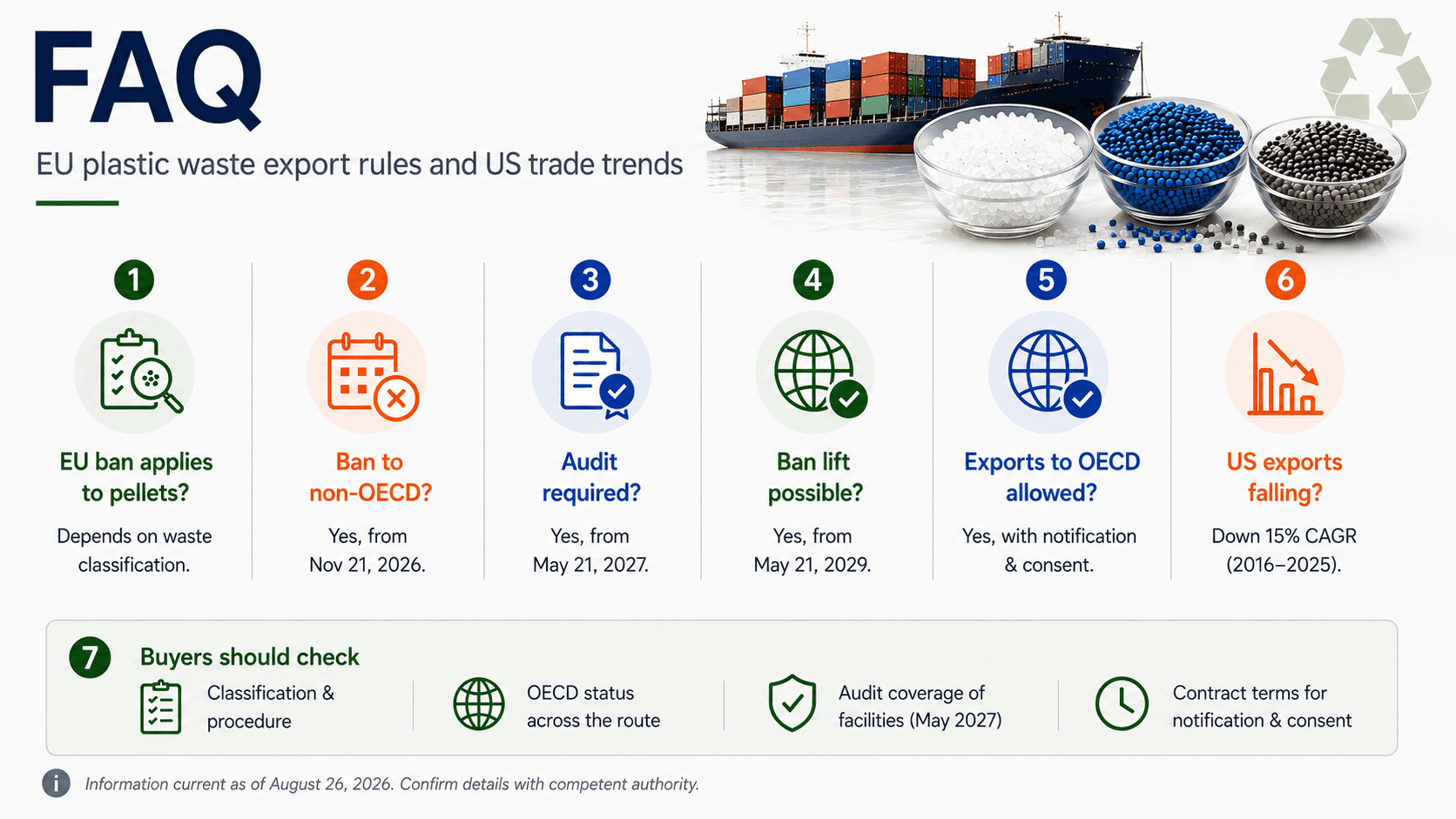
Frequently Asked Questions
Does the EU export ban apply to recycled plastic pellets? It depends on classification, not on physical form. The Regulation governs shipments of waste, so the question for any specific consignment is whether that consignment is classified as waste under EU law — a pellet or flake shipment classified as waste is inside the Regulation, and one classified as a product is not directly subject to it. Confirm in writing, per shipment and per destination, the waste entry being used and the procedure that applies. The customs HS code is a separate determination and does not answer this question.
When does the EU ban plastic waste exports to non-OECD countries? November 21, 2026. Per the European Commission, exports of all plastic waste from the EU to non-OECD countries are banned from that date. From May 21, 2029, a non-OECD country may ask the Commission to lift the ban for its own imports, for non-hazardous plastic waste under Basel entry B3011 only.
What changed on May 21, 2026 for EU plastic waste exports? All plastic waste exports from the EU became subject to the prior notification and consent procedure, meaning a shipment requires approval from the countries of dispatch, destination and transit before it can move.
Are exports to OECD countries such as Türkiye or South Korea still allowed after November 2026? The November 21, 2026 ban is specific to non-OECD destinations. Exports to OECD member countries remain subject to the notification and consent procedure, and from May 21, 2027 to the requirement that receiving facilities be covered by an independent accredited third-party audit. Individual shipments should be confirmed against the applicable procedure rather than assumed.
Is Indonesia an OECD member? No. Indonesia adopted a roadmap for OECD accession in 2024 and is a candidate country rather than a member, which places it on the banned side of the November 21, 2026 rule as it stands.
How much are US recyclable plastics exports falling? Per PlasticsToday's report on the Plastics Industry Association's analysis, US exports of recyclable plastics materials declined at a 15.0 percent compound annual growth rate between 2016 and 2025, and first-quarter 2026 exports of 90.5 million kilograms were down 6.5 percent year on year.
What should buyers check before November 21, 2026? The classification and procedure applying to each shipment, the OECD membership status of every destination and transit or reprocessing country in the chain, whether receiving facilities can meet the May 2027 audit requirement, and whether existing contracts allow for notification and consent lead times.
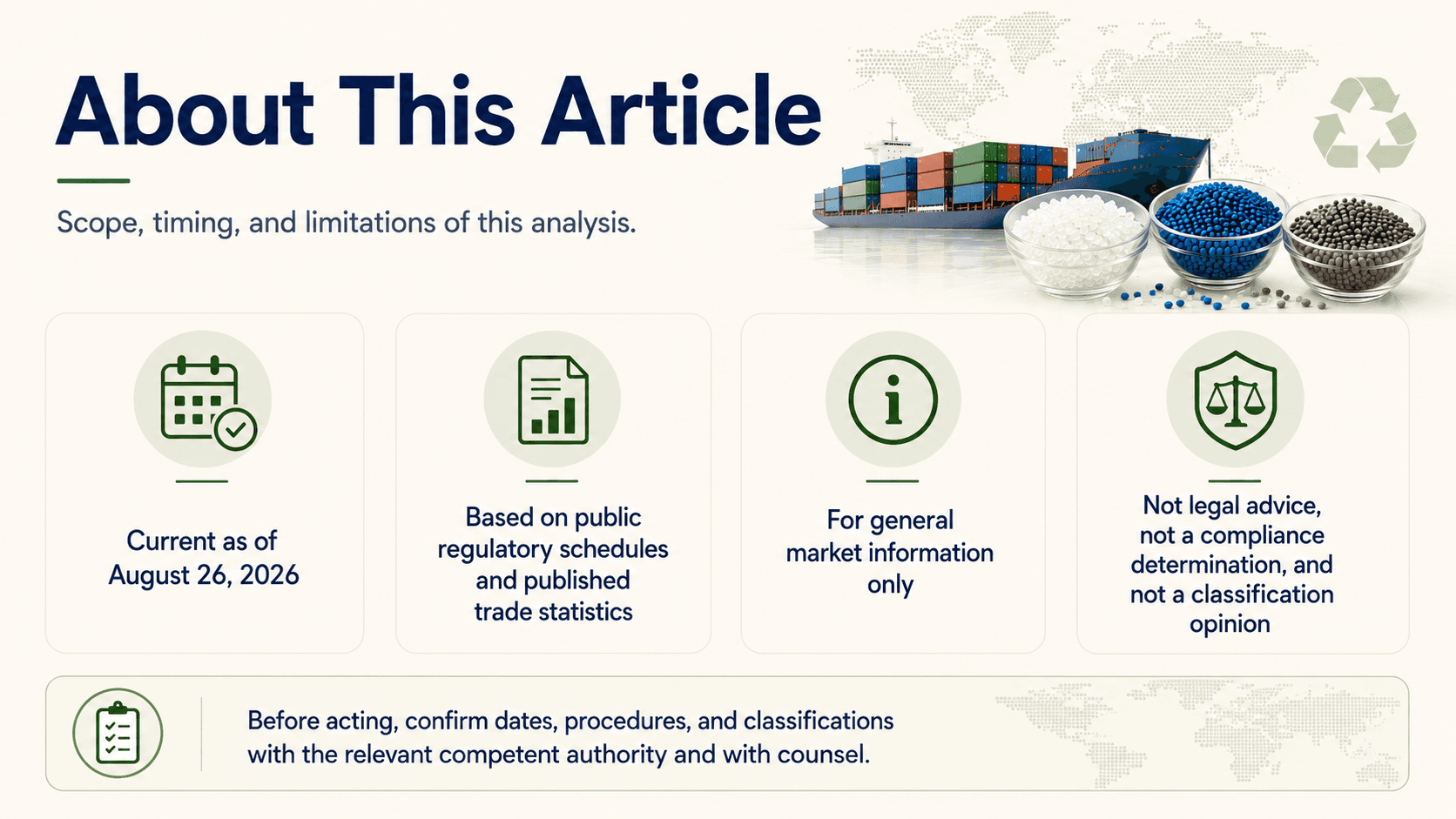
About This Article
Information current as of August 26, 2026. This article summarizes publicly available regulatory schedules and published trade statistics for general market information. It is not legal advice, and it is not a compliance determination for any specific shipment or a classification opinion for any specific material. Regulatory dates, procedures and classifications should be confirmed with the relevant competent authority and with counsel before acting.
Image generated with ChatGPT
Sources
European Commission, "Plastic waste shipments" → Read the Source
David Hutton, PlasticsToday, "US recyclable plastics trade shifts as domestic recycling expands" → Read the Source
The EU Waste Shipment Rules Set Four Dates for Plastic Waste Exports
Regulation (EU) 2024/1157 on shipments of waste — adopted April 11, 2024 and published at OJ L, 2024/1157 — replaced Regulation (EC) 1013/2006 and has applied since May 21, 2026. Per the European Commission, the schedule for plastic waste runs in four steps. Since May 21, 2026, all plastic waste exports from the EU are subject to the prior notification and consent procedure, meaning a shipment needs approval before it moves. From November 21, 2026, exports of all plastic waste to non-OECD countries are banned. From May 21, 2027, exporters must be able to show that receiving facilities in third countries manage the waste in an environmentally sound manner, evidenced by an independent accredited third-party audit. And from May 21, 2029, a non-OECD country may ask the Commission to lift the ban for its own imports, for non-hazardous plastic waste under Basel entry B3011 only.
US Recyclable Plastics Trade Data Points the Same Way
The United States numbers were not produced by policy, and they moved the same way. Per PlasticsToday's June 2, 2026 report on the Plastics Industry Association's economic analysis, first-quarter 2026 US exports of recyclable plastics materials were 90.5 million kilograms, down 7.7 percent from the previous quarter and 6.5 percent year on year, while US imports of recyclable plastics materials were 59.4 million kilograms, up 3.5 percent quarter on quarter but down 39.2 percent year on year. Over the longer run, US exports fell at a 15.0 percent compound annual growth rate between 2016 and 2025, while exports to USMCA partners rose at a 0.7 percent CAGR over the same period. In the first quarter of 2026, Canada took 37.1 percent and Mexico 17.3 percent of US exports — 54.4 percent combined — and the same two countries supplied 61.4 percent and 22.2 percent of US imports, or 83.6 percent together. Exports to China declined at a 53.2 percent CAGR from 2016 to 2025, with Q1 2026 imports from China at 1.3 million kilograms.
The EU figure set is a compliance timetable. The US figure set is the residue of demand: domestic recycled-content commitments pulling material into domestic processing, on top of the export channels that closed after China's 2018 import restrictions. Different mechanisms, same outcome — a shorter trade radius, with a large share of what still crosses a border staying inside a regional bloc.
It is worth being precise about what these numbers do not say. Neither dataset indicates that less plastic is being recycled. They describe where the material is processed, not how much of it there is. For a buyer, that distinction is the whole point: supply is not disappearing, it is relocating, and a sourcing map drawn three years ago may now be pointing at channels that are closed or about to be.
The Line Is OECD Membership, Not Distance
After November 21, 2026, the first question about any EU plastic waste export destination is a membership question. Türkiye is an OECD member. Indonesia opened OECD accession talks in 2024 and is not yet a member; Malaysia, Thailand and Vietnam are not members either. South Korea is a member. Two destinations a similar distance from Rotterdam can therefore end up on opposite sides of the same rule, and a route that has run for years can close on a date rather than on a price.
What volume actually redirects, and where, is an empirical question that the next few quarters of trade data will answer rather than something that can be read off the regulation. The direction of the constraint, though, is already fixed by the calendar.
What Sourcing Desks Should Confirm Before November 21
Four items are worth raising with suppliers and freight forwarders before the November date rather than after it.
Classification, per shipment. The Regulation governs shipments of waste, so whether a given consignment falls inside it turns on how that consignment is classified. Ask for three things in writing per shipment and per destination: the waste entry the material is being moved under, such as Basel entry B3011 for non-hazardous plastic waste; which procedure therefore applies to that shipment; and, separately, the customs classification — an HS code is a customs determination and does not settle the waste classification. A material's status on a previous route should not be assumed to carry over.
Destination status through the whole chain. OECD membership needs checking not only for the final destination but for any country where the material is transited or reprocessed on the way.
Audit readiness ahead of May 2027. The third-party audit requirement for receiving facilities is dated May 21, 2027, which makes it a question to put to facilities now, while alternatives can still be qualified.
Notification lead time. Since May 2026 plastic waste exports run through prior notification and consent, so the timing question is no longer freight alone — it is how long notification and consent take before a shipment can move. That sits on the schedule rather than the price, and contracts written on pre-2026 lead times may need revisiting — the same documentation pressure we covered in our August 12 post on the Tracking Plastic Act, arriving here through logistics instead of labeling.
Market Takeaway
As of August 2026, the trade data available covers the first quarter for the US and the first weeks of the new procedure for the EU, which is too early to describe a settled pattern. What is already visible is that two of the largest sources of internationally traded recycled plastic feedstock are becoming more regional, for unrelated reasons, at the same time.
For procurement teams, the practical consequence is that origin and destination are moving from logistics detail toward specification detail. Several of the ASEAN destinations affected by the November ban are also the markets building out their own producer-responsibility rules, which we covered in our August 25 post on ASEAN EPR harmonization — the same countries appear in both stories from opposite ends. Regenport will keep tracking the quarterly trade data as it is published and share what the numbers show.
Frequently Asked Questions
Does the EU export ban apply to recycled plastic pellets? It depends on classification, not on physical form. The Regulation governs shipments of waste, so the question for any specific consignment is whether that consignment is classified as waste under EU law — a pellet or flake shipment classified as waste is inside the Regulation, and one classified as a product is not directly subject to it. Confirm in writing, per shipment and per destination, the waste entry being used and the procedure that applies. The customs HS code is a separate determination and does not answer this question.
When does the EU ban plastic waste exports to non-OECD countries? November 21, 2026. Per the European Commission, exports of all plastic waste from the EU to non-OECD countries are banned from that date. From May 21, 2029, a non-OECD country may ask the Commission to lift the ban for its own imports, for non-hazardous plastic waste under Basel entry B3011 only.
What changed on May 21, 2026 for EU plastic waste exports? All plastic waste exports from the EU became subject to the prior notification and consent procedure, meaning a shipment requires approval from the countries of dispatch, destination and transit before it can move.
Are exports to OECD countries such as Türkiye or South Korea still allowed after November 2026? The November 21, 2026 ban is specific to non-OECD destinations. Exports to OECD member countries remain subject to the notification and consent procedure, and from May 21, 2027 to the requirement that receiving facilities be covered by an independent accredited third-party audit. Individual shipments should be confirmed against the applicable procedure rather than assumed.
Is Indonesia an OECD member? No. Indonesia adopted a roadmap for OECD accession in 2024 and is a candidate country rather than a member, which places it on the banned side of the November 21, 2026 rule as it stands.
How much are US recyclable plastics exports falling? Per PlasticsToday's report on the Plastics Industry Association's analysis, US exports of recyclable plastics materials declined at a 15.0 percent compound annual growth rate between 2016 and 2025, and first-quarter 2026 exports of 90.5 million kilograms were down 6.5 percent year on year.
What should buyers check before November 21, 2026? The classification and procedure applying to each shipment, the OECD membership status of every destination and transit or reprocessing country in the chain, whether receiving facilities can meet the May 2027 audit requirement, and whether existing contracts allow for notification and consent lead times.
About This Article
Information current as of August 26, 2026. This article summarizes publicly available regulatory schedules and published trade statistics for general market information. It is not legal advice, and it is not a compliance determination for any specific shipment or a classification opinion for any specific material. Regulatory dates, procedures and classifications should be confirmed with the relevant competent authority and with counsel before acting.
Image generated with ChatGPT
Sources
European Commission, "Plastic waste shipments" → Read the Source
David Hutton, PlasticsToday, "US recyclable plastics trade shifts as domestic recycling expands" → Read the Source
Sourcing Across Trade Routes
Grades • Specs • Availability
Browse rLDPE →
Sourcing Across Trade Routes
Sourcing Across Trade Routes
Review Korea-origin rLDPE grades by feedstock, MFI, application and MOQ.
Review Korea-origin rLDPE grades by feedstock, MFI, application and MOQ.
Browse rLDPE →
Browse rLDPE →
Looking for samples or ready to source? Submit your request for pricing, availability, and technical information.
Looking for samples or ready to source? Submit your request for pricing, availability, and technical information.
Request a Quote →
Request a Quote →
Posted by REGENPORT
REGENPORT is a global platform connecting buyers and suppliers in the recycled materials and sustainable packaging industries.