CATEGORY
CATEGORY
Regulation
Regulation
Regulation
China's Recycled Plastics Standards in 2026: What They Do and Don't Prove to an EU Buyer
China's Recycled Plastics Standards in 2026: What They Do and Don't Prove to an EU Buyer
China's Recycled Plastics Standards in 2026: What They Do and Don't Prove to an EU Buyer
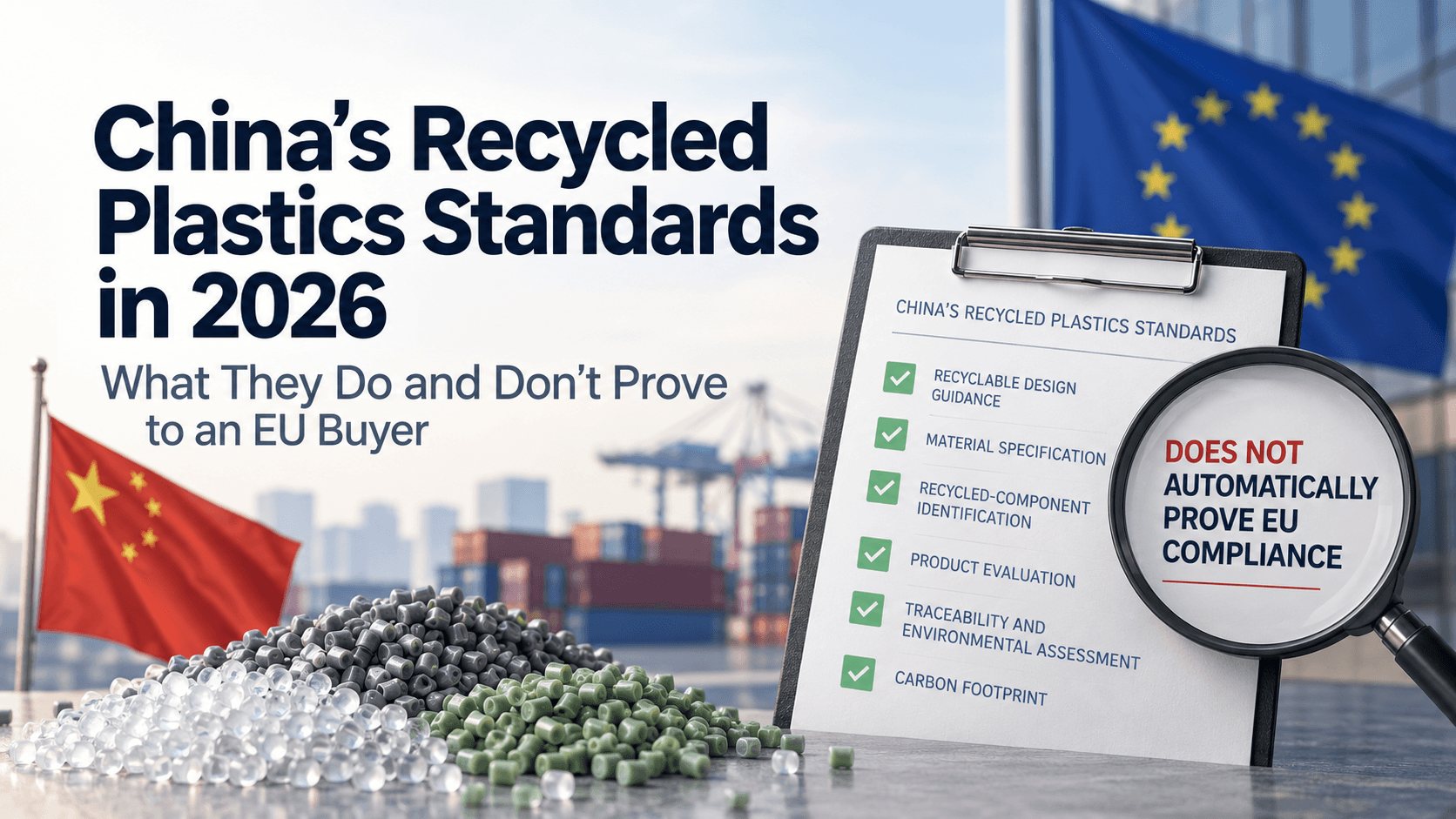
Most recycled-plastics regulation we cover asks what a buyer must prove. China has spent the last few years on the other side of that question: how a supplier describes what it is selling. The result is a set of national standards for recycled plastic. They are worth knowing — and worth not over-reading, because none of them is a route to EU compliance.
Since 2021 China has been building out national standards for recycled plastics. The most recent batch — nine standards issued on 1 August 2025 — took effect on 1 February 2026. Two others matter alongside them: a restricted-substances standard in force since 1 June 2025, and a carbon-footprint method for mechanically recycled plastic products in force since 1 May 2026.
Together they cover ground EU buyers have started asking about: what is in the material, whether recycled content can be identified, where it came from, and what its carbon footprint is. That overlap is why they are worth reading. The limits of that overlap are why they should not be oversold.
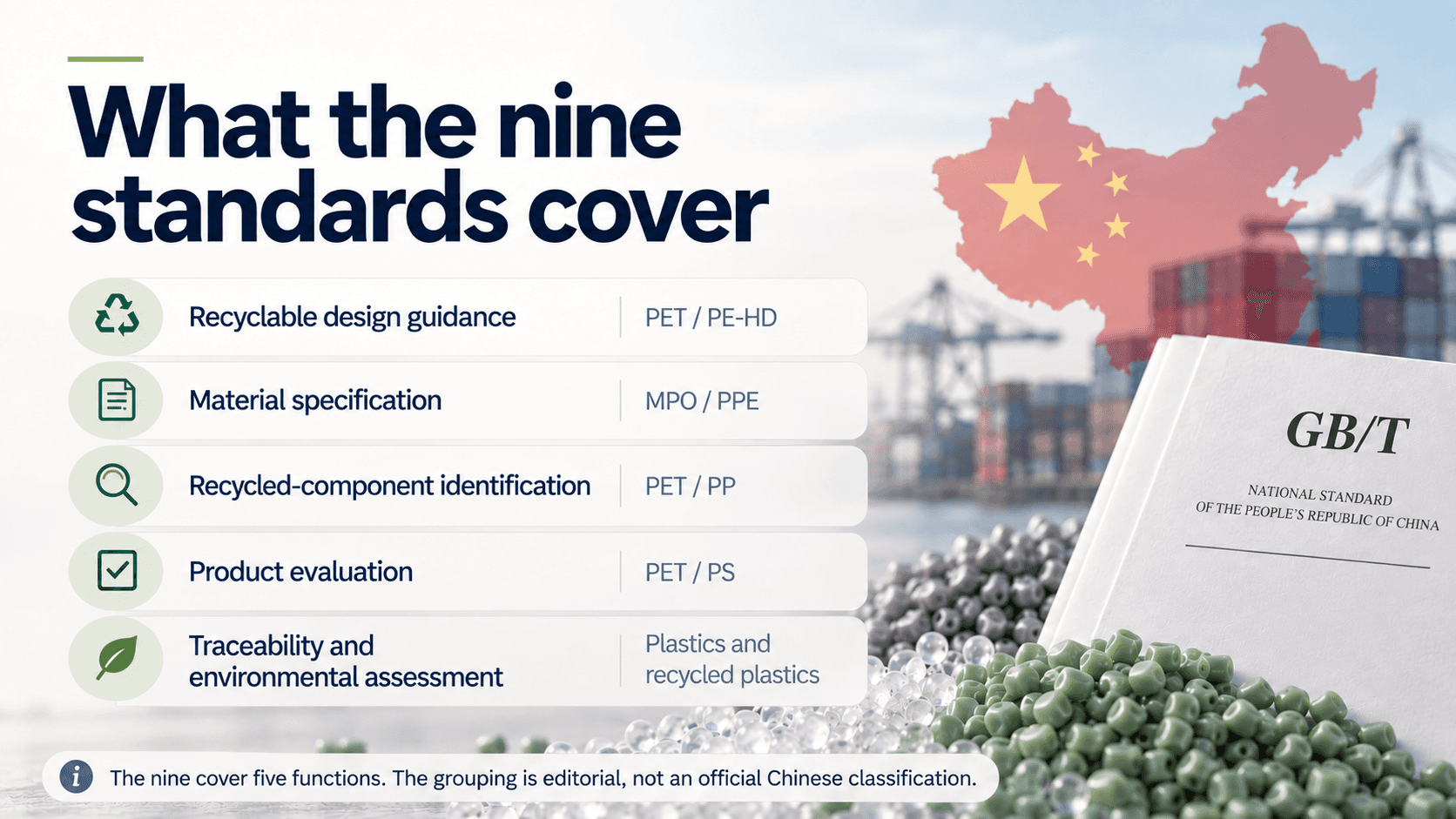
What the nine standards cover
Function | Standard | Material |
|---|---|---|
Recyclable design guidance | GB/T 46020.1 / 46020.2-2025 | PET / PE-HD |
Material specification | GB/T 40006.4 / 40006.13-2025 | Mixed polyolefin (MPO) / PPE |
Recycled-component identification | GB/T 46019.1 / 46019.2-2025 | PET / PP |
Product evaluation | GB/T 46018.1 / 46018.2-2025 | PET / PS |
Traceability and environmental assessment | GB/T 46043-2025 | Plastics and recycled plastics |
This table lists the nine-standard package, not every Chinese recycled-plastics standard.
Two of these extend an older series. GB/T 40006 has specified recycled polyethylene and polypropylene since 2021; the 2025 additions brought in mixed polyolefin and PPE. The series now runs to thirteen parts, with PPE, PBT and PMMA parts all taking effect during 2026.
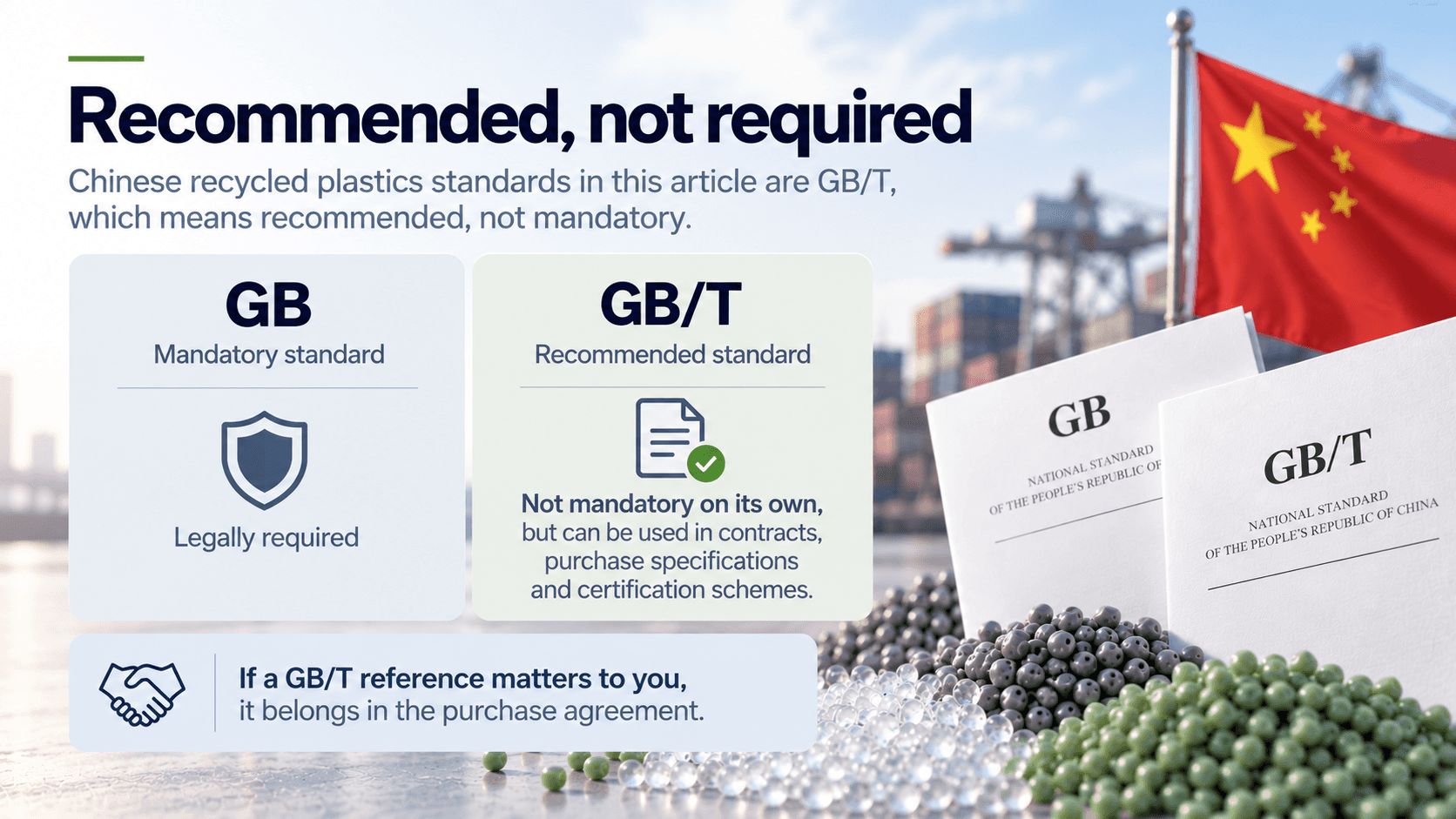
Recommended, not required
This is the distinction most easily lost in translation, and it changes what a supplier's claim is worth.
Chinese national standards come in two forms. GB means mandatory. GB/T means recommended. Every standard in this article is GB/T.
So the GB/T designation does not, by itself, make testing a statutory market-access requirement, and a grade that does not conform is not automatically unlawful for that reason alone. That does not make these standards empty. A recommended standard can become contractually or commercially relevant when it is written into a contract, a purchase specification, or a certification scheme.
The practical consequence for a buyer: if a GB/T reference matters to you, it belongs in the purchase agreement. Otherwise "meets GB/T 40006.4" is a claim you can test, not a status you can assume.
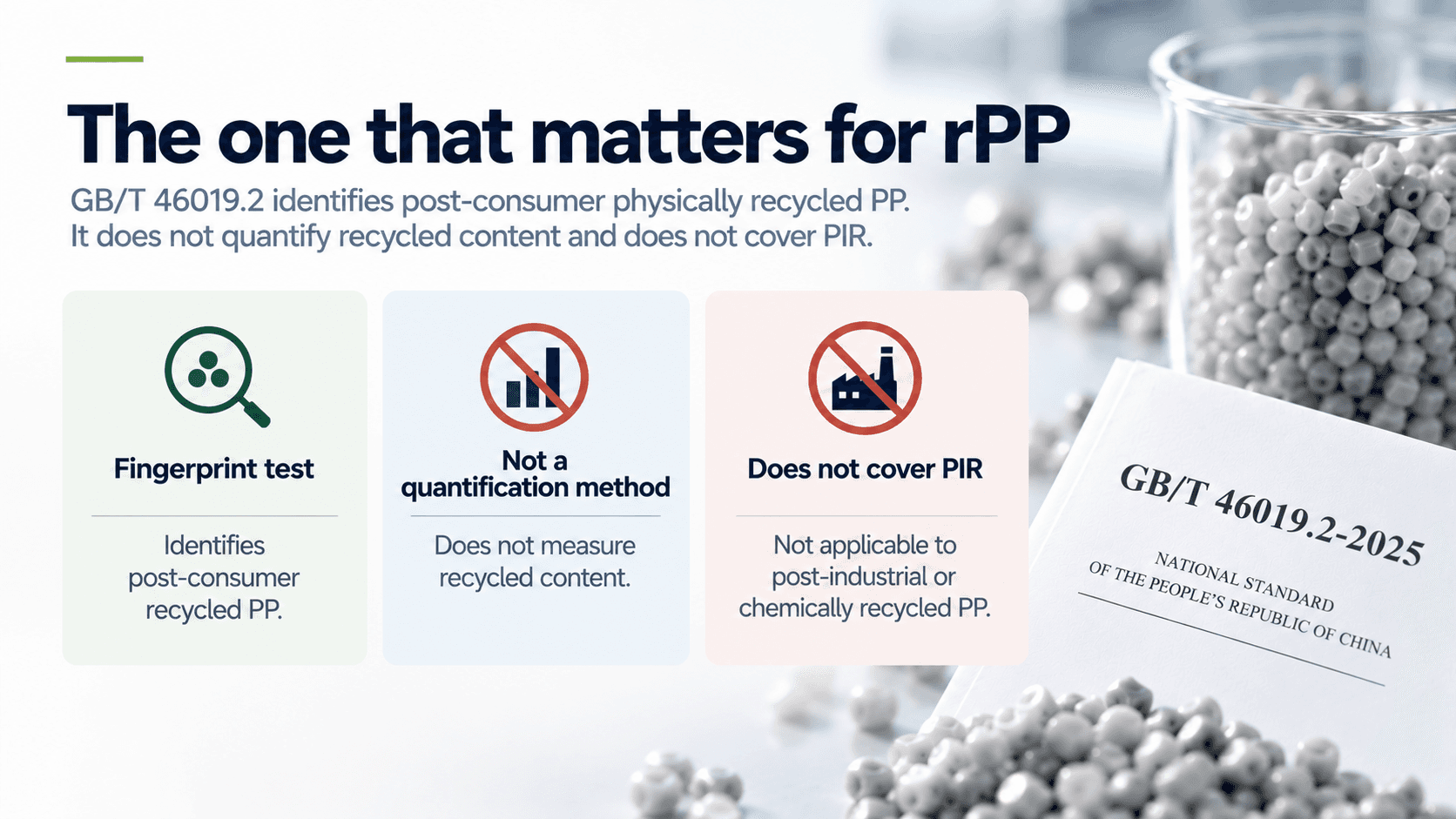
The one that matters for rPP
GB/T 46019.2 is the most useful of the nine for a polyolefin buyer, and also the one most likely to be overstated.
Its standard project record describes a laboratory method: headspace gas chromatography–mass spectrometry, measuring volatile compounds in a sample and matching the result against a database and a machine-learning model. In other words, a fingerprint test.
Two things follow.
It identifies, it does not quantify. The method is designed to identify whether a material fits the profile of post-consumer physically recycled PP that the method describes. It is not a method for quantifying the mass percentage of recycled material in a product or blend, and it should not be treated as a mass-balance or recycled-content certification.
It does not cover PIR. The stated scope is post-consumer PP recycled by crushing, washing and pelletizing. The record says the method does not apply to PP recycled from post-industrial plastic, and does not apply to chemically recycled PP. Other recycled plastics may refer to the method, but that is a reference permission, not an extension of scope.
If you buy both streams, this is the line to remember: GB/T 46019.2 cannot substantiate a PIR rPP grade, because the method's stated scope excludes PP recycled from post-industrial plastic. Substantiation for a PIR grade has to come from somewhere else.
What about polyethylene?
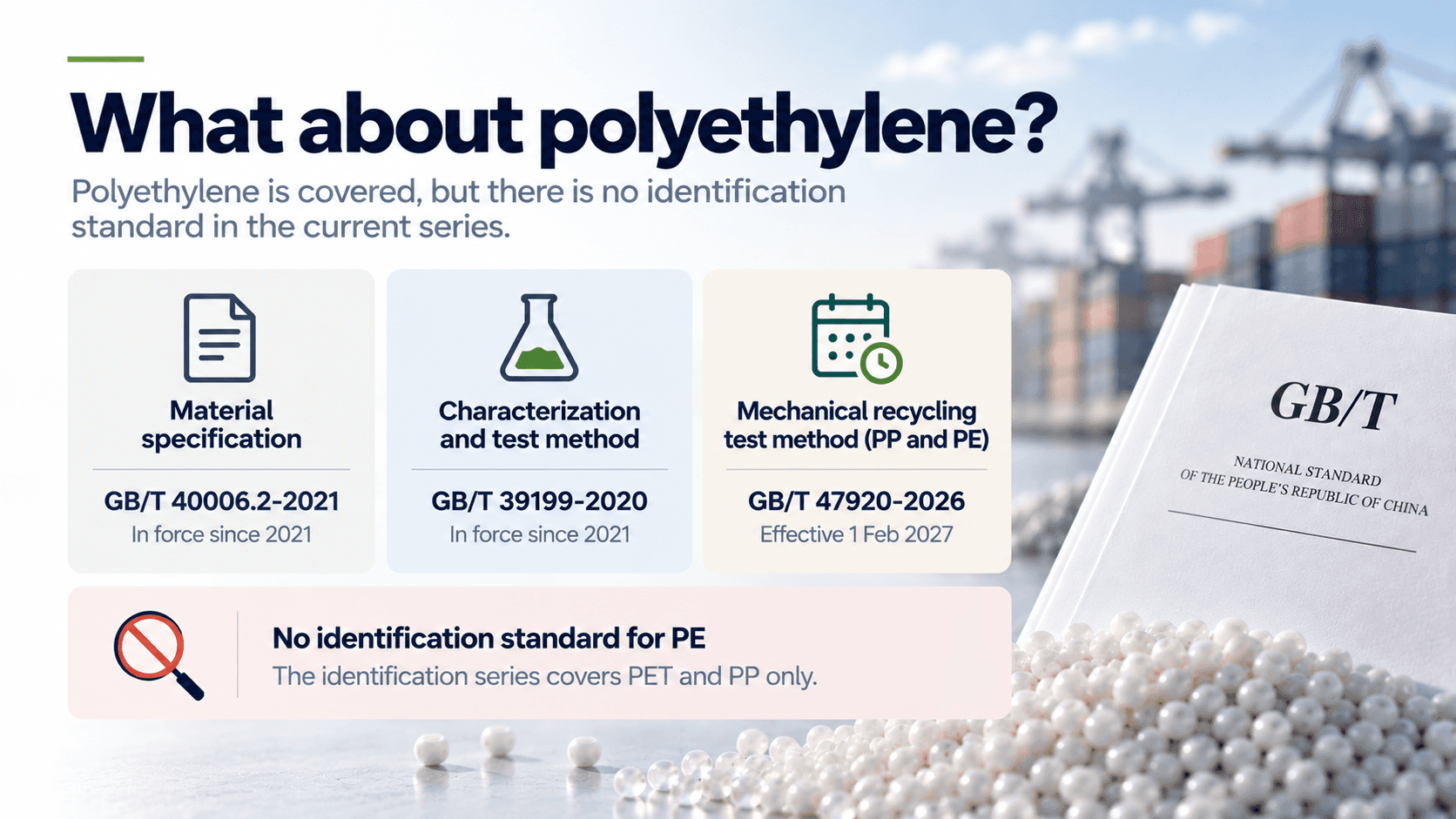
Polyethylene is not left out, though it is easy to read the 2025 package that way.
It has a material specification, GB/T 40006.2-2021, and a characterization and test-method standard, GB/T 39199-2020, in force since 2021. A further standard covering testing of mechanically recycled PP and PE, GB/T 47920-2026, takes effect on 1 February 2027.
What the records reviewed for this article do not show is a polyethylene part in the identification series — the series that applies a defined method to identify recycled components. That series has parts for PET and PP only. So for an rHDPE, rLDPE or rLLDPE grade, recycled-content substantiation still rests on whatever procedure the supplier documents.
Why this matters now
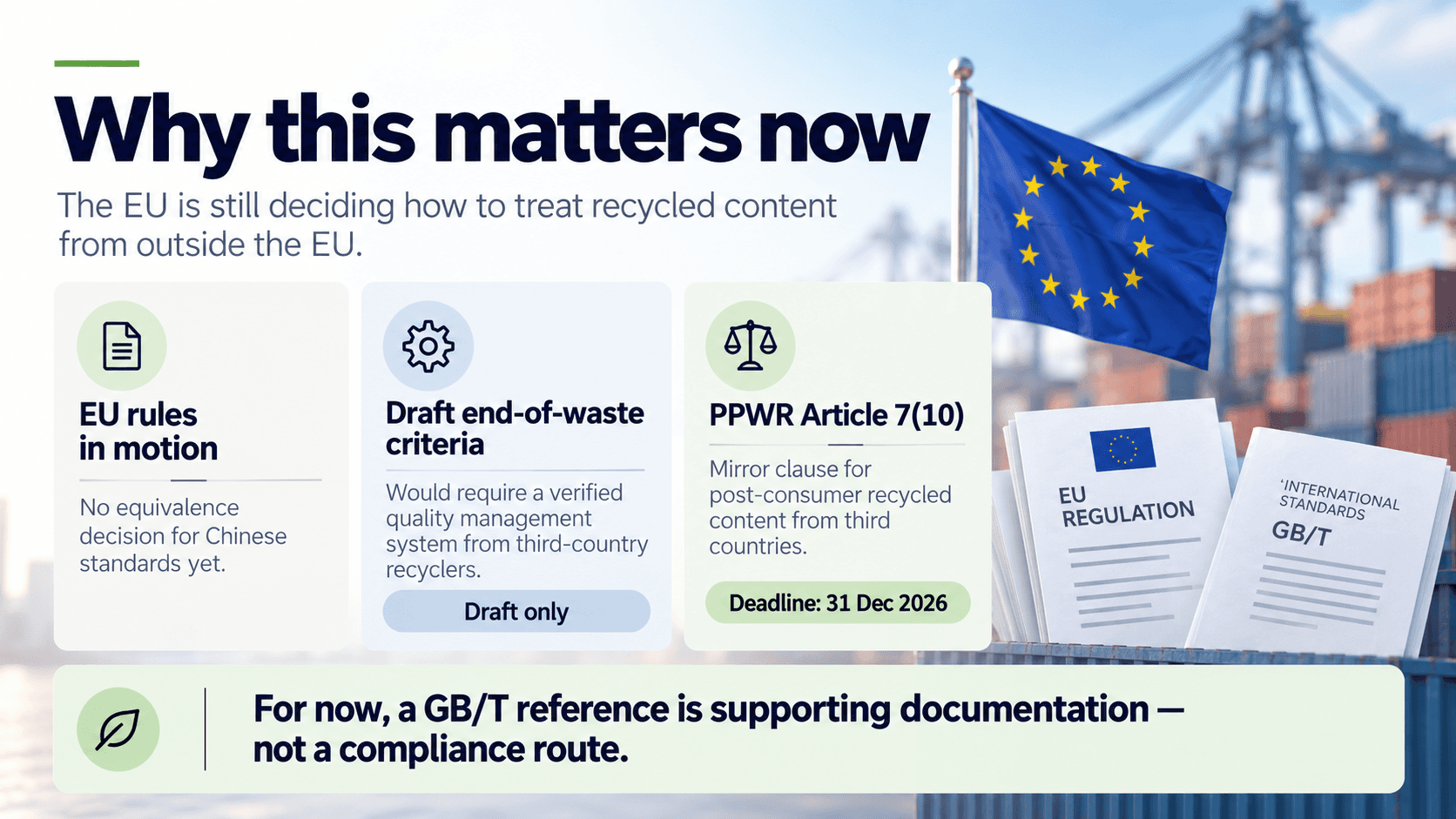
The EU is deciding how to treat recycled content that comes from outside it, and two things are in motion.
The draft end-of-waste criteria would require an EU importer buying recycled plastic from a third-country recycler to make that supplier run a verified quality management system. We covered that draft here; it is not adopted.
Separately, the Packaging and Packaging Waste Regulation splits the recycled-content question. Article 7(8) deals with content collected and recycled inside the EU. Article 7(10) — the mirror clause — concerns post-consumer recycled content collected and recycled in a third country. It requires the Commission to establish a methodology for assessing, verifying and certifying the equivalence of the rules applied there, including through third-party audit. EUROPEN's tracker gives that act a 31 December 2026 deadline and shows the consultation open.
Neither instrument, as reviewed here, contains an equivalence decision for Chinese standards. What has changed is smaller but real: where an EU rule asks for a documented, repeatable method, a Chinese supplier now has domestic standards written in that form to point at. Until Article 7(10) lands, a GB/T reference is supporting documentation — not a compliance route.
What to ask a supplier
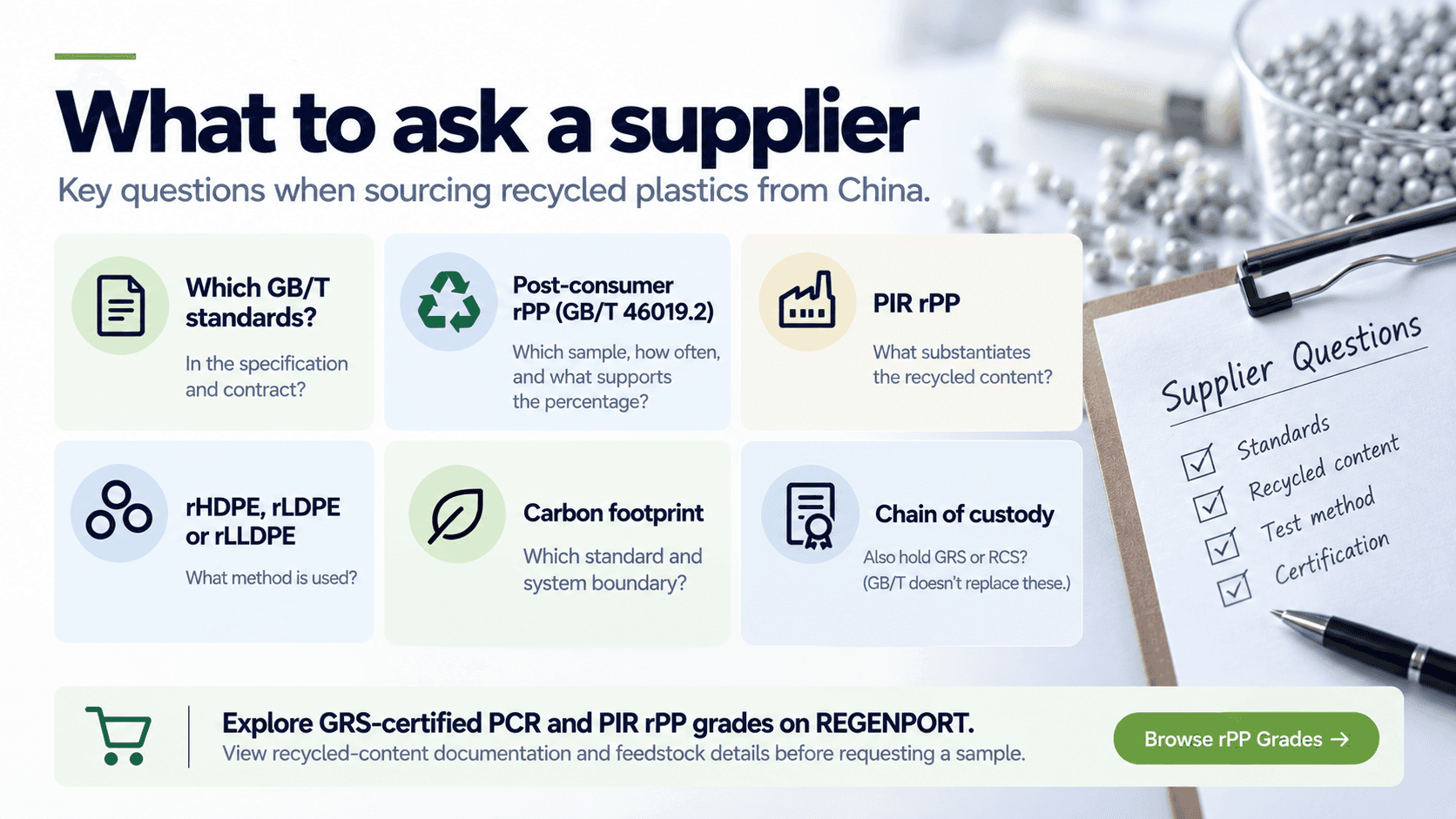
Which GB/T standards does this grade actually reference, and is that reference in the specification and the contract, or only in the marketing?
For a post-consumer rPP grade: was GB/T 46019.2 used, on which sample, how often is it repeated, and what separate evidence supports the percentage claimed?
For a PIR rPP grade: what substantiates the recycled content, given that the stated scope of GB/T 46019.2 excludes post-industrial material?
For rHDPE, rLDPE or rLLDPE: what method is used, and is it documented?
For a carbon-footprint figure: which standard, which system boundary, which allocation assumptions?
Does the supplier also hold chain-of-custody certification? GB/T conformance and GRS or RCS verify different things and neither replaces the other.
REGENPORT lists GRS-certified PCR and PIR recycled polypropylene grades with recycled-content documentation and feedstock descriptions buyers can review before requesting a sample.
Frequently Asked Questions
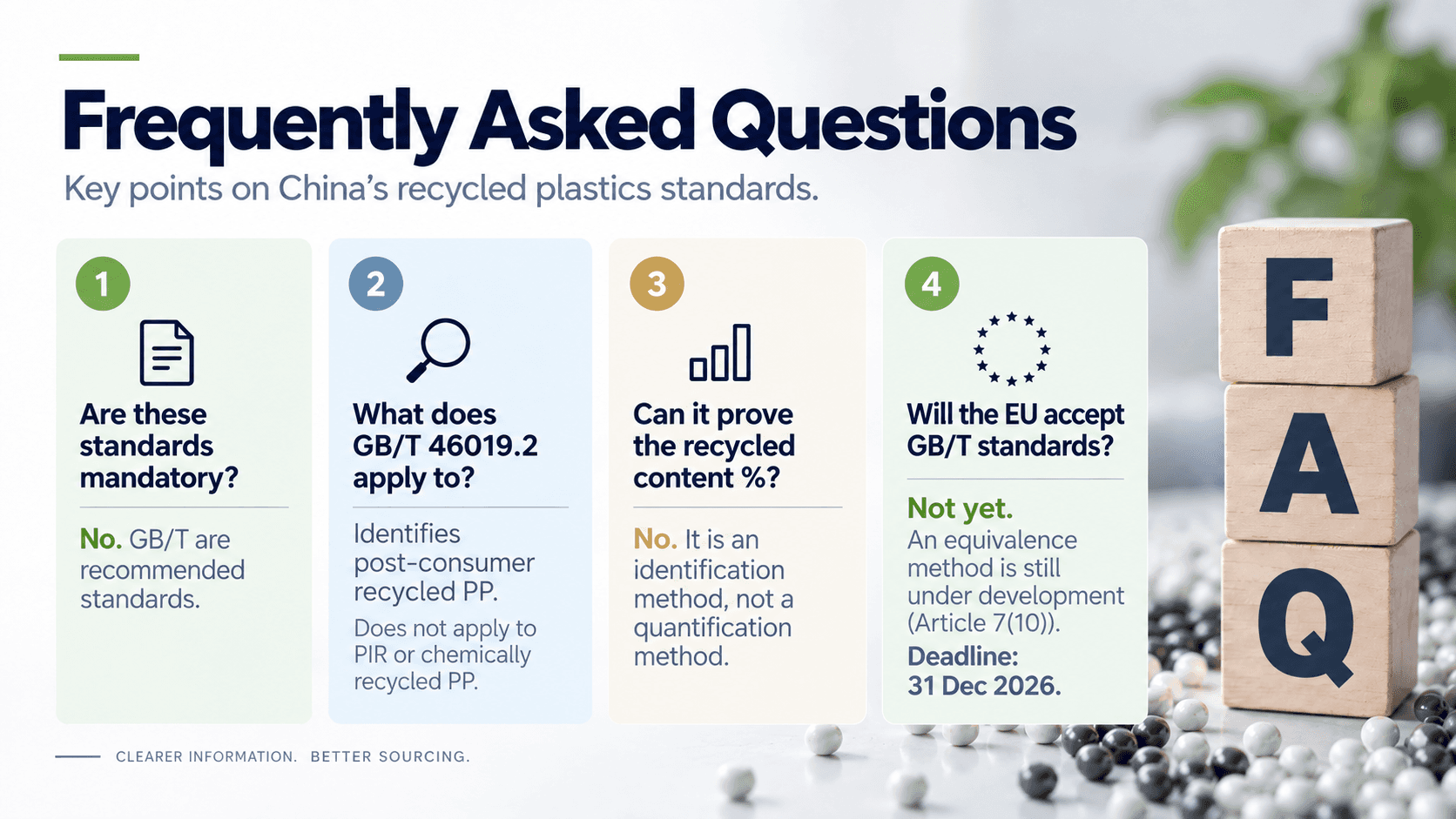
Are China's recycled plastics standards mandatory? No. They carry the GB/T designation, which marks a recommended national standard, as distinct from GB for mandatory ones. Conformance is not automatically mandatory, but a standard can become contractually or commercially relevant when it is incorporated into a contract, a purchase specification, or a certification scheme.
What does GB/T 46019.2 apply to? Its project record describes a headspace gas chromatography–mass spectrometry method for identifying post-consumer physically recycled polypropylene — material produced by crushing, washing and pelletizing. The record states it does not apply to PP recycled from post-industrial plastic, nor to chemically recycled PP.
Can it prove how much recycled content a grade contains? No. It is an identification method rather than a method for quantifying the mass percentage of recycled material, and should not be treated as a mass-balance or recycled-content certification.
Will the EU accept Chinese GB/T standards as evidence of recycled content? There is no equivalence decision as of September 2026. Article 7(10) of the Packaging and Packaging Waste Regulation requires the European Commission to establish how equivalence is assessed for content collected and recycled outside the EU; EUROPEN's tracker records a 31 December 2026 deadline and shows the consultation open.
About this guide. Current as of September 2026, for general information only — not legal advice. Standard numbers, titles and effective dates should be verified against China's national standards information platform before being relied on in a specification or contract.
Image generated with ChatGPT
Sources
State Administration for Market Regulation, national standards information platform, standard project record for GB/T 46019.2, "Plastics Identification of Recycled Plastics Part 2: Polypropylene (PP) Materials" (scope and technical content) → Read the Source
State Administration for Market Regulation, national standards information platform record for GB/T 39199-2020, "Characterization and testing methods of recycled polyethylene (PE)" → Read the Source
State Administration for Market Regulation, national standards information platform record for GB/T 46576-2025, "Greenhouse gases—Quantification methods of carbon footprint of products—Mechanical recycling recycled plastic products" → Read the Source
EUROPEN, PPWR Secondary Legislation Tracker (Articles 7.8 and 7.10) → Read the Source
Since 2021 China has been building out national standards for recycled plastics. The most recent batch — nine standards issued on 1 August 2025 — took effect on 1 February 2026. Two others matter alongside them: a restricted-substances standard in force since 1 June 2025, and a carbon-footprint method for mechanically recycled plastic products in force since 1 May 2026.
Together they cover ground EU buyers have started asking about: what is in the material, whether recycled content can be identified, where it came from, and what its carbon footprint is. That overlap is why they are worth reading. The limits of that overlap are why they should not be oversold.
What the nine standards cover
Function | Standard | Material |
|---|---|---|
Recyclable design guidance | GB/T 46020.1 / 46020.2-2025 | PET / PE-HD |
Material specification | GB/T 40006.4 / 40006.13-2025 | Mixed polyolefin (MPO) / PPE |
Recycled-component identification | GB/T 46019.1 / 46019.2-2025 | PET / PP |
Product evaluation | GB/T 46018.1 / 46018.2-2025 | PET / PS |
Traceability and environmental assessment | GB/T 46043-2025 | Plastics and recycled plastics |
This table lists the nine-standard package, not every Chinese recycled-plastics standard.
Two of these extend an older series. GB/T 40006 has specified recycled polyethylene and polypropylene since 2021; the 2025 additions brought in mixed polyolefin and PPE. The series now runs to thirteen parts, with PPE, PBT and PMMA parts all taking effect during 2026.
Recommended, not required
This is the distinction most easily lost in translation, and it changes what a supplier's claim is worth.
Chinese national standards come in two forms. GB means mandatory. GB/T means recommended. Every standard in this article is GB/T.
So the GB/T designation does not, by itself, make testing a statutory market-access requirement, and a grade that does not conform is not automatically unlawful for that reason alone. That does not make these standards empty. A recommended standard can become contractually or commercially relevant when it is written into a contract, a purchase specification, or a certification scheme.
The practical consequence for a buyer: if a GB/T reference matters to you, it belongs in the purchase agreement. Otherwise "meets GB/T 40006.4" is a claim you can test, not a status you can assume.
The one that matters for rPP
GB/T 46019.2 is the most useful of the nine for a polyolefin buyer, and also the one most likely to be overstated.
Its standard project record describes a laboratory method: headspace gas chromatography–mass spectrometry, measuring volatile compounds in a sample and matching the result against a database and a machine-learning model. In other words, a fingerprint test.
Two things follow.
It identifies, it does not quantify. The method is designed to identify whether a material fits the profile of post-consumer physically recycled PP that the method describes. It is not a method for quantifying the mass percentage of recycled material in a product or blend, and it should not be treated as a mass-balance or recycled-content certification.
It does not cover PIR. The stated scope is post-consumer PP recycled by crushing, washing and pelletizing. The record says the method does not apply to PP recycled from post-industrial plastic, and does not apply to chemically recycled PP. Other recycled plastics may refer to the method, but that is a reference permission, not an extension of scope.
If you buy both streams, this is the line to remember: GB/T 46019.2 cannot substantiate a PIR rPP grade, because the method's stated scope excludes PP recycled from post-industrial plastic. Substantiation for a PIR grade has to come from somewhere else.
What about polyethylene?
Polyethylene is not left out, though it is easy to read the 2025 package that way.
It has a material specification, GB/T 40006.2-2021, and a characterization and test-method standard, GB/T 39199-2020, in force since 2021. A further standard covering testing of mechanically recycled PP and PE, GB/T 47920-2026, takes effect on 1 February 2027.
What the records reviewed for this article do not show is a polyethylene part in the identification series — the series that applies a defined method to identify recycled components. That series has parts for PET and PP only. So for an rHDPE, rLDPE or rLLDPE grade, recycled-content substantiation still rests on whatever procedure the supplier documents.
Why this matters now
The EU is deciding how to treat recycled content that comes from outside it, and two things are in motion.
The draft end-of-waste criteria would require an EU importer buying recycled plastic from a third-country recycler to make that supplier run a verified quality management system. We covered that draft here; it is not adopted.
Separately, the Packaging and Packaging Waste Regulation splits the recycled-content question. Article 7(8) deals with content collected and recycled inside the EU. Article 7(10) — the mirror clause — concerns post-consumer recycled content collected and recycled in a third country. It requires the Commission to establish a methodology for assessing, verifying and certifying the equivalence of the rules applied there, including through third-party audit. EUROPEN's tracker gives that act a 31 December 2026 deadline and shows the consultation open.
Neither instrument, as reviewed here, contains an equivalence decision for Chinese standards. What has changed is smaller but real: where an EU rule asks for a documented, repeatable method, a Chinese supplier now has domestic standards written in that form to point at. Until Article 7(10) lands, a GB/T reference is supporting documentation — not a compliance route.
What to ask a supplier
Which GB/T standards does this grade actually reference, and is that reference in the specification and the contract, or only in the marketing?
For a post-consumer rPP grade: was GB/T 46019.2 used, on which sample, how often is it repeated, and what separate evidence supports the percentage claimed?
For a PIR rPP grade: what substantiates the recycled content, given that the stated scope of GB/T 46019.2 excludes post-industrial material?
For rHDPE, rLDPE or rLLDPE: what method is used, and is it documented?
For a carbon-footprint figure: which standard, which system boundary, which allocation assumptions?
Does the supplier also hold chain-of-custody certification? GB/T conformance and GRS or RCS verify different things and neither replaces the other.
REGENPORT lists GRS-certified PCR and PIR recycled polypropylene grades with recycled-content documentation and feedstock descriptions buyers can review before requesting a sample.
Frequently Asked Questions
Are China's recycled plastics standards mandatory? No. They carry the GB/T designation, which marks a recommended national standard, as distinct from GB for mandatory ones. Conformance is not automatically mandatory, but a standard can become contractually or commercially relevant when it is incorporated into a contract, a purchase specification, or a certification scheme.
What does GB/T 46019.2 apply to? Its project record describes a headspace gas chromatography–mass spectrometry method for identifying post-consumer physically recycled polypropylene — material produced by crushing, washing and pelletizing. The record states it does not apply to PP recycled from post-industrial plastic, nor to chemically recycled PP.
Can it prove how much recycled content a grade contains? No. It is an identification method rather than a method for quantifying the mass percentage of recycled material, and should not be treated as a mass-balance or recycled-content certification.
Will the EU accept Chinese GB/T standards as evidence of recycled content? There is no equivalence decision as of September 2026. Article 7(10) of the Packaging and Packaging Waste Regulation requires the European Commission to establish how equivalence is assessed for content collected and recycled outside the EU; EUROPEN's tracker records a 31 December 2026 deadline and shows the consultation open.
About this guide. Current as of September 2026, for general information only — not legal advice. Standard numbers, titles and effective dates should be verified against China's national standards information platform before being relied on in a specification or contract.
Image generated with ChatGPT
Sources
State Administration for Market Regulation, national standards information platform, standard project record for GB/T 46019.2, "Plastics Identification of Recycled Plastics Part 2: Polypropylene (PP) Materials" (scope and technical content) → Read the Source
State Administration for Market Regulation, national standards information platform record for GB/T 39199-2020, "Characterization and testing methods of recycled polyethylene (PE)" → Read the Source
State Administration for Market Regulation, national standards information platform record for GB/T 46576-2025, "Greenhouse gases—Quantification methods of carbon footprint of products—Mechanical recycling recycled plastic products" → Read the Source
EUROPEN, PPWR Secondary Legislation Tracker (Articles 7.8 and 7.10) → Read the Source
Explore Related Materials
Grades • Specs • Availability
Browse rPP →
Explore Related Materials
Explore Related Materials
GRS-certified rPP grades with recycled-content documentation and feedstock descriptions for review.
GRS-certified rPP grades with recycled-content documentation and feedstock descriptions for review.
Browse rPP →
Browse rPP →
Looking for samples or ready to source? Submit your request for pricing, availability, and technical information.
Looking for samples or ready to source? Submit your request for pricing, availability, and technical information.
Request a Quote →
Request a Quote →
Posted by REGENPORT
REGENPORT is a global platform connecting buyers and suppliers in the recycled materials and sustainable packaging industries.