CATEGORY
CATEGORY
Regulation
Regulation
Regulation
Canada's Federal Plastics Registry in 2026: What Your Canadian Buyer Has to Report About Your Resin
Canada's Federal Plastics Registry in 2026: What Your Canadian Buyer Has to Report About Your Resin
Canada's Federal Plastics Registry in 2026: What Your Canadian Buyer Has to Report About Your Resin
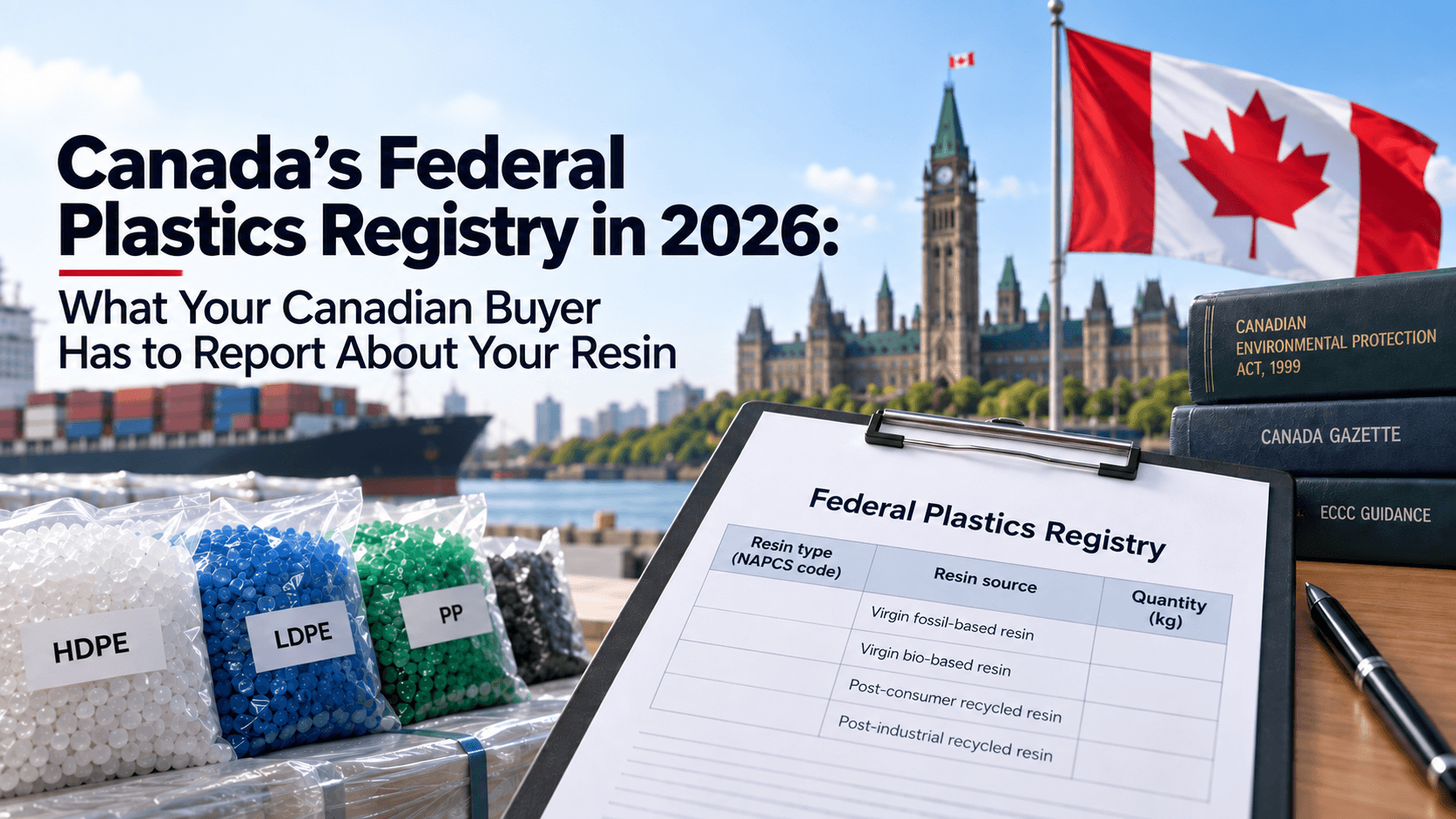
Canada is not asking you for anything. It is asking your customer — and your customer cannot answer without you. The Federal Plastics Registry makes a Canadian company report, in kilograms, which resin it placed on the market and where it came from — post-consumer and post-industrial in separate boxes. That filing is due 29 September 2026.
The Federal Plastics Registry sets no recycled-content target, bans no material, and puts no duty on a supplier outside Canada. It does one thing: it makes a Canadian company file, in kilograms, which resin it put on the market and where that resin came from. Post-consumer and post-industrial go in separate boxes.
The registry was created by a notice under subsection 46(1) of the Canadian Environmental Protection Act, 1999, published in the Canada Gazette, Part I on 20 April 2024. The notice states: "Information pertaining to the 2025 calendar year shall be provided no later than September 29, 2026."
Asked whether companies outside Canada that export to Canada have to report, Environment and Climate Change Canada's (ECCC) phase 1 guide answers that only persons resident in Canada, with a Canadian address, have the responsibility to report on plastics in imported products. So the deadline is your customer's, not yours. What reaches you is the question behind it: the same guide notes that phase 1 reporting may require contacting parties further upstream in the supply chain, and ECCC provides a downloadable letter intended to help entities obtain information from their suppliers. A Canadian customer may arrive with it.

Who the notice lands on
Phase 1 applies to producers of plastic packaging, electronic and electrical equipment (EEE), and single-use or disposable products destined for the residential waste stream. Small volumes are out: ECCC's guide states that persons manufacturing, importing or placing on the market less than 1,000 kg of plastic products or packaging in a calendar year are exempt from the reporting requirements.
Where the brand owner sits outside Canada, the guide identifies the producer as the first resident person in Canada to import or manufacture the product. For an exporter, that is usually the customer itself — the importer, the converter, or the brand's Canadian entity. Knowing which of your customers carries the obligation is useful, because that is the one whose questions will be specific.

Two fields a supplier can affect
A report also covers quantities, product categories and the calculation method used. Two entries travel back up the chain.
Resin type. Resins are reported by North American Product Classification System (NAPCS) Canada 2022 code, not by the resin identification code (RIC) stamped on the packaging. ECCC's guide is explicit on this: it states that the RIC numbers appear in its table for illustration purposes only, and that reporting must use the NAPCS code corresponding to the applicable group of resins. The table maps #2 HDPE to 2811223, #4 LDPE to 2811221 and #5 PP to 2811293.
Resin source. Schedule 1 of the notice lists four:
Resin source category |
|---|
Virgin fossil-based resin |
Virgin bio-based resin |
Post-consumer recycled resin |
Post-industrial recycled resin |
Post-consumer and post-industrial are two boxes, not one. A declaration that gives a single combined recycled figure fills neither.
For a polyolefin seller that is a sorting question before it is a paperwork question. A grade blended from both streams cannot be described by one number, and the split has to be traceable to the shipment rather than reconstructed afterwards. Where PCR and PIR lines are kept separate in production, that separation is most of the documentation.
Records outlast the filing. The notice requires the reported information — and the calculations, measurements and other data behind it — to be kept for three years from the date it is due.

What changed in March 2026
On 14 March 2026, ECCC published a notice amending the 2024 notice. Its explanatory note states that the amendments are made to reflect that the reporting due date for phases 2 and 3 of the Federal Plastics Registry has been postponed.
Phase 1 reporting continues on 2024, 2025 and 2026 data. A notice of intent published the same day says the Minister intends to issue a new notice continuing the registry's information-gathering for the 2027, 2028 and 2029 calendar years, and will be soliciting the views of stakeholders on its content. No new deadline is given for the postponed phases.

Canada is not the only one asking
China's recycled-component identification method for polypropylene, reviewed here, covers post-consumer material and excludes post-industrial. The EU's draft end-of-waste criteria for plastics would require an EU importer to have its third-country recycler run a verified quality management system. Canada asks a buyer for quantities split by source.
Three instruments, three jurisdictions, three different legal effects. One shared assumption: whoever sells the material documents where it came from.

What a Canadian customer is likely to ask for
The resin in terms that map to a NAPCS grouping, not a trade name
Quantities by source, with post-consumer and post-industrial stated separately
A feedstock description that supports that source classification
Whether chain-of-custody certification such as GRS or RCS applies to the specific grade, and what its scope covers
Documentation that can still be produced three years later, since that is how long the buyer's records must be kept
None of this is a legal duty for a supplier outside Canada. All of it fits on a specification sheet.
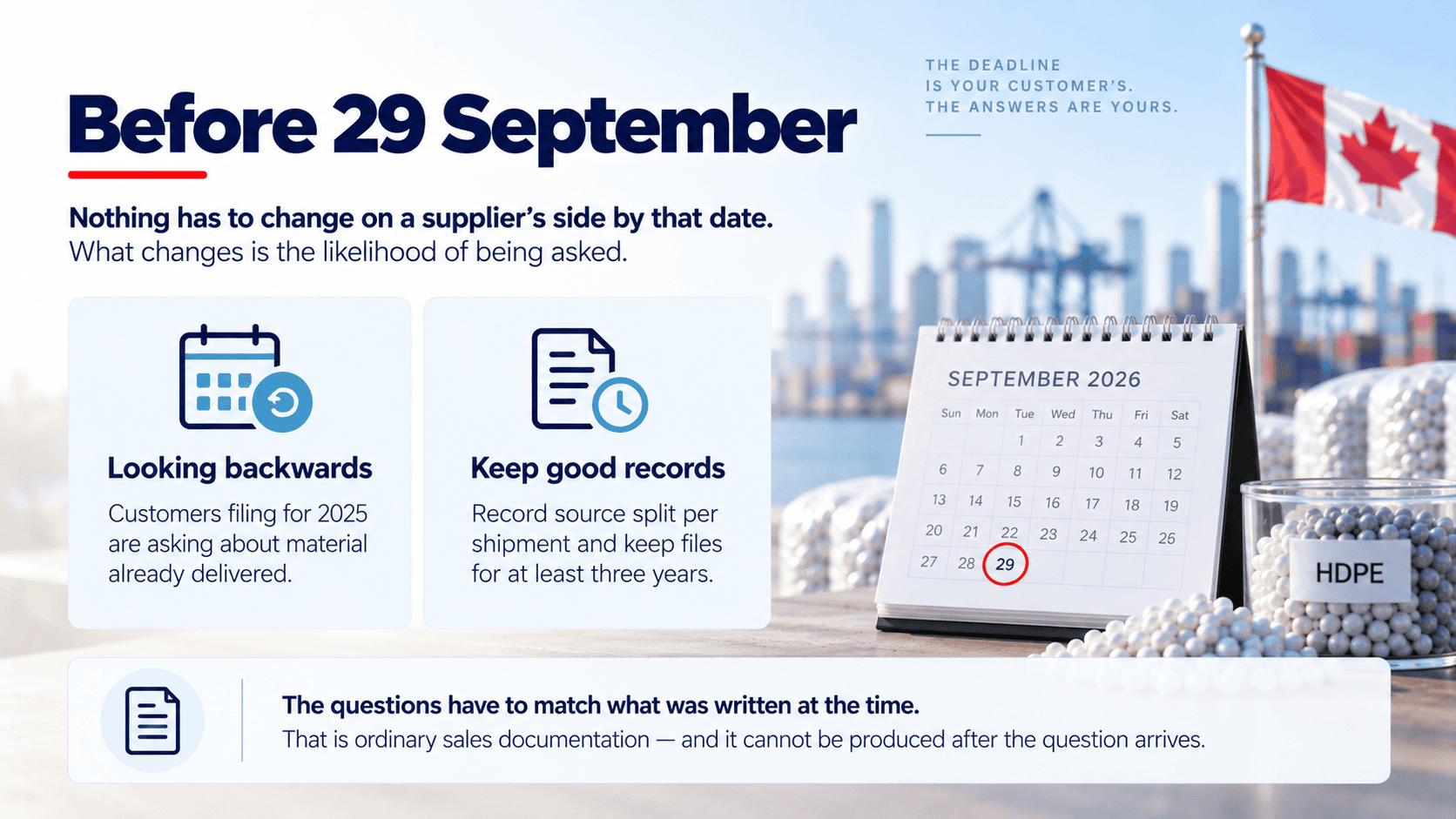
Before 29 September
Nothing on a supplier's side has to change by that date. What changes is the likelihood of being asked.
A customer assembling a filing for the 2025 calendar year is looking backwards, at material already delivered. The questions land on shipments that closed months ago, and the answers have to match what was written at the time. Two habits make that straightforward: a source split recorded per shipment rather than per grade, and records kept in a form that still opens three years later. Both are ordinary sales documentation. Neither can be produced after the question arrives.
REGENPORT lists GRS-certified recycled HDPE grades with recycled-content documentation and feedstock descriptions buyers can review before requesting a sample.

Frequently Asked Questions
Does Canada's Federal Plastics Registry require a minimum recycled content? No. It is an information-gathering notice under subsection 46(1) of the Canadian Environmental Protection Act, 1999, collecting quantities of plastic by resin type and source. Canada has consulted separately on recycled content and labelling rules for plastics; those are a different instrument.
What is due on 29 September 2026? Data for the 2025 calendar year. The notice states: "Information pertaining to the 2025 calendar year shall be provided no later than September 29, 2026."
Does a recycler or trader outside Canada have to report? No. ECCC's phase 1 guide states that only persons resident in Canada, with a Canadian address, have that responsibility. The guide notes that reporting may require contacting parties further upstream in the supply chain, and ECCC provides a downloadable letter intended to help entities obtain information from their suppliers.
Have the later phases of the registry taken effect? Not as of September 2026. The 14 March 2026 amending notice states that the reporting due date for phases 2 and 3 has been postponed, and a notice of intent published the same day signals a new notice for 2027, 2028 and 2029, subject to stakeholder consultation.
How do post-consumer and post-industrial resin appear? As two separate source categories in Schedule 1, alongside virgin fossil-based and virgin bio-based resin.
About this guide.
Current as of September 2026, for general information only — not legal advice. Reporting obligations, deadlines and data fields should be verified against the notice as published in the Canada Gazette and ECCC's reporting guidance before being relied on.
Image generated with ChatGPT
Sources
Department of the Environment, Canada Gazette, Part I, Volume 158, Number 16, "Notice with respect to reporting of plastic resins and certain plastic products for the Federal Plastics Registry for 2024, 2025 and 2026" (20 April 2024) → Read the Source
Department of the Environment, Canada Gazette, Part I, Volume 160, Number 11, "Notice amending the Notice with respect to reporting of plastic resins and certain plastic products for the Federal Plastics Registry for 2024, 2025 and 2026" and the notice of intent for 2027, 2028 and 2029 (14 March 2026) → Read the Source
Environment and Climate Change Canada, "Guide for reporting to the Federal Plastics Registry – phase 1" → Read the Source
Environment and Climate Change Canada, "Federal Plastics Registry" (phase status and reporting years) → Read the Source
The Federal Plastics Registry sets no recycled-content target, bans no material, and puts no duty on a supplier outside Canada. It does one thing: it makes a Canadian company file, in kilograms, which resin it put on the market and where that resin came from. Post-consumer and post-industrial go in separate boxes.
The registry was created by a notice under subsection 46(1) of the Canadian Environmental Protection Act, 1999, published in the Canada Gazette, Part I on 20 April 2024. The notice states: "Information pertaining to the 2025 calendar year shall be provided no later than September 29, 2026."
Asked whether companies outside Canada that export to Canada have to report, Environment and Climate Change Canada's (ECCC) phase 1 guide answers that only persons resident in Canada, with a Canadian address, have the responsibility to report on plastics in imported products. So the deadline is your customer's, not yours. What reaches you is the question behind it: the same guide notes that phase 1 reporting may require contacting parties further upstream in the supply chain, and ECCC provides a downloadable letter intended to help entities obtain information from their suppliers. A Canadian customer may arrive with it.
Who the notice lands on
Phase 1 applies to producers of plastic packaging, electronic and electrical equipment (EEE), and single-use or disposable products destined for the residential waste stream. Small volumes are out: ECCC's guide states that persons manufacturing, importing or placing on the market less than 1,000 kg of plastic products or packaging in a calendar year are exempt from the reporting requirements.
Where the brand owner sits outside Canada, the guide identifies the producer as the first resident person in Canada to import or manufacture the product. For an exporter, that is usually the customer itself — the importer, the converter, or the brand's Canadian entity. Knowing which of your customers carries the obligation is useful, because that is the one whose questions will be specific.
Two fields a supplier can affect
A report also covers quantities, product categories and the calculation method used. Two entries travel back up the chain.
Resin type. Resins are reported by North American Product Classification System (NAPCS) Canada 2022 code, not by the resin identification code (RIC) stamped on the packaging. ECCC's guide is explicit on this: it states that the RIC numbers appear in its table for illustration purposes only, and that reporting must use the NAPCS code corresponding to the applicable group of resins. The table maps #2 HDPE to 2811223, #4 LDPE to 2811221 and #5 PP to 2811293.
Resin source. Schedule 1 of the notice lists four:
Resin source category |
|---|
Virgin fossil-based resin |
Virgin bio-based resin |
Post-consumer recycled resin |
Post-industrial recycled resin |
Post-consumer and post-industrial are two boxes, not one. A declaration that gives a single combined recycled figure fills neither.
For a polyolefin seller that is a sorting question before it is a paperwork question. A grade blended from both streams cannot be described by one number, and the split has to be traceable to the shipment rather than reconstructed afterwards. Where PCR and PIR lines are kept separate in production, that separation is most of the documentation.
Records outlast the filing. The notice requires the reported information — and the calculations, measurements and other data behind it — to be kept for three years from the date it is due.
What changed in March 2026
On 14 March 2026, ECCC published a notice amending the 2024 notice. Its explanatory note states that the amendments are made to reflect that the reporting due date for phases 2 and 3 of the Federal Plastics Registry has been postponed.
Phase 1 reporting continues on 2024, 2025 and 2026 data. A notice of intent published the same day says the Minister intends to issue a new notice continuing the registry's information-gathering for the 2027, 2028 and 2029 calendar years, and will be soliciting the views of stakeholders on its content. No new deadline is given for the postponed phases.
Canada is not the only one asking
China's recycled-component identification method for polypropylene, reviewed here, covers post-consumer material and excludes post-industrial. The EU's draft end-of-waste criteria for plastics would require an EU importer to have its third-country recycler run a verified quality management system. Canada asks a buyer for quantities split by source.
Three instruments, three jurisdictions, three different legal effects. One shared assumption: whoever sells the material documents where it came from.
What a Canadian customer is likely to ask for
The resin in terms that map to a NAPCS grouping, not a trade name
Quantities by source, with post-consumer and post-industrial stated separately
A feedstock description that supports that source classification
Whether chain-of-custody certification such as GRS or RCS applies to the specific grade, and what its scope covers
Documentation that can still be produced three years later, since that is how long the buyer's records must be kept
None of this is a legal duty for a supplier outside Canada. All of it fits on a specification sheet.
Before 29 September
Nothing on a supplier's side has to change by that date. What changes is the likelihood of being asked.
A customer assembling a filing for the 2025 calendar year is looking backwards, at material already delivered. The questions land on shipments that closed months ago, and the answers have to match what was written at the time. Two habits make that straightforward: a source split recorded per shipment rather than per grade, and records kept in a form that still opens three years later. Both are ordinary sales documentation. Neither can be produced after the question arrives.
REGENPORT lists GRS-certified recycled HDPE grades with recycled-content documentation and feedstock descriptions buyers can review before requesting a sample.
Frequently Asked Questions
Does Canada's Federal Plastics Registry require a minimum recycled content? No. It is an information-gathering notice under subsection 46(1) of the Canadian Environmental Protection Act, 1999, collecting quantities of plastic by resin type and source. Canada has consulted separately on recycled content and labelling rules for plastics; those are a different instrument.
What is due on 29 September 2026? Data for the 2025 calendar year. The notice states: "Information pertaining to the 2025 calendar year shall be provided no later than September 29, 2026."
Does a recycler or trader outside Canada have to report? No. ECCC's phase 1 guide states that only persons resident in Canada, with a Canadian address, have that responsibility. The guide notes that reporting may require contacting parties further upstream in the supply chain, and ECCC provides a downloadable letter intended to help entities obtain information from their suppliers.
Have the later phases of the registry taken effect? Not as of September 2026. The 14 March 2026 amending notice states that the reporting due date for phases 2 and 3 has been postponed, and a notice of intent published the same day signals a new notice for 2027, 2028 and 2029, subject to stakeholder consultation.
How do post-consumer and post-industrial resin appear? As two separate source categories in Schedule 1, alongside virgin fossil-based and virgin bio-based resin.
About this guide.
Current as of September 2026, for general information only — not legal advice. Reporting obligations, deadlines and data fields should be verified against the notice as published in the Canada Gazette and ECCC's reporting guidance before being relied on.
Image generated with ChatGPT
Sources
Department of the Environment, Canada Gazette, Part I, Volume 158, Number 16, "Notice with respect to reporting of plastic resins and certain plastic products for the Federal Plastics Registry for 2024, 2025 and 2026" (20 April 2024) → Read the Source
Department of the Environment, Canada Gazette, Part I, Volume 160, Number 11, "Notice amending the Notice with respect to reporting of plastic resins and certain plastic products for the Federal Plastics Registry for 2024, 2025 and 2026" and the notice of intent for 2027, 2028 and 2029 (14 March 2026) → Read the Source
Environment and Climate Change Canada, "Guide for reporting to the Federal Plastics Registry – phase 1" → Read the Source
Environment and Climate Change Canada, "Federal Plastics Registry" (phase status and reporting years) → Read the Source
Explore Related Materials
Grades • Specs • Availability
Browse rHDPE →
Explore Related Materials
Explore Related Materials
GRS-certified rHDPE grades with recycled-content documentation and feedstock descriptions for review.
GRS-certified rHDPE grades with recycled-content documentation and feedstock descriptions for review.
Browse rHDPE →
Browse rHDPE →
Looking for samples or ready to source? Submit your request for pricing, availability, and technical information.
Looking for samples or ready to source? Submit your request for pricing, availability, and technical information.
Request a Quote →
Request a Quote →
Posted by REGENPORT
REGENPORT is a global platform connecting buyers and suppliers in the recycled materials and sustainable packaging industries.