CATEGORY
CATEGORY
Trend
Trend
Trend
UK Plastic Tax Pushes Europe Toward PCR as rPET Softens – Week 1, October 2026
UK Plastic Tax Pushes Europe Toward PCR as rPET Softens – Week 1, October 2026
UK Plastic Tax Pushes Europe Toward PCR as rPET Softens – Week 1, October 2026

European rLDPE, rPP and recycled styrenics firmed this week as buyers shifted from PIR to PCR material ahead of an April 2027 UK Plastic Packaging Tax change, while rPET fell on bale oversupply and cheap imports even as virgin PET overtook US recycled pellet prices. Brazil's market, meanwhile, held its breath ahead of an Oct. 4 election that could decide an anti-dumping duty on US-origin PE.
This week split the recycled complex along a line that had nothing to do with the season: regulation versus feedstock. Grades tied to Europe's upcoming packaging-tax rules firmed on buyer repositioning, while rPET traded on its own supply glut regardless of what virgin PET or the regulatory calendar were doing. Latin America, meanwhile, was defined less by this week's trading and more by what happens at the ballot box on Oct. 4.

Three Factors Shaping This Week's Market
1. The UK's 2027 tax change is already moving European demand from PIR to PCR From April 1, 2027, pre-consumer (PIR) waste will no longer count toward the UK Plastic Packaging Tax's recycled-content threshold. That change is still a year and a half away, but UK buyers are reformulating now, and the reformulation is showing up in this week's European rLDPE and rPP pricing rather than waiting for the deadline.
2. rPET is trading against its own glut, not against the regulatory calendar While rLDPE, rPP and styrenics firmed on PCR demand, European and US rPET moved in the opposite direction on bale oversupply and cheap imports. The split matters because it shows the PCR-preference story is not lifting every recycled grade uniformly — rPET's price action this week was a feedstock-supply story, not a regulation story.
3. Brazil's Oct. 4 election carries a trade-policy outcome alongside a political one Brazil is due to hold its election on Oct. 4, with the outcome expected to help determine the country's anti-dumping duty on US-origin polyethylene. For buyers and sellers with Brazil exposure, this week's inactivity reflects positioning ahead of a result rather than a read on current demand.

Key Grade Performance: rLDPE, rHDPE, rPP and rPET
rLDPE Market — Europe firms on PCR demand European clear rLDPE pellets rose significantly as early-October natural PCR offers were heard higher, while colored grades were largely a rollover from the prior week. The UK Plastic Packaging Tax change is the direct driver: as UK buyers reformulate away from PIR ahead of the April 2027 rule, added pressure has shown up on PIR-grade pricing. Why it matters: a price move keyed to a rule change 18 months out is a positioning trade. Buyers evaluating rLDPE cover may want to ask whether an offer reflects current PCR availability or the UK reformulation trend, since the two can diverge once near-term supply catches up.
rHDPE Market — Europe flat, Southeast Asia stable-weak European natural rHDPE pellets were unchanged this week, and the seasonal September demand rebound that buyers typically watch for did not materialize. Buyers are instead watching the price gap between virgin HDPE and PCR pellets rather than reacting to fresh demand. In Southeast Asia, prices held stable on weak converter demand, while regional recyclers were reported stockpiling European scrap ahead of the EU's Nov. 21 export ban to non-OECD countries. Why it matters: a flat European rHDPE market and a stockpiling-driven Asian market are two different stories wearing the same "stable" label. Buyers should treat SEA stability as ban-related positioning rather than a demand signal.
rPP and Styrenics Market — PCR preference lifts European prices European rPP natural pellets gained this week, with black pellets slightly higher as well. As with rLDPE, some consumers are moving away from PIR grades ahead of restrictions expected next year. Recycled styrenics also firmed modestly, with both rPS and rABS registering small gains. Why it matters: the same UK-driven PIR-to-PCR shift lifting rLDPE is now visible across rPP and styrenics, which suggests this is a market-wide repositioning rather than a single-grade story.
rPET Market — Europe and the US move against the PCR trend European and US rPET prices fell this week, weighed down by bale oversupply and cheap imports, even as virgin PET rose in all three major regions. The result is an unusual spread: virgin PET has climbed back above US recycled pellet prices. Why it matters: rPET's decline during a week when every other recycled grade covered here firmed is a reminder that "recycled plastics" is not one market. Buyers should price rPET on its own bale-supply fundamentals rather than assuming it will track the PCR-preference trend lifting rLDPE and rPP.

Key Company, Trade and Regulatory Updates
Borouge — specialty PP compounding plant starts commercial operations in Austria. Borouge started commercial operations at its specialty PP compounding plant in Schwechat, Austria, an investment reported at over €100 million. The plant blends virgin PP with rPP to produce tailored circular grades — a direct example of the virgin-recycled blending buyers are watching for as regulatory pressure builds.
Braskem — unofficial October price increases reported in Brazil. Braskem is reported to have issued unofficial October price increases in Brazil, against the backdrop of its ongoing debt restructuring and the Oct. 4 election.
EU — anti-dumping investigation opened into PVC imports. The European Commission opened an anti-dumping investigation into PVC imports from China, South Korea, Mexico and Taiwan. Separately, the EU's ban on plastic waste exports to non-OECD countries takes effect Nov. 21 and is already reshaping bale flows, as this week's Southeast Asian stockpiling shows.
UK — Plastic Packaging Tax change remains the key driver, alongside PET safeguarding. The April 1, 2027 PIR-to-PCR rule change is the main force behind this week's European rLDPE and rPP demand. UK PET safeguarding measures are also widening the UK's price premium over Northwest Europe.
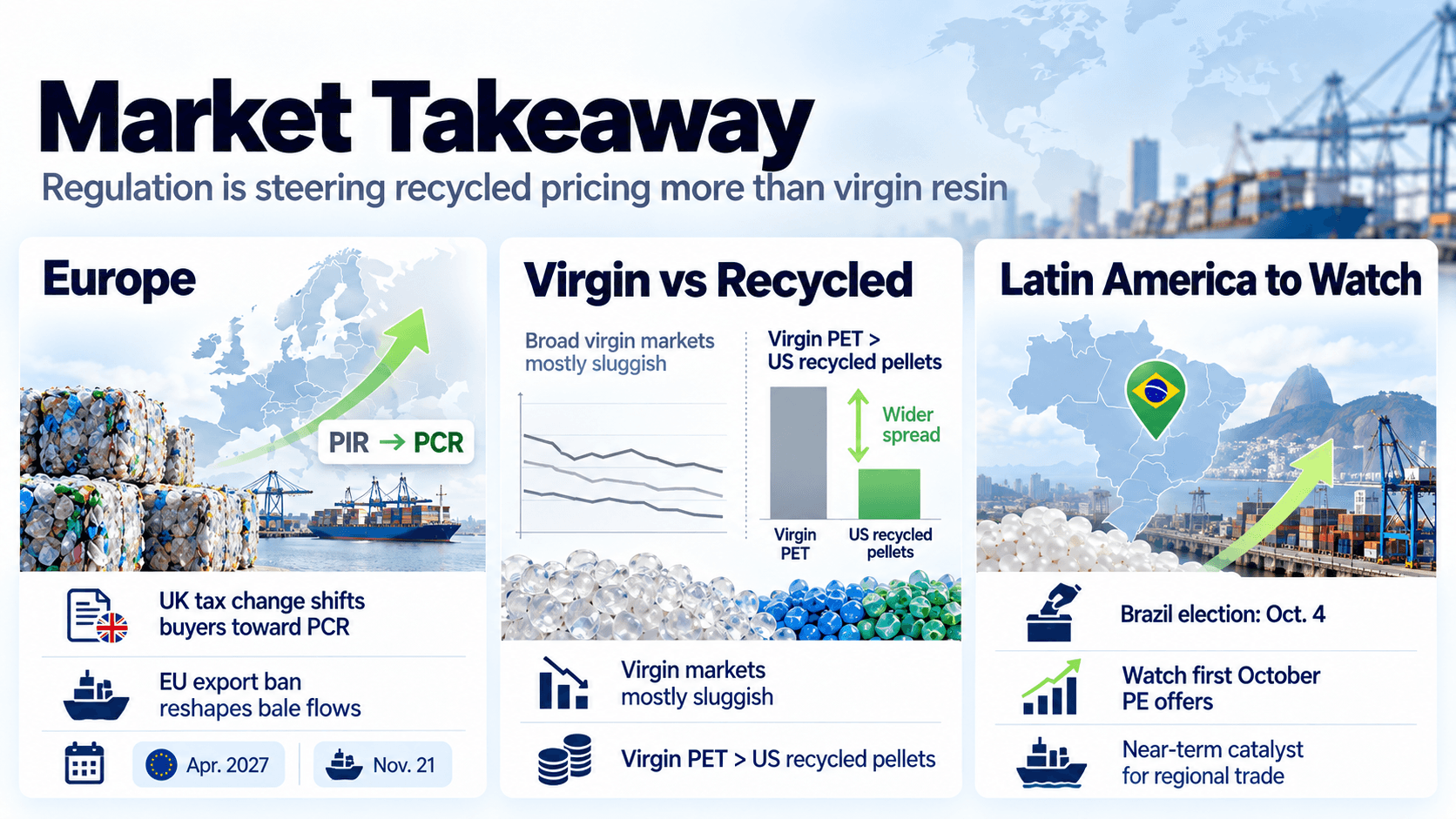
Market Takeaway
Regulation is steering recycled pricing more than virgin resin is right now. The UK Plastic Packaging Tax change is already shifting European buyers from PIR to PCR material across rLDPE, rPP and styrenics, well ahead of its April 2027 start date, while the EU's Nov. 21 ban on non-OECD plastic waste exports is working in the same direction on bale flows. Virgin markets, by contrast, stayed comparatively sluggish even with oil holding at an elevated level — the exception being virgin PET, which climbed enough to flip its usual spread against US recycled pellets. Latin America is the market to watch most closely into next week: Brazil's Oct. 4 election and the first October price offers that follow it are the near-term catalysts for the region's PE trade. Regenport will continue monitoring market conditions and sharing updates as the picture develops.

Frequently Asked Questions
Why are European rLDPE and rPP prices rising while rPET falls? The two are responding to different drivers. rLDPE and rPP are firming because UK buyers are shifting from post-industrial (PIR) to post-consumer (PCR) material ahead of an April 2027 change to the UK Plastic Packaging Tax, which will stop pre-consumer waste from counting toward the tax's recycled-content threshold. rPET, by contrast, is moving on its own bale oversupply and cheap imports, a feedstock-supply story unrelated to the UK rule change.
What is changing under the UK Plastic Packaging Tax in April 2027? From April 1, 2027, pre-consumer (PIR) waste will no longer count toward the UK Plastic Packaging Tax's recycled-content requirement. UK buyers are already reformulating away from PIR ahead of that date, which is adding price pressure to PIR grades and lifting demand for PCR material in the European rLDPE and rPP markets.
Image generated with ChatGPT
This week split the recycled complex along a line that had nothing to do with the season: regulation versus feedstock. Grades tied to Europe's upcoming packaging-tax rules firmed on buyer repositioning, while rPET traded on its own supply glut regardless of what virgin PET or the regulatory calendar were doing. Latin America, meanwhile, was defined less by this week's trading and more by what happens at the ballot box on Oct. 4.
Three Factors Shaping This Week's Market
1. The UK's 2027 tax change is already moving European demand from PIR to PCR From April 1, 2027, pre-consumer (PIR) waste will no longer count toward the UK Plastic Packaging Tax's recycled-content threshold. That change is still a year and a half away, but UK buyers are reformulating now, and the reformulation is showing up in this week's European rLDPE and rPP pricing rather than waiting for the deadline.
2. rPET is trading against its own glut, not against the regulatory calendar While rLDPE, rPP and styrenics firmed on PCR demand, European and US rPET moved in the opposite direction on bale oversupply and cheap imports. The split matters because it shows the PCR-preference story is not lifting every recycled grade uniformly — rPET's price action this week was a feedstock-supply story, not a regulation story.
3. Brazil's Oct. 4 election carries a trade-policy outcome alongside a political one Brazil is due to hold its election on Oct. 4, with the outcome expected to help determine the country's anti-dumping duty on US-origin polyethylene. For buyers and sellers with Brazil exposure, this week's inactivity reflects positioning ahead of a result rather than a read on current demand.
Key Grade Performance: rLDPE, rHDPE, rPP and rPET
rLDPE Market — Europe firms on PCR demand European clear rLDPE pellets rose significantly as early-October natural PCR offers were heard higher, while colored grades were largely a rollover from the prior week. The UK Plastic Packaging Tax change is the direct driver: as UK buyers reformulate away from PIR ahead of the April 2027 rule, added pressure has shown up on PIR-grade pricing. Why it matters: a price move keyed to a rule change 18 months out is a positioning trade. Buyers evaluating rLDPE cover may want to ask whether an offer reflects current PCR availability or the UK reformulation trend, since the two can diverge once near-term supply catches up.
rHDPE Market — Europe flat, Southeast Asia stable-weak European natural rHDPE pellets were unchanged this week, and the seasonal September demand rebound that buyers typically watch for did not materialize. Buyers are instead watching the price gap between virgin HDPE and PCR pellets rather than reacting to fresh demand. In Southeast Asia, prices held stable on weak converter demand, while regional recyclers were reported stockpiling European scrap ahead of the EU's Nov. 21 export ban to non-OECD countries. Why it matters: a flat European rHDPE market and a stockpiling-driven Asian market are two different stories wearing the same "stable" label. Buyers should treat SEA stability as ban-related positioning rather than a demand signal.
rPP and Styrenics Market — PCR preference lifts European prices European rPP natural pellets gained this week, with black pellets slightly higher as well. As with rLDPE, some consumers are moving away from PIR grades ahead of restrictions expected next year. Recycled styrenics also firmed modestly, with both rPS and rABS registering small gains. Why it matters: the same UK-driven PIR-to-PCR shift lifting rLDPE is now visible across rPP and styrenics, which suggests this is a market-wide repositioning rather than a single-grade story.
rPET Market — Europe and the US move against the PCR trend European and US rPET prices fell this week, weighed down by bale oversupply and cheap imports, even as virgin PET rose in all three major regions. The result is an unusual spread: virgin PET has climbed back above US recycled pellet prices. Why it matters: rPET's decline during a week when every other recycled grade covered here firmed is a reminder that "recycled plastics" is not one market. Buyers should price rPET on its own bale-supply fundamentals rather than assuming it will track the PCR-preference trend lifting rLDPE and rPP.
Key Company, Trade and Regulatory Updates
Borouge — specialty PP compounding plant starts commercial operations in Austria. Borouge started commercial operations at its specialty PP compounding plant in Schwechat, Austria, an investment reported at over €100 million. The plant blends virgin PP with rPP to produce tailored circular grades — a direct example of the virgin-recycled blending buyers are watching for as regulatory pressure builds.
Braskem — unofficial October price increases reported in Brazil. Braskem is reported to have issued unofficial October price increases in Brazil, against the backdrop of its ongoing debt restructuring and the Oct. 4 election.
EU — anti-dumping investigation opened into PVC imports. The European Commission opened an anti-dumping investigation into PVC imports from China, South Korea, Mexico and Taiwan. Separately, the EU's ban on plastic waste exports to non-OECD countries takes effect Nov. 21 and is already reshaping bale flows, as this week's Southeast Asian stockpiling shows.
UK — Plastic Packaging Tax change remains the key driver, alongside PET safeguarding. The April 1, 2027 PIR-to-PCR rule change is the main force behind this week's European rLDPE and rPP demand. UK PET safeguarding measures are also widening the UK's price premium over Northwest Europe.
Market Takeaway
Regulation is steering recycled pricing more than virgin resin is right now. The UK Plastic Packaging Tax change is already shifting European buyers from PIR to PCR material across rLDPE, rPP and styrenics, well ahead of its April 2027 start date, while the EU's Nov. 21 ban on non-OECD plastic waste exports is working in the same direction on bale flows. Virgin markets, by contrast, stayed comparatively sluggish even with oil holding at an elevated level — the exception being virgin PET, which climbed enough to flip its usual spread against US recycled pellets. Latin America is the market to watch most closely into next week: Brazil's Oct. 4 election and the first October price offers that follow it are the near-term catalysts for the region's PE trade. Regenport will continue monitoring market conditions and sharing updates as the picture develops.
Frequently Asked Questions
Why are European rLDPE and rPP prices rising while rPET falls? The two are responding to different drivers. rLDPE and rPP are firming because UK buyers are shifting from post-industrial (PIR) to post-consumer (PCR) material ahead of an April 2027 change to the UK Plastic Packaging Tax, which will stop pre-consumer waste from counting toward the tax's recycled-content threshold. rPET, by contrast, is moving on its own bale oversupply and cheap imports, a feedstock-supply story unrelated to the UK rule change.
What is changing under the UK Plastic Packaging Tax in April 2027? From April 1, 2027, pre-consumer (PIR) waste will no longer count toward the UK Plastic Packaging Tax's recycled-content requirement. UK buyers are already reformulating away from PIR ahead of that date, which is adding price pressure to PIR grades and lifting demand for PCR material in the European rLDPE and rPP markets.
Image generated with ChatGPT
Where rLDPE Stands This Week
Grades • Specs • Availability
Browse rLDPE →
Where rLDPE Stands This Week
Where rLDPE Stands This Week
Check rLDPE grades by feedstock, MFI, stock and MOQ.
Check rLDPE grades by feedstock, MFI, stock and MOQ.
Browse rLDPE →
Browse rLDPE →
Looking for samples or ready to source? Submit your request for pricing, availability, and technical information.
Looking for samples or ready to source? Submit your request for pricing, availability, and technical information.
Request a Quote →
Request a Quote →
Posted by REGENPORT
REGENPORT is a global platform connecting buyers and suppliers in the recycled materials and sustainable packaging industries.