CATEGORY
CATEGORY
News
News
News
New Jersey Delayed Only the Food Rule: Non-Food Rigid PCR Still Doubles in 2027
New Jersey Delayed Only the Food Rule: Non-Food Rigid PCR Still Doubles in 2027
New Jersey Delayed Only the Food Rule: Non-Food Rigid PCR Still Doubles in 2027

The food-contact exemption moved out by nearly three years — the 10%-to-20% step for non-food rigid containers stayed where it was, about fifteen months away.
On September 2, 2026, the New Jersey Department of Environmental Protection (NJDEP) issued a memo extending the temporary exemption for food-contact packaging under the state's recycled content law. The exemption had been set to expire on January 18, 2027; it now runs to December 31, 2029. Trade coverage read the change as New Jersey pushing its recycled content mandate back. That is true of the one category that was extended. It is misleading for all the others.
New Jersey's law, P.L.2021, c.391, is generally described as the broadest recycled content mandate in the United States. Its postconsumer recycled (PCR) content requirements took effect on January 18, 2024 and rise on a fixed schedule. The September memo changed one line of that schedule — and it was not the line non-food rigid packaging buyers need to watch.

What NJDEP Actually Changed in the Recycled Content Law
The extension covers packages and containers that hold food, and nothing else. NJDEP's stated reason is scale: the department said the technologies for making food-safe PCR are not yet at a scale that would justify a mandate, and that it expects supply to be more robust by 2030. The memo also leaves room for a further extension if the department decides one is warranted.
Every other regulated category stays where it was. Plastic beverage containers, glass containers, plastic and paper carryout bags, and non-food rigid plastic containers all remain on the schedule NJDEP publishes in its own compliance guidance.

The Non-Food Rigid Requirement Doubles in 2027
The law defines a rigid plastic container as a plastic container with a relatively inflexible fixed shape and a capacity between eight fluid ounces and five fluid gallons. NJDEP's compliance schedule sets these minimums:
Compliance year | Rigid plastic containers | Plastic beverage containers | Plastic carryout bags |
|---|---|---|---|
2024 | 10% | 15% | 20% |
2027 | 20% | 20% | 40% |
2030 | 30% | 25% | - |
2033 | 40% | 30% | - |
2036 | 50% | 35% | - |
Three things stand out. The non-food rigid requirement does not creep up — it doubles, from 10% to 20%. Carryout bags double too, from 20% to 40%. And 2027 was also the year the food-contact exemption was originally due to end, so the delay lifted one obligation off that year and left the rest of them there.
For sourcing, the conclusion is simple. This memo does not push back demand for non-food-grade rHDPE and rPP with documented recycled content. Only the food-grade segment moved.

Why Recyclers Pushed Back
The Association of Plastic Recyclers (APR) objected. The group said the extension discounts the proven use and availability of food-grade PCR, which it noted has been used safely for more than three decades. It also warned that recyclers who already invested in capacity for the 2027 date now face stranded assets — equipment bought for demand that has just been pushed out three years. KW Plastics, a reclaimer, said HDPE and PP material remains readily available.
The two sides are answering different questions. NJDEP is talking about processing capacity — whether food-grade PCR can be made at the scale a statewide mandate would demand. The recyclers are talking about material — whether recycled HDPE and PP resin is available to buy. Both can be true at once, and neither question touches non-food packaging, which was never part of the dispute. One thing the exchange does confirm: capacity built for the 2027 date exists, which is why its owners are objecting to the delay. Whether it is available in your grade and your volume is a question for a supplier, not for a news article.
What Non-Food Packaging Buyers Should Check Now
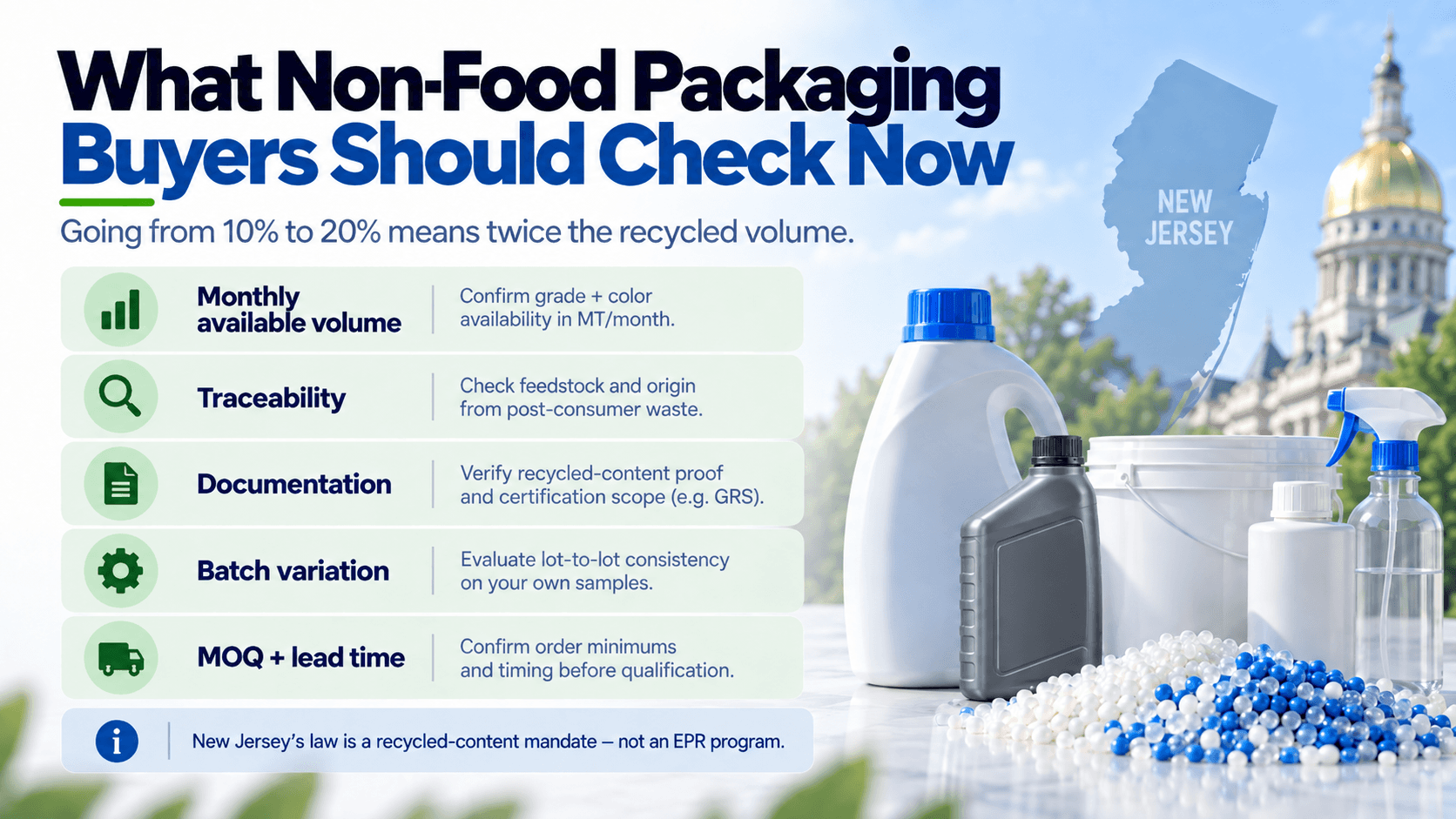
Going from 10% to 20% is not only a paperwork change — it is twice the recycled volume. Qualification, sampling and contracting also tend to take longer than the compliance date makes it look. Points worth confirming with a supplier before committing:
Monthly available volume at the grade and color required, stated in MT per month rather than as capacity.
Feedstock and origin traceability, since PCR eligibility under the law turns on material collected and recycled from the solid waste stream after consumer use.
Recycled content documentation — certification scope (for example the Global Recycled Standard, GRS), what the certificate covers, and how content percentage is evidenced per shipment.
Batch-to-batch variation in the properties relevant to the part, evaluated on your own samples rather than on a datasheet alone.
Minimum order quantity and lead time, which determine whether a qualification cycle can realistically finish before the compliance year.
Buyers tracking recycled content rules in more than one state may want to read this alongside California's SB 54 PCR content requirements and the wider picture of divergent US state programs. One distinction helps here: New Jersey's law is a recycled content mandate, not a packaging extended producer responsibility (EPR) program, which is why it is usually counted separately from the EPR states.

Frequently Asked Questions
Did New Jersey delay its entire recycled content mandate? No — the September 2, 2026 memo extended the temporary exemption for food-contact packaging only, from January 18, 2027 to December 31, 2029, and did not change the requirements for non-food rigid containers, beverage containers, glass containers or carryout bags.
What recycled content will non-food rigid plastic containers require in 2027? 20% postconsumer recycled content on average, up from the 10% minimum that has applied since January 18, 2024, according to NJDEP's published compliance schedule.
Which containers count as rigid plastic containers under the law? Plastic containers with a relatively inflexible finite shape and a capacity between eight fluid ounces and five fluid gallons.
Does the delay reduce demand for recycled HDPE and PP? Not for non-food applications. The extension applies to packaging that contains food, so obligations tied to non-food rigid packaging remain on their original schedule.
About This Article
Informational summary as of September 2026, based on NJDEP's published compliance guidance and trade reporting on the department's September 2, 2026 memo. It is not legal advice. Compliance percentages, definitions and exemption status should be confirmed against the current text of P.L.2021, c.391 and NJDEP guidance before they are relied on.
Image generated with ChatGPT
Sources
NJDEP Division of Sustainable Waste Management, "Recycled Content Law — Frequently Asked Questions" → Read the Source
Resource Recycling, "New Jersey pushes back PCR mandate to 2030" → Read the Source
Waste Dive, "New Jersey delays PCR requirements for food-contact packaging to 2030" → Read the Source
On September 2, 2026, the New Jersey Department of Environmental Protection (NJDEP) issued a memo extending the temporary exemption for food-contact packaging under the state's recycled content law. The exemption had been set to expire on January 18, 2027; it now runs to December 31, 2029. Trade coverage read the change as New Jersey pushing its recycled content mandate back. That is true of the one category that was extended. It is misleading for all the others.
New Jersey's law, P.L.2021, c.391, is generally described as the broadest recycled content mandate in the United States. Its postconsumer recycled (PCR) content requirements took effect on January 18, 2024 and rise on a fixed schedule. The September memo changed one line of that schedule — and it was not the line non-food rigid packaging buyers need to watch.
What NJDEP Actually Changed in the Recycled Content Law
The extension covers packages and containers that hold food, and nothing else. NJDEP's stated reason is scale: the department said the technologies for making food-safe PCR are not yet at a scale that would justify a mandate, and that it expects supply to be more robust by 2030. The memo also leaves room for a further extension if the department decides one is warranted.
Every other regulated category stays where it was. Plastic beverage containers, glass containers, plastic and paper carryout bags, and non-food rigid plastic containers all remain on the schedule NJDEP publishes in its own compliance guidance.
The Non-Food Rigid Requirement Doubles in 2027
The law defines a rigid plastic container as a plastic container with a relatively inflexible fixed shape and a capacity between eight fluid ounces and five fluid gallons. NJDEP's compliance schedule sets these minimums:
Compliance year | Rigid plastic containers | Plastic beverage containers | Plastic carryout bags |
|---|---|---|---|
2024 | 10% | 15% | 20% |
2027 | 20% | 20% | 40% |
2030 | 30% | 25% | - |
2033 | 40% | 30% | - |
2036 | 50% | 35% | - |
Three things stand out. The non-food rigid requirement does not creep up — it doubles, from 10% to 20%. Carryout bags double too, from 20% to 40%. And 2027 was also the year the food-contact exemption was originally due to end, so the delay lifted one obligation off that year and left the rest of them there.
For sourcing, the conclusion is simple. This memo does not push back demand for non-food-grade rHDPE and rPP with documented recycled content. Only the food-grade segment moved.
Why Recyclers Pushed Back
The Association of Plastic Recyclers (APR) objected. The group said the extension discounts the proven use and availability of food-grade PCR, which it noted has been used safely for more than three decades. It also warned that recyclers who already invested in capacity for the 2027 date now face stranded assets — equipment bought for demand that has just been pushed out three years. KW Plastics, a reclaimer, said HDPE and PP material remains readily available.
The two sides are answering different questions. NJDEP is talking about processing capacity — whether food-grade PCR can be made at the scale a statewide mandate would demand. The recyclers are talking about material — whether recycled HDPE and PP resin is available to buy. Both can be true at once, and neither question touches non-food packaging, which was never part of the dispute. One thing the exchange does confirm: capacity built for the 2027 date exists, which is why its owners are objecting to the delay. Whether it is available in your grade and your volume is a question for a supplier, not for a news article.
What Non-Food Packaging Buyers Should Check Now
Going from 10% to 20% is not only a paperwork change — it is twice the recycled volume. Qualification, sampling and contracting also tend to take longer than the compliance date makes it look. Points worth confirming with a supplier before committing:
Monthly available volume at the grade and color required, stated in MT per month rather than as capacity.
Feedstock and origin traceability, since PCR eligibility under the law turns on material collected and recycled from the solid waste stream after consumer use.
Recycled content documentation — certification scope (for example the Global Recycled Standard, GRS), what the certificate covers, and how content percentage is evidenced per shipment.
Batch-to-batch variation in the properties relevant to the part, evaluated on your own samples rather than on a datasheet alone.
Minimum order quantity and lead time, which determine whether a qualification cycle can realistically finish before the compliance year.
Buyers tracking recycled content rules in more than one state may want to read this alongside California's SB 54 PCR content requirements and the wider picture of divergent US state programs. One distinction helps here: New Jersey's law is a recycled content mandate, not a packaging extended producer responsibility (EPR) program, which is why it is usually counted separately from the EPR states.
Frequently Asked Questions
Did New Jersey delay its entire recycled content mandate? No — the September 2, 2026 memo extended the temporary exemption for food-contact packaging only, from January 18, 2027 to December 31, 2029, and did not change the requirements for non-food rigid containers, beverage containers, glass containers or carryout bags.
What recycled content will non-food rigid plastic containers require in 2027? 20% postconsumer recycled content on average, up from the 10% minimum that has applied since January 18, 2024, according to NJDEP's published compliance schedule.
Which containers count as rigid plastic containers under the law? Plastic containers with a relatively inflexible finite shape and a capacity between eight fluid ounces and five fluid gallons.
Does the delay reduce demand for recycled HDPE and PP? Not for non-food applications. The extension applies to packaging that contains food, so obligations tied to non-food rigid packaging remain on their original schedule.
About This Article
Informational summary as of September 2026, based on NJDEP's published compliance guidance and trade reporting on the department's September 2, 2026 memo. It is not legal advice. Compliance percentages, definitions and exemption status should be confirmed against the current text of P.L.2021, c.391 and NJDEP guidance before they are relied on.
Image generated with ChatGPT
Sources
NJDEP Division of Sustainable Waste Management, "Recycled Content Law — Frequently Asked Questions" → Read the Source
Resource Recycling, "New Jersey pushes back PCR mandate to 2030" → Read the Source
Waste Dive, "New Jersey delays PCR requirements for food-contact packaging to 2030" → Read the Source
Sourcing for the 2027 Step
Grades • Specs • Availability
Browse rHDPE →
Sourcing for the 2027 Step
Sourcing for the 2027 Step
Non-food rigid packaging moves to 20% PCR. Review available recycled HDPE grades by feedstock, properties, stock and MOQ.
Non-food rigid packaging moves to 20% PCR. Review available recycled HDPE grades by feedstock, properties, stock and MOQ.
Browse rHDPE →
Browse rHDPE →
Looking for samples or ready to source? Submit your request for pricing, availability, and technical information.
Looking for samples or ready to source? Submit your request for pricing, availability, and technical information.
Request a Quote →
Request a Quote →
Posted by REGENPORT
REGENPORT is a global platform connecting buyers and suppliers in the recycled materials and sustainable packaging industries.