CATEGORY
CATEGORY
Trend
Trend
Trend
Virgin PP Splits Asia From Europe as Recycled Holds Flat – Week 3, September 2026
Virgin PP Splits Asia From Europe as Recycled Holds Flat – Week 3, September 2026
Virgin PP Splits Asia From Europe as Recycled Holds Flat – Week 3, September 2026
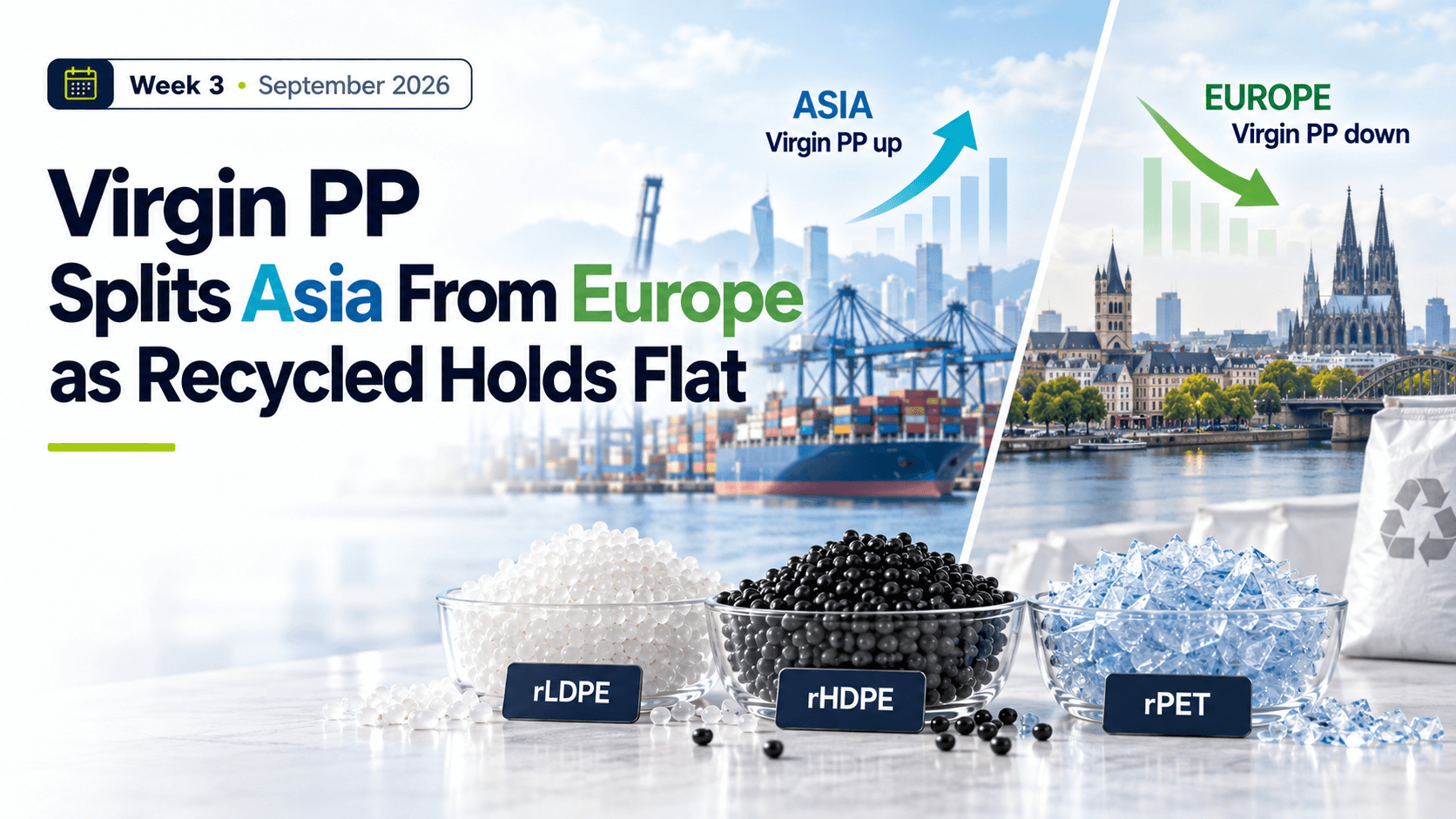
The regional split flagged last week widened rather than narrowed: Asian virgin polypropylene (PP) rose for a second consecutive week on a renewed crude rally; European PP fell on oversupply, while European low-density polyethylene (LDPE) and linear low-density polyethylene (LLDPE) declined on weak buyer appetite; and US recycled high-density polyethylene (rHDPE) and recycled LDPE (rLDPE) remained unchanged. Brazil's August polyethylene (PE) import volume fell 36% from July.
Virgin polymer markets moved in opposite directions by region this week while recycled grades in the Americas held still for a second consecutive week. In Asia, Chinese domestic raffia PP, Vietnamese PP and Southeast Asian PP all gained as producers tracked a renewed crude rally, even though China's expected "Golden September" demand recovery did not materialize. In Europe, PP spot prices fell further on oversupply, and LDPE and linear low-density polyethylene (LLDPE) spot prices fell on weak buyer appetite despite reduced availability. US PE rose on stronger export demand into Asia and Africa, and US PP rose as producers withdrew homopolymer export offers amid tighter supply following a strong August selling period. Recycled PET (rPET), rHDPE and rLDPE in the US were broadly unchanged, while southern Brazil rPET bales and flakes eased. Price observations in this report are as of Sept. 15, 2026.
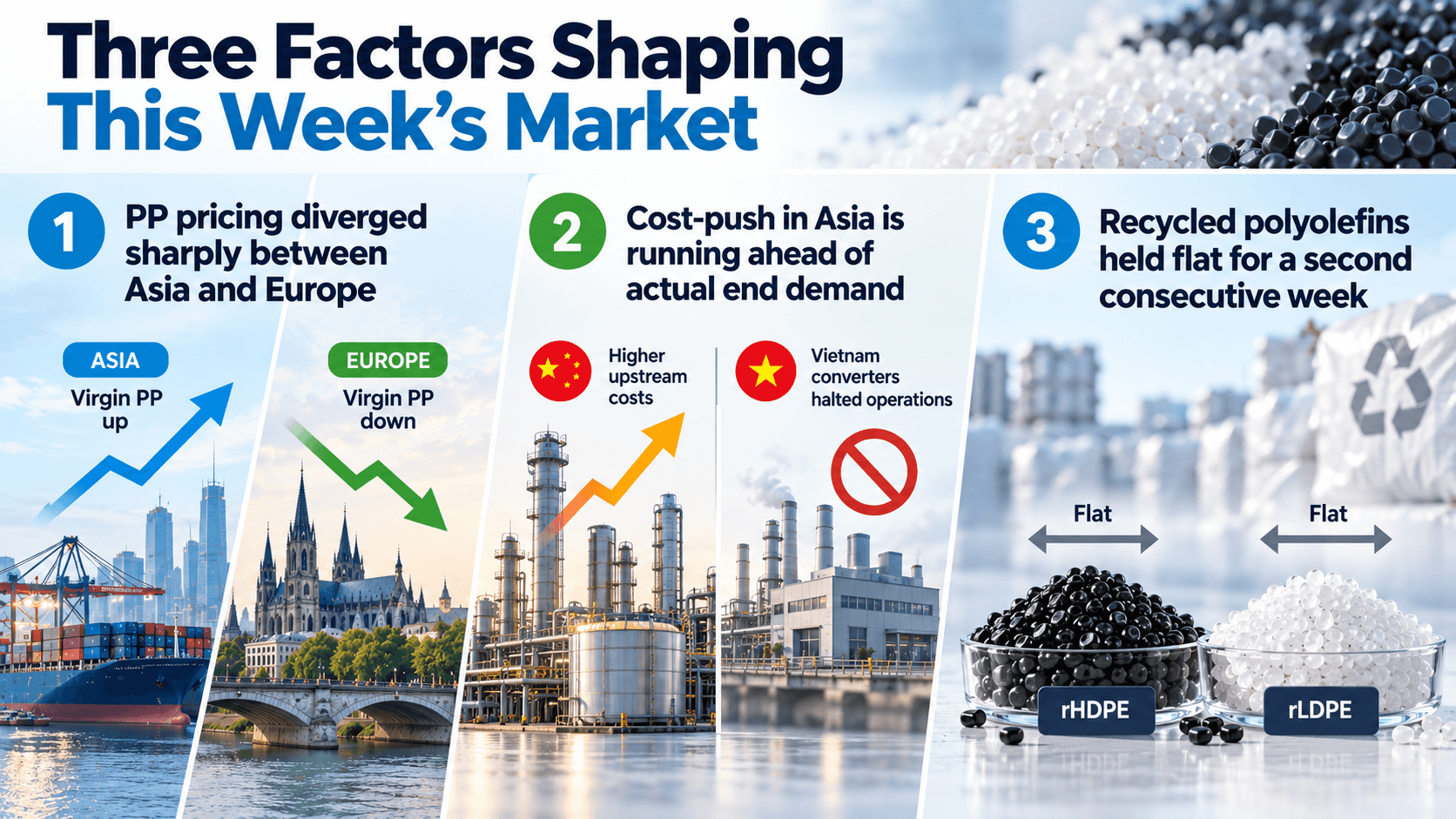
Three Factors Shaping This Week's Market
1. PP pricing diverged sharply between Asia and Europe Asian PP followed crude higher for a second straight week while European PP spot prices fell further on oversupply — a widening of the divergence noted in last week's report rather than a correction of it. For buyers running multi-region sourcing, this means a single global PP reference point is unlikely to describe either market accurately right now, and offers may need to be assessed against the region they originate from.
2. Cost-push in Asia is running ahead of actual end demand China's traditionally stronger September restocking period was reported as disappointing, and Asian PE prices fluctuated by region rather than following the crude move cleanly. In Vietnam, converters reportedly halted operations, unable to sustain margins at current PP levels. The available signals suggest that the increase was driven more by upstream cost pressure than by any confirmed improvement in consumption. Such cost-driven gains may not hold if converter buying does not return.
3. Recycled polyolefins held flat for a second consecutive week US rHDPE and rLDPE prices remained unchanged while virgin PP in Asia gained for a second week and virgin PE moved differently in each region. Heading into what is usually a fourth-quarter demand peak, recycled and virgin markets in these grades continued to price on separate drivers.
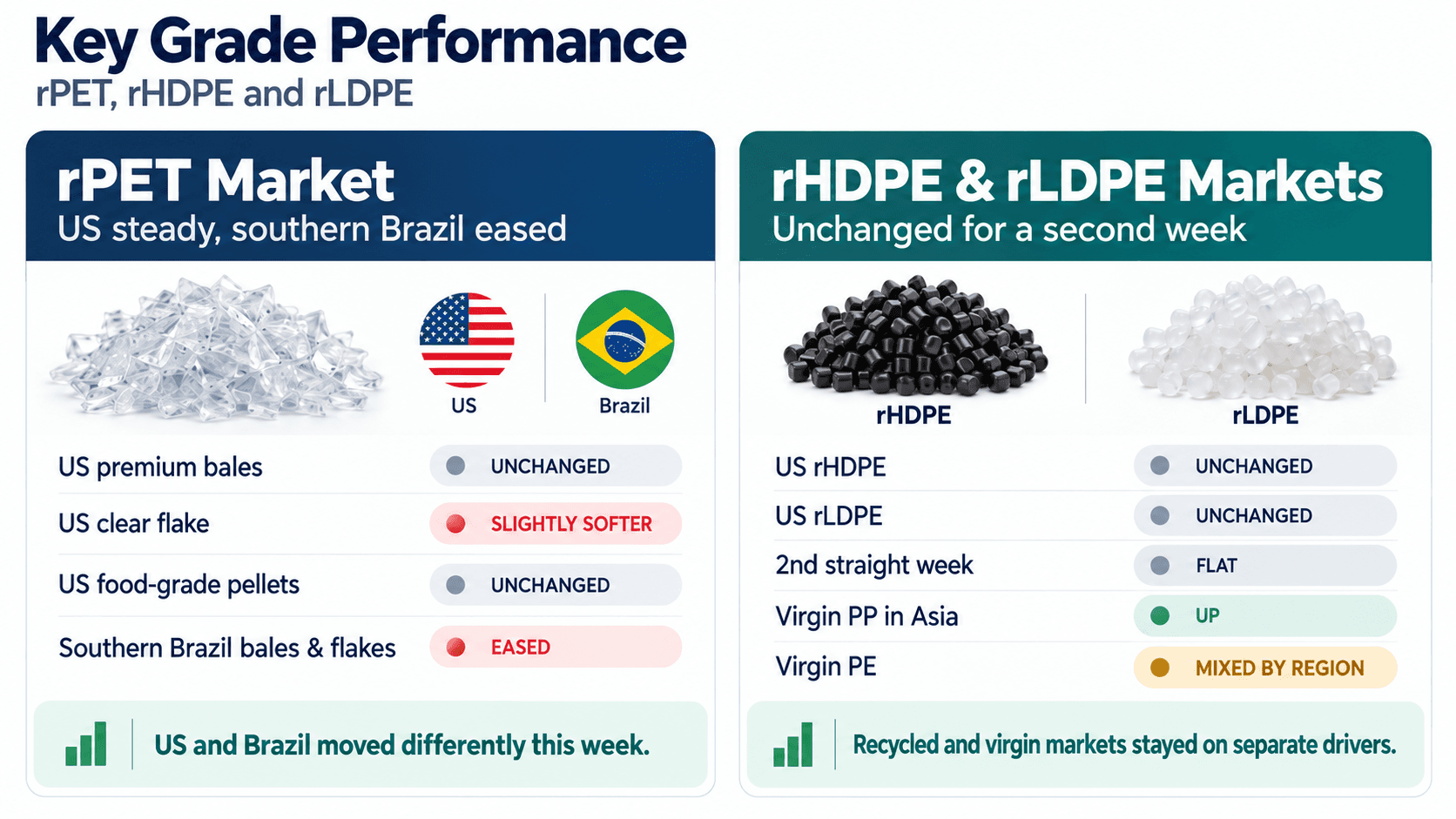
Key Grade Performance: rPET, rHDPE and rLDPE
rPET Market — US steady, southern Brazil eased Premium bale prices in major US cities were unchanged this week, clear flake softened slightly, and food-grade pellets were unchanged. Southern Brazil showed the clearest directional move: clear and green bottle bales and flakes all eased, a modest softening after several weeks of Brazilian rPET strength. Why it matters: the US and Brazilian rPET markets moved differently this week after a period of parallel firmness. Buyers comparing offers across the two origins may want to confirm which market a quote is benchmarked to before treating a price change as regional.
rHDPE and rLDPE Markets — unchanged for a second week US recycled HDPE and LDPE prices stayed flat while Asian virgin PP gained for a second straight week and virgin PE moved inconsistently by region. The gap between the two markets did not narrow as Q4 approaches. Why it matters: an rHDPE or rLDPE offer that cites virgin or crude movement as the reason for an increase may not reflect what the recycled market did this week. Buyers may want to ask how a quote was built before accepting an escalation indexed to the virgin complex.
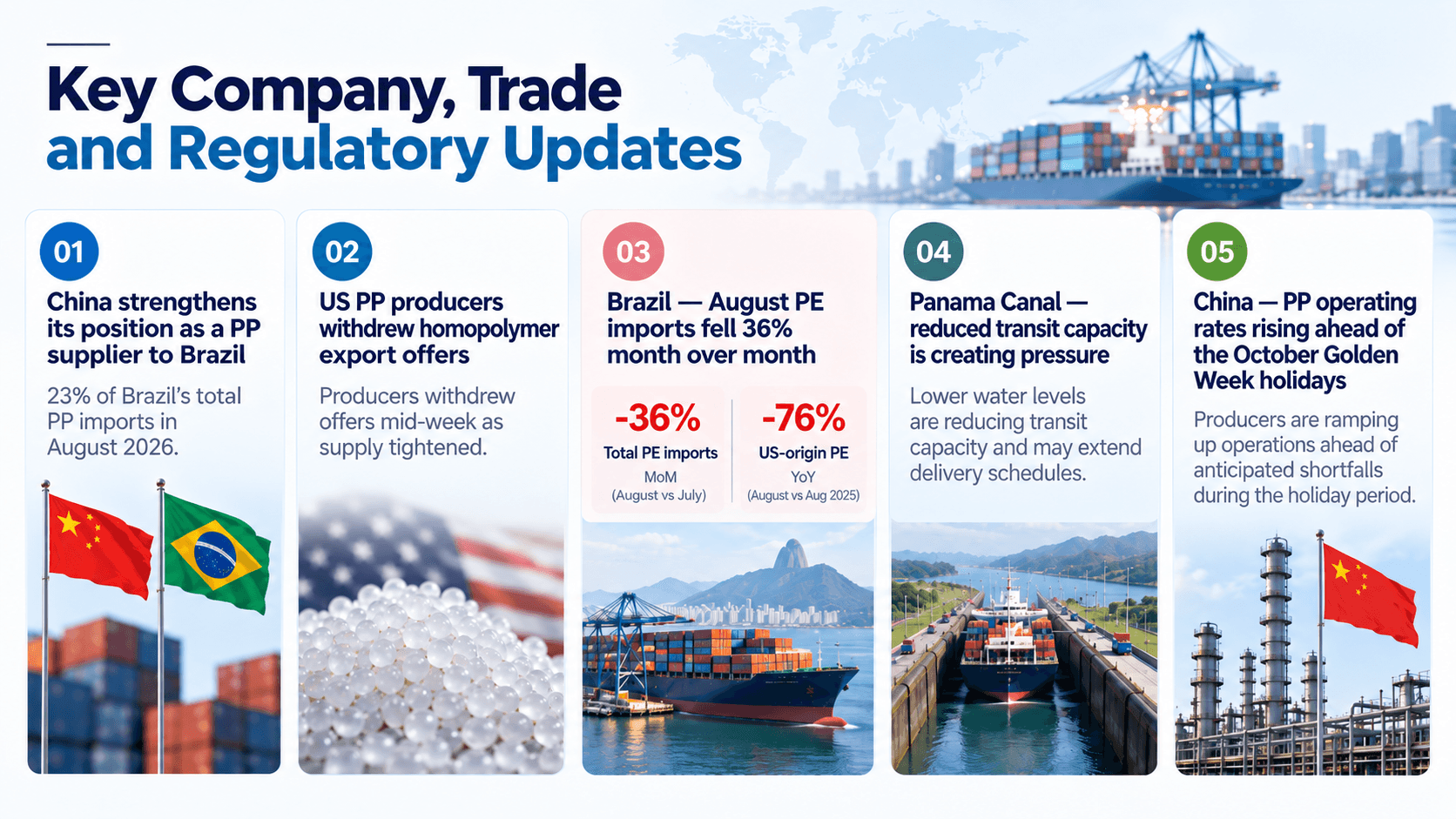
Key Company, Trade and Regulatory Updates
China strengthened its position as a PP supplier to Brazil, accounting for 23% of Brazil's total PP imports in August 2026.
US PP producers withdrew homopolymer export offers. US producers were reported withdrawing PP homopolymer export offers mid-week as supply tightened following a strong August selling period. Buyers sourcing US-origin homopolymer should confirm offer validity before planning Q4 cargoes.
Brazil — August PE imports fell 36% month over month. Data released by Brazil's Ministry of Development, Industry, Trade and Services showed an August decline of 36% from July and 29% below the year-ago period. US-origin PE volumes into Brazil fell 76% year over year in August alone as better netbacks elsewhere drew US supply away from the market. Two trade measures continued to affect US-origin PE: the definitive anti-dumping duty of $199.04 per tonne, confirmed for five years in March 2026 at the earlier provisional level, and the 20% import tariff on resins, renewed for a further 12 months on Aug. 27, 2026 and covered in last week's report. Together they remained the central structural factor keeping US material less competitive than Egypt-origin supply, which is exempt under a bilateral trade agreement.
Panama Canal — reduced transit capacity is creating booking and scheduling pressure. Lower water levels have reduced available transit capacity and may extend delivery schedules for US-origin shipments into West Coast South America. The Canal authority postponed a further draft reduction for Neopanamax vessels in September 2026, so the current constraint sits with transit slots and schedule reliability rather than with maximum vessel draft. As of this week the effect appeared to be concentrated in delivery timing rather than in freight rates or US resin pricing.
China — PP operating rates rising ahead of the October Golden Week holidays. Producers were reported ramping PP operations ahead of anticipated output shortfalls during the Golden Week holiday period in October, adding a seasonal supply consideration on top of already-tight domestic inventories.
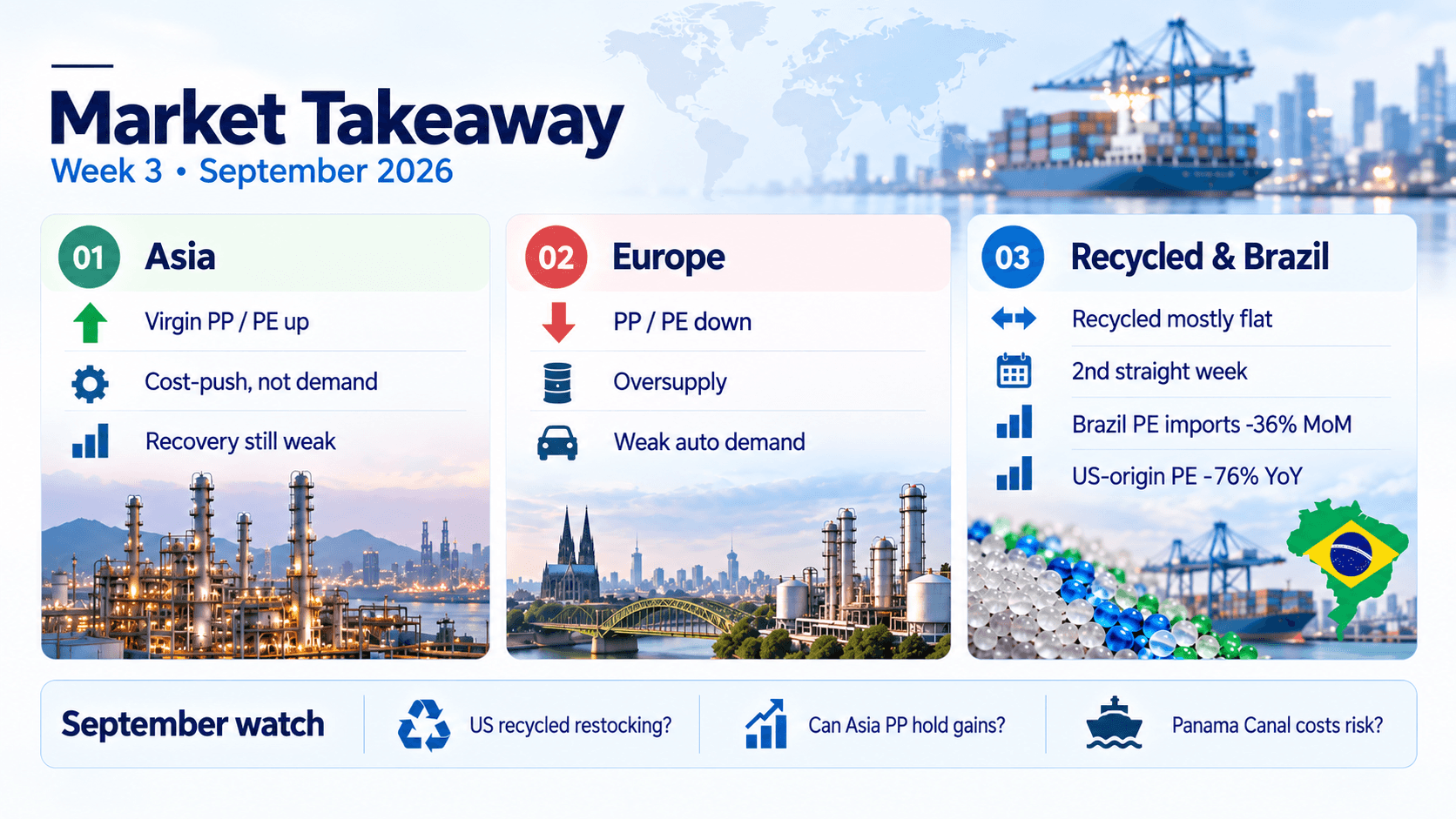
Market Takeaway
The clearest theme this week was the widening gap between Asia, where crude-driven costs kept pushing PP and to a lesser extent PE higher despite a disappointing seasonal demand recovery, and Europe, where oversupply and weak end-market conditions — automotive in particular — pushed PP and PE spot prices lower. Recycled polymer markets showed essentially no reaction for a second consecutive week, holding flat across nearly every grade. Brazil's import channel narrowed at the same time: a 36% month-over-month drop in PE imports with US-origin volumes down 76% year over year shows how far the duty and tariff structure has redirected trade flows toward Egypt-origin supply. With China's Golden Week approaching and the disconnect between Asian cost-push and actual end demand unresolved, virgin markets may stay choppy through the rest of September.
September watch: whether Q4 restocking finally moves US recycled bale and pellet prices, whether Asian PP can hold gains built on cost rather than demand, and whether Panama Canal transit constraints begin to show up in landed costs for West Coast South America.
Regenport will continue monitoring market conditions and sharing updates as the picture develops.
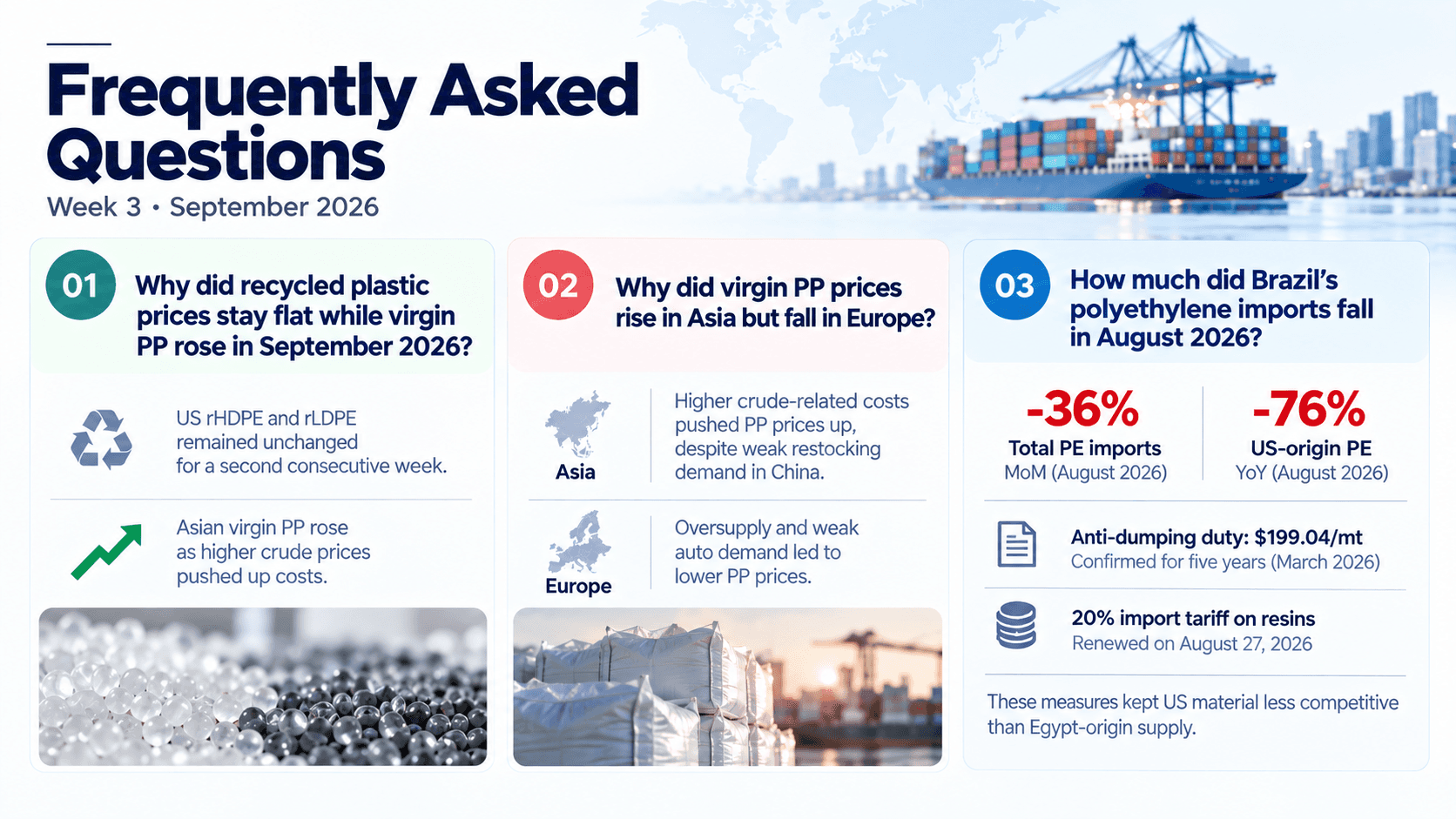
Frequently Asked Questions
Why did recycled plastic prices stay flat while virgin PP rose in September 2026? US rHDPE and rLDPE prices were unchanged for a second consecutive week because they continued to reflect domestic bale availability, collection economics and recycled-resin demand. Asian virgin PP, by contrast, rose as higher crude prices moved through the naphtha and propylene cost chain. The two markets responded to different pricing drivers during the same week, and the gap did not narrow going into the fourth-quarter demand period.
Why did virgin PP prices rise in Asia but fall in Europe? Asian PP prices rose as producers and sellers followed higher crude-related costs, while European PP spot prices fell over the same week on oversupply and weak buyer appetite, with weak automotive demand identified as a particular drag. The divergence reflected different regional balances: cost pressure in Asia against availability and demand weakness in Europe. In Asia the increase came despite a disappointing September restocking period in China and reports of Vietnamese converters halting operations over margins.
How much did Brazil's polyethylene imports fall in August 2026? Brazil's PE imports fell 36% month over month in August 2026 and were 29% below the year-ago period, according to data from the Ministry of Development, Industry, Trade and Services. US-origin PE volumes fell 76% year over year in the month. Two trade measures continued to affect US-origin PE: the definitive anti-dumping duty of $199.04 per tonne, confirmed for five years in March 2026, and the 20% import tariff on resins renewed on Aug. 27, 2026. Together they kept US material less competitive than Egypt-origin supply, which is exempt under a bilateral trade agreement.
Image generated with ChatGPT
Virgin polymer markets moved in opposite directions by region this week while recycled grades in the Americas held still for a second consecutive week. In Asia, Chinese domestic raffia PP, Vietnamese PP and Southeast Asian PP all gained as producers tracked a renewed crude rally, even though China's expected "Golden September" demand recovery did not materialize. In Europe, PP spot prices fell further on oversupply, and LDPE and linear low-density polyethylene (LLDPE) spot prices fell on weak buyer appetite despite reduced availability. US PE rose on stronger export demand into Asia and Africa, and US PP rose as producers withdrew homopolymer export offers amid tighter supply following a strong August selling period. Recycled PET (rPET), rHDPE and rLDPE in the US were broadly unchanged, while southern Brazil rPET bales and flakes eased. Price observations in this report are as of Sept. 15, 2026.
Three Factors Shaping This Week's Market
1. PP pricing diverged sharply between Asia and Europe Asian PP followed crude higher for a second straight week while European PP spot prices fell further on oversupply — a widening of the divergence noted in last week's report rather than a correction of it. For buyers running multi-region sourcing, this means a single global PP reference point is unlikely to describe either market accurately right now, and offers may need to be assessed against the region they originate from.
2. Cost-push in Asia is running ahead of actual end demand China's traditionally stronger September restocking period was reported as disappointing, and Asian PE prices fluctuated by region rather than following the crude move cleanly. In Vietnam, converters reportedly halted operations, unable to sustain margins at current PP levels. The available signals suggest that the increase was driven more by upstream cost pressure than by any confirmed improvement in consumption. Such cost-driven gains may not hold if converter buying does not return.
3. Recycled polyolefins held flat for a second consecutive week US rHDPE and rLDPE prices remained unchanged while virgin PP in Asia gained for a second week and virgin PE moved differently in each region. Heading into what is usually a fourth-quarter demand peak, recycled and virgin markets in these grades continued to price on separate drivers.
Key Grade Performance: rPET, rHDPE and rLDPE
rPET Market — US steady, southern Brazil eased Premium bale prices in major US cities were unchanged this week, clear flake softened slightly, and food-grade pellets were unchanged. Southern Brazil showed the clearest directional move: clear and green bottle bales and flakes all eased, a modest softening after several weeks of Brazilian rPET strength. Why it matters: the US and Brazilian rPET markets moved differently this week after a period of parallel firmness. Buyers comparing offers across the two origins may want to confirm which market a quote is benchmarked to before treating a price change as regional.
rHDPE and rLDPE Markets — unchanged for a second week US recycled HDPE and LDPE prices stayed flat while Asian virgin PP gained for a second straight week and virgin PE moved inconsistently by region. The gap between the two markets did not narrow as Q4 approaches. Why it matters: an rHDPE or rLDPE offer that cites virgin or crude movement as the reason for an increase may not reflect what the recycled market did this week. Buyers may want to ask how a quote was built before accepting an escalation indexed to the virgin complex.
Key Company, Trade and Regulatory Updates
China strengthened its position as a PP supplier to Brazil, accounting for 23% of Brazil's total PP imports in August 2026.
US PP producers withdrew homopolymer export offers. US producers were reported withdrawing PP homopolymer export offers mid-week as supply tightened following a strong August selling period. Buyers sourcing US-origin homopolymer should confirm offer validity before planning Q4 cargoes.
Brazil — August PE imports fell 36% month over month. Data released by Brazil's Ministry of Development, Industry, Trade and Services showed an August decline of 36% from July and 29% below the year-ago period. US-origin PE volumes into Brazil fell 76% year over year in August alone as better netbacks elsewhere drew US supply away from the market. Two trade measures continued to affect US-origin PE: the definitive anti-dumping duty of $199.04 per tonne, confirmed for five years in March 2026 at the earlier provisional level, and the 20% import tariff on resins, renewed for a further 12 months on Aug. 27, 2026 and covered in last week's report. Together they remained the central structural factor keeping US material less competitive than Egypt-origin supply, which is exempt under a bilateral trade agreement.
Panama Canal — reduced transit capacity is creating booking and scheduling pressure. Lower water levels have reduced available transit capacity and may extend delivery schedules for US-origin shipments into West Coast South America. The Canal authority postponed a further draft reduction for Neopanamax vessels in September 2026, so the current constraint sits with transit slots and schedule reliability rather than with maximum vessel draft. As of this week the effect appeared to be concentrated in delivery timing rather than in freight rates or US resin pricing.
China — PP operating rates rising ahead of the October Golden Week holidays. Producers were reported ramping PP operations ahead of anticipated output shortfalls during the Golden Week holiday period in October, adding a seasonal supply consideration on top of already-tight domestic inventories.
Market Takeaway
The clearest theme this week was the widening gap between Asia, where crude-driven costs kept pushing PP and to a lesser extent PE higher despite a disappointing seasonal demand recovery, and Europe, where oversupply and weak end-market conditions — automotive in particular — pushed PP and PE spot prices lower. Recycled polymer markets showed essentially no reaction for a second consecutive week, holding flat across nearly every grade. Brazil's import channel narrowed at the same time: a 36% month-over-month drop in PE imports with US-origin volumes down 76% year over year shows how far the duty and tariff structure has redirected trade flows toward Egypt-origin supply. With China's Golden Week approaching and the disconnect between Asian cost-push and actual end demand unresolved, virgin markets may stay choppy through the rest of September.
September watch: whether Q4 restocking finally moves US recycled bale and pellet prices, whether Asian PP can hold gains built on cost rather than demand, and whether Panama Canal transit constraints begin to show up in landed costs for West Coast South America.
Regenport will continue monitoring market conditions and sharing updates as the picture develops.
Frequently Asked Questions
Why did recycled plastic prices stay flat while virgin PP rose in September 2026? US rHDPE and rLDPE prices were unchanged for a second consecutive week because they continued to reflect domestic bale availability, collection economics and recycled-resin demand. Asian virgin PP, by contrast, rose as higher crude prices moved through the naphtha and propylene cost chain. The two markets responded to different pricing drivers during the same week, and the gap did not narrow going into the fourth-quarter demand period.
Why did virgin PP prices rise in Asia but fall in Europe? Asian PP prices rose as producers and sellers followed higher crude-related costs, while European PP spot prices fell over the same week on oversupply and weak buyer appetite, with weak automotive demand identified as a particular drag. The divergence reflected different regional balances: cost pressure in Asia against availability and demand weakness in Europe. In Asia the increase came despite a disappointing September restocking period in China and reports of Vietnamese converters halting operations over margins.
How much did Brazil's polyethylene imports fall in August 2026? Brazil's PE imports fell 36% month over month in August 2026 and were 29% below the year-ago period, according to data from the Ministry of Development, Industry, Trade and Services. US-origin PE volumes fell 76% year over year in the month. Two trade measures continued to affect US-origin PE: the definitive anti-dumping duty of $199.04 per tonne, confirmed for five years in March 2026, and the 20% import tariff on resins renewed on Aug. 27, 2026. Together they kept US material less competitive than Egypt-origin supply, which is exempt under a bilateral trade agreement.
Image generated with ChatGPT
Where rPP Sits This Week
Grades • Specs • Availability
Browse rPP →
Where rPP Sits This Week
Where rPP Sits This Week
Review rPP grades by feedstock, MFI, stock and MOQ.
Review rPP grades by feedstock, MFI, stock and MOQ.
Browse rPP →
Browse rPP →
Looking for samples or ready to source? Submit your request for pricing, availability, and technical information.
Looking for samples or ready to source? Submit your request for pricing, availability, and technical information.
Request a Quote →
Request a Quote →
Posted by REGENPORT
REGENPORT is a global platform connecting buyers and suppliers in the recycled materials and sustainable packaging industries.