CATEGORY
CATEGORY
News
News
News
US E-Plastics Recovery Gains Ground in 2026: What It Means for Recycled ABS and HIPS Buyers
US E-Plastics Recovery Gains Ground in 2026: What It Means for Recycled ABS and HIPS Buyers
US E-Plastics Recovery Gains Ground in 2026: What It Means for Recycled ABS and HIPS Buyers
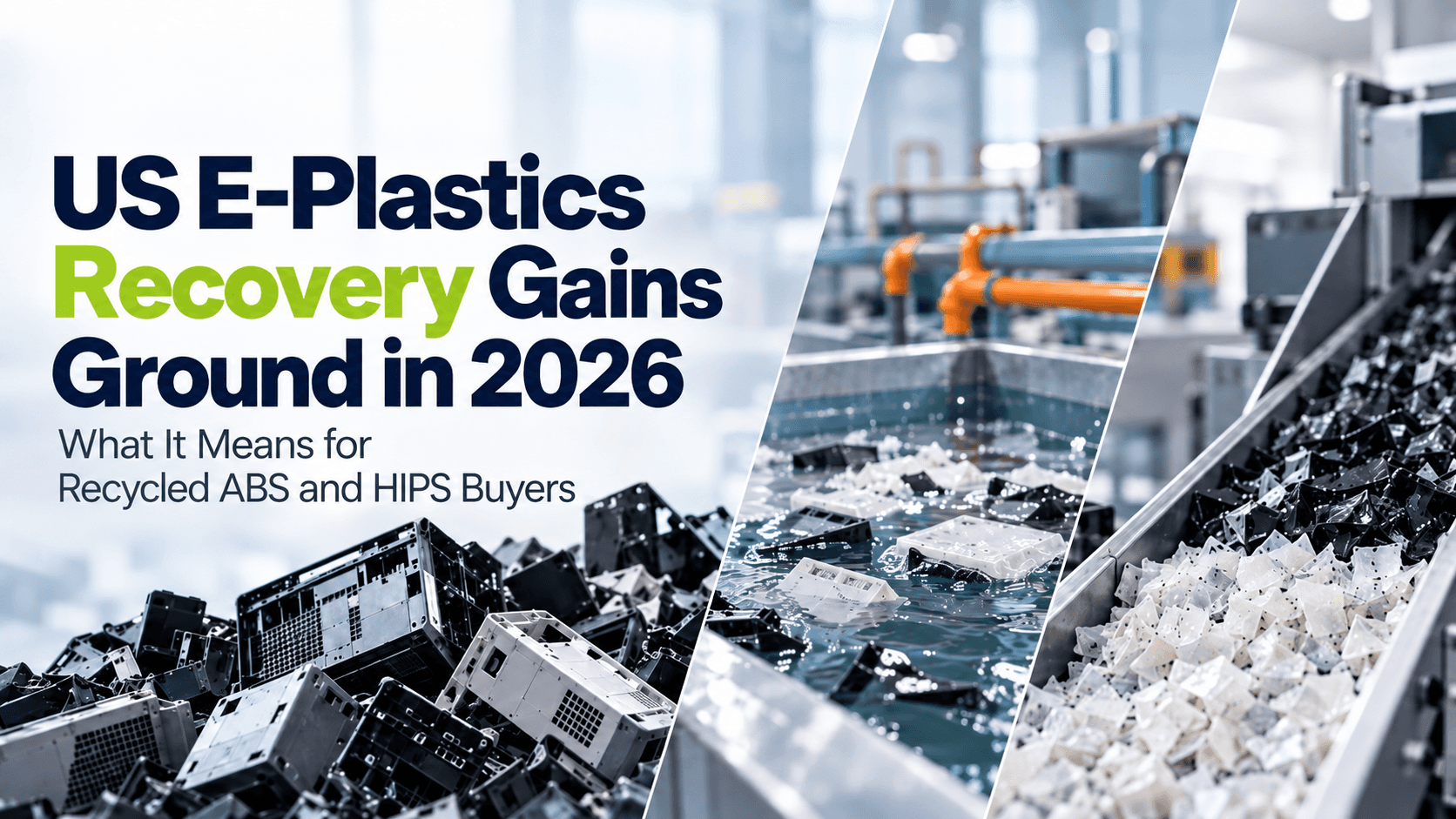
US processors are scaling domestic recovery of electronics-derived ABS and HIPS — driven by closing export channels abroad and Basel Convention classification rules, not a company announcement. This doesn't mean US recovery is yet a stable, traceable supply source — it changes which questions buyers can expect any supplier to answer. Written for buyers who assume "recycled engineering resin" means import-dependent, hard-to-trace supply.
Electronics-derived plastics — mainly acrylonitrile-butadiene-styrene (ABS), high-impact polystyrene (HIPS) and polycarbonate (PC) pulled from end-of-life devices — have historically moved through long, export-heavy supply chains before reaching a compounder. (The reporting behind this piece covers all three resins, but its separation specifics concentrate on ABS and HIPS.) Trade coverage in late September 2026 describes a slower, less visible shift: as manufacturers face new pressure to source raw materials from North America, US processors are investing directly in domestic separation capacity, through two differing approaches.
The critical-minerals nearshoring story moves on geopolitical urgency and high-profile funding. E-plastics recovery is scaling more quietly, with comparatively little fanfare. That makes it easy to miss. It matters mainly to buyers who already specify recycled ABS or HIPS and want to know what "domestic" and "traceable" actually require upstream.

Two Approaches, One Direction
The reporting describes two differing approaches among US e-plastics processors. (This article uses the distinction to organize the reporting; it isn't a formal industry classification.) One processor pairs a domestic separator with an overseas partner for electrostatic separation and compounding — an alliance that spans separation, compounding and injection molding. The other keeps the full chain — collection, separation and sale — inside the US, investing in its own equipment instead of contracting pieces out.
Both are reported to treat the same thing as the real constraint: producing a clean, specification-ready output, not simply collecting more material. Collection volume alone doesn't get recovered ABS or HIPS into an electronics supply chain. Sink-float tanks separate resin families by density, using water and salt-density adjustment. Electrostatic separation works differently — it's reported to reach up to 99% purity on streams where optical sorters struggle, particularly black-pigmented housings that optical sensors can't read.

Why This Is Accelerating Now
Domestic investment in e-scrap processing isn't happening in isolation. Separate industry reporting from March 2026 covers the broader US e-scrap sector — mainly metals and critical-minerals recovery, not plastics specifically. It points to two pressures that plausibly extend to plastics too. First, US policy increasingly treats e-scrap as a domestic resource rather than waste, with new federal funding going toward processing and recovery capacity. Second, several Southeast Asian governments have tightened or closed the informal import and re-export channels that used to absorb much of US e-scrap — echoing the enforcement pattern that followed China's National Sword policy. Neither data point is plastics-specific. But both describe the same export-channel environment that makes domestic recovery of ABS, HIPS and similar e-plastics more attractive, across resin types.

The Basel Rule That Actually Decides What Can Be Exported
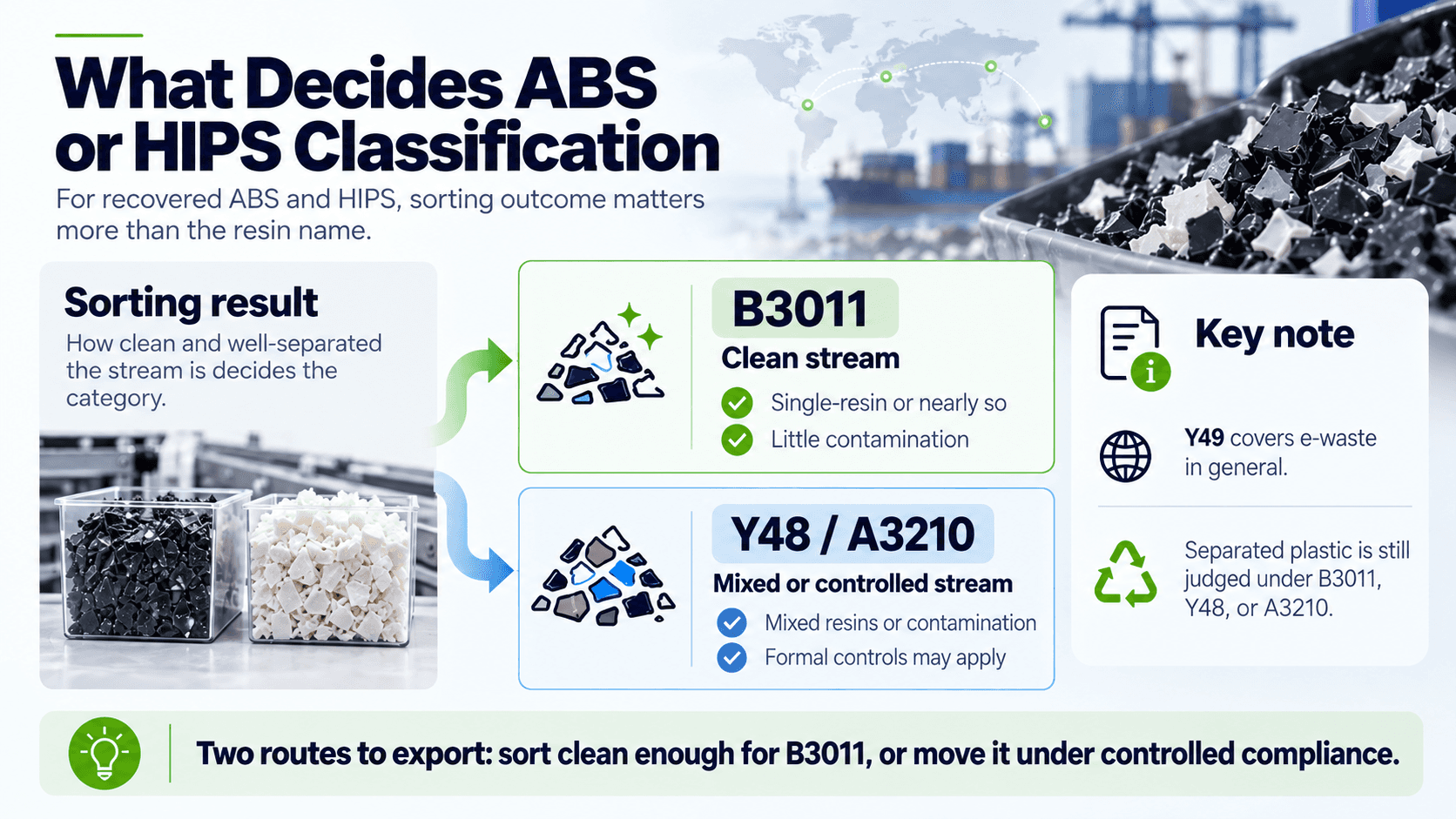
Here's the compliance mechanism behind this, in plain terms. The Basel Convention is the international treaty that governs waste shipped across borders. It sorts plastic waste into three categories, based mostly on how well-sorted and how clean it is:
Clean, single-resin material (code B3011). Plastic waste that's almost entirely one resin, with little to no contamination, headed for proper recycling. (US EPA guidance names ABS specifically, along with PE, PP, PET and PS.) Material that qualifies here generally skips Basel's formal pre-approval process.
Mixed or contaminated material (code Y48). Plastic waste that doesn't meet the bar above — mixed resins, contamination, or waste containing something like PVC, for example. Nothing hazardous enough to count as the next category, though. This has to go through Basel's formal pre-approval process before it can cross a border.
Hazardous material (code A3210). Plastic waste with enough flame retardant or another hazardous constituent in it to count as hazardous under Basel's rules. In some Basel jurisdictions, this applies even when the polymer fraction itself is otherwise highly pure.
What Decides ABS or HIPS Classification
For recovered ABS or HIPS, the sorting usually decides which category applies — not the resin itself. A single-resin ABS stream that's well separated and largely contamination-free can qualify for the clean category. A stream that still mixes two resins of similar density generally can't — for example, ABS and HIPS together from a float/sink process. That mixed outcome is actually the more common result when sorting stops at the first stage.
A separate set of Basel amendments, in effect since January 2025, added a new listing — Y49 — for non-hazardous electronic waste in general: devices, parts, residue. That listing covers e-waste as a category. Plastic pulled out of electronics is still judged under the three categories above, not this one.
One more wrinkle: the US hasn't joined the Basel Convention. So shipping mixed or hazardous plastic waste (Y48 or A3210) to a Basel-member country isn't automatic — it usually needs a separate agreement.
The OECD framework is an important route for US exporters in some cases. It provides an alternative control framework for certain Basel-regulated waste movements between participating OECD countries, though the fine print still depends on the countries and material involved. A properly sorted, clean shipment (B3011) generally doesn't need this arrangement — though the importing country's own rules can still apply separately.
In practice, a processor has two ways to get sellable, border-crossing material. One: sort it well enough to qualify as clean (B3011). Two: build out the compliance process to move it as regulated material (Y48 or A3210), through something like the OECD arrangement. Investing in sink-float and electrostatic separation — as described above — is one way of pursuing the first option.
Why Compliance, Not Cost, Is the Entry Barrier
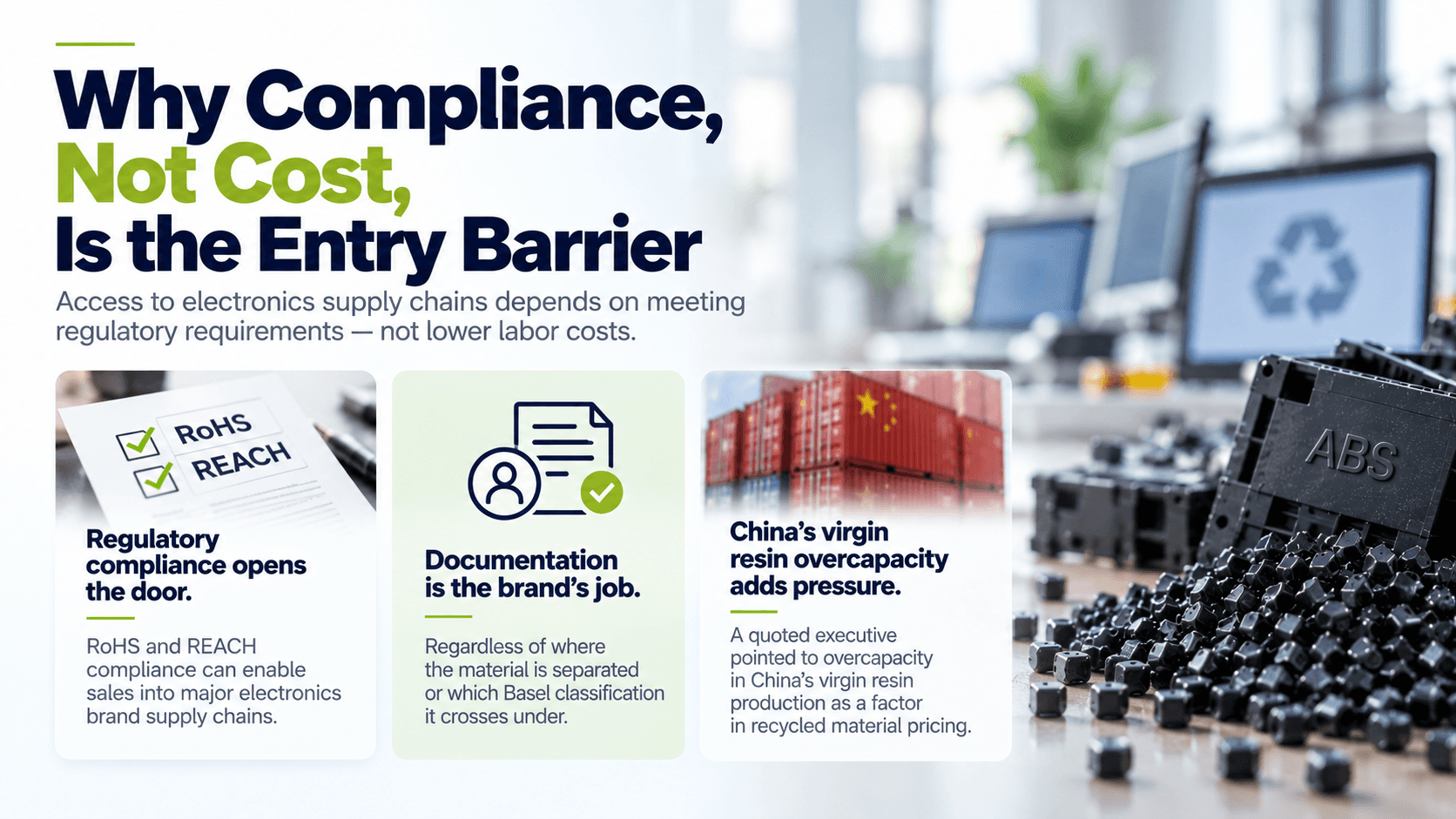
The processors quoted in the original reporting frame their investment case around compliance, not labor-cost arbitrage. The reporting cites one processor's ability to sell recycled resin into named electronics-brand supply chains as an example of how RoHS and REACH compliance can open that door. Documentation responsibility sits with the brand — regardless of where the material was separated, or which Basel classification it crossed any border under.
Separately, one processor's leadership pointed to overcapacity in China's virgin resin production as a competitive pressure on recycled material pricing. That's a quoted executive's characterization of the market, not an independently verified capacity figure. No public tonnage data for either processor's recovery volume was available at publication.

What This Means for ABS and HIPS Buyers
Domestic US recovery growth does not, on its own, change global pricing or availability for recycled ABS and HIPS — the reporting gives no volume figures that would support that claim. What it does confirm is which questions a buyer can now reasonably expect a supplier to answer, regardless of where that supplier is based:
Separation method and purity. Sink-float and electrostatic separation produce different purity profiles; ask which method applies to the specific grade and lot.
Basel classification, if material crossed a border. If the material moved internationally at any point, ask whether it qualified as clean, single-resin material (B3011) or moved as regulated material (Y48 or A3210) through a valid channel such as an OECD agreement.
Feedstock stream. Electronics-derived ABS/HIPS/PC differs from packaging- or automotive-derived streams in contamination risk and color range — ask for the feedstock source, not just the resin family.
Compliance documentation. For RoHS/REACH-relevant applications, ask what testing or certification accompanies each shipment, not only what the datasheet claims.
Certification scope. Confirm what a recycled-content certification (for example GRS) actually covers for that specific shipment, rather than assuming it applies uniformly across a supplier's catalog.
These are the same questions worth asking of any recycled-ABS supplier, including one sourcing from outside the US. The traceability and classification requirements described here aren't unique to the US market.
Frequently Asked Questions
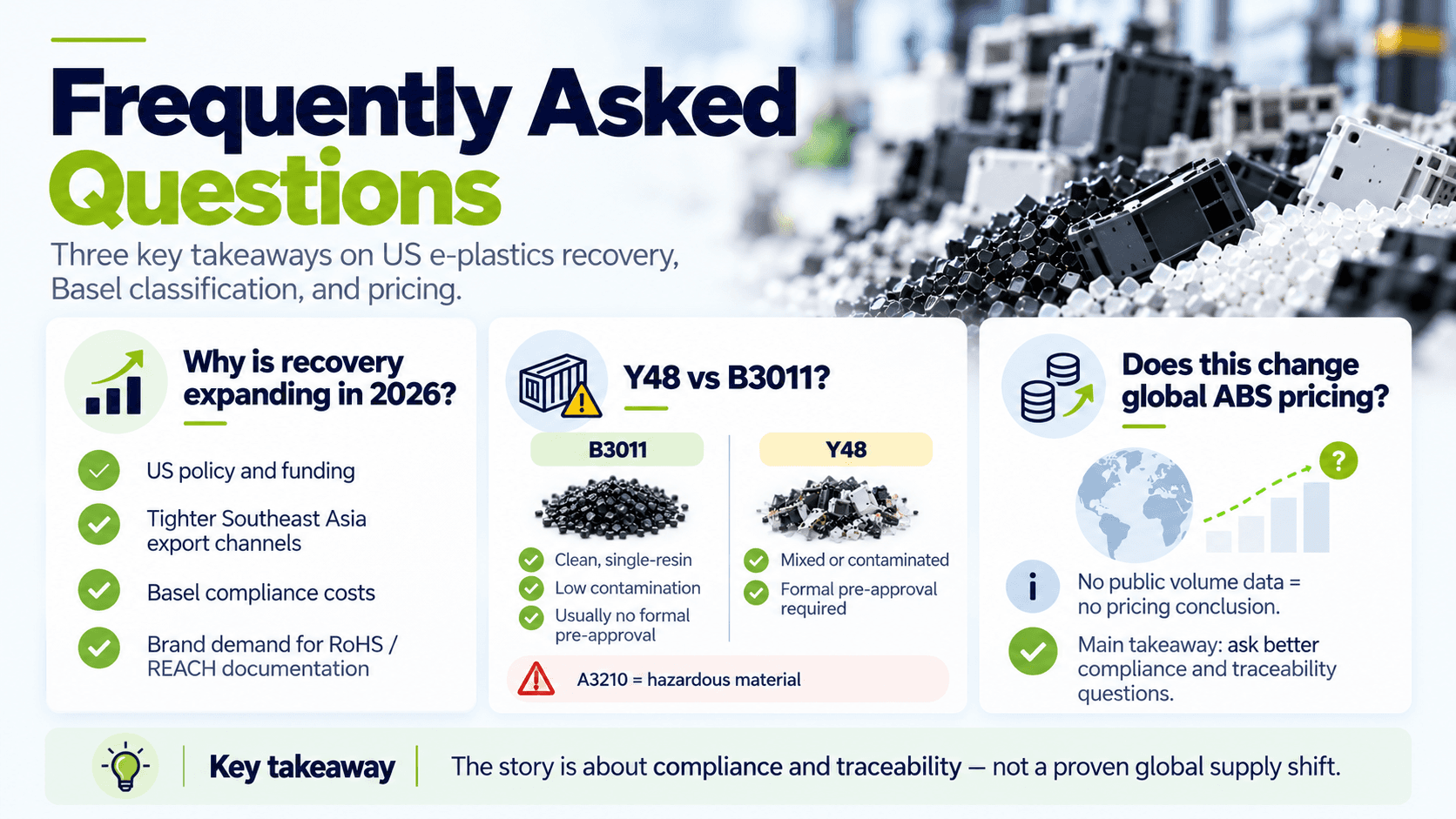
Why is US e-plastics recovery expanding in 2026? Trade reporting attributes it to a combination of factors: a broader US policy shift toward treating e-scrap as a domestic resource, Southeast Asian governments tightening the export and re-export channels that used to absorb much of this material, Basel Convention compliance costs on cross-border e-plastics shipments, and brand demand for RoHS/REACH-documented recycled content.
What is Y48 versus B3011 under the Basel Convention, and why does it matter for recycled ABS? B3011 is the "clean" category — plastic waste that's almost entirely one resin (ABS counts, by name, in US guidance), with little contamination, headed for proper recycling. Material here generally skips Basel's formal pre-approval process. Y48 is the "mixed or contaminated" category — it covers streams that don't meet that bar, like float/sink output still containing more than one resin (ABS and HIPS together, for example), and it does require pre-approval. (Material with enough flame retardant or another hazardous constituent to count as hazardous falls under a third category, A3210, instead.) A single, well-separated ABS or HIPS stream can qualify as clean; a mixed one generally can't without further processing.
Does this trend affect global recycled ABS pricing? No public volume data accompanies the reporting, so it is not possible to draw a pricing or availability conclusion from it. The relevant takeaway for buyers is which compliance and traceability questions to ask, not a supply forecast.
About This Article
Informational summary as of October 2026, based on trade reporting on US e-plastics processors and compliance guidance on the Basel Convention's plastic waste and e-waste amendments (US EPA, SERI). It is not sourcing, trade-compliance or legal advice. Separation methods, purity figures and Basel classification vary by shipment and should be confirmed with a supplier before being relied on.
Image generated with ChatGPT
Sources
Antoinette Smith, Resource Recycling, "Domestic e-plastics recovery picks up pace" → Read the Source
David Daoud, Resource Recycling, "Top 5 reasons for the rise of US e-scrap recycling" → Read the Source
Sustainable Electronics Recycling International (SERI), "Basel Plastic Waste and E-Waste Amendments Q&A" → Read the Source
US EPA, "New International Requirements for the Export and Import of Plastic Recyclables and Waste" → Read the Source
Electronics-derived plastics — mainly acrylonitrile-butadiene-styrene (ABS), high-impact polystyrene (HIPS) and polycarbonate (PC) pulled from end-of-life devices — have historically moved through long, export-heavy supply chains before reaching a compounder. (The reporting behind this piece covers all three resins, but its separation specifics concentrate on ABS and HIPS.) Trade coverage in late September 2026 describes a slower, less visible shift: as manufacturers face new pressure to source raw materials from North America, US processors are investing directly in domestic separation capacity, through two differing approaches.
The critical-minerals nearshoring story moves on geopolitical urgency and high-profile funding. E-plastics recovery is scaling more quietly, with comparatively little fanfare. That makes it easy to miss. It matters mainly to buyers who already specify recycled ABS or HIPS and want to know what "domestic" and "traceable" actually require upstream.
Two Approaches, One Direction
The reporting describes two differing approaches among US e-plastics processors. (This article uses the distinction to organize the reporting; it isn't a formal industry classification.) One processor pairs a domestic separator with an overseas partner for electrostatic separation and compounding — an alliance that spans separation, compounding and injection molding. The other keeps the full chain — collection, separation and sale — inside the US, investing in its own equipment instead of contracting pieces out.
Both are reported to treat the same thing as the real constraint: producing a clean, specification-ready output, not simply collecting more material. Collection volume alone doesn't get recovered ABS or HIPS into an electronics supply chain. Sink-float tanks separate resin families by density, using water and salt-density adjustment. Electrostatic separation works differently — it's reported to reach up to 99% purity on streams where optical sorters struggle, particularly black-pigmented housings that optical sensors can't read.
Why This Is Accelerating Now
Domestic investment in e-scrap processing isn't happening in isolation. Separate industry reporting from March 2026 covers the broader US e-scrap sector — mainly metals and critical-minerals recovery, not plastics specifically. It points to two pressures that plausibly extend to plastics too. First, US policy increasingly treats e-scrap as a domestic resource rather than waste, with new federal funding going toward processing and recovery capacity. Second, several Southeast Asian governments have tightened or closed the informal import and re-export channels that used to absorb much of US e-scrap — echoing the enforcement pattern that followed China's National Sword policy. Neither data point is plastics-specific. But both describe the same export-channel environment that makes domestic recovery of ABS, HIPS and similar e-plastics more attractive, across resin types.
The Basel Rule That Actually Decides What Can Be Exported
Here's the compliance mechanism behind this, in plain terms. The Basel Convention is the international treaty that governs waste shipped across borders. It sorts plastic waste into three categories, based mostly on how well-sorted and how clean it is:
Clean, single-resin material (code B3011). Plastic waste that's almost entirely one resin, with little to no contamination, headed for proper recycling. (US EPA guidance names ABS specifically, along with PE, PP, PET and PS.) Material that qualifies here generally skips Basel's formal pre-approval process.
Mixed or contaminated material (code Y48). Plastic waste that doesn't meet the bar above — mixed resins, contamination, or waste containing something like PVC, for example. Nothing hazardous enough to count as the next category, though. This has to go through Basel's formal pre-approval process before it can cross a border.
Hazardous material (code A3210). Plastic waste with enough flame retardant or another hazardous constituent in it to count as hazardous under Basel's rules. In some Basel jurisdictions, this applies even when the polymer fraction itself is otherwise highly pure.
What Decides ABS or HIPS Classification
For recovered ABS or HIPS, the sorting usually decides which category applies — not the resin itself. A single-resin ABS stream that's well separated and largely contamination-free can qualify for the clean category. A stream that still mixes two resins of similar density generally can't — for example, ABS and HIPS together from a float/sink process. That mixed outcome is actually the more common result when sorting stops at the first stage.
A separate set of Basel amendments, in effect since January 2025, added a new listing — Y49 — for non-hazardous electronic waste in general: devices, parts, residue. That listing covers e-waste as a category. Plastic pulled out of electronics is still judged under the three categories above, not this one.
One more wrinkle: the US hasn't joined the Basel Convention. So shipping mixed or hazardous plastic waste (Y48 or A3210) to a Basel-member country isn't automatic — it usually needs a separate agreement.
The OECD framework is an important route for US exporters in some cases. It provides an alternative control framework for certain Basel-regulated waste movements between participating OECD countries, though the fine print still depends on the countries and material involved. A properly sorted, clean shipment (B3011) generally doesn't need this arrangement — though the importing country's own rules can still apply separately.
In practice, a processor has two ways to get sellable, border-crossing material. One: sort it well enough to qualify as clean (B3011). Two: build out the compliance process to move it as regulated material (Y48 or A3210), through something like the OECD arrangement. Investing in sink-float and electrostatic separation — as described above — is one way of pursuing the first option.
Why Compliance, Not Cost, Is the Entry Barrier
The processors quoted in the original reporting frame their investment case around compliance, not labor-cost arbitrage. The reporting cites one processor's ability to sell recycled resin into named electronics-brand supply chains as an example of how RoHS and REACH compliance can open that door. Documentation responsibility sits with the brand — regardless of where the material was separated, or which Basel classification it crossed any border under.
Separately, one processor's leadership pointed to overcapacity in China's virgin resin production as a competitive pressure on recycled material pricing. That's a quoted executive's characterization of the market, not an independently verified capacity figure. No public tonnage data for either processor's recovery volume was available at publication.
What This Means for ABS and HIPS Buyers
Domestic US recovery growth does not, on its own, change global pricing or availability for recycled ABS and HIPS — the reporting gives no volume figures that would support that claim. What it does confirm is which questions a buyer can now reasonably expect a supplier to answer, regardless of where that supplier is based:
Separation method and purity. Sink-float and electrostatic separation produce different purity profiles; ask which method applies to the specific grade and lot.
Basel classification, if material crossed a border. If the material moved internationally at any point, ask whether it qualified as clean, single-resin material (B3011) or moved as regulated material (Y48 or A3210) through a valid channel such as an OECD agreement.
Feedstock stream. Electronics-derived ABS/HIPS/PC differs from packaging- or automotive-derived streams in contamination risk and color range — ask for the feedstock source, not just the resin family.
Compliance documentation. For RoHS/REACH-relevant applications, ask what testing or certification accompanies each shipment, not only what the datasheet claims.
Certification scope. Confirm what a recycled-content certification (for example GRS) actually covers for that specific shipment, rather than assuming it applies uniformly across a supplier's catalog.
These are the same questions worth asking of any recycled-ABS supplier, including one sourcing from outside the US. The traceability and classification requirements described here aren't unique to the US market.
Frequently Asked Questions
Why is US e-plastics recovery expanding in 2026? Trade reporting attributes it to a combination of factors: a broader US policy shift toward treating e-scrap as a domestic resource, Southeast Asian governments tightening the export and re-export channels that used to absorb much of this material, Basel Convention compliance costs on cross-border e-plastics shipments, and brand demand for RoHS/REACH-documented recycled content.
What is Y48 versus B3011 under the Basel Convention, and why does it matter for recycled ABS? B3011 is the "clean" category — plastic waste that's almost entirely one resin (ABS counts, by name, in US guidance), with little contamination, headed for proper recycling. Material here generally skips Basel's formal pre-approval process. Y48 is the "mixed or contaminated" category — it covers streams that don't meet that bar, like float/sink output still containing more than one resin (ABS and HIPS together, for example), and it does require pre-approval. (Material with enough flame retardant or another hazardous constituent to count as hazardous falls under a third category, A3210, instead.) A single, well-separated ABS or HIPS stream can qualify as clean; a mixed one generally can't without further processing.
Does this trend affect global recycled ABS pricing? No public volume data accompanies the reporting, so it is not possible to draw a pricing or availability conclusion from it. The relevant takeaway for buyers is which compliance and traceability questions to ask, not a supply forecast.
About This Article
Informational summary as of October 2026, based on trade reporting on US e-plastics processors and compliance guidance on the Basel Convention's plastic waste and e-waste amendments (US EPA, SERI). It is not sourcing, trade-compliance or legal advice. Separation methods, purity figures and Basel classification vary by shipment and should be confirmed with a supplier before being relied on.
Image generated with ChatGPT
Sources
Antoinette Smith, Resource Recycling, "Domestic e-plastics recovery picks up pace" → Read the Source
David Daoud, Resource Recycling, "Top 5 reasons for the rise of US e-scrap recycling" → Read the Source
Sustainable Electronics Recycling International (SERI), "Basel Plastic Waste and E-Waste Amendments Q&A" → Read the Source
US EPA, "New International Requirements for the Export and Import of Plastic Recyclables and Waste" → Read the Source
Recycled ABS Sourcing Questions, Answered
Grades • Specs • Availability
Browse rABS →
Recycled ABS Sourcing Questions, Answered
Recycled ABS Sourcing Questions, Answered
Review recycled ABS by feedstock, color and properties — including a GRS-certified grade — plus stock and MOQ.
Review recycled ABS by feedstock, color and properties — including a GRS-certified grade — plus stock and MOQ.
Browse rABS →
Browse rABS →
Looking for samples or ready to source? Submit your request for pricing, availability, and technical information.
Looking for samples or ready to source? Submit your request for pricing, availability, and technical information.
Request a Quote →
Request a Quote →
Posted by REGENPORT
REGENPORT is a global platform connecting buyers and suppliers in the recycled materials and sustainable packaging industries.