CATEGORY
CATEGORY
Trend
Trend
Trend
rLDPE Bales Firm Two Months Before the EU Export Ban – Week 4, September 2026
rLDPE Bales Firm Two Months Before the EU Export Ban – Week 4, September 2026
rLDPE Bales Firm Two Months Before the EU Export Ban – Week 4, September 2026
rLDPE bale prices firmed in the US and Europe ahead of the EU’s Nov. 21 plastic waste export ban. European rPP natural pellets surged, rHDPE softened, and rPS/rABS interest improved modestly, while virgin markets firmed on Middle East supply risk.
Two months out from the EU export ban, the recycled market this week priced the deadline rather than the season. rLDPE bales firmed on both sides of the Atlantic as material moved ahead of the cut-off, and the European Commission gave the deadline its first concrete shape by publishing a draft list of non-OECD countries applying to keep receiving EU waste. Below film, grades split sharply: European rPP natural pellets rose on genuine demand while black pellets eased, European rHDPE weakened against virgin PE competition and a slow construction sector, and rPS and rABS saw a real if modest uptick tied to regulatory pressure. Virgin markets firmed across regions as transits through the Strait of Hormuz remained at a fraction of pre-crisis averages, lifting naphtha and European gas costs. Price observations in this report are as of Sept. 22, 2026.
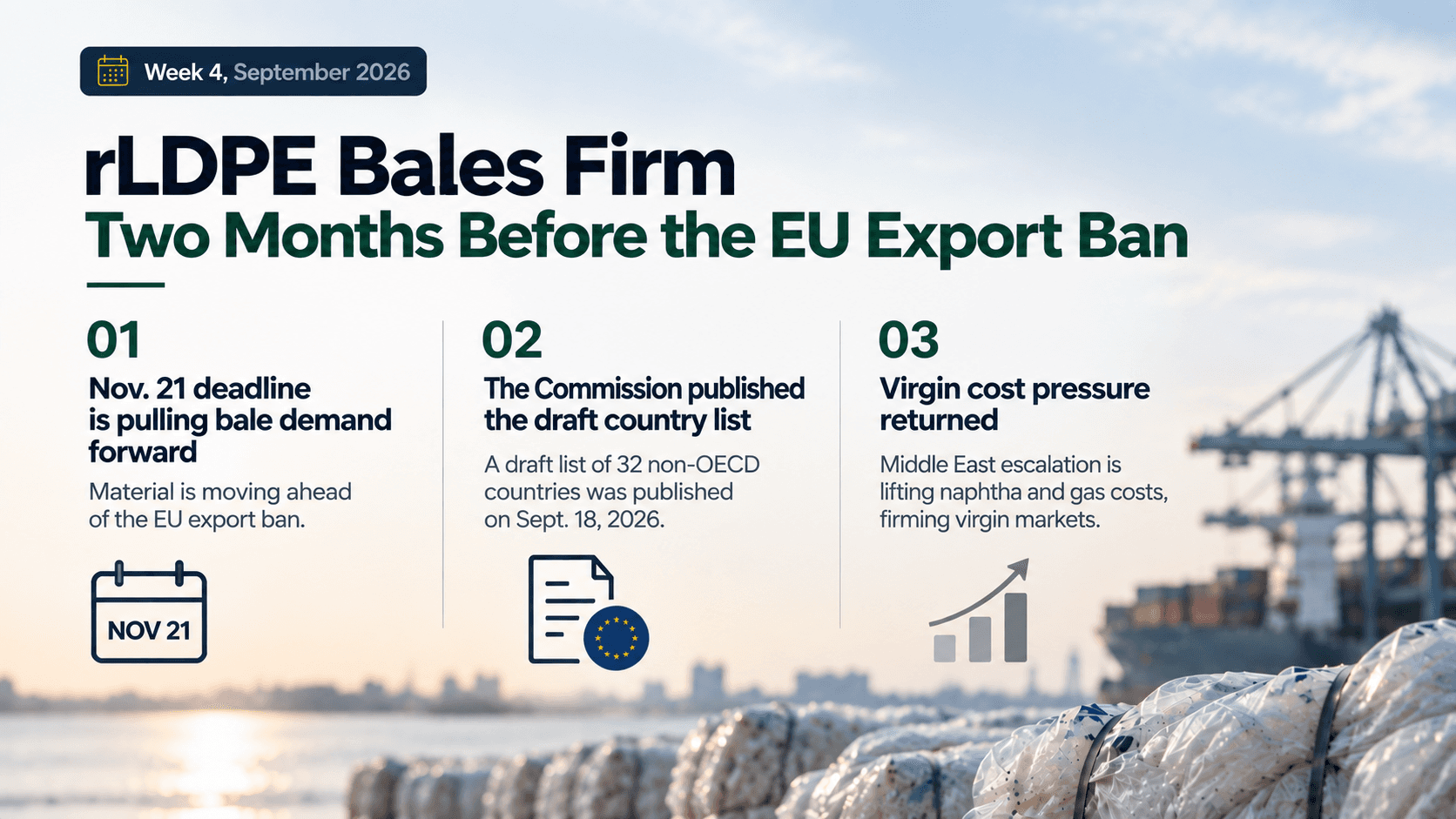
Three Factors Shaping This Week's Market
1. The Nov. 21 deadline is pulling bale demand forward, not creating new demand
European rLDPE pellet prices rose as buyers rushed to secure volume ahead of the Nov. 21 export ban, prompting sellers to bring forward shipments. The same dynamic showed up in the US from the demand side, with firm domestic buying in major cities and export interest reported into India. This is displaced volume rather than incremental consumption. Buyers planning Q4 and Q1 bale cover may want to treat the firmness as a timing effect with a defined end date rather than a new price level.
2. The Commission put names to the ban On Sept. 18, 2026 the European Commission published a draft list of non-OECD countries authorised to import EU waste, confirming that 32 countries applied. Stakeholders can comment until Oct. 16, 2026, with the first authorised list due by the end of 2026. Until that list is final, the question for EU-origin bales is no longer when the ban starts but which destinations survive it.
3. Virgin cost pressure returned as a floor under substitution economics Virgin markets firmed broadly on Middle East escalation, with transits through the Strait of Hormuz running at a fraction of the pre-crisis average of roughly 85 vessels a day. European PVC firmed on speculative buying tied to higher gas prices and a sharp naphtha increase, and Asian and Brazilian virgin PE and PP firmed further. Higher virgin costs usually narrow the discount recycled grades must offer to win volume, but European rHDPE showed the effect is not automatic.
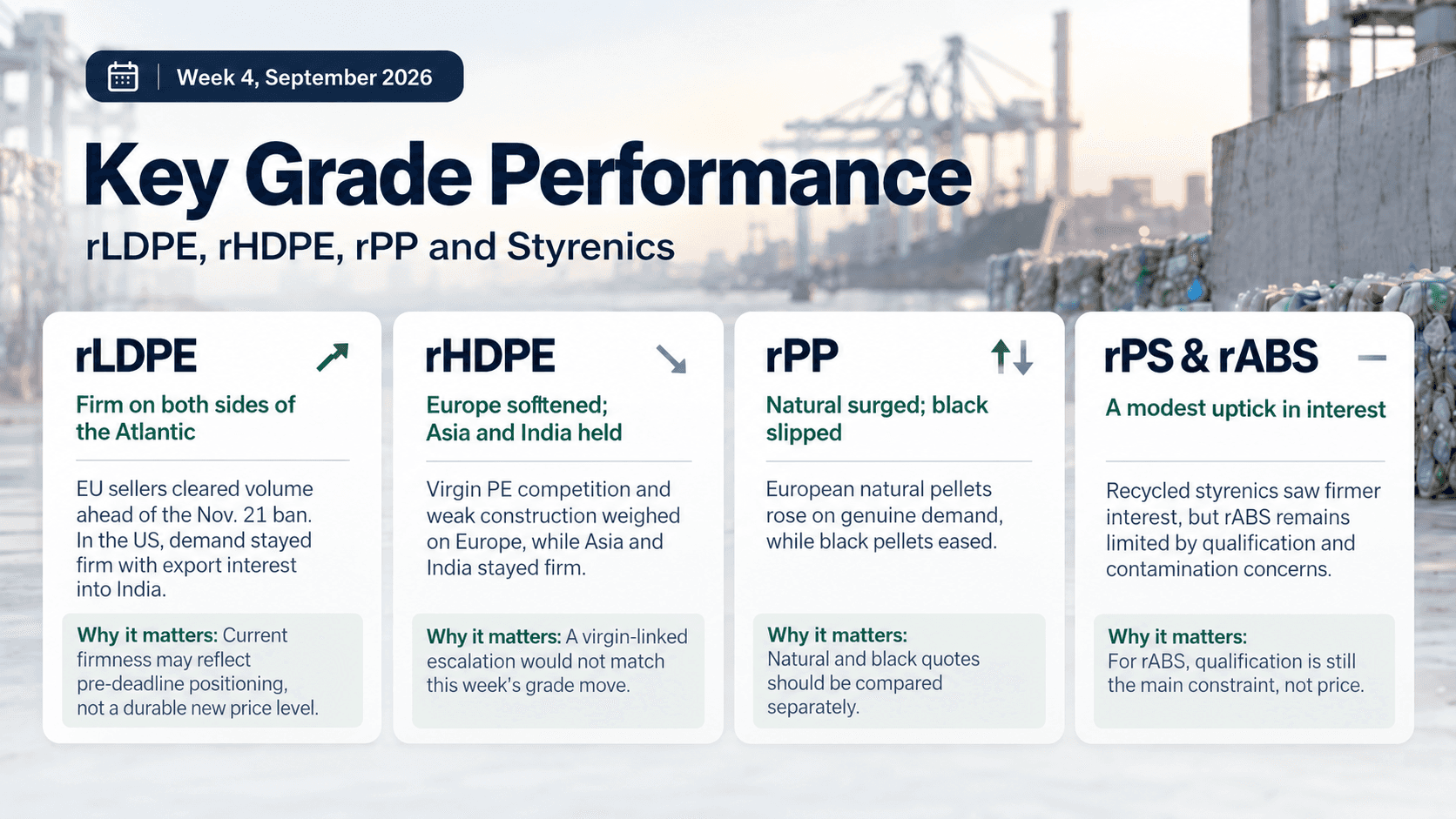
Key Grade Performance: rLDPE, rHDPE, rPP and Styrenics
rLDPE Market — firm on both sides of the Atlantic European rLDPE pellets rose as sellers cleared volume ahead of the Nov. 21 ban. In the US the same pressure appeared from the demand side: domestic demand in major cities was reported robust and some grades drew strong export interest, notably to India. Sources expect US material to become more competitive once the EU ban takes effect in November. Why it matters: a quote firming on ban-related urgency has a built-in expiry. Buyers may want to ask whether an increase reflects current bale availability or pre-deadline positioning, and whether the same level is offered for February delivery.
rHDPE Market — Europe softened, Asia and India held European rHDPE weakened as continued competition from virgin PE and a still-sluggish construction sector weighed on lower-grade material, while Asian and Indian markets held firm. Discussion around recycled-content requirements under the Packaging and Packaging Waste Regulation (PPWR) continued to draw attention, but demand did not move with it this week. Why it matters: rHDPE fell while virgin PE rallied, which is the reverse of the substitution logic often quoted in offers. For buyers, a European rHDPE escalation indexed to the virgin complex would not match what the grade actually did.
rPP Market — the sharpest split of the week European rPP natural pellets surged on genuine demand while black pellets slipped. Seasonal support from Christmas e-commerce and construction was expected but had not materialised broadly by the end of the week. Why it matters: the colour split means a single rPP reference is not describing both streams. Natural and black quotes should be compared separately, and a natural-grade increase should not be read across to black.
rPS and rABS Markets — a real but modest uptick European recycled styrenics registered a genuine pickup in interest as regulatory pressure pushed demand. A trader noted that strict automotive specifications and metal contamination in electronics-sourced ABS scrap continue to limit broader use of recycled material. Why it matters: the constraint on rABS this week was qualification, not price. Buyers evaluating recycled styrenics for automotive or electrical applications should expect specification and contamination screening to set the pace rather than availability.
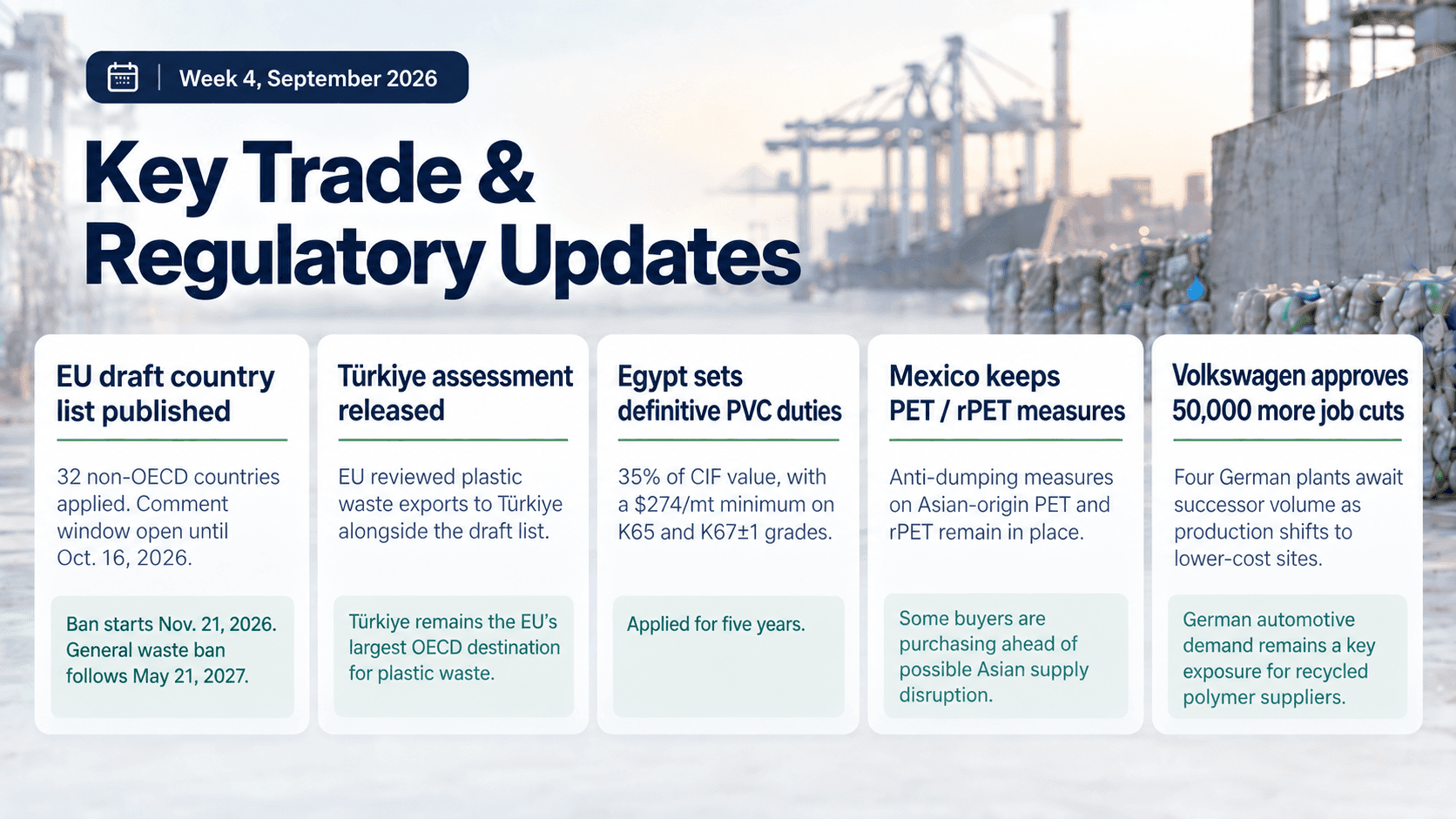
Key Company, Trade and Regulatory Updates
European Union — draft country list published Sept. 18, 2026. The Commission published its draft list of non-OECD countries authorised to import EU waste, with 32 countries having applied and a comment window open until Oct. 16, 2026. The plastic waste export ban to non-OECD countries takes effect Nov. 21, 2026, and a general waste export ban follows on May 21, 2027.
European Union — Türkiye assessment released alongside the list. The Commission also published an assessment of plastic waste exports to Türkiye, the largest OECD destination for EU plastic waste, which received 510,000 tonnes of the 1.4 million tonnes the EU exported in 2025. The assessment recognises that Türkiye has strengthened its plastic waste legislation but identifies remaining gaps in transparency, implementation information and governance.
Egypt — definitive anti-dumping duties on EU-origin suspension-grade PVC. Duties were set at 35% of CIF value with a minimum charge of $274 per tonne on K65 and K67±1 grades, applied for five years and reshaping African and Turkish PVC flows. (Arabic-language trade press reported the measure, taken by Egypt's Ministry of Investment and Foreign Trade, on Sept. 8, 2026; an English-language official notice was not located at time of writing.)
Mexico — anti-dumping measures on Asian-origin PET and rPET continue, with some buyers increasing purchases pre-emptively over concerns about potential Asian supply-chain disruption.
Volkswagen — 50,000 further job cuts approved, four German plants awaiting successor volume. VW's board approved an additional 50,000 job cuts by 2030, taking the group total to roughly 100,000 when combined with reductions already under way. Emden, Zwickau, Hanover and Audi's Neckarsulm face staggered phase-outs as current models end between 2031 and 2034, with no confirmed successor products yet; management must present a European production strategy by June 2027. Successor volume is being directed to lower-cost sites in the Czech Republic, Slovakia and Poland. For recycled polyolefin and styrenics suppliers, German automotive demand is the exposure to watch rather than the headline job number.
Market Takeaway
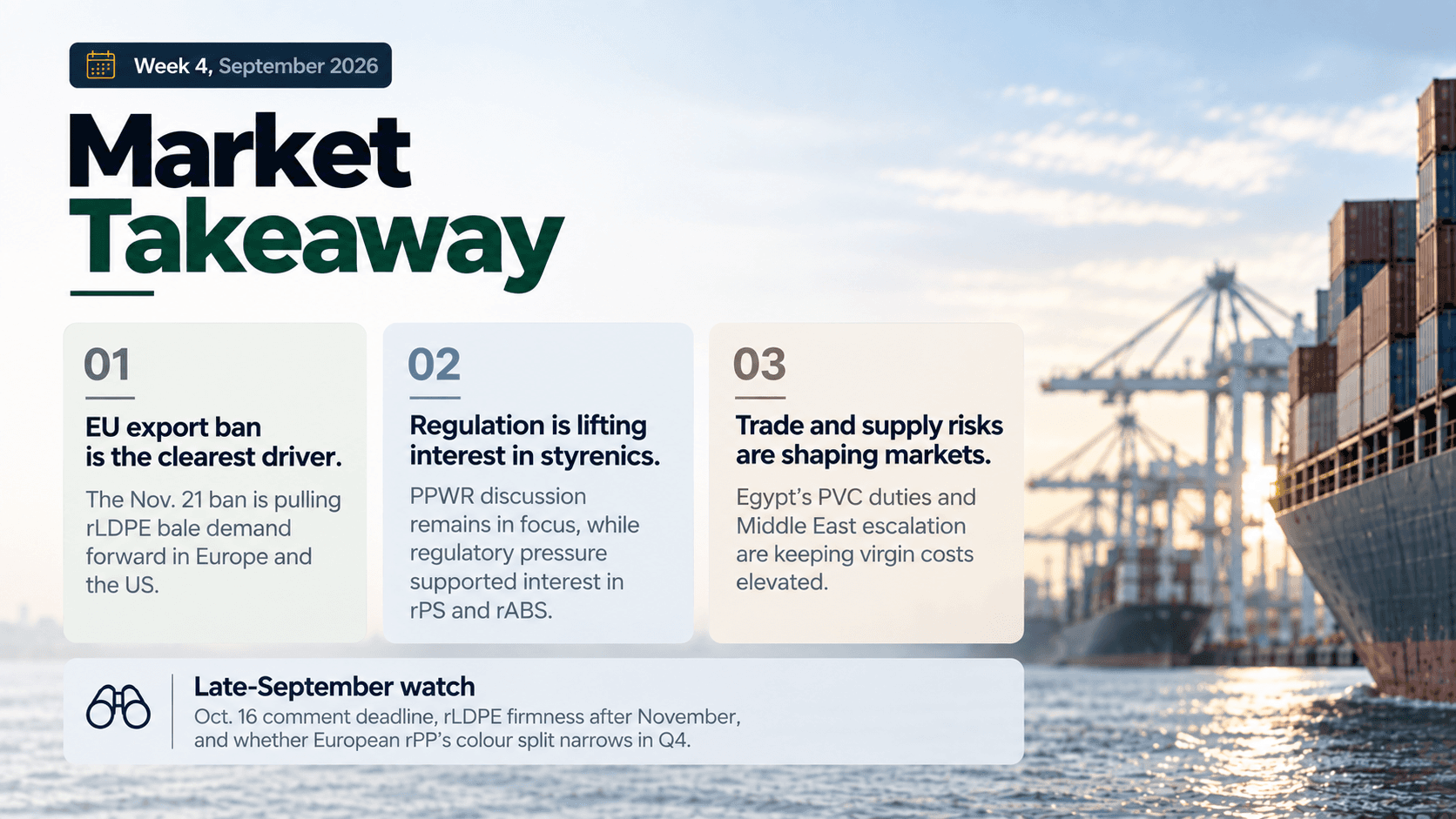
The EU's November export ban was the clearest driver this week, pulling rLDPE bale demand forward in both Europe and the US and giving the market its first concrete view of which destinations may survive the cut-off. Broader regulatory pressure — PPWR recycled-content discussion and sustainability requirements — generated visible interest in rPP natural, rPS and rABS, though rABS remains gated by automotive specifications and contamination rather than by price. European rHDPE was the counter-example, softening even as virgin PE rallied. With the Nov. 21 deadline approaching, Egypt's PVC duties redirecting African and Turkish flows and Middle East escalation keeping virgin costs elevated, trade policy rather than seasonal demand looks like the dominant driver of both markets through the rest of September.
Late-September watch: whether the Oct. 16 comment deadline changes the draft country list, whether rLDPE firmness survives the pull-forward once November passes, and whether European rPP's colour split narrows as Q4 construction and e-commerce demand arrives.
Regenport will continue monitoring market conditions and sharing updates as the picture develops.
Frequently Asked Questions
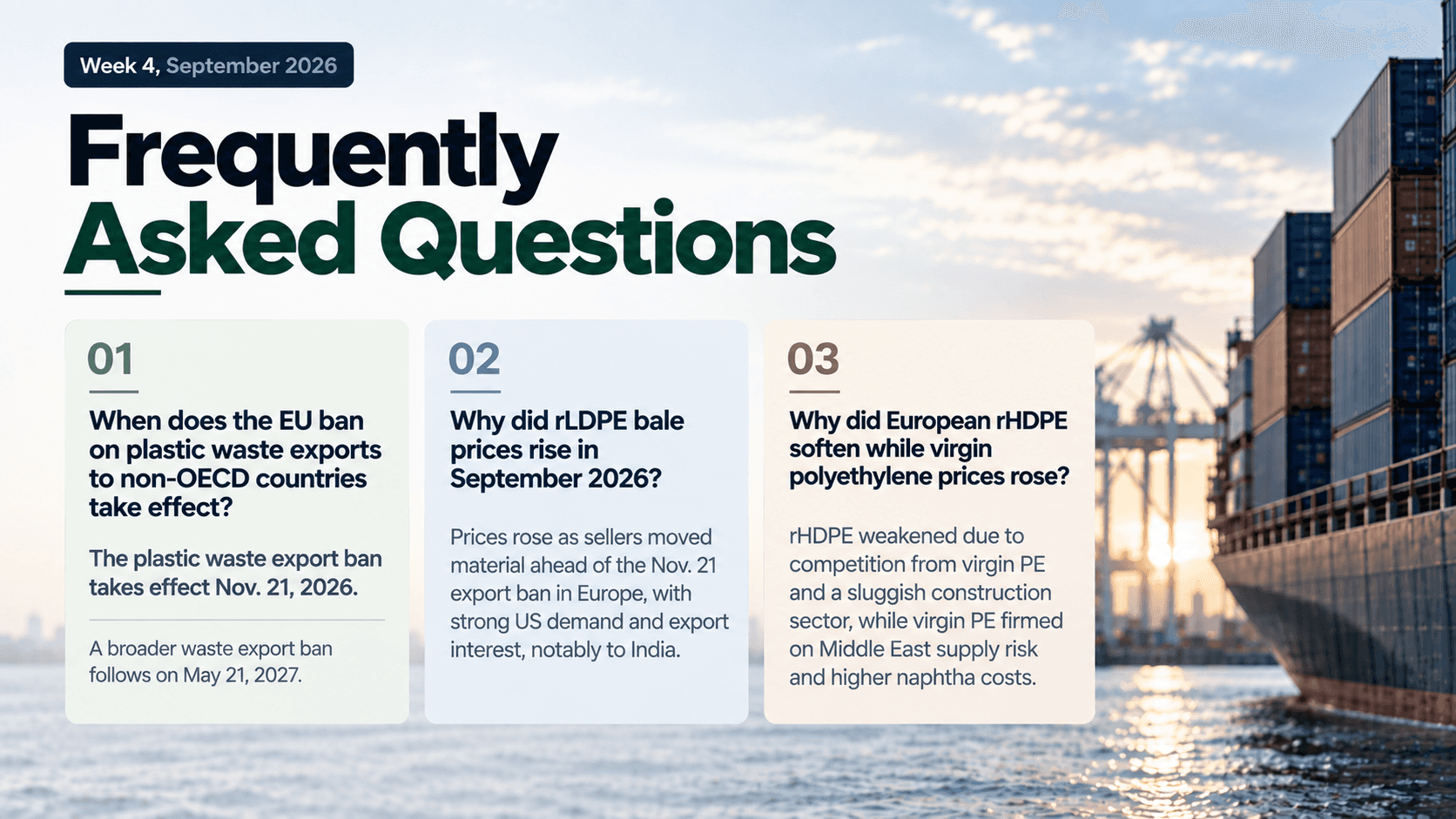
When does the EU ban on plastic waste exports to non-OECD countries take effect? The ban applies from Nov. 21, 2026 under the revised Waste Shipment Regulation, and a general ban on waste exports to non-OECD countries follows on May 21, 2027. On Sept. 18, 2026 the European Commission published a draft list of non-OECD countries authorised to continue importing EU waste, confirming that 32 countries had applied; stakeholders can comment until Oct. 16, 2026 and the first authorised list is expected by the end of 2026. Until that list is final, EU-origin bale sellers cannot confirm which non-OECD destinations remain open after November.
Why did rLDPE bale prices rise in September 2026? European rLDPE pellet prices rose because sellers moved material ahead of the Nov. 21, 2026 export ban, and US prices firmed on the same dynamic from the demand side, with robust domestic buying in major cities and export interest reported into India. The increase reflects volume being pulled forward ahead of a fixed deadline rather than a rise in underlying consumption, which is why sources expect US material to become more competitive once the EU ban takes effect in November.
Why did European rHDPE soften while virgin polyethylene prices rose? European rHDPE weakened in week 4 of September 2026 because competition from virgin PE and a still-sluggish construction sector weighed on lower-grade material, while virgin PE firmed on Middle East supply risk and higher naphtha costs. Recycled and virgin polyethylene priced on different drivers during the same week: recycled on end-use demand and bale economics, virgin on feedstock and logistics cost. Discussion of recycled-content requirements under the Packaging and Packaging Waste Regulation (PPWR) continued but did not translate into rHDPE demand this week.
Image generated with ChatGPT
Two months out from the EU export ban, the recycled market this week priced the deadline rather than the season. rLDPE bales firmed on both sides of the Atlantic as material moved ahead of the cut-off, and the European Commission gave the deadline its first concrete shape by publishing a draft list of non-OECD countries applying to keep receiving EU waste. Below film, grades split sharply: European rPP natural pellets rose on genuine demand while black pellets eased, European rHDPE weakened against virgin PE competition and a slow construction sector, and rPS and rABS saw a real if modest uptick tied to regulatory pressure. Virgin markets firmed across regions as transits through the Strait of Hormuz remained at a fraction of pre-crisis averages, lifting naphtha and European gas costs. Price observations in this report are as of Sept. 22, 2026.
Three Factors Shaping This Week's Market
1. The Nov. 21 deadline is pulling bale demand forward, not creating new demand
European rLDPE pellet prices rose as buyers rushed to secure volume ahead of the Nov. 21 export ban, prompting sellers to bring forward shipments. The same dynamic showed up in the US from the demand side, with firm domestic buying in major cities and export interest reported into India. This is displaced volume rather than incremental consumption. Buyers planning Q4 and Q1 bale cover may want to treat the firmness as a timing effect with a defined end date rather than a new price level.
2. The Commission put names to the ban On Sept. 18, 2026 the European Commission published a draft list of non-OECD countries authorised to import EU waste, confirming that 32 countries applied. Stakeholders can comment until Oct. 16, 2026, with the first authorised list due by the end of 2026. Until that list is final, the question for EU-origin bales is no longer when the ban starts but which destinations survive it.
3. Virgin cost pressure returned as a floor under substitution economics Virgin markets firmed broadly on Middle East escalation, with transits through the Strait of Hormuz running at a fraction of the pre-crisis average of roughly 85 vessels a day. European PVC firmed on speculative buying tied to higher gas prices and a sharp naphtha increase, and Asian and Brazilian virgin PE and PP firmed further. Higher virgin costs usually narrow the discount recycled grades must offer to win volume, but European rHDPE showed the effect is not automatic.
Key Grade Performance: rLDPE, rHDPE, rPP and Styrenics
rLDPE Market — firm on both sides of the Atlantic European rLDPE pellets rose as sellers cleared volume ahead of the Nov. 21 ban. In the US the same pressure appeared from the demand side: domestic demand in major cities was reported robust and some grades drew strong export interest, notably to India. Sources expect US material to become more competitive once the EU ban takes effect in November. Why it matters: a quote firming on ban-related urgency has a built-in expiry. Buyers may want to ask whether an increase reflects current bale availability or pre-deadline positioning, and whether the same level is offered for February delivery.
rHDPE Market — Europe softened, Asia and India held European rHDPE weakened as continued competition from virgin PE and a still-sluggish construction sector weighed on lower-grade material, while Asian and Indian markets held firm. Discussion around recycled-content requirements under the Packaging and Packaging Waste Regulation (PPWR) continued to draw attention, but demand did not move with it this week. Why it matters: rHDPE fell while virgin PE rallied, which is the reverse of the substitution logic often quoted in offers. For buyers, a European rHDPE escalation indexed to the virgin complex would not match what the grade actually did.
rPP Market — the sharpest split of the week European rPP natural pellets surged on genuine demand while black pellets slipped. Seasonal support from Christmas e-commerce and construction was expected but had not materialised broadly by the end of the week. Why it matters: the colour split means a single rPP reference is not describing both streams. Natural and black quotes should be compared separately, and a natural-grade increase should not be read across to black.
rPS and rABS Markets — a real but modest uptick European recycled styrenics registered a genuine pickup in interest as regulatory pressure pushed demand. A trader noted that strict automotive specifications and metal contamination in electronics-sourced ABS scrap continue to limit broader use of recycled material. Why it matters: the constraint on rABS this week was qualification, not price. Buyers evaluating recycled styrenics for automotive or electrical applications should expect specification and contamination screening to set the pace rather than availability.
Key Company, Trade and Regulatory Updates
European Union — draft country list published Sept. 18, 2026. The Commission published its draft list of non-OECD countries authorised to import EU waste, with 32 countries having applied and a comment window open until Oct. 16, 2026. The plastic waste export ban to non-OECD countries takes effect Nov. 21, 2026, and a general waste export ban follows on May 21, 2027.
European Union — Türkiye assessment released alongside the list. The Commission also published an assessment of plastic waste exports to Türkiye, the largest OECD destination for EU plastic waste, which received 510,000 tonnes of the 1.4 million tonnes the EU exported in 2025. The assessment recognises that Türkiye has strengthened its plastic waste legislation but identifies remaining gaps in transparency, implementation information and governance.
Egypt — definitive anti-dumping duties on EU-origin suspension-grade PVC. Duties were set at 35% of CIF value with a minimum charge of $274 per tonne on K65 and K67±1 grades, applied for five years and reshaping African and Turkish PVC flows. (Arabic-language trade press reported the measure, taken by Egypt's Ministry of Investment and Foreign Trade, on Sept. 8, 2026; an English-language official notice was not located at time of writing.)
Mexico — anti-dumping measures on Asian-origin PET and rPET continue, with some buyers increasing purchases pre-emptively over concerns about potential Asian supply-chain disruption.
Volkswagen — 50,000 further job cuts approved, four German plants awaiting successor volume. VW's board approved an additional 50,000 job cuts by 2030, taking the group total to roughly 100,000 when combined with reductions already under way. Emden, Zwickau, Hanover and Audi's Neckarsulm face staggered phase-outs as current models end between 2031 and 2034, with no confirmed successor products yet; management must present a European production strategy by June 2027. Successor volume is being directed to lower-cost sites in the Czech Republic, Slovakia and Poland. For recycled polyolefin and styrenics suppliers, German automotive demand is the exposure to watch rather than the headline job number.
Market Takeaway
The EU's November export ban was the clearest driver this week, pulling rLDPE bale demand forward in both Europe and the US and giving the market its first concrete view of which destinations may survive the cut-off. Broader regulatory pressure — PPWR recycled-content discussion and sustainability requirements — generated visible interest in rPP natural, rPS and rABS, though rABS remains gated by automotive specifications and contamination rather than by price. European rHDPE was the counter-example, softening even as virgin PE rallied. With the Nov. 21 deadline approaching, Egypt's PVC duties redirecting African and Turkish flows and Middle East escalation keeping virgin costs elevated, trade policy rather than seasonal demand looks like the dominant driver of both markets through the rest of September.
Late-September watch: whether the Oct. 16 comment deadline changes the draft country list, whether rLDPE firmness survives the pull-forward once November passes, and whether European rPP's colour split narrows as Q4 construction and e-commerce demand arrives.
Regenport will continue monitoring market conditions and sharing updates as the picture develops.
Frequently Asked Questions
When does the EU ban on plastic waste exports to non-OECD countries take effect? The ban applies from Nov. 21, 2026 under the revised Waste Shipment Regulation, and a general ban on waste exports to non-OECD countries follows on May 21, 2027. On Sept. 18, 2026 the European Commission published a draft list of non-OECD countries authorised to continue importing EU waste, confirming that 32 countries had applied; stakeholders can comment until Oct. 16, 2026 and the first authorised list is expected by the end of 2026. Until that list is final, EU-origin bale sellers cannot confirm which non-OECD destinations remain open after November.
Why did rLDPE bale prices rise in September 2026? European rLDPE pellet prices rose because sellers moved material ahead of the Nov. 21, 2026 export ban, and US prices firmed on the same dynamic from the demand side, with robust domestic buying in major cities and export interest reported into India. The increase reflects volume being pulled forward ahead of a fixed deadline rather than a rise in underlying consumption, which is why sources expect US material to become more competitive once the EU ban takes effect in November.
Why did European rHDPE soften while virgin polyethylene prices rose? European rHDPE weakened in week 4 of September 2026 because competition from virgin PE and a still-sluggish construction sector weighed on lower-grade material, while virgin PE firmed on Middle East supply risk and higher naphtha costs. Recycled and virgin polyethylene priced on different drivers during the same week: recycled on end-use demand and bale economics, virgin on feedstock and logistics cost. Discussion of recycled-content requirements under the Packaging and Packaging Waste Regulation (PPWR) continued but did not translate into rHDPE demand this week.
Image generated with ChatGPT
rLDPE Before the November Deadline
Grades • Specs • Availability
Browse rLDPE →
rLDPE Before the November Deadline
rLDPE Before the November Deadline
Review rLDPE grades by feedstock, MFI, stock and MOQ.
Review rLDPE grades by feedstock, MFI, stock and MOQ.
Browse rLDPE →
Browse rLDPE →
Looking for samples or ready to source? Submit your request for pricing, availability, and technical information.
Looking for samples or ready to source? Submit your request for pricing, availability, and technical information.
Request a Quote →
Request a Quote →
Posted by REGENPORT
REGENPORT is a global platform connecting buyers and suppliers in the recycled materials and sustainable packaging industries.