CATEGORY
CATEGORY
News
News
News
Recycled ABS in 2027: A Chemical Ceiling Arrives Before the Performance One
Recycled ABS in 2027: A Chemical Ceiling Arrives Before the Performance One
Recycled ABS in 2027: A Chemical Ceiling Arrives Before the Performance One

News-track post on the EU PBDE limit dropping to 200 mg/kg on 30 December 2027, and why that reaches recycled ABS buyers before performance qualification does. Links to the rABS category page.
Ask a procurement team what worries them about recycled acrylonitrile butadiene styrene (ABS) and you will usually hear about performance. Will it stay tough after thermal aging. Will the molded part pass a flame rating.
Those are fair questions. But as of September 2026 they are not the ones that decide first. A chemical limit gets there ahead of them, and it has a date on it.
Under the EU POPs framework, the sum of five listed polybrominated diphenyl ethers (PBDEs) is capped at 350 mg/kg in mixtures or articles that contain, or are made of, recovered material carrying those substances. That unintentional trace contaminant limit is scheduled to fall to 200 mg/kg on 30 December 2027. The change comes from Commission Delegated Regulation (EU) 2025/1482, adopted on 24 July 2025, published in the Official Journal on 28 October 2025 and in force since 17 November 2025, which amends the EU Persistent Organic Pollutants (POPs) Regulation (EU) 2019/1021.
That is especially relevant to recycled ABS from legacy electrical and electronic equipment streams, and the reason is worth spelling out.

What PBDEs Are, and Why They Keep Coming Back
PBDEs are brominated flame retardants. From the 1970s through the 2000s they were added to plastics to slow down ignition, and electronics were one of the biggest users. Televisions, monitors and computer housings run warm and carry power, so the plastic around them had to resist catching fire. ABS and high-impact polystyrene housings absorbed a large share of that use.
They are no longer added to new products. PBDEs are listed as persistent organic pollutants, meaning they break down slowly and build up in living organisms, and that listing is what drove them out of use internationally.
Here is the part that reaches a recycler. A television housing molded in 2003 still contains what was put into it. Grind that housing into flake and pellet it, and the flame retardant travels with the polymer. Nobody added anything. The residue arrived with the feedstock. The regulation reflects this by treating PBDEs in recycled material as an "unintentional trace contaminant" — a contaminant that is present without having been put there on purpose.
The five substances named in the regulation are distinguished by how many bromine atoms they carry: tetrabromodiphenyl ether (four), pentabromodiphenyl ether (five), hexabromodiphenyl ether (six), heptabromodiphenyl ether (seven) and decabromodiphenyl ether (ten). They are not measured separately. What counts is the sum of all five.

Where the Numbers Sit Now
The regulation works from one default limit, with a higher temporary figure carved out where the recovered material itself carries these substances.
Category | Limit as of September 2026 | Next step |
|---|---|---|
Mixtures or articles, other than those made of or containing recovered material with these PBDEs | 10 mg/kg (food-contact materials excepted) | No further change scheduled |
Mixtures or articles made of or containing recovered material with these PBDEs | 350 mg/kg | 200 mg/kg from 30 December 2027 |
Toys and childcare articles made of or containing recovered material with these PBDEs | 350 mg/kg | 10 mg/kg from 17 May 2027 |
The food-contact exception is written into the 10 mg/kg entry, not into the recovered-material entries.
The 350 and 200 figures are not a general allowance. They apply only where a mixture or article is made of, or contains, recovered material that carries these PBDEs. Virgin resin is not expected to carry legacy PBDE residues, so the 10 mg/kg limit is generally less difficult for virgin-material supply chains to meet. Recovered material can carry residues from earlier product generations, and applying the 10 mg/kg limit immediately to all recovered material derived from waste electrical and electronic equipment (WEEE) could substantially constrain the mechanical-recycling routes currently used for those streams.
So the recovered-material row is a transition, not a permanent carve-out. The gap between 10 and 200 mg/kg is the room that keeps mechanically recycled WEEE usable in the EU, and the regulation already says when that room shrinks.

Why WEEE-Derived ABS Sits Closest to the Line
The limit applies to mixtures and articles regardless of polymer type. In practice it bears most on ABS and high-impact polystyrene recovered from legacy electrical and electronic equipment, because that is where brominated flame-retardant residues are most likely to be present.
Two figures from Recycling Europe's EU Recyclers' Roadmap on WEEE, published in January 2026, describe the base a buyer is working from. The recycling rate for WEEE plastics in the EU is around 20%. And in 2021, only 4.5% of recycled plastics were used in the production of new electrical and electronic equipment.
The two numbers approach the same problem from opposite ends. Little WEEE plastic gets recycled, and the electronics sector takes in very little recycled plastic of any kind. Neither figure explains why, and the roadmap does not pin either one on the PBDE limits alone.
What the roadmap does argue is that WEEE recycling gets squeezed when a threshold drops below what industrial-scale testing can reliably measure, and it asks regulators to weigh actual risk rather than hazard alone. That is an association's position, not a settled conclusion. But it points at something a buyer can act on: the amount of WEEE-derived recyclate that can be documented against a tightening number may be smaller than the amount that physically exists.
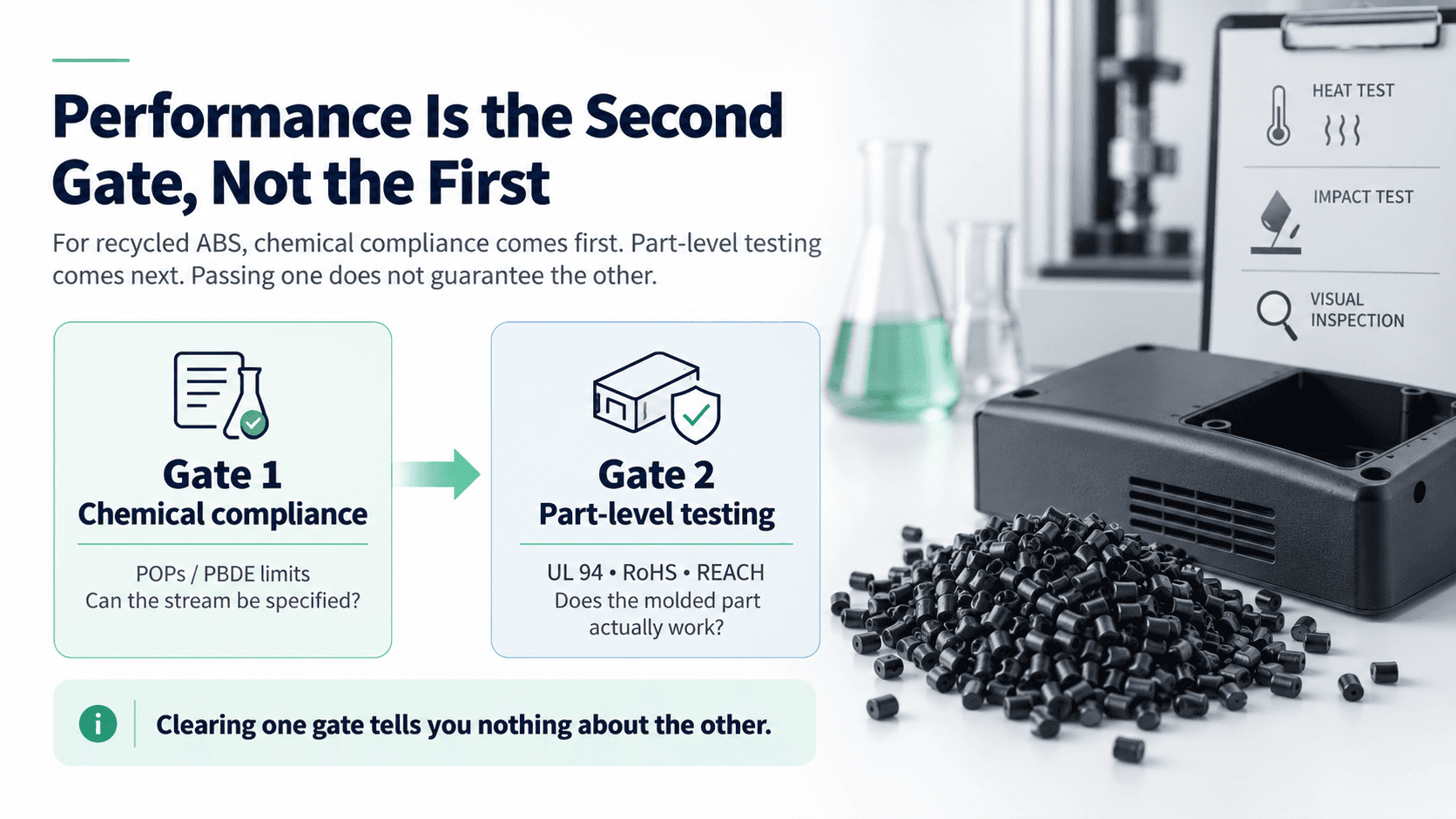
Performance Is the Second Gate, Not the First
Plastics Engineering reported in August 2026 that mechanical recycling wears down the rubber phase in ABS and lowers the molecular weight of polycarbonate. The practical effect is a narrower processing window for housings that have to keep their shape and strength after heat exposure. The article's conclusion is that qualification should rest on testing the molded part, not on a recycled-content figure.
So a sourcing team faces two gates, in order. Chemical compliance with the POPs limits decides whether a stream can be specified at all. Part-level testing against UL 94, RoHS and REACH decides whether it actually works. Clearing one tells you nothing about the other.
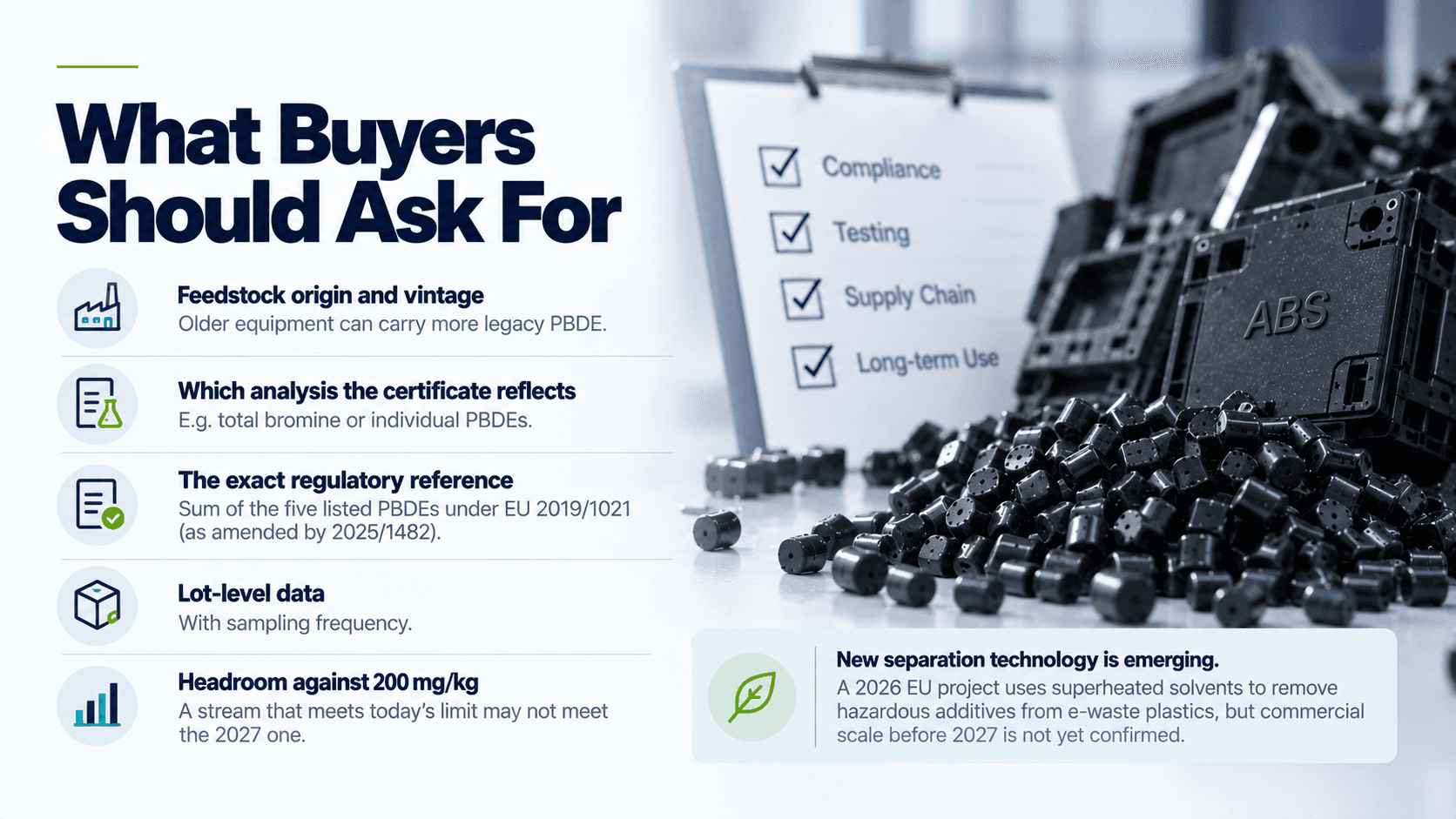
What Buyers Should Ask For
Feedstock origin and vintage. Older equipment carries more legacy PBDE, so the age profile of the input stream can matter more than the resin name on the datasheet.
Which analysis the certificate reflects. Screening for total bromine and quantifying individual PBDEs answer different questions. Confirm which method produced the number, and whether it reports the sum of the five listed substances.
The exact reference the certificate cites. It should point to the sum of the five listed PBDEs under Annex I to Regulation (EU) 2019/1021 as amended by Delegated Regulation (EU) 2025/1482, so a regulatory or legal reviewer can match it without interpretation.
Lot-level data rather than type-level, with the sampling frequency stated.
Headroom against 200 mg/kg, not 350 mg/kg. A stream that clears today's limit may not clear the 2027 one — and a product specified now will still be on the market then.
Separation technology is moving alongside this. A European Commission update in January 2026 described a project that dissolves e-waste plastic in superheated solvents, then pulls the hazardous additives out of the solution and recovers clean polymer along with bromine and antimony trioxide. Whether it reaches commercial volume before the 2027 step is not established.

Frequently Asked Questions
What are PBDEs, and why are they in recycled plastic? PBDEs are brominated flame retardants that were added to plastics, especially electronics housings, from the 1970s through the 2000s. They are no longer used in new products, but they remain in the products made back then — so when that plastic is recycled, the flame retardant comes with it rather than being added.
What is the PBDE limit for recycled plastics in the EU right now? Under the EU POPs framework, mixtures or articles made of or containing recovered material with these PBDEs are subject to a transitional limit of 350 mg/kg for the sum of the five listed substances as of September 2026, falling to 200 mg/kg from 30 December 2027. Mixtures or articles without such recovered material are held to 10 mg/kg, food-contact materials excepted.
Does the limit single out recycled ABS? No. It applies to mixtures or articles regardless of polymer. It matters most for ABS and high-impact polystyrene because those resins carry the largest share of legacy brominated flame retardants in the WEEE stream.
Why does a 2027 date matter to a product being specified in 2026? An electronics housing qualified today will still be on sale after 30 December 2027. A stream checked only against the 350 mg/kg limit may need requalification partway through the product's life.
About This Article
Information as of September 2026, based on the published text of Commission Delegated Regulation (EU) 2025/1482 and public reporting. This is general information for sourcing teams and not legal advice; obligations should be confirmed with the relevant authority or your own counsel.
Image generated with ChatGPT
Sources
European Commission, EUR-Lex, "Commission Delegated Regulation (EU) 2025/1482 of 24 July 2025" → Read the Source
Recycling Europe, "EU Recyclers' Roadmap on WEEE" (January 2026) → Read the Source
Maria Vargas, Plastics Engineering, "Recycled Plastics in Electronics Housings Face Heat and Compliance Limits" (6 August 2026) → Read the Source
European Commission, "Closing the loop by cleaning up e-waste" (22 January 2026) → Read the Source
Ask a procurement team what worries them about recycled acrylonitrile butadiene styrene (ABS) and you will usually hear about performance. Will it stay tough after thermal aging. Will the molded part pass a flame rating.
Those are fair questions. But as of September 2026 they are not the ones that decide first. A chemical limit gets there ahead of them, and it has a date on it.
Under the EU POPs framework, the sum of five listed polybrominated diphenyl ethers (PBDEs) is capped at 350 mg/kg in mixtures or articles that contain, or are made of, recovered material carrying those substances. That unintentional trace contaminant limit is scheduled to fall to 200 mg/kg on 30 December 2027. The change comes from Commission Delegated Regulation (EU) 2025/1482, adopted on 24 July 2025, published in the Official Journal on 28 October 2025 and in force since 17 November 2025, which amends the EU Persistent Organic Pollutants (POPs) Regulation (EU) 2019/1021.
That is especially relevant to recycled ABS from legacy electrical and electronic equipment streams, and the reason is worth spelling out.
What PBDEs Are, and Why They Keep Coming Back
PBDEs are brominated flame retardants. From the 1970s through the 2000s they were added to plastics to slow down ignition, and electronics were one of the biggest users. Televisions, monitors and computer housings run warm and carry power, so the plastic around them had to resist catching fire. ABS and high-impact polystyrene housings absorbed a large share of that use.
They are no longer added to new products. PBDEs are listed as persistent organic pollutants, meaning they break down slowly and build up in living organisms, and that listing is what drove them out of use internationally.
Here is the part that reaches a recycler. A television housing molded in 2003 still contains what was put into it. Grind that housing into flake and pellet it, and the flame retardant travels with the polymer. Nobody added anything. The residue arrived with the feedstock. The regulation reflects this by treating PBDEs in recycled material as an "unintentional trace contaminant" — a contaminant that is present without having been put there on purpose.
The five substances named in the regulation are distinguished by how many bromine atoms they carry: tetrabromodiphenyl ether (four), pentabromodiphenyl ether (five), hexabromodiphenyl ether (six), heptabromodiphenyl ether (seven) and decabromodiphenyl ether (ten). They are not measured separately. What counts is the sum of all five.
Where the Numbers Sit Now
The regulation works from one default limit, with a higher temporary figure carved out where the recovered material itself carries these substances.
Category | Limit as of September 2026 | Next step |
|---|---|---|
Mixtures or articles, other than those made of or containing recovered material with these PBDEs | 10 mg/kg (food-contact materials excepted) | No further change scheduled |
Mixtures or articles made of or containing recovered material with these PBDEs | 350 mg/kg | 200 mg/kg from 30 December 2027 |
Toys and childcare articles made of or containing recovered material with these PBDEs | 350 mg/kg | 10 mg/kg from 17 May 2027 |
The food-contact exception is written into the 10 mg/kg entry, not into the recovered-material entries.
The 350 and 200 figures are not a general allowance. They apply only where a mixture or article is made of, or contains, recovered material that carries these PBDEs. Virgin resin is not expected to carry legacy PBDE residues, so the 10 mg/kg limit is generally less difficult for virgin-material supply chains to meet. Recovered material can carry residues from earlier product generations, and applying the 10 mg/kg limit immediately to all recovered material derived from waste electrical and electronic equipment (WEEE) could substantially constrain the mechanical-recycling routes currently used for those streams.
So the recovered-material row is a transition, not a permanent carve-out. The gap between 10 and 200 mg/kg is the room that keeps mechanically recycled WEEE usable in the EU, and the regulation already says when that room shrinks.
Why WEEE-Derived ABS Sits Closest to the Line
The limit applies to mixtures and articles regardless of polymer type. In practice it bears most on ABS and high-impact polystyrene recovered from legacy electrical and electronic equipment, because that is where brominated flame-retardant residues are most likely to be present.
Two figures from Recycling Europe's EU Recyclers' Roadmap on WEEE, published in January 2026, describe the base a buyer is working from. The recycling rate for WEEE plastics in the EU is around 20%. And in 2021, only 4.5% of recycled plastics were used in the production of new electrical and electronic equipment.
The two numbers approach the same problem from opposite ends. Little WEEE plastic gets recycled, and the electronics sector takes in very little recycled plastic of any kind. Neither figure explains why, and the roadmap does not pin either one on the PBDE limits alone.
What the roadmap does argue is that WEEE recycling gets squeezed when a threshold drops below what industrial-scale testing can reliably measure, and it asks regulators to weigh actual risk rather than hazard alone. That is an association's position, not a settled conclusion. But it points at something a buyer can act on: the amount of WEEE-derived recyclate that can be documented against a tightening number may be smaller than the amount that physically exists.
Performance Is the Second Gate, Not the First
Plastics Engineering reported in August 2026 that mechanical recycling wears down the rubber phase in ABS and lowers the molecular weight of polycarbonate. The practical effect is a narrower processing window for housings that have to keep their shape and strength after heat exposure. The article's conclusion is that qualification should rest on testing the molded part, not on a recycled-content figure.
So a sourcing team faces two gates, in order. Chemical compliance with the POPs limits decides whether a stream can be specified at all. Part-level testing against UL 94, RoHS and REACH decides whether it actually works. Clearing one tells you nothing about the other.
What Buyers Should Ask For
Feedstock origin and vintage. Older equipment carries more legacy PBDE, so the age profile of the input stream can matter more than the resin name on the datasheet.
Which analysis the certificate reflects. Screening for total bromine and quantifying individual PBDEs answer different questions. Confirm which method produced the number, and whether it reports the sum of the five listed substances.
The exact reference the certificate cites. It should point to the sum of the five listed PBDEs under Annex I to Regulation (EU) 2019/1021 as amended by Delegated Regulation (EU) 2025/1482, so a regulatory or legal reviewer can match it without interpretation.
Lot-level data rather than type-level, with the sampling frequency stated.
Headroom against 200 mg/kg, not 350 mg/kg. A stream that clears today's limit may not clear the 2027 one — and a product specified now will still be on the market then.
Separation technology is moving alongside this. A European Commission update in January 2026 described a project that dissolves e-waste plastic in superheated solvents, then pulls the hazardous additives out of the solution and recovers clean polymer along with bromine and antimony trioxide. Whether it reaches commercial volume before the 2027 step is not established.
Frequently Asked Questions
What are PBDEs, and why are they in recycled plastic? PBDEs are brominated flame retardants that were added to plastics, especially electronics housings, from the 1970s through the 2000s. They are no longer used in new products, but they remain in the products made back then — so when that plastic is recycled, the flame retardant comes with it rather than being added.
What is the PBDE limit for recycled plastics in the EU right now? Under the EU POPs framework, mixtures or articles made of or containing recovered material with these PBDEs are subject to a transitional limit of 350 mg/kg for the sum of the five listed substances as of September 2026, falling to 200 mg/kg from 30 December 2027. Mixtures or articles without such recovered material are held to 10 mg/kg, food-contact materials excepted.
Does the limit single out recycled ABS? No. It applies to mixtures or articles regardless of polymer. It matters most for ABS and high-impact polystyrene because those resins carry the largest share of legacy brominated flame retardants in the WEEE stream.
Why does a 2027 date matter to a product being specified in 2026? An electronics housing qualified today will still be on sale after 30 December 2027. A stream checked only against the 350 mg/kg limit may need requalification partway through the product's life.
About This Article
Information as of September 2026, based on the published text of Commission Delegated Regulation (EU) 2025/1482 and public reporting. This is general information for sourcing teams and not legal advice; obligations should be confirmed with the relevant authority or your own counsel.
Image generated with ChatGPT
Sources
European Commission, EUR-Lex, "Commission Delegated Regulation (EU) 2025/1482 of 24 July 2025" → Read the Source
Recycling Europe, "EU Recyclers' Roadmap on WEEE" (January 2026) → Read the Source
Maria Vargas, Plastics Engineering, "Recycled Plastics in Electronics Housings Face Heat and Compliance Limits" (6 August 2026) → Read the Source
European Commission, "Closing the loop by cleaning up e-waste" (22 January 2026) → Read the Source
Start With Feedstock Origin
Grades • Specs • Availability
Browse rABS →
Start With Feedstock Origin
Start With Feedstock Origin
Review rABS grades by feedstock, color, MFI, form, stock and MOQ.
Review rABS grades by feedstock, color, MFI, form, stock and MOQ.
Browse rABS →
Browse rABS →
Looking for samples or ready to source? Submit your request for pricing, availability, and technical information.
Looking for samples or ready to source? Submit your request for pricing, availability, and technical information.
Request a Quote →
Request a Quote →
Posted by REGENPORT
REGENPORT is a global platform connecting buyers and suppliers in the recycled materials and sustainable packaging industries.