CATEGORY
CATEGORY
Regulation
Regulation
Regulation
China’s National Sword Policy: How It Reshaped Global Recycling (And Why It Still Matters)
China’s National Sword Policy: How It Reshaped Global Recycling (And Why It Still Matters)
China’s National Sword Policy: How It Reshaped Global Recycling (And Why It Still Matters)
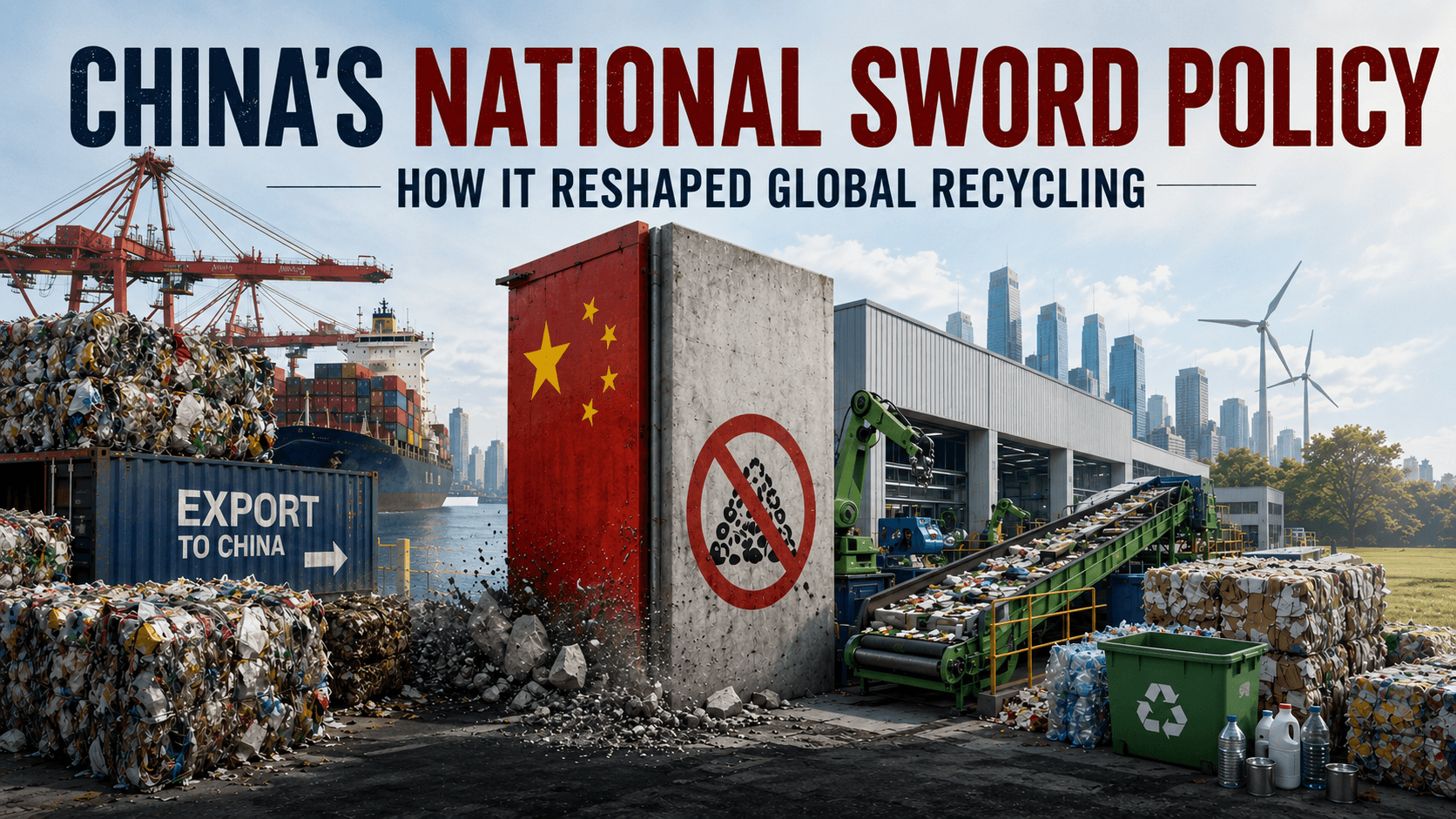
China's 2018 National Sword policy banned low-quality recyclable imports, disrupting global recycling markets. Learn what changed and what cities, businesses, and policymakers should do next.
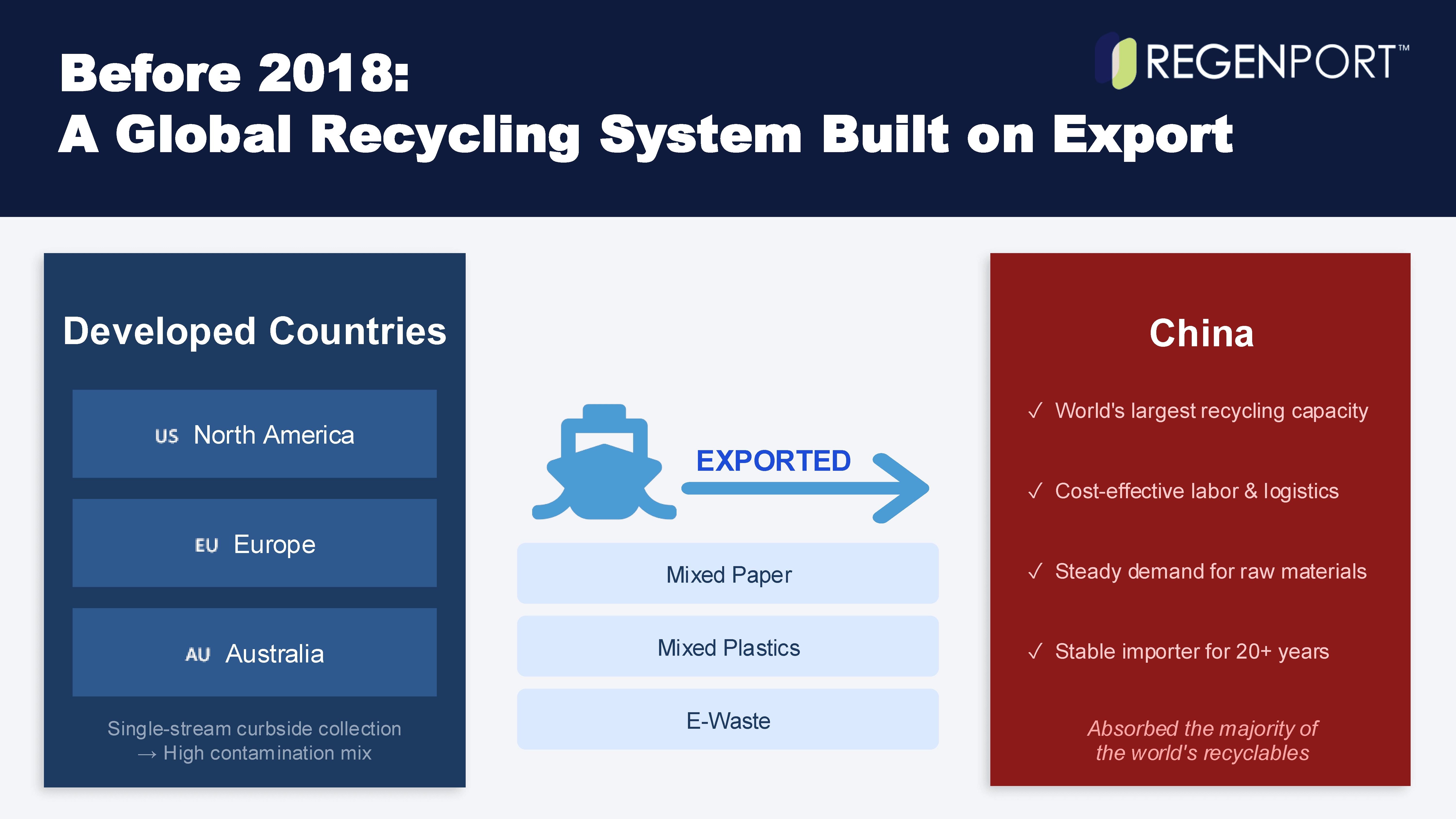
For more than two decades, many countries in North America, Europe, and Australia sent a large share of their collected recyclables to China. China had the factories, logistics, and demand for raw materials to absorb much of the world’s used paper and plastics.
That arrangement changed abruptly on January 1, 2018, when China’s National Sword policy went into full force. What began as a tighter environmental rule turned into a major realignment of global recycling markets, revealing how fragile many systems were.
What Is China’s National Sword Policy?
China’s National Sword policy was formally announced by the Customs General Administration on February 7, 2017, and implemented in phases throughout 2018. It marked the most comprehensive tightening of recycling‑import rules China had made in years.
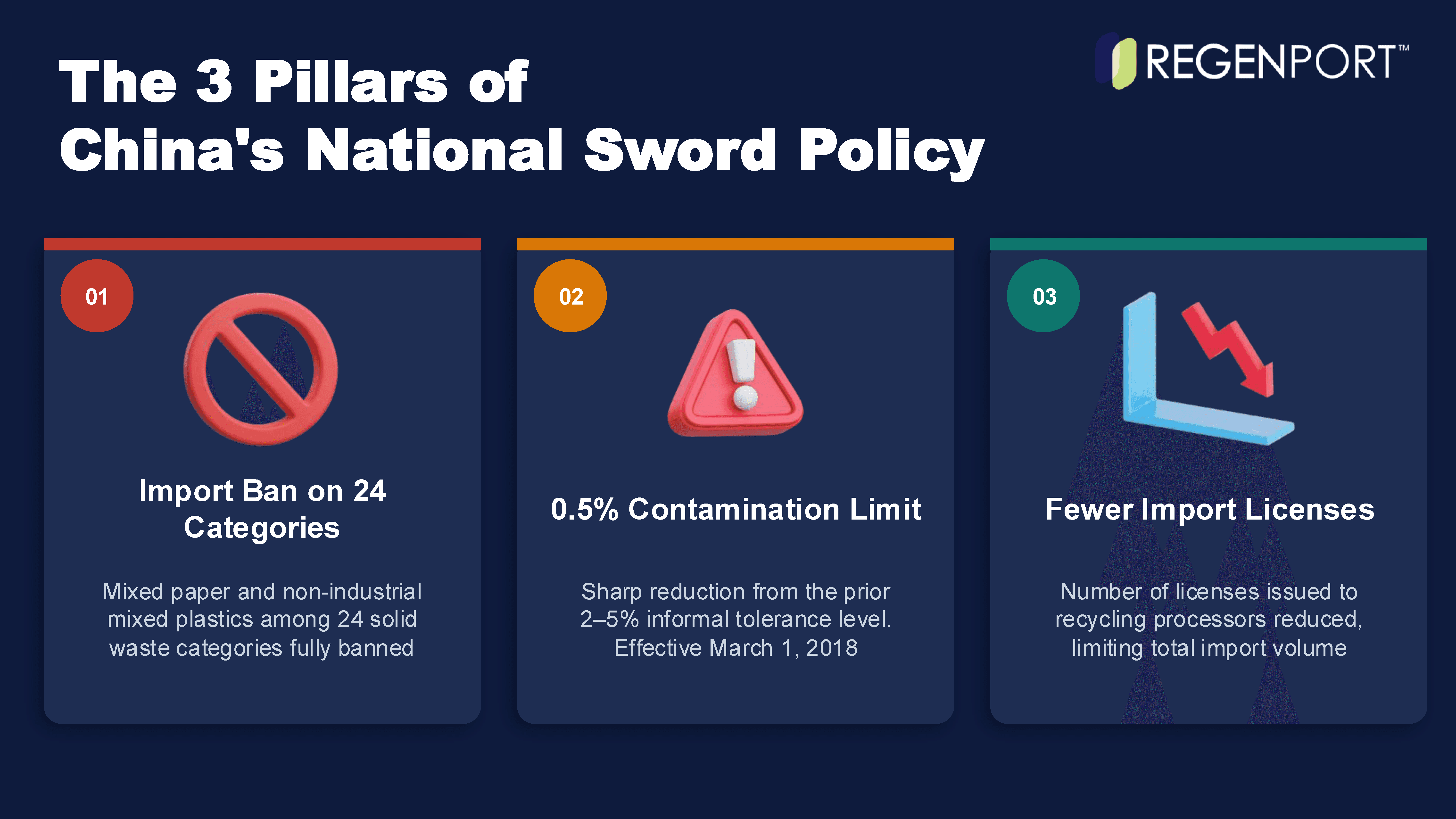
The policy had three main pillars:
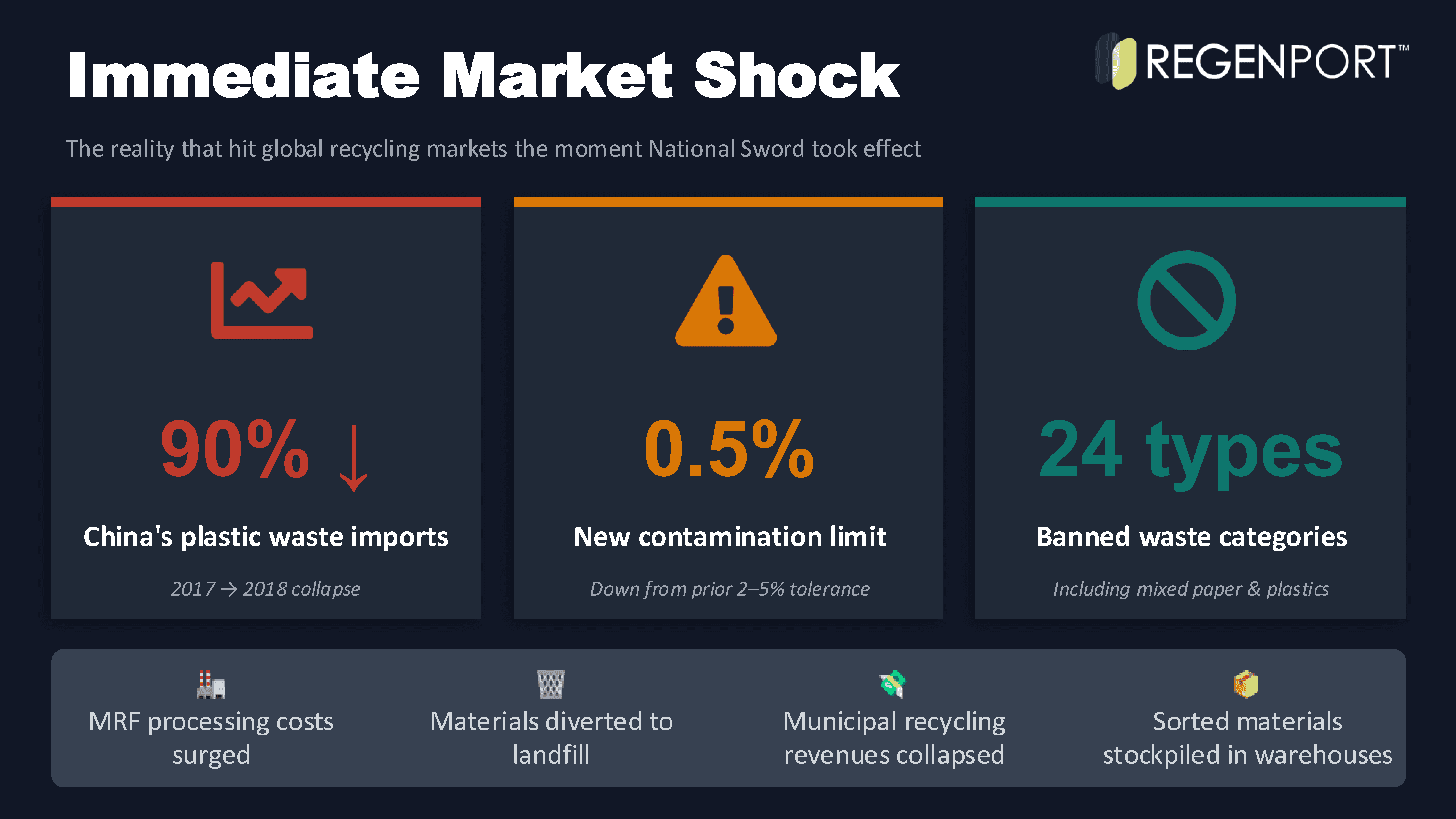
It banned the import of 24 categories of solid waste, including mixed paper and non‑industrial mixed plastics. These were materials that were often heavily contaminated or difficult to sort at scale, and many had been exported from single‑stream curbside recycling programs.
It set a strict contamination limit of 0.5% on most other imported recyclable materials, effective March 1, 2018. This was a sharp reduction from the earlier informal tolerance of about 2–5% contamination, which exporting countries had long treated as a practical guideline.
It reduced the number of import licenses issued to recycling processors, limiting how many companies could legally receive and sort foreign waste. This tightened oversight and further reduced the volume of imports.
National Sword was not created in a vacuum. For years, Chinese processing facilities had been receiving shipments contaminated with food residue, hazardous materials, and non‑recyclable items. The 2016 documentary Plastic China highlighted poor conditions at some informal recycling operations, amplifying public pressure on the government to act. At the same time, lower prices for raw materials made it less profitable for Chinese operators to process low‑grade recyclables.
The policy was also a logical extension of earlier enforcement efforts like the 2013 Green Fence campaign and a 2015 pilot inspection initiative. Unlike those earlier moves, however, National Sword was broader, stricter, and designed to be more permanent. It signaled that China was no longer willing to accept low‑quality, mixed recyclables as a default part of its material supply chain.
How National Sword Disrupted Global Recycling Markets
The Scale of Dependency
Before 2018, many recycling systems in developed countries were built around export. China had become a major outlet for mixed paper and plastics that were hard to process domestically or not economically viable in local markets. The global trade in recyclables depended on this external demand, especially for lower‑grade or contaminated streams.
When National Sword took effect, those export routes narrowed quickly. Municipalities and materials recovery facilities suddenly faced a core question: if China no longer wanted these materials, what should be done with them?
Immediate Market Effects
The first impact was price pressure. Without a reliable export outlet, many materials lost value. Revenues from the sale of recyclables fell, while processing costs rose as facilities adapted to new markets and standards. In some places, cities had to raise fees, change collection programs, or temporarily accept lower recycling rates.
In other regions, recyclables that had previously been sold were instead landfilled or incinerated. Stockpiles of sorted material appeared in warehouses, and some programs struggled to justify continued collection without stable end‑market demand.
The disruption also highlighted how much existing infrastructure relied on high contamination tolerance. When China’s 0.5% standard became the de facto benchmark, many bales from Western systems no longer met the grade without significant upgrades to sorting and quality control.
Why Contamination and Single‑Stream Recycling Became Central
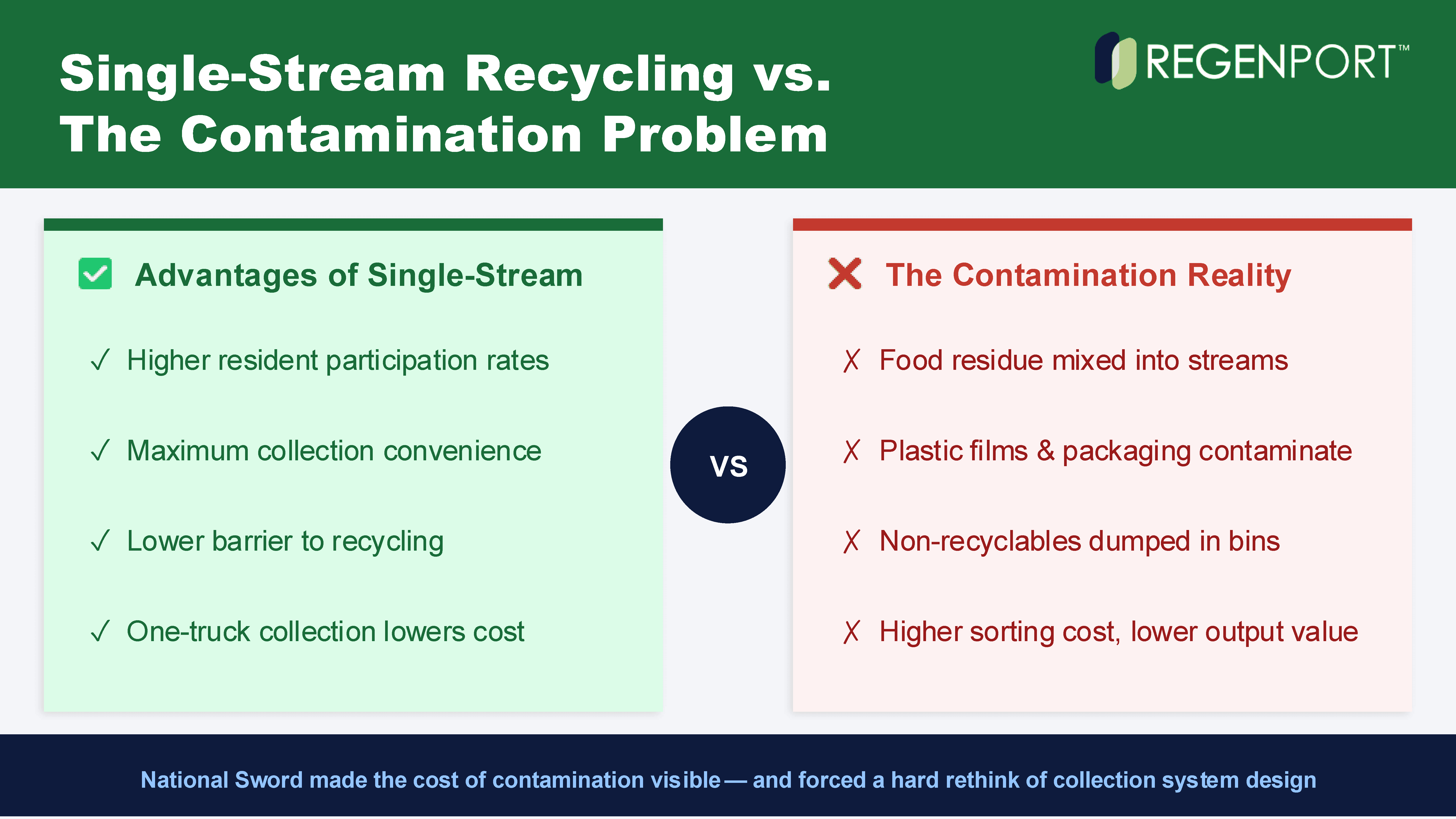
A key lesson from National Sword was the role of contamination. Single‑stream recycling—where households put all recyclables into one bin—had been effective at increasing participation, but it also made contamination harder to control. Food residue, plastic films, mixed packaging, and non‑recyclable items regularly entered the stream.
For many recycling programs, the cost of contamination is substantial. Adds sorting complexity, raises processing costs, and lowers the value of output. In practice, National Sword made that cost more visible, forcing many operators to rethink how they design and operate their collection systems.
What Changed After 2018
Domestic Infrastructure Investment
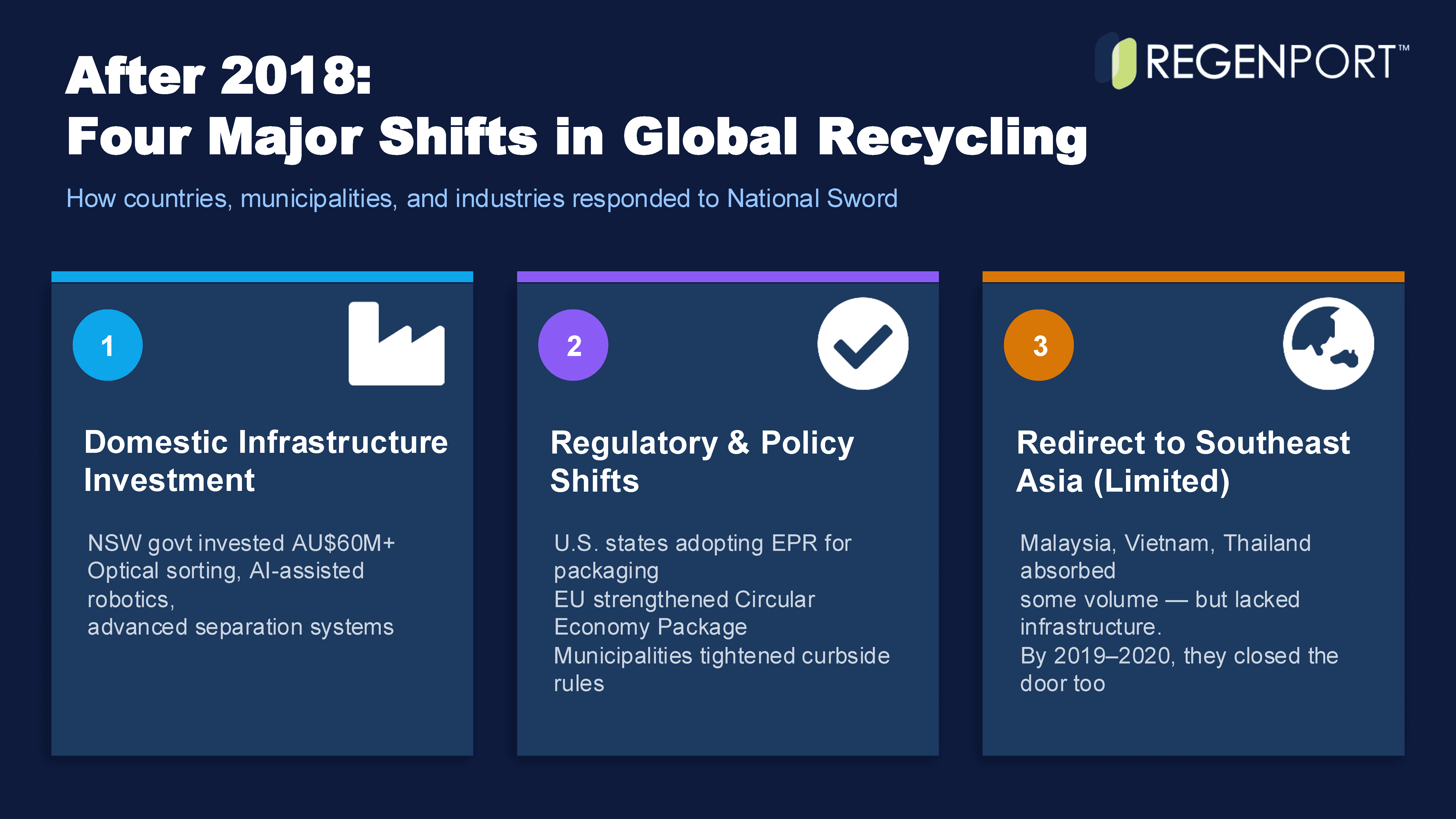
One of the most visible responses to National Sword was investment in domestic recycling capacity. Countries that had long deferred upgrades to materials recovery facilities began building higher‑capacity, more automated sorting lines. Optical sorting, AI‑assisted robotics, and advanced separation systems helped produce cleaner, higher‑quality bales that could meet tighter export standards or be used in local markets.
In Australia, for example, the New South Wales government invested over AU$60 million in domestic sorting, processing, and recycling infrastructure in response to the policy. Other regions followed similar paths, treating National Sword as a wake‑up call rather than a crisis.
Regulatory and Policy Shifts
National Sword also accelerated policy changes at multiple levels:
Several U.S. states began exploring or adopting Extended Producer Responsibility (EPR) for packaging, requiring manufacturers to help cover the costs of end‑of‑life management.
The European Union strengthened its Circular Economy Package, setting binding targets for recycled content and recyclability.
Municipalities and national agencies tightened rules on what materials were accepted in curbside recycling, excluding hard‑to‑process items and improving overall quality.
Taken together, these moves signaled a shift away from “export‑first” recycling toward systems that treat recycling as a local infrastructure and policy issue, not just a commodity trade.
Redirection to Southeast Asia (and Its Limits)
In the short term, some of the displaced recyclable volume shifted to countries in Southeast Asia, particularly Malaysia, Vietnam, Thailand, and Indonesia. These nations had growing manufacturing sectors and rising demand for materials, so they initially absorbed a portion of the material that had once gone to China.
However, the new markets were not ready to handle the full volume. Many Southeast Asian countries lacked the regulatory framework and infrastructure to manage large, contaminated imports, and within a few years, several introduced their own import restrictions and bans. By 2019–2020, Southeast Asia had largely closed the door on the same kind of low‑quality waste that China had shut out earlier.
That experience reinforced the lesson: recycling systems that rely on exporting low‑quality material to the next available country are inherently unstable. National Sword and its regional ripple effects made that vulnerability clear.
What To Expect Going Forward
Several long‑term trends have taken shape directly or indirectly because of National Sword:
Growth of Domestic Processing Capacity
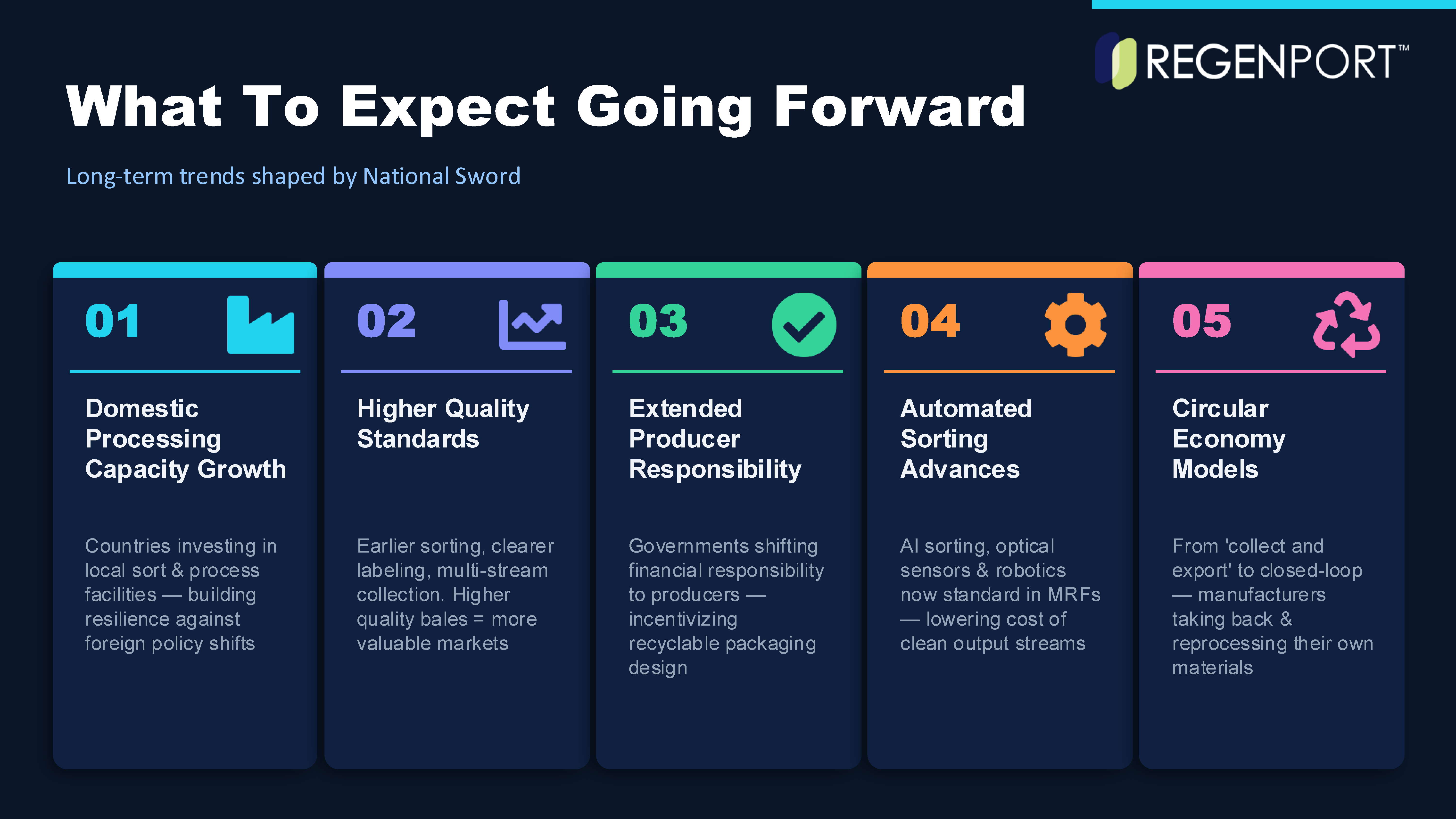
Countries that once exported large volumes of recyclables are now investing in domestic facilities that can sort, clean, and process materials locally. This is a long‑term infrastructure build, but it improves resilience and reduces dependence on foreign policy decisions.
Higher Quality Standards Across the Supply Chain
Contamination reduction has become a consistent priority. Programs now emphasize earlier sorting, clearer labeling for residents, and, in some cases, multi‑stream collection to reduce contamination at the source. Higher quality bales are more valuable in both domestic and export markets.
Expansion of Extended Producer Responsibility
More governments are moving toward EPR for packaging, which shifts some of the financial and operational responsibility for recycling from municipalities to producers. This can create incentives for companies to design packaging that is easier to recycle, less contaminated, and more compatible with real‑world systems.
Advances in Mechanized and Automated Sorting
AI‑assisted sorting, optical sensors, and robotics are becoming more common in modern MRFs. These technologies lower the cost of producing clean, high‑purity streams, which in turn makes it easier to meet strict contamination standards and serve more stable markets.
A Shift Toward Circular Economy Models
In some industries, the focus is shifting from “collect and export” to closed‑loop recycling, where manufacturers take back and reprocess their own materials. This reduces dependence on global commodity markets and improves traceability and quality control.
What Countries, Municipalities, and Businesses Should Do
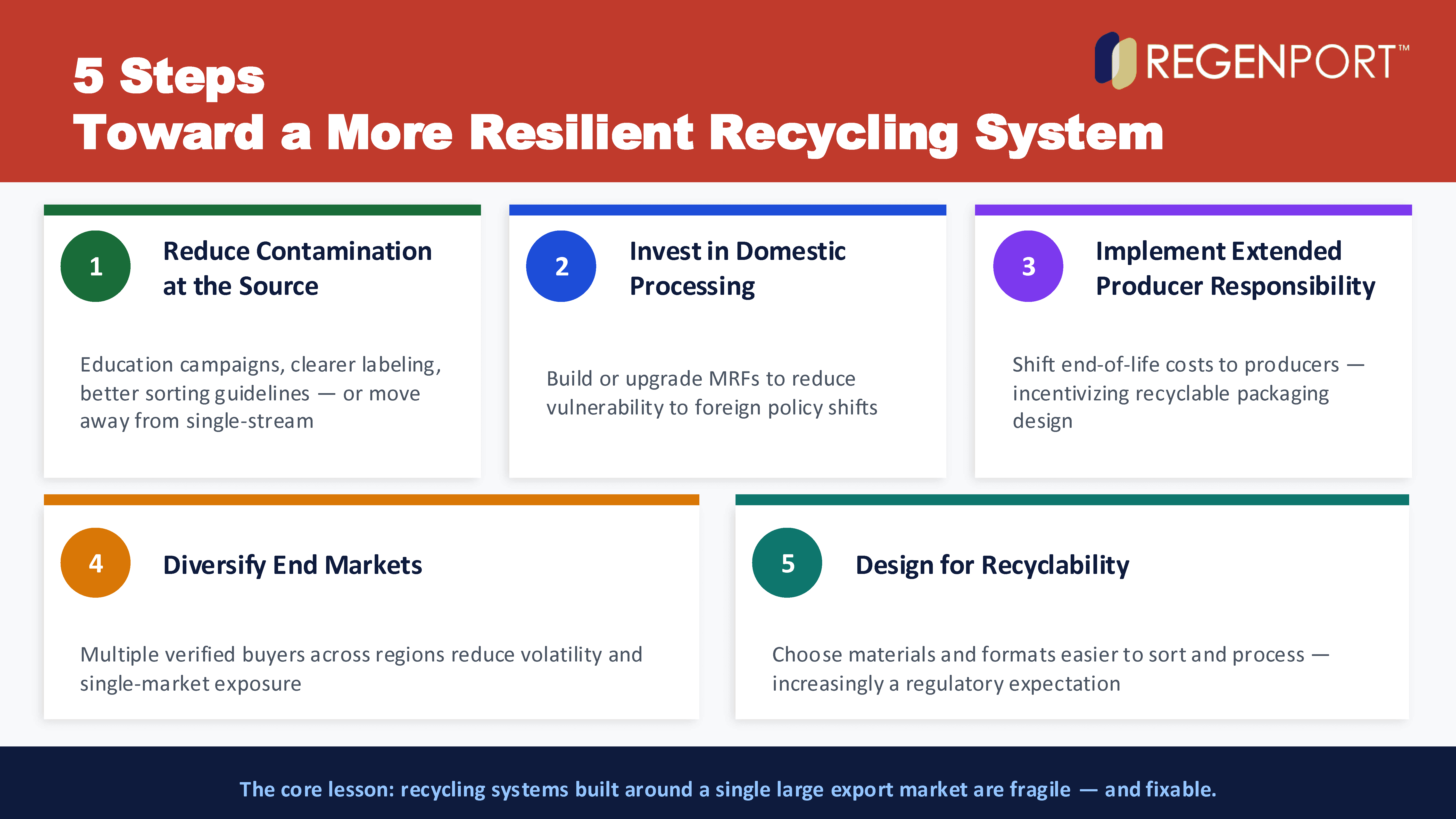
The core lesson of National Sword is that recycling systems built around a single large export market are fragile. The adjustments required are now reasonably well understood.
1. Reduce Contamination at the Source
Education campaigns, clearer labeling, and better sorting guidelines help residents understand what can and cannot be recycled. In some cases, moving away from single‑stream collection or adding pre‑sorting steps can significantly improve material quality.
2. Invest in Domestic Processing Infrastructure
Countries and regions that lack the capacity to process their own recyclables domestically are vulnerable to policy changes abroad. Building or upgrading MRFs and sorting facilities is a form of resource resilience that benefits long‑term system stability.
3. Implement Extended Producer Responsibility (EPR)
EPR frameworks shift some of the cost and responsibility for end‑of‑life material management to producers, who are best placed to influence packaging design. Countries that lack EPR frameworks are leaving important policy levers on the table.
4. Diversify End Markets
Rather than routing all recyclables to a single country or market, recycling systems benefit from having multiple verified buyers across different regions and industries. Market diversification helps reduce volatility and makes systems less vulnerable to sudden import changes.
5. Design for Recyclability From the Start
Manufacturers, brands, and packaging designers can reduce downstream costs by choosing materials and formats that are easier to sort and process. In many markets, this is increasingly becoming a regulatory expectation as well as a business advantage.
Conclusion
China’s National Sword policy did not create the problems it exposed. It revealed that decades of export‑dependent recycling had allowed many countries to delay investment in domestic infrastructure, quality control, and sustainable design. In some cases, the disruption led to more landfilling or incineration than before, but it also forced a more honest conversation about the real cost of recycling.
At the same time, National Sword prompted meaningful changes: more serious investment in domestic processing, stronger policy tools like EPR, and clearer standards for material quality. Those changes are uneven and still evolving, but they represent a more durable foundation for recycling than the fragile export model that National Sword dismantled.
For municipalities, businesses, and policymakers, the path forward is clear: build systems that can function without depending on any single foreign market as a disposal outlet. In that sense, National Sword was not the end of recycling, but the beginning of a more mature conversation about how to make it truly sustainable.
Image generated with ChatGPT and Claude
For more than two decades, many countries in North America, Europe, and Australia sent a large share of their collected recyclables to China. China had the factories, logistics, and demand for raw materials to absorb much of the world’s used paper and plastics.
That arrangement changed abruptly on January 1, 2018, when China’s National Sword policy went into full force. What began as a tighter environmental rule turned into a major realignment of global recycling markets, revealing how fragile many systems were.
What Is China’s National Sword Policy?
China’s National Sword policy was formally announced by the Customs General Administration on February 7, 2017, and implemented in phases throughout 2018. It marked the most comprehensive tightening of recycling‑import rules China had made in years.
The policy had three main pillars:
It banned the import of 24 categories of solid waste, including mixed paper and non‑industrial mixed plastics. These were materials that were often heavily contaminated or difficult to sort at scale, and many had been exported from single‑stream curbside recycling programs.
It set a strict contamination limit of 0.5% on most other imported recyclable materials, effective March 1, 2018. This was a sharp reduction from the earlier informal tolerance of about 2–5% contamination, which exporting countries had long treated as a practical guideline.
It reduced the number of import licenses issued to recycling processors, limiting how many companies could legally receive and sort foreign waste. This tightened oversight and further reduced the volume of imports.
National Sword was not created in a vacuum. For years, Chinese processing facilities had been receiving shipments contaminated with food residue, hazardous materials, and non‑recyclable items. The 2016 documentary Plastic China highlighted poor conditions at some informal recycling operations, amplifying public pressure on the government to act. At the same time, lower prices for raw materials made it less profitable for Chinese operators to process low‑grade recyclables.
The policy was also a logical extension of earlier enforcement efforts like the 2013 Green Fence campaign and a 2015 pilot inspection initiative. Unlike those earlier moves, however, National Sword was broader, stricter, and designed to be more permanent. It signaled that China was no longer willing to accept low‑quality, mixed recyclables as a default part of its material supply chain.
How National Sword Disrupted Global Recycling Markets
The Scale of Dependency
Before 2018, many recycling systems in developed countries were built around export. China had become a major outlet for mixed paper and plastics that were hard to process domestically or not economically viable in local markets. The global trade in recyclables depended on this external demand, especially for lower‑grade or contaminated streams.
When National Sword took effect, those export routes narrowed quickly. Municipalities and materials recovery facilities suddenly faced a core question: if China no longer wanted these materials, what should be done with them?
Immediate Market Effects
The first impact was price pressure. Without a reliable export outlet, many materials lost value. Revenues from the sale of recyclables fell, while processing costs rose as facilities adapted to new markets and standards. In some places, cities had to raise fees, change collection programs, or temporarily accept lower recycling rates.
In other regions, recyclables that had previously been sold were instead landfilled or incinerated. Stockpiles of sorted material appeared in warehouses, and some programs struggled to justify continued collection without stable end‑market demand.
The disruption also highlighted how much existing infrastructure relied on high contamination tolerance. When China’s 0.5% standard became the de facto benchmark, many bales from Western systems no longer met the grade without significant upgrades to sorting and quality control.
Why Contamination and Single‑Stream Recycling Became Central
A key lesson from National Sword was the role of contamination. Single‑stream recycling—where households put all recyclables into one bin—had been effective at increasing participation, but it also made contamination harder to control. Food residue, plastic films, mixed packaging, and non‑recyclable items regularly entered the stream.
For many recycling programs, the cost of contamination is substantial. Adds sorting complexity, raises processing costs, and lowers the value of output. In practice, National Sword made that cost more visible, forcing many operators to rethink how they design and operate their collection systems.
What Changed After 2018
Domestic Infrastructure Investment
One of the most visible responses to National Sword was investment in domestic recycling capacity. Countries that had long deferred upgrades to materials recovery facilities began building higher‑capacity, more automated sorting lines. Optical sorting, AI‑assisted robotics, and advanced separation systems helped produce cleaner, higher‑quality bales that could meet tighter export standards or be used in local markets.
In Australia, for example, the New South Wales government invested over AU$60 million in domestic sorting, processing, and recycling infrastructure in response to the policy. Other regions followed similar paths, treating National Sword as a wake‑up call rather than a crisis.
Regulatory and Policy Shifts
National Sword also accelerated policy changes at multiple levels:
Several U.S. states began exploring or adopting Extended Producer Responsibility (EPR) for packaging, requiring manufacturers to help cover the costs of end‑of‑life management.
The European Union strengthened its Circular Economy Package, setting binding targets for recycled content and recyclability.
Municipalities and national agencies tightened rules on what materials were accepted in curbside recycling, excluding hard‑to‑process items and improving overall quality.
Taken together, these moves signaled a shift away from “export‑first” recycling toward systems that treat recycling as a local infrastructure and policy issue, not just a commodity trade.
Redirection to Southeast Asia (and Its Limits)
In the short term, some of the displaced recyclable volume shifted to countries in Southeast Asia, particularly Malaysia, Vietnam, Thailand, and Indonesia. These nations had growing manufacturing sectors and rising demand for materials, so they initially absorbed a portion of the material that had once gone to China.
However, the new markets were not ready to handle the full volume. Many Southeast Asian countries lacked the regulatory framework and infrastructure to manage large, contaminated imports, and within a few years, several introduced their own import restrictions and bans. By 2019–2020, Southeast Asia had largely closed the door on the same kind of low‑quality waste that China had shut out earlier.
That experience reinforced the lesson: recycling systems that rely on exporting low‑quality material to the next available country are inherently unstable. National Sword and its regional ripple effects made that vulnerability clear.
What To Expect Going Forward
Several long‑term trends have taken shape directly or indirectly because of National Sword:
Growth of Domestic Processing Capacity
Countries that once exported large volumes of recyclables are now investing in domestic facilities that can sort, clean, and process materials locally. This is a long‑term infrastructure build, but it improves resilience and reduces dependence on foreign policy decisions.
Higher Quality Standards Across the Supply Chain
Contamination reduction has become a consistent priority. Programs now emphasize earlier sorting, clearer labeling for residents, and, in some cases, multi‑stream collection to reduce contamination at the source. Higher quality bales are more valuable in both domestic and export markets.
Expansion of Extended Producer Responsibility
More governments are moving toward EPR for packaging, which shifts some of the financial and operational responsibility for recycling from municipalities to producers. This can create incentives for companies to design packaging that is easier to recycle, less contaminated, and more compatible with real‑world systems.
Advances in Mechanized and Automated Sorting
AI‑assisted sorting, optical sensors, and robotics are becoming more common in modern MRFs. These technologies lower the cost of producing clean, high‑purity streams, which in turn makes it easier to meet strict contamination standards and serve more stable markets.
A Shift Toward Circular Economy Models
In some industries, the focus is shifting from “collect and export” to closed‑loop recycling, where manufacturers take back and reprocess their own materials. This reduces dependence on global commodity markets and improves traceability and quality control.
What Countries, Municipalities, and Businesses Should Do
The core lesson of National Sword is that recycling systems built around a single large export market are fragile. The adjustments required are now reasonably well understood.
1. Reduce Contamination at the Source
Education campaigns, clearer labeling, and better sorting guidelines help residents understand what can and cannot be recycled. In some cases, moving away from single‑stream collection or adding pre‑sorting steps can significantly improve material quality.
2. Invest in Domestic Processing Infrastructure
Countries and regions that lack the capacity to process their own recyclables domestically are vulnerable to policy changes abroad. Building or upgrading MRFs and sorting facilities is a form of resource resilience that benefits long‑term system stability.
3. Implement Extended Producer Responsibility (EPR)
EPR frameworks shift some of the cost and responsibility for end‑of‑life material management to producers, who are best placed to influence packaging design. Countries that lack EPR frameworks are leaving important policy levers on the table.
4. Diversify End Markets
Rather than routing all recyclables to a single country or market, recycling systems benefit from having multiple verified buyers across different regions and industries. Market diversification helps reduce volatility and makes systems less vulnerable to sudden import changes.
5. Design for Recyclability From the Start
Manufacturers, brands, and packaging designers can reduce downstream costs by choosing materials and formats that are easier to sort and process. In many markets, this is increasingly becoming a regulatory expectation as well as a business advantage.
Conclusion
China’s National Sword policy did not create the problems it exposed. It revealed that decades of export‑dependent recycling had allowed many countries to delay investment in domestic infrastructure, quality control, and sustainable design. In some cases, the disruption led to more landfilling or incineration than before, but it also forced a more honest conversation about the real cost of recycling.
At the same time, National Sword prompted meaningful changes: more serious investment in domestic processing, stronger policy tools like EPR, and clearer standards for material quality. Those changes are uneven and still evolving, but they represent a more durable foundation for recycling than the fragile export model that National Sword dismantled.
For municipalities, businesses, and policymakers, the path forward is clear: build systems that can function without depending on any single foreign market as a disposal outlet. In that sense, National Sword was not the end of recycling, but the beginning of a more mature conversation about how to make it truly sustainable.
Image generated with ChatGPT and Claude
Sourcing in the New Trade Map
Grades • Specs • Availability
Browse rLDPE →
Sourcing in the New Trade Map
Sourcing in the New Trade Map
Browse rLDPE grades by feedstock, MFI, color and stock status.
Browse rLDPE grades by feedstock, MFI, color and stock status.
Browse rLDPE →
Browse rLDPE →
Looking for samples or ready to source? Submit your request for pricing, availability, and technical information.
Looking for samples or ready to source? Submit your request for pricing, availability, and technical information.
Request a Quote →
Request a Quote →
Posted by REGENPORT
REGENPORT is a global platform connecting buyers and suppliers in the recycled materials and sustainable packaging industries.