CATEGORY
CATEGORY
Regulation
Regulation
Regulation
Food-Contact Recycled Plastics: What "Recycled" Doesn't Automatically Mean
Food-Contact Recycled Plastics: What "Recycled" Doesn't Automatically Mean
Food-Contact Recycled Plastics: What "Recycled" Doesn't Automatically Mean

Not all recycled plastics are approved for food contact — and the difference isn't visible. A breakdown of FDA NOLs, EFSA approvals, and what compliance actually requires.
Many companies developing sustainable packaging make the same assumption: if a material is recycled, it must be usable for food packaging.
It isn't. And the gap between "recycled" and "food-grade recycled" is where regulatory risk lives.
Food-contact recycled plastics occupy one of the most tightly regulated spaces in the entire materials industry. The rules aren't just about what's in the plastic—they govern how it was processed, where it came from, and whether it's been formally validated for food contact by the relevant authority.
Why PCR Content Alone Doesn't Qualify a Material
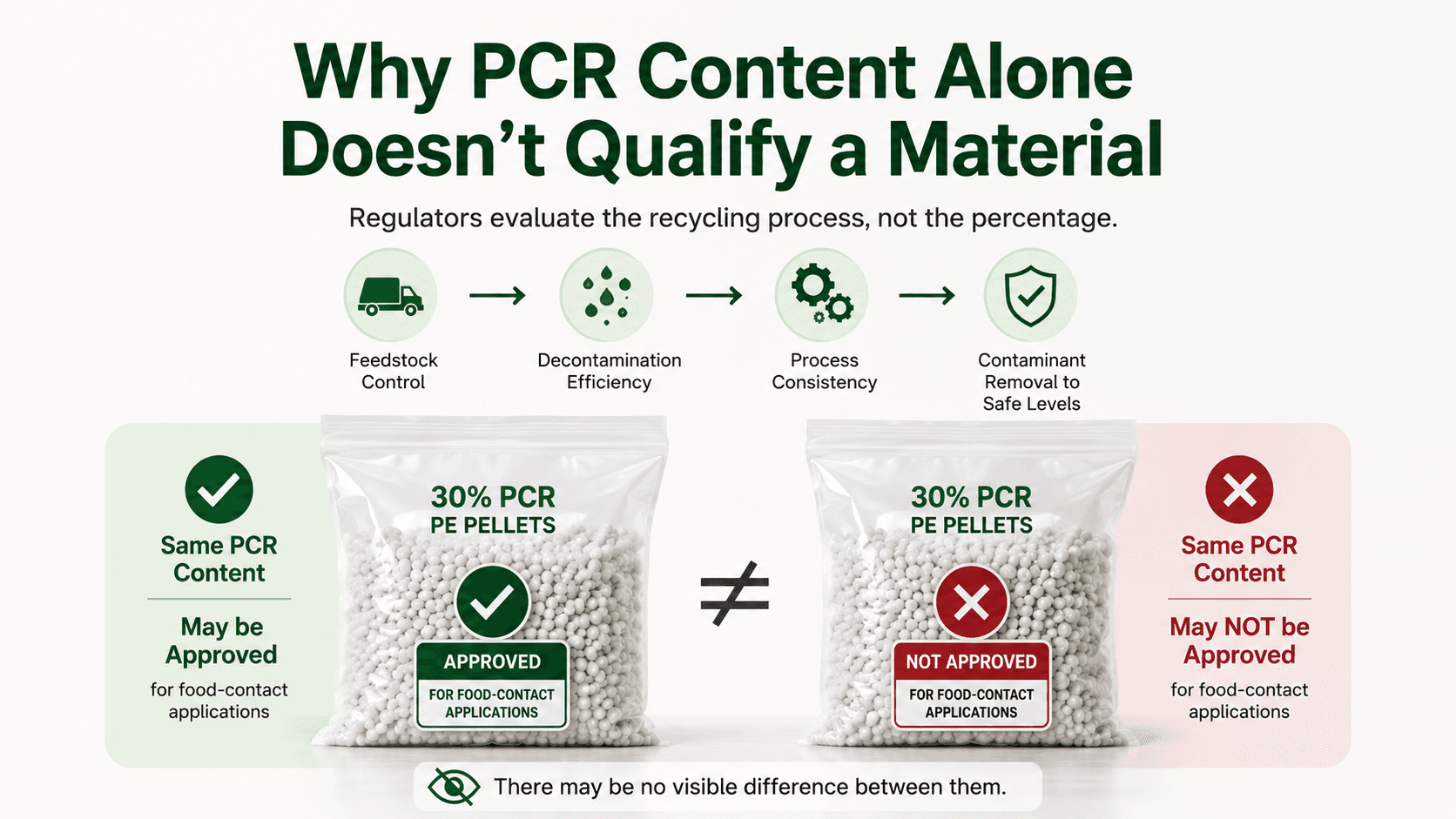
Recycled content—sometimes called PCR (post-consumer recycled) content—refers to how much of a material came from end-of-life waste streams. But regulatory bodies like the U.S. FDA and EFSA (European Food Safety Authority) don't approve materials based on recycled content percentages.
What they evaluate is the entire recycling process: feedstock control, decontamination efficiency, process consistency, and demonstrated ability to remove chemical contaminants to safe levels.
This means that two bags of recycled polyethylene pellets with identical PCR content can have entirely different regulatory statuses. One may be approved for food-contact applications. The other may not—and there may be no visible difference between them.
The rPET Exception—and Why It Matters
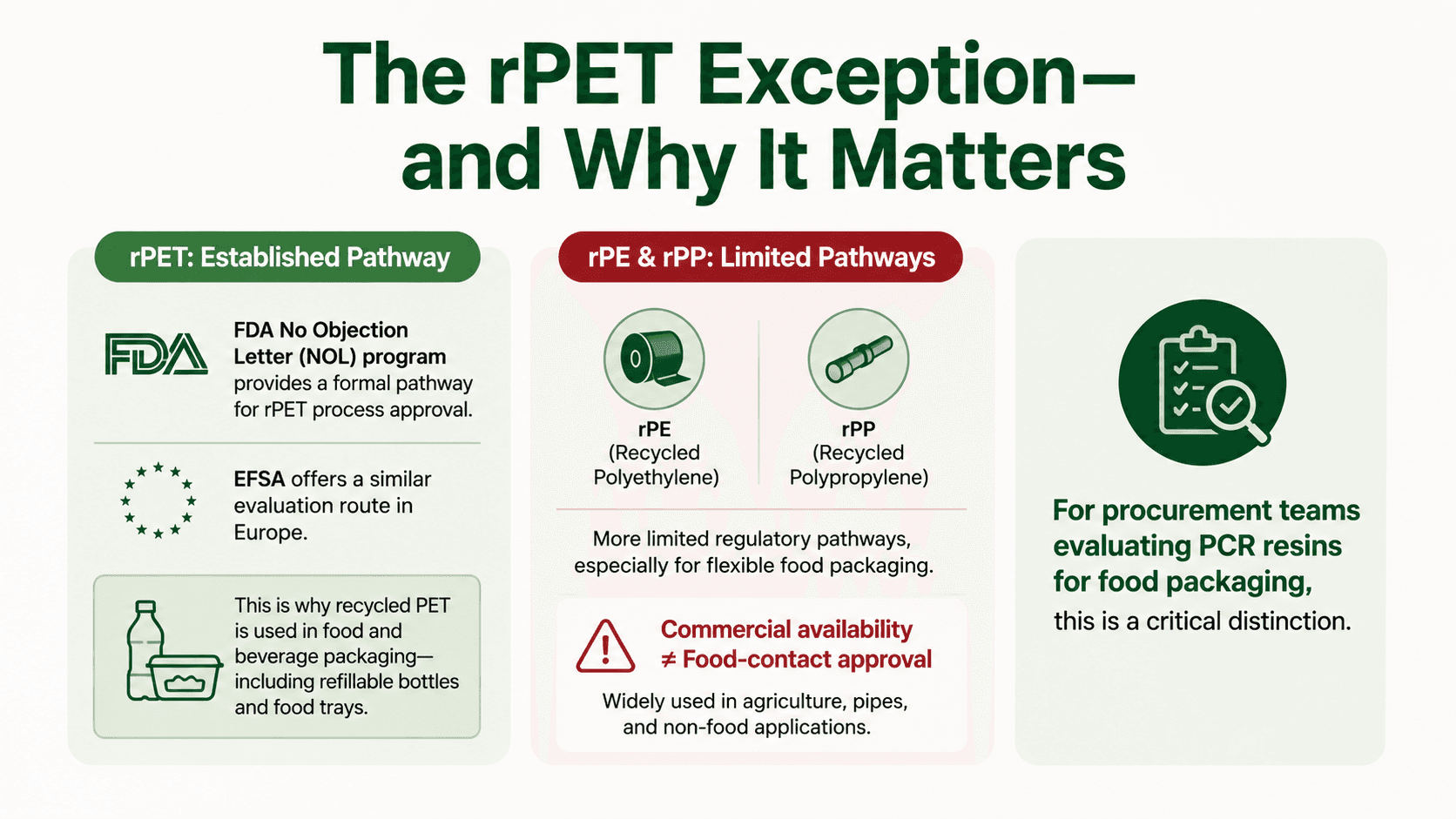
Among recycled polymers, rPET has the most established food-contact regulatory pathway. The FDA's No Objection Letter (NOL) program provides a formal mechanism for recyclers to seek approval for specific rPET processes. EFSA offers a similar evaluation route in Europe.
This is why recycled PET shows up in food and beverage packaging—including refillable bottles and food trays—more often than other recycled resins.
rPE (recycled polyethylene) and rPP (recycled polypropylene), however, face more limited regulatory pathways, particularly for flexible food packaging. Commercially available rPE or rPP materials are widely used in agricultural films, pipes, and non-food applications—but a material being commercially available does not mean it holds food-contact approval.
For procurement teams evaluating PCR resins for food packaging, this is a critical distinction.
What Compliance Actually Requires
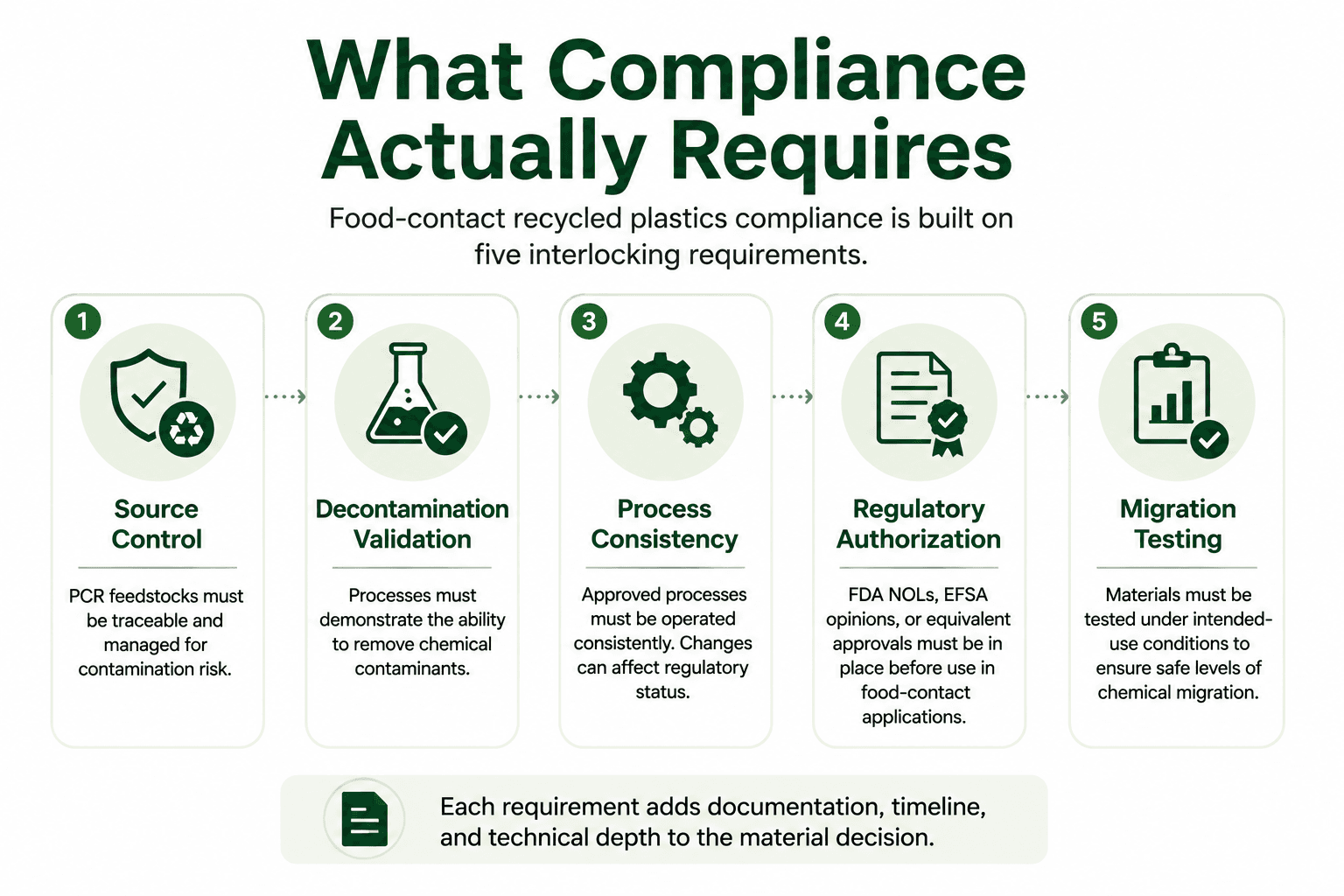
Food-contact recycled plastics compliance is built on several interlocking requirements:
Source control — PCR feedstocks must be traceable and managed for contamination risk. Not all post-consumer waste streams are suitable inputs for food-contact production.
Decontamination validation — Recycling processes must demonstrate the ability to remove chemical contaminants. This typically involves challenge testing using surrogate contaminants to simulate worst-case scenarios.
Process consistency — Approved processes must be operated consistently. Changes in equipment, feedstock sources, or operating conditions can affect regulatory status.
Regulatory authorization — FDA NOLs, EFSA positive opinions, or equivalent national approvals must be in place before a material can be used in food-contact applications.
Migration testing — Even with process approvals, materials must be tested under intended-use conditions to confirm that chemical migration into food stays within permitted limits.
Each of these requirements adds documentation, timeline, and technical depth to what might otherwise seem like a simple material procurement decision.

The Documentation Behind a Compliant Material
For food-contact PCR packaging projects, technical compliance is only part of the picture. Procurement and quality teams also need to collect and verify supplier documentation, including:
Declarations of Compliance (DoC)
Letters of Guarantee (LoG)
Recycling process descriptions (covering feedstock, decontamination steps, and quality controls)
Migration test reports under relevant food simulant and temperature conditions
Supplier qualification for food-contact recycled plastics also involves deeper due diligence—including process audits and verification of regulatory approval status—compared to standard recycled resin procurement.

A Note on Claims and Credibility
Terms like "food-grade recycled plastic," "100% PCR packaging," and "sustainable food packaging" are frequently used in product marketing. But each of these claims carries regulatory implications.
A material marketed as food-grade must actually hold the required approvals. A "100% PCR" claim doesn't confirm food-contact suitability—it only describes content. Misalignment between marketing language and regulatory reality creates risk: regulatory enforcement exposure, customer disputes, and credibility damage in the market.
For companies serious about PCR packaging at scale, aligning claims with documented compliance is not optional.
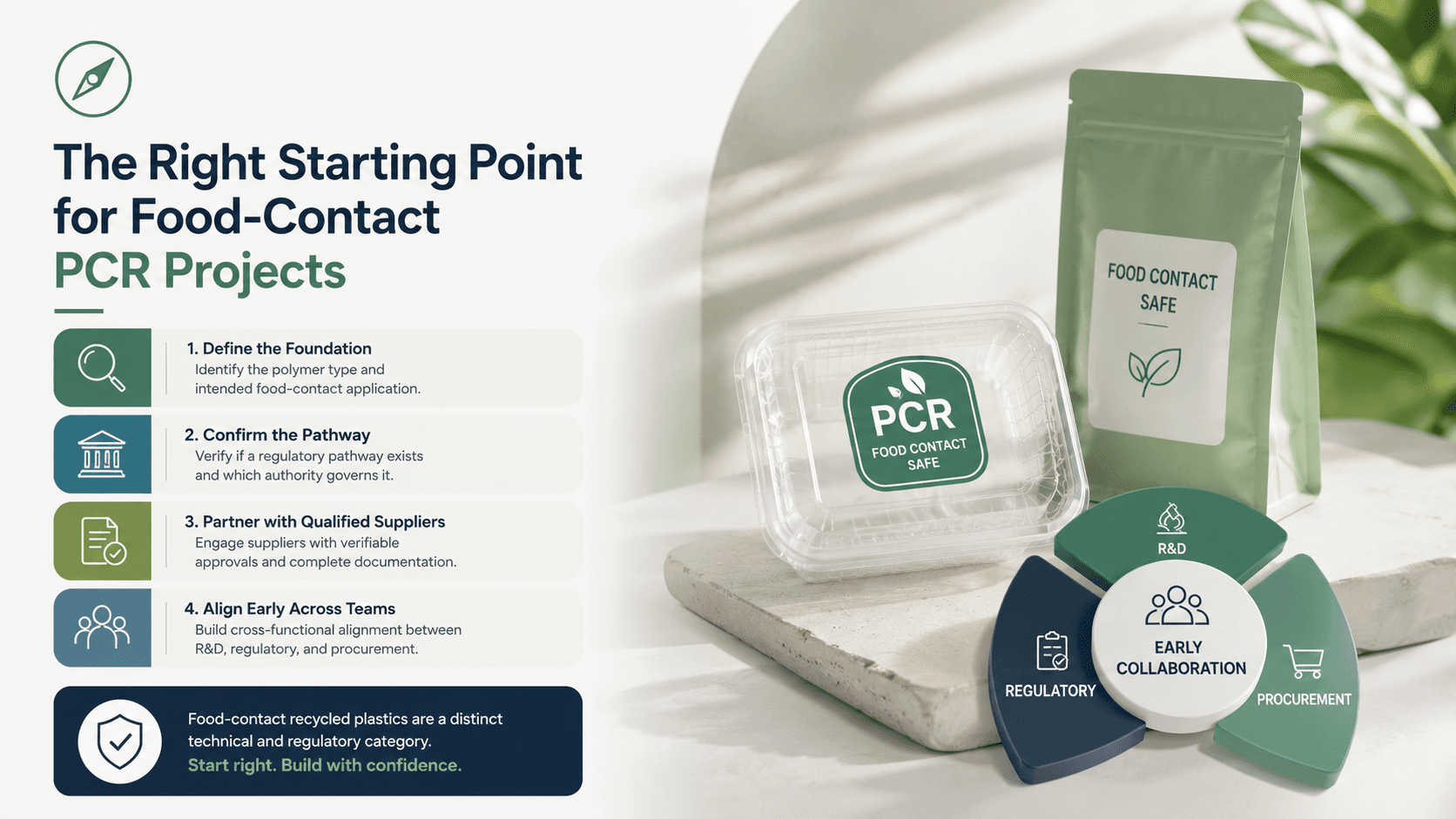
The Right Starting Point for Food-Contact PCR Projects
If your organization is evaluating recycled content for food packaging applications, the regulatory question shouldn't come at the end of material selection—it should come first.
That means:
Identifying the specific polymer type and intended food-contact application
Confirming whether a regulatory pathway exists (and which authority governs it)
Engaging suppliers who can provide verifiable process approvals and full documentation packages
Building cross-functional alignment between R&D, regulatory, and procurement teams early in the project
Food-contact recycled plastics are not a variation of standard PCR materials. They are a distinct technical and regulatory category—and they require procurement strategies built around that distinction.
🔜 NEXT WEEK ON REGENPORT INSIGHTS
When it comes to recycled plastics, food-contact compliance sets the highest bar. But what about non-food packaging?
Next week, we'll look at how to evaluate PCR materials for non-food and industrial packaging applications — where the regulatory barriers are lower, but the performance and supply challenges are just as real.
→ Stay tuned on Regenport Insights
Image generated with ChatGPT
Many companies developing sustainable packaging make the same assumption: if a material is recycled, it must be usable for food packaging.
It isn't. And the gap between "recycled" and "food-grade recycled" is where regulatory risk lives.
Food-contact recycled plastics occupy one of the most tightly regulated spaces in the entire materials industry. The rules aren't just about what's in the plastic—they govern how it was processed, where it came from, and whether it's been formally validated for food contact by the relevant authority.
Why PCR Content Alone Doesn't Qualify a Material
Recycled content—sometimes called PCR (post-consumer recycled) content—refers to how much of a material came from end-of-life waste streams. But regulatory bodies like the U.S. FDA and EFSA (European Food Safety Authority) don't approve materials based on recycled content percentages.
What they evaluate is the entire recycling process: feedstock control, decontamination efficiency, process consistency, and demonstrated ability to remove chemical contaminants to safe levels.
This means that two bags of recycled polyethylene pellets with identical PCR content can have entirely different regulatory statuses. One may be approved for food-contact applications. The other may not—and there may be no visible difference between them.
The rPET Exception—and Why It Matters
Among recycled polymers, rPET has the most established food-contact regulatory pathway. The FDA's No Objection Letter (NOL) program provides a formal mechanism for recyclers to seek approval for specific rPET processes. EFSA offers a similar evaluation route in Europe.
This is why recycled PET shows up in food and beverage packaging—including refillable bottles and food trays—more often than other recycled resins.
rPE (recycled polyethylene) and rPP (recycled polypropylene), however, face more limited regulatory pathways, particularly for flexible food packaging. Commercially available rPE or rPP materials are widely used in agricultural films, pipes, and non-food applications—but a material being commercially available does not mean it holds food-contact approval.
For procurement teams evaluating PCR resins for food packaging, this is a critical distinction.
What Compliance Actually Requires
Food-contact recycled plastics compliance is built on several interlocking requirements:
Source control — PCR feedstocks must be traceable and managed for contamination risk. Not all post-consumer waste streams are suitable inputs for food-contact production.
Decontamination validation — Recycling processes must demonstrate the ability to remove chemical contaminants. This typically involves challenge testing using surrogate contaminants to simulate worst-case scenarios.
Process consistency — Approved processes must be operated consistently. Changes in equipment, feedstock sources, or operating conditions can affect regulatory status.
Regulatory authorization — FDA NOLs, EFSA positive opinions, or equivalent national approvals must be in place before a material can be used in food-contact applications.
Migration testing — Even with process approvals, materials must be tested under intended-use conditions to confirm that chemical migration into food stays within permitted limits.
Each of these requirements adds documentation, timeline, and technical depth to what might otherwise seem like a simple material procurement decision.
The Documentation Behind a Compliant Material
For food-contact PCR packaging projects, technical compliance is only part of the picture. Procurement and quality teams also need to collect and verify supplier documentation, including:
Declarations of Compliance (DoC)
Letters of Guarantee (LoG)
Recycling process descriptions (covering feedstock, decontamination steps, and quality controls)
Migration test reports under relevant food simulant and temperature conditions
Supplier qualification for food-contact recycled plastics also involves deeper due diligence—including process audits and verification of regulatory approval status—compared to standard recycled resin procurement.
A Note on Claims and Credibility
Terms like "food-grade recycled plastic," "100% PCR packaging," and "sustainable food packaging" are frequently used in product marketing. But each of these claims carries regulatory implications.
A material marketed as food-grade must actually hold the required approvals. A "100% PCR" claim doesn't confirm food-contact suitability—it only describes content. Misalignment between marketing language and regulatory reality creates risk: regulatory enforcement exposure, customer disputes, and credibility damage in the market.
For companies serious about PCR packaging at scale, aligning claims with documented compliance is not optional.
The Right Starting Point for Food-Contact PCR Projects
If your organization is evaluating recycled content for food packaging applications, the regulatory question shouldn't come at the end of material selection—it should come first.
That means:
Identifying the specific polymer type and intended food-contact application
Confirming whether a regulatory pathway exists (and which authority governs it)
Engaging suppliers who can provide verifiable process approvals and full documentation packages
Building cross-functional alignment between R&D, regulatory, and procurement teams early in the project
Food-contact recycled plastics are not a variation of standard PCR materials. They are a distinct technical and regulatory category—and they require procurement strategies built around that distinction.
🔜 NEXT WEEK ON REGENPORT INSIGHTS
When it comes to recycled plastics, food-contact compliance sets the highest bar. But what about non-food packaging?
Next week, we'll look at how to evaluate PCR materials for non-food and industrial packaging applications — where the regulatory barriers are lower, but the performance and supply challenges are just as real.
→ Stay tuned on Regenport Insights
Image generated with ChatGPT
rPP for Non-Food Uses
Grades • Specs • Availability
Browse rPP →
rPP for Non-Food Uses
rPP for Non-Food Uses
Review rPP grades for non-food applications by feedstock, properties, stock and MOQ.
Review rPP grades for non-food applications by feedstock, properties, stock and MOQ.
Browse rPP →
Browse rPP →
Looking for samples or ready to source? Submit your request for pricing, availability, and technical information.
Looking for samples or ready to source? Submit your request for pricing, availability, and technical information.
Request a Quote →
Request a Quote →
Posted by REGENPORT
REGENPORT is a global platform connecting buyers and suppliers in the recycled materials and sustainable packaging industries.