CATEGORY
CATEGORY
Regulation
Regulation
Regulation
rPE vs rPP vs rPET: How to Choose the Right PCR Material for Non-Food Packaging
rPE vs rPP vs rPET: How to Choose the Right PCR Material for Non-Food Packaging
rPE vs rPP vs rPET: How to Choose the Right PCR Material for Non-Food Packaging

Compare rPE, rPP, and rPET for non-food packaging. A practical guide to choosing the right recycled polymer based on application, performance, and supply.
As companies move from regulatory understanding to practical implementation of PCR (post-consumer recycled) packaging, the key question shifts from “how much PCR can we use?” to “which PCR material should we choose?”
In previous posts, we covered:
Food-contact recycled plastics: strict regulatory requirements (FDA, NOL, EFSA, etc.).
Non-food PCR packaging: evaluation criteria such as performance consistency, contamination risk, and supply stability.
Now, the next step is practical material selection. For non-food packaging, the most common options are rPE, rPP, and rPET. Each material has distinct advantages and limitations.
This article compares these three materials and provides a simple decision framework to help you choose the right PCR material for your application.
For reference:

How to Choose PCR Materials: From Criteria to Decision
Material selection for non-food packaging should align polymer characteristics with:
Application type: flexible film, rigid container, injection-molded part, etc.
Performance requirements: strength, stiffness, clarity, sealability.
Processing constraints: extrusion speed, molding temperature, line stability.
Sustainability targets: PCR content level, carbon footprint goals.
A simple approach:
Define application and performance priorities.
Compare rPE, rPP, and rPET against these priorities.
Validate with trial runs and adjust PCR content or blend ratios.
The following sections focus on step 2 and 3.
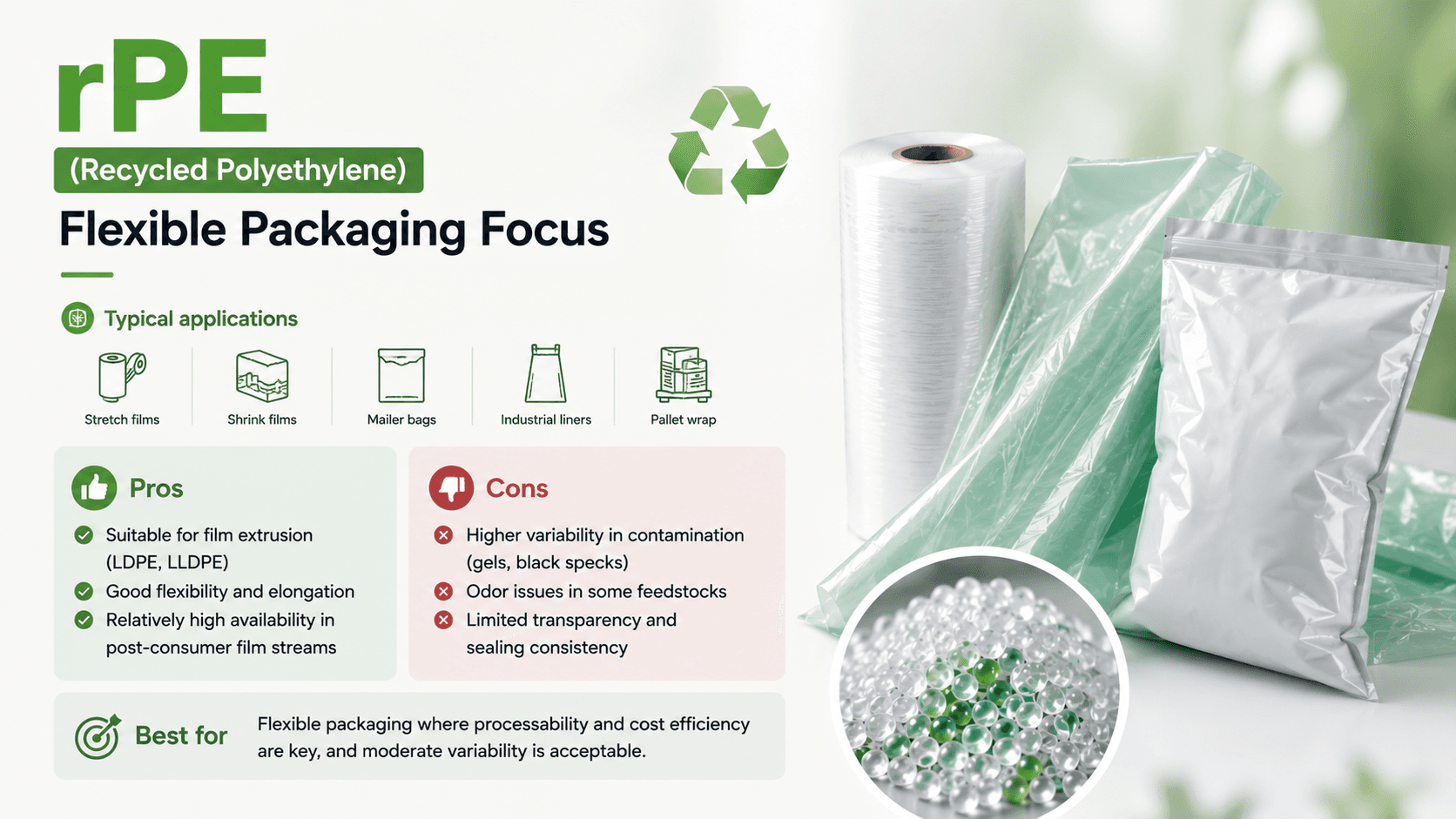
rPE (Recycled Polyethylene): Flexible Packaging Focus
Typical applications:
Stretch films, shrink films, mailer bags, industrial liners, pallet wrap.
Pros:
Suitable for film extrusion (LDPE, LLDPE).
Good flexibility and elongation.
Relatively high availability in post-consumer film streams.
Cons:
Higher variability in contamination (gels, black specks).
Odor issues in some feedstocks.
Limited transparency and sealing consistency.
Best for:
Flexible packaging where processability and cost efficiency are key, and moderate variability is acceptable.
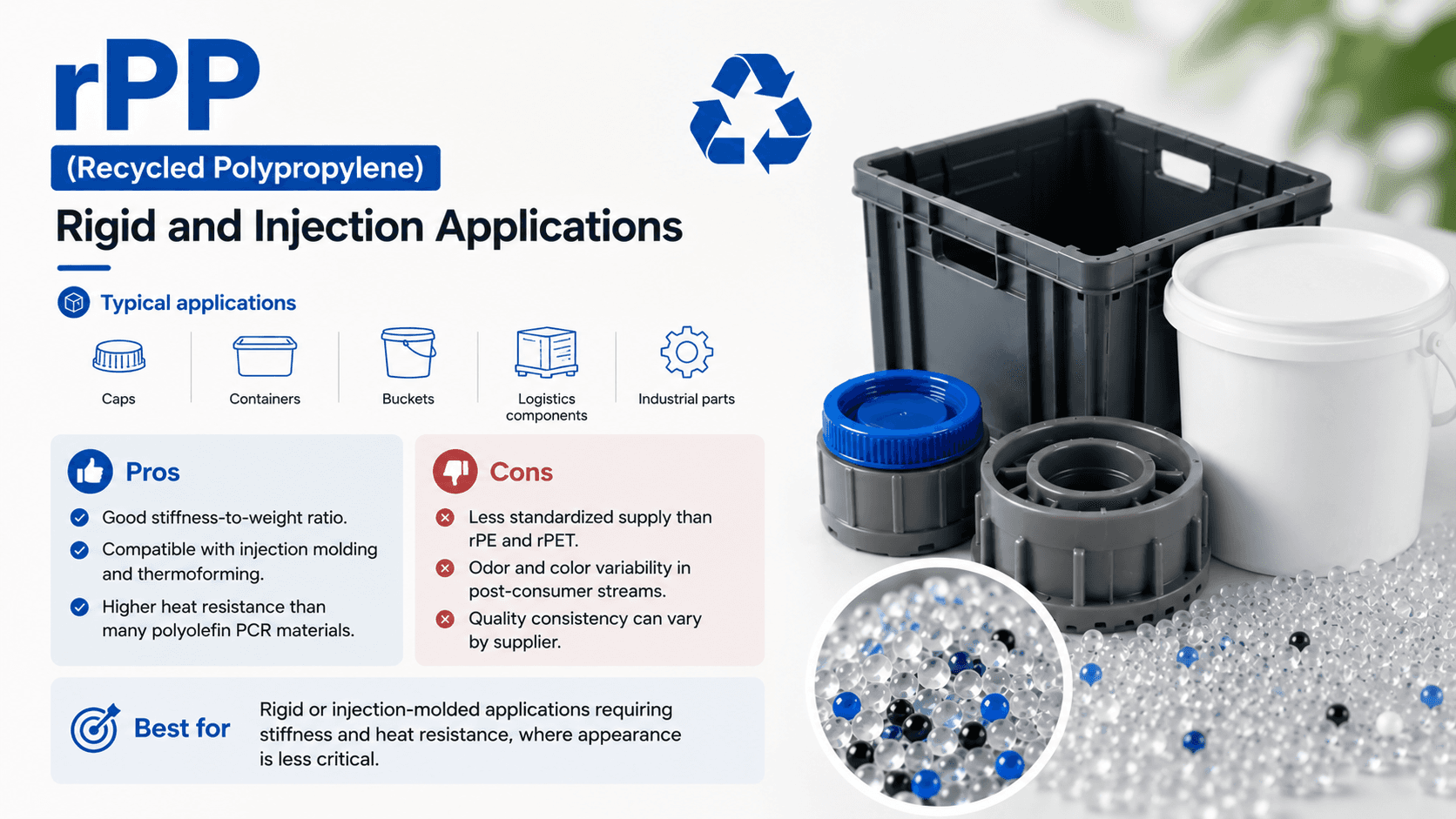
rPP (Recycled Polypropylene): Rigid and Injection Applications
Typical applications:
Caps, containers, buckets, logistics components, industrial parts.
Pros:
Good stiffness-to-weight ratio.
Compatible with injection molding and thermoforming.
Higher heat resistance than many polyolefin PCR materials.
Cons:
Less standardized supply than rPE and rPET.
Odor and color variability in post-consumer streams.
Quality consistency can vary by supplier.
Best for:
Rigid or injection-molded applications requiring stiffness and heat resistance, where appearance is less critical.
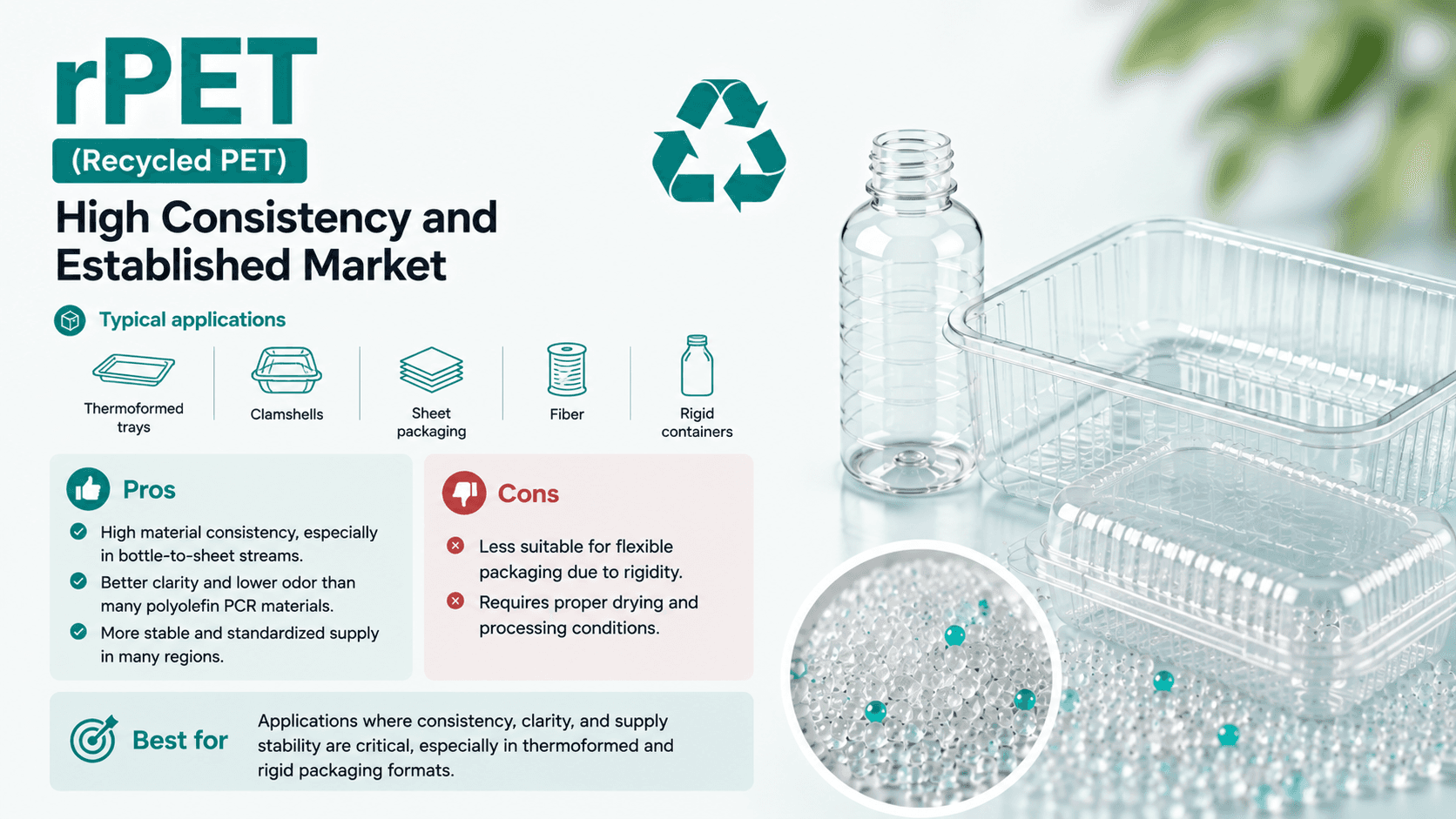
rPET (Recycled PET): High Consistency and Established Market
Typical applications:
Thermoformed trays, clamshells, sheet packaging, fiber, rigid containers.
Pros:
High material consistency, especially in bottle-to-sheet streams.
Better clarity and lower odor than many polyolefin PCR materials.
More stable and standardized supply in many regions.
Cons:
Less suitable for flexible packaging due to rigidity.
Requires proper drying and processing conditions.
Best for:
Applications where consistency, clarity, and supply stability are critical, especially in thermoformed and rigid packaging formats.
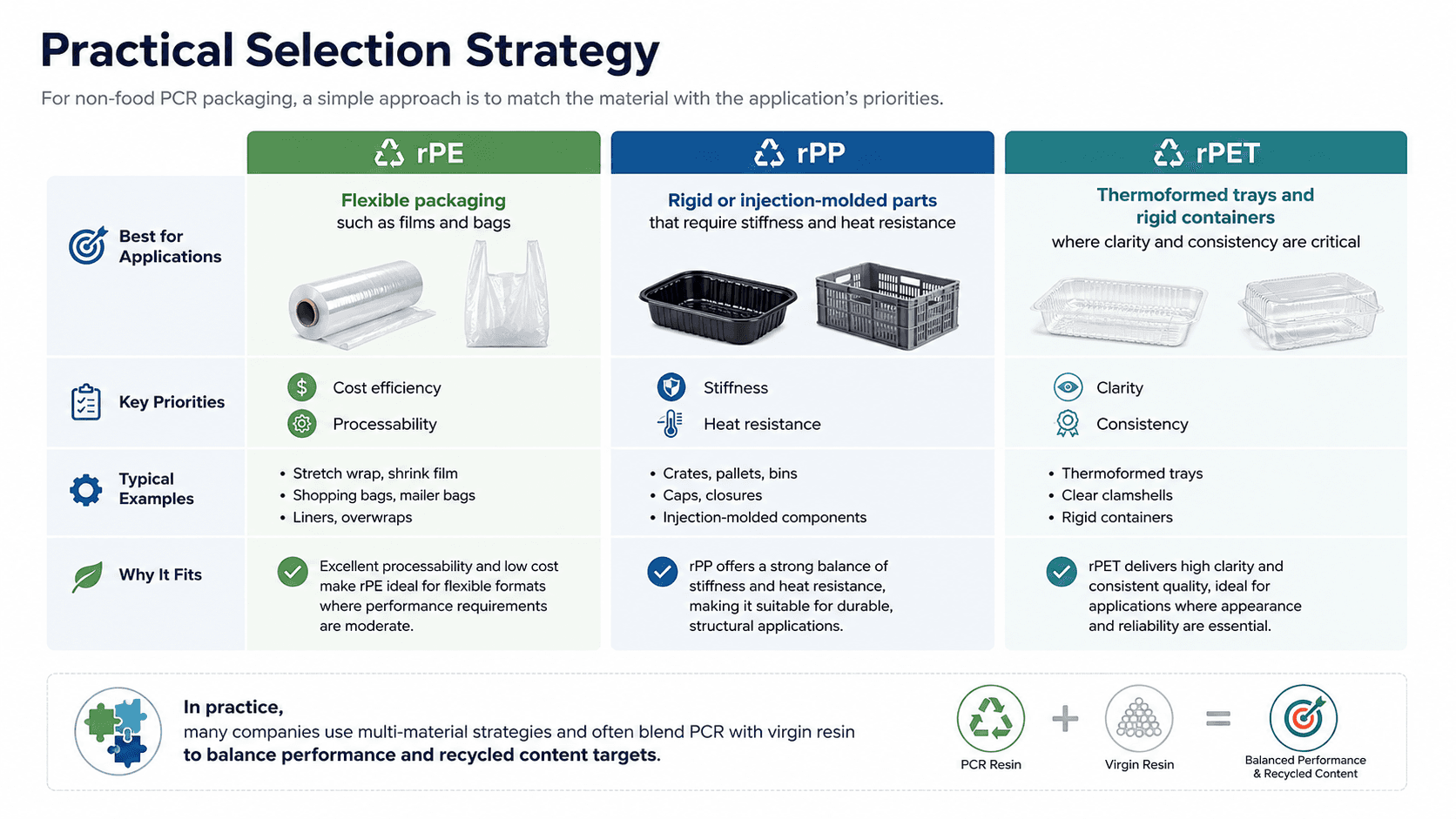
Practical Selection Strategy
For non-food PCR packaging, a simple approach is to match the material with the application’s priorities. rPE is best for flexible packaging such as films and bags where cost and processability matter, while rPP is preferred for rigid or injection-molded parts that require stiffness and heat resistance. rPET is ideal for thermoformed trays and rigid containers where clarity and consistency are critical. In practice, many companies use multi-material strategies and often blend PCR with virgin resin to balance performance and recycled content targets.
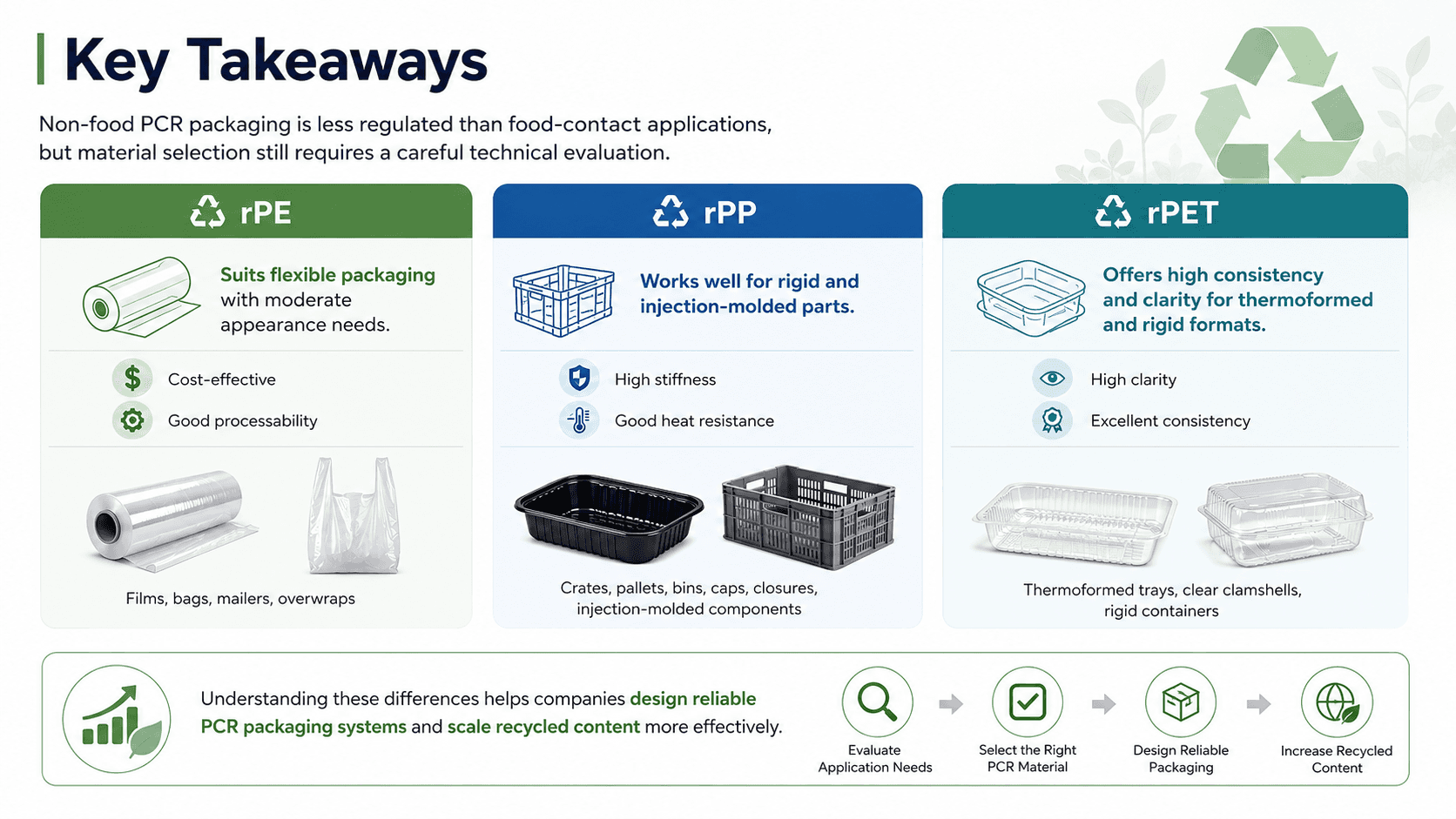
Key Takeaways
Non-food PCR packaging is less regulated than food-contact applications, but material selection still requires a careful technical evaluation. rPE suits flexible packaging with moderate appearance needs, rPP works well for rigid and injection-molded parts, and rPET offers high consistency and clarity for thermoformed and rigid formats. Understanding these differences helps companies design reliable PCR packaging systems and scale recycled content more effectively.
Image generated with ChatGPT
As companies move from regulatory understanding to practical implementation of PCR (post-consumer recycled) packaging, the key question shifts from “how much PCR can we use?” to “which PCR material should we choose?”
In previous posts, we covered:
Food-contact recycled plastics: strict regulatory requirements (FDA, NOL, EFSA, etc.).
Non-food PCR packaging: evaluation criteria such as performance consistency, contamination risk, and supply stability.
Now, the next step is practical material selection. For non-food packaging, the most common options are rPE, rPP, and rPET. Each material has distinct advantages and limitations.
This article compares these three materials and provides a simple decision framework to help you choose the right PCR material for your application.
For reference:
How to Choose PCR Materials: From Criteria to Decision
Material selection for non-food packaging should align polymer characteristics with:
Application type: flexible film, rigid container, injection-molded part, etc.
Performance requirements: strength, stiffness, clarity, sealability.
Processing constraints: extrusion speed, molding temperature, line stability.
Sustainability targets: PCR content level, carbon footprint goals.
A simple approach:
Define application and performance priorities.
Compare rPE, rPP, and rPET against these priorities.
Validate with trial runs and adjust PCR content or blend ratios.
The following sections focus on step 2 and 3.
rPE (Recycled Polyethylene): Flexible Packaging Focus
Typical applications:
Stretch films, shrink films, mailer bags, industrial liners, pallet wrap.
Pros:
Suitable for film extrusion (LDPE, LLDPE).
Good flexibility and elongation.
Relatively high availability in post-consumer film streams.
Cons:
Higher variability in contamination (gels, black specks).
Odor issues in some feedstocks.
Limited transparency and sealing consistency.
Best for:
Flexible packaging where processability and cost efficiency are key, and moderate variability is acceptable.
rPP (Recycled Polypropylene): Rigid and Injection Applications
Typical applications:
Caps, containers, buckets, logistics components, industrial parts.
Pros:
Good stiffness-to-weight ratio.
Compatible with injection molding and thermoforming.
Higher heat resistance than many polyolefin PCR materials.
Cons:
Less standardized supply than rPE and rPET.
Odor and color variability in post-consumer streams.
Quality consistency can vary by supplier.
Best for:
Rigid or injection-molded applications requiring stiffness and heat resistance, where appearance is less critical.
rPET (Recycled PET): High Consistency and Established Market
Typical applications:
Thermoformed trays, clamshells, sheet packaging, fiber, rigid containers.
Pros:
High material consistency, especially in bottle-to-sheet streams.
Better clarity and lower odor than many polyolefin PCR materials.
More stable and standardized supply in many regions.
Cons:
Less suitable for flexible packaging due to rigidity.
Requires proper drying and processing conditions.
Best for:
Applications where consistency, clarity, and supply stability are critical, especially in thermoformed and rigid packaging formats.
Practical Selection Strategy
For non-food PCR packaging, a simple approach is to match the material with the application’s priorities. rPE is best for flexible packaging such as films and bags where cost and processability matter, while rPP is preferred for rigid or injection-molded parts that require stiffness and heat resistance. rPET is ideal for thermoformed trays and rigid containers where clarity and consistency are critical. In practice, many companies use multi-material strategies and often blend PCR with virgin resin to balance performance and recycled content targets.
Key Takeaways
Non-food PCR packaging is less regulated than food-contact applications, but material selection still requires a careful technical evaluation. rPE suits flexible packaging with moderate appearance needs, rPP works well for rigid and injection-molded parts, and rPET offers high consistency and clarity for thermoformed and rigid formats. Understanding these differences helps companies design reliable PCR packaging systems and scale recycled content more effectively.
Image generated with ChatGPT
Start With rPP Grades
Grades • Specs • Availability
Browse rPP →
Start With rPP Grades
Start With rPP Grades
Compare rPP grades by feedstock, properties, applications, stock and MOQ.
Compare rPP grades by feedstock, properties, applications, stock and MOQ.
Browse rPP →
Browse rPP →
Looking for samples or ready to source? Submit your request for pricing, availability, and technical information.
Looking for samples or ready to source? Submit your request for pricing, availability, and technical information.
Request a Quote →
Request a Quote →
Posted by REGENPORT
REGENPORT is a global platform connecting buyers and suppliers in the recycled materials and sustainable packaging industries.