CATEGORY
CATEGORY
Regulation
Regulation
Regulation
How Much PCR Is Realistic? Flexible Film vs Rigid Packaging
How Much PCR Is Realistic? Flexible Film vs Rigid Packaging
How Much PCR Is Realistic? Flexible Film vs Rigid Packaging

PCR content ranges from 10% in sealing-critical films to 100% in rigid industrial packaging. See the key limiting factors—contamination, MFI variability, aesthetics—and how to set application-specific targets.
As companies expand their PCR (post-consumer recycled) packaging strategies, one of the most common questions is: how much recycled content is actually achievable in real-world applications?
While sustainability targets often push for high PCR percentages, practical limits vary significantly depending on packaging format, processing conditions, and performance requirements.
Understanding realistic PCR content ranges is essential for balancing sustainability goals with product quality, cost efficiency, and manufacturing stability.
If you haven’t read our previous articles in this series, you can start here:
Food-Contact Recycled Plastics: What "Recycled" Doesn't Automatically Mean
rPE vs rPP vs rPET: How to Choose the Right PCR Material for Non-Food Packaging
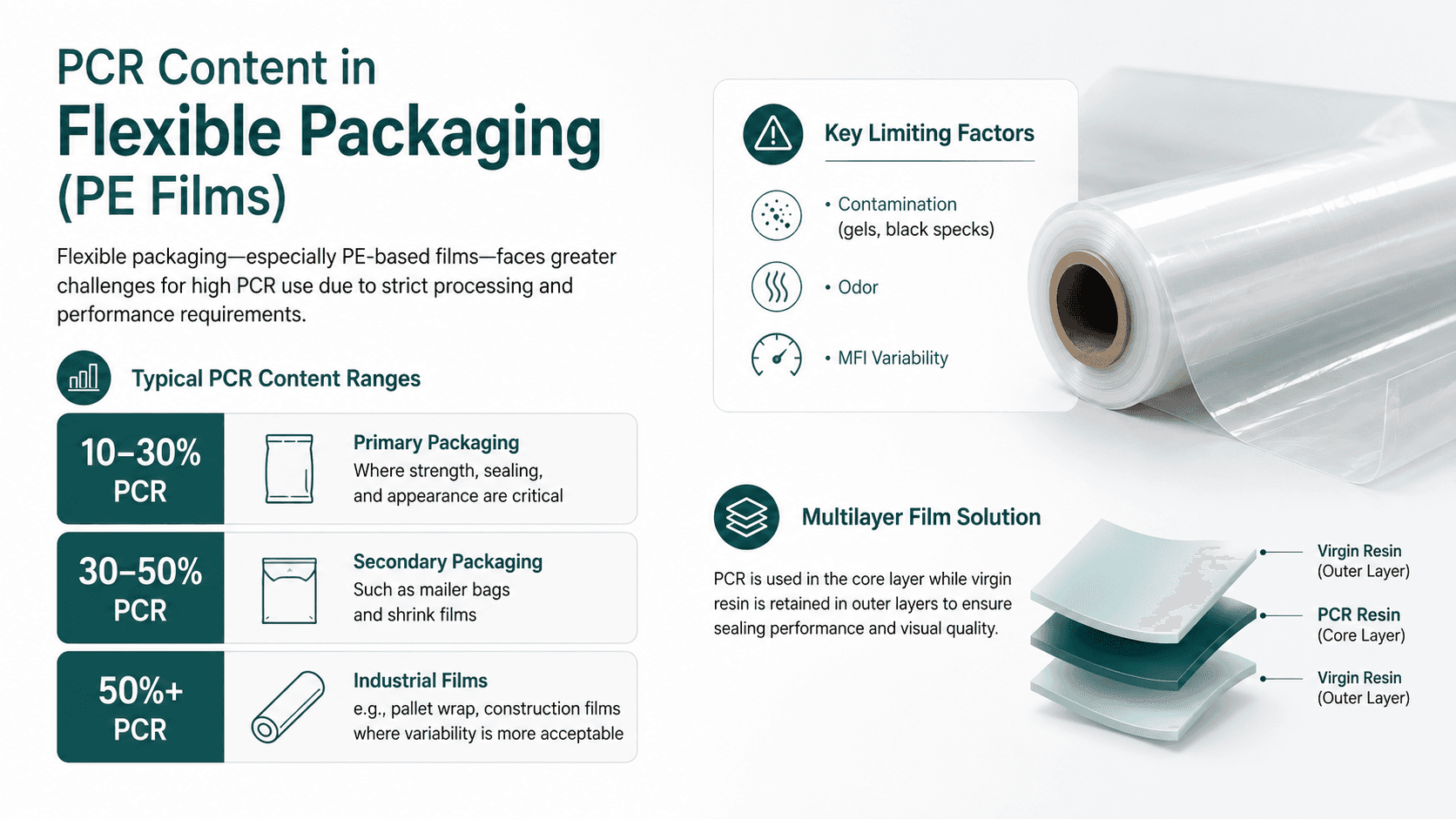
PCR Content in Flexible Packaging (PE Films)
Flexible packaging—especially polyethylene (PE)-based films—is one of the most challenging areas for high PCR integration due to strict processing and performance requirements.
Typical PCR content ranges:
10–30% PCR: Common in primary packaging where mechanical strength, sealing, and appearance are critical
30–50% PCR: Widely used in secondary packaging such as mailer bags and shrink films
50%+ PCR: Feasible in industrial films (e.g., pallet wrap, construction films) where variability is more acceptable
Key limiting factors include contamination (gels, black specks), odor, and variability in melt flow index (MFI). In blown film extrusion, increasing PCR content can lead to film breakage, unstable bubble formation, and sealing inconsistency.
A widely adopted solution is multilayer film structures, where PCR is used in the core layer while virgin resin is retained in outer layers to maintain sealing performance and visual quality.
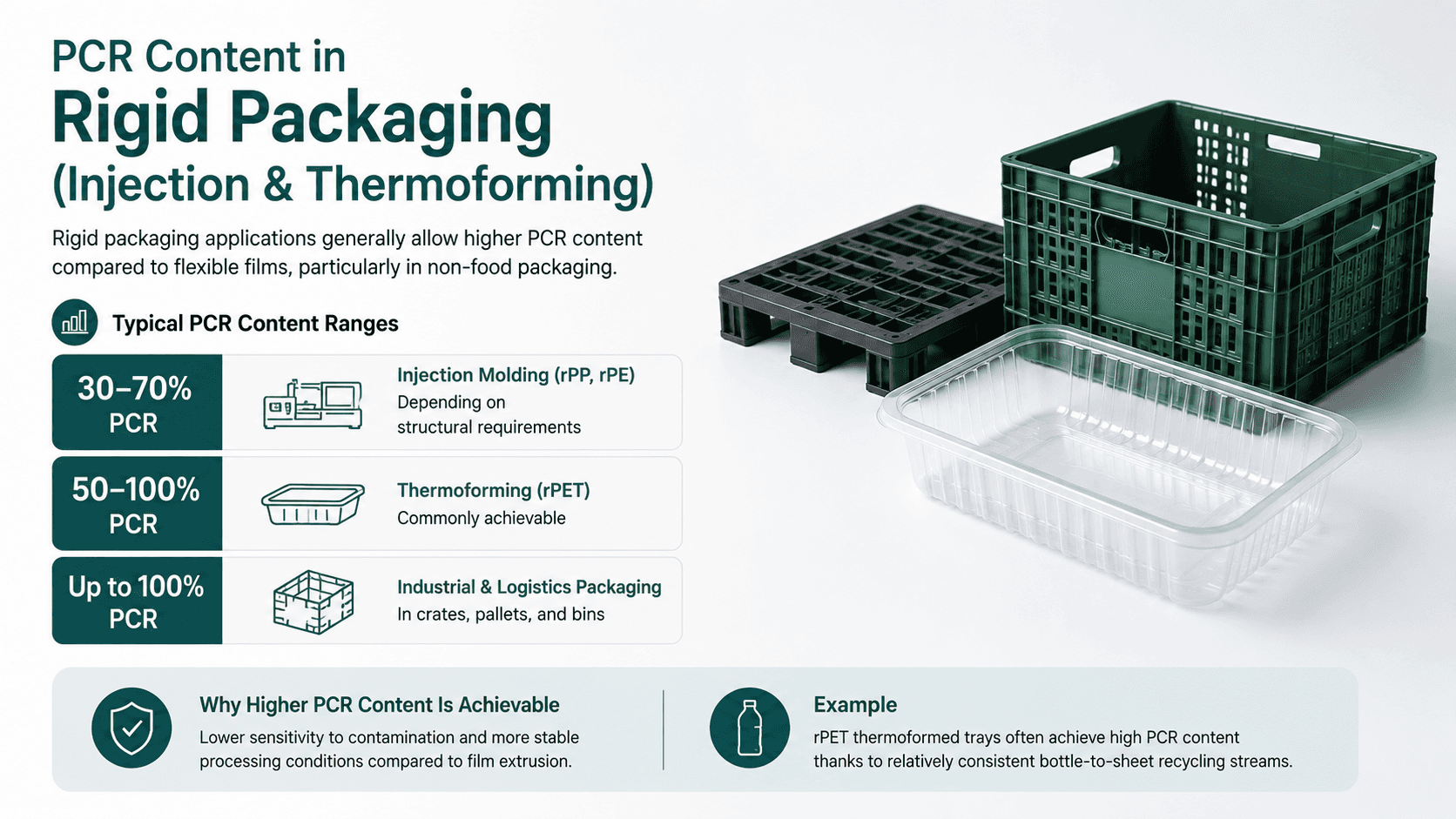
PCR Content in Rigid Packaging (Injection & Thermoforming)
Rigid packaging applications generally allow higher PCR content compared to flexible films, particularly in non-food packaging.
Typical PCR content ranges:
Injection molding (rPP, rPE): 30–70% PCR depending on structural requirements
Thermoforming (rPET): 50–100% PCR commonly achievable
Industrial and logistics packaging: Up to 100% PCR in crates, pallets, and bins
This higher tolerance is due to lower sensitivity to contamination and more stable processing conditions compared to film extrusion.
For example, rPET thermoformed trays often achieve high PCR content thanks to relatively consistent bottle-to-sheet recycling streams.
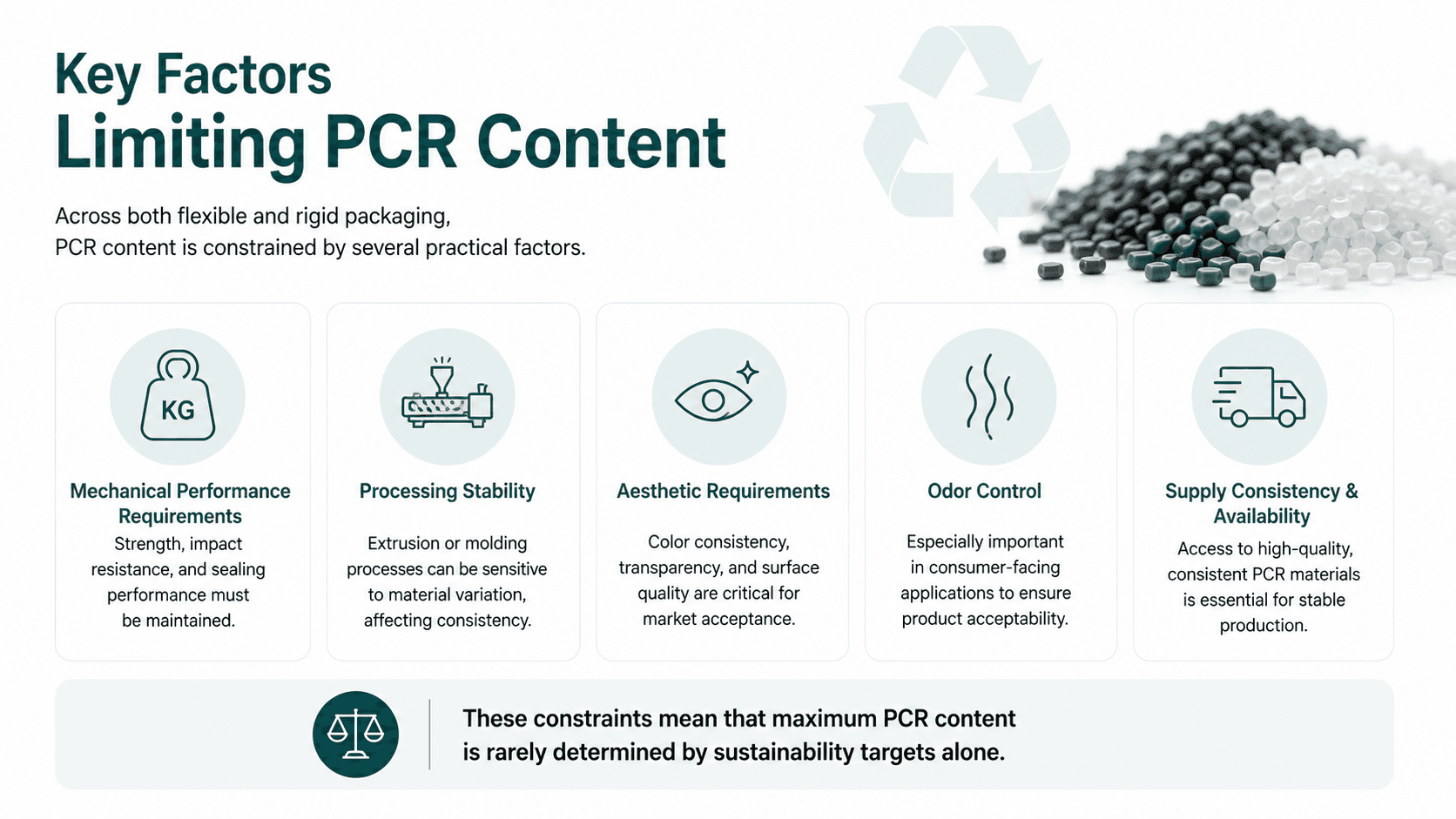
Key Factors Limiting PCR Content
Across both flexible and rigid packaging, PCR content is constrained by several practical factors:
Mechanical performance requirements (strength, impact resistance, sealing)
Processing stability (extrusion or molding sensitivity to material variation)
Aesthetic requirements (color consistency, transparency, surface defects)
Odor control, especially in consumer-facing applications
Supply consistency and availability of high-quality PCR materials
These constraints mean that maximum PCR content is rarely determined by sustainability targets alone.
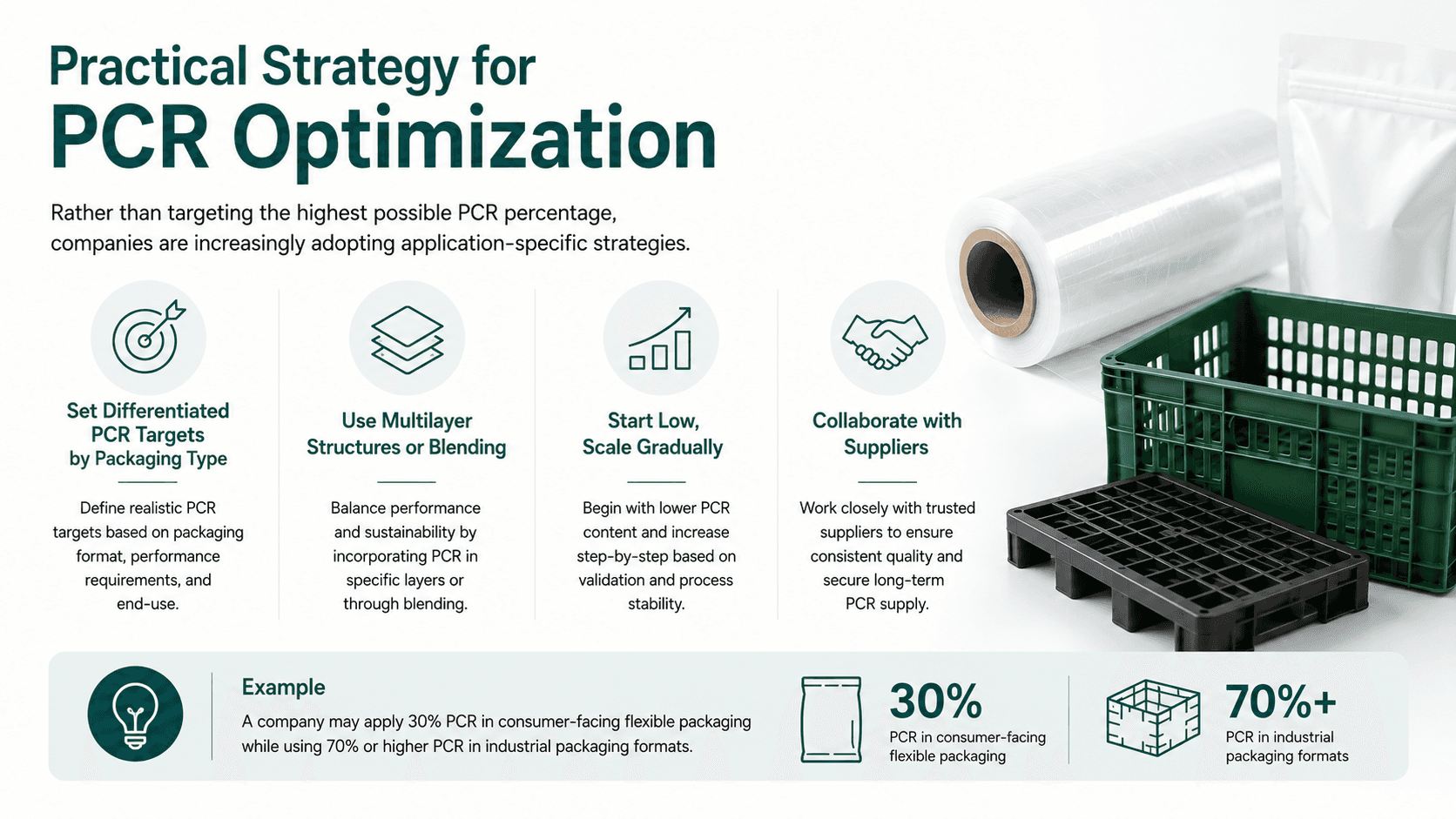
Practical Strategy for PCR Optimization
Rather than targeting the highest possible PCR percentage, companies are increasingly adopting application-specific strategies:
Set differentiated PCR targets by packaging type instead of uniform goals
Use multilayer structures or blending to balance performance and sustainability
Start with lower PCR content and scale gradually based on validation results
Collaborate closely with suppliers to secure consistent PCR grades
For example, a company may apply 30% PCR in consumer-facing flexible packaging while using 70% or higher PCR in industrial packaging formats.
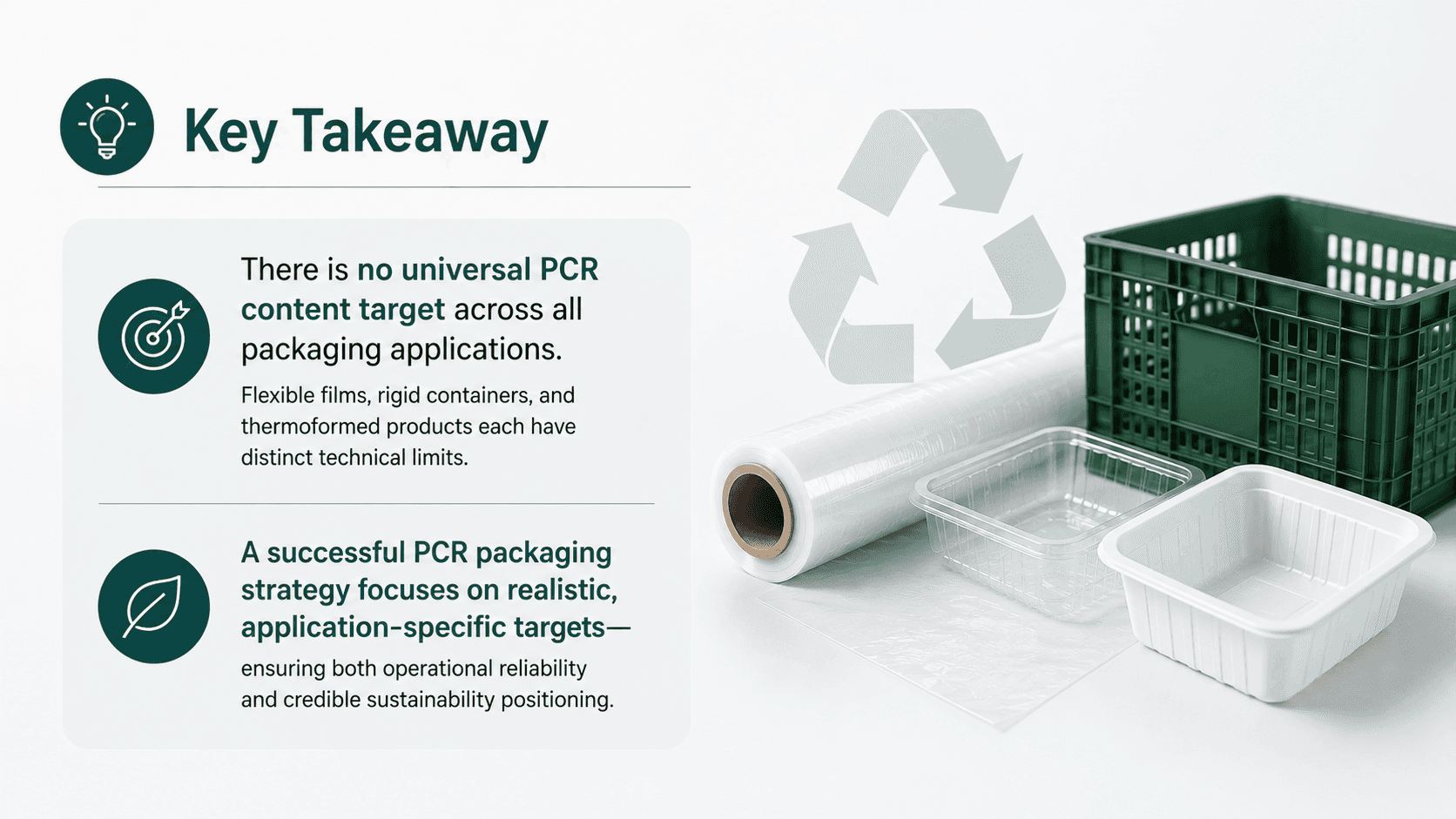
Key Takeaway
There is no universal PCR content target across all packaging applications. Flexible films, rigid containers, and thermoformed products each have distinct technical limits.
A successful PCR packaging strategy focuses on realistic, application-specific targets—ensuring both operational reliability and credible sustainability positioning.
Image generated with ChatGPT
As companies expand their PCR (post-consumer recycled) packaging strategies, one of the most common questions is: how much recycled content is actually achievable in real-world applications?
While sustainability targets often push for high PCR percentages, practical limits vary significantly depending on packaging format, processing conditions, and performance requirements.
Understanding realistic PCR content ranges is essential for balancing sustainability goals with product quality, cost efficiency, and manufacturing stability.
If you haven’t read our previous articles in this series, you can start here:
Food-Contact Recycled Plastics: What "Recycled" Doesn't Automatically Mean
rPE vs rPP vs rPET: How to Choose the Right PCR Material for Non-Food Packaging
PCR Content in Flexible Packaging (PE Films)
Flexible packaging—especially polyethylene (PE)-based films—is one of the most challenging areas for high PCR integration due to strict processing and performance requirements.
Typical PCR content ranges:
10–30% PCR: Common in primary packaging where mechanical strength, sealing, and appearance are critical
30–50% PCR: Widely used in secondary packaging such as mailer bags and shrink films
50%+ PCR: Feasible in industrial films (e.g., pallet wrap, construction films) where variability is more acceptable
Key limiting factors include contamination (gels, black specks), odor, and variability in melt flow index (MFI). In blown film extrusion, increasing PCR content can lead to film breakage, unstable bubble formation, and sealing inconsistency.
A widely adopted solution is multilayer film structures, where PCR is used in the core layer while virgin resin is retained in outer layers to maintain sealing performance and visual quality.
PCR Content in Rigid Packaging (Injection & Thermoforming)
Rigid packaging applications generally allow higher PCR content compared to flexible films, particularly in non-food packaging.
Typical PCR content ranges:
Injection molding (rPP, rPE): 30–70% PCR depending on structural requirements
Thermoforming (rPET): 50–100% PCR commonly achievable
Industrial and logistics packaging: Up to 100% PCR in crates, pallets, and bins
This higher tolerance is due to lower sensitivity to contamination and more stable processing conditions compared to film extrusion.
For example, rPET thermoformed trays often achieve high PCR content thanks to relatively consistent bottle-to-sheet recycling streams.
Key Factors Limiting PCR Content
Across both flexible and rigid packaging, PCR content is constrained by several practical factors:
Mechanical performance requirements (strength, impact resistance, sealing)
Processing stability (extrusion or molding sensitivity to material variation)
Aesthetic requirements (color consistency, transparency, surface defects)
Odor control, especially in consumer-facing applications
Supply consistency and availability of high-quality PCR materials
These constraints mean that maximum PCR content is rarely determined by sustainability targets alone.
Practical Strategy for PCR Optimization
Rather than targeting the highest possible PCR percentage, companies are increasingly adopting application-specific strategies:
Set differentiated PCR targets by packaging type instead of uniform goals
Use multilayer structures or blending to balance performance and sustainability
Start with lower PCR content and scale gradually based on validation results
Collaborate closely with suppliers to secure consistent PCR grades
For example, a company may apply 30% PCR in consumer-facing flexible packaging while using 70% or higher PCR in industrial packaging formats.
Key Takeaway
There is no universal PCR content target across all packaging applications. Flexible films, rigid containers, and thermoformed products each have distinct technical limits.
A successful PCR packaging strategy focuses on realistic, application-specific targets—ensuring both operational reliability and credible sustainability positioning.
Image generated with ChatGPT
PCR Levels in rLLDPE Film
Grades • Specs • Availability
Browse rLLDPE →
PCR Levels in rLLDPE Film
PCR Levels in rLLDPE Film
Compare rLLDPE grades by MFI, density and form before sample trials.
Compare rLLDPE grades by MFI, density and form before sample trials.
Browse rLLDPE →
Browse rLLDPE →
Looking for samples or ready to source? Submit your request for pricing, availability, and technical information.
Looking for samples or ready to source? Submit your request for pricing, availability, and technical information.
Request a Quote →
Request a Quote →
Posted by REGENPORT
REGENPORT is a global platform connecting buyers and suppliers in the recycled materials and sustainable packaging industries.