CATEGORY
CATEGORY
Trend
Trend
Trend
Recycled Polymer Market Firm as Middle East Intensifies – Week 2, July 2026
Recycled Polymer Market Firm as Middle East Intensifies – Week 2, July 2026
Recycled Polymer Market Firm as Middle East Intensifies – Week 2, July 2026

Recycled polymers stayed firm this week despite Middle East tensions pushing virgin PE, PP, and PVC prices higher again. Brazil's PET market was the exception. Recycled grades should stay the stable side as virgin volatility continues.
This week’s market made a sharp U-turn as PE, PP and PVC prices were impacted by re-escalation of the Middle East conflict — including drone strikes on tankers near the Strait of Hormuz and a Trump statement declaring the US-Iran ceasefire “over” — The crude and several virgin polymers turned higher again. Recycled polymer markets were showing steady in pricing.
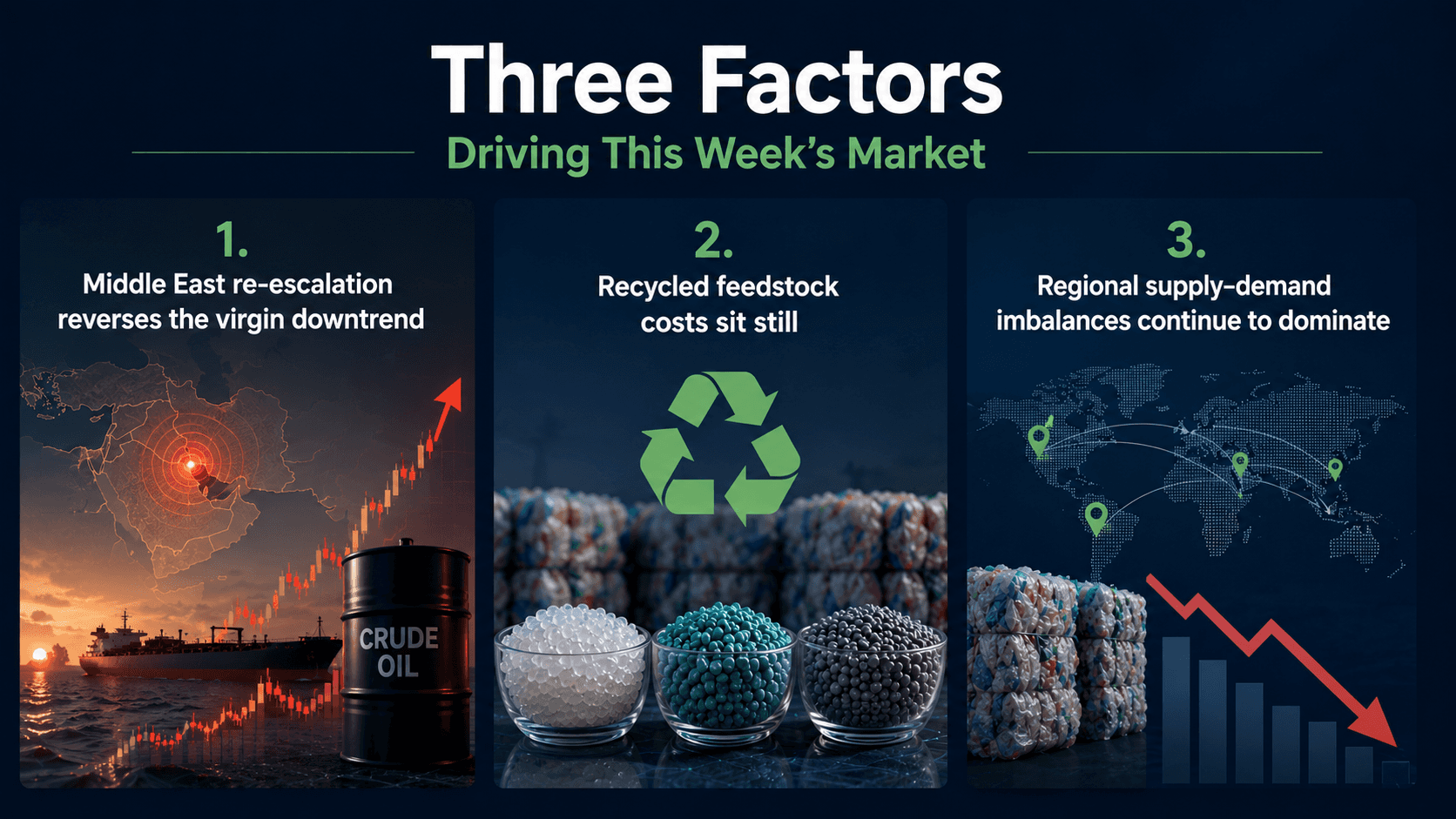
Three Factors Driving This Week’s Market
1. Middle East re-escalation reverses the virgin downtrend
After several weeks of virgin prices sliding back toward pre-war levels, sentiment abruptly flipped as the US–Iran ceasefire was declared “over” and drone strikes hit multiple tankers near the Strait of Hormuz. Brent crude surged to around $78/barrel, up more than $6/ barrel week over week, immediately impacting Asian markets. Chinese PP and PVC prices jumped, while the Asian PE market essentially froze as traders stepped back to assess risk.
2. Recycled feedstock costs sit still
In contrast to the sharp volatility in crude-linked virgin resins, recycled polymer prices remained stable this week. Bale and pellet prices for PET, HDPE and LDPE showed little movement, underscoring that recycled feedstock markets are driven more by domestic collection volumes and end-use demand than by short-term crude swings.
3. Regional supply–demand imbalances continue to dominate
While global virgin markets were rattled by geopolitical headlines, regional supply–demand dynamics in recycled grades continued to play a key role. Oversupply from multiple origins and weak downstream demand kept pressure on recycled LDPE, while natural bale prices in the US slightly softened rHDPE values.
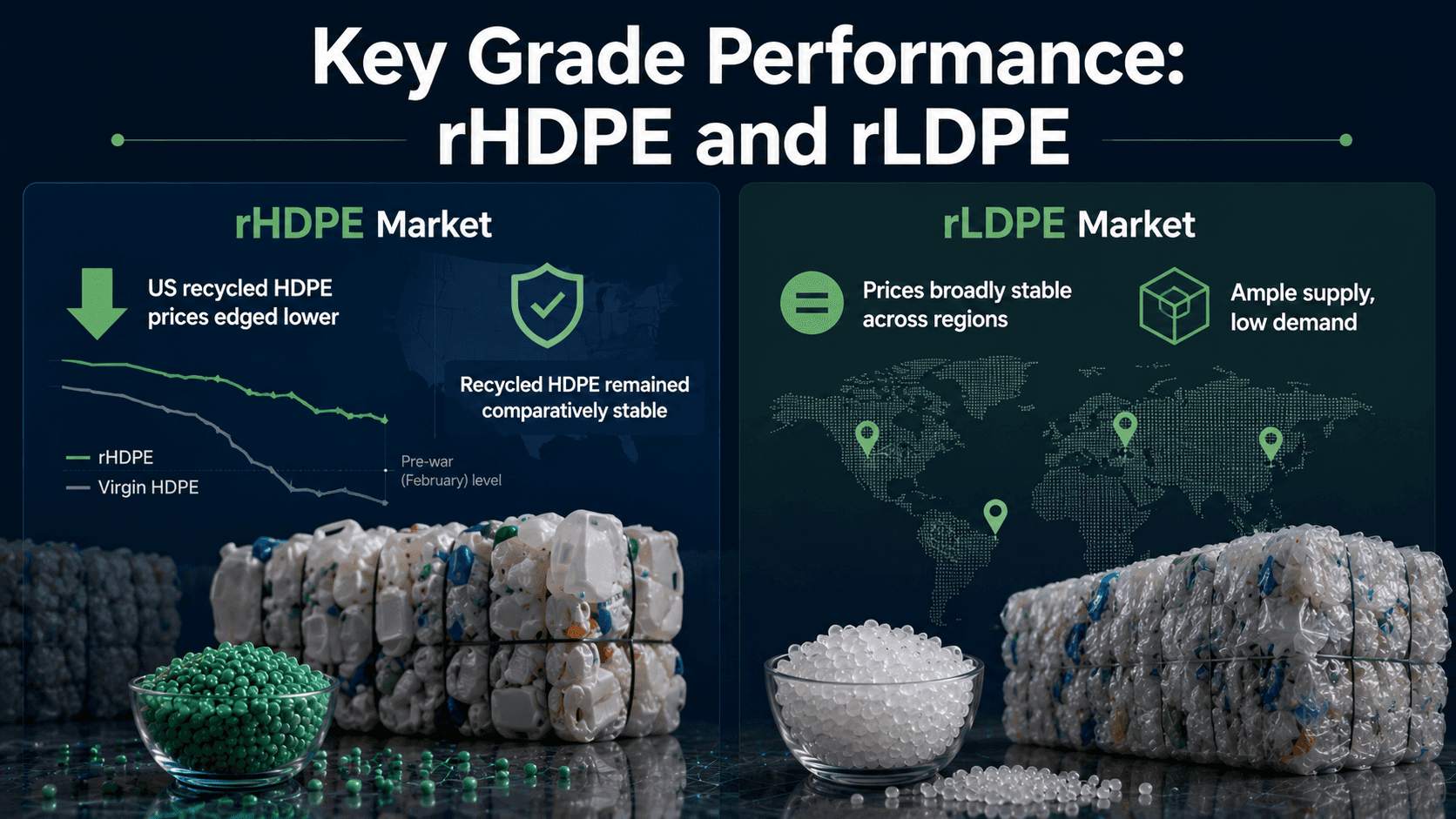
Key Grade Performance: rHDPE and rLDPE
rHDPE Market
US recycled HDPE prices edged lower as natural bale prices softened. However, this move was far more modest than the swings seen in virgin HDPE, which in some grades slid toward—and even below—pre-war (February) levels in the US export market. Recycled HDPE thus remained comparatively stable, reflecting its closer link to domestic collection and steady demand rather than crude volatility.
rLDPE Market
Recycled LDPE bale and pellet prices were broadly stable across regions this week. Supplies from multiple origins remained ample, while demand continued to sit at low levels. The combination of oversupply and tepid downstream activity limited any meaningful price movement in recycled LDPE.
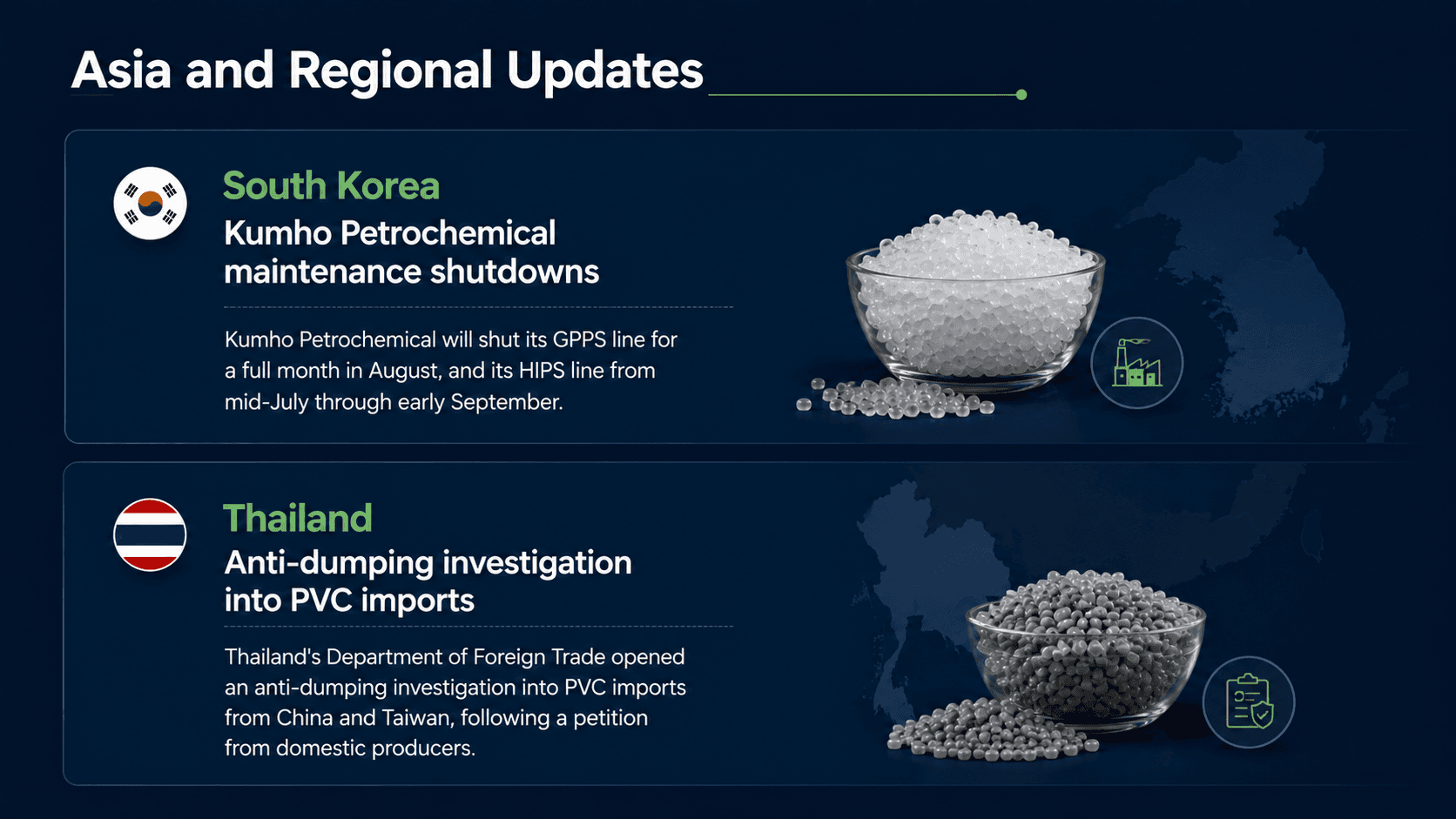
Asia and Regional Updates
South Korea: Kumho Petrochemical maintenance shutdowns
In Asia, South Korea’s Kumho Petrochemical announced maintenance plans that will affect its styrenics lines. The company intends to shut its GPPS line for a full month in August, while its HIPS line will be down from mid-July through early September. These shutdowns could impact local supply of styrenic resins and potentially influence downstream packaging and consumer goods segments.
Thailand: Anti-dumping investigation into PVC imports
Thailand’s Department of Foreign Trade opened an anti-dumping investigation into PVC imports from China and Taiwan, following a petition from dome stic producers alleging material injury. The probe could lead to additional tariffs on Chinese and Taiwanese PVC, altering regional pricing dynamics and potentially shifting some trade flows toward alternative origins.
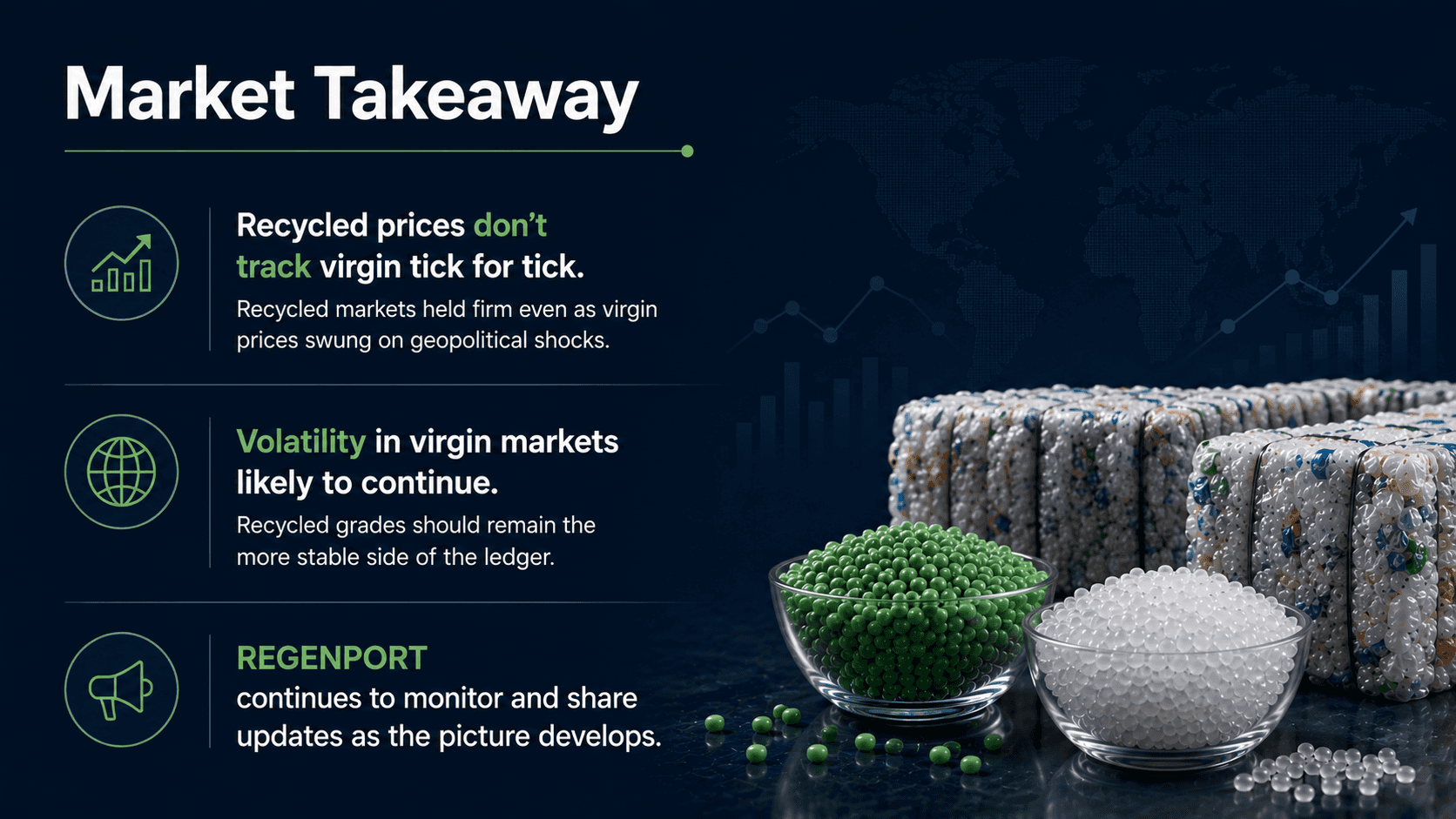
Market Takeaway
This week highlights a core characteristic of the recycled polymer market: recycled pricing does not automatically track virgin resin tick for tick. When a geopolitical shock sends crude and virgin polyolefins swinging within days, recycled bale and pellet markets—tied more closely to domestic collection volumes and steady end-use demand—can hold their ground. The exception was Brazil, where a clear north–south split emerged in recycled PET pricing even as the broader Latin American virgin market drifted back toward pre-war levels.
With the Middle East situation still unresolved and Asian PE/PP trading reportedly frozen amid uncertainty, volatility in virgin markets is likely to continue in the coming week. Recycled grades, by contrast, should remain the more stable side of the ledger as collection and demand fundamentals stay in place.
At REGENPORT, we continue to monitor market conditions and share updates as the picture develops.
Image generated with ChatGPT
This week’s market made a sharp U-turn as PE, PP and PVC prices were impacted by re-escalation of the Middle East conflict — including drone strikes on tankers near the Strait of Hormuz and a Trump statement declaring the US-Iran ceasefire “over” — The crude and several virgin polymers turned higher again. Recycled polymer markets were showing steady in pricing.
Three Factors Driving This Week’s Market
1. Middle East re-escalation reverses the virgin downtrend
After several weeks of virgin prices sliding back toward pre-war levels, sentiment abruptly flipped as the US–Iran ceasefire was declared “over” and drone strikes hit multiple tankers near the Strait of Hormuz. Brent crude surged to around $78/barrel, up more than $6/ barrel week over week, immediately impacting Asian markets. Chinese PP and PVC prices jumped, while the Asian PE market essentially froze as traders stepped back to assess risk.
2. Recycled feedstock costs sit still
In contrast to the sharp volatility in crude-linked virgin resins, recycled polymer prices remained stable this week. Bale and pellet prices for PET, HDPE and LDPE showed little movement, underscoring that recycled feedstock markets are driven more by domestic collection volumes and end-use demand than by short-term crude swings.
3. Regional supply–demand imbalances continue to dominate
While global virgin markets were rattled by geopolitical headlines, regional supply–demand dynamics in recycled grades continued to play a key role. Oversupply from multiple origins and weak downstream demand kept pressure on recycled LDPE, while natural bale prices in the US slightly softened rHDPE values.
Key Grade Performance: rHDPE and rLDPE
rHDPE Market
US recycled HDPE prices edged lower as natural bale prices softened. However, this move was far more modest than the swings seen in virgin HDPE, which in some grades slid toward—and even below—pre-war (February) levels in the US export market. Recycled HDPE thus remained comparatively stable, reflecting its closer link to domestic collection and steady demand rather than crude volatility.
rLDPE Market
Recycled LDPE bale and pellet prices were broadly stable across regions this week. Supplies from multiple origins remained ample, while demand continued to sit at low levels. The combination of oversupply and tepid downstream activity limited any meaningful price movement in recycled LDPE.
Asia and Regional Updates
South Korea: Kumho Petrochemical maintenance shutdowns
In Asia, South Korea’s Kumho Petrochemical announced maintenance plans that will affect its styrenics lines. The company intends to shut its GPPS line for a full month in August, while its HIPS line will be down from mid-July through early September. These shutdowns could impact local supply of styrenic resins and potentially influence downstream packaging and consumer goods segments.
Thailand: Anti-dumping investigation into PVC imports
Thailand’s Department of Foreign Trade opened an anti-dumping investigation into PVC imports from China and Taiwan, following a petition from dome stic producers alleging material injury. The probe could lead to additional tariffs on Chinese and Taiwanese PVC, altering regional pricing dynamics and potentially shifting some trade flows toward alternative origins.
Market Takeaway
This week highlights a core characteristic of the recycled polymer market: recycled pricing does not automatically track virgin resin tick for tick. When a geopolitical shock sends crude and virgin polyolefins swinging within days, recycled bale and pellet markets—tied more closely to domestic collection volumes and steady end-use demand—can hold their ground. The exception was Brazil, where a clear north–south split emerged in recycled PET pricing even as the broader Latin American virgin market drifted back toward pre-war levels.
With the Middle East situation still unresolved and Asian PE/PP trading reportedly frozen amid uncertainty, volatility in virgin markets is likely to continue in the coming week. Recycled grades, by contrast, should remain the more stable side of the ledger as collection and demand fundamentals stay in place.
At REGENPORT, we continue to monitor market conditions and share updates as the picture develops.
Image generated with ChatGPT
rHDPE Availability in July
Grades • Specs • Availability
Browse rHDPE →
rHDPE Availability in July
rHDPE Availability in July
Check rHDPE grades by feedstock, MFI, stock and MOQ.
Check rHDPE grades by feedstock, MFI, stock and MOQ.
Browse rHDPE →
Browse rHDPE →
Looking for samples or ready to source? Submit your request for pricing, availability, and technical information.
Looking for samples or ready to source? Submit your request for pricing, availability, and technical information.
Request a Quote →
Request a Quote →
Posted by REGENPORT
REGENPORT is a global platform connecting buyers and suppliers in the recycled materials and sustainable packaging industries.