CATEGORY
CATEGORY
Regulation
Regulation
Regulation
UK Packaging EPR Fees in 2026: How Modulated RAM Ratings Impact Recycled Plastic Buyers
UK Packaging EPR Fees in 2026: How Modulated RAM Ratings Impact Recycled Plastic Buyers
UK Packaging EPR Fees in 2026: How Modulated RAM Ratings Impact Recycled Plastic Buyers

From the 2026–2027 scheme year, UK packaging fees are no longer flat-rate. PackUK's Recyclability Assessment Methodology now ties what producers pay to how recyclable — and how recyclable-by-design — their packaging actually is.
The UK's Extended Producer Responsibility (EPR) scheme for packaging has collected producer data since 2024, but 2026 is when the fee structure itself changes. Under illustrative Year 2 base fees, the plastic packaging rate is proposed to rise from £423 to £455 per tonne — and for the first time, that base rate is adjusted up or down depending on a packaging format's recyclability rating. PackUK, the scheme administrator working under Defra (the UK's Department for Environment, Food and Rural Affairs), expects the first invoices reflecting this modulation to go out in the second half of 2026.
For buyers and converters sourcing recycled plastics, the practical shift is that recyclability — not just tonnage reported — now sets the price. Packaging built as a mono-material with recycled content is positioned to land in a lower fee band, while multi-material or hard-to-recycle formats are pushed toward the highest band. Design and sourcing decisions made now will show up directly in 2026–2027 invoices.

How the Recyclability Assessment Methodology (RAM) Sets Fees
RAM is the standardized framework large producers use to rate household (and commonly street-binned) packaging across five sequential stages: Classification (identifying materials and components, including multi-material items), Collection (whether UK local authorities widely collect it), Sortation (whether it can be separated at scale), Reprocessing (whether it recycles without technical or quality issues), and Application (whether the resulting recyclate can be used in new products). The output is a Green, Amber, or Red rating that PackUK maps directly to the fee a producer pays.
RAM Rating | Fee vs. Base |
|---|---|
Green (highly recyclable) | ~0.91x base fee ("green discount") |
Amber (recyclable with limitations) | 1x base fee |
Red (not currently recyclable at scale) | 1.2x base fee |
Illustrative 2026–2027 Base Fees
Material | 2025 Rate | 2026 Illustrative Rate |
|---|---|---|
Plastic | £423/tonne | £455/tonne |
Glass | £192/tonne | £205/tonne |
Wood | £280/tonne | £450/tonne (amber) |
These figures are PackUK's illustrative Year 2 numbers, projected from large-producer data; final rates are confirmed closer to invoicing.
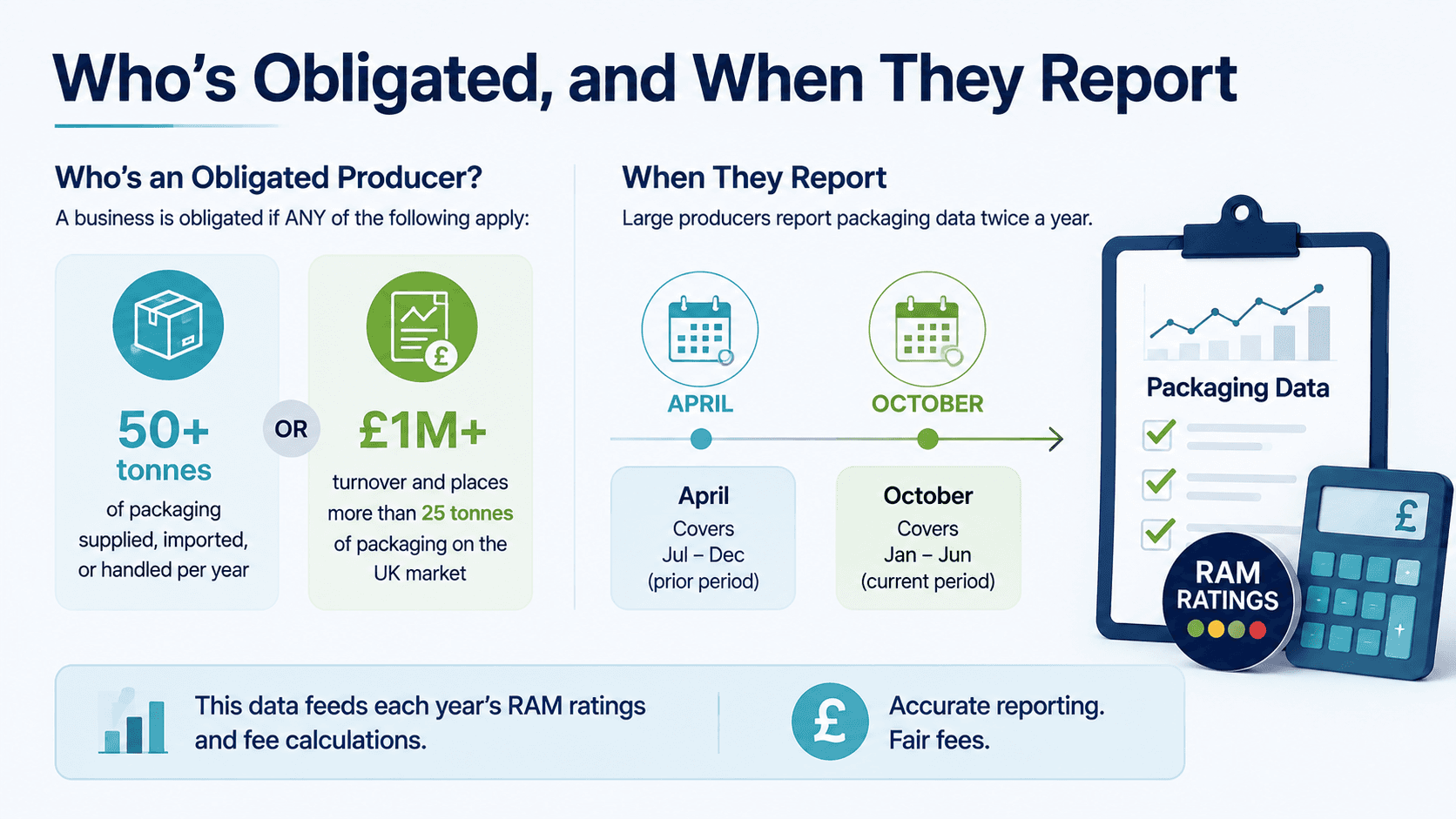
Who's Obligated, and When They Report
A business is an obligated producer if it supplies, imports, or handles 50 tonnes or more of packaging a year, or has turnover above £1 million and places more than 25 tonnes on the UK market. Large producers report packaging data twice a year — in April (covering the prior July–December) and October (covering the current January–June) — and it's this data that feeds each year's RAM ratings and fee calculations.
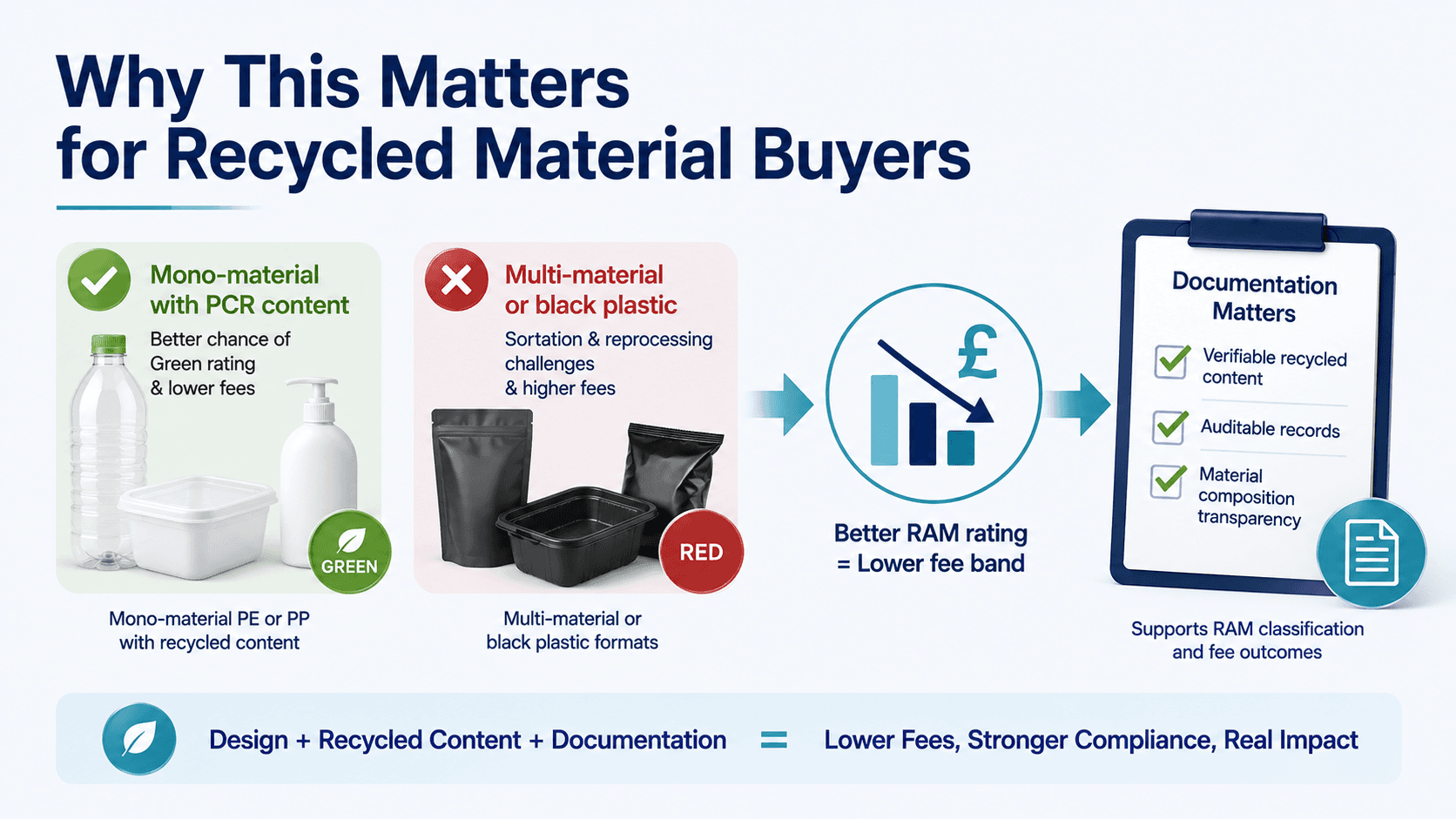
Why This Matters for Recycled Material Buyers
Eco-modulation turns recyclable, mono-material design into a direct line item rather than a sustainability talking point. Packaging advisors note that mono-material PE or PP structures built with PCR content are better positioned for a Green rating than multi-material or black-plastic formats, which RAM flags for sortation and reprocessing problems — in practice, a mono-material PE or PP pack with recycled content is the profile most likely to clear RAM's Collection and Reprocessing checks and land in the lowest fee band. For teams sourcing rPET, rHDPE, or rPP, that means documentation matters as much as the resin itself: verifiable, auditable records of recycled content and material composition will increasingly support both RAM classification and fee-band outcomes, not just marketing claims.
Key Dates to Track
Date | Milestone |
|---|---|
2025 | Large producers begin RAM assessments on household packaging |
April 2026 | Large producer data submission (July–Dec 2025); PackUK issues illustrative Year 2 base fees |
2026–2027 scheme year | Modulated fees apply; first invoices reflecting RAM bands expected in H2 2026 |
October 2026 | Large producer data submission (Jan–June 2026) |
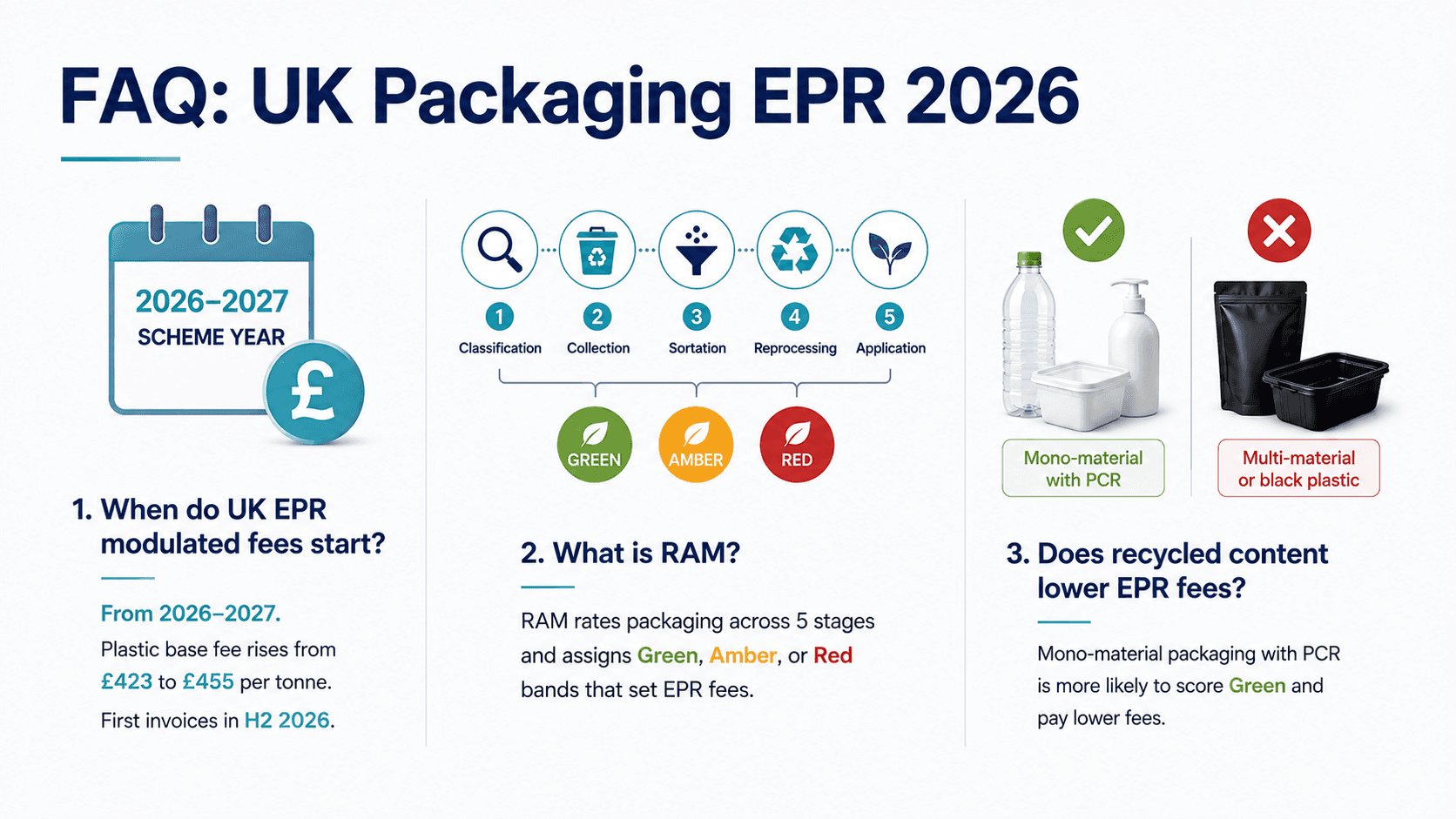
Frequently Asked Questions
When do UK EPR modulated fees start? From the 2026–2027 scheme year. PackUK's illustrative Year 2 base fees include a plastic packaging rate proposed to rise from £423 to £455 per tonne, with the first invoices reflecting RAM-based modulation expected in the second half of 2026.
What is the Recyclability Assessment Methodology (RAM)? RAM is the UK's standardized framework for rating household packaging recyclability across five stages — Classification, Collection, Sortation, Reprocessing, and Application — sorting packaging into Green, Amber, or Red bands that PackUK uses to set modulated EPR fees from 2026.
Does using recycled content lower UK EPR fees? Recycled content isn't a direct RAM input, but mono-material packaging built with PCR resin is more likely to score Green, since RAM specifically penalizes multi-material and black-plastic formats for sortation and reprocessing issues — so recycled-content, mono-material design can indirectly lower the fee band versus a Red-rated format.
About This Guide
This guide reflects publicly available information on the UK's packaging EPR scheme as of August 2026. Illustrative base fees, RAM guidance, and reporting deadlines continue to be finalized by PackUK and Defra. This content is intended for general informational purposes and does not constitute legal or compliance advice. Businesses should consult qualified UK compliance counsel for guidance specific to their packaging portfolio.
Image generated with ChatGPT
Sources
RECOUP, "Defra Announce EPR Illustrative Base Fees for 2026-2027" → Read the Source GOV.UK, "Assess packaging recyclability: Recyclability Assessment Methodology (RAM)" → Read the Source
The UK's Extended Producer Responsibility (EPR) scheme for packaging has collected producer data since 2024, but 2026 is when the fee structure itself changes. Under illustrative Year 2 base fees, the plastic packaging rate is proposed to rise from £423 to £455 per tonne — and for the first time, that base rate is adjusted up or down depending on a packaging format's recyclability rating. PackUK, the scheme administrator working under Defra (the UK's Department for Environment, Food and Rural Affairs), expects the first invoices reflecting this modulation to go out in the second half of 2026.
For buyers and converters sourcing recycled plastics, the practical shift is that recyclability — not just tonnage reported — now sets the price. Packaging built as a mono-material with recycled content is positioned to land in a lower fee band, while multi-material or hard-to-recycle formats are pushed toward the highest band. Design and sourcing decisions made now will show up directly in 2026–2027 invoices.
How the Recyclability Assessment Methodology (RAM) Sets Fees
RAM is the standardized framework large producers use to rate household (and commonly street-binned) packaging across five sequential stages: Classification (identifying materials and components, including multi-material items), Collection (whether UK local authorities widely collect it), Sortation (whether it can be separated at scale), Reprocessing (whether it recycles without technical or quality issues), and Application (whether the resulting recyclate can be used in new products). The output is a Green, Amber, or Red rating that PackUK maps directly to the fee a producer pays.
RAM Rating | Fee vs. Base |
|---|---|
Green (highly recyclable) | ~0.91x base fee ("green discount") |
Amber (recyclable with limitations) | 1x base fee |
Red (not currently recyclable at scale) | 1.2x base fee |
Illustrative 2026–2027 Base Fees
Material | 2025 Rate | 2026 Illustrative Rate |
|---|---|---|
Plastic | £423/tonne | £455/tonne |
Glass | £192/tonne | £205/tonne |
Wood | £280/tonne | £450/tonne (amber) |
These figures are PackUK's illustrative Year 2 numbers, projected from large-producer data; final rates are confirmed closer to invoicing.
Who's Obligated, and When They Report
A business is an obligated producer if it supplies, imports, or handles 50 tonnes or more of packaging a year, or has turnover above £1 million and places more than 25 tonnes on the UK market. Large producers report packaging data twice a year — in April (covering the prior July–December) and October (covering the current January–June) — and it's this data that feeds each year's RAM ratings and fee calculations.
Why This Matters for Recycled Material Buyers
Eco-modulation turns recyclable, mono-material design into a direct line item rather than a sustainability talking point. Packaging advisors note that mono-material PE or PP structures built with PCR content are better positioned for a Green rating than multi-material or black-plastic formats, which RAM flags for sortation and reprocessing problems — in practice, a mono-material PE or PP pack with recycled content is the profile most likely to clear RAM's Collection and Reprocessing checks and land in the lowest fee band. For teams sourcing rPET, rHDPE, or rPP, that means documentation matters as much as the resin itself: verifiable, auditable records of recycled content and material composition will increasingly support both RAM classification and fee-band outcomes, not just marketing claims.
Key Dates to Track
Date | Milestone |
|---|---|
2025 | Large producers begin RAM assessments on household packaging |
April 2026 | Large producer data submission (July–Dec 2025); PackUK issues illustrative Year 2 base fees |
2026–2027 scheme year | Modulated fees apply; first invoices reflecting RAM bands expected in H2 2026 |
October 2026 | Large producer data submission (Jan–June 2026) |
Frequently Asked Questions
When do UK EPR modulated fees start? From the 2026–2027 scheme year. PackUK's illustrative Year 2 base fees include a plastic packaging rate proposed to rise from £423 to £455 per tonne, with the first invoices reflecting RAM-based modulation expected in the second half of 2026.
What is the Recyclability Assessment Methodology (RAM)? RAM is the UK's standardized framework for rating household packaging recyclability across five stages — Classification, Collection, Sortation, Reprocessing, and Application — sorting packaging into Green, Amber, or Red bands that PackUK uses to set modulated EPR fees from 2026.
Does using recycled content lower UK EPR fees? Recycled content isn't a direct RAM input, but mono-material packaging built with PCR resin is more likely to score Green, since RAM specifically penalizes multi-material and black-plastic formats for sortation and reprocessing issues — so recycled-content, mono-material design can indirectly lower the fee band versus a Red-rated format.
About This Guide
This guide reflects publicly available information on the UK's packaging EPR scheme as of August 2026. Illustrative base fees, RAM guidance, and reporting deadlines continue to be finalized by PackUK and Defra. This content is intended for general informational purposes and does not constitute legal or compliance advice. Businesses should consult qualified UK compliance counsel for guidance specific to their packaging portfolio.
Image generated with ChatGPT
Sources
RECOUP, "Defra Announce EPR Illustrative Base Fees for 2026-2027" → Read the Source GOV.UK, "Assess packaging recyclability: Recyclability Assessment Methodology (RAM)" → Read the Source
Sourcing Mono-Material rPP
Grades • Specs • Availability
Browse rPP →
Sourcing Mono-Material rPP
Sourcing Mono-Material rPP
Compare rPP grades by feedstock, properties, stock and MOQ.
Compare rPP grades by feedstock, properties, stock and MOQ.
Browse rPP →
Browse rPP →
Looking for samples or ready to source? Submit your request for pricing, availability, and technical information.
Looking for samples or ready to source? Submit your request for pricing, availability, and technical information.
Request a Quote →
Request a Quote →
Posted by REGENPORT
REGENPORT is a global platform connecting buyers and suppliers in the recycled materials and sustainable packaging industries.