CATEGORY
CATEGORY
News
News
News
India's 2025–29 Recycled-Content Mandate Ramps to 60% — rPET and rHDPE Demand in Focus
India's 2025–29 Recycled-Content Mandate Ramps to 60% — rPET and rHDPE Demand in Focus
India's 2025–29 Recycled-Content Mandate Ramps to 60% — rPET and rHDPE Demand in Focus

As of August 2026, India is phasing in one of the world's steeper recycled-content rules for rigid plastic packaging — and the demand signal for recycled polymers is hard to miss.
India has moved recycled-content requirements for rigid plastic packaging from a starting floor of 30% in the 2025–26 financial year up to 60% by 2028–29, tightening the country's Extended Producer Responsibility (EPR) framework under the Plastic Waste Management Rules. The obligation sits with Producers, Importers and Brand Owners (PIBOs), a group that — according to industry reporting — now exceeds 44,000 registered entities.
For buyers of recycled polyethylene terephthalate (rPET) and recycled high-density polyethylene (rHDPE), the rule is worth reading closely: it turns a sustainability ambition into a fixed, year-by-year purchasing obligation across one of the world's largest packaging markets.
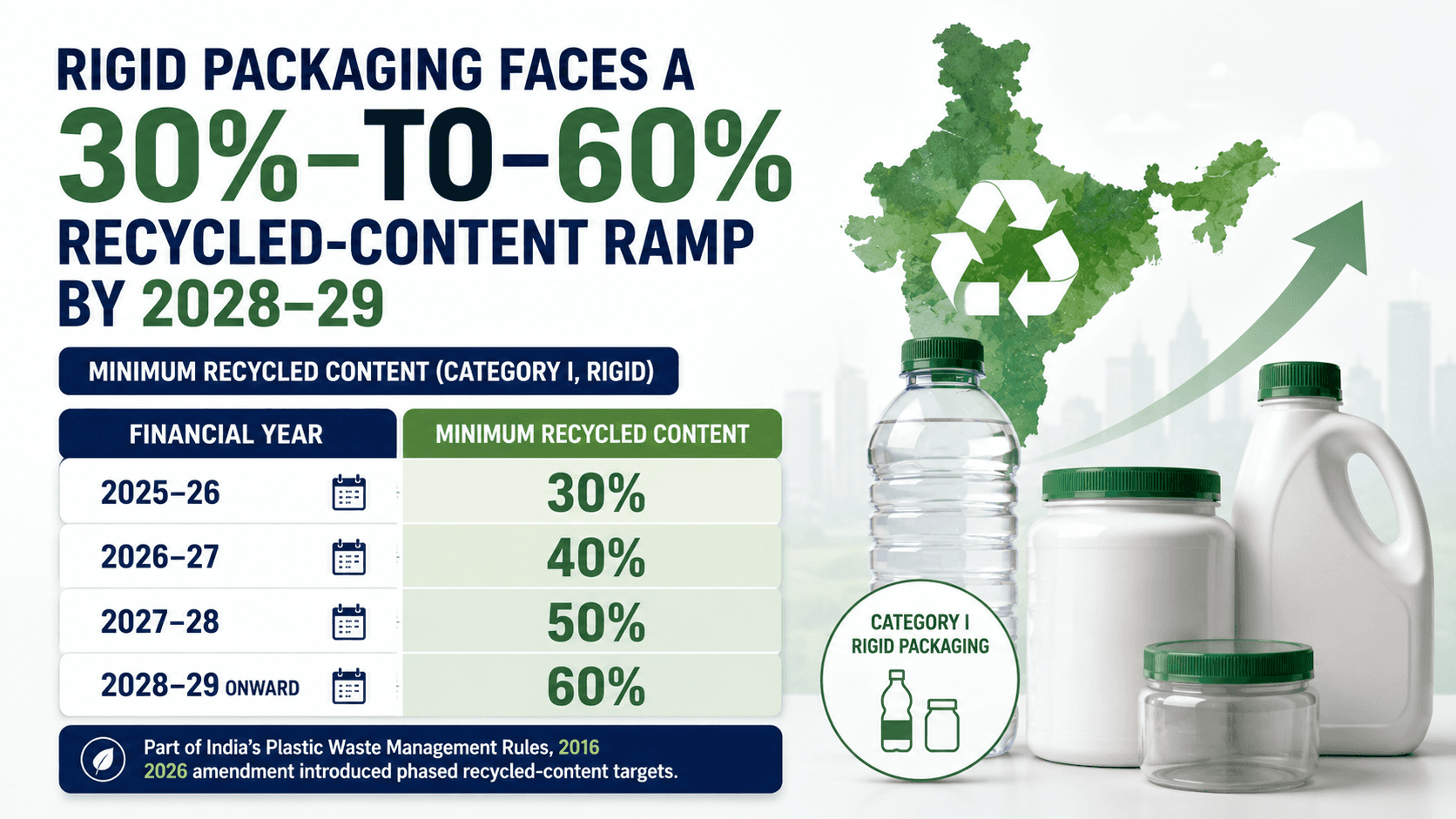
Rigid Packaging Faces a 30%-to-60% Recycled-Content Ramp by 2028–29
The recycled-content targets apply to Category I rigid plastic packaging — including PET bottles and HDPE jars and containers — under India's Plastic Waste Management Rules, 2016. The 2022 amendment strengthened the country's EPR framework, while the 2026 amendment is what introduced the numeric, phased recycled-content targets themselves. Rather than a single deadline, the rule sets a schedule that PIBOs can plan against:
Financial Year | Minimum recycled content (Category I, rigid) |
|---|---|
2025–26 | 30% |
2026–27 | 40% |
2027-28 | 50& |
2028-29 onward | 60% |
Recycled-content packaging must meet the labeling and standards requirements issued by the Central Pollution Control Board (CPCB) and applicable Indian Standards — including IS 14534, which sets guidelines for the recovery and recycling of plastic waste. Multi-layered packaging is handled separately: it is classified as Category III, with only its plastic layers counted when calculating recycled content, so the rigid-packaging (Category I) targets above should not be read as using that same layer-by-layer calculation.
Why This Points to Stronger rPET and rHDPE Demand
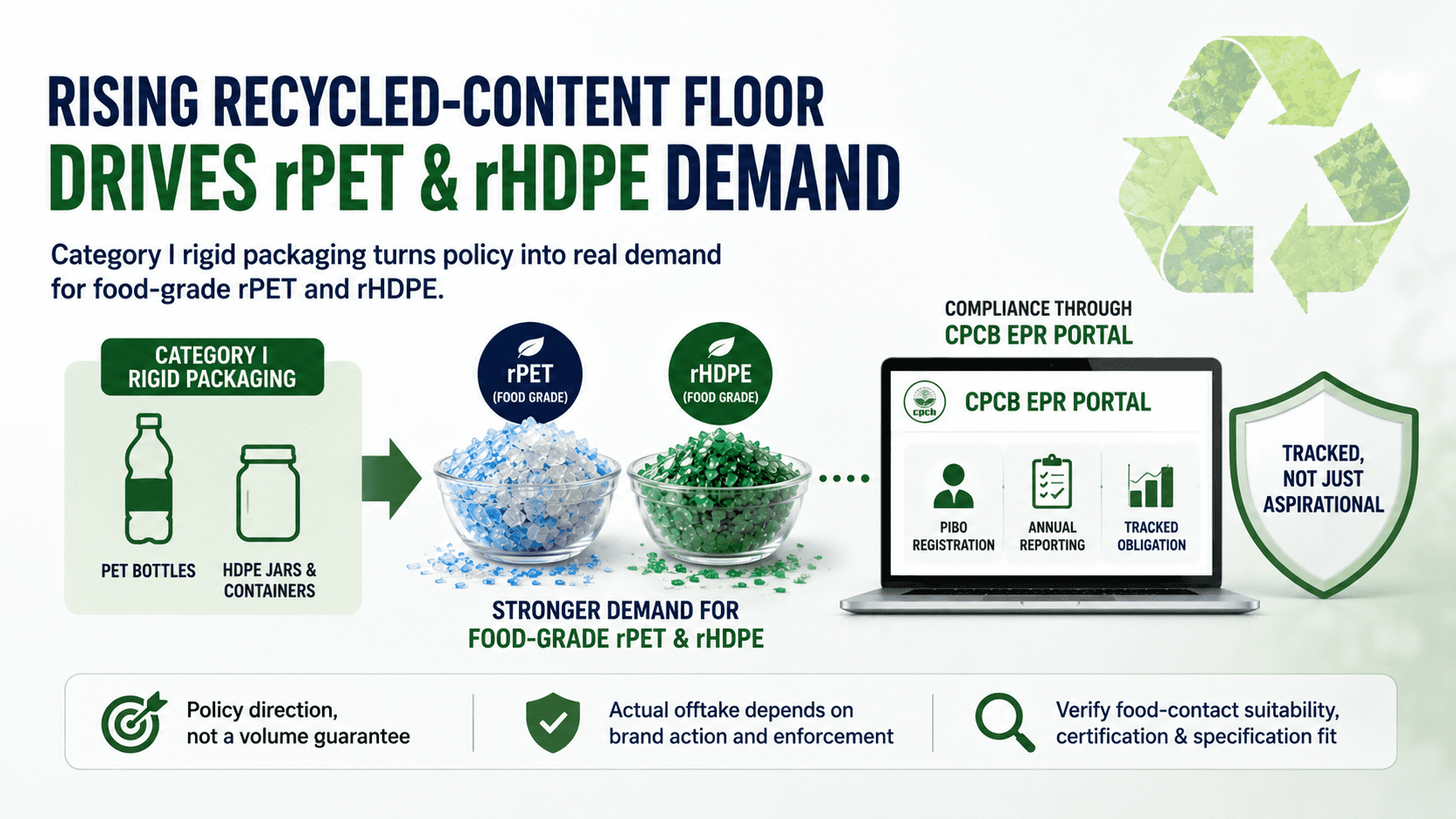
Because Category I covers the bottles, jars and containers most commonly molded from PET and HDPE, a rising recycled-content floor translates fairly directly into demand for food-grade rPET and rHDPE. Compliance is administered through the CPCB online EPR portal, where PIBOs register and report — meaning the obligation is tracked, not merely aspirational.
It should be noted that this is a reading of where the policy points, not a guarantee of volumes; actual offtake will depend on how quickly brands act and how enforcement develops. Buyers evaluating recycled grades against this backdrop will still need to verify food-contact suitability, certification and specification fit for their own applications.
Recycling Capacity Is Built, but Running Below Its Potential
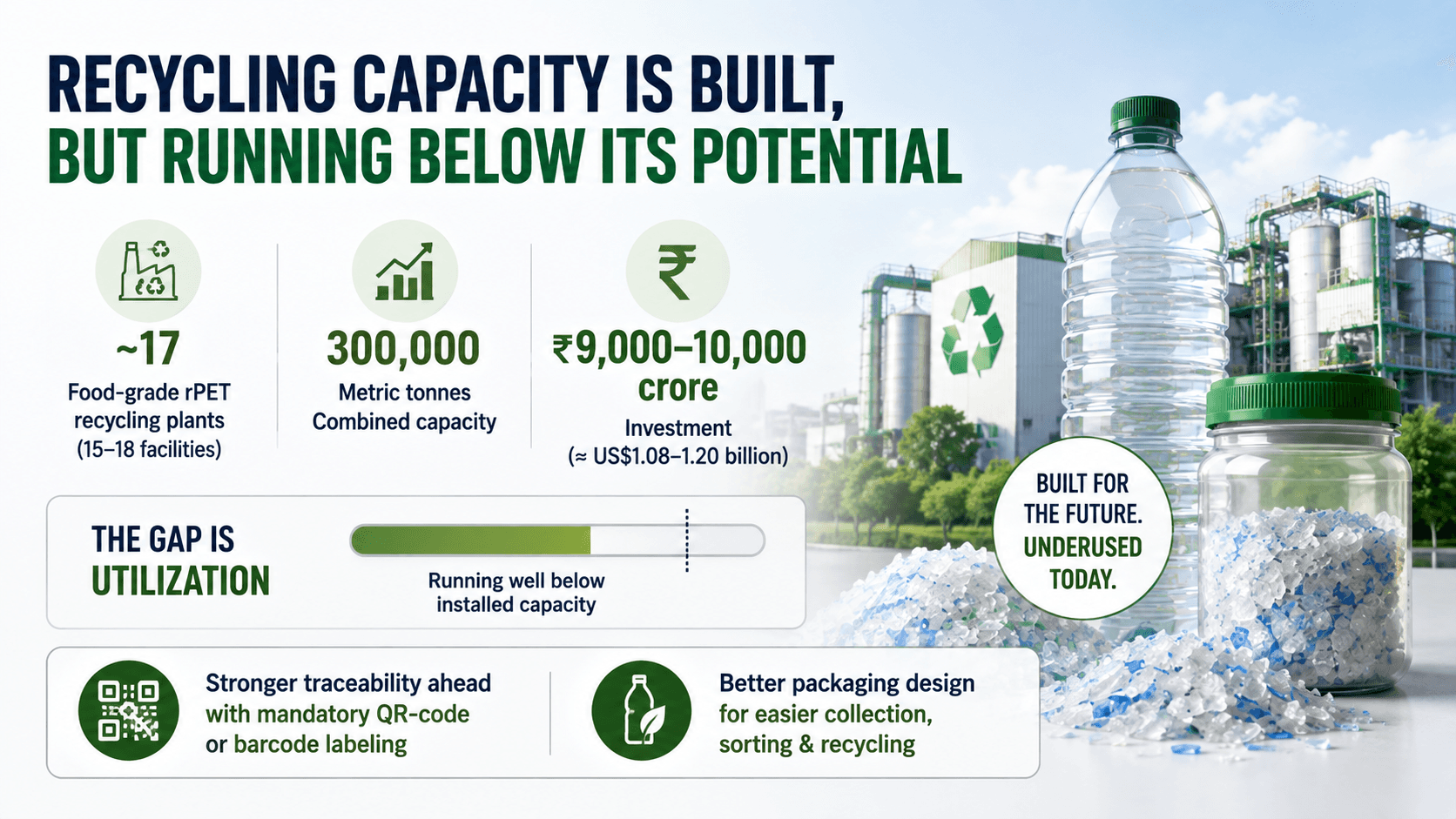
India already hosts recycling capacity aimed at this demand. Industry reporting indicates around 17 food-grade rPET recycling plants (roughly 15–18 facilities) with combined capacity of about 300,000 metric tonnes, built at an estimated ₹9,000–10,000 crore (about US$1.08–1.20 billion) using technology aligned with European Food Safety Authority (EFSA) and US Food and Drug Administration (FDA) standards.
The gap is utilization. The Indian Association of PET Recyclers has warned that some brands are delaying compliance, leaving many PET recycling plants running well below capacity — a reminder that installed capacity and realized demand are not the same thing. The rules are also expected to push material traceability forward through mandatory QR-code or barcode labeling, and to nudge packaging design toward formats that are easier to collect, sort and recycle.
What It Means for Global Buyers Sourcing Asian Recycled Resin
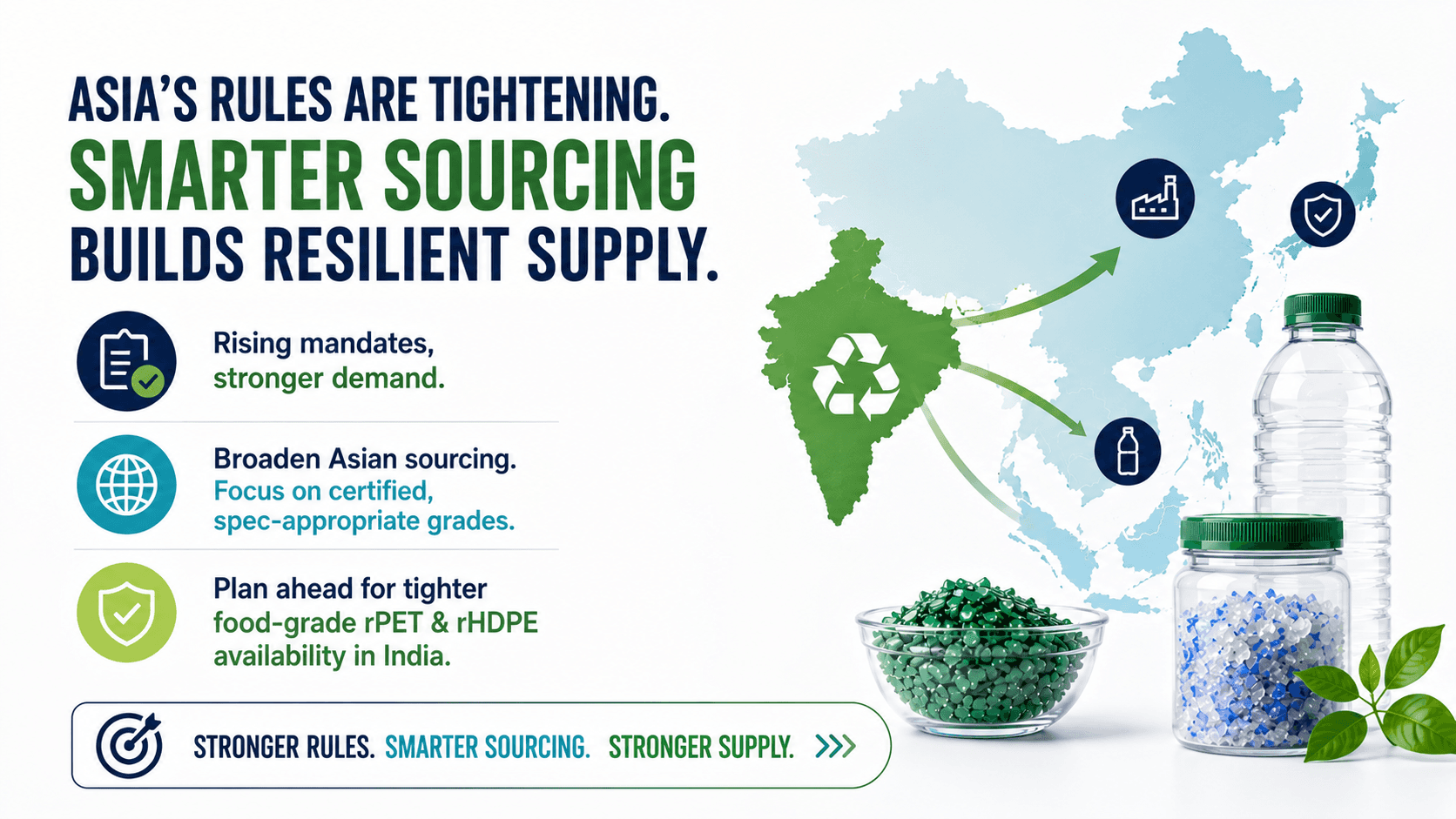
India's mandate is best read as one signal in a wider pattern: recycled-content rules are tightening across Asia, not only in Western markets. For buyers building recycled-polymer supply, that gradually shifts the question from whether recycled material is available to which regions can supply certified, specification-appropriate grades at the volumes their programs need. A rising domestic requirement of this size may also tighten India's own food-grade rPET availability, which is worth factoring into forward sourcing plans rather than assuming supply stays loose.
The practical takeaway for procurement teams is to broaden their sourcing base. Evaluating recycled resin across multiple Asian sources — and verifying certification, food-contact suitability and specification fit case by case — can help buyers keep pace with mandates that are increasingly becoming a standing procurement variable rather than a one-off. India's phased 30-to-60% ramp is a concrete example of that shift, and a reason to review where recycled rPET and rHDPE will realistically come from over the next several years.
Practical Checkpoints for Procurement Teams
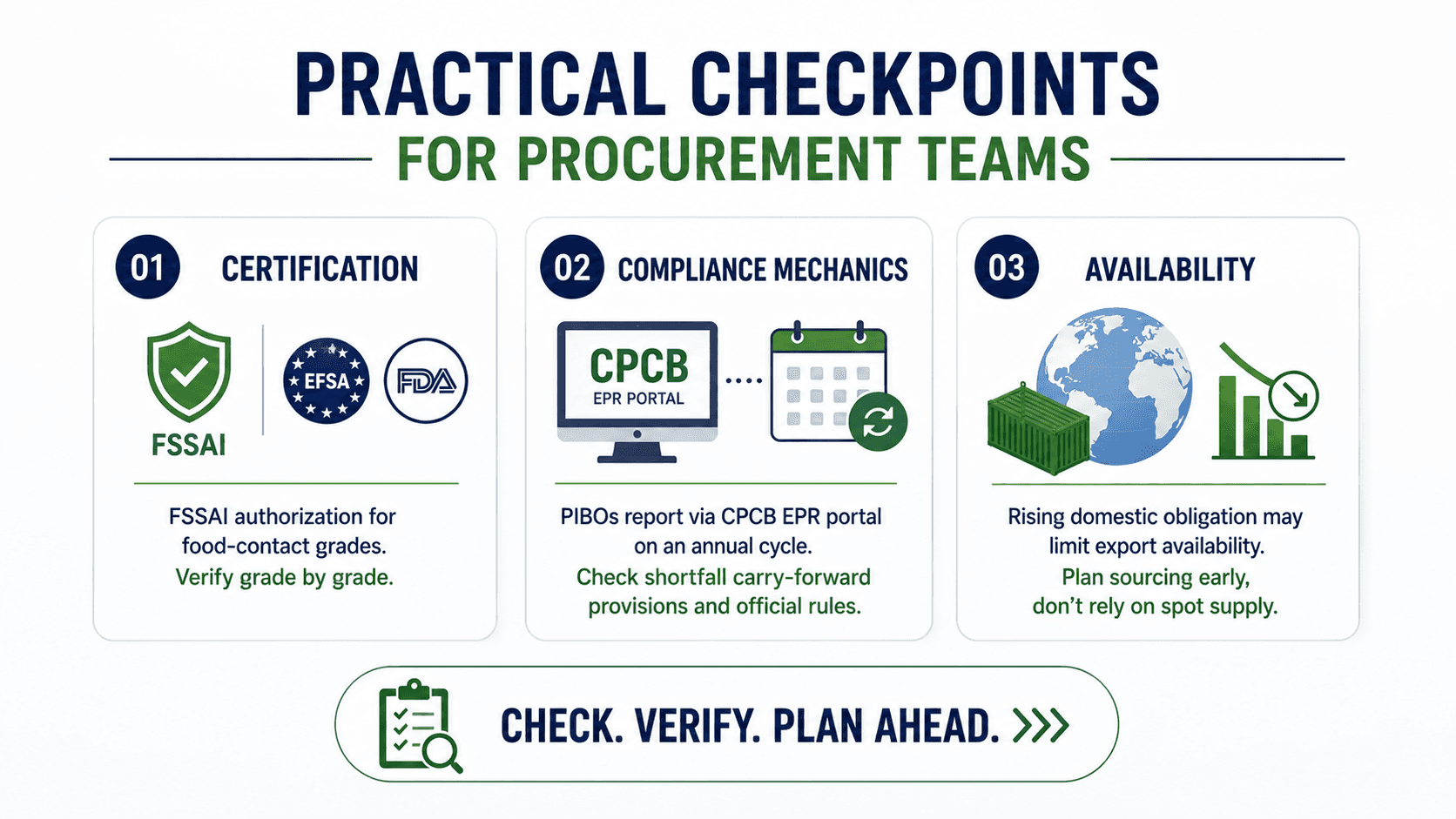
Buyers weighing supply against this schedule will want to confirm a few specifics before committing. On certification, food-contact grades in India run through Food Safety and Standards Authority of India (FSSAI) authorisation, alongside recyclers using EFSA- and FDA-aligned processes — worth verifying grade by grade rather than assuming blanket equivalence. On compliance mechanics, PIBOs report through the CPCB EPR portal on an annual cycle, and reporting has featured shortfall carry-forward provisions within the schedule; the exact current rules should be checked against the official notifications. And on availability, a rising domestic obligation can reduce how much food-grade recycled material stays free for export — a reason to plan sourcing earlier rather than counting on spot availability closer to deadlines.
Frequently Asked Questions
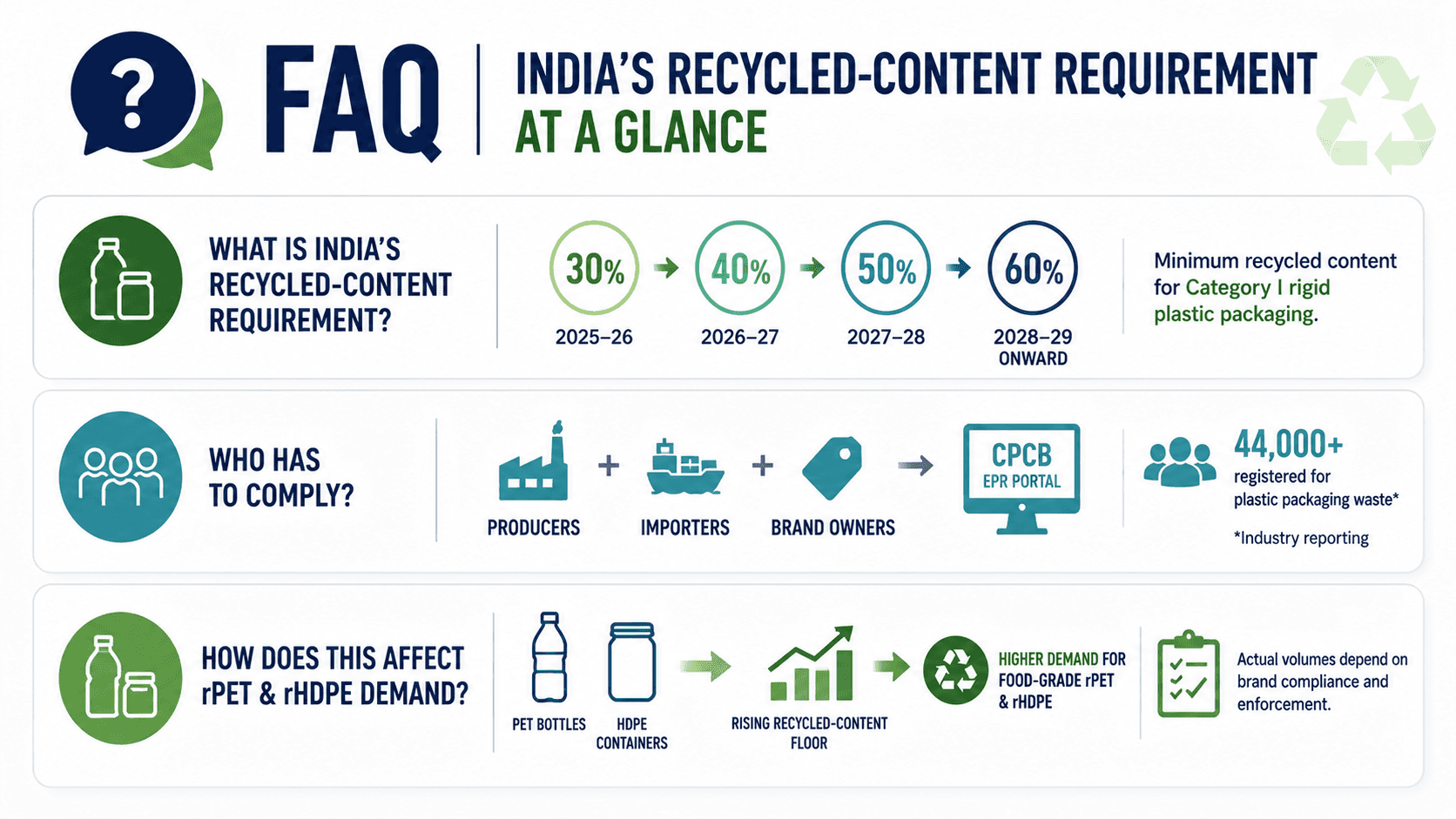
What is India's recycled-content requirement for rigid plastic packaging? Under the amended Plastic Waste Management Rules, Category I rigid plastic packaging must contain a minimum of 30% recycled content in 2025–26, rising to 40% (2026–27), 50% (2027–28) and 60% from 2028–29 onward.
Who has to comply? The obligation applies to Producers, Importers and Brand Owners (PIBOs), who register and report through the Central Pollution Control Board (CPCB) EPR portal; industry reporting indicates more than 44,000 have registered for plastic packaging waste.
How does this affect rPET and rHDPE demand? Because rigid packaging such as PET bottles and HDPE containers falls under Category I, a rising recycled-content floor is generally expected to increase demand for food-grade rPET and rHDPE, though realized volumes will depend on brand compliance and enforcement.
About This Guide
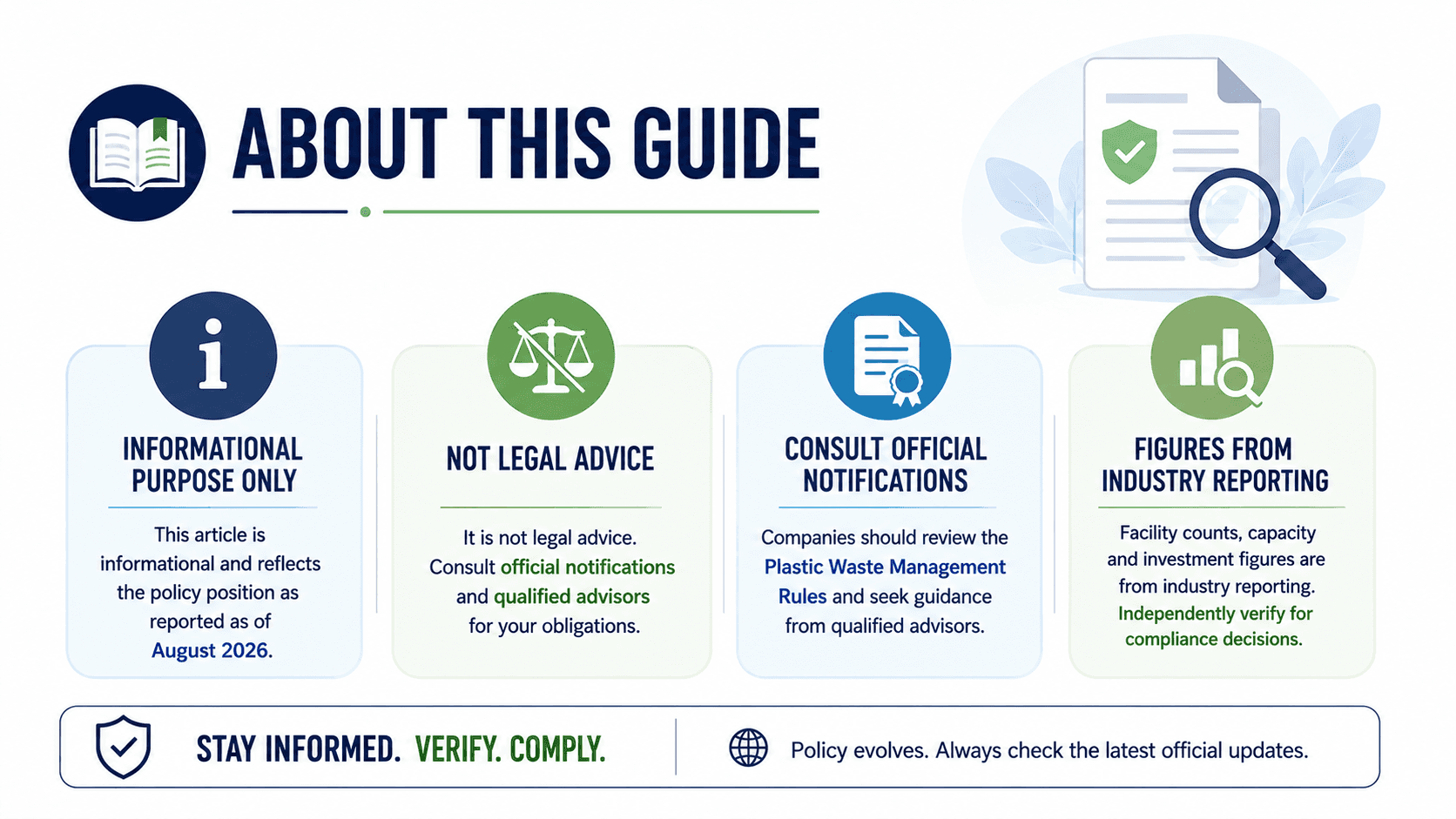
This article is informational and reflects the policy position as reported as of August 2026; it is not legal advice. Companies assessing their obligations under the Plastic Waste Management Rules should consult the official notifications and qualified advisors. Figures on facility counts, capacity and investment are drawn from industry reporting and should be independently verified for compliance decisions.
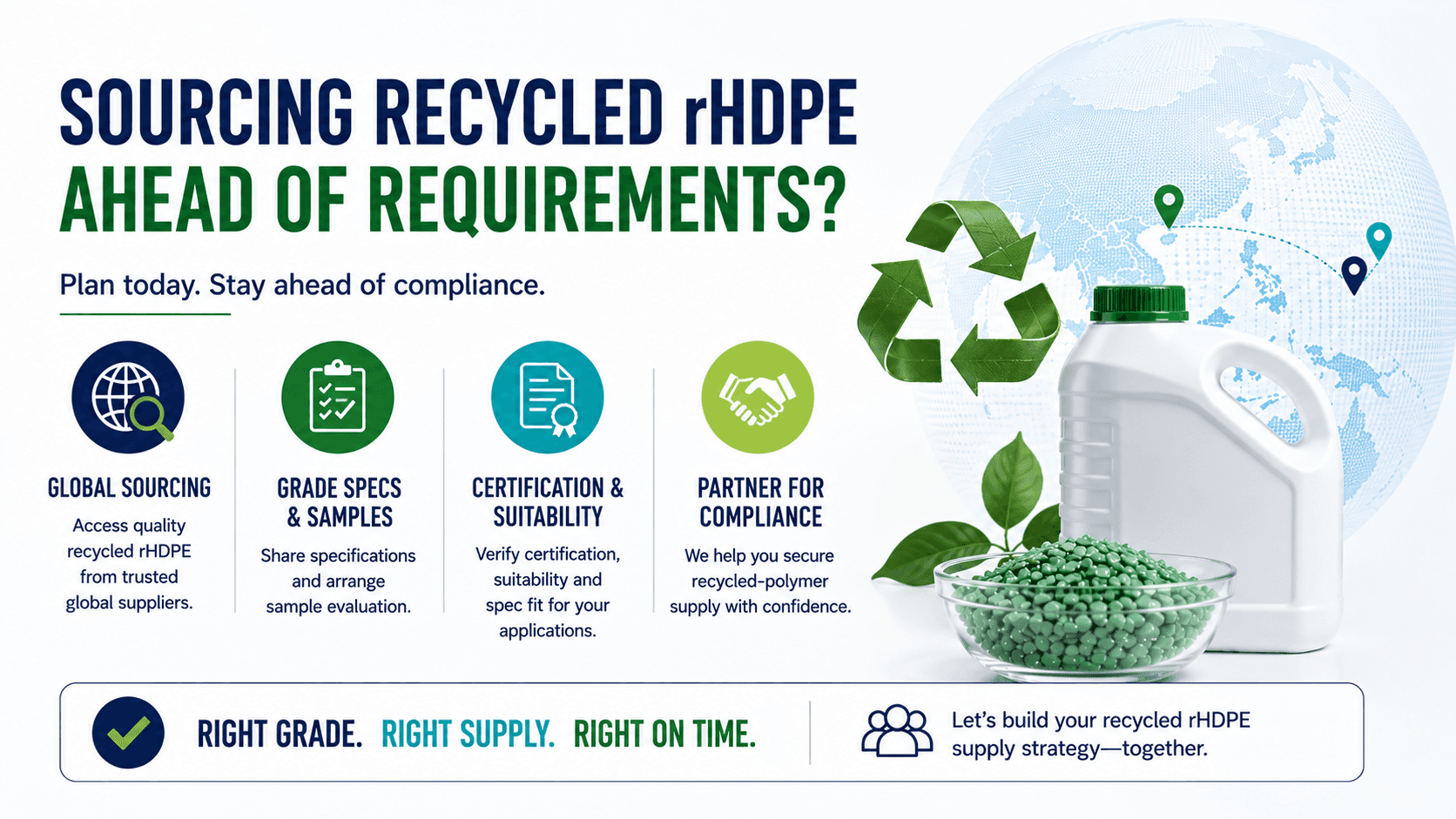
Sourcing Recycled rHDPE Ahead of These Requirements?
As recycled-content mandates like India's move from target to fixed schedule, buyers are increasingly lining up supply before deadlines rather than after. Regenport works with global buyers to source recycled HDPE (rHDPE), share grade specifications, and arrange sample evaluation — so procurement teams can verify certification, suitability and specification fit for their own applications. If you're reviewing recycled-polymer supply for upcoming compliance needs, we're glad to help you explore the grades currently available.
Image generated with ChatGPT
Sources
Sustainable Packaging Middle East & Africa, "India's 60% rigid packaging recycling mandate targets rPET, rHDPE demand growth for PIBOs" → Read the Source
India has moved recycled-content requirements for rigid plastic packaging from a starting floor of 30% in the 2025–26 financial year up to 60% by 2028–29, tightening the country's Extended Producer Responsibility (EPR) framework under the Plastic Waste Management Rules. The obligation sits with Producers, Importers and Brand Owners (PIBOs), a group that — according to industry reporting — now exceeds 44,000 registered entities.
For buyers of recycled polyethylene terephthalate (rPET) and recycled high-density polyethylene (rHDPE), the rule is worth reading closely: it turns a sustainability ambition into a fixed, year-by-year purchasing obligation across one of the world's largest packaging markets.
Rigid Packaging Faces a 30%-to-60% Recycled-Content Ramp by 2028–29
The recycled-content targets apply to Category I rigid plastic packaging — including PET bottles and HDPE jars and containers — under India's Plastic Waste Management Rules, 2016. The 2022 amendment strengthened the country's EPR framework, while the 2026 amendment is what introduced the numeric, phased recycled-content targets themselves. Rather than a single deadline, the rule sets a schedule that PIBOs can plan against:
Financial Year | Minimum recycled content (Category I, rigid) |
|---|---|
2025–26 | 30% |
2026–27 | 40% |
2027-28 | 50& |
2028-29 onward | 60% |
Recycled-content packaging must meet the labeling and standards requirements issued by the Central Pollution Control Board (CPCB) and applicable Indian Standards — including IS 14534, which sets guidelines for the recovery and recycling of plastic waste. Multi-layered packaging is handled separately: it is classified as Category III, with only its plastic layers counted when calculating recycled content, so the rigid-packaging (Category I) targets above should not be read as using that same layer-by-layer calculation.
Why This Points to Stronger rPET and rHDPE Demand
Because Category I covers the bottles, jars and containers most commonly molded from PET and HDPE, a rising recycled-content floor translates fairly directly into demand for food-grade rPET and rHDPE. Compliance is administered through the CPCB online EPR portal, where PIBOs register and report — meaning the obligation is tracked, not merely aspirational.
It should be noted that this is a reading of where the policy points, not a guarantee of volumes; actual offtake will depend on how quickly brands act and how enforcement develops. Buyers evaluating recycled grades against this backdrop will still need to verify food-contact suitability, certification and specification fit for their own applications.
Recycling Capacity Is Built, but Running Below Its Potential
India already hosts recycling capacity aimed at this demand. Industry reporting indicates around 17 food-grade rPET recycling plants (roughly 15–18 facilities) with combined capacity of about 300,000 metric tonnes, built at an estimated ₹9,000–10,000 crore (about US$1.08–1.20 billion) using technology aligned with European Food Safety Authority (EFSA) and US Food and Drug Administration (FDA) standards.
The gap is utilization. The Indian Association of PET Recyclers has warned that some brands are delaying compliance, leaving many PET recycling plants running well below capacity — a reminder that installed capacity and realized demand are not the same thing. The rules are also expected to push material traceability forward through mandatory QR-code or barcode labeling, and to nudge packaging design toward formats that are easier to collect, sort and recycle.
What It Means for Global Buyers Sourcing Asian Recycled Resin
India's mandate is best read as one signal in a wider pattern: recycled-content rules are tightening across Asia, not only in Western markets. For buyers building recycled-polymer supply, that gradually shifts the question from whether recycled material is available to which regions can supply certified, specification-appropriate grades at the volumes their programs need. A rising domestic requirement of this size may also tighten India's own food-grade rPET availability, which is worth factoring into forward sourcing plans rather than assuming supply stays loose.
The practical takeaway for procurement teams is to broaden their sourcing base. Evaluating recycled resin across multiple Asian sources — and verifying certification, food-contact suitability and specification fit case by case — can help buyers keep pace with mandates that are increasingly becoming a standing procurement variable rather than a one-off. India's phased 30-to-60% ramp is a concrete example of that shift, and a reason to review where recycled rPET and rHDPE will realistically come from over the next several years.
Practical Checkpoints for Procurement Teams
Buyers weighing supply against this schedule will want to confirm a few specifics before committing. On certification, food-contact grades in India run through Food Safety and Standards Authority of India (FSSAI) authorisation, alongside recyclers using EFSA- and FDA-aligned processes — worth verifying grade by grade rather than assuming blanket equivalence. On compliance mechanics, PIBOs report through the CPCB EPR portal on an annual cycle, and reporting has featured shortfall carry-forward provisions within the schedule; the exact current rules should be checked against the official notifications. And on availability, a rising domestic obligation can reduce how much food-grade recycled material stays free for export — a reason to plan sourcing earlier rather than counting on spot availability closer to deadlines.
Frequently Asked Questions
What is India's recycled-content requirement for rigid plastic packaging? Under the amended Plastic Waste Management Rules, Category I rigid plastic packaging must contain a minimum of 30% recycled content in 2025–26, rising to 40% (2026–27), 50% (2027–28) and 60% from 2028–29 onward.
Who has to comply? The obligation applies to Producers, Importers and Brand Owners (PIBOs), who register and report through the Central Pollution Control Board (CPCB) EPR portal; industry reporting indicates more than 44,000 have registered for plastic packaging waste.
How does this affect rPET and rHDPE demand? Because rigid packaging such as PET bottles and HDPE containers falls under Category I, a rising recycled-content floor is generally expected to increase demand for food-grade rPET and rHDPE, though realized volumes will depend on brand compliance and enforcement.
About This Guide
This article is informational and reflects the policy position as reported as of August 2026; it is not legal advice. Companies assessing their obligations under the Plastic Waste Management Rules should consult the official notifications and qualified advisors. Figures on facility counts, capacity and investment are drawn from industry reporting and should be independently verified for compliance decisions.
Sourcing Recycled rHDPE Ahead of These Requirements?
As recycled-content mandates like India's move from target to fixed schedule, buyers are increasingly lining up supply before deadlines rather than after. Regenport works with global buyers to source recycled HDPE (rHDPE), share grade specifications, and arrange sample evaluation — so procurement teams can verify certification, suitability and specification fit for their own applications. If you're reviewing recycled-polymer supply for upcoming compliance needs, we're glad to help you explore the grades currently available.
Image generated with ChatGPT
Sources
Sustainable Packaging Middle East & Africa, "India's 60% rigid packaging recycling mandate targets rPET, rHDPE demand growth for PIBOs" → Read the Source
Sourcing for the 60% Mandate
Grades • Specs • Availability
Browse rHDPE →
Sourcing for the 60% Mandate
Sourcing for the 60% Mandate
Compare rHDPE grades by feedstock, properties, certification, stock and MOQ.
Compare rHDPE grades by feedstock, properties, certification, stock and MOQ.
Browse rHDPE →
Browse rHDPE →
Looking for samples or ready to source? Submit your request for pricing, availability, and technical information.
Looking for samples or ready to source? Submit your request for pricing, availability, and technical information.
Request a Quote →
Request a Quote →
Posted by REGENPORT
REGENPORT is a global platform connecting buyers and suppliers in the recycled materials and sustainable packaging industries.