CATEGORY
CATEGORY
Trend
Trend
Trend
Recycled vs Virgin Polymers Diverge on Feedstock Surge – Week 1, August 2026
Recycled vs Virgin Polymers Diverge on Feedstock Surge – Week 1, August 2026
Recycled vs Virgin Polymers Diverge on Feedstock Surge – Week 1, August 2026

Virgin PE and PP climbed across Asia and North America as naphtha and ethylene costs rose, while Europe's recycled HDPE and PP kept sliding on oversupply — a widening gap heading into the EU's November 2026 waste-export ban.
The gap between recycled and virgin polymers widened again in August 2026. Higher feedstock costs — naphtha and ethylene in Asia — lifted virgin PE and PP prices, and North American producers pushed through August increases. Recycled markets moved the other way: European recycled HDPE (rHDPE) and recycled PP (rPP) fell further on oversupply and slow summer demand, while recycled grades in Asia tracked crude rather than real buying. With the EU's plastic waste export ban due in November 2026, here is where the recycled–virgin divergence is widening this week.
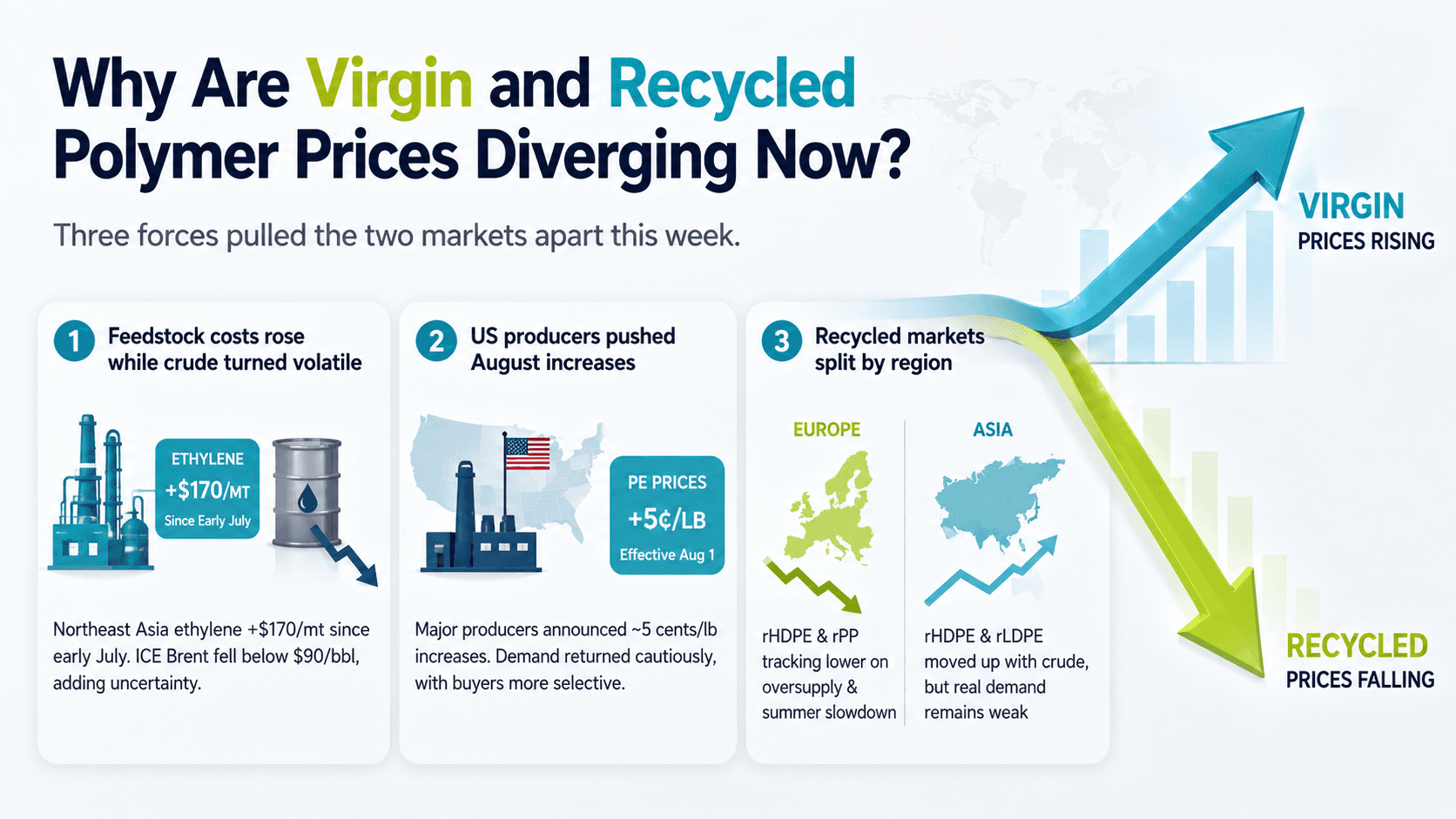
Why Are Virgin and Recycled Polymer Prices Diverging Now?
Three forces pulled the two markets apart this week.
Feedstock costs rose while crude turned volatile. Northeast Asia ethylene has gained roughly $170/mt since the start of July, prompting several Asian PE and PP producers to hold back offers as demand stayed soft. Late in the week, ICE Brent for September fell below $90/barrel, adding uncertainty and leaving many buyers hesitant to commit.
US producers pushed August increases as demand returned cautiously. For North American PE grades effective August 1, major producers moved forward with increases of about 5 cents/lb. Rather than the panic buying seen in earlier cycles, the current pickup looks gradual, with buyers appearing more cautious about accepting the higher levels.
Recycled markets split by region. In Europe, rHDPE and rPP tracked lower on oversupply and the seasonal summer slowdown. In Asia, recycled HDPE and LDPE moved up in line with crude, even though actual traded volumes stayed well behind the price signals.
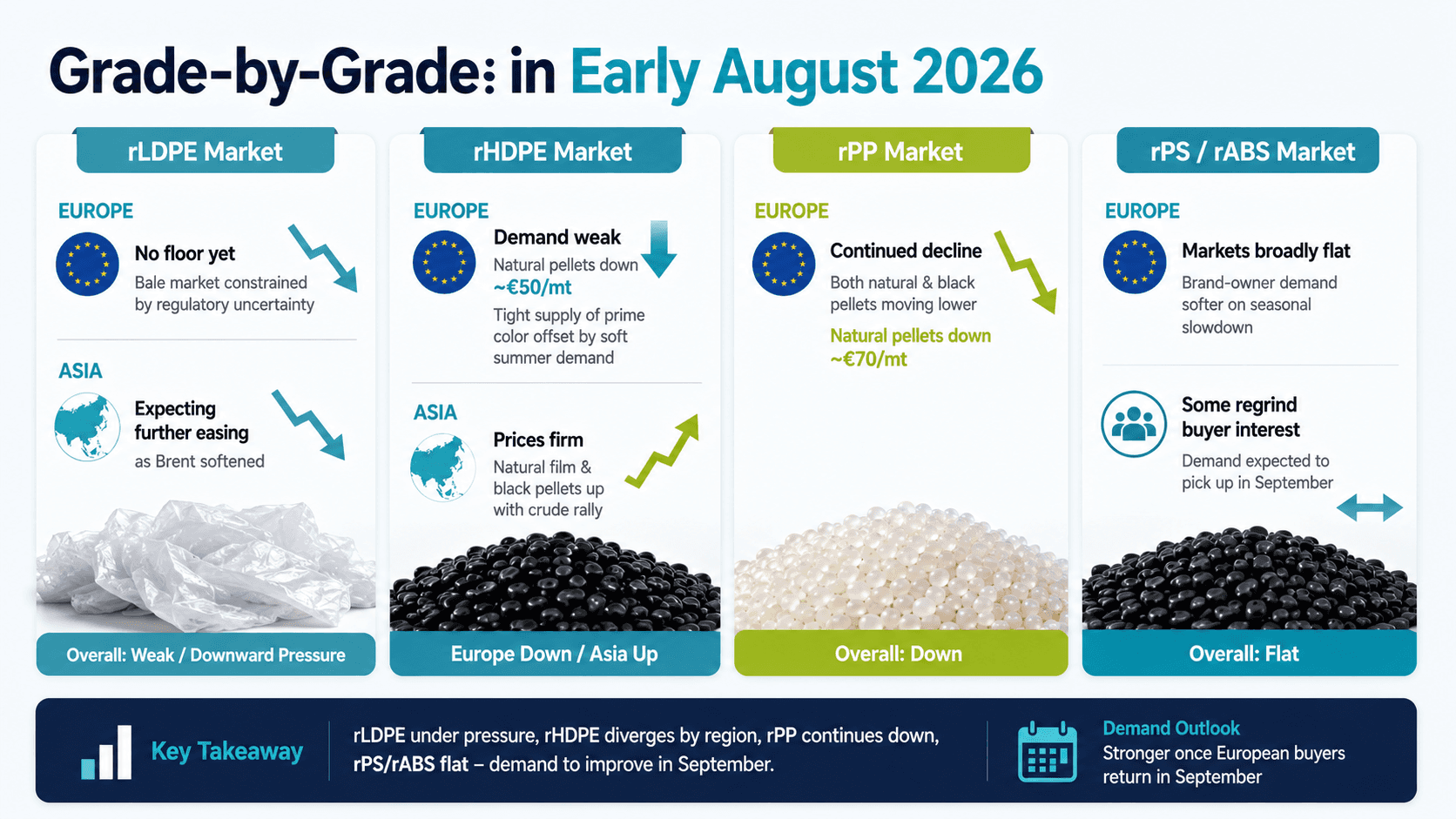
Grade-by-Grade: rLDPE, rHDPE, rPP, rPS/rABS in Early August 2026
rLDPE Market European recycled LDPE has yet to find a floor. The upstream bale market remained constrained by regulatory uncertainty, which is expected to intensify ahead of the EU's full waste-export ban to non-OECD countries scheduled for November. In Asia, buyers of recycled LDPE natural film appeared to expect further easing as Brent softened through the week.
rHDPE Market Europe and Asia moved in opposite directions. Demand for European rHDPE natural pellets was weak, particularly from construction end users. Prime colored material stayed in short supply, but soft summer demand offset that tightness. In Asia, recycled HDPE natural film and black pellets both firmed alongside the crude rally. European rHDPE natural pellets were reported down around €50/mt on the week.
rPP Market European recycled PP extended its decline, with both natural and black pellets moving lower. Natural pellets were reported down about €70/mt on the week.
rPS and rABS Market Europe's recycled PS and ABS markets were broadly flat. Brand-owner demand was described as softer on the seasonal slowdown, while some regrind buyers showed interest. Participants expect demand to pick up once European buyers return in September.
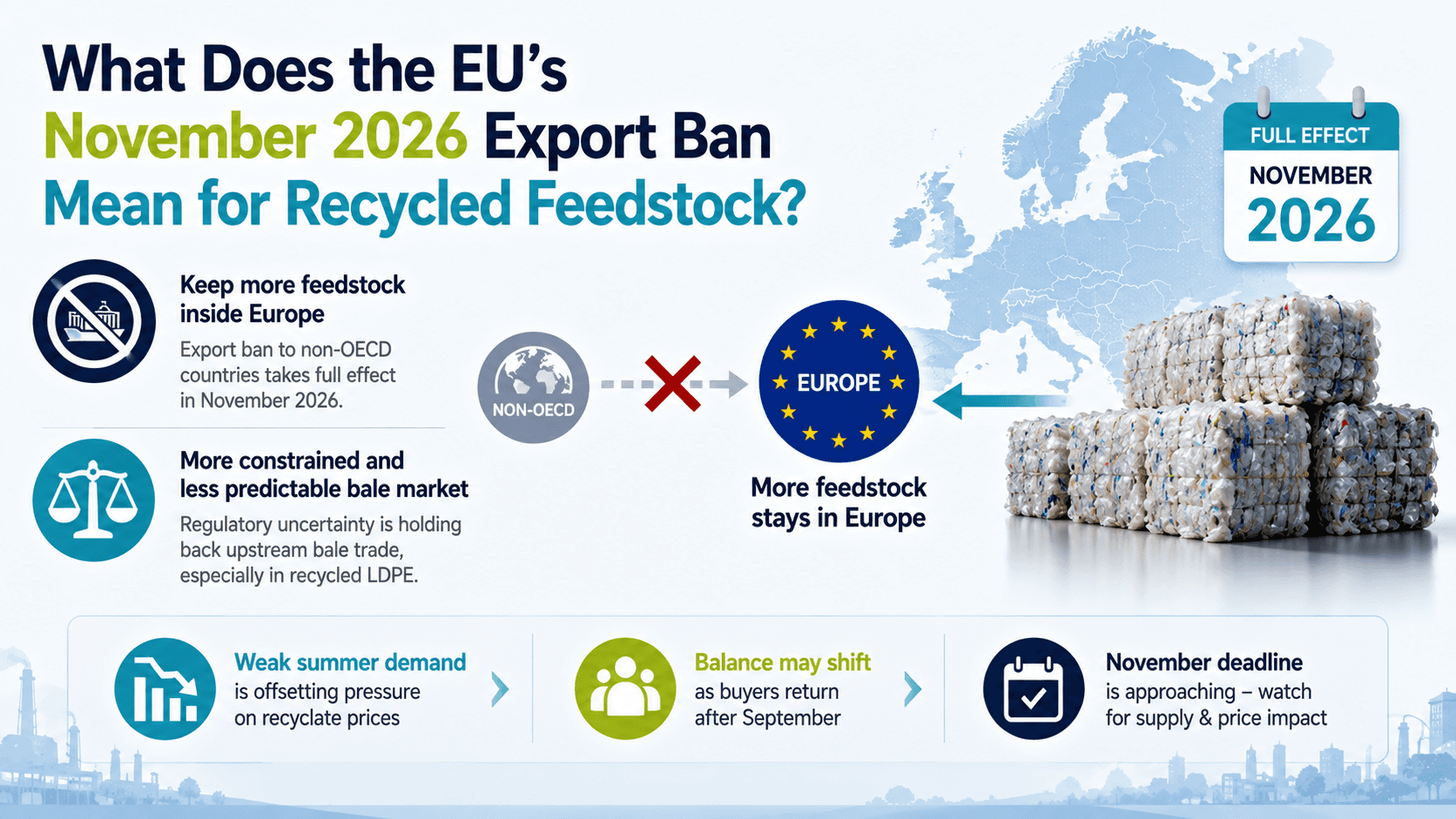
What Does the EU's November 2026 Export Ban Mean for Recycled Feedstock?
The EU's ban on exports of plastic waste to non-OECD countries takes full effect in November 2026, and it is already shaping sentiment in the European bale and recyclate markets. By restricting where post-consumer plastic waste can be sent, the rule is expected to keep more feedstock inside Europe while adding near-term uncertainty for how bale supply and pricing will settle.
For recyclers, the practical read is a more constrained and less predictable feedstock (bale) market, most visible this week in recycled LDPE, where regulatory uncertainty is holding back the upstream bale trade. For now, weak summer demand is offsetting that pressure on finished recyclate prices, but the balance could shift as buyers return after September and the November deadline draws closer.

Key Regulatory and Trade Developments
Pakistan imposed provisional anti-dumping duties on suspension-grade PVC (S-PVC) imports from the United States and Indonesia for a four-month period.
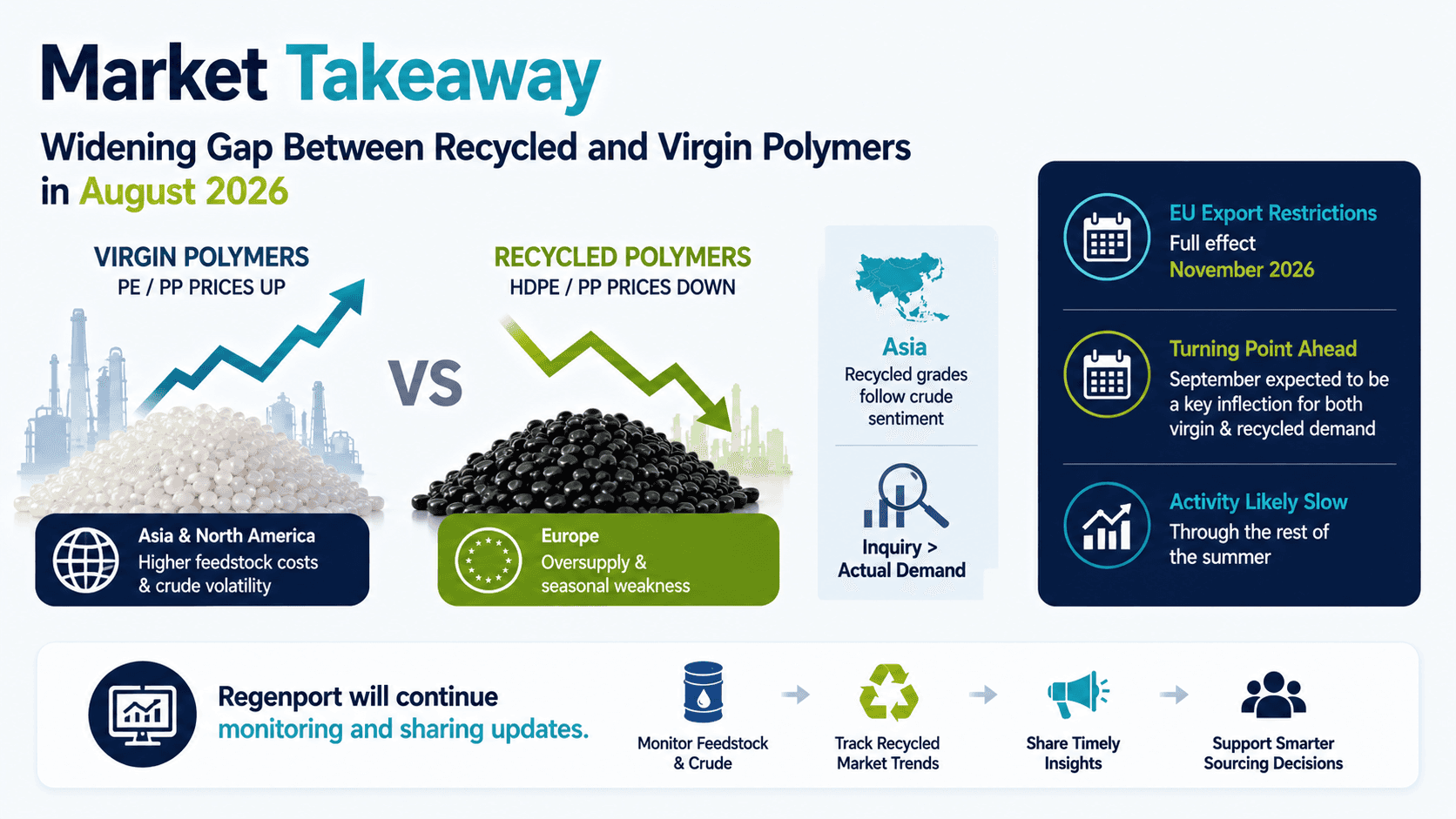
Market Takeaway
This week underlined a widening gap between recycled and virgin polymers in August 2026. Higher feedstock costs and crude volatility lifted virgin PE and PP in Asia and North America, while Europe's recycled HDPE and PP kept sliding under oversupply and seasonal weakness. Asia's recycled grades followed crude sentiment, but with a clear gap between inquiry and actual demand. With the EU's November 2026 export restrictions approaching and September widely seen as a turning point for both virgin and recycled demand, activity is likely to stay slow through the rest of the summer. Regenport will continue monitoring conditions and sharing updates as the picture develops.
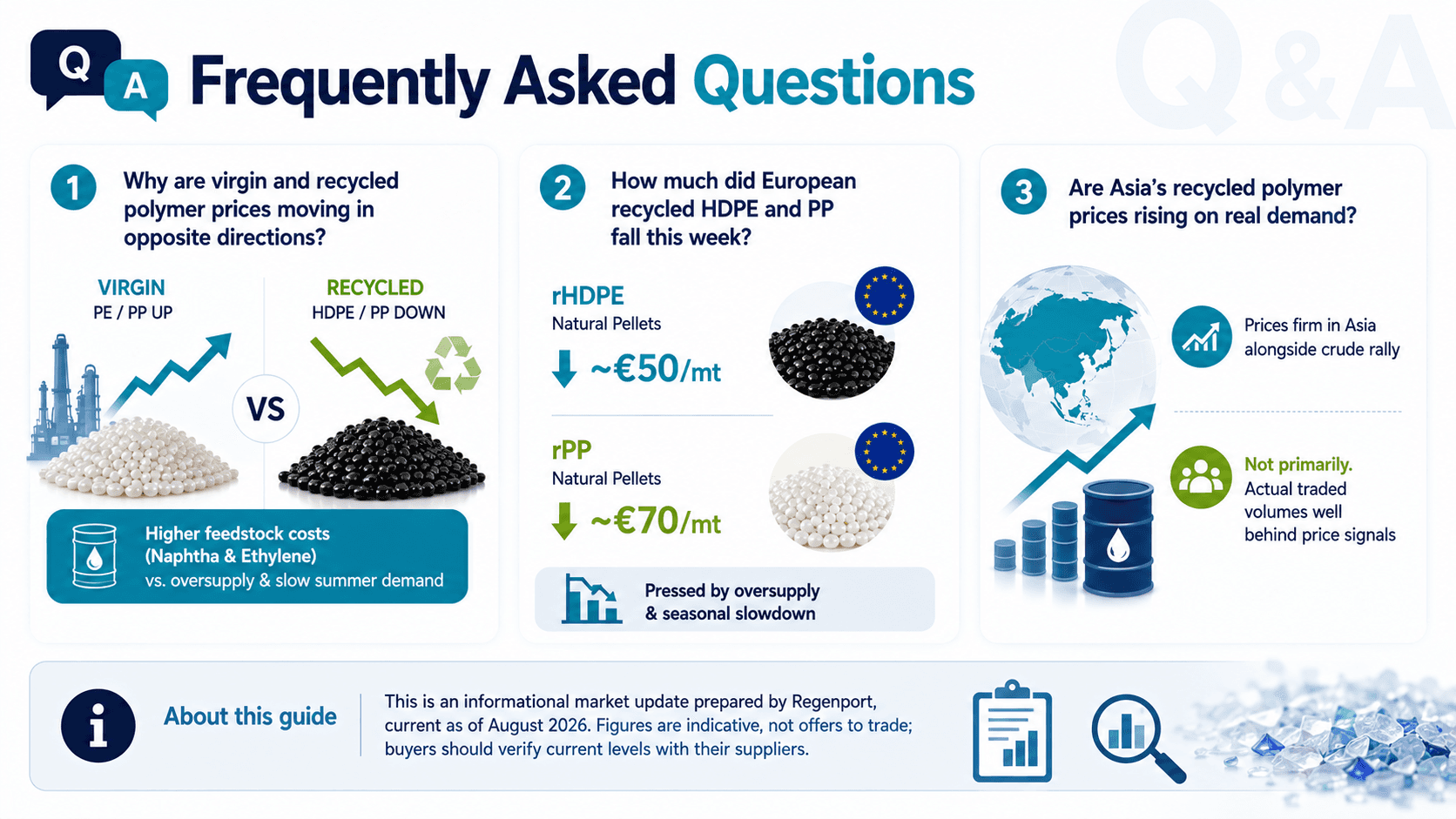
Frequently Asked Questions
Why are virgin and recycled polymer prices moving in opposite directions in early August 2026? Virgin PE and PP rose because feedstock naphtha and ethylene costs increased — Northeast Asia ethylene gained about $170/mt since early July — while European recycled HDPE and PP fell on oversupply and slow summer demand. The two markets are responding to different drivers this week.
How much did European recycled HDPE and PP fall this week? European rHDPE natural pellets were reported down around €50/mt and rPP natural pellets down around €70/mt on the week, pressured by oversupply and the seasonal slowdown.
Are Asia's recycled polymer prices rising on real demand? Not primarily. Recycled HDPE and LDPE in Asia firmed alongside the crude rally, but actual traded volumes stayed well behind the price signals — the move looks driven by sentiment more than end-user buying.
About this guide: This is an informational market update prepared by Regenport, current as of August 2026. Figures are indicative, not offers to trade; buyers should verify current levels with their suppliers.
Image generated with ChatGPT
The gap between recycled and virgin polymers widened again in August 2026. Higher feedstock costs — naphtha and ethylene in Asia — lifted virgin PE and PP prices, and North American producers pushed through August increases. Recycled markets moved the other way: European recycled HDPE (rHDPE) and recycled PP (rPP) fell further on oversupply and slow summer demand, while recycled grades in Asia tracked crude rather than real buying. With the EU's plastic waste export ban due in November 2026, here is where the recycled–virgin divergence is widening this week.
Why Are Virgin and Recycled Polymer Prices Diverging Now?
Three forces pulled the two markets apart this week.
Feedstock costs rose while crude turned volatile. Northeast Asia ethylene has gained roughly $170/mt since the start of July, prompting several Asian PE and PP producers to hold back offers as demand stayed soft. Late in the week, ICE Brent for September fell below $90/barrel, adding uncertainty and leaving many buyers hesitant to commit.
US producers pushed August increases as demand returned cautiously. For North American PE grades effective August 1, major producers moved forward with increases of about 5 cents/lb. Rather than the panic buying seen in earlier cycles, the current pickup looks gradual, with buyers appearing more cautious about accepting the higher levels.
Recycled markets split by region. In Europe, rHDPE and rPP tracked lower on oversupply and the seasonal summer slowdown. In Asia, recycled HDPE and LDPE moved up in line with crude, even though actual traded volumes stayed well behind the price signals.
Grade-by-Grade: rLDPE, rHDPE, rPP, rPS/rABS in Early August 2026
rLDPE Market European recycled LDPE has yet to find a floor. The upstream bale market remained constrained by regulatory uncertainty, which is expected to intensify ahead of the EU's full waste-export ban to non-OECD countries scheduled for November. In Asia, buyers of recycled LDPE natural film appeared to expect further easing as Brent softened through the week.
rHDPE Market Europe and Asia moved in opposite directions. Demand for European rHDPE natural pellets was weak, particularly from construction end users. Prime colored material stayed in short supply, but soft summer demand offset that tightness. In Asia, recycled HDPE natural film and black pellets both firmed alongside the crude rally. European rHDPE natural pellets were reported down around €50/mt on the week.
rPP Market European recycled PP extended its decline, with both natural and black pellets moving lower. Natural pellets were reported down about €70/mt on the week.
rPS and rABS Market Europe's recycled PS and ABS markets were broadly flat. Brand-owner demand was described as softer on the seasonal slowdown, while some regrind buyers showed interest. Participants expect demand to pick up once European buyers return in September.
What Does the EU's November 2026 Export Ban Mean for Recycled Feedstock?
The EU's ban on exports of plastic waste to non-OECD countries takes full effect in November 2026, and it is already shaping sentiment in the European bale and recyclate markets. By restricting where post-consumer plastic waste can be sent, the rule is expected to keep more feedstock inside Europe while adding near-term uncertainty for how bale supply and pricing will settle.
For recyclers, the practical read is a more constrained and less predictable feedstock (bale) market, most visible this week in recycled LDPE, where regulatory uncertainty is holding back the upstream bale trade. For now, weak summer demand is offsetting that pressure on finished recyclate prices, but the balance could shift as buyers return after September and the November deadline draws closer.
Key Regulatory and Trade Developments
Pakistan imposed provisional anti-dumping duties on suspension-grade PVC (S-PVC) imports from the United States and Indonesia for a four-month period.
Market Takeaway
This week underlined a widening gap between recycled and virgin polymers in August 2026. Higher feedstock costs and crude volatility lifted virgin PE and PP in Asia and North America, while Europe's recycled HDPE and PP kept sliding under oversupply and seasonal weakness. Asia's recycled grades followed crude sentiment, but with a clear gap between inquiry and actual demand. With the EU's November 2026 export restrictions approaching and September widely seen as a turning point for both virgin and recycled demand, activity is likely to stay slow through the rest of the summer. Regenport will continue monitoring conditions and sharing updates as the picture develops.
Frequently Asked Questions
Why are virgin and recycled polymer prices moving in opposite directions in early August 2026? Virgin PE and PP rose because feedstock naphtha and ethylene costs increased — Northeast Asia ethylene gained about $170/mt since early July — while European recycled HDPE and PP fell on oversupply and slow summer demand. The two markets are responding to different drivers this week.
How much did European recycled HDPE and PP fall this week? European rHDPE natural pellets were reported down around €50/mt and rPP natural pellets down around €70/mt on the week, pressured by oversupply and the seasonal slowdown.
Are Asia's recycled polymer prices rising on real demand? Not primarily. Recycled HDPE and LDPE in Asia firmed alongside the crude rally, but actual traded volumes stayed well behind the price signals — the move looks driven by sentiment more than end-user buying.
About this guide: This is an informational market update prepared by Regenport, current as of August 2026. Figures are indicative, not offers to trade; buyers should verify current levels with their suppliers.
Image generated with ChatGPT
August rPP Availability
Grades • Specs • Availability
Browse rPP →
August rPP Availability
August rPP Availability
Check the rPP grades listed by feedstock, MFI, stock and MOQ.
Check the rPP grades listed by feedstock, MFI, stock and MOQ.
Browse rPP →
Browse rPP →
Looking for samples or ready to source? Submit your request for pricing, availability, and technical information.
Looking for samples or ready to source? Submit your request for pricing, availability, and technical information.
Request a Quote →
Request a Quote →
Posted by REGENPORT
REGENPORT is a global platform connecting buyers and suppliers in the recycled materials and sustainable packaging industries.