CATEGORY
CATEGORY
Our Materials
Our Materials
Our Materials
Grey rABS PCR Pellet from a Sheet Stream: The Compliance Question Comes First
Grey rABS PCR Pellet from a Sheet Stream: The Compliance Question Comes First
Grey rABS PCR Pellet from a Sheet Stream: The Compliance Question Comes First
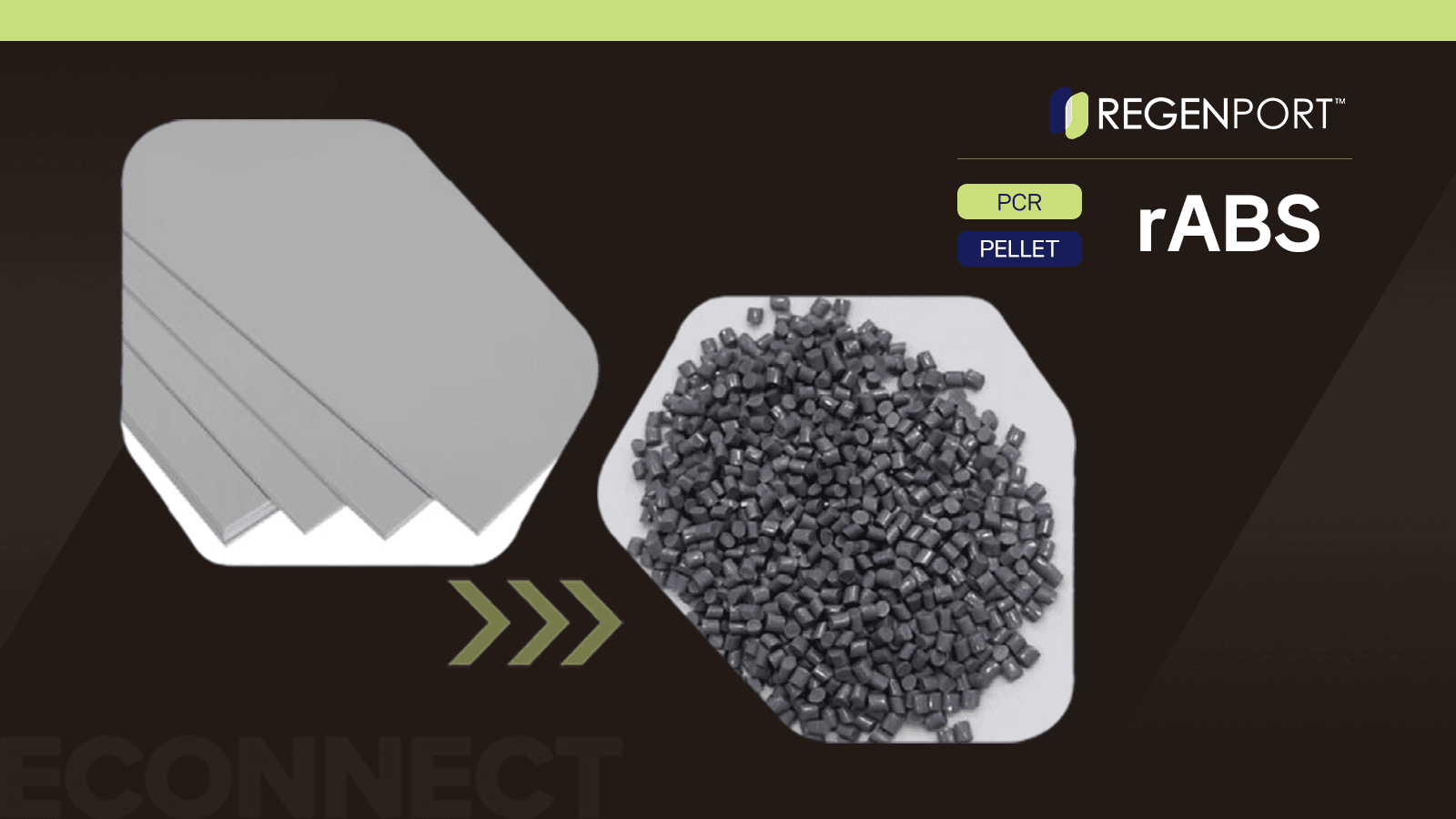
Grey PCR rABS pellet from a sheet feedstock stream, listed at MFI 46.8 g/10 min and density 1.05 g/cm³, with 30 MT/month availability from South Korea. For EU-bound use, review current-lot PBDE analysis, intended application, processing data and traceability before qualification.
Acrylonitrile butadiene styrene (ABS) is the resin behind rigid housings and panels: appliance fronts, enclosures and sheet for thermoforming. This Regenport grade is a grey ABS pellet reprocessed from a sheet stream and classified as post-consumer recycled (PCR), listed at a melt flow index (MFI) of 46.8 g/10 min and a density of 1.05 g/cm³, and listed for film, injection molding and blow molding.
For a buyer specifying recycled ABS into the EU, the first compliance question is not how the resin performs. It is whether the material and intended application can meet the EU POPs limits on listed PBDEs. Commission Delegated Regulation (EU) 2025/1482 sets a transitional unintentional trace contaminant limit for mixtures and articles made from, or containing, PBDE-containing recovered material, with a further reduction scheduled for 2027. We set out those limits and dates in our article on the 2027 PBDE ceiling. What follows is what they mean for a grade like this one.
What the PBDE Rules Mean for This Grade
The applicable PBDE limit depends on whether the material is supplied or assessed as a mixture, or incorporated into a finished article, and on whether it is made from, or contains, PBDE-containing recovered material. Toys and childcare articles run on a shorter timetable, while food-contact materials are excluded from this POPs entry and require separate review. No product listing, this one included, can settle compliance on its own. This grade's feedstock is listed as sheet. That description does not identify whether the stream includes material from electrical and electronic equipment or other legacy sources, and it does not establish the concentration of any legacy additives. Current-lot analysis is what does, and what the report needs to contain is set out in the request list below.
Processing Performance and Application Potential
At the stated test condition, an MFI of 46.8 g/10 min indicates a high-flow ABS grade. ABS melt-flow figures are not comparable across grades unless the temperature, load and test standard match, so those three belong with the number.
Film, injection molding and blow molding are listed as potential applications. They should be treated as categories to validate rather than as confirmation that every lot has been qualified in each process. Easier melt flow can support cavity filling in injection molding, while blow molding also depends on parison stability and melt strength before inflation; the MFI value alone does not establish suitability for either, particularly blow molding. For film, the intended process route needs settling before anything else, since it decides which trial data is even relevant.
Repeated thermal and mechanical processing can affect ABS morphology and may influence impact performance, heat resistance and processing consistency. The result depends on feedstock quality, formulation, contamination control and processing history, so application-specific testing remains necessary.
Material Data
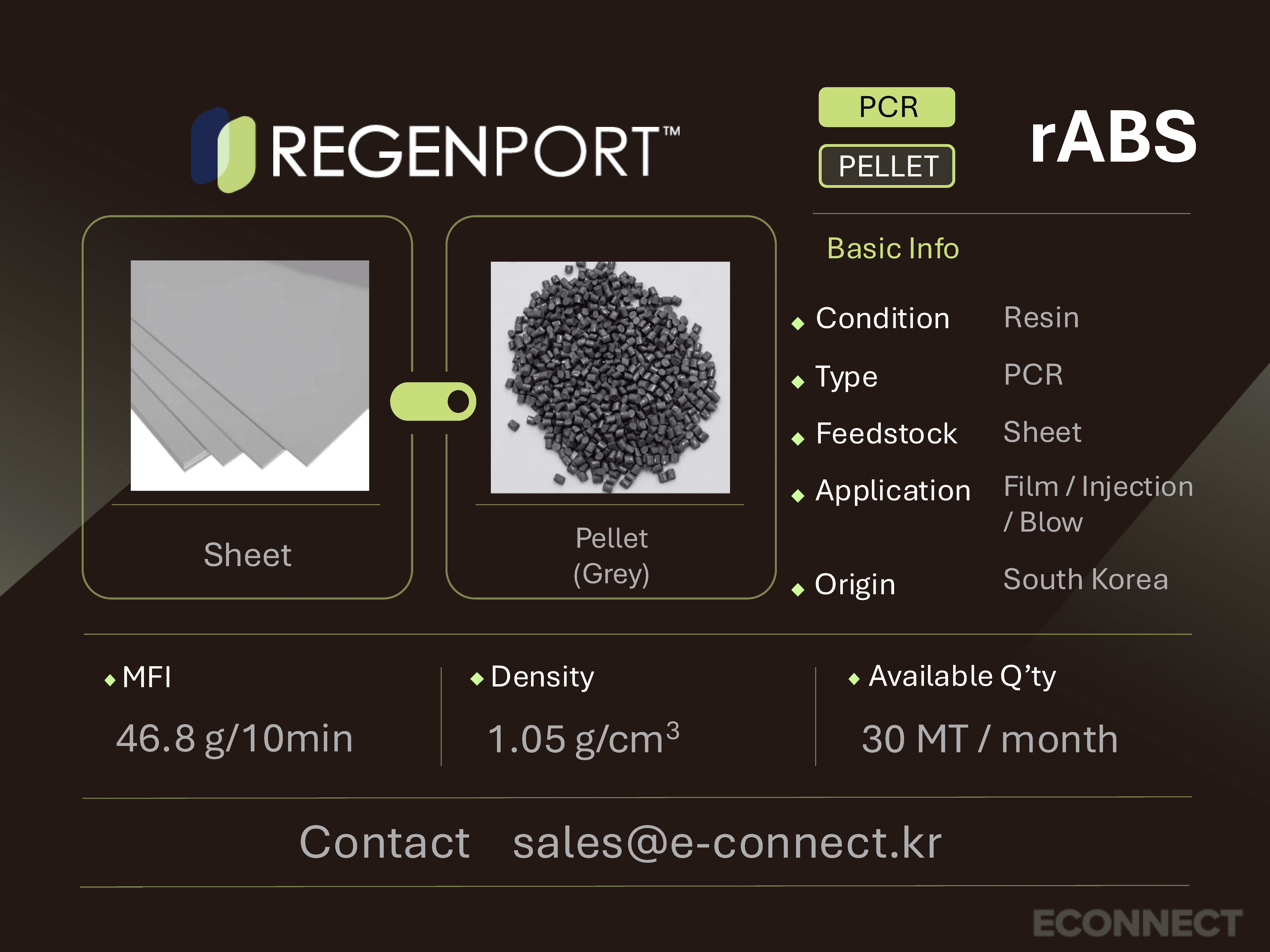
rABS (Regenport material catalog #61) | |
|---|---|
CONDITION : | TYPE : |
FEEDSTOCK : | APPLICATION : |
MFI : | DENSITY : |
What to Ask For
One list covers most of a first review.
PBDE analysis — test report identifying the PBDEs tested, the reported sum where applicable, method, reporting limits, sampling basis, current-lot coverage and testing frequency. A total-bromine screen is a different exercise and does not stand in for PBDE-specific analysis.
End-use and regulatory review — confirmation of the intended market and application, including whether the product is for food contact, toys, childcare products, electrical or electronic equipment, automotive, construction or general industrial use.
Feedstock detail — sheet type and source, age profile, source consistency, sorting, cleaning, decontamination and quality-control procedures.
MFI test condition — test temperature, load and applicable test standard.
Process history — which listed applications have actually been run with the grade, with trial or production data relevant to your process.
Mechanical and thermal data — impact strength, tensile properties where available, heat deflection temperature, thermal-aging retention, ash and moisture.
Appearance consistency — grey color variation, black specks, gels, contamination and lot-to-lot consistency.
Recycled-content evidence — feedstock and production records, chain-of-custody or mass-balance approach, and any site-level or material-level certification such as the Global Recycled Standard (GRS), if available.
Supply confirmation — current lot availability, allocation, MOQ, sample availability, packaging, lead time and export terms.
Recycled-content documentation and PBDE analysis serve different purposes. Neither substitutes for the other, and neither replaces application-specific qualification.
Supply from South Korea
The supplier listing indicates availability of 30 MT per month from South Korea. For recovered-material streams, actual allocable volume can vary with collection, sorting yield, reprocessing output and existing commitments.
A PCR ABS Option to Evaluate
This is a grey PCR rABS pellet from a sheet feedstock stream, listed at an MFI of 46.8 g/10 min and a density of 1.05 g/cm³, with supplier-listed applications in film, injection molding and blow molding. For EU-bound use, qualification starts with current-lot PBDE analysis and a review of the intended end use under the applicable EU POPs requirements. The processing and supply questions follow from there.
Sample quantities may be available for trial. Please share the target application, processing method, destination market and expected monthly demand. We can confirm the current lot data and which documentation is available, including PBDE analysis, MFI test conditions, processing information and lead-time details.
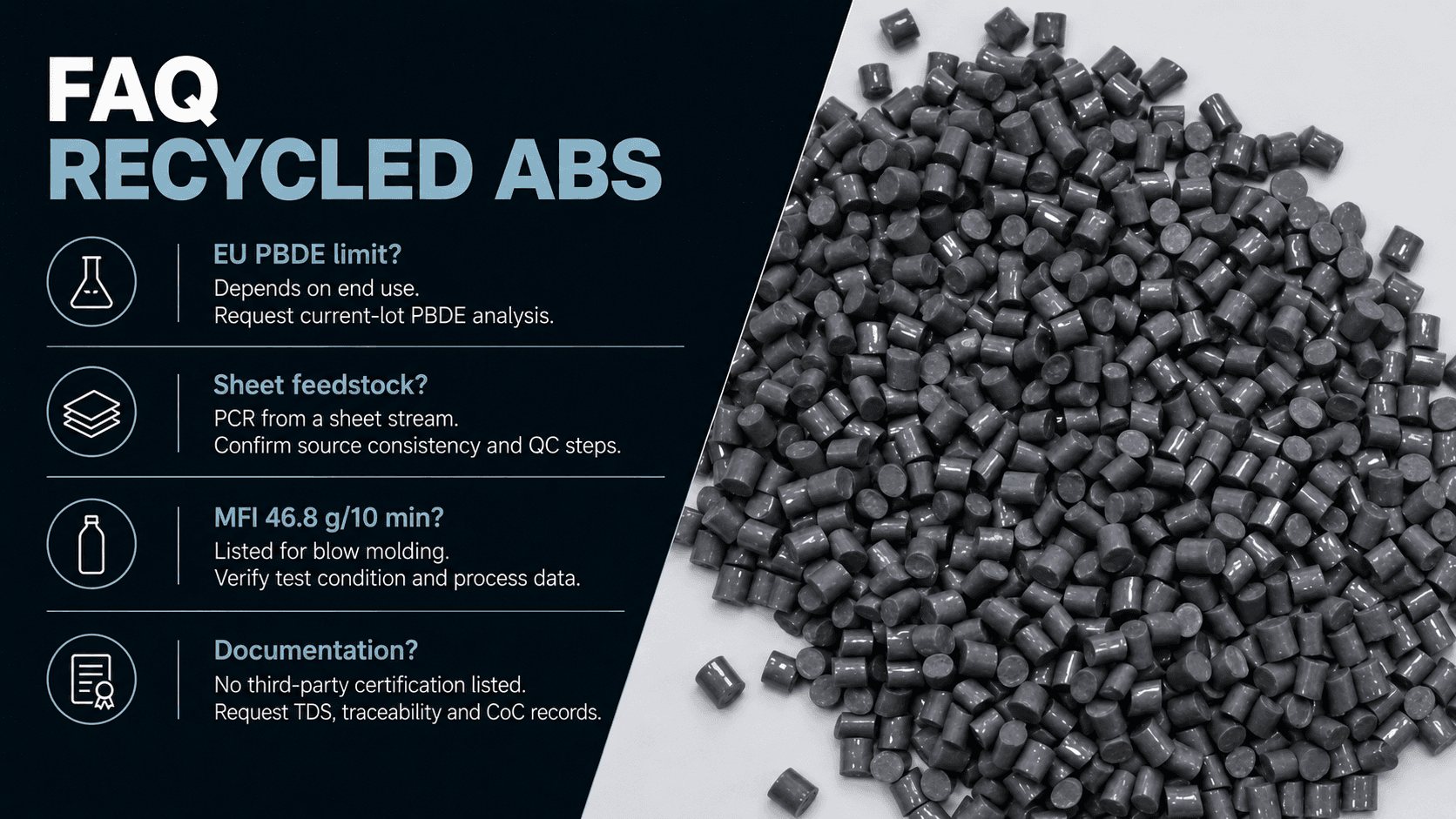
Frequently Asked Questions
Does this grade meet the EU PBDE limit, and why does PBDE come up for recycled ABS at all? Recycled plastics from some legacy streams, particularly electrical and electronic equipment, can contain brominated flame retardants, which is why the question is asked of recycled ABS in the first place. Compliance cannot be confirmed from a product listing. The relevant limit depends on whether the material is assessed as a mixture or incorporated into a finished article, whether it is made from or contains PBDE-containing recovered material, and its intended end use. Ask for current-lot PBDE analysis identifying the substances tested, the analytical method, reporting limits, sampling basis, lot coverage and testing frequency.
What does sheet feedstock mean for this grade? The grade is listed as PCR, meaning its feedstock is described as material recovered after use rather than a manufacturing offcut. "Sheet" identifies the feedstock form, but it does not by itself establish source consistency, contamination risk, legacy-additive concentration or compliance status. Ask what the sheet scrap was, its typical age profile, whether it comes from a single or mixed source, and what sorting, cleaning and quality-control steps are used.
Is MFI 46.8 g/10 min suitable for blow molding? The grade is listed for blow molding, but the MFI value alone does not establish suitability. Blow molding depends on parison stability and melt strength before inflation, while easier melt flow may be more directly useful for cavity filling in injection molding. Ask for the MFI test condition — including temperature, load and standard — and for process data from a comparable blow-molding application and part geometry.
What documentation comes with this grade? No third-party certification is identified for this grade in the supplier listing. Request the producer's feedstock and production records, lot traceability information, and details of any chain-of-custody or mass-balance system in use to support a recycled-content claim, along with the current-lot technical data sheet and its MFI test condition.
Image generated with ChatGPT
Acrylonitrile butadiene styrene (ABS) is the resin behind rigid housings and panels: appliance fronts, enclosures and sheet for thermoforming. This Regenport grade is a grey ABS pellet reprocessed from a sheet stream and classified as post-consumer recycled (PCR), listed at a melt flow index (MFI) of 46.8 g/10 min and a density of 1.05 g/cm³, and listed for film, injection molding and blow molding.
For a buyer specifying recycled ABS into the EU, the first compliance question is not how the resin performs. It is whether the material and intended application can meet the EU POPs limits on listed PBDEs. Commission Delegated Regulation (EU) 2025/1482 sets a transitional unintentional trace contaminant limit for mixtures and articles made from, or containing, PBDE-containing recovered material, with a further reduction scheduled for 2027. We set out those limits and dates in our article on the 2027 PBDE ceiling. What follows is what they mean for a grade like this one.
What the PBDE Rules Mean for This Grade
The applicable PBDE limit depends on whether the material is supplied or assessed as a mixture, or incorporated into a finished article, and on whether it is made from, or contains, PBDE-containing recovered material. Toys and childcare articles run on a shorter timetable, while food-contact materials are excluded from this POPs entry and require separate review. No product listing, this one included, can settle compliance on its own. This grade's feedstock is listed as sheet. That description does not identify whether the stream includes material from electrical and electronic equipment or other legacy sources, and it does not establish the concentration of any legacy additives. Current-lot analysis is what does, and what the report needs to contain is set out in the request list below.
Processing Performance and Application Potential
At the stated test condition, an MFI of 46.8 g/10 min indicates a high-flow ABS grade. ABS melt-flow figures are not comparable across grades unless the temperature, load and test standard match, so those three belong with the number.
Film, injection molding and blow molding are listed as potential applications. They should be treated as categories to validate rather than as confirmation that every lot has been qualified in each process. Easier melt flow can support cavity filling in injection molding, while blow molding also depends on parison stability and melt strength before inflation; the MFI value alone does not establish suitability for either, particularly blow molding. For film, the intended process route needs settling before anything else, since it decides which trial data is even relevant.
Repeated thermal and mechanical processing can affect ABS morphology and may influence impact performance, heat resistance and processing consistency. The result depends on feedstock quality, formulation, contamination control and processing history, so application-specific testing remains necessary.
Material Data
rABS (Regenport material catalog #61) | |
|---|---|
CONDITION : | TYPE : |
FEEDSTOCK : | APPLICATION : |
MFI : | DENSITY : |
What to Ask For
One list covers most of a first review.
PBDE analysis — test report identifying the PBDEs tested, the reported sum where applicable, method, reporting limits, sampling basis, current-lot coverage and testing frequency. A total-bromine screen is a different exercise and does not stand in for PBDE-specific analysis.
End-use and regulatory review — confirmation of the intended market and application, including whether the product is for food contact, toys, childcare products, electrical or electronic equipment, automotive, construction or general industrial use.
Feedstock detail — sheet type and source, age profile, source consistency, sorting, cleaning, decontamination and quality-control procedures.
MFI test condition — test temperature, load and applicable test standard.
Process history — which listed applications have actually been run with the grade, with trial or production data relevant to your process.
Mechanical and thermal data — impact strength, tensile properties where available, heat deflection temperature, thermal-aging retention, ash and moisture.
Appearance consistency — grey color variation, black specks, gels, contamination and lot-to-lot consistency.
Recycled-content evidence — feedstock and production records, chain-of-custody or mass-balance approach, and any site-level or material-level certification such as the Global Recycled Standard (GRS), if available.
Supply confirmation — current lot availability, allocation, MOQ, sample availability, packaging, lead time and export terms.
Recycled-content documentation and PBDE analysis serve different purposes. Neither substitutes for the other, and neither replaces application-specific qualification.
Supply from South Korea
The supplier listing indicates availability of 30 MT per month from South Korea. For recovered-material streams, actual allocable volume can vary with collection, sorting yield, reprocessing output and existing commitments.
A PCR ABS Option to Evaluate
This is a grey PCR rABS pellet from a sheet feedstock stream, listed at an MFI of 46.8 g/10 min and a density of 1.05 g/cm³, with supplier-listed applications in film, injection molding and blow molding. For EU-bound use, qualification starts with current-lot PBDE analysis and a review of the intended end use under the applicable EU POPs requirements. The processing and supply questions follow from there.
Sample quantities may be available for trial. Please share the target application, processing method, destination market and expected monthly demand. We can confirm the current lot data and which documentation is available, including PBDE analysis, MFI test conditions, processing information and lead-time details.
Frequently Asked Questions
Does this grade meet the EU PBDE limit, and why does PBDE come up for recycled ABS at all? Recycled plastics from some legacy streams, particularly electrical and electronic equipment, can contain brominated flame retardants, which is why the question is asked of recycled ABS in the first place. Compliance cannot be confirmed from a product listing. The relevant limit depends on whether the material is assessed as a mixture or incorporated into a finished article, whether it is made from or contains PBDE-containing recovered material, and its intended end use. Ask for current-lot PBDE analysis identifying the substances tested, the analytical method, reporting limits, sampling basis, lot coverage and testing frequency.
What does sheet feedstock mean for this grade? The grade is listed as PCR, meaning its feedstock is described as material recovered after use rather than a manufacturing offcut. "Sheet" identifies the feedstock form, but it does not by itself establish source consistency, contamination risk, legacy-additive concentration or compliance status. Ask what the sheet scrap was, its typical age profile, whether it comes from a single or mixed source, and what sorting, cleaning and quality-control steps are used.
Is MFI 46.8 g/10 min suitable for blow molding? The grade is listed for blow molding, but the MFI value alone does not establish suitability. Blow molding depends on parison stability and melt strength before inflation, while easier melt flow may be more directly useful for cavity filling in injection molding. Ask for the MFI test condition — including temperature, load and standard — and for process data from a comparable blow-molding application and part geometry.
What documentation comes with this grade? No third-party certification is identified for this grade in the supplier listing. Request the producer's feedstock and production records, lot traceability information, and details of any chain-of-custody or mass-balance system in use to support a recycled-content claim, along with the current-lot technical data sheet and its MFI test condition.
Image generated with ChatGPT
Grey rABS
Grey rABS
Looking for samples or ready to source? Submit your request for pricing, availability, and technical information.
Looking for samples or ready to source? Submit your request for pricing, availability, and technical information.
Request a Quote →
Request a Quote →
Posted by REGENPORT
REGENPORT is a global platform connecting buyers and suppliers in the recycled materials and sustainable packaging industries.