CATEGORY
CATEGORY
News
News
News
A 2026 PET Trade Letter and What It Could Mean for Recycled-Content Verification
A 2026 PET Trade Letter and What It Could Mean for Recycled-Content Verification
A 2026 PET Trade Letter and What It Could Mean for Recycled-Content Verification
News-track post on the 25 September 2026 congressional letter asking USTR to investigate PET import capacity and tighten recycled-content/origin verification — and why the traceability part of that ask isn't written as PET-only.
On 25 September 2026, five members of the US House of Representatives sent a letter to the US Trade Representative (USTR), Jamieson Greer. The five are Nick Langworthy (NY-23), Mike Ezell (MS-4), Diana Harshbarger (TN-1), Mariannette Miller-Meeks (IA-1) and Jefferson Shreve (IN-6).
The letter alleges that six countries — Vietnam, Malaysia, Indonesia, India, Thailand and South Korea — are producing recycled PET in volumes that substantially exceed domestic demand and exporting the excess at low prices. It asks USTR to look into that, and to consider trade remedies (special tariffs, for example) on PET imports that fall under specific Harmonized Tariff Schedule (HTS) codes — namely 3907.61, 3907.69 and 3907.99.50. An HTS code is simply the customs code that decides which tariff and import rules apply to a shipment.
That part of the letter is about PET, a resin REGENPORT does not currently carry. But the letter also asks for two other things. Neither of those two is written to apply only to PET — and that is worth a closer look for anyone sourcing rHDPE or rPP too.

What the Letter Asks For
The letter makes four requests to USTR:
Investigate whether the six countries above are overproducing PET recyclate.
Consider trade remedies on PET imports under specific HTS codes (3907.61, 3907.69 and 3907.99.50).
Make it easier to verify recycled-content and country-of-origin claims.
Strengthen enforcement against shipments that are mislabeled or wrongly classified.
Requests #1 and #2 are explicitly about PET. Requests #3 and #4 concern verification and customs enforcement more broadly; they are not written to apply to one resin only.

The Numbers Behind the Letter
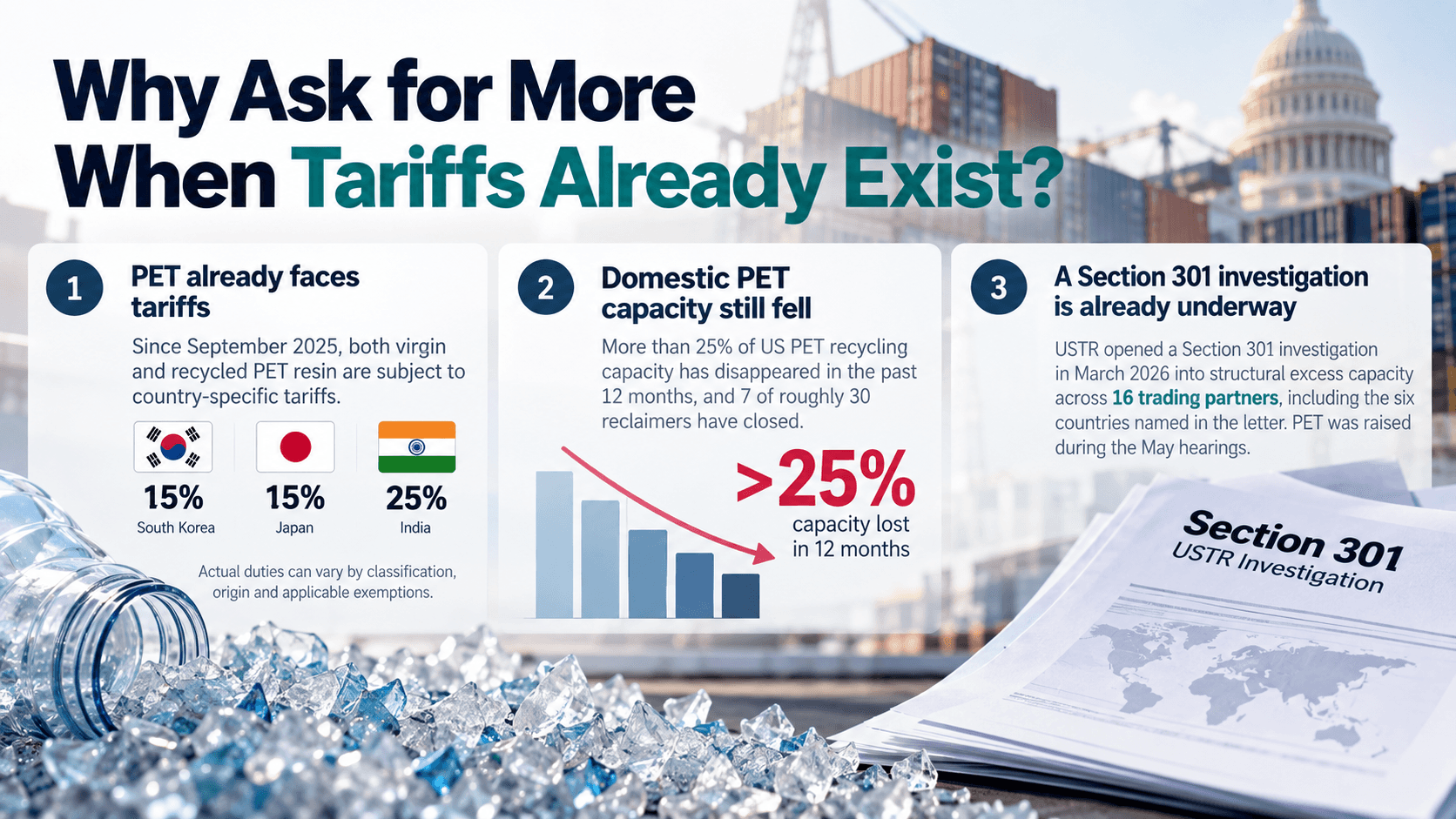
The letter points to a sharp drop in US PET recycling capacity: more than 25% of it has disappeared in the past 12 months, and 7 of roughly 30 domestic PET reclaimers have closed. It also notes that PET bale prices — what processors pay for baled scrap PET before it is cleaned and pelletized — hit an all-time low of 1.44 cents per pound in April 2026.
The Association of Plastic Recyclers (APR), the main US trade group for plastics recyclers, has publicly backed the letter. APR says the US needs clearer, more accurate data on what is actually being imported.
A few US companies are named as examples of reclaimers under pressure: Eastman (Tennessee), Alpek (Mississippi and Indiana) and a Republic Services facility in Indianapolis. These companies are not signers of the letter — they are simply cited as examples of the capacity that has been lost.
Why Ask for More When Tariffs Already Exist?
PET is already subject to country-specific reciprocal tariffs. In September 2025, the White House added both virgin and recycled PET resin to the tariff list, with headline rates ranging from 15% for South Korea and Japan to up to 25% for India. Actual duties can vary depending on classification, origin and applicable exemptions.
The domestic PET capacity losses cited in the letter were reported after those tariffs took effect. That does not prove the tariffs have failed, but it may help explain why lawmakers are seeking a more PET-specific response.
Separately, USTR opened a Section 301 investigation in March 2026 into structural excess capacity across 16 trading partners, including all six countries named in this letter. PET was raised during the May hearings. The new letter can be read as congressional pressure for USTR to consider a PET-specific remedy within that broader process, although USTR has not announced any such action.
Why Verification Could Matter Beyond PET
Verifying a shipment's origin and substantiating a recycled-content claim involve documentation, traceability and enforcement processes that can be relevant across resin types. Those processes are not inherently limited to PET.
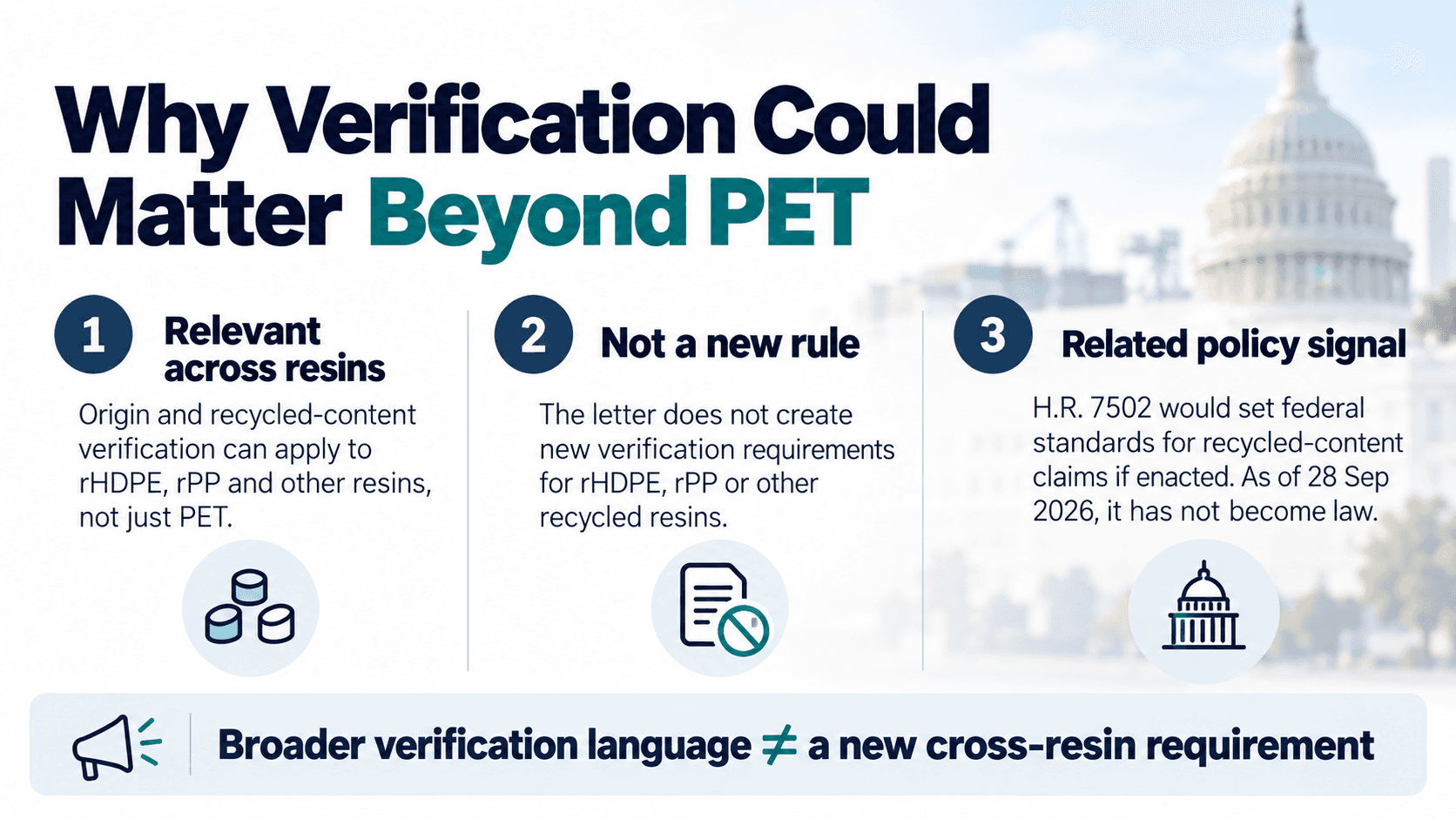
That does not mean new requirements will extend beyond PET. The letter does not announce, create or require new verification rules for rHDPE, rPP or other recycled resins. It simply shows that its verification and enforcement requests are written in broader terms than its PET-specific trade-remedy requests.
There is a related data point, though not a direct link. Rep. Langworthy, who led this letter, is also the lead sponsor of a separate bill: H.R. 7502, the Recycled Materials Attribution Act, introduced in February 2026. If enacted, the bill would direct the Federal Trade Commission to establish federal standards for recycled-content and related recycling claims used in consumer marketing. It is not limited to PET or to a particular resin type. As of 28 September 2026, H.R. 7502 has been ordered reported by the House Energy and Commerce Committee, but it has not passed the House or become law. REGENPORT covered a related Senate bill, the Tracking Plastic Act (S.5182), back in August 2026; it remains at the committee stage.

What Buyers Can Ask For Now
A lot-linked origin declaration from the supplier — a written statement tied to the specific shipment or lot, not a general claim about where the company sources from.
Commercial and shipping records supporting that declaration, such as invoices, packing lists and bills of lading.
Applicable scope and transaction certificates, plus lot-linked chain-of-custody records, for any GRS claim — a scope certificate covers a facility's certification in general; a transaction certificate covers one specific shipment, and the two are not interchangeable.
A reminder that certification records support recycled-content and chain-of-custody claims but are not, by themselves, proof of customs origin.
Confirmation of the HTSUS classification declared by or on behalf of the importer of record, with the understanding that CBP may review or determine the final classification.
A documented process for providing additional evidence if customers, certification bodies or regulators request it.
The letter itself does not create any new rHDPE or rPP documentation requirement. This is a starting checklist for buyers who want to be prepared, not a statement of new compliance obligations, and it is not a substitute for advice from trade counsel or a licensed customs broker.
Frequently Asked Questions
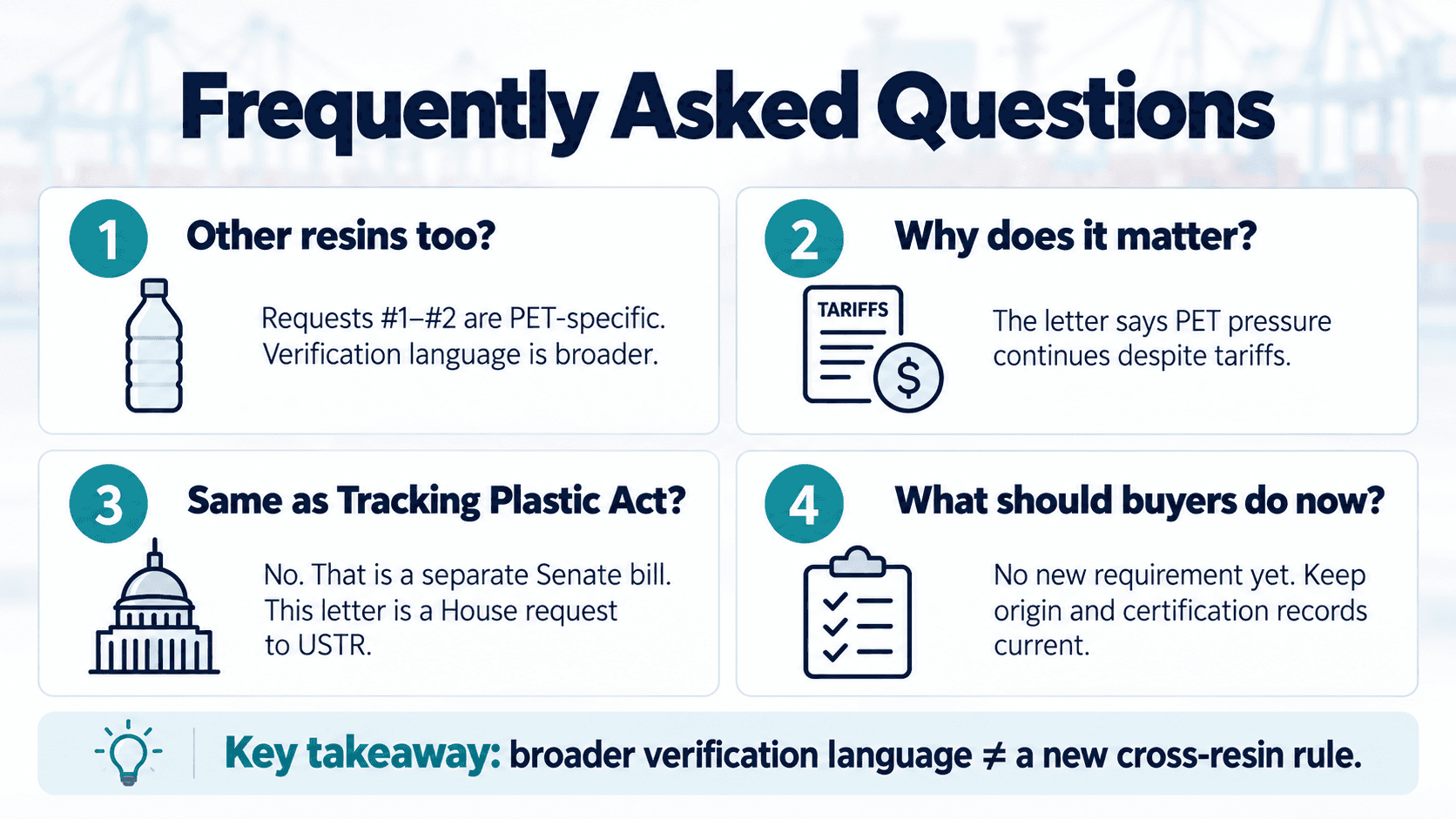
Does the 25 September 2026 letter cover resins other than PET? The letter's first two requests — its call to investigate alleged PET overproduction and its request to consider trade remedies under specified HTS codes (3907.61, 3907.69, 3907.99.50) — are PET-specific. The verification and enforcement requests are not written to apply only to PET, though nothing beyond the letter itself has happened yet for other resins.
If PET already has tariffs, why does this letter matter? The September 2025 tariffs applied broadly, country by country, rather than being designed around PET's specific situation. The letter cites continued pressure on domestic PET recyclers despite those tariffs, which may help explain why lawmakers are seeking a more PET-specific response. That does not, by itself, establish whether the broader tariffs have been effective or ineffective. This new letter can be read as pressure on USTR to turn its ongoing Section 301 investigation into a more targeted PET remedy — though that outcome is not confirmed.
Is this the same as the Tracking Plastic Act covered here in August? No. The Tracking Plastic Act (S.5182) is a separate Senate bill that would create a federal working group to study recycled-plastic traceability, data and reporting — it would not itself set uniform reporting rules. This new letter is a House request to USTR focused on trade and customs enforcement. Both relate to the same wider policy conversation about how recycled-content claims should be measured, documented and substantiated, but they use different mechanisms.
What should a buyer of rHDPE or rPP actually do right now? Nothing is required yet. But keeping country-of-origin and certification records current, and traceable lot by lot, is a reasonable precaution regardless of how this specific letter turns out.
About This Article
Information as of 28 September 2026, based on the letter as reported by Resource Recycling, USTR's Section 301 press materials, and the public status records for H.R. 7502 and S. 5182. This is general market information for sourcing teams, not trade, customs or legal advice; resin-specific requirements, tariff classifications and documentation standards should be confirmed directly with USTR, CBP or a licensed customs broker as they develop.
Image generated with ChatGPT
Sources
Resource Recycling, "US lawmakers urge protection of domestic RPET" (25 September 2026) → Read the Source
Resource Recycling, "Trump adds PET resin to reciprocal tariffs" (8 September 2025) → Read the Source
United States Trade Representative, "USTR Initiates Section 301 Investigations Relating to Structural Excess Capacity and Production in Manufacturing Sectors" (12 March 2026) → Read the Source
Packaging Dive, "Recycled content claims bill introduced in Congress" (13 February 2026) → Read the Source
On 25 September 2026, five members of the US House of Representatives sent a letter to the US Trade Representative (USTR), Jamieson Greer. The five are Nick Langworthy (NY-23), Mike Ezell (MS-4), Diana Harshbarger (TN-1), Mariannette Miller-Meeks (IA-1) and Jefferson Shreve (IN-6).
The letter alleges that six countries — Vietnam, Malaysia, Indonesia, India, Thailand and South Korea — are producing recycled PET in volumes that substantially exceed domestic demand and exporting the excess at low prices. It asks USTR to look into that, and to consider trade remedies (special tariffs, for example) on PET imports that fall under specific Harmonized Tariff Schedule (HTS) codes — namely 3907.61, 3907.69 and 3907.99.50. An HTS code is simply the customs code that decides which tariff and import rules apply to a shipment.
That part of the letter is about PET, a resin REGENPORT does not currently carry. But the letter also asks for two other things. Neither of those two is written to apply only to PET — and that is worth a closer look for anyone sourcing rHDPE or rPP too.
What the Letter Asks For
The letter makes four requests to USTR:
Investigate whether the six countries above are overproducing PET recyclate.
Consider trade remedies on PET imports under specific HTS codes (3907.61, 3907.69 and 3907.99.50).
Make it easier to verify recycled-content and country-of-origin claims.
Strengthen enforcement against shipments that are mislabeled or wrongly classified.
Requests #1 and #2 are explicitly about PET. Requests #3 and #4 concern verification and customs enforcement more broadly; they are not written to apply to one resin only.
The Numbers Behind the Letter
The letter points to a sharp drop in US PET recycling capacity: more than 25% of it has disappeared in the past 12 months, and 7 of roughly 30 domestic PET reclaimers have closed. It also notes that PET bale prices — what processors pay for baled scrap PET before it is cleaned and pelletized — hit an all-time low of 1.44 cents per pound in April 2026.
The Association of Plastic Recyclers (APR), the main US trade group for plastics recyclers, has publicly backed the letter. APR says the US needs clearer, more accurate data on what is actually being imported.
A few US companies are named as examples of reclaimers under pressure: Eastman (Tennessee), Alpek (Mississippi and Indiana) and a Republic Services facility in Indianapolis. These companies are not signers of the letter — they are simply cited as examples of the capacity that has been lost.
Why Ask for More When Tariffs Already Exist?
PET is already subject to country-specific reciprocal tariffs. In September 2025, the White House added both virgin and recycled PET resin to the tariff list, with headline rates ranging from 15% for South Korea and Japan to up to 25% for India. Actual duties can vary depending on classification, origin and applicable exemptions.
The domestic PET capacity losses cited in the letter were reported after those tariffs took effect. That does not prove the tariffs have failed, but it may help explain why lawmakers are seeking a more PET-specific response.
Separately, USTR opened a Section 301 investigation in March 2026 into structural excess capacity across 16 trading partners, including all six countries named in this letter. PET was raised during the May hearings. The new letter can be read as congressional pressure for USTR to consider a PET-specific remedy within that broader process, although USTR has not announced any such action.
Why Verification Could Matter Beyond PET
Verifying a shipment's origin and substantiating a recycled-content claim involve documentation, traceability and enforcement processes that can be relevant across resin types. Those processes are not inherently limited to PET.
That does not mean new requirements will extend beyond PET. The letter does not announce, create or require new verification rules for rHDPE, rPP or other recycled resins. It simply shows that its verification and enforcement requests are written in broader terms than its PET-specific trade-remedy requests.
There is a related data point, though not a direct link. Rep. Langworthy, who led this letter, is also the lead sponsor of a separate bill: H.R. 7502, the Recycled Materials Attribution Act, introduced in February 2026. If enacted, the bill would direct the Federal Trade Commission to establish federal standards for recycled-content and related recycling claims used in consumer marketing. It is not limited to PET or to a particular resin type. As of 28 September 2026, H.R. 7502 has been ordered reported by the House Energy and Commerce Committee, but it has not passed the House or become law. REGENPORT covered a related Senate bill, the Tracking Plastic Act (S.5182), back in August 2026; it remains at the committee stage.
What Buyers Can Ask For Now
A lot-linked origin declaration from the supplier — a written statement tied to the specific shipment or lot, not a general claim about where the company sources from.
Commercial and shipping records supporting that declaration, such as invoices, packing lists and bills of lading.
Applicable scope and transaction certificates, plus lot-linked chain-of-custody records, for any GRS claim — a scope certificate covers a facility's certification in general; a transaction certificate covers one specific shipment, and the two are not interchangeable.
A reminder that certification records support recycled-content and chain-of-custody claims but are not, by themselves, proof of customs origin.
Confirmation of the HTSUS classification declared by or on behalf of the importer of record, with the understanding that CBP may review or determine the final classification.
A documented process for providing additional evidence if customers, certification bodies or regulators request it.
The letter itself does not create any new rHDPE or rPP documentation requirement. This is a starting checklist for buyers who want to be prepared, not a statement of new compliance obligations, and it is not a substitute for advice from trade counsel or a licensed customs broker.
Frequently Asked Questions
Does the 25 September 2026 letter cover resins other than PET? The letter's first two requests — its call to investigate alleged PET overproduction and its request to consider trade remedies under specified HTS codes (3907.61, 3907.69, 3907.99.50) — are PET-specific. The verification and enforcement requests are not written to apply only to PET, though nothing beyond the letter itself has happened yet for other resins.
If PET already has tariffs, why does this letter matter? The September 2025 tariffs applied broadly, country by country, rather than being designed around PET's specific situation. The letter cites continued pressure on domestic PET recyclers despite those tariffs, which may help explain why lawmakers are seeking a more PET-specific response. That does not, by itself, establish whether the broader tariffs have been effective or ineffective. This new letter can be read as pressure on USTR to turn its ongoing Section 301 investigation into a more targeted PET remedy — though that outcome is not confirmed.
Is this the same as the Tracking Plastic Act covered here in August? No. The Tracking Plastic Act (S.5182) is a separate Senate bill that would create a federal working group to study recycled-plastic traceability, data and reporting — it would not itself set uniform reporting rules. This new letter is a House request to USTR focused on trade and customs enforcement. Both relate to the same wider policy conversation about how recycled-content claims should be measured, documented and substantiated, but they use different mechanisms.
What should a buyer of rHDPE or rPP actually do right now? Nothing is required yet. But keeping country-of-origin and certification records current, and traceable lot by lot, is a reasonable precaution regardless of how this specific letter turns out.
About This Article
Information as of 28 September 2026, based on the letter as reported by Resource Recycling, USTR's Section 301 press materials, and the public status records for H.R. 7502 and S. 5182. This is general market information for sourcing teams, not trade, customs or legal advice; resin-specific requirements, tariff classifications and documentation standards should be confirmed directly with USTR, CBP or a licensed customs broker as they develop.
Image generated with ChatGPT
Sources
Resource Recycling, "US lawmakers urge protection of domestic RPET" (25 September 2026) → Read the Source
Resource Recycling, "Trump adds PET resin to reciprocal tariffs" (8 September 2025) → Read the Source
United States Trade Representative, "USTR Initiates Section 301 Investigations Relating to Structural Excess Capacity and Production in Manufacturing Sectors" (12 March 2026) → Read the Source
Packaging Dive, "Recycled content claims bill introduced in Congress" (13 February 2026) → Read the Source
Start With Documented Origin
Grades • Specs • Availability
Browse rPP →
Start With Documented Origin
Start With Documented Origin
Review rPP grades by feedstock, certification, and documented origin.
Review rPP grades by feedstock, certification, and documented origin.
Browse rPP →
Browse rPP →
Looking for samples or ready to source? Submit your request for pricing, availability, and technical information.
Looking for samples or ready to source? Submit your request for pricing, availability, and technical information.
Request a Quote →
Request a Quote →
Posted by REGENPORT
REGENPORT is a global platform connecting buyers and suppliers in the recycled materials and sustainable packaging industries.