CATEGORY
CATEGORY
Our Materials
Our Materials
Our Materials
What Sugar Bag and Diaper Waste Becomes: Grey rLDPE PCR Pellet, GRS Certified
What Sugar Bag and Diaper Waste Becomes: Grey rLDPE PCR Pellet, GRS Certified
What Sugar Bag and Diaper Waste Becomes: Grey rLDPE PCR Pellet, GRS Certified

Grey rLDPE PCR pellet from sugar bag and diaper waste — MFI 4.5 g/10 min, density 0.92 g/cm³, GRS certified, listed availability 30 MT/month from South Korea, offered for evaluation in waterproof sheet applications.
Most recycled polyethylene grades are described by a single recovered product. This Regenport grade is listed against two: sugar bags and diapers — a flexible packaging stream and an absorbent-hygiene stream, the polyethylene in the second one coming from the backsheet film — both reprocessed into grey pellets certified to the Global Recycled Standard (GRS). The listed application sits well away from where the feedstock came from — waterproof sheet, a construction product.
The listing reports a melt flow index (MFI) of 4.5 g/10 min and a density of 0.92 g/cm³, which places the grade in the LDPE range normally converted by film and sheet extrusion. The grey color is consistent with a mixed input reprocessed without decoloring, and both figures are read against the specific line, thickness, and test conditions the material would run on.
Processing Performance and Application Potential
For a sheet whose function is to stop water, discrete defects matter as much as average properties. A pinhole, an unmelted particle, or a gel at a fold line can open a leak path in a membrane that meets its nominal tensile and elongation targets, so gel count, unmelt content, and the recycler's melt-filtration mesh belong in the data set alongside MFI.
That is where a two-stream feedstock needs attention. Sugar bags can arrive with paper plies, printing ink, and adhesive; diaper-derived material comes from a construction that combines PE backsheet with polypropylene nonwoven, superabsorbent polymer, and hot-melt adhesive. How completely the non-PE fractions are separated, and what residue remains after washing, is set by the recycler's process rather than by the feedstock description — so ash content, moisture, and a filtration report are worth requesting with the sample.
The grade is classified as post-consumer recycled (PCR), meaning the input is material collected after end use rather than converting trim or production offcuts diverted before it reached a user. That distinction carries weight where a program counts post-consumer content separately from post-industrial content, which several recycled-content requirements and green building schemes do.
Service conditions add one more check. A waterproof sheet may be buried, ballasted, or exposed, so UV and thermal exposure over the intended service life are evaluated against the grade's residual stabilizer content and the additive package the converter adds.
Material Data
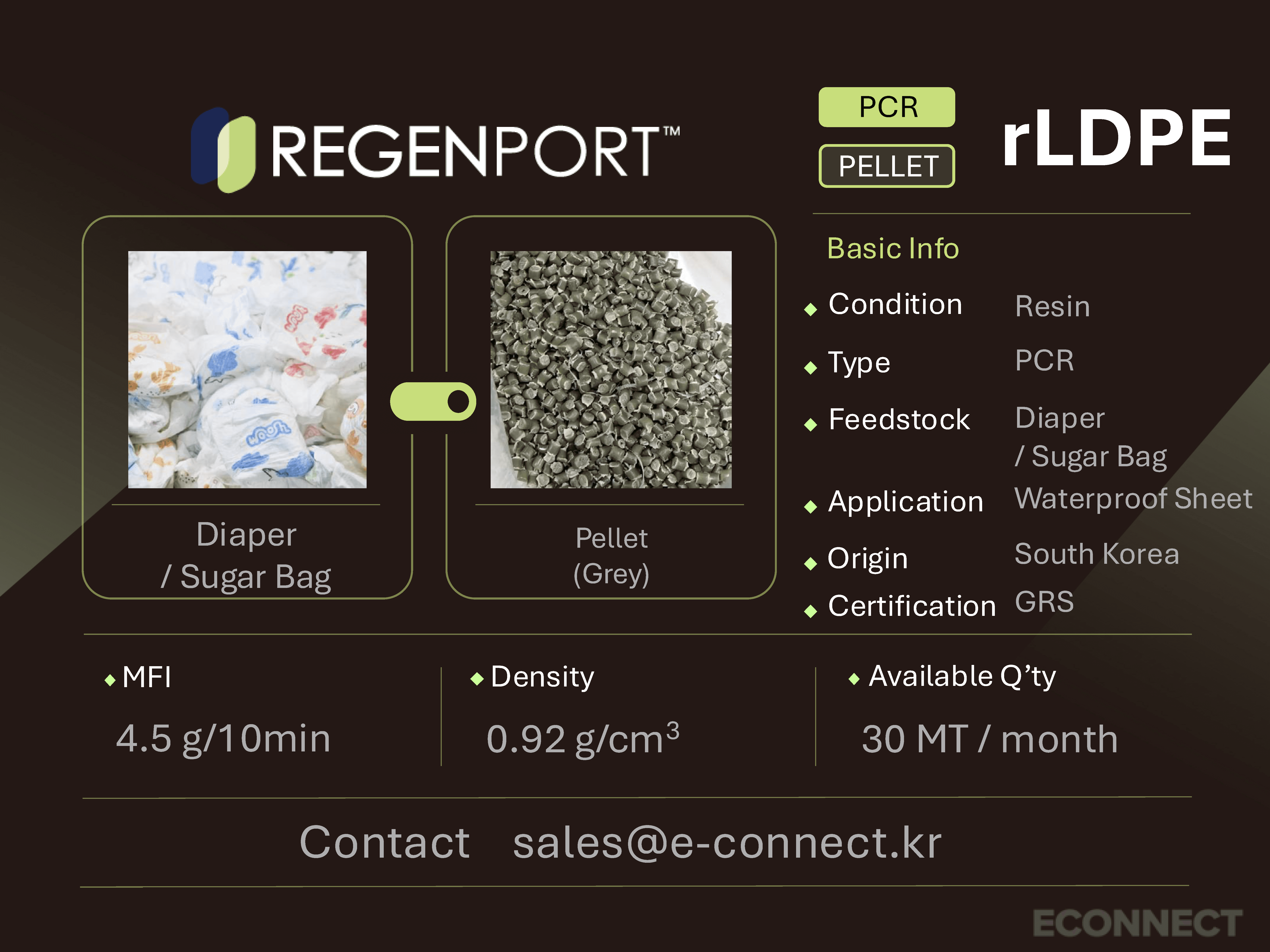
LDPE (Regenport material catalog #31) | |
|---|---|
CONDITION : Resin | TYPE : |
FEEDSTOCK : Diaper / Sugar Bag | APPLICATION : |
MFI : | DENSITY : |
Supply from South Korea and GRS Documentation
GRS is listed for this grade. It is a third-party standard covering recycled content, chain of custody, and associated social, environmental, and chemical criteria, issued as a Scope Certificate for a certified site and product scope and a Transaction Certificate for a specific shipment.
Construction uses that paperwork differently than consumer goods do. Recycled content in a building product is often declared through the project — a tender requirement, a green building credit, or an Environmental Product Declaration (EPD) — and each route asks for the percentage claimed and the evidence behind it. A GRS entry on a spec sheet establishes that the supply chain is certified; the percentage a converter can declare for a finished sheet depends on the certified input share in that sheet and the certificates covering the purchased volume.
The listing shows a monthly quantity of 30 MT from South Korea. Availability moves with collection volume, production yield, existing contracted quantities, and shipping lead time, so allocation against a given specification and delivery schedule is set at contracting.
A Practical PCR Option to Evaluate for Waterproof Sheet Extrusion
This grade is a grey post-consumer rLDPE pellet listed at MFI 4.5 g/10 min and 0.92 g/cm³, GRS certified, with 30 MT available per month and waterproof sheet as its listed application. A film-derived input routed into a non-visible construction layer, with documented recycled content behind it, is what makes it worth a review for sheet and membrane extruders working recycled content into their input mix.
Sample quantities may be available for trial. Share your line configuration and target sheet thickness, and we will confirm current lot data, filtration and ash figures, and lead time.

Frequently Asked Questions
Can post-consumer recycled LDPE be used in a waterproof sheet? It can be evaluated for that use, and this grade lists waterproof sheet as its application. Whether a given lot suits a specific membrane depends on gel and unmelt levels, filtration, residual non-PE content, and the mechanical and weathering targets the finished sheet is specified against.
What does a sugar bag and diaper feedstock mean for the pellet? Both are multi-material constructions in which the polyethylene sits alongside something else — paper plies, ink, and adhesive in a sugar bag; polypropylene nonwoven, superabsorbent polymer, and hot-melt adhesive around the PE backsheet film in a diaper. The purity of the pellet therefore depends on the recycler's separation, washing, and melt-filtration steps, which is why ash, moisture, and a filtration report are worth requesting.
Is this grade PCR or PIR? It is PCR. The input is sugar bag and diaper material collected after end use, not converting trim or production offcuts diverted before reaching a user, which is what separates post-consumer from post-industrial material under ISO 14021.
Is this grey rLDPE grade GRS certified? GRS is listed for this grade on the current spec sheet. GRS operates through a Scope Certificate covering a site and product scope and a Transaction Certificate covering a specific shipment, so a recycled-content claim rests on both the SC's scope and validity and a TC issued for the purchased volume.
How does it behave under UV exposure? That is not established by the listed data. A recycled PE carries a stabilizer history from its previous life that is not visible in MFI or density, so UV and thermal ageing are assessed against the intended service condition — buried, ballasted, or exposed — and against the additive package the converter adds.
How much is available per month? The listing shows 30 MT per month from South Korea. Actual allocation depends on collection volume, yield, existing commitments, and order timing.
Most recycled polyethylene grades are described by a single recovered product. This Regenport grade is listed against two: sugar bags and diapers — a flexible packaging stream and an absorbent-hygiene stream, the polyethylene in the second one coming from the backsheet film — both reprocessed into grey pellets certified to the Global Recycled Standard (GRS). The listed application sits well away from where the feedstock came from — waterproof sheet, a construction product.
The listing reports a melt flow index (MFI) of 4.5 g/10 min and a density of 0.92 g/cm³, which places the grade in the LDPE range normally converted by film and sheet extrusion. The grey color is consistent with a mixed input reprocessed without decoloring, and both figures are read against the specific line, thickness, and test conditions the material would run on.
Processing Performance and Application Potential
For a sheet whose function is to stop water, discrete defects matter as much as average properties. A pinhole, an unmelted particle, or a gel at a fold line can open a leak path in a membrane that meets its nominal tensile and elongation targets, so gel count, unmelt content, and the recycler's melt-filtration mesh belong in the data set alongside MFI.
That is where a two-stream feedstock needs attention. Sugar bags can arrive with paper plies, printing ink, and adhesive; diaper-derived material comes from a construction that combines PE backsheet with polypropylene nonwoven, superabsorbent polymer, and hot-melt adhesive. How completely the non-PE fractions are separated, and what residue remains after washing, is set by the recycler's process rather than by the feedstock description — so ash content, moisture, and a filtration report are worth requesting with the sample.
The grade is classified as post-consumer recycled (PCR), meaning the input is material collected after end use rather than converting trim or production offcuts diverted before it reached a user. That distinction carries weight where a program counts post-consumer content separately from post-industrial content, which several recycled-content requirements and green building schemes do.
Service conditions add one more check. A waterproof sheet may be buried, ballasted, or exposed, so UV and thermal exposure over the intended service life are evaluated against the grade's residual stabilizer content and the additive package the converter adds.
Material Data
LDPE (Regenport material catalog #31) | |
|---|---|
CONDITION : Resin | TYPE : |
FEEDSTOCK : Diaper / Sugar Bag | APPLICATION : |
MFI : | DENSITY : |
Supply from South Korea and GRS Documentation
GRS is listed for this grade. It is a third-party standard covering recycled content, chain of custody, and associated social, environmental, and chemical criteria, issued as a Scope Certificate for a certified site and product scope and a Transaction Certificate for a specific shipment.
Construction uses that paperwork differently than consumer goods do. Recycled content in a building product is often declared through the project — a tender requirement, a green building credit, or an Environmental Product Declaration (EPD) — and each route asks for the percentage claimed and the evidence behind it. A GRS entry on a spec sheet establishes that the supply chain is certified; the percentage a converter can declare for a finished sheet depends on the certified input share in that sheet and the certificates covering the purchased volume.
The listing shows a monthly quantity of 30 MT from South Korea. Availability moves with collection volume, production yield, existing contracted quantities, and shipping lead time, so allocation against a given specification and delivery schedule is set at contracting.
A Practical PCR Option to Evaluate for Waterproof Sheet Extrusion
This grade is a grey post-consumer rLDPE pellet listed at MFI 4.5 g/10 min and 0.92 g/cm³, GRS certified, with 30 MT available per month and waterproof sheet as its listed application. A film-derived input routed into a non-visible construction layer, with documented recycled content behind it, is what makes it worth a review for sheet and membrane extruders working recycled content into their input mix.
Sample quantities may be available for trial. Share your line configuration and target sheet thickness, and we will confirm current lot data, filtration and ash figures, and lead time.
Frequently Asked Questions
Can post-consumer recycled LDPE be used in a waterproof sheet? It can be evaluated for that use, and this grade lists waterproof sheet as its application. Whether a given lot suits a specific membrane depends on gel and unmelt levels, filtration, residual non-PE content, and the mechanical and weathering targets the finished sheet is specified against.
What does a sugar bag and diaper feedstock mean for the pellet? Both are multi-material constructions in which the polyethylene sits alongside something else — paper plies, ink, and adhesive in a sugar bag; polypropylene nonwoven, superabsorbent polymer, and hot-melt adhesive around the PE backsheet film in a diaper. The purity of the pellet therefore depends on the recycler's separation, washing, and melt-filtration steps, which is why ash, moisture, and a filtration report are worth requesting.
Is this grade PCR or PIR? It is PCR. The input is sugar bag and diaper material collected after end use, not converting trim or production offcuts diverted before reaching a user, which is what separates post-consumer from post-industrial material under ISO 14021.
Is this grey rLDPE grade GRS certified? GRS is listed for this grade on the current spec sheet. GRS operates through a Scope Certificate covering a site and product scope and a Transaction Certificate covering a specific shipment, so a recycled-content claim rests on both the SC's scope and validity and a TC issued for the purchased volume.
How does it behave under UV exposure? That is not established by the listed data. A recycled PE carries a stabilizer history from its previous life that is not visible in MFI or density, so UV and thermal ageing are assessed against the intended service condition — buried, ballasted, or exposed — and against the additive package the converter adds.
How much is available per month? The listing shows 30 MT per month from South Korea. Actual allocation depends on collection volume, yield, existing commitments, and order timing.
Grey rLDPE
Grey rLDPE
Looking for samples or ready to source? Submit your request for pricing, availability, and technical information.
Looking for samples or ready to source? Submit your request for pricing, availability, and technical information.
Request a Quote →
Request a Quote →
Posted by REGENPORT
REGENPORT is a global platform connecting buyers and suppliers in the recycled materials and sustainable packaging industries.