CATEGORY
CATEGORY
Regulation
Regulation
Regulation
ASEAN's Plastic EPR Rules Are Converging in 2026: What Harmonization Would Mean for Recycled-Content Buyers
ASEAN's Plastic EPR Rules Are Converging in 2026: What Harmonization Would Mean for Recycled-Content Buyers
ASEAN's Plastic EPR Rules Are Converging in 2026: What Harmonization Would Mean for Recycled-Content Buyers

ASEAN's ten member states sit in three EPR tiers (Vietnam/Philippines mandatory, four transitioning, four early-stage), with regional harmonization talks now underway. First non-EU/US Regulation post in the series.
Extended Producer Responsibility (EPR) — the principle that producers bear responsibility for a product's waste, including packaging, after consumer use — is not new to ASEAN. What changed in the past two years is the direction of travel: from country-by-country pilots toward an explicit, if still early, push for regional alignment. For buyers sourcing recycled plastic from or into Southeast Asia, the practical question is less "which country has a rule" and more "which countries are converging, and on what."
Where the Ten ASEAN Member States Actually Stand
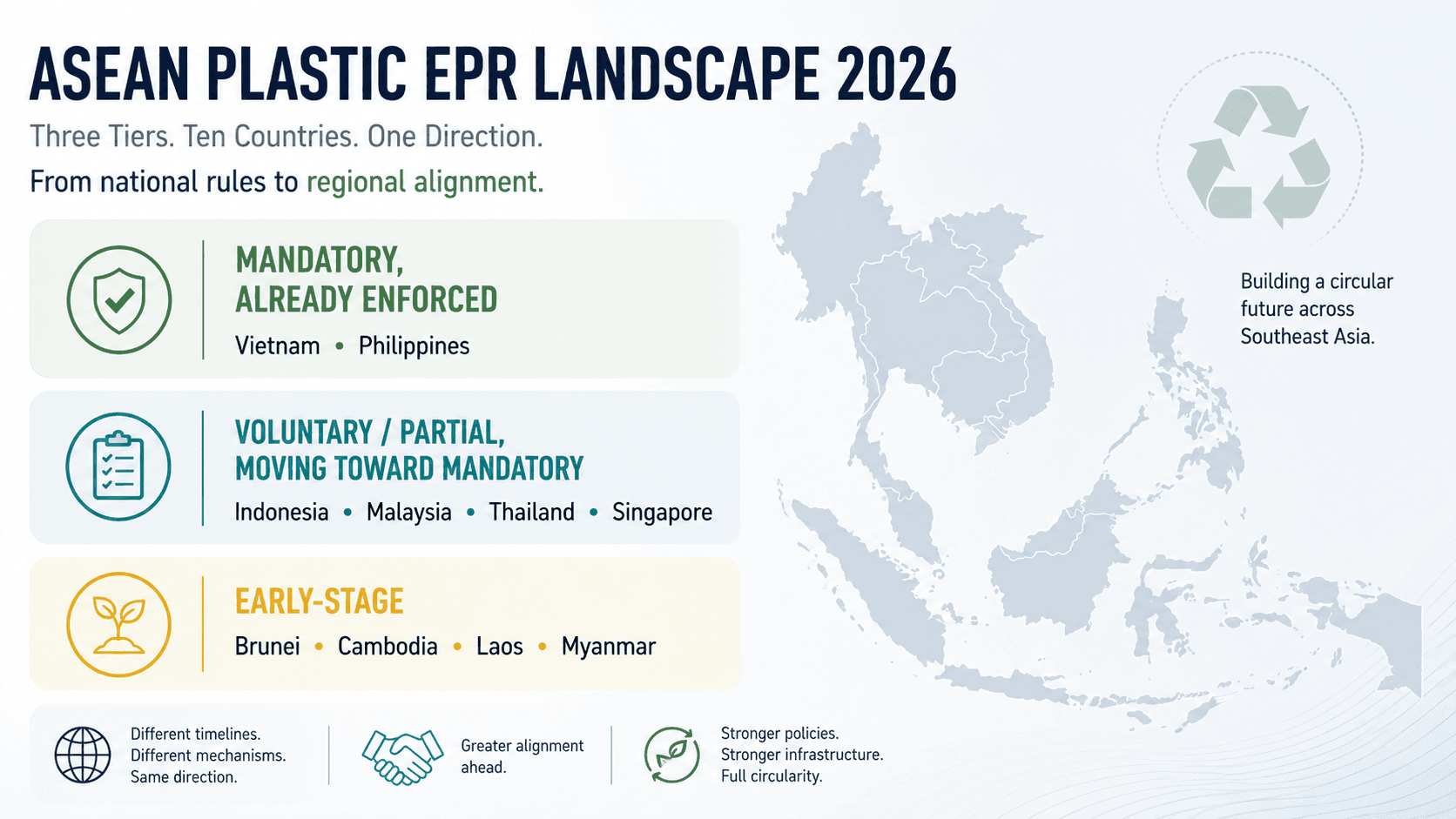
The ten ASEAN member states fall into three rough tiers, drawn from Packaging Insights' December 2025 reporting (citing WEF Global Plastic Action Partnership commentary) and cross-checked against country-specific coverage:
Tier | Countries | Where things stand |
|---|---|---|
Mandatory, already enforced | Vietnam, Philippines | Vietnam's Decree 110/2026/NĐ-CP (effective 25 May 2026) sets recycling-rate targets by packaging type — e.g. 22% for rigid PET, 15% for rigid HDPE/LDPE/PP/PS — met by recycling directly or paying a per-kg fee (Fs) into the Environment Protection Fund. The Philippines' RA 11898 sets a recovery-rate schedule rising from 20% (2023) to 80% (2028+); it reported 55.98% in 2025 against that year's 50% target. |
Voluntary/partial, moving toward mandatory | Indonesia, Malaysia, Thailand, Singapore | Each is moving on its own track: Indonesia's voluntary roadmap (since 2019) was aimed at becoming mandatory around mid-2026, and as of August 2026 the regulation was reported to be in near-final ministerial form; Malaysia opens a voluntary phase in 2026 ahead of mandatory status by 2030; Thailand's voluntary PRO-Thailand Network precedes legislation, for which industry summaries have cited a roughly 2027 target; Singapore's mandatory beverage-container deposit scheme starts 1 April 2026, but its broader packaging EPR stays reporting-based. |
Early-stage | Brunei, Cambodia, Laos, Myanmar | Still building policy foundations and piloting early approaches — no mandatory packaging EPR yet. |
This tier breakdown, and the country-level figures in it, are compiled from Packaging Insights' reporting and from ANTARA News, Enviliance ASIA, ChemLinked Sustainability and Packaging-Gateway's country-specific coverage (named inline where each fact appears; see Sources). What follows — what this tiering means for a recycled-content buyer, and why financing is part of the story — is Regenport's own reading, not a claim made by any of those outlets.
The Regional Push, and Why Financing Is Part of It
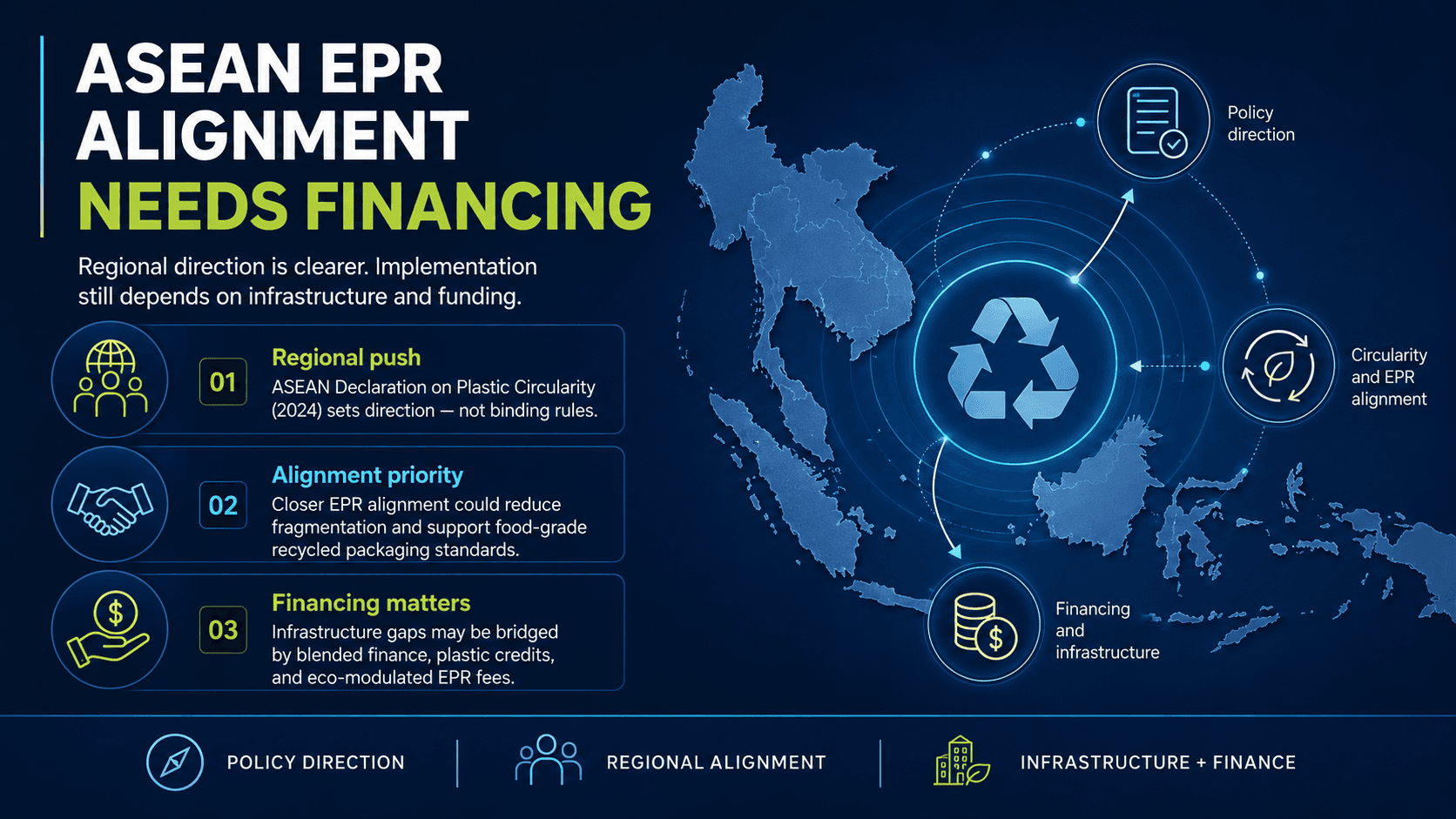
None of this tiering was designed by a single authority. The only region-wide document is the ASEAN Declaration on Plastic Circularity, adopted 9 October 2024 at the 44th/45th ASEAN Summits in Vientiane — a statement of principles (circular design, reuse and refill, non-plastic substitutes, better waste management, public-private collaboration), not a binding rule. It sets no EPR mandate, recycled-content percentage, or technical standard; those stay with each member state, which is exactly why the tiers above still exist a year on. What has moved since is the conversation about aligning the details — WEF GPAP's Liviana Zorzi has argued that closer EPR alignment would cut regulatory fragmentation and simplify multi-country compliance, and has flagged food-grade recycled-packaging standards specifically as a cooperation priority, though no concrete technical criteria have surfaced yet.
A regulatory target only moves material if collection and sorting infrastructure exists to hit it, and that's the other half of the story: reporting cited an infrastructure gap running into the billions of dollars across five NPAP-tracked countries (Cambodia, Indonesia, Laos, the Philippines, Vietnam), to be closed through mechanisms like blended finance, outcome-linked financing, plastic credits, and eco-modulated EPR fees. None of that is a legal requirement in itself, but it is a reasonable proxy for how fast the mandatory tier can realistically expand — worth tracking alongside the legal text rather than instead of it.
What This Means for Recycled-Content Buyers
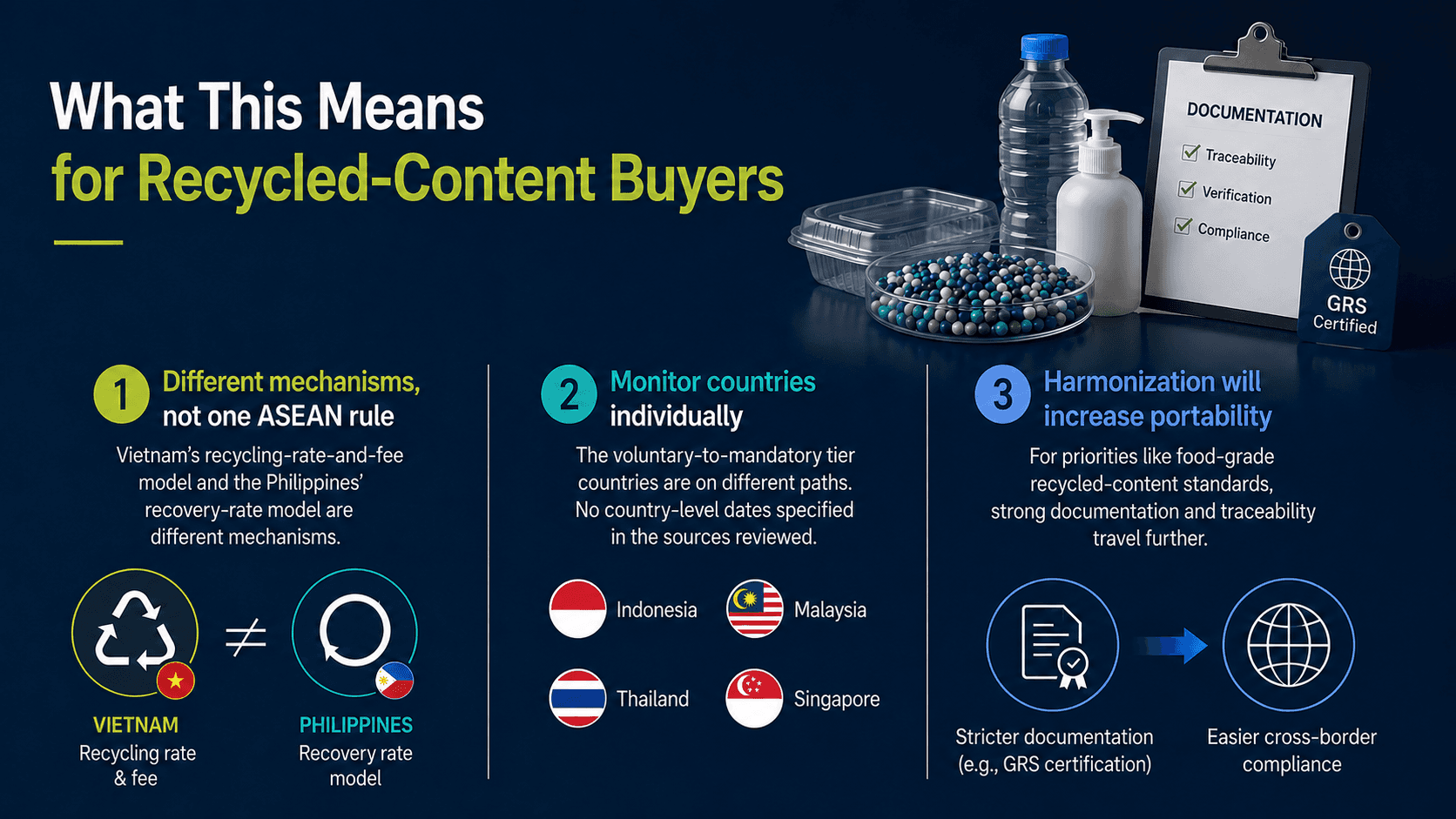
For a buyer sourcing recycled plastic in or through Southeast Asia, three things are worth separating. First, "ASEAN regulation" is not one thing yet — Vietnam's recycling-rate-and-fee model and the Philippines' recovery-rate model are different mechanisms, and a compliance approach built for one will not automatically satisfy the other. Second, the four countries in the voluntary-to-mandatory tier are worth monitoring individually rather than assuming a single regional timeline, since the sources reviewed here did not specify country-level dates. Third, where harmonization does progress — particularly on food-grade recycled-content standards, which several sources flagged as a cooperation priority — documentation and traceability that already meet a stricter regime (GRS chain-of-custody certification, for example) are likely to translate more easily across borders than documentation built for a single country's current rule. Buyers evaluating suppliers across multiple ASEAN markets may want to weight that portability alongside price and specification.

Key Dates to Track
As of August 2026:
2019 — Indonesia's voluntary EPR roadmap established under Ministry of Environment and Forestry Regulation No. 75/2019.
2022 — Philippines Extended Producer Responsibility Act (Republic Act No. 11898) enacted, setting a recovery-rate schedule rising from 20% (2023) to 80% (2028 and beyond).
9 October 2024 — ASEAN Declaration on Plastic Circularity adopted at the 44th/45th ASEAN Summits, Vientiane, Lao PDR.
2025 — Philippines reports a 55.98% national plastic waste diversion rate, above that year's 50% target.
Targeted for mid-2026 — Indonesia's Ministry of Environment and Forestry has said it aims to finalize a mandatory EPR regulation, moving beyond the 2019 voluntary roadmap.
2026 — Malaysia's KPKT has said an EPR regulation for packaging materials is in its final drafting stage, with a voluntary compliance period opening in 2026 ahead of a mandatory phase reported for 2030.
1 April 2026 — Singapore's mandatory Beverage Container Return Scheme (BCRS) for beverage containers takes effect; Singapore's broader packaging EPR remains a separate, reporting-based framework.
25 May 2026 — Vietnam's Decree 110/2026/NĐ-CP takes effect.
Vietnam's decree also sets an annual declaration-and-payment cycle for producers. This post does not cite specific calendar dates for that cycle: they were not confirmed in the primary sources reviewed, so readers with Vietnam compliance obligations should confirm current deadlines against the decree text or official guidance rather than rely on a secondary date here.
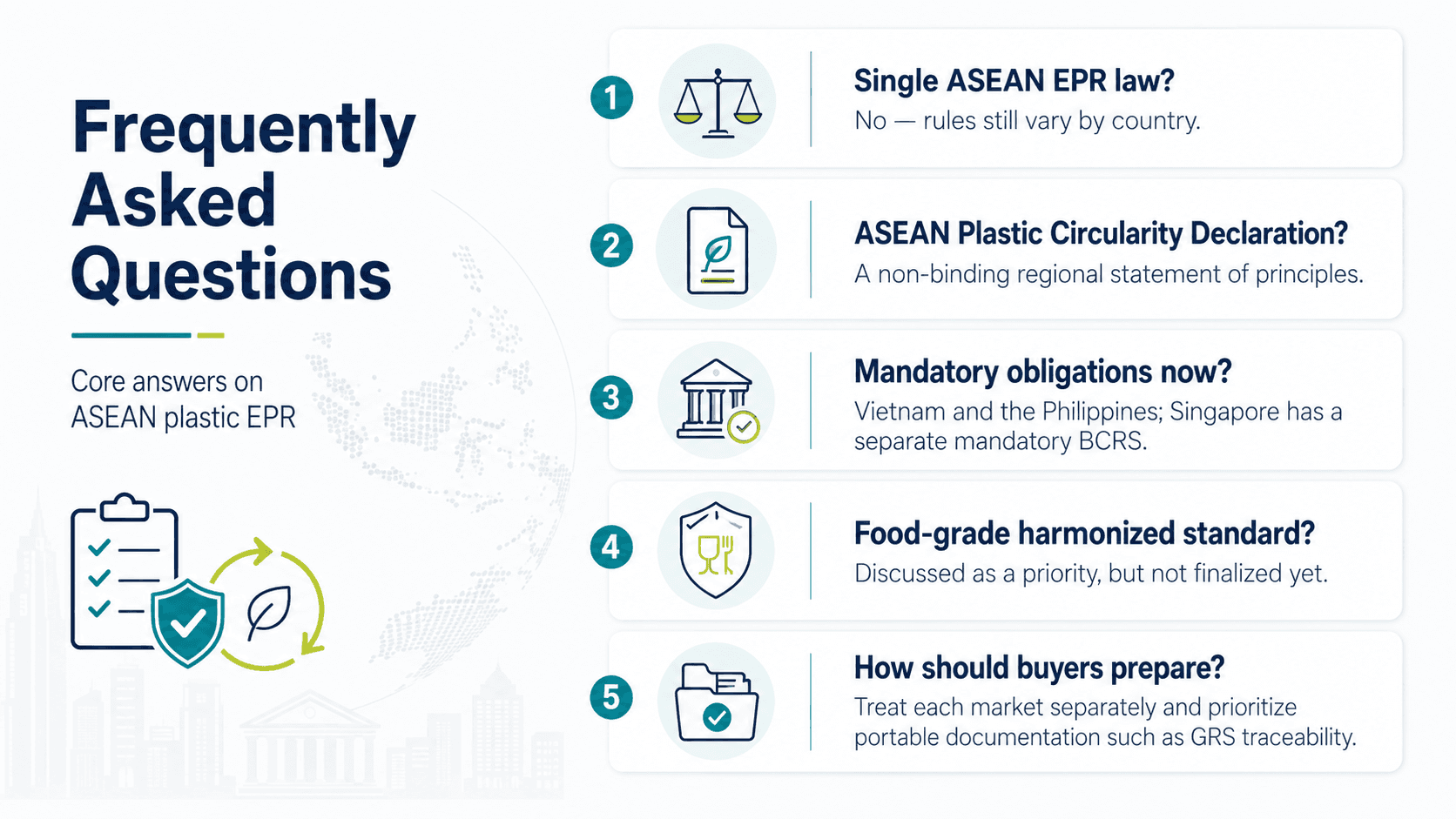
Frequently Asked Questions
Does ASEAN have a single, unified EPR law for plastic packaging? No — the ten member states currently sit in three tiers: Vietnam and the Philippines mandatory, Indonesia/Malaysia/Thailand/Singapore transitioning, Brunei/Cambodia/Laos/Myanmar still early-stage.
What is the ASEAN Declaration on Plastic Circularity? A non-binding statement of principles adopted 9 October 2024 (circular design, reuse, waste management, cooperation) — it does not itself set EPR mandates, recycled-content percentages, or technical standards.
Which ASEAN countries already have mandatory recycled-content or recovery obligations? Vietnam sets recycling-rate targets by packaging type under Decree 110/2026/NĐ-CP; the Philippines' RA 11898 sets a schedule rising from 20% (2023) to 80% (2028), exceeded in 2025 at 55.98%; and Singapore's beverage-container deposit scheme becomes mandatory on 1 April 2026, separate from its broader packaging EPR framework.
Is a harmonized food-grade recycled-content standard coming to ASEAN? It has been flagged as a cooperation priority, but no finalized standard or effective date has surfaced yet — confirm current country-specific requirements for food-contact applications.
How should buyers sourcing across multiple ASEAN markets prepare? Treat each country's current rule as distinct, and prioritize documentation (such as GRS chain-of-custody certification) that travels across borders rather than being built for a single country's rule.
About This Guide
This guide is current as of August 2026 and is provided for general information only. It is not legal advice. Country-level EPR requirements, deadlines and enforcement vary and can change; confirm current obligations with qualified local counsel before relying on them.
Image generated with ChatGPT
Sources
Sichong Wang, Packaging Insights, "ASEAN advances harmonized packaging EPR as mandatory systems and circular investment scale" (16 December 2025) → Read the Source
ASEAN, "ASEAN Declaration on Plastic Circularity" (9 October 2024) → Read the Source
Extended Producer Responsibility (EPR) — the principle that producers bear responsibility for a product's waste, including packaging, after consumer use — is not new to ASEAN. What changed in the past two years is the direction of travel: from country-by-country pilots toward an explicit, if still early, push for regional alignment. For buyers sourcing recycled plastic from or into Southeast Asia, the practical question is less "which country has a rule" and more "which countries are converging, and on what."
Where the Ten ASEAN Member States Actually Stand
The ten ASEAN member states fall into three rough tiers, drawn from Packaging Insights' December 2025 reporting (citing WEF Global Plastic Action Partnership commentary) and cross-checked against country-specific coverage:
Tier | Countries | Where things stand |
|---|---|---|
Mandatory, already enforced | Vietnam, Philippines | Vietnam's Decree 110/2026/NĐ-CP (effective 25 May 2026) sets recycling-rate targets by packaging type — e.g. 22% for rigid PET, 15% for rigid HDPE/LDPE/PP/PS — met by recycling directly or paying a per-kg fee (Fs) into the Environment Protection Fund. The Philippines' RA 11898 sets a recovery-rate schedule rising from 20% (2023) to 80% (2028+); it reported 55.98% in 2025 against that year's 50% target. |
Voluntary/partial, moving toward mandatory | Indonesia, Malaysia, Thailand, Singapore | Each is moving on its own track: Indonesia's voluntary roadmap (since 2019) was aimed at becoming mandatory around mid-2026, and as of August 2026 the regulation was reported to be in near-final ministerial form; Malaysia opens a voluntary phase in 2026 ahead of mandatory status by 2030; Thailand's voluntary PRO-Thailand Network precedes legislation, for which industry summaries have cited a roughly 2027 target; Singapore's mandatory beverage-container deposit scheme starts 1 April 2026, but its broader packaging EPR stays reporting-based. |
Early-stage | Brunei, Cambodia, Laos, Myanmar | Still building policy foundations and piloting early approaches — no mandatory packaging EPR yet. |
This tier breakdown, and the country-level figures in it, are compiled from Packaging Insights' reporting and from ANTARA News, Enviliance ASIA, ChemLinked Sustainability and Packaging-Gateway's country-specific coverage (named inline where each fact appears; see Sources). What follows — what this tiering means for a recycled-content buyer, and why financing is part of the story — is Regenport's own reading, not a claim made by any of those outlets.
The Regional Push, and Why Financing Is Part of It
None of this tiering was designed by a single authority. The only region-wide document is the ASEAN Declaration on Plastic Circularity, adopted 9 October 2024 at the 44th/45th ASEAN Summits in Vientiane — a statement of principles (circular design, reuse and refill, non-plastic substitutes, better waste management, public-private collaboration), not a binding rule. It sets no EPR mandate, recycled-content percentage, or technical standard; those stay with each member state, which is exactly why the tiers above still exist a year on. What has moved since is the conversation about aligning the details — WEF GPAP's Liviana Zorzi has argued that closer EPR alignment would cut regulatory fragmentation and simplify multi-country compliance, and has flagged food-grade recycled-packaging standards specifically as a cooperation priority, though no concrete technical criteria have surfaced yet.
A regulatory target only moves material if collection and sorting infrastructure exists to hit it, and that's the other half of the story: reporting cited an infrastructure gap running into the billions of dollars across five NPAP-tracked countries (Cambodia, Indonesia, Laos, the Philippines, Vietnam), to be closed through mechanisms like blended finance, outcome-linked financing, plastic credits, and eco-modulated EPR fees. None of that is a legal requirement in itself, but it is a reasonable proxy for how fast the mandatory tier can realistically expand — worth tracking alongside the legal text rather than instead of it.
What This Means for Recycled-Content Buyers
For a buyer sourcing recycled plastic in or through Southeast Asia, three things are worth separating. First, "ASEAN regulation" is not one thing yet — Vietnam's recycling-rate-and-fee model and the Philippines' recovery-rate model are different mechanisms, and a compliance approach built for one will not automatically satisfy the other. Second, the four countries in the voluntary-to-mandatory tier are worth monitoring individually rather than assuming a single regional timeline, since the sources reviewed here did not specify country-level dates. Third, where harmonization does progress — particularly on food-grade recycled-content standards, which several sources flagged as a cooperation priority — documentation and traceability that already meet a stricter regime (GRS chain-of-custody certification, for example) are likely to translate more easily across borders than documentation built for a single country's current rule. Buyers evaluating suppliers across multiple ASEAN markets may want to weight that portability alongside price and specification.
Key Dates to Track
As of August 2026:
2019 — Indonesia's voluntary EPR roadmap established under Ministry of Environment and Forestry Regulation No. 75/2019.
2022 — Philippines Extended Producer Responsibility Act (Republic Act No. 11898) enacted, setting a recovery-rate schedule rising from 20% (2023) to 80% (2028 and beyond).
9 October 2024 — ASEAN Declaration on Plastic Circularity adopted at the 44th/45th ASEAN Summits, Vientiane, Lao PDR.
2025 — Philippines reports a 55.98% national plastic waste diversion rate, above that year's 50% target.
Targeted for mid-2026 — Indonesia's Ministry of Environment and Forestry has said it aims to finalize a mandatory EPR regulation, moving beyond the 2019 voluntary roadmap.
2026 — Malaysia's KPKT has said an EPR regulation for packaging materials is in its final drafting stage, with a voluntary compliance period opening in 2026 ahead of a mandatory phase reported for 2030.
1 April 2026 — Singapore's mandatory Beverage Container Return Scheme (BCRS) for beverage containers takes effect; Singapore's broader packaging EPR remains a separate, reporting-based framework.
25 May 2026 — Vietnam's Decree 110/2026/NĐ-CP takes effect.
Vietnam's decree also sets an annual declaration-and-payment cycle for producers. This post does not cite specific calendar dates for that cycle: they were not confirmed in the primary sources reviewed, so readers with Vietnam compliance obligations should confirm current deadlines against the decree text or official guidance rather than rely on a secondary date here.
Frequently Asked Questions
Does ASEAN have a single, unified EPR law for plastic packaging? No — the ten member states currently sit in three tiers: Vietnam and the Philippines mandatory, Indonesia/Malaysia/Thailand/Singapore transitioning, Brunei/Cambodia/Laos/Myanmar still early-stage.
What is the ASEAN Declaration on Plastic Circularity? A non-binding statement of principles adopted 9 October 2024 (circular design, reuse, waste management, cooperation) — it does not itself set EPR mandates, recycled-content percentages, or technical standards.
Which ASEAN countries already have mandatory recycled-content or recovery obligations? Vietnam sets recycling-rate targets by packaging type under Decree 110/2026/NĐ-CP; the Philippines' RA 11898 sets a schedule rising from 20% (2023) to 80% (2028), exceeded in 2025 at 55.98%; and Singapore's beverage-container deposit scheme becomes mandatory on 1 April 2026, separate from its broader packaging EPR framework.
Is a harmonized food-grade recycled-content standard coming to ASEAN? It has been flagged as a cooperation priority, but no finalized standard or effective date has surfaced yet — confirm current country-specific requirements for food-contact applications.
How should buyers sourcing across multiple ASEAN markets prepare? Treat each country's current rule as distinct, and prioritize documentation (such as GRS chain-of-custody certification) that travels across borders rather than being built for a single country's rule.
About This Guide
This guide is current as of August 2026 and is provided for general information only. It is not legal advice. Country-level EPR requirements, deadlines and enforcement vary and can change; confirm current obligations with qualified local counsel before relying on them.
Image generated with ChatGPT
Sources
Sichong Wang, Packaging Insights, "ASEAN advances harmonized packaging EPR as mandatory systems and circular investment scale" (16 December 2025) → Read the Source
ASEAN, "ASEAN Declaration on Plastic Circularity" (9 October 2024) → Read the Source
Sourcing for ASEAN EPR
Grades • Specs • Availability
Browse rHDPE →
Sourcing for ASEAN EPR
Sourcing for ASEAN EPR
Compare rigid-feedstock rHDPE grades by properties, certification, stock and MOQ.
Compare rigid-feedstock rHDPE grades by properties, certification, stock and MOQ.
Browse rHDPE →
Browse rHDPE →
Looking for samples or ready to source? Submit your request for pricing, availability, and technical information.
Looking for samples or ready to source? Submit your request for pricing, availability, and technical information.
Request a Quote →
Request a Quote →
Posted by REGENPORT
REGENPORT is a global platform connecting buyers and suppliers in the recycled materials and sustainable packaging industries.