CATEGORY
CATEGORY
News
News
News
75% PCR Polycarbonate in 2026: Why the Percentage Isn't the Spec
75% PCR Polycarbonate in 2026: Why the Percentage Isn't the Spec
75% PCR Polycarbonate in 2026: Why the Percentage Isn't the Spec

Most recycled-content news in 2026 has been about packaging: bottles, film, trays, and the policies that govern them. A carbon fiber-reinforced polycarbonate compound announced this summer points somewhere else — at laptop housings and large structural parts, where the material has to hold a tolerance and pass a flame test, not just carry a label.
According to SABIC's press release dated June 24, 2026, its Specialties business launched LNP™ ELCRIN™ DC0051RC1, a carbon fiber-reinforced polycarbonate (PC) compound containing 75 percent post-consumer recycled (PCR) content, and describes it as its first PCR-based carbon fiber-reinforced compound. SABIC states the grade achieves UL94 V0 flame retardancy at 0.8 mm thin-wall thickness with non-chlorinated and non-brominated flame retardant chemistry, alongside high modulus, dimensional stability and low warpage, targeting consumer electronics and laptop housings.
Per Resource Recycling's August 11, 2026 reporting, that 75 percent comes from two separate recycled streams: the matrix is mechanically recycled post-consumer PC from wastewater bottles and compact discs, and the carbon fiber is recovered through pyrolysis from golf club shafts, wind turbine blades and fishing rods. Qualified suppliers collect and process the end-of-life material, and it is those raw materials that carry ISCC+ certification. The compound is produced in Shanghai, China and sold globally. The report also states that 75 percent was the maximum level SABIC reached — through material characterization, mechanical testing, processing evaluations and durability testing — while still meeting mechanical requirements and containing flame retardants.
Why an Engineering Grade Is a Different Signal
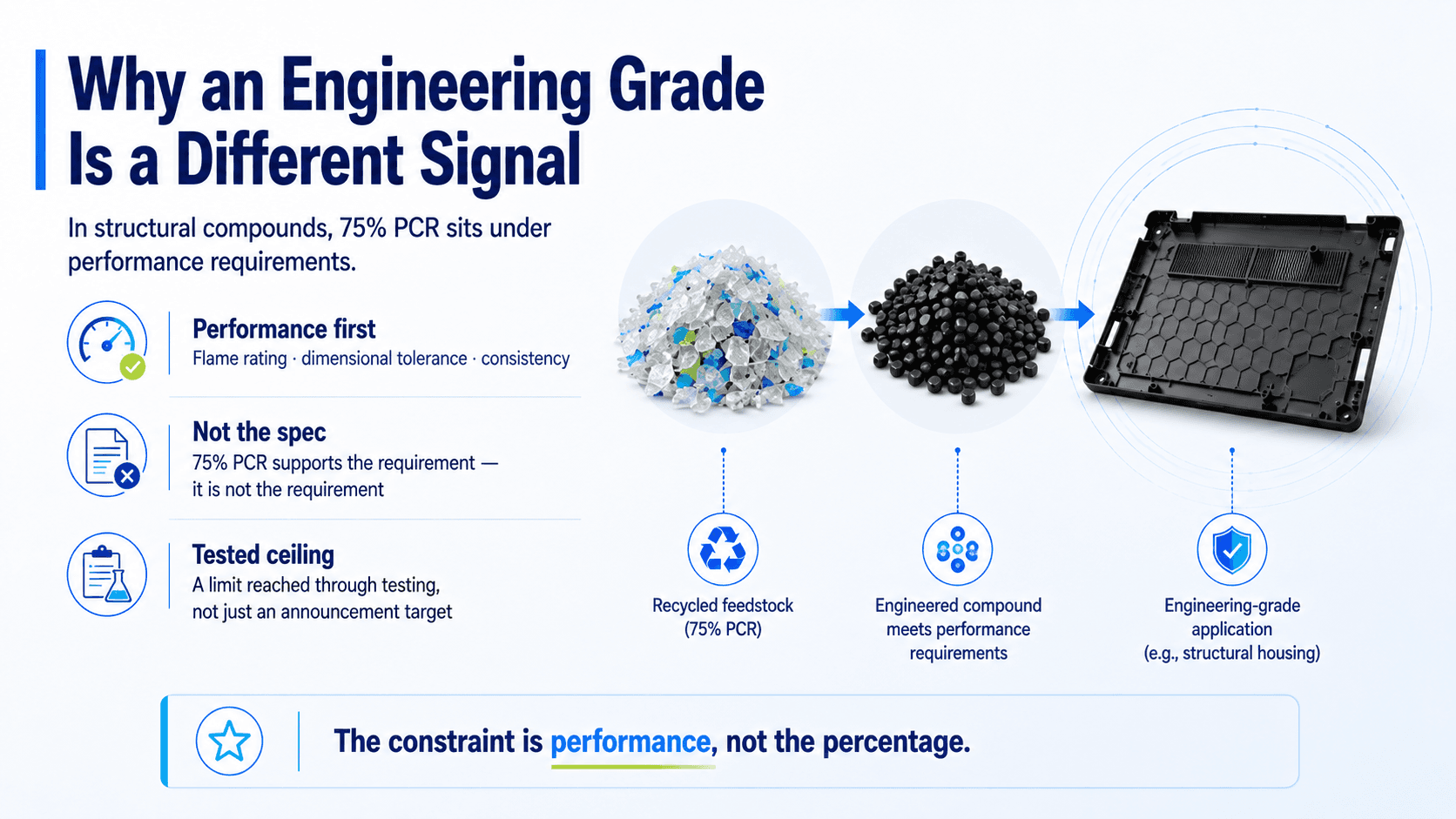
A 75 percent PCR figure means one thing in a packaging resin and another in a structural compound. Packaging is largely governed by content mandates and labeling rules, so the number itself is often the deliverable. A laptop housing has to clear a flame rating at a specified wall thickness and hold dimensional tolerance across a large molded part, batch after batch. The recycled content is not what the part is accepted against; the flame rating and the tolerance are. It has to be achieved without disturbing them. Reinforced compounds are also where feedstock variability shows up fastest, in fiber length, moisture and residual contamination.
The way the 75 percent figure is described fits that reading: a ceiling reached through testing, not a target chosen for the announcement. That says where the constraint sits, which a higher number would not.
The New Variable Is the Feedstock, Not the Formulation
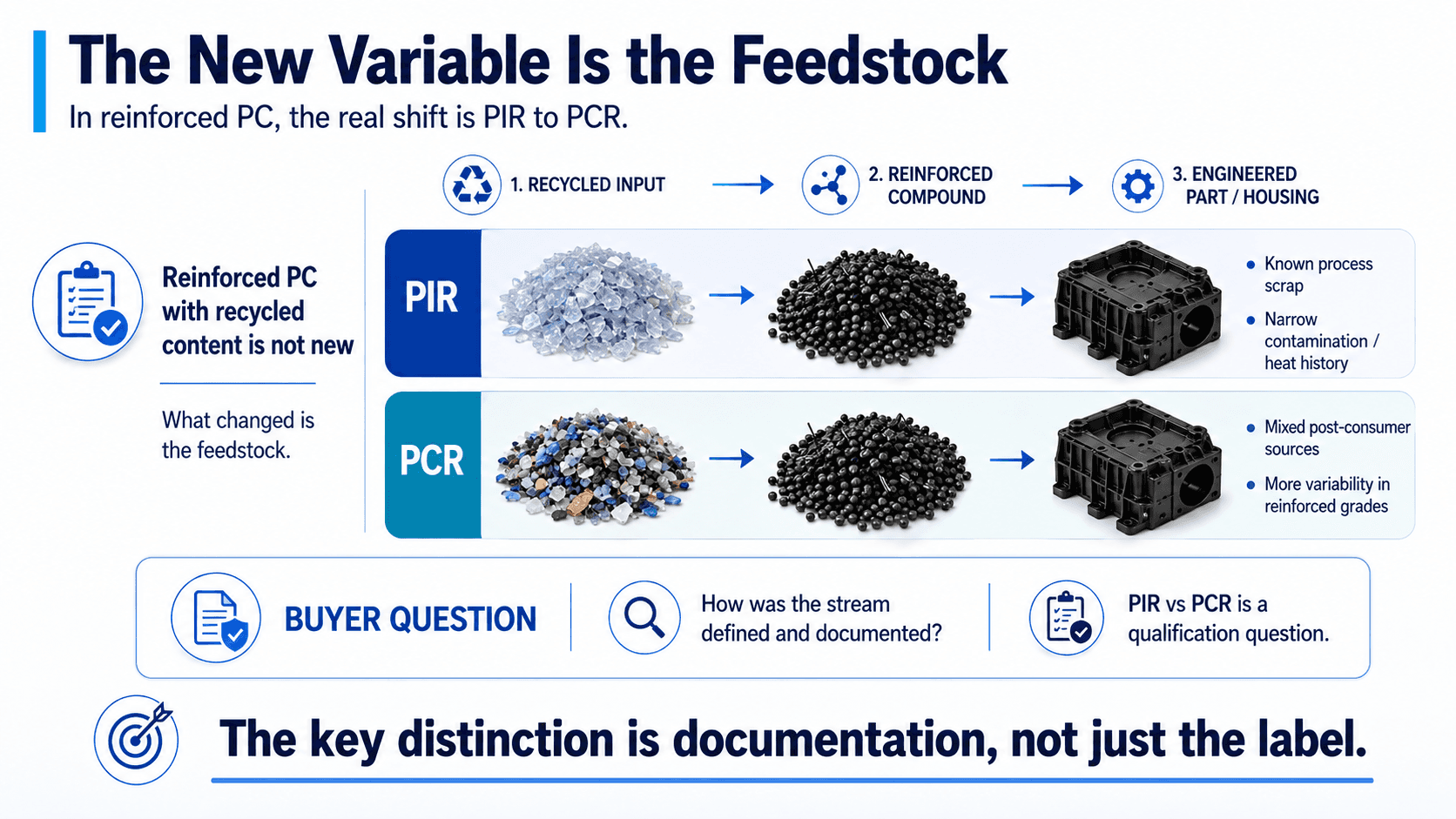
SABIC calls this its first PCR-based carbon fiber-reinforced compound, and that word is worth pausing on. Per Resource Recycling, the company already sells carbon fiber-reinforced polycarbonate built on post-industrial recycled (PIR) content — LNP™ THERMOCOMP™ DC0041PE and LNP™ ELCRIN™ DC0041RC. Reinforced PC with recycled content is not new here. Doing it on post-consumer feedstock is.
Between those two product families, the feedstock type is what changed. PIR is process scrap that never reached a consumer, so which resin came off which line is known from the start, and the range of contamination and heat history is narrow. Post-consumer material arrives from many sources at once with no record of what any individual item went through in use — and in a reinforced grade that range is what shows up in mechanical results.
The consequence for a buyer is practical. PIR content is usually framed as the cheaper alternative to PCR, with the recycled-content narrative attached to PCR. In reinforced engineering grades the more useful distinction is a documentation one: what the feedstock's prior use was, and how tightly the collection stream is defined. Which of the two suits a given part is the buyer's qualification question, not something the PIR/PCR label answers.
What to Ask For at the Specification Stage
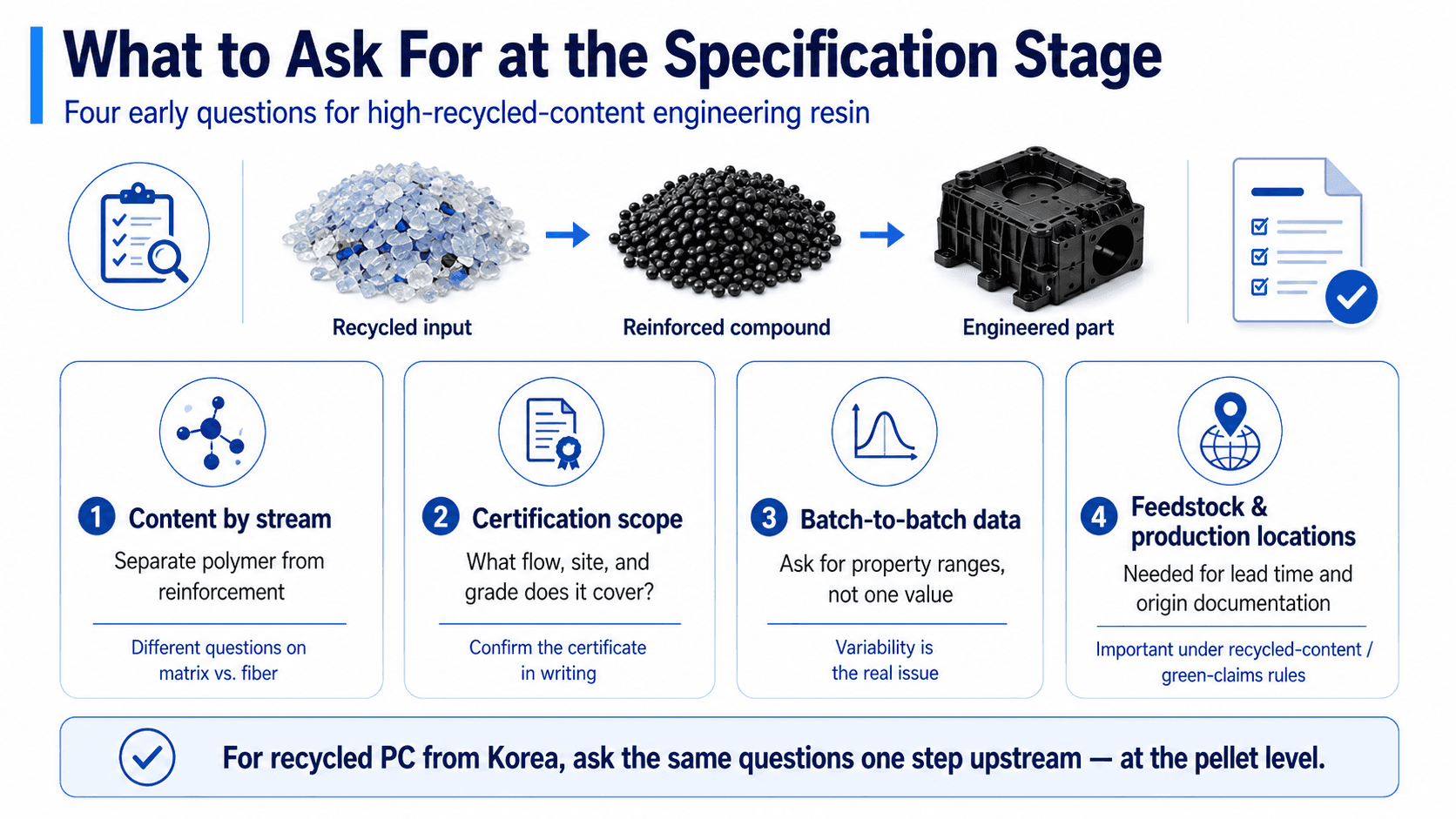
Four items are worth raising early with any supplier offering high-recycled-content engineering resin.
Content broken out by stream. A blended percentage does not distinguish polymer from reinforcement, and the two raise different questions — collection consistency, colour and yellowness index range and prior heat history on the matrix side; recovered fiber length distribution and sizing compatibility on the fiber side.
What the certification actually covers. This launch is a useful illustration: per Resource Recycling, the ISCC+ certification applies to the raw materials collected and processed by qualified suppliers, not to the finished compound as a product claim. Confirm in writing which material flow, which site and which grade a certificate names.
Batch-to-batch property data rather than a single datasheet value, since variability is the practical question in reinforced compounds.
Feedstock collection and production locations — here, multiple recovery streams feeding a compound produced in Shanghai for global sale — which matter for lead time and for origin documentation, increasingly requested under recycled-content and green-claims rules as we covered in our August 12 post on the Tracking Plastic Act.
For buyers working with recycled polycarbonate from Korea, the same questions apply one step upstream, at the pellet rather than the compound level. Our August 6 post on Blue rPC PIR pellets shows what that documentation looks like for a specific grade.
Market Takeaway
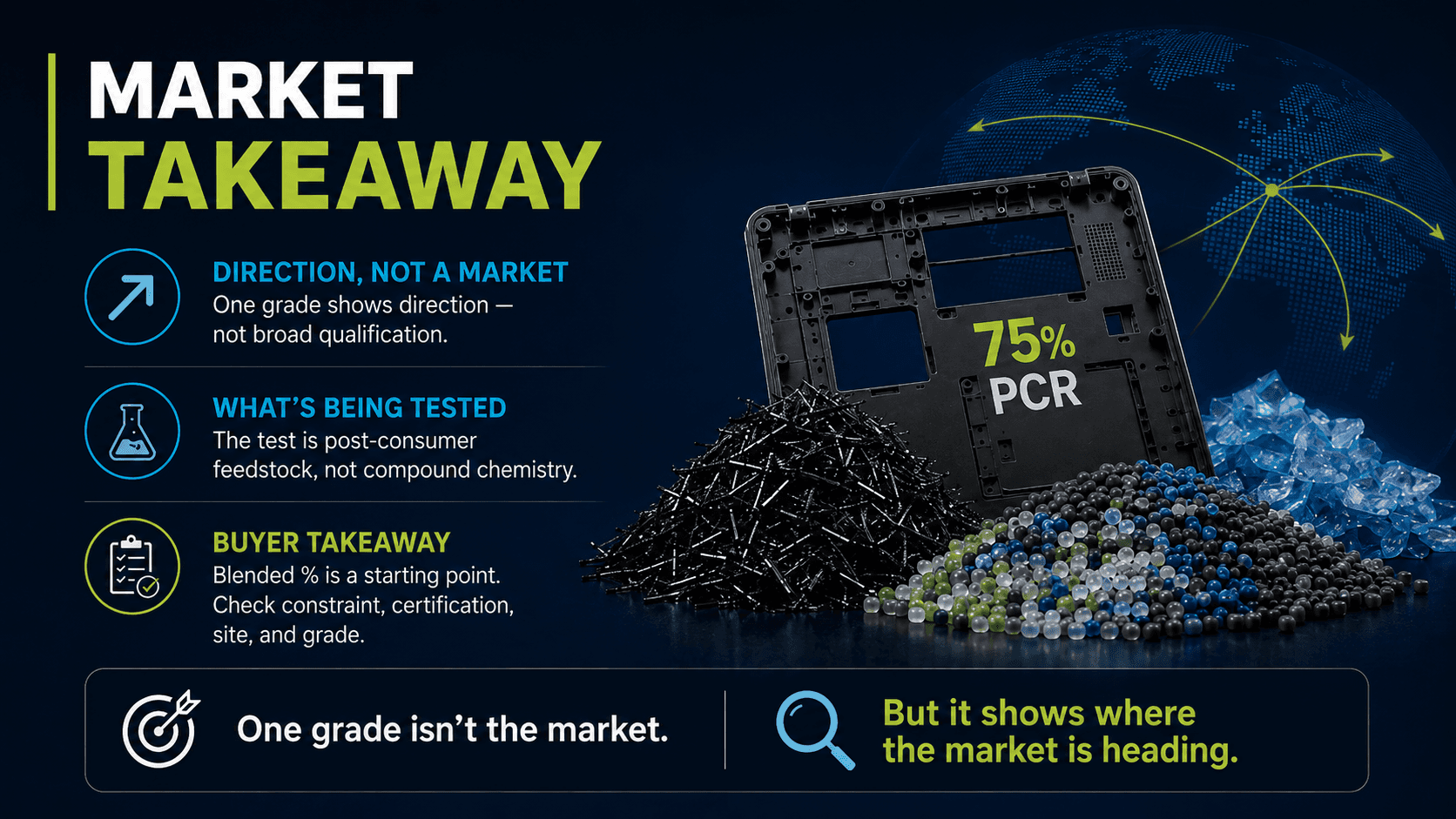
As of August 2026, this launch does not indicate that PCR content is broadly qualified for structural applications, and one grade is not a market. What it does indicate is direction: recycled content is being formulated into applications where performance is contractual, and recycled reinforcement is being drawn from waste streams — wind blades, sporting goods — that were not part of the plastics recycling conversation a few years ago. And because PIR-based reinforced grades already existed, what is being put to the test here is post-consumer feedstock rather than the compound chemistry.
For procurement teams tracking rPC and rPC/ABS, the questions asked of a recycled engineering resin need to be narrower than those asked of a recycled packaging resin: a blended percentage is a starting point rather than an answer, a stated maximum tells you where the constraint sits, and a certification is only as useful as the flow, site and grade it names. Regenport will continue monitoring how recycled content develops in engineering grades and sharing updates as the picture becomes clearer.
Frequently Asked Questions
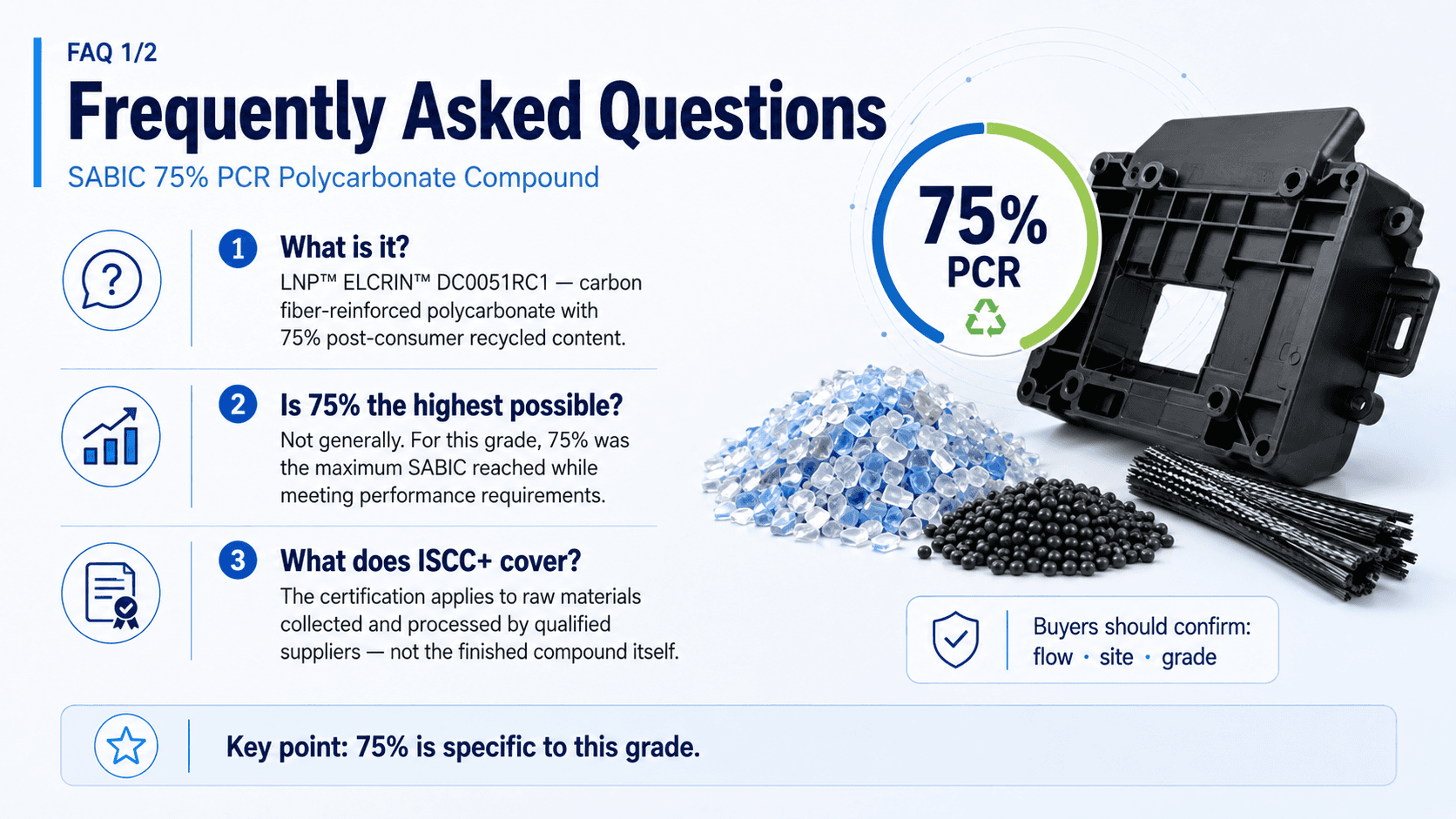
What is SABIC's 75% PCR polycarbonate compound? It is LNP™ ELCRIN™ DC0051RC1, a carbon fiber-reinforced polycarbonate compound containing 75 percent post-consumer recycled content, launched by SABIC on June 24, 2026 for consumer electronics housings and large structural components. SABIC describes it as its first PCR-based carbon fiber-reinforced compound.
Is 75% the highest recycled content possible in a reinforced polycarbonate compound? Not as a general rule. Per Resource Recycling, 75 percent was the maximum level SABIC reached for this specific compound while still meeting mechanical requirements and containing flame retardants, established through material characterization, mechanical testing, processing evaluations and durability testing.
What does ISCC+ certification cover in this case? Per Resource Recycling, the ISCC+ certification applies to the raw materials that qualified suppliers collect and process, rather than functioning as a claim about the finished compound. Buyers reviewing any ISCC+ reference should confirm which material flow, production site and grade the certificate names.
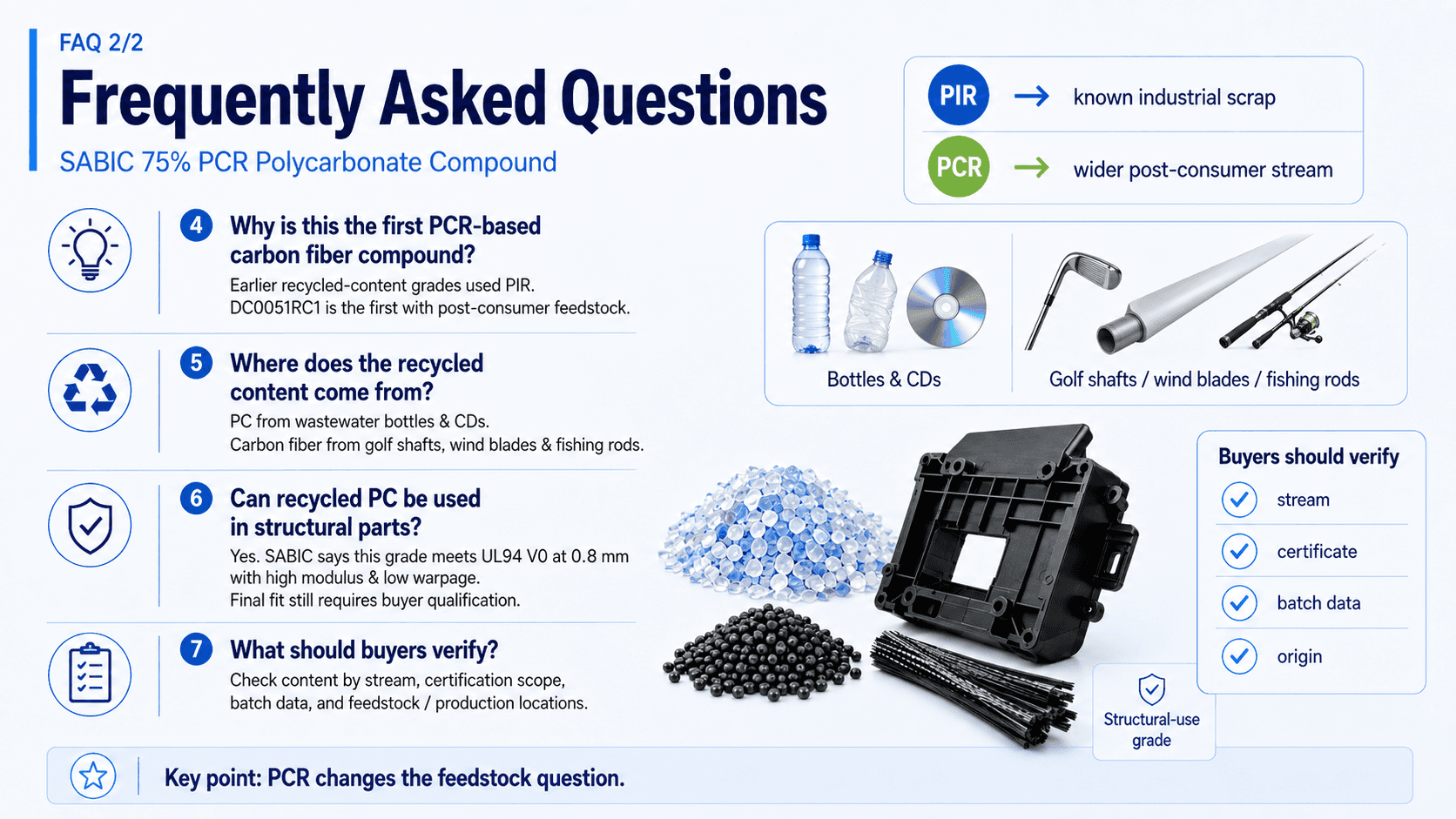
Why is this SABIC's first PCR-based carbon fiber compound when it already sells recycled-content versions? Per Resource Recycling, SABIC's existing carbon fiber-reinforced polycarbonate grades with recycled content — LNP™ THERMOCOMP™ DC0041PE and LNP™ ELCRIN™ DC0041RC — use post-industrial recycled (PIR) material. DC0051RC1 is the first to use post-consumer feedstock, which comes from a wider and less documented collection stream than industrial scrap.
Where does the recycled content in the compound come from? Per Resource Recycling's reporting, the polycarbonate is mechanically recycled post-consumer material from wastewater bottles and compact discs, while the carbon fiber is recovered through pyrolysis from golf club shafts, wind turbine blades and fishing rods.
Can recycled polycarbonate be used in structural parts? Suppliers are now offering high-PCR reinforced polycarbonate grades positioned for structural use, and SABIC states its grade meets UL94 V0 at 0.8 mm with high modulus and low warpage. Whether a given grade suits a specific part is established through the buyer's own qualification testing, not from a datasheet alone.
What should buyers verify when sourcing high-PCR engineering resin? Request the content broken out by stream (polymer versus reinforcement), the exact scope of any certification such as ISCC+ including grade and production site, batch-to-batch property data rather than a single nominal value, and feedstock collection and production locations for origin documentation.
About This Article
Information current as of August 19, 2026. This article summarizes a publicly announced product launch for general market information and is not a product endorsement, a technical recommendation, or legal advice. Product specifications, certifications and availability are those stated by the manufacturer and should be confirmed directly with the supplier before qualification.
Image generated with ChatGPT
Sources
SABIC, "SABIC launches novel PCR-based LNP™ ELCRIN™ compound with enhanced performance" → Read the Source
Resource Recycling, "Sabic launches engineered plastic with 75% PCR" → Read the Source
According to SABIC's press release dated June 24, 2026, its Specialties business launched LNP™ ELCRIN™ DC0051RC1, a carbon fiber-reinforced polycarbonate (PC) compound containing 75 percent post-consumer recycled (PCR) content, and describes it as its first PCR-based carbon fiber-reinforced compound. SABIC states the grade achieves UL94 V0 flame retardancy at 0.8 mm thin-wall thickness with non-chlorinated and non-brominated flame retardant chemistry, alongside high modulus, dimensional stability and low warpage, targeting consumer electronics and laptop housings.
Per Resource Recycling's August 11, 2026 reporting, that 75 percent comes from two separate recycled streams: the matrix is mechanically recycled post-consumer PC from wastewater bottles and compact discs, and the carbon fiber is recovered through pyrolysis from golf club shafts, wind turbine blades and fishing rods. Qualified suppliers collect and process the end-of-life material, and it is those raw materials that carry ISCC+ certification. The compound is produced in Shanghai, China and sold globally. The report also states that 75 percent was the maximum level SABIC reached — through material characterization, mechanical testing, processing evaluations and durability testing — while still meeting mechanical requirements and containing flame retardants.
Why an Engineering Grade Is a Different Signal
A 75 percent PCR figure means one thing in a packaging resin and another in a structural compound. Packaging is largely governed by content mandates and labeling rules, so the number itself is often the deliverable. A laptop housing has to clear a flame rating at a specified wall thickness and hold dimensional tolerance across a large molded part, batch after batch. The recycled content is not what the part is accepted against; the flame rating and the tolerance are. It has to be achieved without disturbing them. Reinforced compounds are also where feedstock variability shows up fastest, in fiber length, moisture and residual contamination.
The way the 75 percent figure is described fits that reading: a ceiling reached through testing, not a target chosen for the announcement. That says where the constraint sits, which a higher number would not.
The New Variable Is the Feedstock, Not the Formulation
SABIC calls this its first PCR-based carbon fiber-reinforced compound, and that word is worth pausing on. Per Resource Recycling, the company already sells carbon fiber-reinforced polycarbonate built on post-industrial recycled (PIR) content — LNP™ THERMOCOMP™ DC0041PE and LNP™ ELCRIN™ DC0041RC. Reinforced PC with recycled content is not new here. Doing it on post-consumer feedstock is.
Between those two product families, the feedstock type is what changed. PIR is process scrap that never reached a consumer, so which resin came off which line is known from the start, and the range of contamination and heat history is narrow. Post-consumer material arrives from many sources at once with no record of what any individual item went through in use — and in a reinforced grade that range is what shows up in mechanical results.
The consequence for a buyer is practical. PIR content is usually framed as the cheaper alternative to PCR, with the recycled-content narrative attached to PCR. In reinforced engineering grades the more useful distinction is a documentation one: what the feedstock's prior use was, and how tightly the collection stream is defined. Which of the two suits a given part is the buyer's qualification question, not something the PIR/PCR label answers.
What to Ask For at the Specification Stage
Four items are worth raising early with any supplier offering high-recycled-content engineering resin.
Content broken out by stream. A blended percentage does not distinguish polymer from reinforcement, and the two raise different questions — collection consistency, colour and yellowness index range and prior heat history on the matrix side; recovered fiber length distribution and sizing compatibility on the fiber side.
What the certification actually covers. This launch is a useful illustration: per Resource Recycling, the ISCC+ certification applies to the raw materials collected and processed by qualified suppliers, not to the finished compound as a product claim. Confirm in writing which material flow, which site and which grade a certificate names.
Batch-to-batch property data rather than a single datasheet value, since variability is the practical question in reinforced compounds.
Feedstock collection and production locations — here, multiple recovery streams feeding a compound produced in Shanghai for global sale — which matter for lead time and for origin documentation, increasingly requested under recycled-content and green-claims rules as we covered in our August 12 post on the Tracking Plastic Act.
For buyers working with recycled polycarbonate from Korea, the same questions apply one step upstream, at the pellet rather than the compound level. Our August 6 post on Blue rPC PIR pellets shows what that documentation looks like for a specific grade.
Market Takeaway
As of August 2026, this launch does not indicate that PCR content is broadly qualified for structural applications, and one grade is not a market. What it does indicate is direction: recycled content is being formulated into applications where performance is contractual, and recycled reinforcement is being drawn from waste streams — wind blades, sporting goods — that were not part of the plastics recycling conversation a few years ago. And because PIR-based reinforced grades already existed, what is being put to the test here is post-consumer feedstock rather than the compound chemistry.
For procurement teams tracking rPC and rPC/ABS, the questions asked of a recycled engineering resin need to be narrower than those asked of a recycled packaging resin: a blended percentage is a starting point rather than an answer, a stated maximum tells you where the constraint sits, and a certification is only as useful as the flow, site and grade it names. Regenport will continue monitoring how recycled content develops in engineering grades and sharing updates as the picture becomes clearer.
Frequently Asked Questions
What is SABIC's 75% PCR polycarbonate compound? It is LNP™ ELCRIN™ DC0051RC1, a carbon fiber-reinforced polycarbonate compound containing 75 percent post-consumer recycled content, launched by SABIC on June 24, 2026 for consumer electronics housings and large structural components. SABIC describes it as its first PCR-based carbon fiber-reinforced compound.
Is 75% the highest recycled content possible in a reinforced polycarbonate compound? Not as a general rule. Per Resource Recycling, 75 percent was the maximum level SABIC reached for this specific compound while still meeting mechanical requirements and containing flame retardants, established through material characterization, mechanical testing, processing evaluations and durability testing.
What does ISCC+ certification cover in this case? Per Resource Recycling, the ISCC+ certification applies to the raw materials that qualified suppliers collect and process, rather than functioning as a claim about the finished compound. Buyers reviewing any ISCC+ reference should confirm which material flow, production site and grade the certificate names.
Why is this SABIC's first PCR-based carbon fiber compound when it already sells recycled-content versions? Per Resource Recycling, SABIC's existing carbon fiber-reinforced polycarbonate grades with recycled content — LNP™ THERMOCOMP™ DC0041PE and LNP™ ELCRIN™ DC0041RC — use post-industrial recycled (PIR) material. DC0051RC1 is the first to use post-consumer feedstock, which comes from a wider and less documented collection stream than industrial scrap.
Where does the recycled content in the compound come from? Per Resource Recycling's reporting, the polycarbonate is mechanically recycled post-consumer material from wastewater bottles and compact discs, while the carbon fiber is recovered through pyrolysis from golf club shafts, wind turbine blades and fishing rods.
Can recycled polycarbonate be used in structural parts? Suppliers are now offering high-PCR reinforced polycarbonate grades positioned for structural use, and SABIC states its grade meets UL94 V0 at 0.8 mm with high modulus and low warpage. Whether a given grade suits a specific part is established through the buyer's own qualification testing, not from a datasheet alone.
What should buyers verify when sourcing high-PCR engineering resin? Request the content broken out by stream (polymer versus reinforcement), the exact scope of any certification such as ISCC+ including grade and production site, batch-to-batch property data rather than a single nominal value, and feedstock collection and production locations for origin documentation.
About This Article
Information current as of August 19, 2026. This article summarizes a publicly announced product launch for general market information and is not a product endorsement, a technical recommendation, or legal advice. Product specifications, certifications and availability are those stated by the manufacturer and should be confirmed directly with the supplier before qualification.
Image generated with ChatGPT
Sources
SABIC, "SABIC launches novel PCR-based LNP™ ELCRIN™ compound with enhanced performance" → Read the Source
Resource Recycling, "Sabic launches engineered plastic with 75% PCR" → Read the Source
Sourcing High-PCR rPC
Grades • Specs • Availability
Browse rPC →
Sourcing High-PCR rPC
Sourcing High-PCR rPC
Review rPC grades by feedstock, properties, stock and MOQ.
Review rPC grades by feedstock, properties, stock and MOQ.
Browse rPC →
Browse rPC →
Looking for samples or ready to source? Submit your request for pricing, availability, and technical information.
Looking for samples or ready to source? Submit your request for pricing, availability, and technical information.
Request a Quote →
Request a Quote →
Posted by REGENPORT
REGENPORT is a global platform connecting buyers and suppliers in the recycled materials and sustainable packaging industries.