CATEGORY
CATEGORY
Our Materials
Our Materials
Our Materials
From Logistics Pallets to Household Parts: GRS-Certified Grey rPP PCR Pellet
From Logistics Pallets to Household Parts: GRS-Certified Grey rPP PCR Pellet
From Logistics Pallets to Household Parts: GRS-Certified Grey rPP PCR Pellet

Grey rPP PCR pellet from recovered pallet waste — MFI 7.5 g/10 min, density 0.9 g/cm³, GRS certified, listed availability 30 MT/month from South Korea, offered for evaluation in household product and injection applications.
Recycled polypropylene is usually described by where it ends up. This Regenport grade is worth reading from the other direction — by where it starts. The listed feedstock is pallet waste, supplied as grey pellets and certified to the Global Recycled Standard (GRS), while the listed application sits on the consumer side, in household products and general injection molding.
An industrial setting does not by itself make this a post-industrial (PIR) grade. Under ISO 14021, the line runs by who last used the product rather than where it was used: material discarded by commercial, industrial, and institutional facilities acting as end users is post-consumer, while post-industrial covers material diverted from a manufacturing process before it reaches an end user. A pallet recovered after it has served its purpose in logistics falls on the post-consumer side; scrap or unused reject units from pallet manufacturing would not. The grade is listed as PCR on the spec sheet, and confirming the input is end-of-service pallets rather than production scrap is what puts that classification on record.
Processing Performance and Application Potential
The listing reports a melt flow index (MFI) of 7.5 g/10 min and a density of 0.9 g/cm³. Household product molding spans thin-wall housewares through thicker functional parts, so that figure is read against a specific part's wall thickness and cycle target — and against the test temperature, load, and standard it was measured under.
A pallet-based feedstock allows the collection scope to be drawn around a narrower product group than mixed household waste. What that scope delivers depends on the resin mix across pallet manufacturers, how labels, metal fittings, and other non-polymer parts are removed, and the recycler's sorting and washing criteria — so lot-to-lot consistency comes from the supplier's control limits and test data, not from the feedstock description.
Two material questions follow. Filler: pallet PP may be unfilled or carry talc or another mineral filler depending on design and manufacturer, and the current spec sheet lists neither filler nor ash content. The two are separate measurements — an ash figure gives total inorganic residue, while pinning down filler type and loading can take further analysis. Use history: PP that has been through service and reprocessing can differ from virgin PP at the same nominal MFI in impact strength, stiffness, elongation, and color stability, depending on heat and UV exposure, washing conditions, and the stabilizer package.
Consumer-facing parts add checks industrial parts do not. The grade is listed as grey, so color consistency against the intended finish and odor on a molded sample both belong in the trial. Food contact is not established by the data above and needs separate compliance documentation.
Material Data
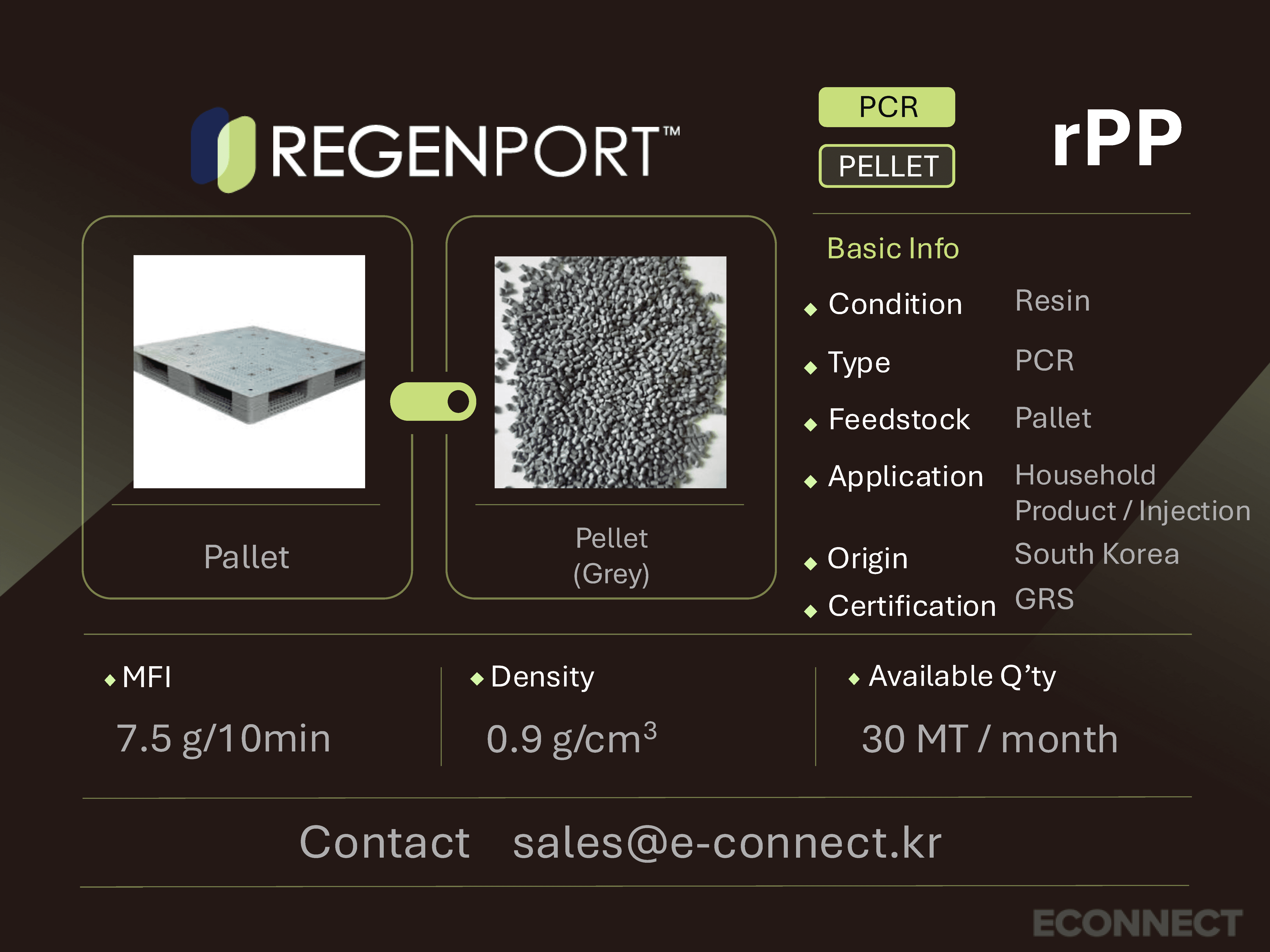
rPP (Regenport material catalog #44) | |
|---|---|
CONDITION : | TYPE : |
FEEDSTOCK : | APPLICATION : |
MFI : | DENSITY : |
Supply from South Korea and GRS Documentation
GRS is listed for this grade. It is a third-party standard covering recycled content, chain of custody, and associated social, environmental, and chemical criteria, and it runs on two documents worth keeping separate. A Scope Certificate (SC) shows that a given site and product scope meet GRS requirements; a Transaction Certificate (TC) confirms that a specific shipment moved through that certified supply chain. A GRS entry on a spec sheet does not on its own mean every lot ships with a TC.
For a household product brand reporting recycled content to a customer, a retailer program, or a regulatory requirement, that distinction is what separates a claim that holds from one that does not — so a GRS-based claim on this grade rests on the SC's scope and validity plus a TC issued for the purchased volume.
The listing shows a monthly quantity of 30 MT from South Korea. Availability moves with collection volume, production yield, existing contracted quantities, and shipping lead time, so allocation against a given specification and delivery schedule is set at contracting.
A Practical PCR Option to Evaluate for Household Injection Molding
This grade is a grey post-consumer rPP pellet listed at MFI 7.5 g/10 min and 0.9 g/cm³, GRS certified, with 30 MT available per month and household product and injection listed as its applications. A focused collection stream and documented recycled content are what make it worth a review for housewares and general injection molders working recycled content into their input mix.
Sample quantities may be available for trial. Share your part geometry and target mechanical properties, and we will confirm current lot data, filler content, and lead time.
Frequently Asked Questions
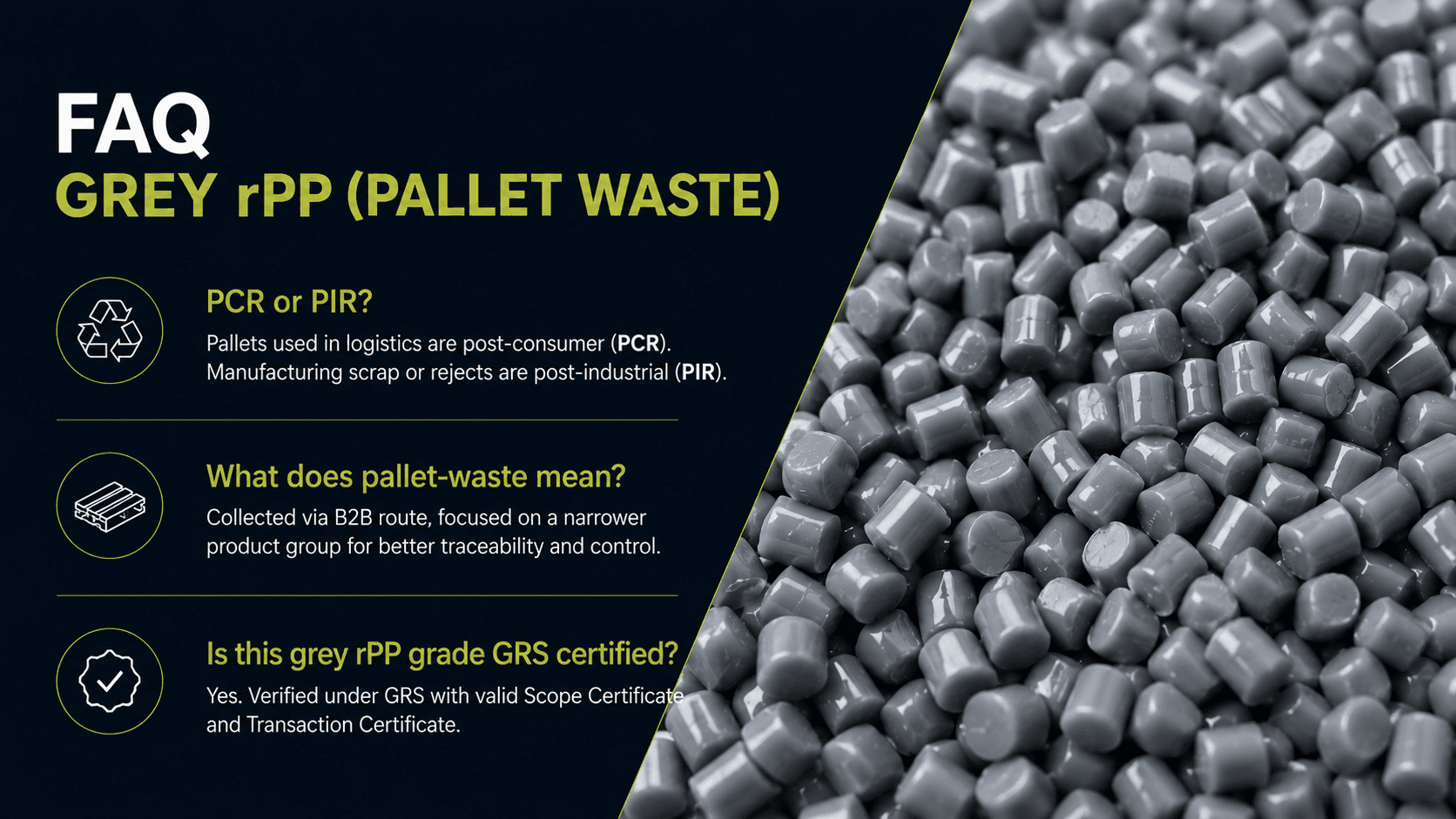
Is pallet waste PCR or PIR? Pallets recovered after they have served their purpose in logistics are post-consumer (PCR): under ISO 14021, post-consumer material includes material generated by commercial, industrial, and institutional facilities in their role as end users of a product that can no longer be used for its intended purpose. Scrap or unused reject units from pallet manufacturing are post-industrial (PIR) instead, so the classification rests on which of the two the input actually is.
What does a pallet-waste feedstock mean for a household product? It means the input arrives through a business-to-business collection route, which allows the collection scope to be drawn around a narrower product group than mixed household waste. Lot-to-lot consistency still depends on the resin mix across pallet manufacturers, contamination control, and the recycler's sorting criteria.
Is this grey rPP grade GRS certified? GRS is listed for this grade on the current spec sheet. GRS operates through a Scope Certificate covering a site and product scope and a Transaction Certificate covering a specific shipment, so a recycled-content claim rests on both the SC's scope and validity and a TC issued for the purchased volume.
Recycled polypropylene is usually described by where it ends up. This Regenport grade is worth reading from the other direction — by where it starts. The listed feedstock is pallet waste, supplied as grey pellets and certified to the Global Recycled Standard (GRS), while the listed application sits on the consumer side, in household products and general injection molding.
An industrial setting does not by itself make this a post-industrial (PIR) grade. Under ISO 14021, the line runs by who last used the product rather than where it was used: material discarded by commercial, industrial, and institutional facilities acting as end users is post-consumer, while post-industrial covers material diverted from a manufacturing process before it reaches an end user. A pallet recovered after it has served its purpose in logistics falls on the post-consumer side; scrap or unused reject units from pallet manufacturing would not. The grade is listed as PCR on the spec sheet, and confirming the input is end-of-service pallets rather than production scrap is what puts that classification on record.
Processing Performance and Application Potential
The listing reports a melt flow index (MFI) of 7.5 g/10 min and a density of 0.9 g/cm³. Household product molding spans thin-wall housewares through thicker functional parts, so that figure is read against a specific part's wall thickness and cycle target — and against the test temperature, load, and standard it was measured under.
A pallet-based feedstock allows the collection scope to be drawn around a narrower product group than mixed household waste. What that scope delivers depends on the resin mix across pallet manufacturers, how labels, metal fittings, and other non-polymer parts are removed, and the recycler's sorting and washing criteria — so lot-to-lot consistency comes from the supplier's control limits and test data, not from the feedstock description.
Two material questions follow. Filler: pallet PP may be unfilled or carry talc or another mineral filler depending on design and manufacturer, and the current spec sheet lists neither filler nor ash content. The two are separate measurements — an ash figure gives total inorganic residue, while pinning down filler type and loading can take further analysis. Use history: PP that has been through service and reprocessing can differ from virgin PP at the same nominal MFI in impact strength, stiffness, elongation, and color stability, depending on heat and UV exposure, washing conditions, and the stabilizer package.
Consumer-facing parts add checks industrial parts do not. The grade is listed as grey, so color consistency against the intended finish and odor on a molded sample both belong in the trial. Food contact is not established by the data above and needs separate compliance documentation.
Material Data
rPP (Regenport material catalog #44) | |
|---|---|
CONDITION : | TYPE : |
FEEDSTOCK : | APPLICATION : |
MFI : | DENSITY : |
Supply from South Korea and GRS Documentation
GRS is listed for this grade. It is a third-party standard covering recycled content, chain of custody, and associated social, environmental, and chemical criteria, and it runs on two documents worth keeping separate. A Scope Certificate (SC) shows that a given site and product scope meet GRS requirements; a Transaction Certificate (TC) confirms that a specific shipment moved through that certified supply chain. A GRS entry on a spec sheet does not on its own mean every lot ships with a TC.
For a household product brand reporting recycled content to a customer, a retailer program, or a regulatory requirement, that distinction is what separates a claim that holds from one that does not — so a GRS-based claim on this grade rests on the SC's scope and validity plus a TC issued for the purchased volume.
The listing shows a monthly quantity of 30 MT from South Korea. Availability moves with collection volume, production yield, existing contracted quantities, and shipping lead time, so allocation against a given specification and delivery schedule is set at contracting.
A Practical PCR Option to Evaluate for Household Injection Molding
This grade is a grey post-consumer rPP pellet listed at MFI 7.5 g/10 min and 0.9 g/cm³, GRS certified, with 30 MT available per month and household product and injection listed as its applications. A focused collection stream and documented recycled content are what make it worth a review for housewares and general injection molders working recycled content into their input mix.
Sample quantities may be available for trial. Share your part geometry and target mechanical properties, and we will confirm current lot data, filler content, and lead time.
Frequently Asked Questions
Is pallet waste PCR or PIR? Pallets recovered after they have served their purpose in logistics are post-consumer (PCR): under ISO 14021, post-consumer material includes material generated by commercial, industrial, and institutional facilities in their role as end users of a product that can no longer be used for its intended purpose. Scrap or unused reject units from pallet manufacturing are post-industrial (PIR) instead, so the classification rests on which of the two the input actually is.
What does a pallet-waste feedstock mean for a household product? It means the input arrives through a business-to-business collection route, which allows the collection scope to be drawn around a narrower product group than mixed household waste. Lot-to-lot consistency still depends on the resin mix across pallet manufacturers, contamination control, and the recycler's sorting criteria.
Is this grey rPP grade GRS certified? GRS is listed for this grade on the current spec sheet. GRS operates through a Scope Certificate covering a site and product scope and a Transaction Certificate covering a specific shipment, so a recycled-content claim rests on both the SC's scope and validity and a TC issued for the purchased volume.
Grey rPP
Grey rPP
Looking for samples or ready to source? Submit your request for pricing, availability, and technical information.
Looking for samples or ready to source? Submit your request for pricing, availability, and technical information.
Request a Quote →
Request a Quote →
Posted by REGENPORT
REGENPORT is a global platform connecting buyers and suppliers in the recycled materials and sustainable packaging industries.