CATEGORY
CATEGORY
Trend
Trend
Trend
Brazil's rPET Prices Climb a Second Week as European Drought Squeezes PP – Week 3, August 2026
Brazil's rPET Prices Climb a Second Week as European Drought Squeezes PP – Week 3, August 2026
Brazil's rPET Prices Climb a Second Week as European Drought Squeezes PP – Week 3, August 2026

Recycled polymer prices were mostly flat this week, except in Brazil, where rPET bales and flakes rose for a second week. US and Mexican grades were flat to slightly lower, while Europe’s drought disrupted both plant cooling and Rhine barge capacity.
The week of August 12, 2026 looked quiet on price screens across most recycled grades, but the few places that moved are worth separating from the noise. Brazil's rPET market extended its rebound into a second week, while US clear flake and food-grade pellet prices were flat to marginally softer. In Europe, record-low river levels became a supply-side constraint on polypropylene rather than only a freight problem — an important distinction, because production constraints tend to persist longer than logistics ones. Demand across the chain stayed weak, which is the backdrop against which both stories should be read.
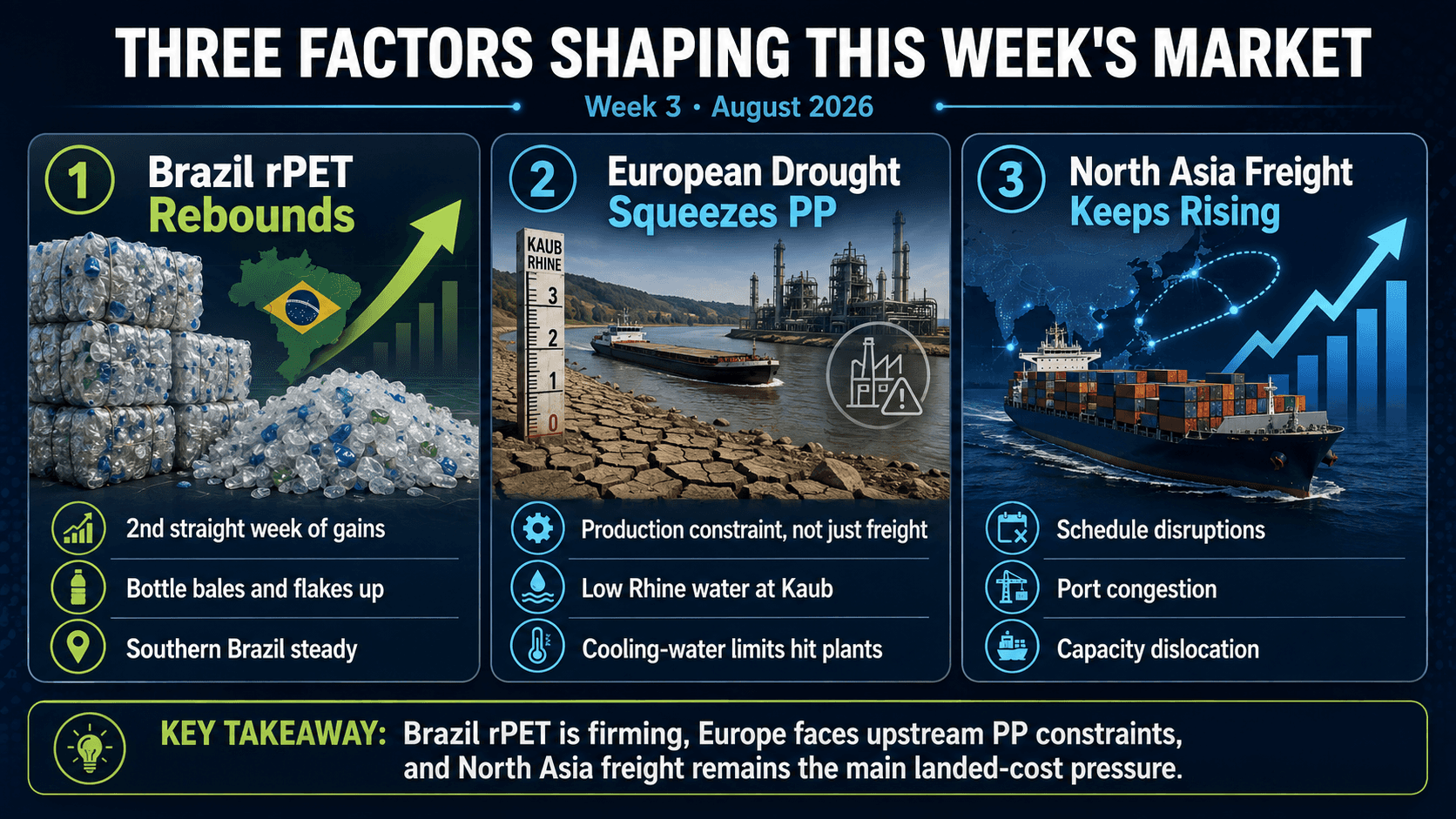
Three Factors Shaping This Week's Market
1. Brazil's rPET rebound extended to a second week Clear and green bottle bales rose in Brazil, with flakes following the same direction, while southern Brazil pricing held steady. Two consecutive weeks of gains in a market that has otherwise been flat is a change in direction, though not yet a confirmed trend. Regional feedstock availability is the variable to watch here, since bale-led moves usually signal collection or supply-side tightness before they show up in flake and pellet quotes.
2. European drought became a production constraint, not just a freight one Continued drought conditions cut water-cooling capacity at Northwest European polymerization plants and restricted Rhine barge transport in the same week. The gauge reading at Kaub, the Rhine's shallowest navigable point, fell to its lowest since records began in 1880. The gauge is a reference level for navigation rather than the depth of the water itself, so the practical effect is a sharp cut in how much each barge can carry rather than a closed river. Site-level effects have followed, with force majeure declared at chemical plants in the region — so far in polyurethane feedstock rather than polyolefins. Some polypropylene producers turned to alternative freight to meet delivery commitments, which raises landed cost even where volumes are met.
3. Freight from North Asia kept rising Container rates out of North Asia continued to climb, attributed to ongoing schedule disruptions, port congestion and capacity dislocation. Carriers have kept pushing rates higher against that backdrop. For buyers importing from Asia, the freight line has been moving more than the resin line for several weeks now.
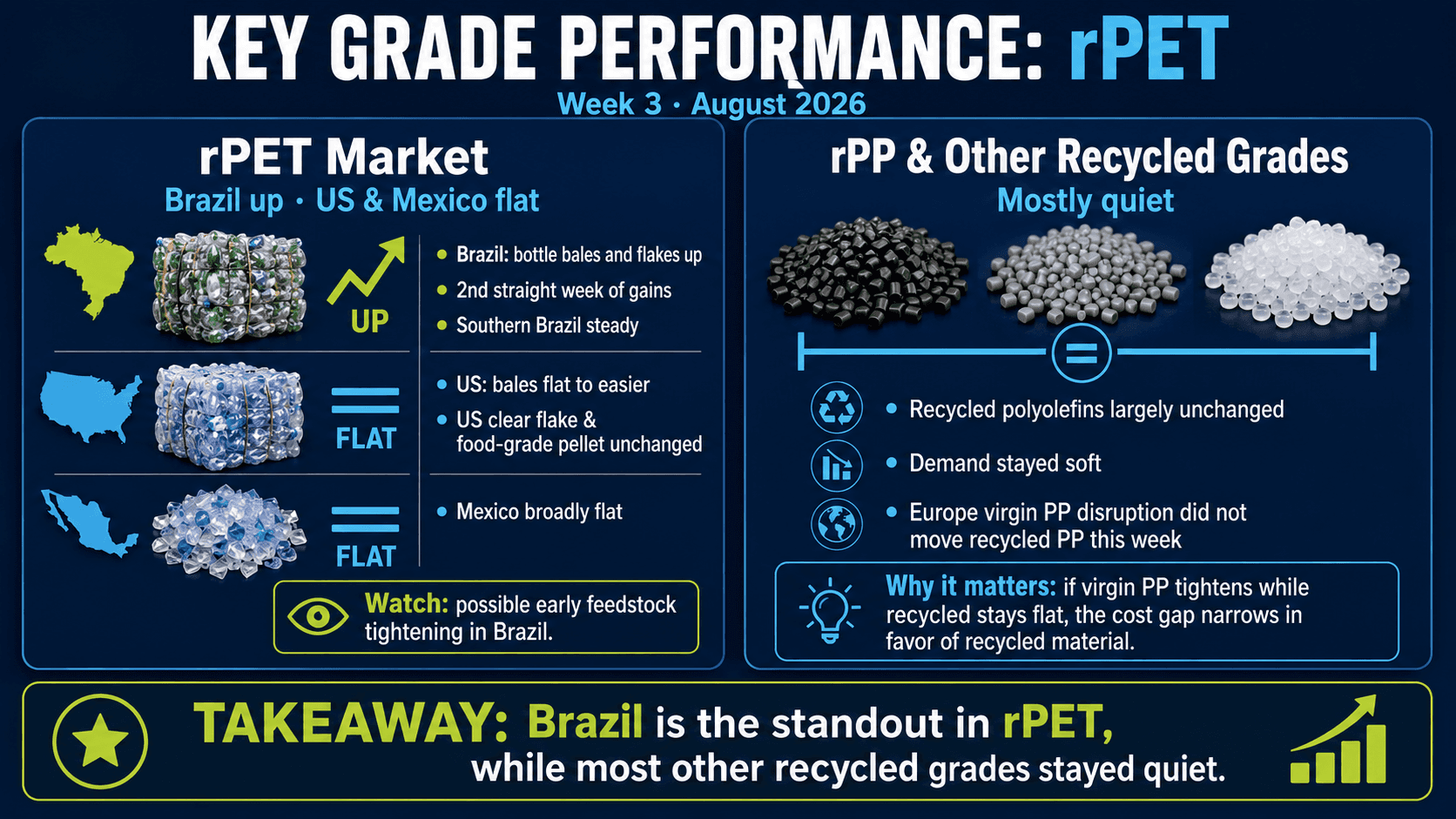
Key Grade Performance: rPET
rPET Market — Brazil up, US and Mexico flat US premium PET bales were flat to easier across major cities, and clear flakes and food-grade pellets were unchanged across all US regions. Mexico followed broadly the same pattern. Brazil was the contrast: clear and green bottle bales rose, flakes moved with them, and southern Brazil held steady — the second consecutive week of gains in that market. Why it matters: buyers sourcing rPET from South America may see quotes firm before US-origin material does, and a second week of bale gains is worth tracking as a possible early signal of regional feedstock tightening. It is not yet enough to treat as a confirmed direction, and buyers comparing origins should verify current offers rather than assume the US–Brazil spread will hold.
rPP and other recycled grades — quiet Recycled polyolefin grades were largely unchanged on the week, with demand continuing to soften across the chain. The virgin PP disruption in Europe described below did not translate into recycled PP price movement during the week itself. Why it matters: when virgin supply tightens in a region while recycled prices stay flat, the cost gap narrows in favour of recycled material — European buyers reviewing rPP on landed cost may find the current spread worth examining, though any pass-through would depend on how long the production constraint lasts.
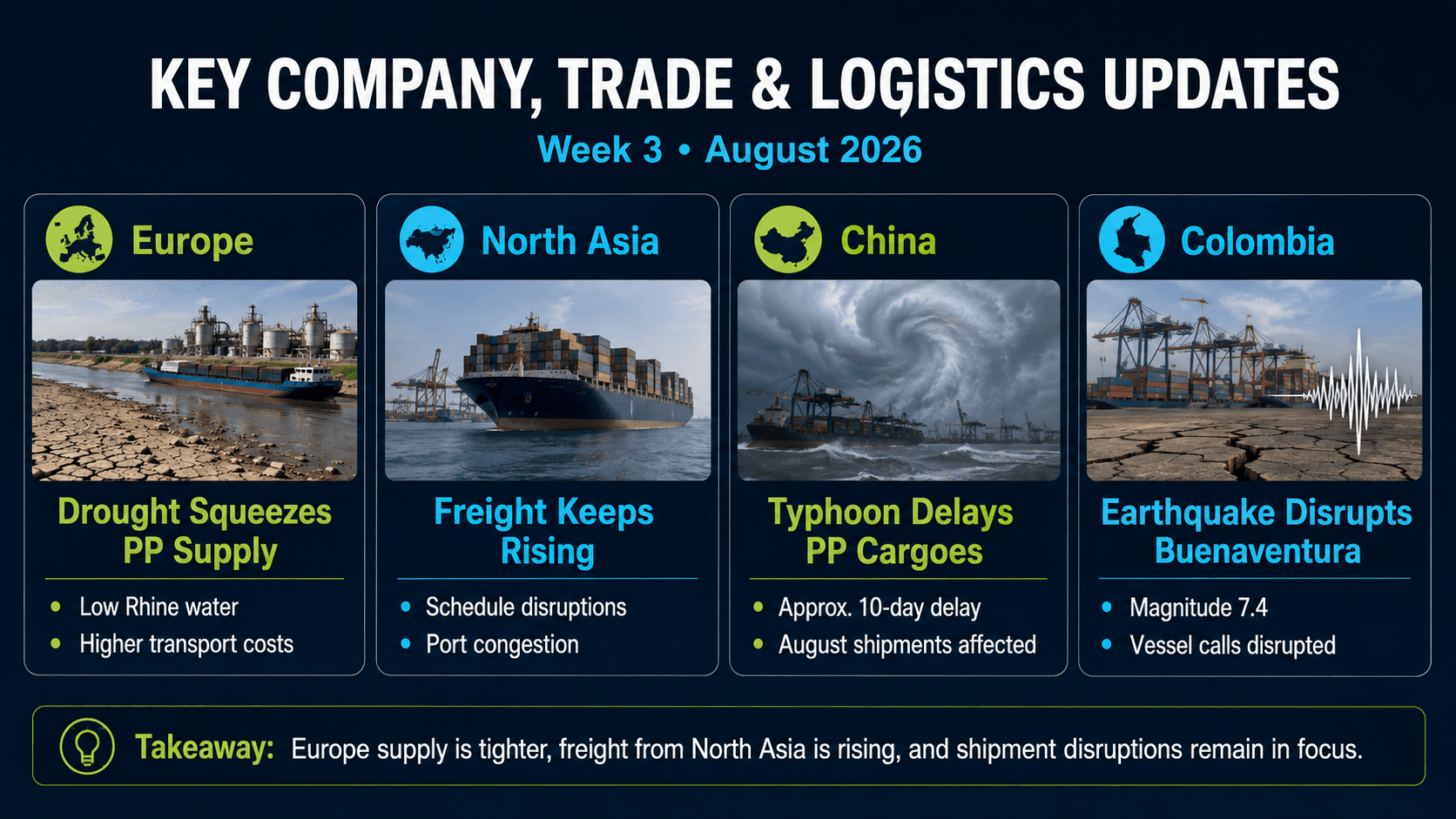
Key Company, Trade and Logistics Updates
Europe — drought restricts PP production and Rhine transport. Continued drought reduced water-cooling capacity at Northwest European polymerization plants while record-low water restricted Rhine barge movements. Barges on the Upper Rhine have struggled to return to the Antwerp–Rotterdam–Amsterdam (ARA) hub, effectively creating a bottleneck at Kaub, and producers across the region have shifted volumes to rail and road at higher cost. Force majeure has been declared at chemical sites in the region, though the declarations reported so far sit in polyurethane feedstock rather than polyolefins. Some polypropylene producers used alternative freight to meet delivery commitments.
North Asia — container freight continues to rise. Schedule disruptions, congestion and capacity dislocation have allowed carriers to keep raising rates out of North Asia. Effective landed costs for Asian-origin cargoes have moved even where resin prices have not.
China — typhoon delays PP cargoes by roughly 10 days. A major Chinese producer's polypropylene cargoes were delayed by approximately 10 days after a typhoon disrupted loading operations. Buyers with August shipments from the affected loading ports should reconfirm laycans.
Colombia — earthquake disrupts Buenaventura port. A magnitude 7.4 earthquake struck the western part of the country on August 10, 2026, the largest recorded in Colombia this century. Buenaventura terminals were affected unevenly rather than uniformly: some suspended operations pending safety clearance while others resumed vessel handling after inspection, and gate restrictions remained in place at parts of the port while containers were repositioned. Several vessel calls were disrupted. Buyers with cargo routed through Buenaventura should confirm terminal-level status rather than assume the port as a whole is either open or closed.
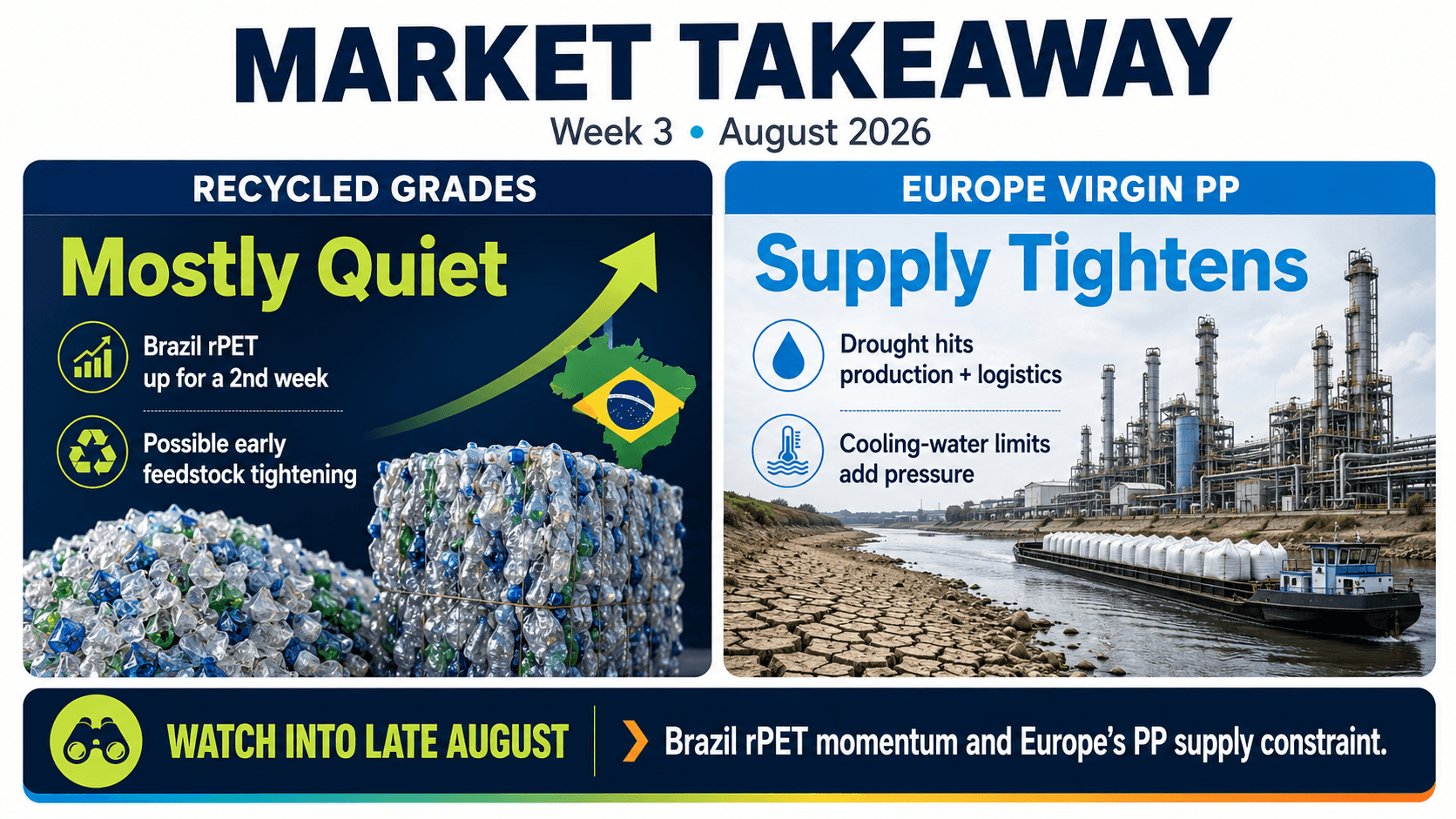
Market Takeaway
As of August 2026, recycled grades stayed largely quiet this week while Brazil's rPET market moved up for a second week — worth tracking as a potential early signal of regional feedstock tightening rather than treated as an established trend. On the virgin side, the standout was Europe: Regenport's market monitoring showed European PP spot prices moving higher as drought-driven production and logistics constraints tightened effective supply. The distinction that matters for the weeks ahead is that Europe's issue is now partly a production issue: cooling-water limits at Northwest European polymerization plants do not clear as quickly as a barge backlog does.
Recycled prices are flat almost everywhere except Brazil, and Europe's virgin PP constraint is now upstream of logistics — those are the two lines to watch into late August.
Regenport will continue monitoring market conditions and sharing updates as the picture develops.
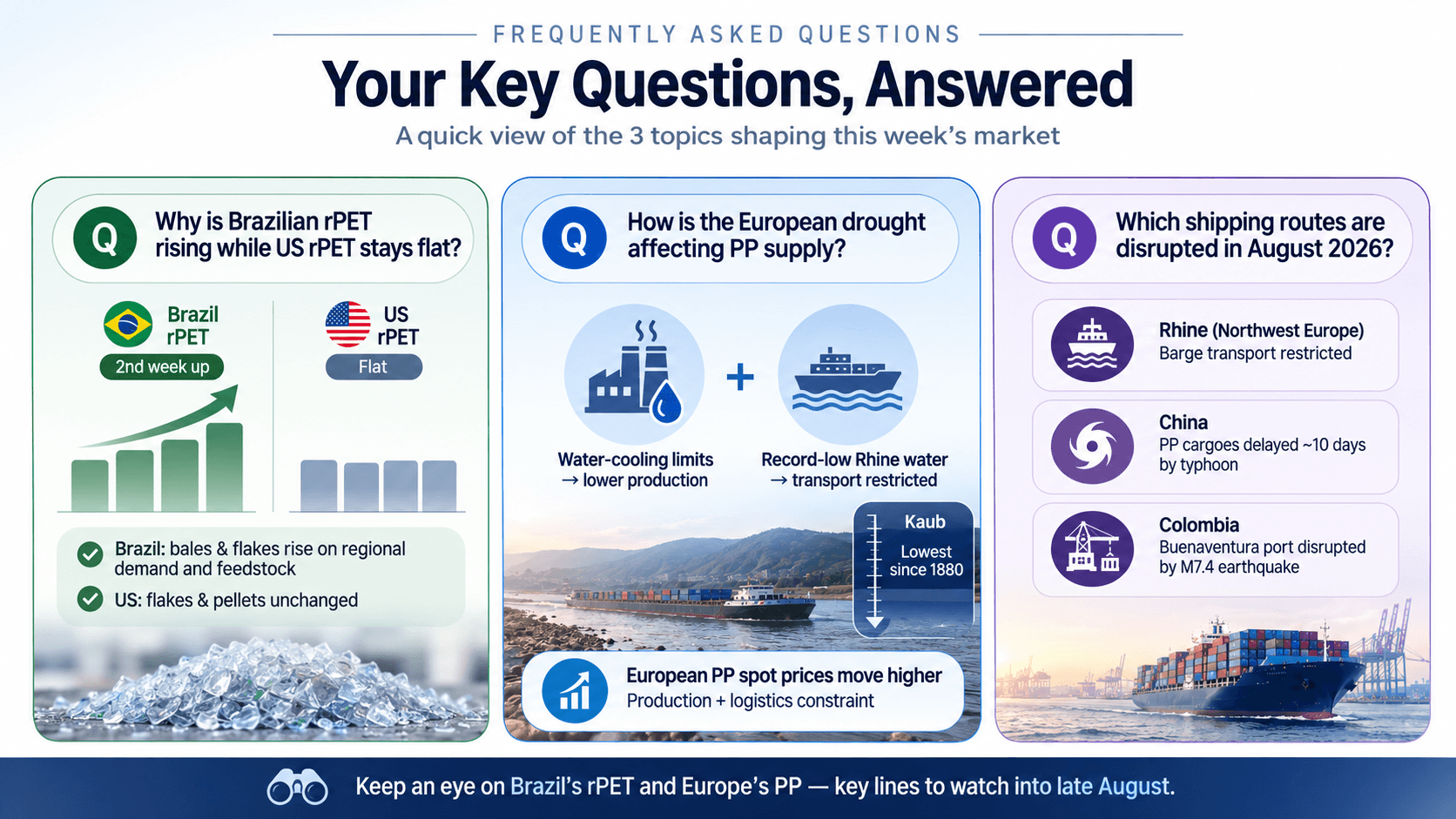
Frequently Asked Questions
Why are Brazilian recycled PET prices rising while US rPET prices stay flat in August 2026? The two markets are moving on separate regional conditions: Brazilian clear and green bottle bales and flakes rose for a second consecutive week on regional demand and feedstock conditions, while US clear flakes and food-grade recycled pellets were unchanged and premium bales were flat to easier across major cities.
How is the European drought affecting polypropylene supply in 2026? Drought conditions reduced water-cooling capacity at Northwest European polymerization plants and restricted Rhine barge transport in the same week, so the constraint affects both production and distribution. The gauge at Kaub fell to its lowest since records began in 1880, and some producers used alternative freight such as truck and rail to meet delivery commitments, which raises landed cost. Force majeure declarations reported in the region so far sit in polyurethane feedstock rather than polyolefins.
Which shipping routes are disrupted for polymer cargoes in August 2026? Three were disrupted in the week of August 12: Rhine barge transport in Northwest Europe on record-low water levels, Chinese polypropylene loadings delayed roughly 10 days by a typhoon, and Buenaventura port in Colombia after a magnitude 7.4 earthquake on August 10, where terminals resumed at different speeds.
Image generated with ChatGPT
The week of August 12, 2026 looked quiet on price screens across most recycled grades, but the few places that moved are worth separating from the noise. Brazil's rPET market extended its rebound into a second week, while US clear flake and food-grade pellet prices were flat to marginally softer. In Europe, record-low river levels became a supply-side constraint on polypropylene rather than only a freight problem — an important distinction, because production constraints tend to persist longer than logistics ones. Demand across the chain stayed weak, which is the backdrop against which both stories should be read.
Three Factors Shaping This Week's Market
1. Brazil's rPET rebound extended to a second week Clear and green bottle bales rose in Brazil, with flakes following the same direction, while southern Brazil pricing held steady. Two consecutive weeks of gains in a market that has otherwise been flat is a change in direction, though not yet a confirmed trend. Regional feedstock availability is the variable to watch here, since bale-led moves usually signal collection or supply-side tightness before they show up in flake and pellet quotes.
2. European drought became a production constraint, not just a freight one Continued drought conditions cut water-cooling capacity at Northwest European polymerization plants and restricted Rhine barge transport in the same week. The gauge reading at Kaub, the Rhine's shallowest navigable point, fell to its lowest since records began in 1880. The gauge is a reference level for navigation rather than the depth of the water itself, so the practical effect is a sharp cut in how much each barge can carry rather than a closed river. Site-level effects have followed, with force majeure declared at chemical plants in the region — so far in polyurethane feedstock rather than polyolefins. Some polypropylene producers turned to alternative freight to meet delivery commitments, which raises landed cost even where volumes are met.
3. Freight from North Asia kept rising Container rates out of North Asia continued to climb, attributed to ongoing schedule disruptions, port congestion and capacity dislocation. Carriers have kept pushing rates higher against that backdrop. For buyers importing from Asia, the freight line has been moving more than the resin line for several weeks now.
Key Grade Performance: rPET
rPET Market — Brazil up, US and Mexico flat US premium PET bales were flat to easier across major cities, and clear flakes and food-grade pellets were unchanged across all US regions. Mexico followed broadly the same pattern. Brazil was the contrast: clear and green bottle bales rose, flakes moved with them, and southern Brazil held steady — the second consecutive week of gains in that market. Why it matters: buyers sourcing rPET from South America may see quotes firm before US-origin material does, and a second week of bale gains is worth tracking as a possible early signal of regional feedstock tightening. It is not yet enough to treat as a confirmed direction, and buyers comparing origins should verify current offers rather than assume the US–Brazil spread will hold.
rPP and other recycled grades — quiet Recycled polyolefin grades were largely unchanged on the week, with demand continuing to soften across the chain. The virgin PP disruption in Europe described below did not translate into recycled PP price movement during the week itself. Why it matters: when virgin supply tightens in a region while recycled prices stay flat, the cost gap narrows in favour of recycled material — European buyers reviewing rPP on landed cost may find the current spread worth examining, though any pass-through would depend on how long the production constraint lasts.
Key Company, Trade and Logistics Updates
Europe — drought restricts PP production and Rhine transport. Continued drought reduced water-cooling capacity at Northwest European polymerization plants while record-low water restricted Rhine barge movements. Barges on the Upper Rhine have struggled to return to the Antwerp–Rotterdam–Amsterdam (ARA) hub, effectively creating a bottleneck at Kaub, and producers across the region have shifted volumes to rail and road at higher cost. Force majeure has been declared at chemical sites in the region, though the declarations reported so far sit in polyurethane feedstock rather than polyolefins. Some polypropylene producers used alternative freight to meet delivery commitments.
North Asia — container freight continues to rise. Schedule disruptions, congestion and capacity dislocation have allowed carriers to keep raising rates out of North Asia. Effective landed costs for Asian-origin cargoes have moved even where resin prices have not.
China — typhoon delays PP cargoes by roughly 10 days. A major Chinese producer's polypropylene cargoes were delayed by approximately 10 days after a typhoon disrupted loading operations. Buyers with August shipments from the affected loading ports should reconfirm laycans.
Colombia — earthquake disrupts Buenaventura port. A magnitude 7.4 earthquake struck the western part of the country on August 10, 2026, the largest recorded in Colombia this century. Buenaventura terminals were affected unevenly rather than uniformly: some suspended operations pending safety clearance while others resumed vessel handling after inspection, and gate restrictions remained in place at parts of the port while containers were repositioned. Several vessel calls were disrupted. Buyers with cargo routed through Buenaventura should confirm terminal-level status rather than assume the port as a whole is either open or closed.
Market Takeaway
As of August 2026, recycled grades stayed largely quiet this week while Brazil's rPET market moved up for a second week — worth tracking as a potential early signal of regional feedstock tightening rather than treated as an established trend. On the virgin side, the standout was Europe: Regenport's market monitoring showed European PP spot prices moving higher as drought-driven production and logistics constraints tightened effective supply. The distinction that matters for the weeks ahead is that Europe's issue is now partly a production issue: cooling-water limits at Northwest European polymerization plants do not clear as quickly as a barge backlog does.
Recycled prices are flat almost everywhere except Brazil, and Europe's virgin PP constraint is now upstream of logistics — those are the two lines to watch into late August.
Regenport will continue monitoring market conditions and sharing updates as the picture develops.
Frequently Asked Questions
Why are Brazilian recycled PET prices rising while US rPET prices stay flat in August 2026? The two markets are moving on separate regional conditions: Brazilian clear and green bottle bales and flakes rose for a second consecutive week on regional demand and feedstock conditions, while US clear flakes and food-grade recycled pellets were unchanged and premium bales were flat to easier across major cities.
How is the European drought affecting polypropylene supply in 2026? Drought conditions reduced water-cooling capacity at Northwest European polymerization plants and restricted Rhine barge transport in the same week, so the constraint affects both production and distribution. The gauge at Kaub fell to its lowest since records began in 1880, and some producers used alternative freight such as truck and rail to meet delivery commitments, which raises landed cost. Force majeure declarations reported in the region so far sit in polyurethane feedstock rather than polyolefins.
Which shipping routes are disrupted for polymer cargoes in August 2026? Three were disrupted in the week of August 12: Rhine barge transport in Northwest Europe on record-low water levels, Chinese polypropylene loadings delayed roughly 10 days by a typhoon, and Buenaventura port in Colombia after a magnitude 7.4 earthquake on August 10, where terminals resumed at different speeds.
Image generated with ChatGPT
Where rPP Stands Now
Grades • Specs • Availability
Browse rPP →
Where rPP Stands Now
Where rPP Stands Now
Check current rPP grades by feedstock, MFI, stock and MOQ.
Check current rPP grades by feedstock, MFI, stock and MOQ.
Browse rPP →
Browse rPP →
Looking for samples or ready to source? Submit your request for pricing, availability, and technical information.
Looking for samples or ready to source? Submit your request for pricing, availability, and technical information.
Request a Quote →
Request a Quote →
Posted by REGENPORT
REGENPORT is a global platform connecting buyers and suppliers in the recycled materials and sustainable packaging industries.