CATEGORY
CATEGORY
News
News
News
Tracking Plastic Act 2026: U.S. Senate Bill to Standardize Recycled Content Verification
Tracking Plastic Act 2026: U.S. Senate Bill to Standardize Recycled Content Verification
Tracking Plastic Act 2026: U.S. Senate Bill to Standardize Recycled Content Verification

The Tracking Plastic Act of 2026 directs the federal government to define how recycled plastic content is measured and traced, signaling a market shift from content percentages to verification quality for procurement teams.
On July 30, 2026, Senator Adam Schiff (D-Calif.) introduced S. 5182, the Tracking Plastic Act of 2026, with cosponsors Jeff Merkley (D-Ore.), Ron Wyden (D-Ore.) and Cory Booker (D-N.J.). Referred to the Senate Committee on Commerce, Science, and Transportation, the bill would create a federal interagency working group and direct the National Institute of Standards and Technology (NIST) to develop recommendations for measuring, tracking and reporting recycled plastic content across packaging, construction, infrastructure and automotive applications.
Schiff framed the purpose plainly: "Consumers deserve the truth when making choices among competing products. Our legislation will crack down on companies that mislead the public." The bill is supported by the Association of Plastic Recyclers (APR), The Recycling Partnership, World Wildlife Fund, Ocean Conservancy and the Monterey Bay Aquarium.
What the Bill Would Actually Do
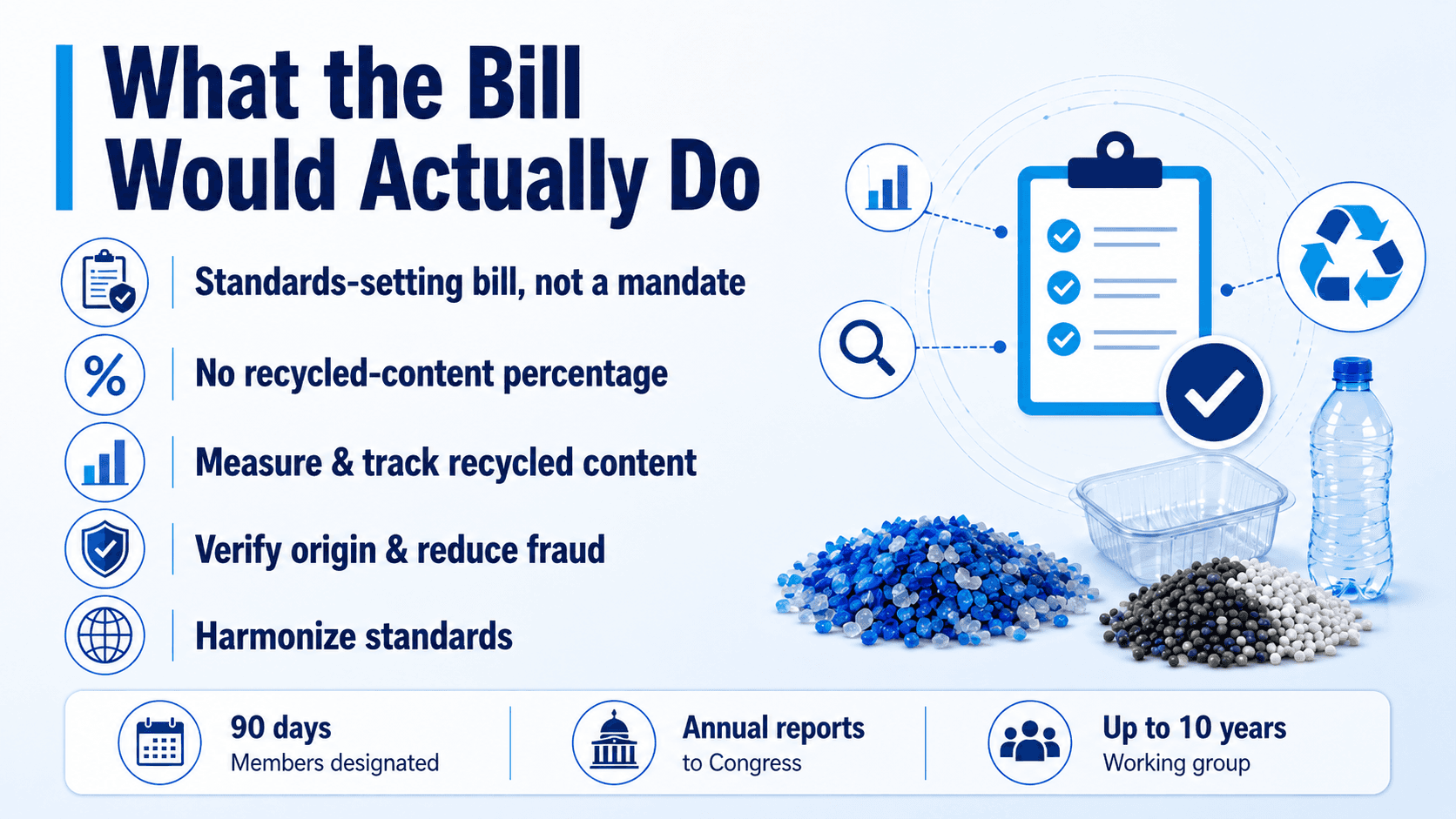
The Tracking Plastic Act is a standards-setting bill, not a mandate. It does not set a recycled-content percentage. Instead, it directs the working group to develop recommendations for:
Measuring and tracking recycled content across packaging, construction, infrastructure and automotive applications
Addressing mislabeling and fraud, reducing measurement error, and verifying the origin of recycled plastic content
Clarifying trade data on plastic codes, improving traceability of plastic marine debris, and harmonizing U.S. approaches with Australian and North American standards
Initial working group members would be designated within 90 days of enactment, annual reports to Congress would be required, and the group would operate for a maximum of 10 years, guided by the EPA's National Recycling Strategy roadmap through 2030.
Why the Bill Exists: A Patchwork Problem
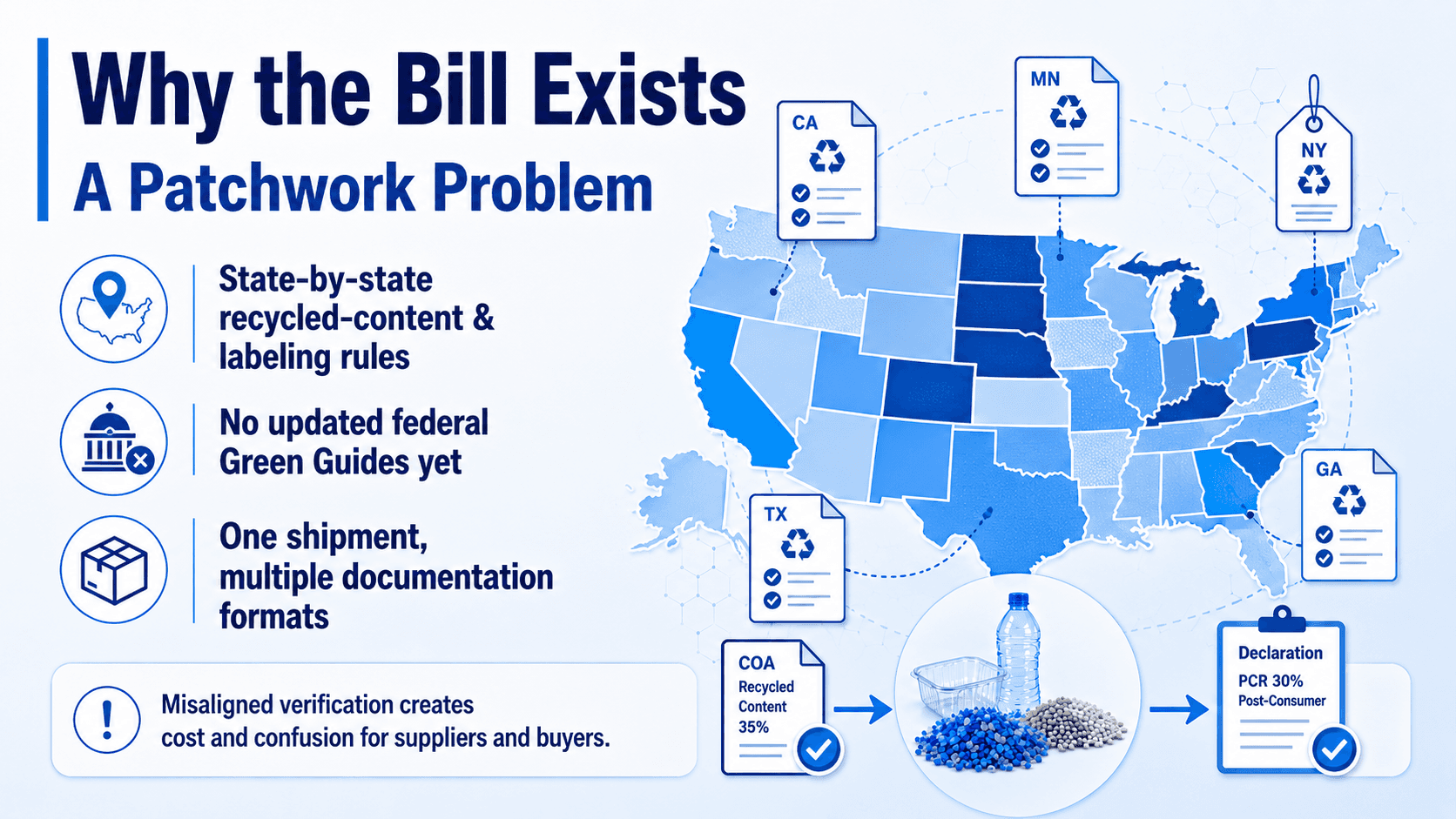
The bill lands in a market where recycled-content obligations are already in force but the verification methods behind them are not aligned. U.S. producers currently navigate state-by-state recycled-content and labeling requirements that were written independently of one another, while updated federal FTC Green Guides guidance has not arrived — a gap that reporting on the bill describes as a source of ongoing frustration across the packaging value chain. California's state recycling label approach was recently temporarily blocked in federal court, which further unsettled what producers can safely put on a package.
For a supplier or a buyer, that patchwork translates into a practical cost: the same shipment of recycled resin may need to satisfy several different documentation formats depending on where the finished product is sold.
The Competitive Bill Landscape
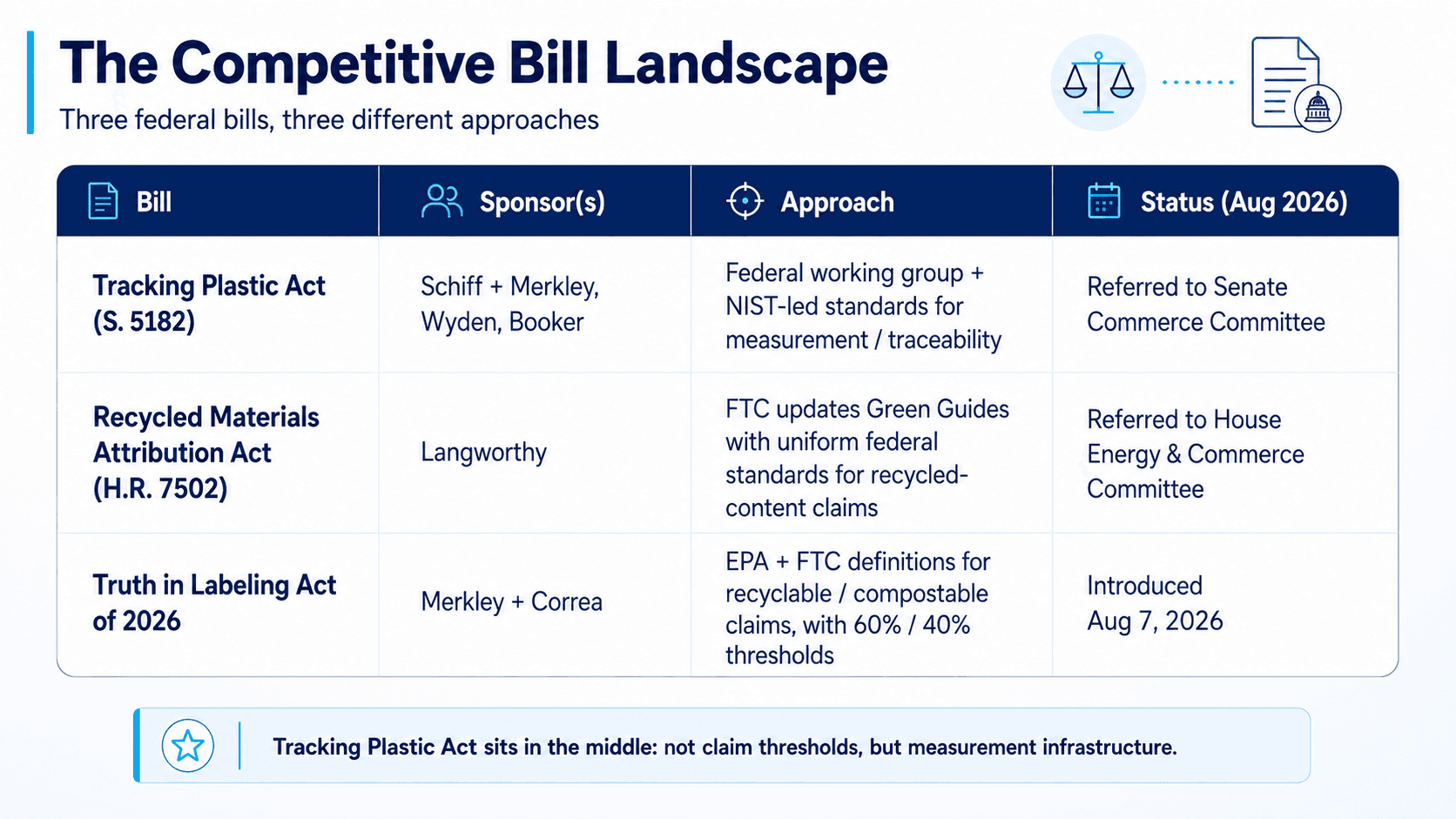
The Tracking Plastic Act is one of several federal bills advancing in the 119th Congress that seek to address the same structural problem — inconsistent state rules and unverifiable claims — but with different mechanisms and political alignments.
Bill | Sponsor(s) | Approach | Status (as of Aug 2026) |
|---|---|---|---|
Tracking Plastic Act (S. 5182) | Schiff (D-CA) + Merkley, Wyden, Booker | Federal working group + NIST-led standards for measurement/traceability | Referred to Senate Commerce Committee |
Recycled Materials Attribution Act (H.R. 7502) | Langworthy (R-NY) | Directs FTC to update Green Guides with uniform federal standards for recycled-content claims | Referred to House Energy & Commerce Committee |
Truth in Labeling Act of 2026 | Merkley (D-OR) + Correa (D-CA) | EPA + FTC jointly establish enforceable definitions for “recyclable,” “compostable,” etc., with 60%/40% thresholds | Introduced Aug 7, 2026 |
The Tracking Plastic Act occupies a middle ground: it does not preempt state rules or set claim thresholds, but it builds the measurement infrastructure that any future federal standard — whether industry-backed or consumer-protection focused — would rely on.
Verification Is Becoming the Product: What Procurement Teams Can Do Now
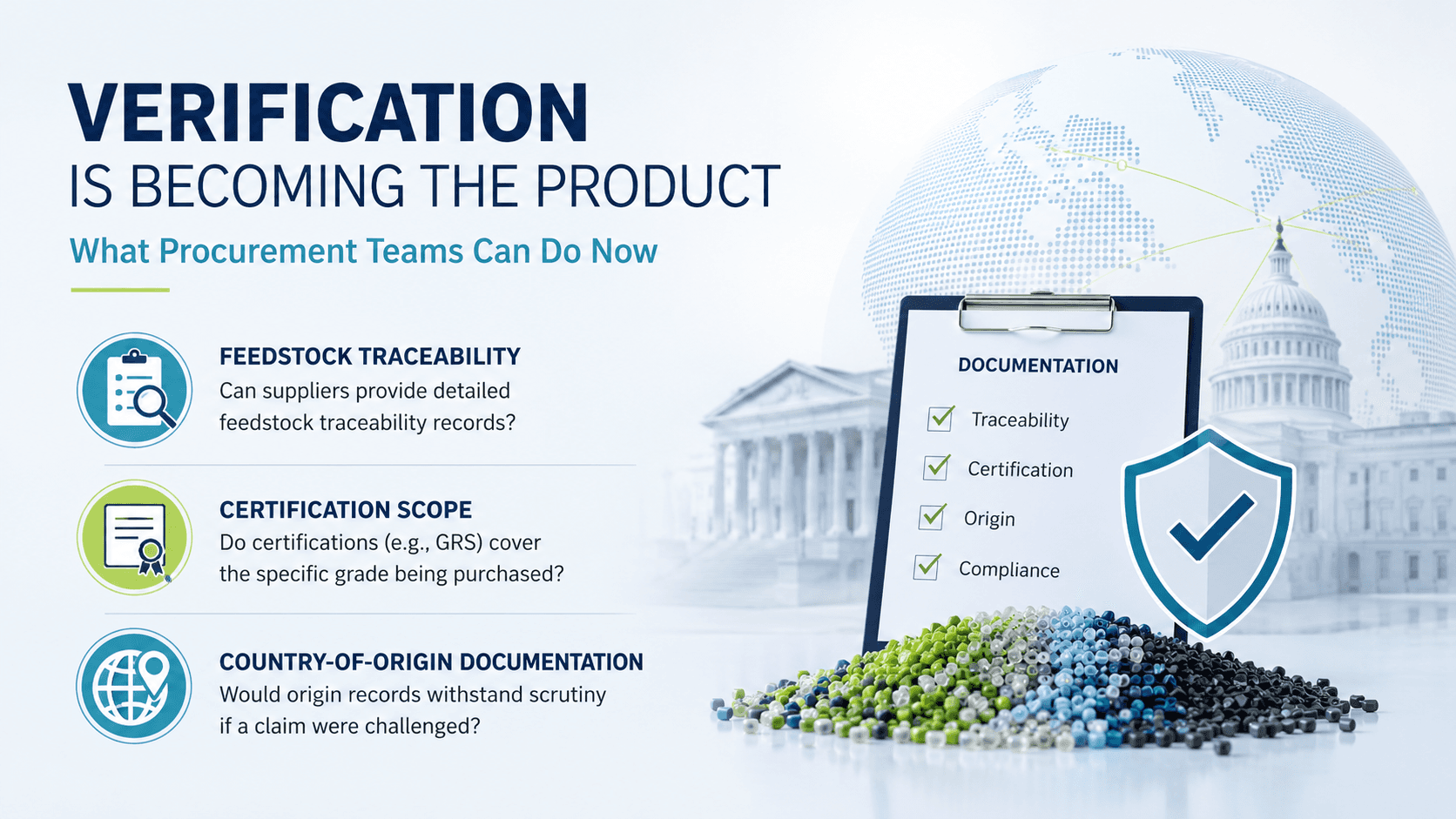
Nothing in this bill is enforceable today, and it may not become law. But the documentation work it points toward is worth starting regardless, because state mandates and EU rules already require much of it. The convergence of these bills signals that recycled resin backed by feedstock records, certification and origin documentation is easier to use in regulated packaging than material sold on a content claim alone.
Three items are worth reviewing now:
Feedstock traceability: Can current suppliers produce feedstock traceability records on request rather than only a summary certificate?
Certification scope: Do certifications held (GRS, for example) actually cover the specific grade being purchased rather than the supplier generally?
Country-of-origin documentation: Would origin records survive scrutiny if a claim on the finished package were challenged?
Buyers evaluating suppliers may want to weight documentation quality more heavily than they have historically, rather than treating it as a formality settled after the commercial terms.
Market Takeaway
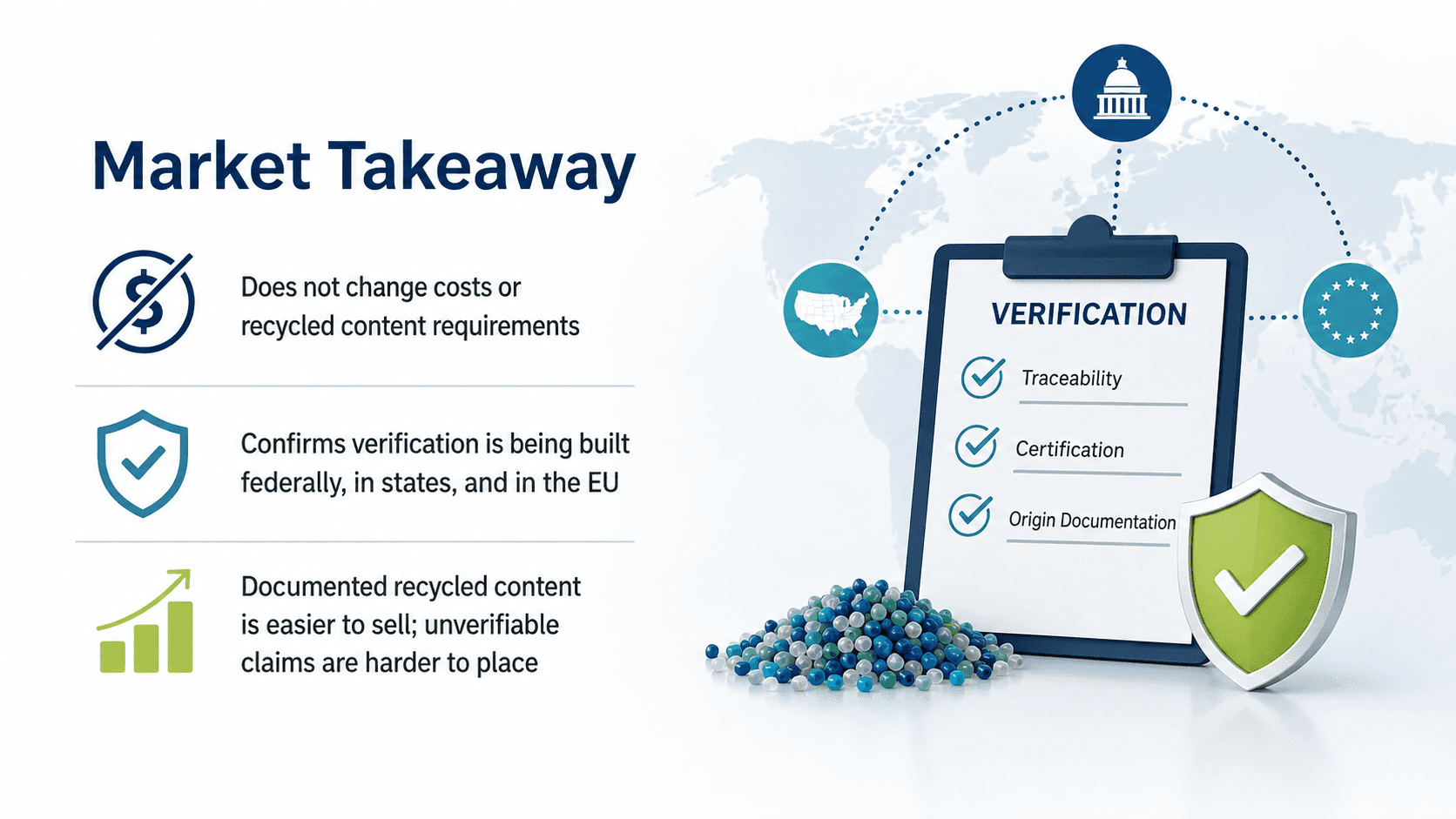
The Tracking Plastic Act does not change what recycled plastic costs or how much of it a producer must use. What it does is confirm that the verification layer around recycled content is being built — federally, in states, and in the EU simultaneously — and that unverifiable recycled content is becoming harder to sell into regulated markets. Procurement teams that can already document where their material came from are positioned for that shift; those relying on percentage claims alone have work to do.
Frequently Asked Questions
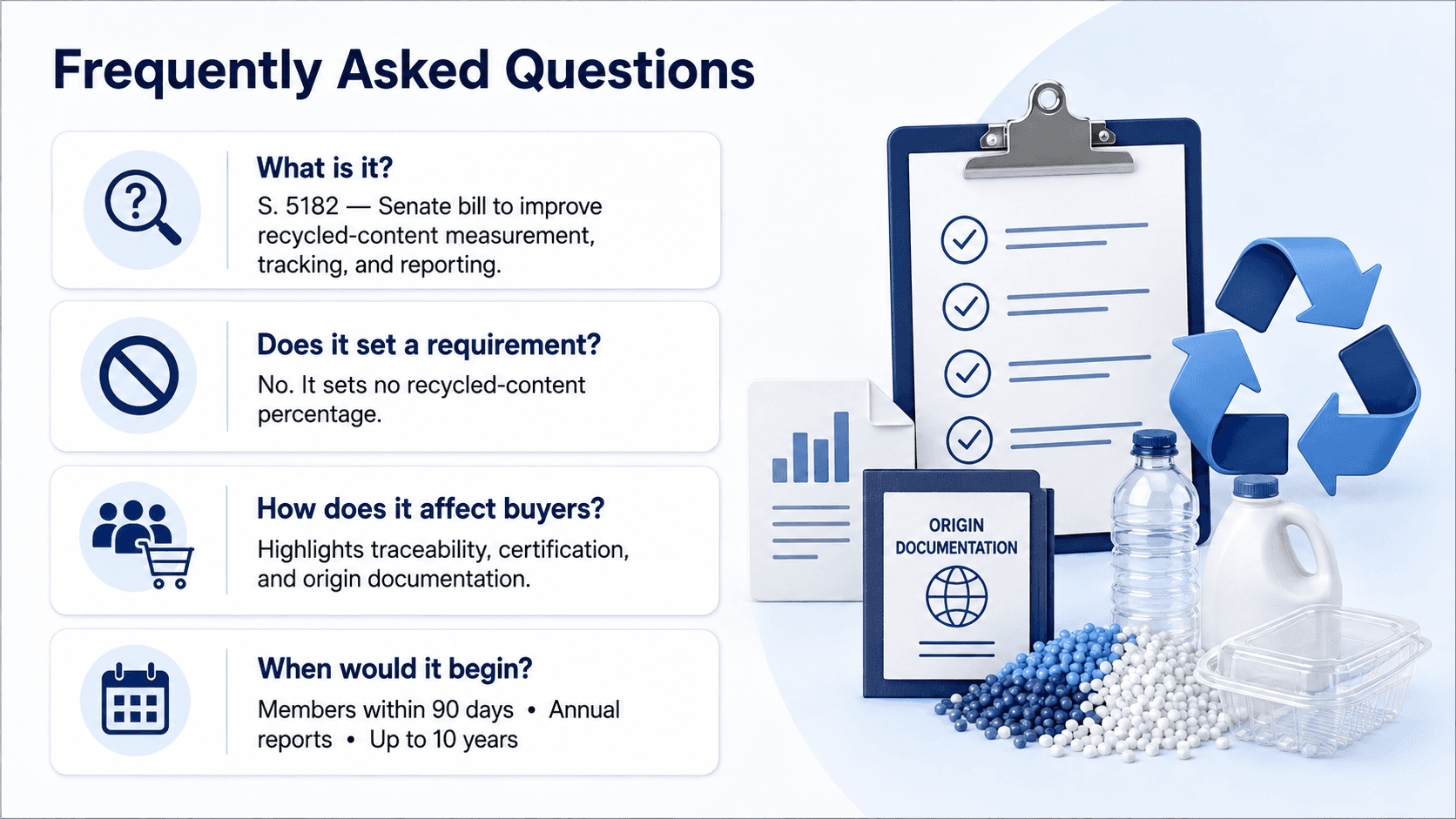
What is the Tracking Plastic Act of 2026? It is Senate Bill 5182, introduced by Senator Adam Schiff on July 30, 2026, which would create a federal interagency working group and direct NIST to develop recommendations for measuring, tracking and reporting recycled plastic content.
Does the Tracking Plastic Act set a recycled content requirement? No. The bill sets no recycled-content percentage; it addresses how recycled content is measured and verified, and directs the working group to help harmonize the existing patchwork of state-level requirements.
How would the bill affect companies buying recycled plastic? It would not impose obligations on buyers directly, but by standardizing measurement and traceability expectations it points toward a market in which recycled resin backed by feedstock records, certification and origin documentation is easier to use in regulated packaging than material sold on a content claim alone.
When would the working group begin? Initial members would be designated within 90 days of enactment, with annual reports to Congress and a maximum operating period of 10 years, guided by the EPA's National Recycling Strategy roadmap through 2030.
About This Article
Information current as of August 12, 2026. This article is provided for general information about market and regulatory developments and is not legal advice. S. 5182 is pending before the Senate Committee on Commerce, Science, and Transportation and has not been enacted; companies with compliance obligations should confirm current requirements with qualified counsel.
Image generated with ChatGPT
Sources
U.S. Government Publishing Office, "S. 5182 — Tracking Plastic Act of 2026 (119th Congress, 2nd Session)" → Read the Source
Maria Rachal, Packaging Dive, "Tracking Plastic Act proposes advancing recycled content standards" → Read the Source
PlasticsToday, "Senators Introduce Legislation to Verify Recycled Plastic Claims" → Read the Source
On July 30, 2026, Senator Adam Schiff (D-Calif.) introduced S. 5182, the Tracking Plastic Act of 2026, with cosponsors Jeff Merkley (D-Ore.), Ron Wyden (D-Ore.) and Cory Booker (D-N.J.). Referred to the Senate Committee on Commerce, Science, and Transportation, the bill would create a federal interagency working group and direct the National Institute of Standards and Technology (NIST) to develop recommendations for measuring, tracking and reporting recycled plastic content across packaging, construction, infrastructure and automotive applications.
Schiff framed the purpose plainly: "Consumers deserve the truth when making choices among competing products. Our legislation will crack down on companies that mislead the public." The bill is supported by the Association of Plastic Recyclers (APR), The Recycling Partnership, World Wildlife Fund, Ocean Conservancy and the Monterey Bay Aquarium.
What the Bill Would Actually Do
The Tracking Plastic Act is a standards-setting bill, not a mandate. It does not set a recycled-content percentage. Instead, it directs the working group to develop recommendations for:
Measuring and tracking recycled content across packaging, construction, infrastructure and automotive applications
Addressing mislabeling and fraud, reducing measurement error, and verifying the origin of recycled plastic content
Clarifying trade data on plastic codes, improving traceability of plastic marine debris, and harmonizing U.S. approaches with Australian and North American standards
Initial working group members would be designated within 90 days of enactment, annual reports to Congress would be required, and the group would operate for a maximum of 10 years, guided by the EPA's National Recycling Strategy roadmap through 2030.
Why the Bill Exists: A Patchwork Problem
The bill lands in a market where recycled-content obligations are already in force but the verification methods behind them are not aligned. U.S. producers currently navigate state-by-state recycled-content and labeling requirements that were written independently of one another, while updated federal FTC Green Guides guidance has not arrived — a gap that reporting on the bill describes as a source of ongoing frustration across the packaging value chain. California's state recycling label approach was recently temporarily blocked in federal court, which further unsettled what producers can safely put on a package.
For a supplier or a buyer, that patchwork translates into a practical cost: the same shipment of recycled resin may need to satisfy several different documentation formats depending on where the finished product is sold.
The Competitive Bill Landscape
The Tracking Plastic Act is one of several federal bills advancing in the 119th Congress that seek to address the same structural problem — inconsistent state rules and unverifiable claims — but with different mechanisms and political alignments.
Bill | Sponsor(s) | Approach | Status (as of Aug 2026) |
|---|---|---|---|
Tracking Plastic Act (S. 5182) | Schiff (D-CA) + Merkley, Wyden, Booker | Federal working group + NIST-led standards for measurement/traceability | Referred to Senate Commerce Committee |
Recycled Materials Attribution Act (H.R. 7502) | Langworthy (R-NY) | Directs FTC to update Green Guides with uniform federal standards for recycled-content claims | Referred to House Energy & Commerce Committee |
Truth in Labeling Act of 2026 | Merkley (D-OR) + Correa (D-CA) | EPA + FTC jointly establish enforceable definitions for “recyclable,” “compostable,” etc., with 60%/40% thresholds | Introduced Aug 7, 2026 |
The Tracking Plastic Act occupies a middle ground: it does not preempt state rules or set claim thresholds, but it builds the measurement infrastructure that any future federal standard — whether industry-backed or consumer-protection focused — would rely on.
Verification Is Becoming the Product: What Procurement Teams Can Do Now
Nothing in this bill is enforceable today, and it may not become law. But the documentation work it points toward is worth starting regardless, because state mandates and EU rules already require much of it. The convergence of these bills signals that recycled resin backed by feedstock records, certification and origin documentation is easier to use in regulated packaging than material sold on a content claim alone.
Three items are worth reviewing now:
Feedstock traceability: Can current suppliers produce feedstock traceability records on request rather than only a summary certificate?
Certification scope: Do certifications held (GRS, for example) actually cover the specific grade being purchased rather than the supplier generally?
Country-of-origin documentation: Would origin records survive scrutiny if a claim on the finished package were challenged?
Buyers evaluating suppliers may want to weight documentation quality more heavily than they have historically, rather than treating it as a formality settled after the commercial terms.
Market Takeaway
The Tracking Plastic Act does not change what recycled plastic costs or how much of it a producer must use. What it does is confirm that the verification layer around recycled content is being built — federally, in states, and in the EU simultaneously — and that unverifiable recycled content is becoming harder to sell into regulated markets. Procurement teams that can already document where their material came from are positioned for that shift; those relying on percentage claims alone have work to do.
Frequently Asked Questions
What is the Tracking Plastic Act of 2026? It is Senate Bill 5182, introduced by Senator Adam Schiff on July 30, 2026, which would create a federal interagency working group and direct NIST to develop recommendations for measuring, tracking and reporting recycled plastic content.
Does the Tracking Plastic Act set a recycled content requirement? No. The bill sets no recycled-content percentage; it addresses how recycled content is measured and verified, and directs the working group to help harmonize the existing patchwork of state-level requirements.
How would the bill affect companies buying recycled plastic? It would not impose obligations on buyers directly, but by standardizing measurement and traceability expectations it points toward a market in which recycled resin backed by feedstock records, certification and origin documentation is easier to use in regulated packaging than material sold on a content claim alone.
When would the working group begin? Initial members would be designated within 90 days of enactment, with annual reports to Congress and a maximum operating period of 10 years, guided by the EPA's National Recycling Strategy roadmap through 2030.
About This Article
Information current as of August 12, 2026. This article is provided for general information about market and regulatory developments and is not legal advice. S. 5182 is pending before the Senate Committee on Commerce, Science, and Transportation and has not been enacted; companies with compliance obligations should confirm current requirements with qualified counsel.
Image generated with ChatGPT
Sources
U.S. Government Publishing Office, "S. 5182 — Tracking Plastic Act of 2026 (119th Congress, 2nd Session)" → Read the Source
Maria Rachal, Packaging Dive, "Tracking Plastic Act proposes advancing recycled content standards" → Read the Source
PlasticsToday, "Senators Introduce Legislation to Verify Recycled Plastic Claims" → Read the Source
Sourcing With Documentation
Grades • Specs • Availability
Browse rHDPE →
Sourcing With Documentation
Sourcing With Documentation
Review rHDPE grades with GRS or GR documents by feedstock and properties.
Review rHDPE grades with GRS or GR documents by feedstock and properties.
Browse rHDPE →
Browse rHDPE →
Looking for samples or ready to source? Submit your request for pricing, availability, and technical information.
Looking for samples or ready to source? Submit your request for pricing, availability, and technical information.
Request a Quote →
Request a Quote →
Posted by REGENPORT
REGENPORT is a global platform connecting buyers and suppliers in the recycled materials and sustainable packaging industries.