CATEGORY
CATEGORY
Trend
Trend
Trend
Recycled HDPE Slides as US Virgin PE Prices Climb – Week 2, August 2026
Recycled HDPE Slides as US Virgin PE Prices Climb – Week 2, August 2026
Recycled HDPE Slides as US Virgin PE Prices Climb – Week 2, August 2026

Crude eased as the US–Iran talks over the Strait of Hormuz moved closer to an interim agreement, yet North American producers still pushed August 1 polyethylene increases through a sluggish market. The sharpest split of the week sat inside HDPE itself: US post-consumer bale and natural pellet prices fell while virgin HDPE moved higher.
Demand across the polyolefin chain stayed slow in the week of August 5, 2026, and crude softened on reports of progress in the US–Iran negotiations. Virgin polyethylene, however, moved the other way in North America, where producers confirmed increases effective August 1. Recycled HDPE did not follow. US post-consumer recycled (PCR) HDPE bales and natural pellets fell over the week, opening a visible gap against a rising virgin market — the same grade-level divergence that has defined much of this summer, now showing up inside a single polymer family rather than between them.

Three Factors Shaping This Week's Market
1. Crude eased as US–Iran talks advanced toward reopening the Strait of Hormuz Iranian and Omani sources indicated progress toward a temporary arrangement to reopen the Strait of Hormuz, though no final agreement had been announced as of the time of writing. Crude weakened on the news, easing the feedstock cost picture for Asian and Middle Eastern producers. Because the strait has carried outsized influence over crude and feedstock costs through 2026, the market is watching the talks closely rather than treating any single price move as settled.
2. North American producers lifted PE prices into weak demand Equistar Chemicals, Dow, ExxonMobil and Nova Chemicals all confirmed North American polyethylene price increases effective August 1, with ExxonMobil and Dow among the first to announce. Asian and European suppliers were only able to push limited increases against poor demand, leaving the price action concentrated in the US. Several market participants questioned whether demand would actually follow the announced increases.
3. Recycled HDPE feedstock stayed available while virgin tightened The divergence between virgin and recycled HDPE this week points to different supply conditions on each side. Virgin HDPE tightened enough to support higher offers, while recycled HDPE feedstock remained readily available in the US — a combination that pushed the two markets in opposite directions within the same week.
Key Grade Performance: rHDPE and rPET
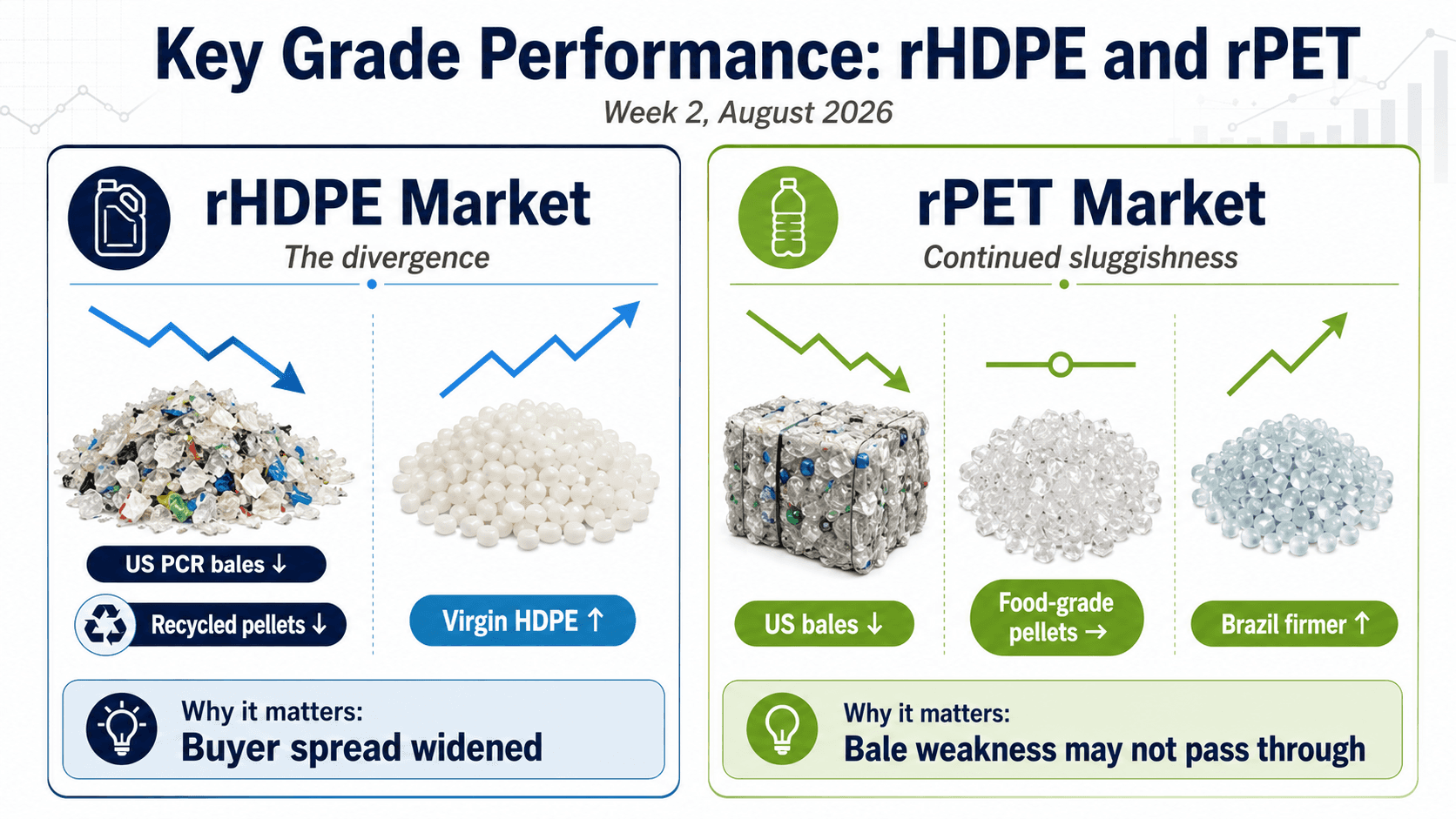
rHDPE Market — the divergence US PCR natural and mixed-color HDPE bales fell sharply, and recycled natural pellets moved down with them. Virgin HDPE in the US rose over the same period across blow molding and injection/film grades. Recycled and virgin HDPE therefore moved in opposite directions this week, which market conditions suggest reflects ample recycled feedstock availability against a tighter virgin market. Why it matters: the cost gap between recycled and virgin HDPE has widened in the buyer's favor in the US — buyers evaluating rHDPE on landed cost may find the current spread worth reviewing, though bale price weakness this steep can also compress recycler margins and should be watched for supply effects.
rPET Market — continued sluggishness PET bale prices extended their decline across major US cities. Food-grade recycled pellets and clear flakes were unchanged on the week, leaving the weakness concentrated at the bale end of the chain. In Brazil, bale and flake pricing continued to extend the rebound seen over recent weeks, on the back of firmer demand. Why it matters: falling US bales alongside flat food-grade pellets narrows the recycler's processing spread rather than the buyer's purchase price — buyers should not assume bale softness will pass through to rPET pellet quotes in the near term, while Brazil is moving on a separate demand cycle.
Key Company and Trade Updates
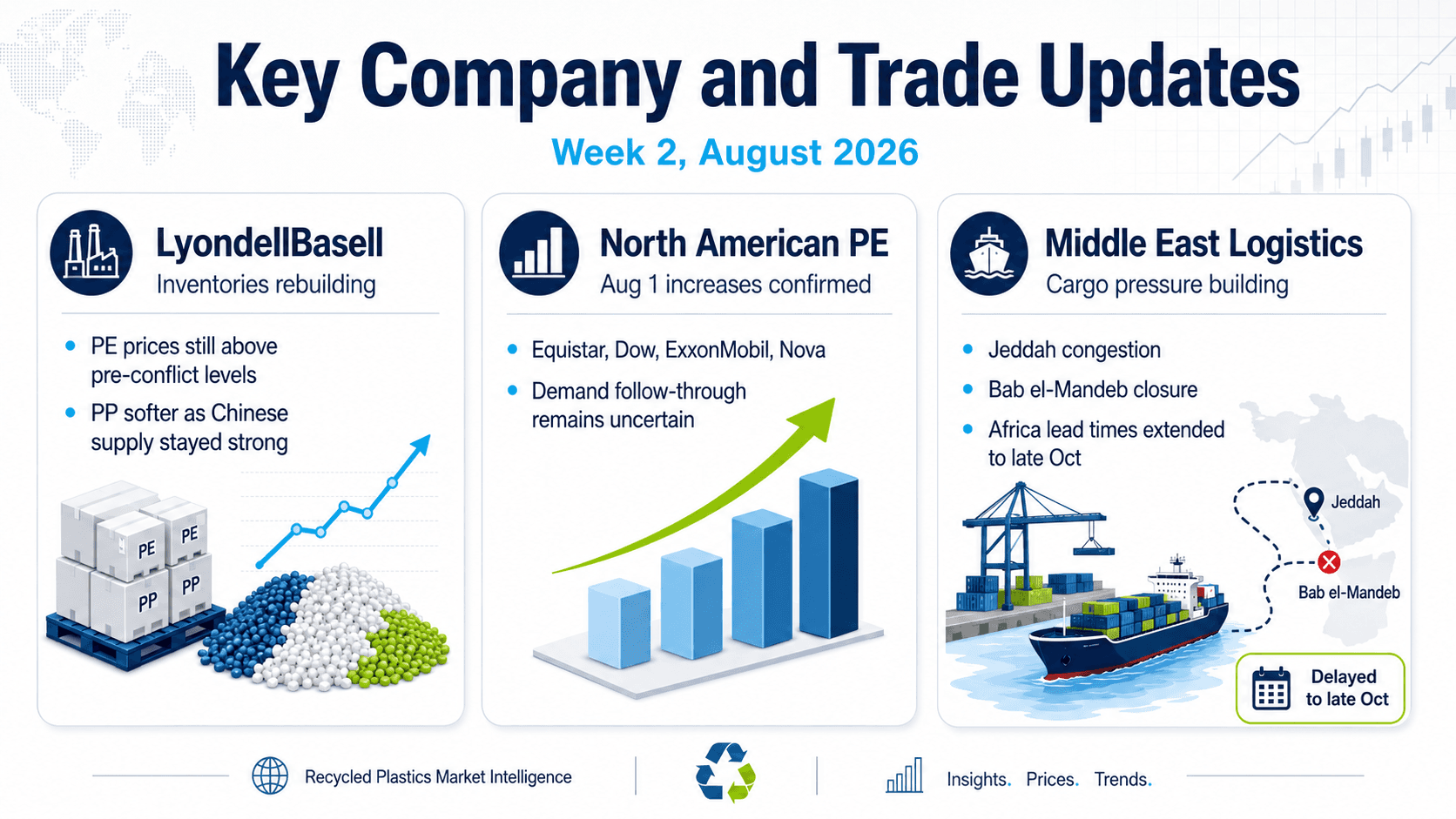
LyondellBasell — inventories rebuilding, prices holding above pre-conflict levels. LyondellBasell indicated that polyethylene inventories are expected to rebuild gradually as supply chains normalize, but that prices are likely to remain above pre-conflict levels. Polypropylene did not perform as well as polyethylene, as Chinese supply stayed strong — Chinese producers used liquefied petroleum gas (LPG) as feedstock to keep export volumes running.
August 1 North American PE increases confirmed. Equistar Chemicals, Dow, ExxonMobil and Nova Chemicals each confirmed increases effective August 1. Market participants remained doubtful that demand would follow the announced price direction.
Middle East logistics — Jeddah congestion and the Bab el-Mandeb closure. Congestion at Jeddah port and the closure of the Bab el-Mandeb Strait are putting pressure on Middle East-origin PE and PP cargoes. Market participants expect September loadings into Africa to slip into late October, extending effective lead times for African buyers sourcing from the region.
Market Takeaway
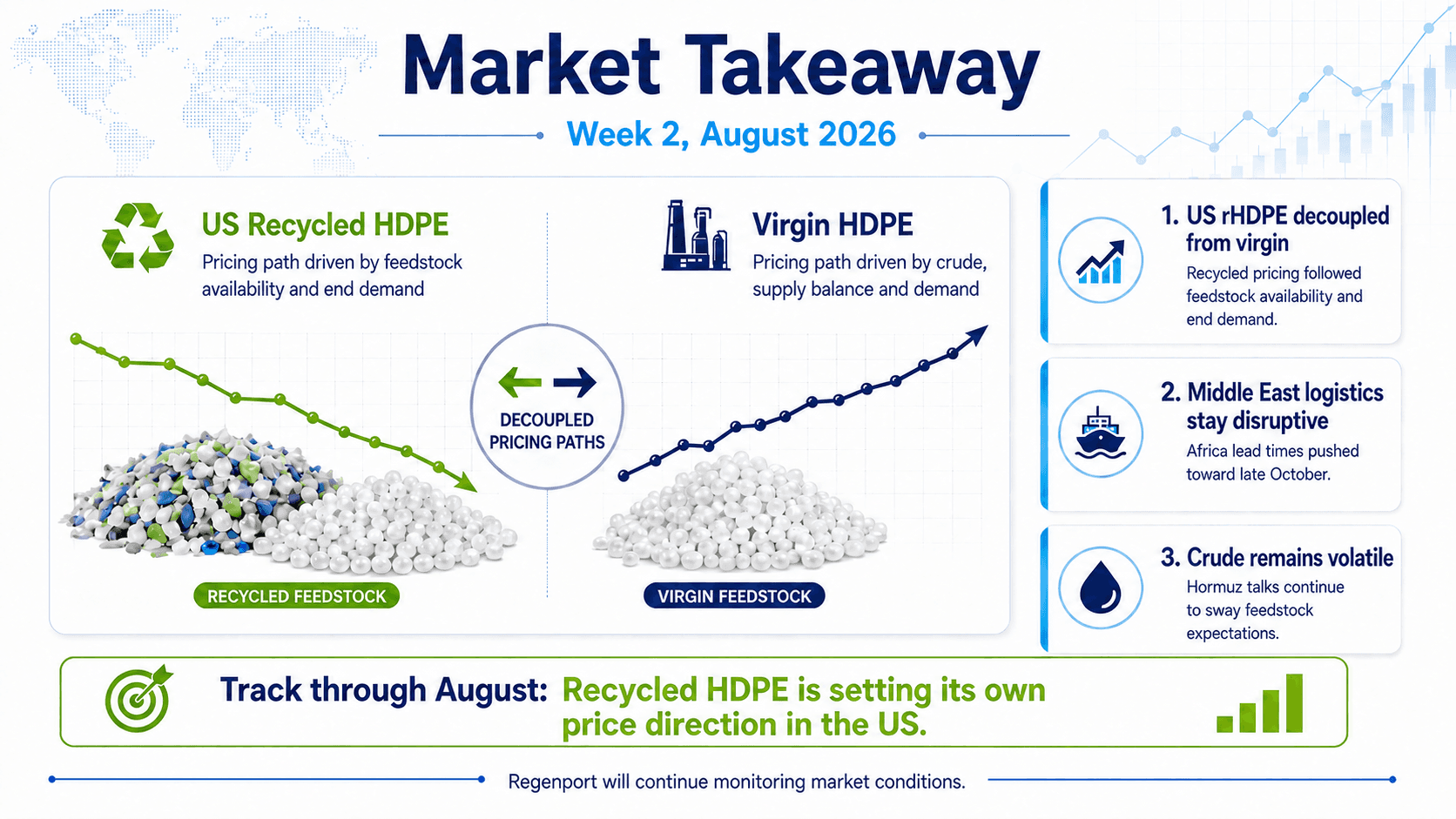
The defining feature of this week, as of August 2026, was the split between virgin and recycled HDPE in the US. It repeats a pattern seen through the summer: recycled grades are being priced by their own feedstock availability and end demand rather than tracking virgin resin. With Middle East logistics disruptions pushing African deliveries out to late October, and the Strait of Hormuz talks still driving crude and feedstock costs, volatility looks likely to continue in both virgin and recycled markets through August.
Recycled HDPE is now setting its own price direction in the US, independent of virgin — and that decoupling is the variable buyers should be tracking through August.
Regenport will continue monitoring market conditions and sharing updates as the picture develops.
Frequently Asked Questions
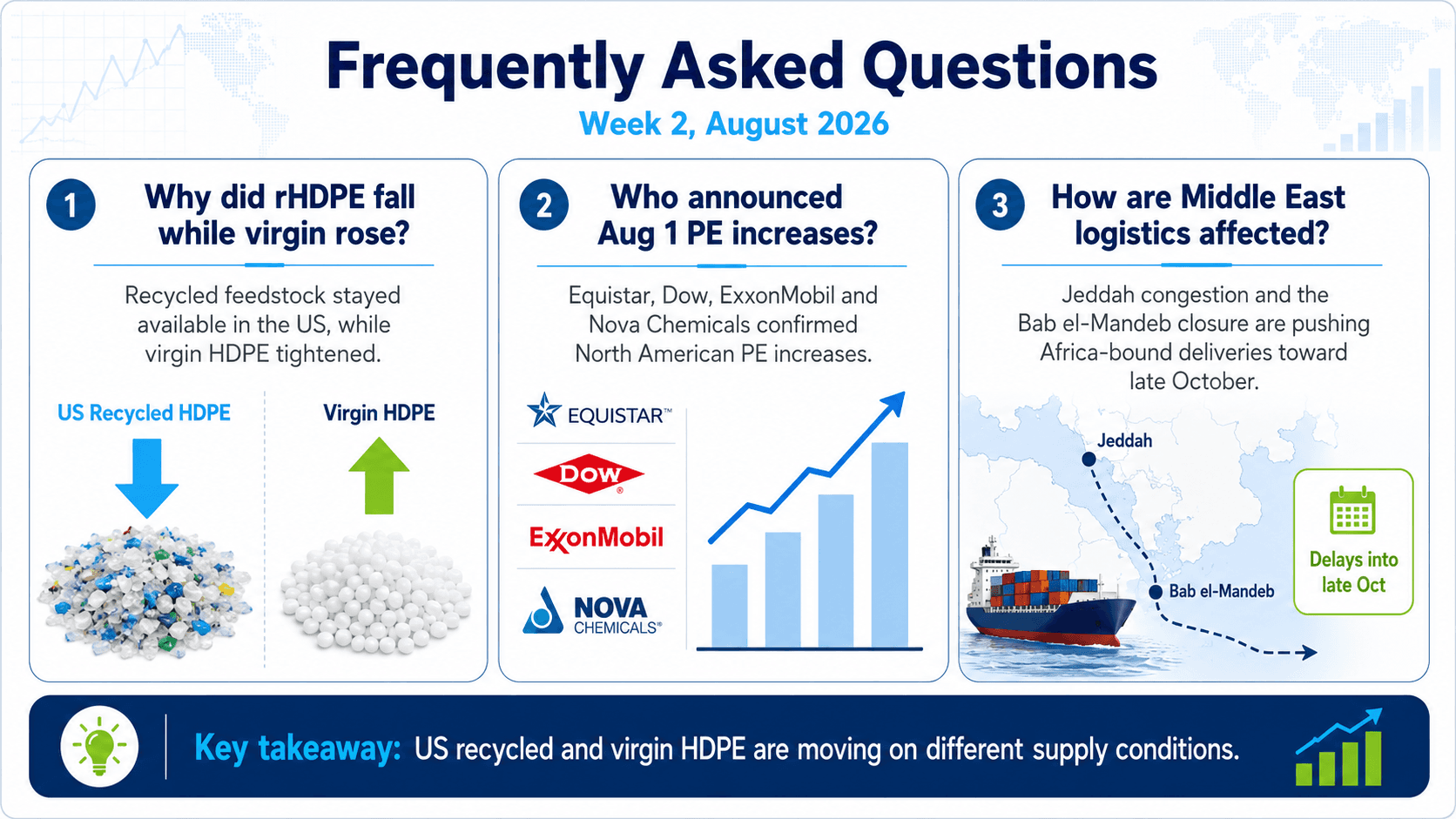
Why did US recycled HDPE prices fall while virgin HDPE rose in early August 2026? The two markets moved on different supply conditions: recycled HDPE feedstock remained readily available in the US while virgin HDPE tightened, so PCR natural and mixed-color bales and natural pellets fell in the same week that virgin blow molding and injection/film grades rose.
Which producers announced August 1 North American polyethylene increases? Equistar Chemicals, Dow, ExxonMobil and Nova Chemicals all confirmed increases effective August 1, 2026, with ExxonMobil and Dow among the first to announce, while Asian and European suppliers achieved only limited increases against weaker demand.
How are Middle East logistics disruptions affecting PE and PP delivery times? Congestion at Jeddah port and the closure of the Bab el-Mandeb Strait mean September loadings of Middle East-origin PE and PP cargoes bound for Africa are expected by market participants to slip into late October, effectively adding weeks to delivered lead times.
Image generated with ChatGPT
Demand across the polyolefin chain stayed slow in the week of August 5, 2026, and crude softened on reports of progress in the US–Iran negotiations. Virgin polyethylene, however, moved the other way in North America, where producers confirmed increases effective August 1. Recycled HDPE did not follow. US post-consumer recycled (PCR) HDPE bales and natural pellets fell over the week, opening a visible gap against a rising virgin market — the same grade-level divergence that has defined much of this summer, now showing up inside a single polymer family rather than between them.
Three Factors Shaping This Week's Market
1. Crude eased as US–Iran talks advanced toward reopening the Strait of Hormuz Iranian and Omani sources indicated progress toward a temporary arrangement to reopen the Strait of Hormuz, though no final agreement had been announced as of the time of writing. Crude weakened on the news, easing the feedstock cost picture for Asian and Middle Eastern producers. Because the strait has carried outsized influence over crude and feedstock costs through 2026, the market is watching the talks closely rather than treating any single price move as settled.
2. North American producers lifted PE prices into weak demand Equistar Chemicals, Dow, ExxonMobil and Nova Chemicals all confirmed North American polyethylene price increases effective August 1, with ExxonMobil and Dow among the first to announce. Asian and European suppliers were only able to push limited increases against poor demand, leaving the price action concentrated in the US. Several market participants questioned whether demand would actually follow the announced increases.
3. Recycled HDPE feedstock stayed available while virgin tightened The divergence between virgin and recycled HDPE this week points to different supply conditions on each side. Virgin HDPE tightened enough to support higher offers, while recycled HDPE feedstock remained readily available in the US — a combination that pushed the two markets in opposite directions within the same week.
Key Grade Performance: rHDPE and rPET
rHDPE Market — the divergence US PCR natural and mixed-color HDPE bales fell sharply, and recycled natural pellets moved down with them. Virgin HDPE in the US rose over the same period across blow molding and injection/film grades. Recycled and virgin HDPE therefore moved in opposite directions this week, which market conditions suggest reflects ample recycled feedstock availability against a tighter virgin market. Why it matters: the cost gap between recycled and virgin HDPE has widened in the buyer's favor in the US — buyers evaluating rHDPE on landed cost may find the current spread worth reviewing, though bale price weakness this steep can also compress recycler margins and should be watched for supply effects.
rPET Market — continued sluggishness PET bale prices extended their decline across major US cities. Food-grade recycled pellets and clear flakes were unchanged on the week, leaving the weakness concentrated at the bale end of the chain. In Brazil, bale and flake pricing continued to extend the rebound seen over recent weeks, on the back of firmer demand. Why it matters: falling US bales alongside flat food-grade pellets narrows the recycler's processing spread rather than the buyer's purchase price — buyers should not assume bale softness will pass through to rPET pellet quotes in the near term, while Brazil is moving on a separate demand cycle.
Key Company and Trade Updates
LyondellBasell — inventories rebuilding, prices holding above pre-conflict levels. LyondellBasell indicated that polyethylene inventories are expected to rebuild gradually as supply chains normalize, but that prices are likely to remain above pre-conflict levels. Polypropylene did not perform as well as polyethylene, as Chinese supply stayed strong — Chinese producers used liquefied petroleum gas (LPG) as feedstock to keep export volumes running.
August 1 North American PE increases confirmed. Equistar Chemicals, Dow, ExxonMobil and Nova Chemicals each confirmed increases effective August 1. Market participants remained doubtful that demand would follow the announced price direction.
Middle East logistics — Jeddah congestion and the Bab el-Mandeb closure. Congestion at Jeddah port and the closure of the Bab el-Mandeb Strait are putting pressure on Middle East-origin PE and PP cargoes. Market participants expect September loadings into Africa to slip into late October, extending effective lead times for African buyers sourcing from the region.
Market Takeaway
The defining feature of this week, as of August 2026, was the split between virgin and recycled HDPE in the US. It repeats a pattern seen through the summer: recycled grades are being priced by their own feedstock availability and end demand rather than tracking virgin resin. With Middle East logistics disruptions pushing African deliveries out to late October, and the Strait of Hormuz talks still driving crude and feedstock costs, volatility looks likely to continue in both virgin and recycled markets through August.
Recycled HDPE is now setting its own price direction in the US, independent of virgin — and that decoupling is the variable buyers should be tracking through August.
Regenport will continue monitoring market conditions and sharing updates as the picture develops.
Frequently Asked Questions
Why did US recycled HDPE prices fall while virgin HDPE rose in early August 2026? The two markets moved on different supply conditions: recycled HDPE feedstock remained readily available in the US while virgin HDPE tightened, so PCR natural and mixed-color bales and natural pellets fell in the same week that virgin blow molding and injection/film grades rose.
Which producers announced August 1 North American polyethylene increases? Equistar Chemicals, Dow, ExxonMobil and Nova Chemicals all confirmed increases effective August 1, 2026, with ExxonMobil and Dow among the first to announce, while Asian and European suppliers achieved only limited increases against weaker demand.
How are Middle East logistics disruptions affecting PE and PP delivery times? Congestion at Jeddah port and the closure of the Bab el-Mandeb Strait mean September loadings of Middle East-origin PE and PP cargoes bound for Africa are expected by market participants to slip into late October, effectively adding weeks to delivered lead times.
Image generated with ChatGPT
This Week's rHDPE Grades
Grades • Specs • Availability
Browse rHDPE →
This Week's rHDPE Grades
This Week's rHDPE Grades
Check rHDPE availability by feedstock, MFI, stock and MOQ.
Check rHDPE availability by feedstock, MFI, stock and MOQ.
Browse rHDPE →
Browse rHDPE →
Looking for samples or ready to source? Submit your request for pricing, availability, and technical information.
Looking for samples or ready to source? Submit your request for pricing, availability, and technical information.
Request a Quote →
Request a Quote →
Posted by REGENPORT
REGENPORT is a global platform connecting buyers and suppliers in the recycled materials and sustainable packaging industries.