CATEGORY
CATEGORY
Regulation
Regulation
Regulation
EU PFAS Limits in 2026: Why Recycled Content Gets No Exemption
EU PFAS Limits in 2026: Why Recycled Content Gets No Exemption
EU PFAS Limits in 2026: Why Recycled Content Gets No Exemption
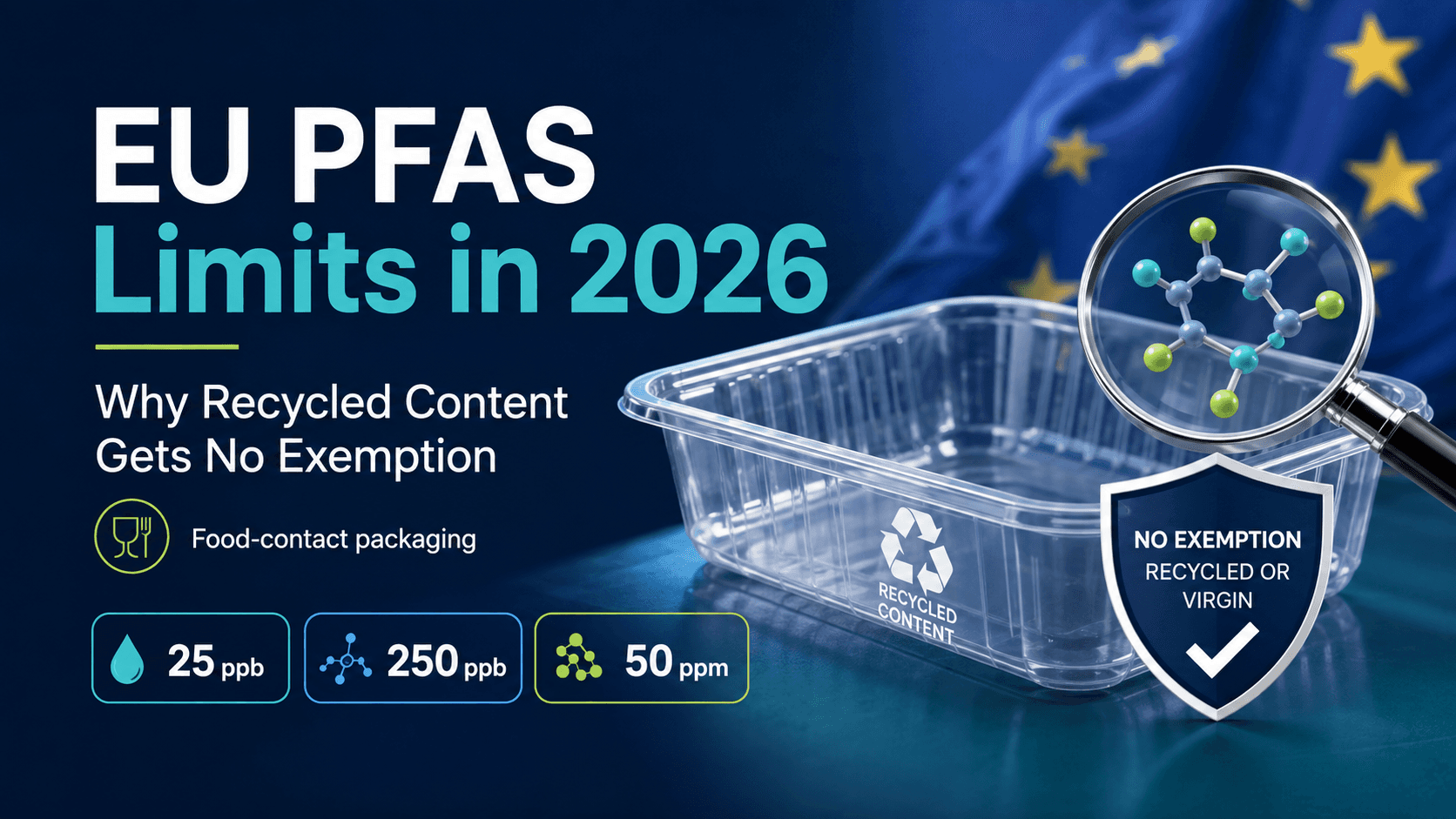
The PPWR's PFAS restriction on food-contact packaging applied from 12 August 2026 — 25 ppb per individual PFAS, 250 ppb summed, 50 ppm including polymeric PFAS. Recycled content is not exempt, so the limits become a sourcing and documentation question. Companion to the earlier PPWR and EmpCo posts.
The EU Packaging and Packaging Waste Regulation (PPWR), Regulation (EU) 2025/40, became applicable on 12 August 2026. Alongside the conformity and registration duties, one provision lands directly on material selection: a restriction on per- and polyfluoroalkyl substances (PFAS) in food-contact packaging. This guide follows our earlier posts on the PPWR itself and on the EmpCo Directive's rules for recycled claims. Where those covered how much recycled content is required and how it may be described, this one covers a limit that applies to the material regardless of whether it is virgin or recycled.
PFAS are not a single substance but a family of synthetic chemicals — the class is commonly estimated at more than 10,000 — built around carbon–fluorine bonds, among the strongest in organic chemistry. That bond is why PFAS repel water, oil and heat, and why they have been used in non-stick cookware coatings, water-repellent textiles, grease-resistant paper packaging and firefighting foams. It is also why they resist breaking down in the environment, which is the origin of the "forever chemicals" label. The regulatory concern is persistence and accumulation, and ECHA's Risk Assessment Committee cited exactly those properties in March 2026 when it concluded that an EU-wide restriction was the most appropriate measure.
What the PPWR PFAS Limits Actually Say
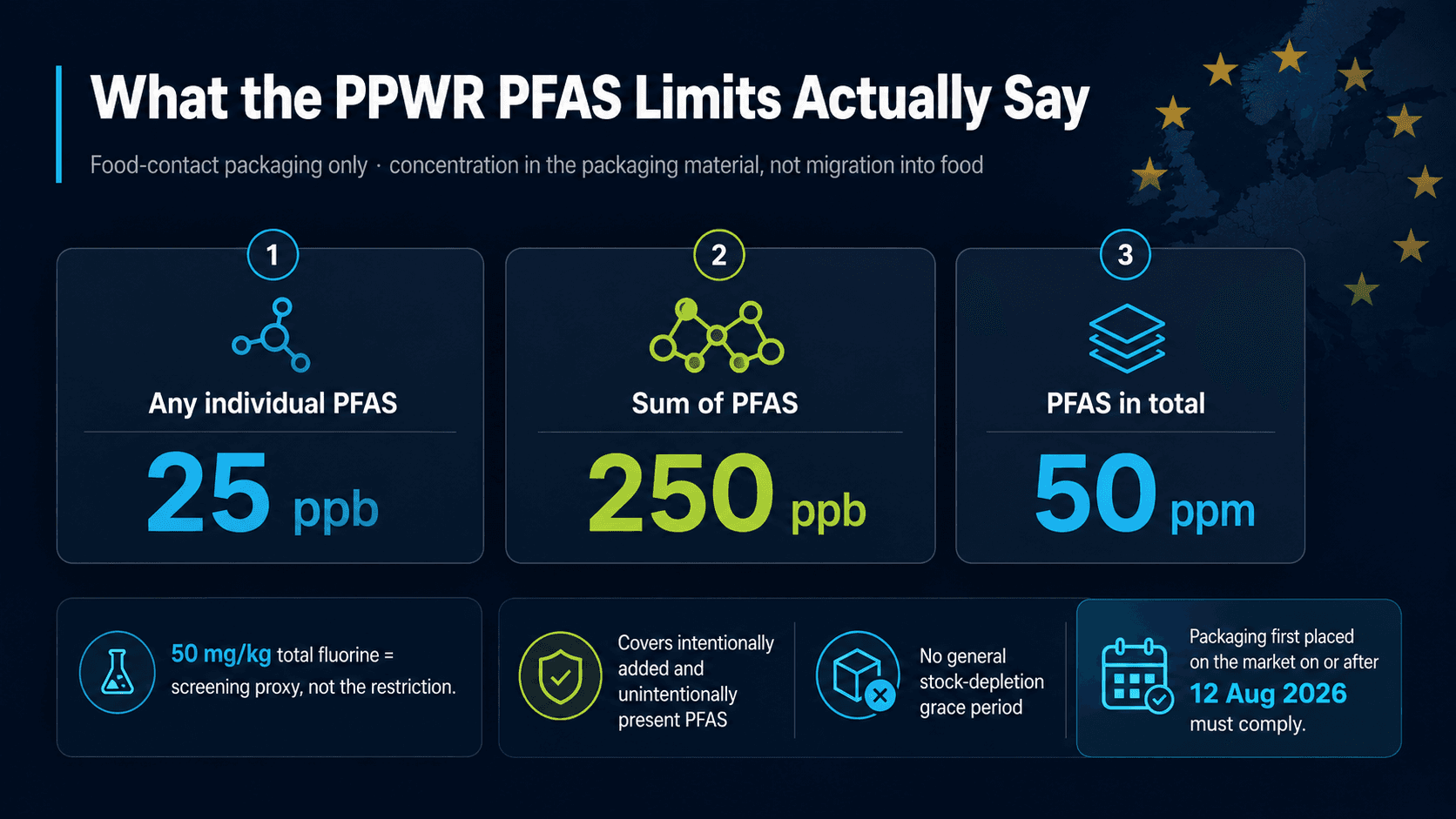
The restriction applies to packaging intended to come into contact with food, and it is written as a concentration limit in the packaging material — not as a migration limit into the food. Three thresholds apply, at or above which food-contact packaging may not be placed on the EU market:
Measurement basis | Limit |
|---|---|
Any individual PFAS (targeted analysis, polymeric PFAS excluded) | 25 ppb |
Sum of PFAS (targeted analysis, polymeric PFAS excluded; with prior degradation of precursors where applicable) | 250 ppb |
PFAS in total, including polymeric PFAS | 50 ppm |
One point of vocabulary is worth fixing early, because the same number appears twice with different meanings. The third row is a limit on PFAS, not on fluorine. Total fluorine also appears at 50 mg/kg — numerically identical to 50 ppm — but it does so in the Commission's guidance as a screening proxy, described below, not as the restriction itself. Fluorine in a packaging material does not necessarily originate from PFAS.
Two features matter for sourcing. First, the restriction covers both intentionally added PFAS and PFAS present without being intentionally added — so "we do not add any" is not, on its own, a demonstration of compliance. Second, the restriction contains no general stock-depletion grace period: packaging first placed on the market on or after 12 August 2026 must meet the limits regardless of when it was manufactured. Packaging already placed on the market before that date is not subject to withdrawal on this basis, though businesses should confirm how their national authority reads the boundary.
Recycled Content Gets No Exemption
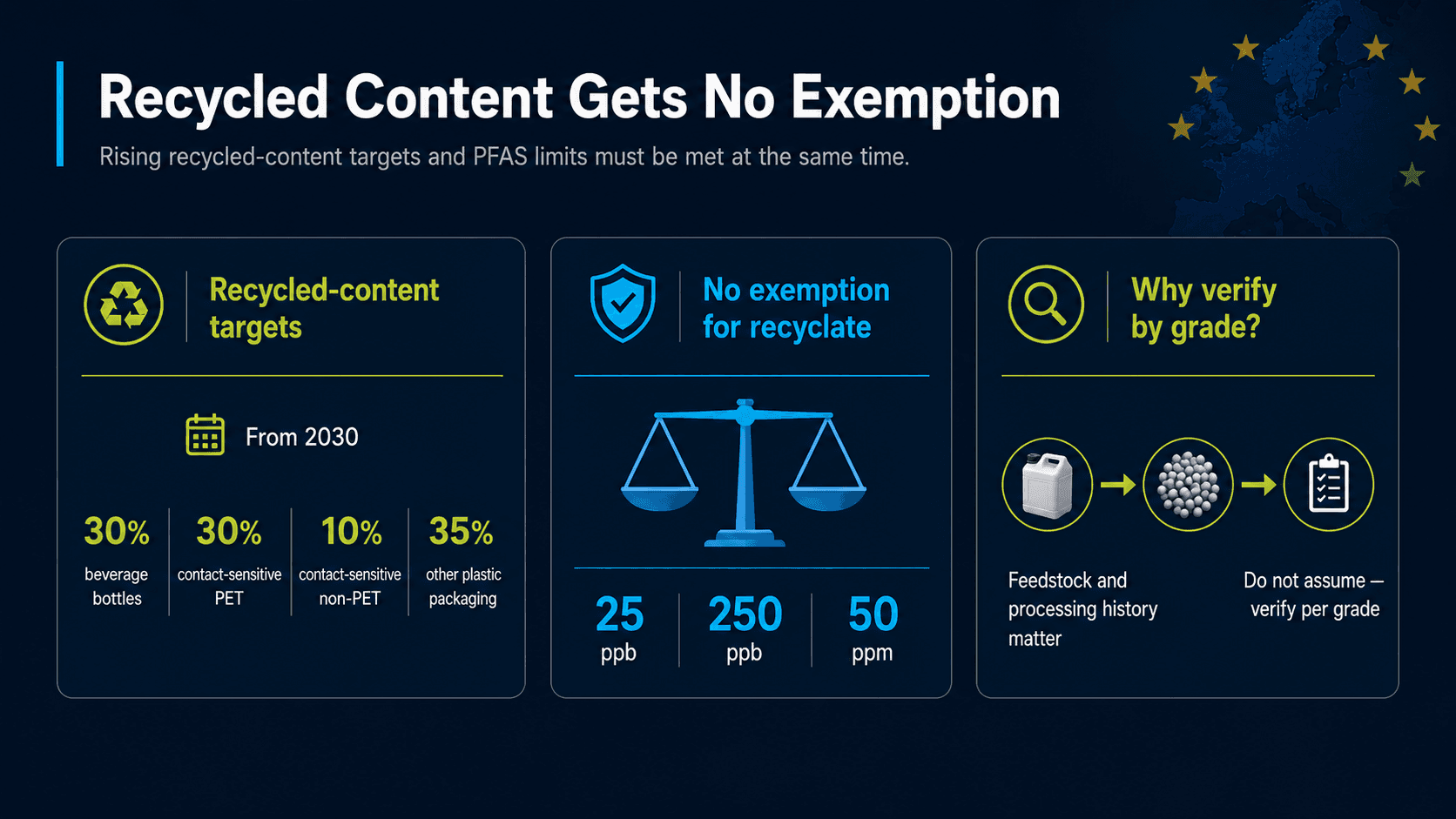
This is the point most easily missed. The PPWR requires rising minimum recycled content in plastic packaging from 1 January 2030 — 30% for single-use plastic beverage bottles, 30% for contact-sensitive PET packaging other than those bottles, 10% for contact-sensitive plastic packaging other than PET, and 35% for other plastic packaging, with higher figures set for 2040. The PFAS restriction contains no corresponding allowance for recyclate. A producer is expected to raise recycled content and stay under the PFAS thresholds at the same time.
That matters because recycled feedstock carries whatever the original stream carried. The US Environmental Protection Agency's testing of fluorinated high-density polyethylene (HDPE) containers, published from 2021 onward, found that the post-mould fluorination process used to make containers solvent-resistant can itself generate PFAS in the container wall, which then leach into the contents over time. On 11 July 2024 EPA granted a Toxic Substances Control Act (TSCA) petition covering three PFAS — PFOA, PFNA and PFDA — formed during that fluorination process. Containers of that kind can enter mechanical recycling streams. Peer-reviewed measurement points the same way while keeping the scale in proportion: a 2025 study in Chemosphere, "Levels of perfluoroalkyl carboxylic acids in recycled plastic pellets," characterised what it found as a small input into the plastics cycle — measurable, but low.
Taken together, these do not say recycled plastic is a PFAS problem. They say the PFAS content of a given recycled grade is a property of its feedstock and its processing history, and therefore something to be established per grade rather than assumed either way.
How Compliance Is Demonstrated
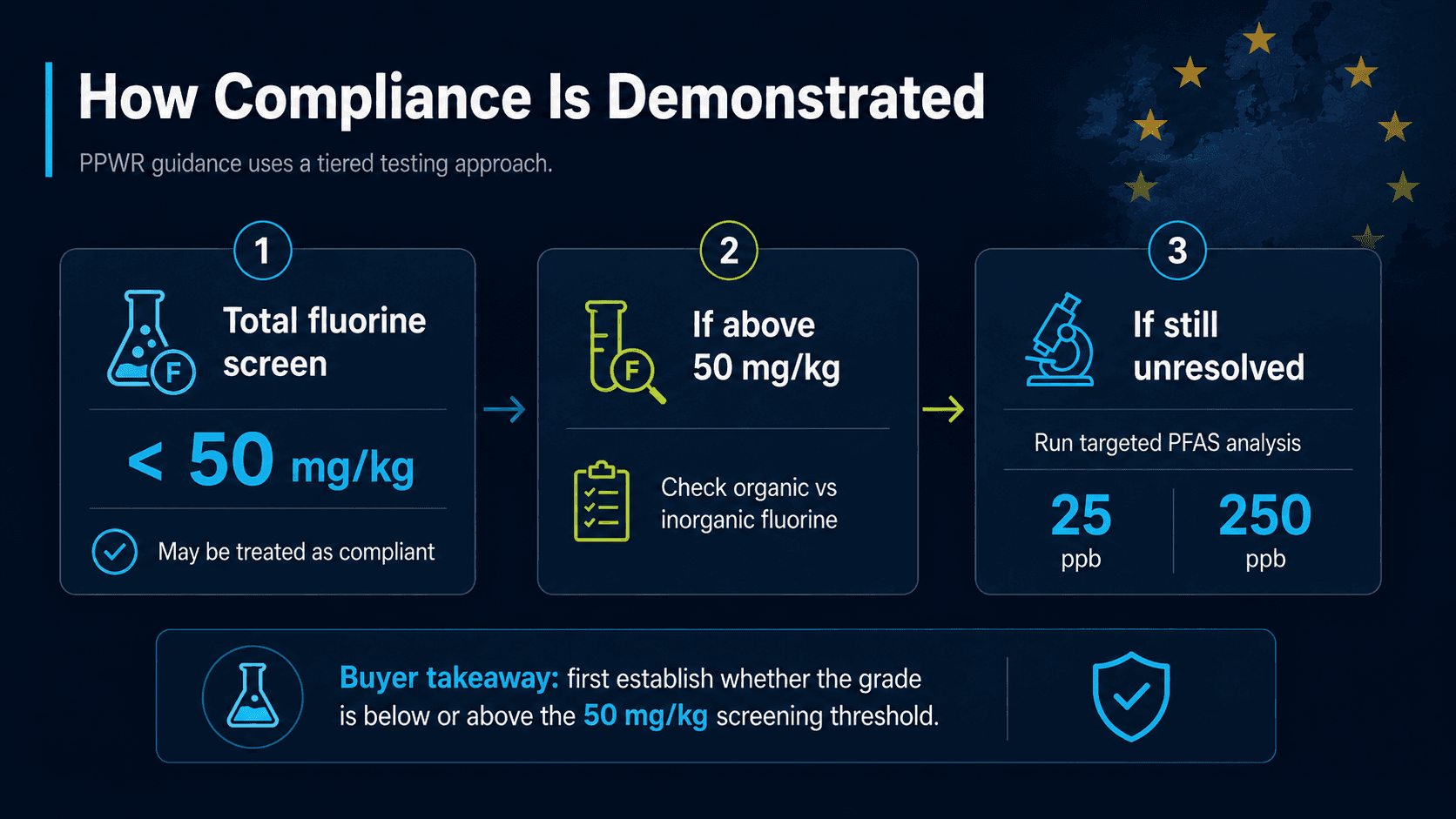
The European Commission's PPWR guidance, published as Commission Notice C(2026) 2151 in March 2026, sets out a tiered analytical approach rather than requiring full PFAS speciation on every sample. In outline: measure total fluorine first, and material below 50 mg/kg may be treated as compliant; where total fluorine is higher, distinguish organic from inorganic fluorine, since fluorine in a packaging material does not necessarily come from PFAS; and where that step does not resolve it, run targeted analysis against the 25 ppb and 250 ppb figures. Where total fluorine exceeds 50 mg/kg, the manufacturer or importer is expected to be able to show how much of it originates from PFAS.
For a buyer, the practical consequence is that the tiered structure makes a single cheap test useful. A result below the 50 mg/kg total-fluorine screening threshold can support a compliance presumption for that lot without commissioning compound-specific PFAS analysis at all; a result above it moves the conversation to organic fluorine and, if needed, targeted analysis. Knowing which of those two situations a grade is in is usually the first thing worth establishing.
What Buyers Should Ask For
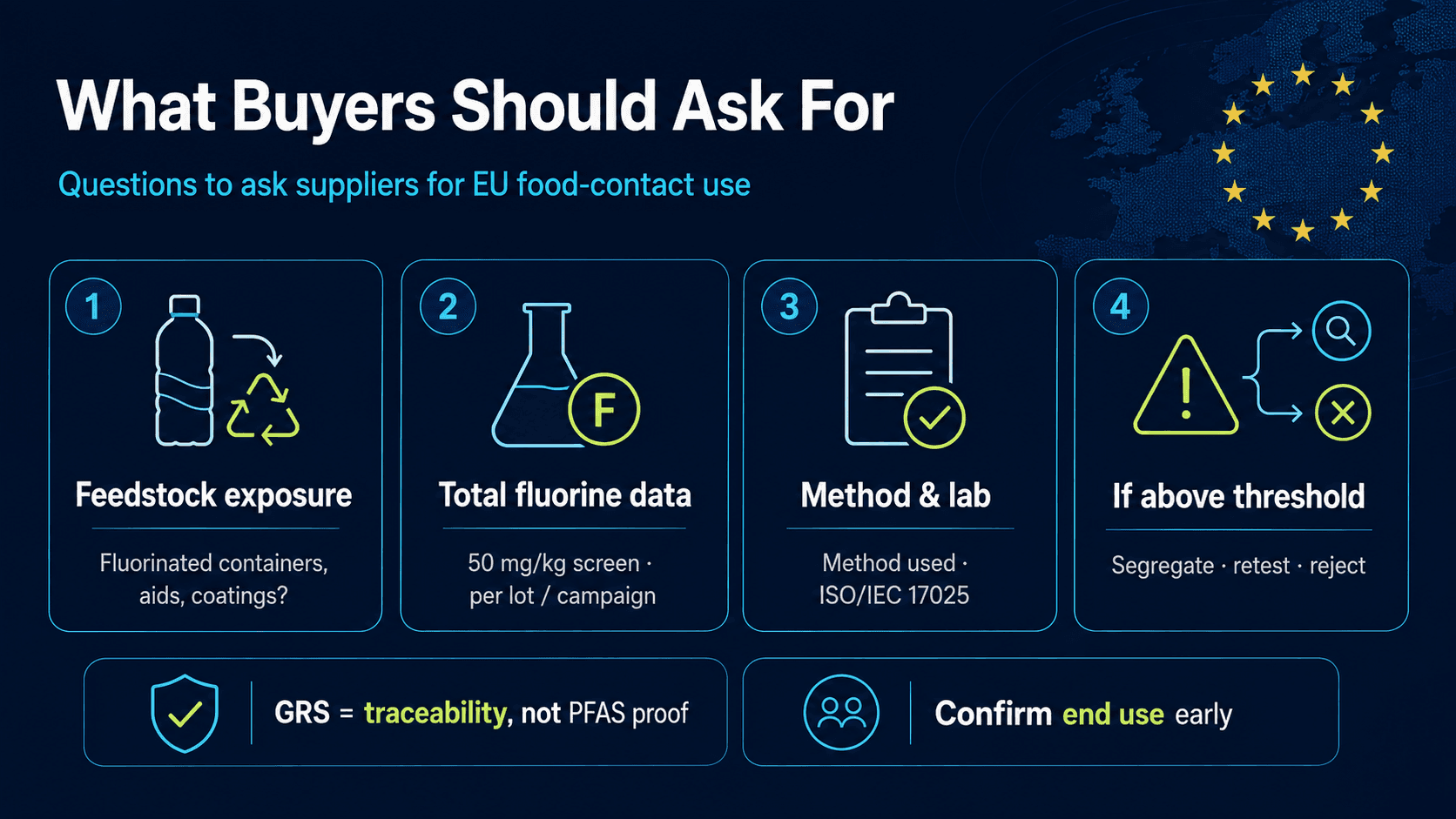
The restriction is on the packaging placed on the market, so obligations sit with the packaging manufacturer or importer — but the evidence has to come from upstream. Points worth raising with a supplier when a grade is destined for EU food-contact use:
Feedstock description at a level that lets you assess PFAS exposure — whether the input stream may include post-mould fluorinated containers, fluoropolymer processing aids, or fluorinated coatings.
Total fluorine screening data against the 50 mg/kg threshold, per lot or per production campaign, and whether the supplier can produce it on request rather than only once.
Which analytical method and laboratory produced any figure quoted — including whether the laboratory holds ISO/IEC 17025 accreditation for that method — since the three thresholds are defined against different measurement bases.
How the supplier handles a lot that screens above threshold — segregation, retesting, or rejection.
Chain-of-custody certification such as the Global Recycled Standard (GRS) addresses recycled-content traceability, not PFAS content — these are separate questions with separate evidence. Buyers with EU food-contact applications should therefore specify PFAS-related testing requirements explicitly at the enquiry stage, rather than treating a recycled-content certificate as covering them. Many recycled polyolefin grades are supplied for non-food applications, where the PPWR restriction as written does not apply; confirming the intended end use early determines which set of questions a supplier needs to answer.
Key Dates to Track
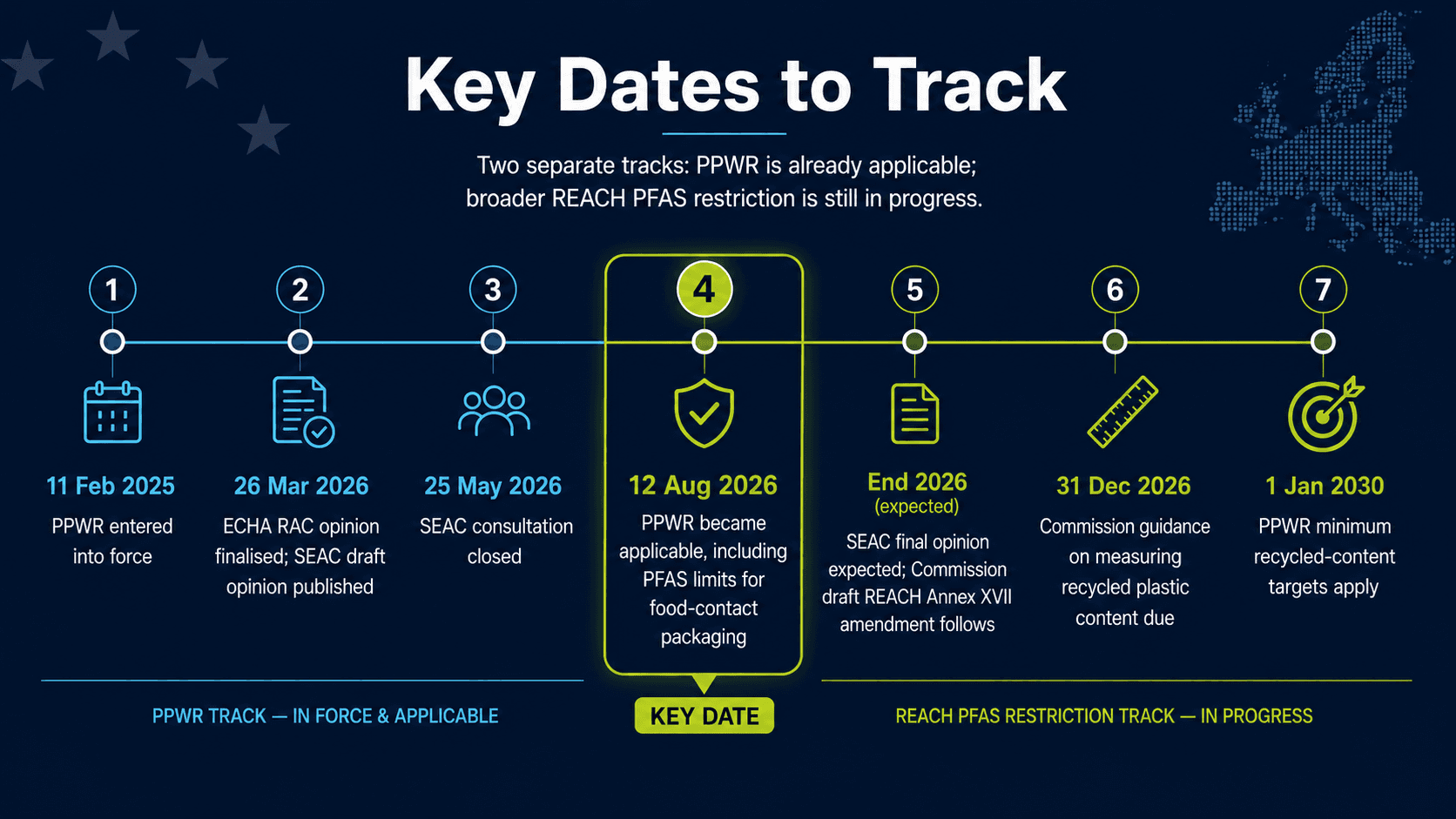
As of August 2026:
11 February 2025 | PPWR (Regulation (EU) 2025/40) entered into force. |
26 March 2026 | ECHA's Risk Assessment Committee (RAC) finalised its opinion on the proposed universal PFAS restriction under REACH; the Socio-Economic Analysis Committee (SEAC) published its draft opinion the same day. |
25 May 2026 | consultation on the SEAC draft opinion closed. |
12 August 2026 | PPWR became applicable, including the PFAS restriction on food-contact packaging. |
End of 2026 (expected) | SEAC to finalise its opinion, after which the European Commission would prepare a draft amendment to REACH Annex XVII. |
31 December 2026 | date by which the Commission is to develop guidance on measuring recycled plastic content. |
1 January 2030 | PPWR minimum recycled-content targets apply. |
These are two separate tracks and are easily conflated. The PPWR food-contact PFAS restriction applies from 12 August 2026 and is already law; the broader EU-wide PFAS restriction under REACH is still being prepared and would take effect through an amendment to REACH Annex XVII once adopted, on a timeline that has not been set.
Outside the EU, several US states brought intentionally-added-PFAS restrictions into effect during 2026, including Colorado, Maine and Vermont on 1 January and further Connecticut and Minnesota obligations on 1 July. These are framed around intentionally added PFAS rather than the concentration-in-material basis the PPWR uses, so the two regimes ask different questions of the same material.
Frequently Asked Questions
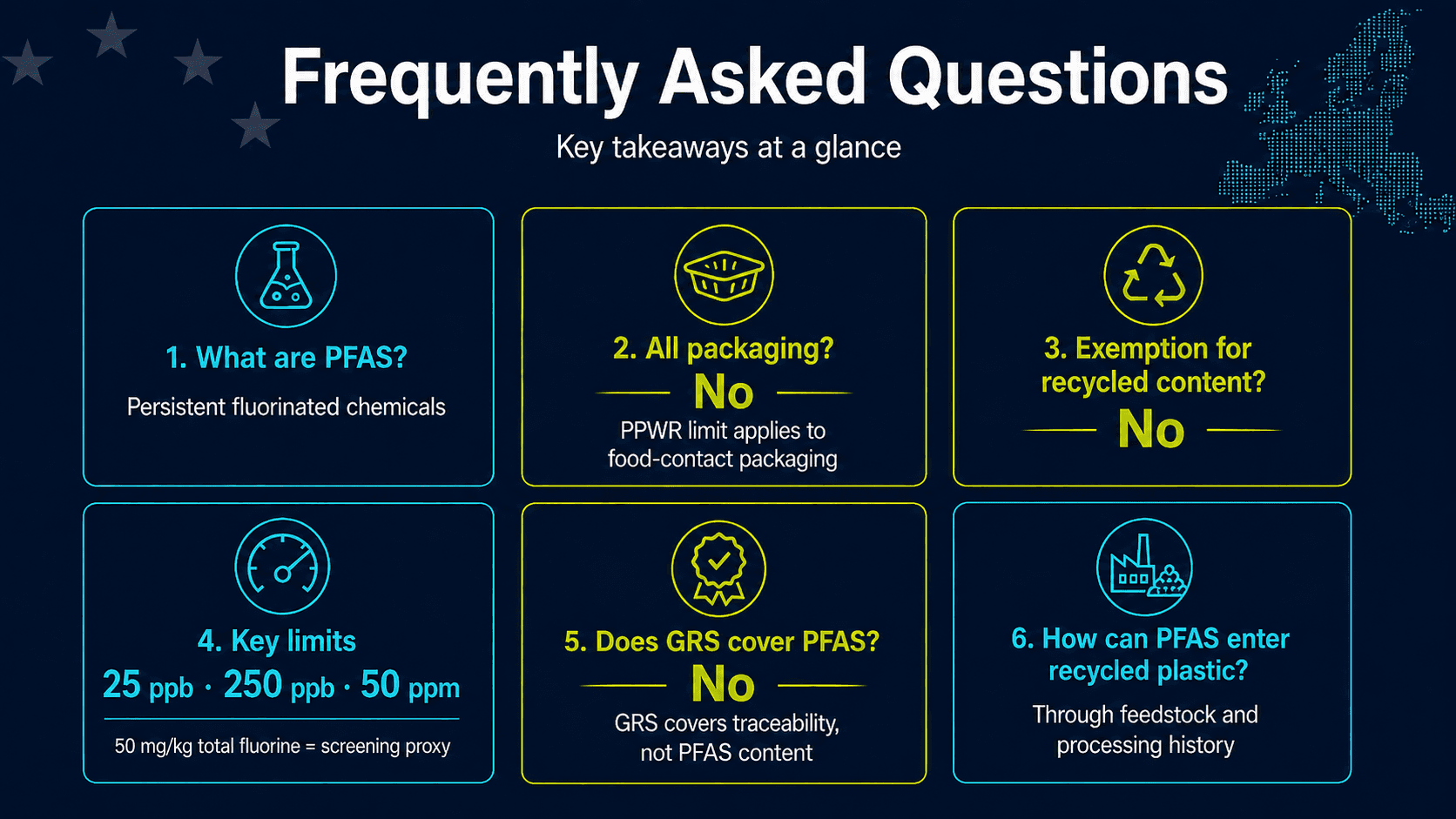
What are PFAS? PFAS — per- and polyfluoroalkyl substances — are a family of synthetic chemicals, commonly estimated at more than 10,000 substances, built around carbon–fluorine bonds that make them repel water, oil and heat. The same bond strength makes them resistant to breaking down in the environment, which is why they are often called "forever chemicals" and why regulators have focused on their persistence and accumulation.
Do the PPWR PFAS limits apply to all packaging? No. The PPWR restriction is written for packaging intended to come into contact with food. Packaging for non-food applications is outside that particular restriction, though other PFAS rules — including the proposed universal REACH restriction — are broader in scope.
Does recycled content have an exemption from the PFAS limits? No. The restriction applies to the packaging material irrespective of whether it is virgin or recycled, which means recycled-content targets and PFAS thresholds have to be met at the same time.
What are the actual numbers? At or above 25 ppb for any individual PFAS and 250 ppb for the sum of PFAS — both by targeted analysis excluding polymeric PFAS, with prior degradation of precursors where applicable — and 50 ppm for PFAS in total including polymeric PFAS. The 50 mg/kg total-fluorine figure that appears in the Commission's guidance is a screening proxy, not a fourth limit.
Does GRS certification cover PFAS? No. The Global Recycled Standard is a chain-of-custody standard for recycled content and traceability. PFAS content is a separate question requiring its own analytical evidence.
How can PFAS end up in recycled plastic? Through the feedstock. One documented route is post-mould fluorination of HDPE containers, which US EPA testing found can generate PFAS in the container wall; such containers can enter recycling streams. Whether any given grade is affected depends on its specific feedstock and processing history.
About This Guide
This guide is current as of August 2026 and is provided for general information only. It is not legal advice, and it is not an analytical or food-safety assessment of any material. Regulatory status, thresholds, guidance and enforcement can change, and national implementation varies — confirm specifics with qualified legal counsel and an accredited laboratory before relying on them.
Image generated with ChatGPT
The EU Packaging and Packaging Waste Regulation (PPWR), Regulation (EU) 2025/40, became applicable on 12 August 2026. Alongside the conformity and registration duties, one provision lands directly on material selection: a restriction on per- and polyfluoroalkyl substances (PFAS) in food-contact packaging. This guide follows our earlier posts on the PPWR itself and on the EmpCo Directive's rules for recycled claims. Where those covered how much recycled content is required and how it may be described, this one covers a limit that applies to the material regardless of whether it is virgin or recycled.
PFAS are not a single substance but a family of synthetic chemicals — the class is commonly estimated at more than 10,000 — built around carbon–fluorine bonds, among the strongest in organic chemistry. That bond is why PFAS repel water, oil and heat, and why they have been used in non-stick cookware coatings, water-repellent textiles, grease-resistant paper packaging and firefighting foams. It is also why they resist breaking down in the environment, which is the origin of the "forever chemicals" label. The regulatory concern is persistence and accumulation, and ECHA's Risk Assessment Committee cited exactly those properties in March 2026 when it concluded that an EU-wide restriction was the most appropriate measure.
What the PPWR PFAS Limits Actually Say
The restriction applies to packaging intended to come into contact with food, and it is written as a concentration limit in the packaging material — not as a migration limit into the food. Three thresholds apply, at or above which food-contact packaging may not be placed on the EU market:
Measurement basis | Limit |
|---|---|
Any individual PFAS (targeted analysis, polymeric PFAS excluded) | 25 ppb |
Sum of PFAS (targeted analysis, polymeric PFAS excluded; with prior degradation of precursors where applicable) | 250 ppb |
PFAS in total, including polymeric PFAS | 50 ppm |
One point of vocabulary is worth fixing early, because the same number appears twice with different meanings. The third row is a limit on PFAS, not on fluorine. Total fluorine also appears at 50 mg/kg — numerically identical to 50 ppm — but it does so in the Commission's guidance as a screening proxy, described below, not as the restriction itself. Fluorine in a packaging material does not necessarily originate from PFAS.
Two features matter for sourcing. First, the restriction covers both intentionally added PFAS and PFAS present without being intentionally added — so "we do not add any" is not, on its own, a demonstration of compliance. Second, the restriction contains no general stock-depletion grace period: packaging first placed on the market on or after 12 August 2026 must meet the limits regardless of when it was manufactured. Packaging already placed on the market before that date is not subject to withdrawal on this basis, though businesses should confirm how their national authority reads the boundary.
Recycled Content Gets No Exemption
This is the point most easily missed. The PPWR requires rising minimum recycled content in plastic packaging from 1 January 2030 — 30% for single-use plastic beverage bottles, 30% for contact-sensitive PET packaging other than those bottles, 10% for contact-sensitive plastic packaging other than PET, and 35% for other plastic packaging, with higher figures set for 2040. The PFAS restriction contains no corresponding allowance for recyclate. A producer is expected to raise recycled content and stay under the PFAS thresholds at the same time.
That matters because recycled feedstock carries whatever the original stream carried. The US Environmental Protection Agency's testing of fluorinated high-density polyethylene (HDPE) containers, published from 2021 onward, found that the post-mould fluorination process used to make containers solvent-resistant can itself generate PFAS in the container wall, which then leach into the contents over time. On 11 July 2024 EPA granted a Toxic Substances Control Act (TSCA) petition covering three PFAS — PFOA, PFNA and PFDA — formed during that fluorination process. Containers of that kind can enter mechanical recycling streams. Peer-reviewed measurement points the same way while keeping the scale in proportion: a 2025 study in Chemosphere, "Levels of perfluoroalkyl carboxylic acids in recycled plastic pellets," characterised what it found as a small input into the plastics cycle — measurable, but low.
Taken together, these do not say recycled plastic is a PFAS problem. They say the PFAS content of a given recycled grade is a property of its feedstock and its processing history, and therefore something to be established per grade rather than assumed either way.
How Compliance Is Demonstrated
The European Commission's PPWR guidance, published as Commission Notice C(2026) 2151 in March 2026, sets out a tiered analytical approach rather than requiring full PFAS speciation on every sample. In outline: measure total fluorine first, and material below 50 mg/kg may be treated as compliant; where total fluorine is higher, distinguish organic from inorganic fluorine, since fluorine in a packaging material does not necessarily come from PFAS; and where that step does not resolve it, run targeted analysis against the 25 ppb and 250 ppb figures. Where total fluorine exceeds 50 mg/kg, the manufacturer or importer is expected to be able to show how much of it originates from PFAS.
For a buyer, the practical consequence is that the tiered structure makes a single cheap test useful. A result below the 50 mg/kg total-fluorine screening threshold can support a compliance presumption for that lot without commissioning compound-specific PFAS analysis at all; a result above it moves the conversation to organic fluorine and, if needed, targeted analysis. Knowing which of those two situations a grade is in is usually the first thing worth establishing.
What Buyers Should Ask For
The restriction is on the packaging placed on the market, so obligations sit with the packaging manufacturer or importer — but the evidence has to come from upstream. Points worth raising with a supplier when a grade is destined for EU food-contact use:
Feedstock description at a level that lets you assess PFAS exposure — whether the input stream may include post-mould fluorinated containers, fluoropolymer processing aids, or fluorinated coatings.
Total fluorine screening data against the 50 mg/kg threshold, per lot or per production campaign, and whether the supplier can produce it on request rather than only once.
Which analytical method and laboratory produced any figure quoted — including whether the laboratory holds ISO/IEC 17025 accreditation for that method — since the three thresholds are defined against different measurement bases.
How the supplier handles a lot that screens above threshold — segregation, retesting, or rejection.
Chain-of-custody certification such as the Global Recycled Standard (GRS) addresses recycled-content traceability, not PFAS content — these are separate questions with separate evidence. Buyers with EU food-contact applications should therefore specify PFAS-related testing requirements explicitly at the enquiry stage, rather than treating a recycled-content certificate as covering them. Many recycled polyolefin grades are supplied for non-food applications, where the PPWR restriction as written does not apply; confirming the intended end use early determines which set of questions a supplier needs to answer.
Key Dates to Track
As of August 2026:
11 February 2025 | PPWR (Regulation (EU) 2025/40) entered into force. |
26 March 2026 | ECHA's Risk Assessment Committee (RAC) finalised its opinion on the proposed universal PFAS restriction under REACH; the Socio-Economic Analysis Committee (SEAC) published its draft opinion the same day. |
25 May 2026 | consultation on the SEAC draft opinion closed. |
12 August 2026 | PPWR became applicable, including the PFAS restriction on food-contact packaging. |
End of 2026 (expected) | SEAC to finalise its opinion, after which the European Commission would prepare a draft amendment to REACH Annex XVII. |
31 December 2026 | date by which the Commission is to develop guidance on measuring recycled plastic content. |
1 January 2030 | PPWR minimum recycled-content targets apply. |
These are two separate tracks and are easily conflated. The PPWR food-contact PFAS restriction applies from 12 August 2026 and is already law; the broader EU-wide PFAS restriction under REACH is still being prepared and would take effect through an amendment to REACH Annex XVII once adopted, on a timeline that has not been set.
Outside the EU, several US states brought intentionally-added-PFAS restrictions into effect during 2026, including Colorado, Maine and Vermont on 1 January and further Connecticut and Minnesota obligations on 1 July. These are framed around intentionally added PFAS rather than the concentration-in-material basis the PPWR uses, so the two regimes ask different questions of the same material.
Frequently Asked Questions
What are PFAS? PFAS — per- and polyfluoroalkyl substances — are a family of synthetic chemicals, commonly estimated at more than 10,000 substances, built around carbon–fluorine bonds that make them repel water, oil and heat. The same bond strength makes them resistant to breaking down in the environment, which is why they are often called "forever chemicals" and why regulators have focused on their persistence and accumulation.
Do the PPWR PFAS limits apply to all packaging? No. The PPWR restriction is written for packaging intended to come into contact with food. Packaging for non-food applications is outside that particular restriction, though other PFAS rules — including the proposed universal REACH restriction — are broader in scope.
Does recycled content have an exemption from the PFAS limits? No. The restriction applies to the packaging material irrespective of whether it is virgin or recycled, which means recycled-content targets and PFAS thresholds have to be met at the same time.
What are the actual numbers? At or above 25 ppb for any individual PFAS and 250 ppb for the sum of PFAS — both by targeted analysis excluding polymeric PFAS, with prior degradation of precursors where applicable — and 50 ppm for PFAS in total including polymeric PFAS. The 50 mg/kg total-fluorine figure that appears in the Commission's guidance is a screening proxy, not a fourth limit.
Does GRS certification cover PFAS? No. The Global Recycled Standard is a chain-of-custody standard for recycled content and traceability. PFAS content is a separate question requiring its own analytical evidence.
How can PFAS end up in recycled plastic? Through the feedstock. One documented route is post-mould fluorination of HDPE containers, which US EPA testing found can generate PFAS in the container wall; such containers can enter recycling streams. Whether any given grade is affected depends on its specific feedstock and processing history.
About This Guide
This guide is current as of August 2026 and is provided for general information only. It is not legal advice, and it is not an analytical or food-safety assessment of any material. Regulatory status, thresholds, guidance and enforcement can change, and national implementation varies — confirm specifics with qualified legal counsel and an accredited laboratory before relying on them.
Image generated with ChatGPT
Where rHDPE Is Used Today
Grades • Specs • Availability
Browse rHDPE →
Where rHDPE Is Used Today
Where rHDPE Is Used Today
Review rHDPE grades for non-food applications by feedstock, properties and stock.
Review rHDPE grades for non-food applications by feedstock, properties and stock.
Browse rHDPE →
Browse rHDPE →
Looking for samples or ready to source? Submit your request for pricing, availability, and technical information.
Looking for samples or ready to source? Submit your request for pricing, availability, and technical information.
Request a Quote →
Request a Quote →
Posted by REGENPORT
REGENPORT is a global platform connecting buyers and suppliers in the recycled materials and sustainable packaging industries.