CATEGORY
CATEGORY
News
News
News
Braskem's $10.9 Billion Restructuring: What PCR Buyers Should Watch
Braskem's $10.9 Billion Restructuring: What PCR Buyers Should Watch
Braskem's $10.9 Billion Restructuring: What PCR Buyers Should Watch

Braskem, the Brazilian petrochemical company behind the Wenew recycled-content portfolio, has filed for an out-of-court restructuring covering approximately $10.9 billion in financial debt. The reported plan covers financial obligations rather than debts to suppliers or customers. For PCR buyers, the immediate question isn't whether Braskem's shipments stop tomorrow — it's how much confidence to place in the company's longer-term recycled-content expansion plans while its financial position is being renegotiated.
What Braskem Actually Makes
Braskem is the largest thermoplastic resin producer in the Americas and the leading polypropylene (PP) producer in the United States, with significant polyethylene (PE) and PVC production (2024 net revenue: more than $14.4 billion; thermoplastic resin capacity: roughly 9.3 million tons). Notably, it does not produce PET directly — its core resins are PP, PE and PVC. That matters here: the food-contact PCR business discussed below (including Wenew) is built on recycled PP and PE, not PET. Where PET appears later in this piece, it's a comparison point from a different, adjacent part of the recycled-plastics industry — not a Braskem product line.
The Immediate Supply Question
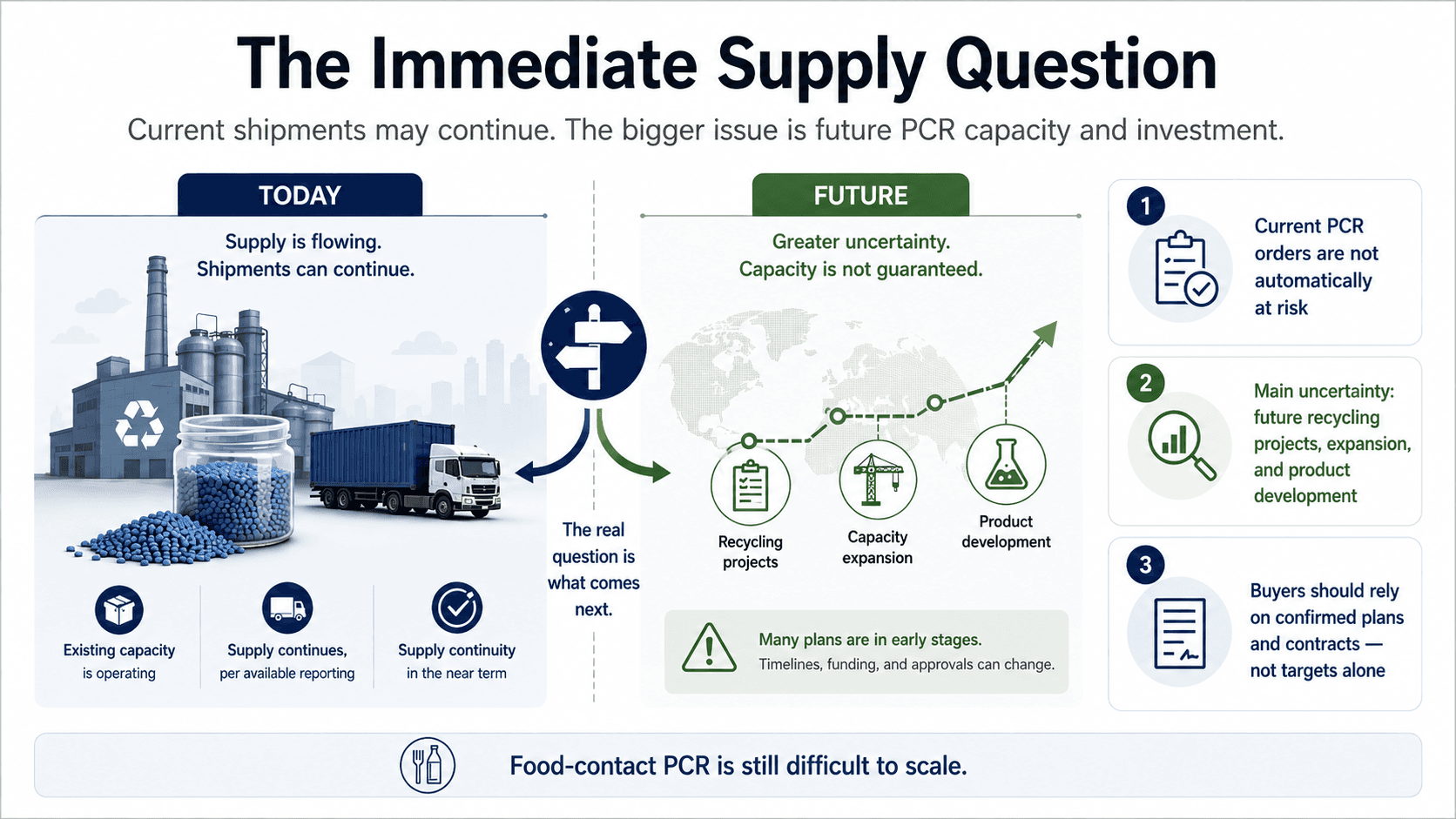
Because Wenew's recycled PP and PE sit on top of Braskem's much larger virgin-resin business, the restructuring's most direct relevance to PCR buyers is about future capacity and investment — not about whether today's shipments continue. The restructuring does not automatically mean current Braskem PCR orders are at risk: a company can keep serving existing customers while still delaying or reprioritizing new recycling projects, capacity expansions or product-development plans.
That distinction matters for buyers building multi-year recycled-content programs. Public sustainability targets can show a company's strategic direction, but shouldn't be treated as guaranteed future capacity unless backed by confirmed production plans and contractual commitments — and that capacity question would matter less if food-contact PCR were an easy market to expand into. It isn't, which is the backdrop the next two sections lay out before returning to what buyers should actually do.
Why Food-Contact PCR Is Already Tight
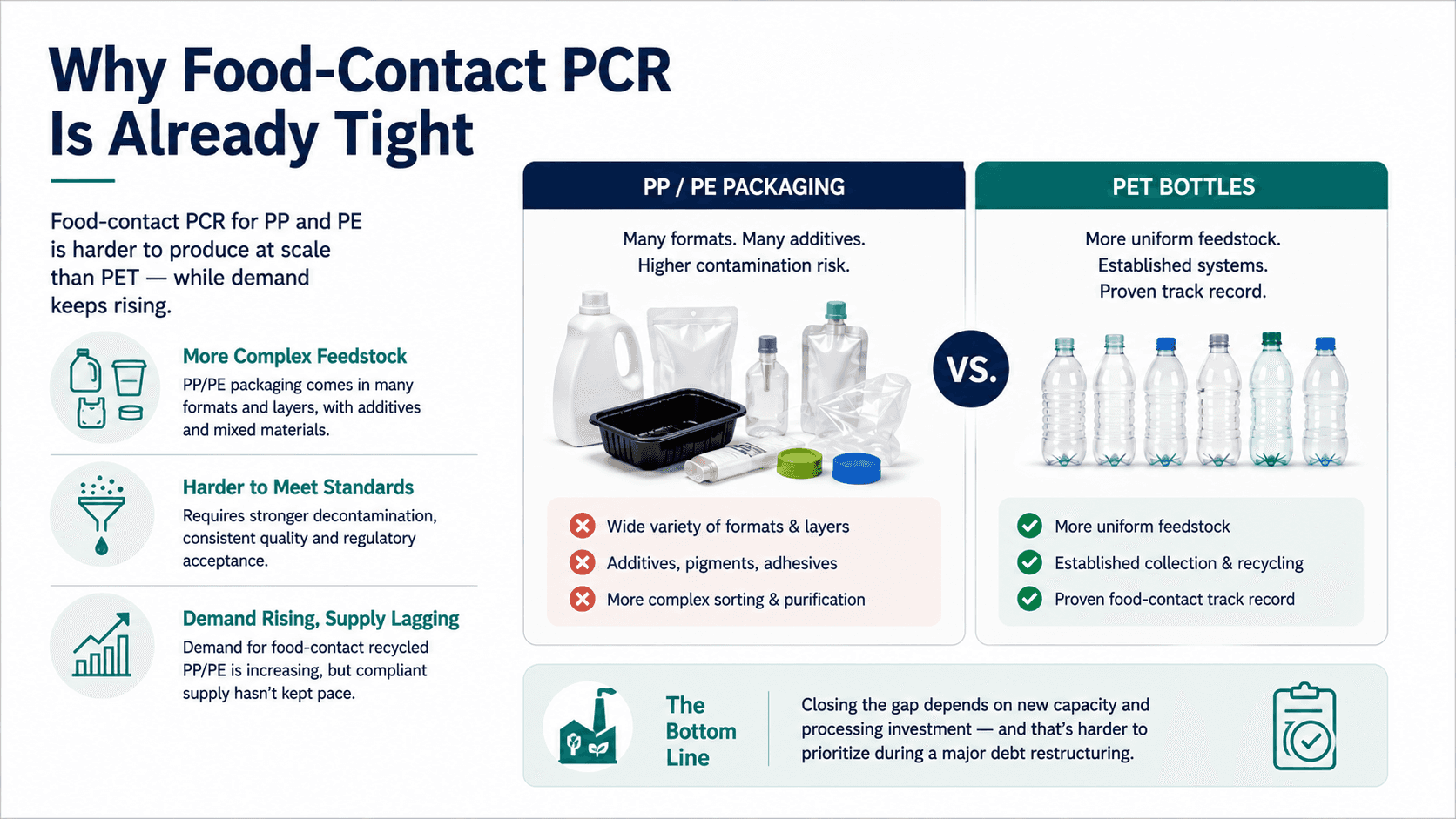
Braskem's restructuring comes at a difficult time for the food-contact PCR market — a market where Braskem, as one of the largest PP and PE producers in the Americas, is also one of the companies positioned to help expand supply through its Wenew recycled-content line. That's the connection worth keeping in mind through this section: the tighter the underlying market already is, the more a large supplier's reduced room to invest in new capacity matters.
Food-contact recycled polypropylene and polyethylene are more difficult to produce consistently at scale than recycled PET. Polyolefin packaging enters the waste stream through a much wider range of formats — rigid containers, films, closures, multilayer structures, flexible packaging — carrying pigments, fillers, adhesives, barrier layers and other additives, and often mixed in with non-food packaging. That variable feedstock makes sorting, purification and decontamination harder. PET, by contrast, benefits from more established bottle collection systems, a more uniform feedstock and a longer regulatory track record in food-contact recycling.
Mechanical recycling remains important where feedstock is well controlled and the end use is less demanding, but producing recycled PP or PE for direct food-contact use takes more than collecting and reprocessing used packaging — recyclers must demonstrate effective contaminant control, consistent quality, traceability and regulatory acceptance. As a result, food-contact-compliant PCR remains much more limited than general-purpose recycled PP or PE.
The result is a structural market mismatch: demand for food-contact recycled polyolefins is increasing, but supply that meets regulatory and performance requirements hasn't expanded at the same pace. Closing that gap depends on new capacity and processing investment — exactly the kind of spending a company is least able to prioritize while renegotiating billions of dollars in debt.
The Role of Advanced Recycling
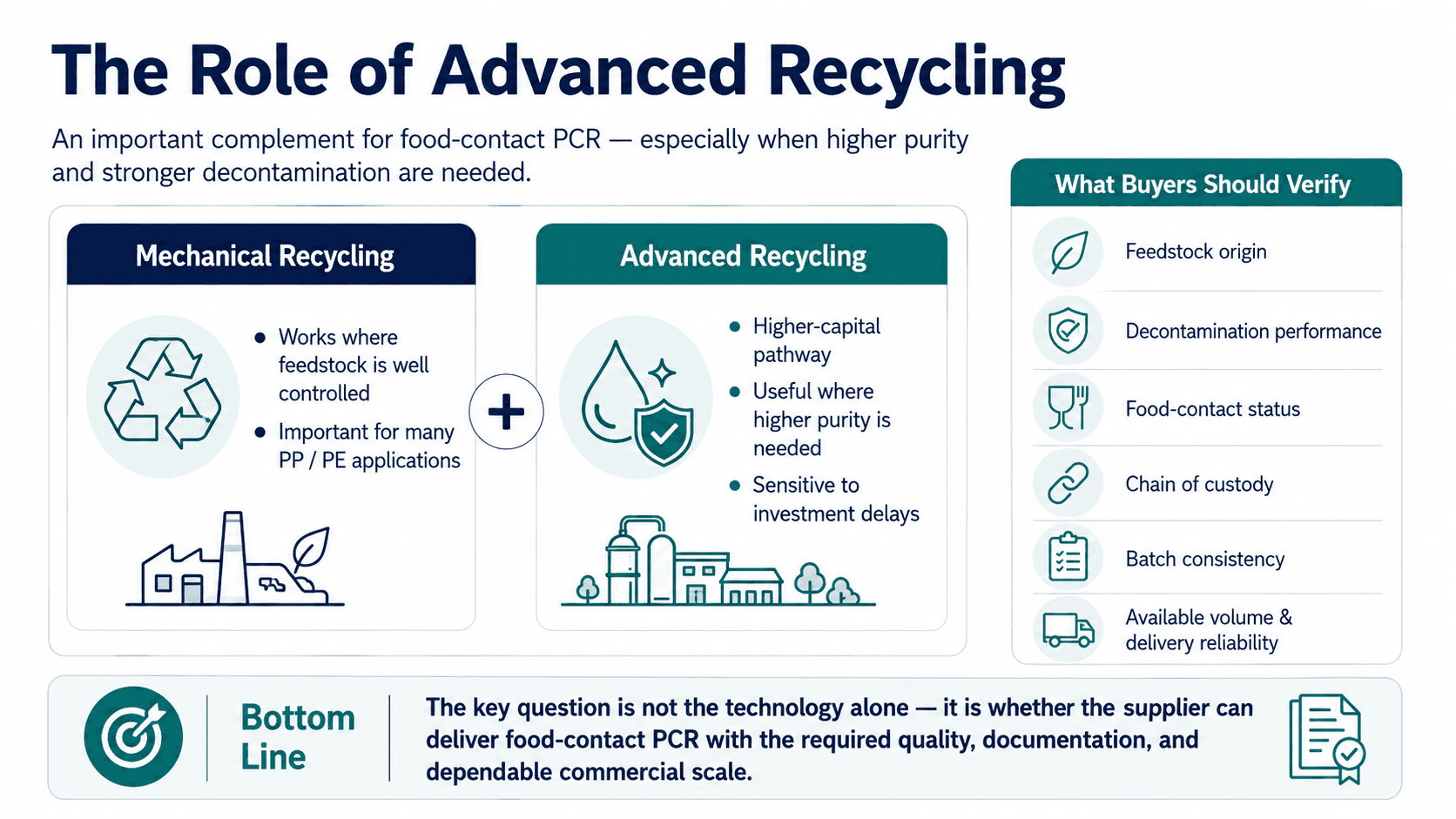
This supply gap is increasing interest in advanced, or "molecular," recycling — one of the more capital-intensive routes to closing it, and so one of the areas most sensitive to whether a major producer's investment plans hold up during a restructuring. It shouldn't be described as mandatory for every food-contact PP or PE application — mechanical recycling will keep serving markets where feedstock quality and end-use requirements allow it — but advanced recycling may become an important complementary route where higher purity or more consistent decontamination is required.
For buyers, the key issue isn't choosing one technology in isolation; it's verifying whether the selected process delivers the required quality and regulatory documentation at a dependable commercial scale. A PCR specification should cover more than recycled-content percentage — feedstock origin, decontamination performance, food-contact regulatory status, chain-of-custody, melt flow/color/batch-to-batch consistency, and available volume and delivery reliability all matter. A supplier offering recycled PP or PE is not necessarily one that can supply food-contact PCR in stable commercial quantities.
Lessons from the rPET Market
Braskem isn't the only sign that recycling capacity can come under strain when producers face financial pressure. The U.S. rPET market — a different resin, a different set of companies, and a different cause — shows what that strain can look like once it plays out.
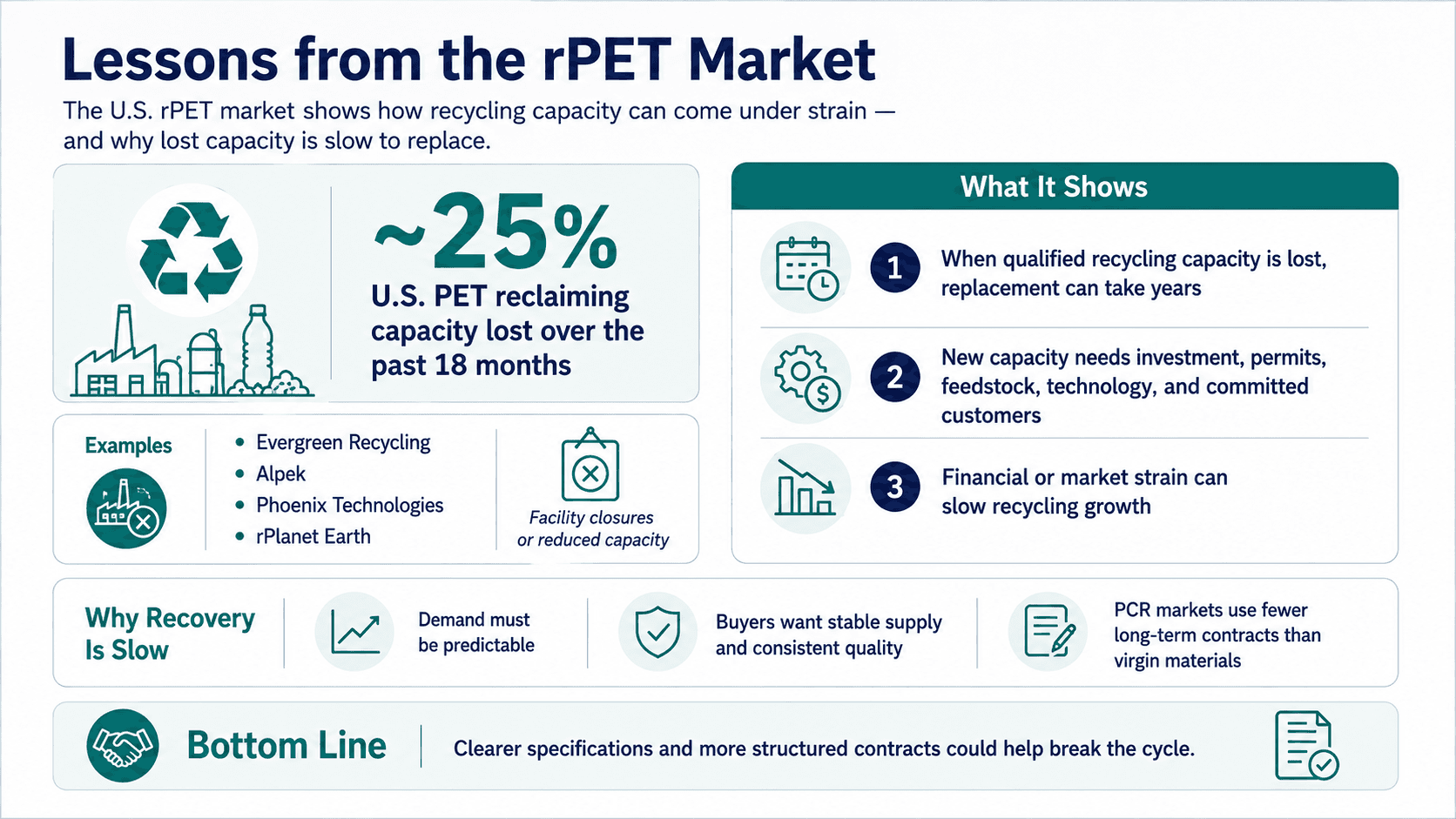
Resource Recycling reported that the United States has lost approximately 25% of its PET reclaiming capacity over the past 18 months. Companies including Evergreen Recycling, Alpek, Phoenix Technologies and rPlanet Earth have closed facilities or reduced capacity amid factors such as low-priced virgin resin imports and weak demand.
PET and PP/PE have different feedstocks, technologies and market structures, and the RPET closures were driven by different causes (import pricing and demand, not a debt restructuring) — so this shouldn't be treated as direct evidence that Braskem's PCR supply will be disrupted. What it illustrates is the general pattern worth watching: once qualified recycling capacity is lost, replacing it can take years, since new projects require investment, permits, reliable feedstock, technology and committed customers — regardless of what caused the original strain.
The report also highlights why that capacity is often slow to come back: recyclers need predictable demand to justify investment, buyers need stable supply and consistent quality, yet recycled-plastics markets still use far fewer long-term contracts than virgin-material markets — partly because PCR pricing, quality and specifications are harder to standardize. That leaves both sides hesitant (buyers to commit long-term, recyclers to invest without it), a cycle that clearer specifications and more structured contracts could help break.
What PCR Buyers Should Do
Put together, the picture is this: Braskem's current shipments aren't reported to be at risk, but the restructuring lands on a food-contact PCR market that was already tight before it happened, that depends on continued capital investment (including in advanced recycling) to close that gap, and where the RPET market has shown how quickly capacity can erode once a producer group comes under financial strain — for any reason. None of that means buyers need to assume Braskem orders will stop. It does mean the restructuring is a reasonable trigger to review longer-term sourcing exposure now rather than later.
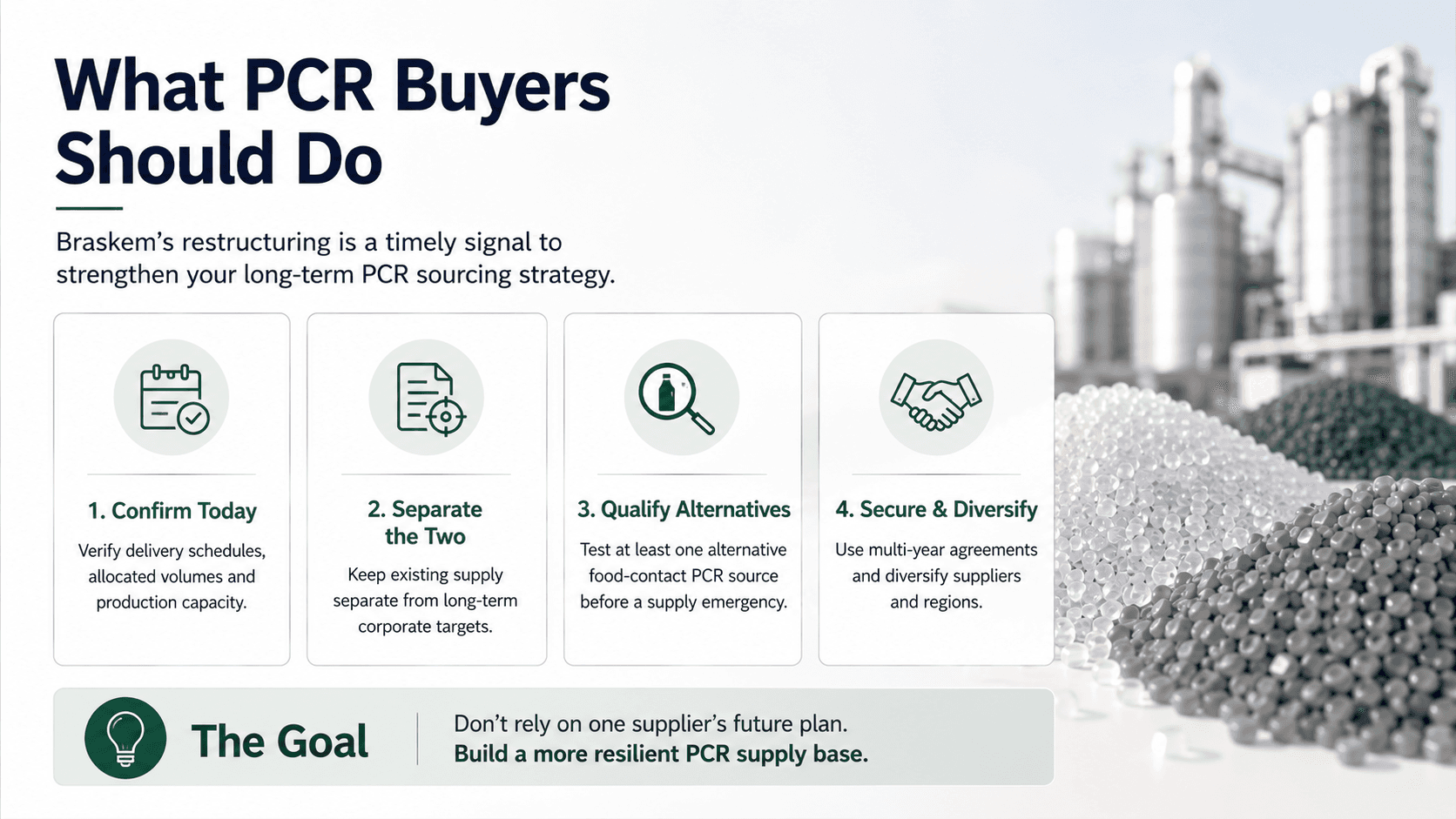
Procurement teams should:
Confirm current delivery schedules and allocated volumes, and ask suppliers about production sites, recycling technologies and available capacity
Separate existing contractual supply from long-term corporate targets
Begin qualifying and testing at least one alternative food-contact PCR PP or PE source, verifying food-contact approvals, traceability and quality-control documentation — before a supply emergency, not during one
Where possible, use multi-year agreements with clearly defined quality, volume and pricing conditions, and diversify suppliers and regions
The objective is not necessarily to replace Braskem. It is to avoid relying on one supplier's future expansion plan in a market where qualified food-contact PCR capacity is already limited.
Frequently Asked Questions
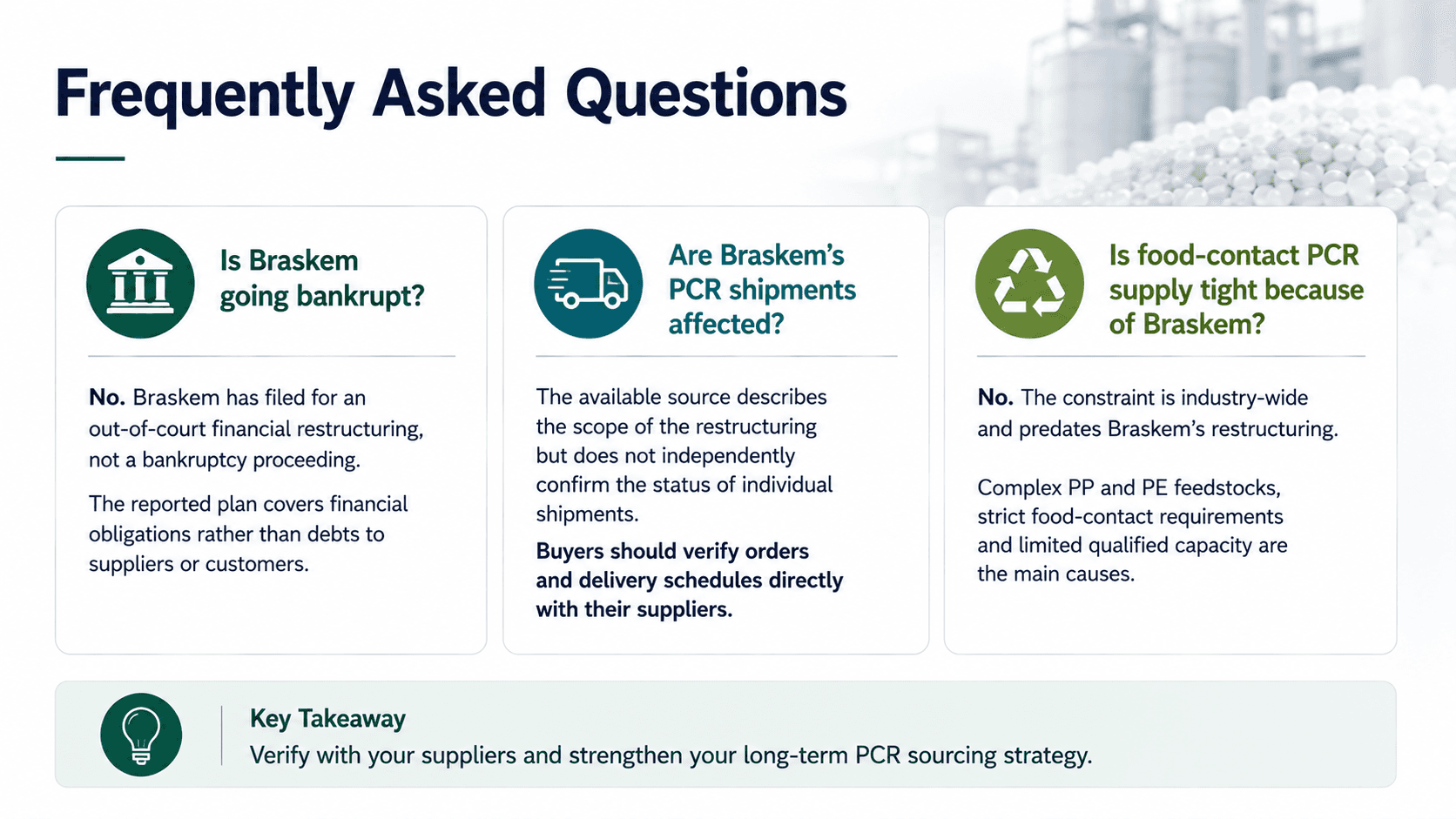
Is Braskem going bankrupt? No. Braskem has filed for an out-of-court financial restructuring, not a bankruptcy proceeding. The reported plan covers financial obligations rather than debts to suppliers or customers.
Are Braskem's PCR shipments affected? The available source describes the scope of the restructuring but does not independently confirm the status of individual shipments. Buyers should verify orders and delivery schedules directly with their suppliers.
Is food-contact PCR supply tight because of Braskem? No. The constraint is industry-wide and predates Braskem's restructuring. Complex PP and PE feedstocks, strict food-contact requirements and limited qualified capacity are the main causes.
About This Article
Information is current as of September 1, 2026, based on Braskem restructuring coverage from Rio Times Online, food-grade PCR analysis from Plastics Engineering and RPET market coverage from Resource Recycling. This article is not investment advice. Buyers should verify product availability, contractual commitments, regulatory documentation and delivery schedules directly with their suppliers.
Image generated with ChatGPT
Sources
Braskem, "Profile and History" (company profile, production capacity, market position) → Read the SourceRio Times Online, "Brazil's Braskem Files For Extrajudicial Recovery On US$10.9 Billion Debt" → Read the Source
Plastics Engineering, "Why Food-Grade PCR Supply Still Lags in Food Packaging" → Read the Source
Resource Recycling, "With RPET in crisis, focus turns to solutions" → Read the Source
What Braskem Actually Makes
Braskem is the largest thermoplastic resin producer in the Americas and the leading polypropylene (PP) producer in the United States, with significant polyethylene (PE) and PVC production (2024 net revenue: more than $14.4 billion; thermoplastic resin capacity: roughly 9.3 million tons). Notably, it does not produce PET directly — its core resins are PP, PE and PVC. That matters here: the food-contact PCR business discussed below (including Wenew) is built on recycled PP and PE, not PET. Where PET appears later in this piece, it's a comparison point from a different, adjacent part of the recycled-plastics industry — not a Braskem product line.
The Immediate Supply Question
Because Wenew's recycled PP and PE sit on top of Braskem's much larger virgin-resin business, the restructuring's most direct relevance to PCR buyers is about future capacity and investment — not about whether today's shipments continue. The restructuring does not automatically mean current Braskem PCR orders are at risk: a company can keep serving existing customers while still delaying or reprioritizing new recycling projects, capacity expansions or product-development plans.
That distinction matters for buyers building multi-year recycled-content programs. Public sustainability targets can show a company's strategic direction, but shouldn't be treated as guaranteed future capacity unless backed by confirmed production plans and contractual commitments — and that capacity question would matter less if food-contact PCR were an easy market to expand into. It isn't, which is the backdrop the next two sections lay out before returning to what buyers should actually do.
Why Food-Contact PCR Is Already Tight
Braskem's restructuring comes at a difficult time for the food-contact PCR market — a market where Braskem, as one of the largest PP and PE producers in the Americas, is also one of the companies positioned to help expand supply through its Wenew recycled-content line. That's the connection worth keeping in mind through this section: the tighter the underlying market already is, the more a large supplier's reduced room to invest in new capacity matters.
Food-contact recycled polypropylene and polyethylene are more difficult to produce consistently at scale than recycled PET. Polyolefin packaging enters the waste stream through a much wider range of formats — rigid containers, films, closures, multilayer structures, flexible packaging — carrying pigments, fillers, adhesives, barrier layers and other additives, and often mixed in with non-food packaging. That variable feedstock makes sorting, purification and decontamination harder. PET, by contrast, benefits from more established bottle collection systems, a more uniform feedstock and a longer regulatory track record in food-contact recycling.
Mechanical recycling remains important where feedstock is well controlled and the end use is less demanding, but producing recycled PP or PE for direct food-contact use takes more than collecting and reprocessing used packaging — recyclers must demonstrate effective contaminant control, consistent quality, traceability and regulatory acceptance. As a result, food-contact-compliant PCR remains much more limited than general-purpose recycled PP or PE.
The result is a structural market mismatch: demand for food-contact recycled polyolefins is increasing, but supply that meets regulatory and performance requirements hasn't expanded at the same pace. Closing that gap depends on new capacity and processing investment — exactly the kind of spending a company is least able to prioritize while renegotiating billions of dollars in debt.
The Role of Advanced Recycling
This supply gap is increasing interest in advanced, or "molecular," recycling — one of the more capital-intensive routes to closing it, and so one of the areas most sensitive to whether a major producer's investment plans hold up during a restructuring. It shouldn't be described as mandatory for every food-contact PP or PE application — mechanical recycling will keep serving markets where feedstock quality and end-use requirements allow it — but advanced recycling may become an important complementary route where higher purity or more consistent decontamination is required.
For buyers, the key issue isn't choosing one technology in isolation; it's verifying whether the selected process delivers the required quality and regulatory documentation at a dependable commercial scale. A PCR specification should cover more than recycled-content percentage — feedstock origin, decontamination performance, food-contact regulatory status, chain-of-custody, melt flow/color/batch-to-batch consistency, and available volume and delivery reliability all matter. A supplier offering recycled PP or PE is not necessarily one that can supply food-contact PCR in stable commercial quantities.
Lessons from the rPET Market
Braskem isn't the only sign that recycling capacity can come under strain when producers face financial pressure. The U.S. rPET market — a different resin, a different set of companies, and a different cause — shows what that strain can look like once it plays out.
Resource Recycling reported that the United States has lost approximately 25% of its PET reclaiming capacity over the past 18 months. Companies including Evergreen Recycling, Alpek, Phoenix Technologies and rPlanet Earth have closed facilities or reduced capacity amid factors such as low-priced virgin resin imports and weak demand.
PET and PP/PE have different feedstocks, technologies and market structures, and the RPET closures were driven by different causes (import pricing and demand, not a debt restructuring) — so this shouldn't be treated as direct evidence that Braskem's PCR supply will be disrupted. What it illustrates is the general pattern worth watching: once qualified recycling capacity is lost, replacing it can take years, since new projects require investment, permits, reliable feedstock, technology and committed customers — regardless of what caused the original strain.
The report also highlights why that capacity is often slow to come back: recyclers need predictable demand to justify investment, buyers need stable supply and consistent quality, yet recycled-plastics markets still use far fewer long-term contracts than virgin-material markets — partly because PCR pricing, quality and specifications are harder to standardize. That leaves both sides hesitant (buyers to commit long-term, recyclers to invest without it), a cycle that clearer specifications and more structured contracts could help break.
What PCR Buyers Should Do
Put together, the picture is this: Braskem's current shipments aren't reported to be at risk, but the restructuring lands on a food-contact PCR market that was already tight before it happened, that depends on continued capital investment (including in advanced recycling) to close that gap, and where the RPET market has shown how quickly capacity can erode once a producer group comes under financial strain — for any reason. None of that means buyers need to assume Braskem orders will stop. It does mean the restructuring is a reasonable trigger to review longer-term sourcing exposure now rather than later.
Procurement teams should:
Confirm current delivery schedules and allocated volumes, and ask suppliers about production sites, recycling technologies and available capacity
Separate existing contractual supply from long-term corporate targets
Begin qualifying and testing at least one alternative food-contact PCR PP or PE source, verifying food-contact approvals, traceability and quality-control documentation — before a supply emergency, not during one
Where possible, use multi-year agreements with clearly defined quality, volume and pricing conditions, and diversify suppliers and regions
The objective is not necessarily to replace Braskem. It is to avoid relying on one supplier's future expansion plan in a market where qualified food-contact PCR capacity is already limited.
Frequently Asked Questions
Is Braskem going bankrupt? No. Braskem has filed for an out-of-court financial restructuring, not a bankruptcy proceeding. The reported plan covers financial obligations rather than debts to suppliers or customers.
Are Braskem's PCR shipments affected? The available source describes the scope of the restructuring but does not independently confirm the status of individual shipments. Buyers should verify orders and delivery schedules directly with their suppliers.
Is food-contact PCR supply tight because of Braskem? No. The constraint is industry-wide and predates Braskem's restructuring. Complex PP and PE feedstocks, strict food-contact requirements and limited qualified capacity are the main causes.
About This Article
Information is current as of September 1, 2026, based on Braskem restructuring coverage from Rio Times Online, food-grade PCR analysis from Plastics Engineering and RPET market coverage from Resource Recycling. This article is not investment advice. Buyers should verify product availability, contractual commitments, regulatory documentation and delivery schedules directly with their suppliers.
Image generated with ChatGPT
Sources
Braskem, "Profile and History" (company profile, production capacity, market position) → Read the SourceRio Times Online, "Brazil's Braskem Files For Extrajudicial Recovery On US$10.9 Billion Debt" → Read the Source
Plastics Engineering, "Why Food-Grade PCR Supply Still Lags in Food Packaging" → Read the Source
Resource Recycling, "With RPET in crisis, focus turns to solutions" → Read the Source
Checking rPP Supply Options
Grades • Specs • Availability
Browse rPP →
Checking rPP Supply Options
Checking rPP Supply Options
Review rPP grades from multiple suppliers by feedstock, properties, stock and MOQ.
Review rPP grades from multiple suppliers by feedstock, properties, stock and MOQ.
Browse rPP →
Browse rPP →
Looking for samples or ready to source? Submit your request for pricing, availability, and technical information.
Looking for samples or ready to source? Submit your request for pricing, availability, and technical information.
Request a Quote →
Request a Quote →
Posted by REGENPORT
REGENPORT is a global platform connecting buyers and suppliers in the recycled materials and sustainable packaging industries.