CATEGORY
CATEGORY
News
News
News
The rPET Reclamation Crisis Is Pushing PCR Buyers to Diversify Beyond PET
The rPET Reclamation Crisis Is Pushing PCR Buyers to Diversify Beyond PET
The rPET Reclamation Crisis Is Pushing PCR Buyers to Diversify Beyond PET

A wave of U.S. PET reclaimer closures is exposing how fragile a single-resin sourcing strategy has become. As rPET supply tightens and import dependence grows, procurement teams working with recycled content are increasingly spreading their sourcing across other polymer streams instead of leaning on one material alone.
According to Packaging Dive's recent reporting on the U.S. postconsumer resin market, the U.S. recycled PET (rPET) market has lost roughly a quarter of its reclamation capacity over the past 12 to 18 months — a figure industry stakeholders also raised at this year's Plastics Recycling Conference. Per Packaging Dive, at least four U.S. PET reclaimers shut down operations in 2025 alone — including Evergreen Recycling's Riverside, California facility and rPlanet Earth, which by some estimates held close to 4% of total U.S. rPET processing capacity — with at least one more closure already announced in 2026. At that same conference, one panelist described the situation for recycled PET bottles and thermoformed packaging as a "crisis," according to Recycling Today's coverage of the event.
For buyers who built sourcing strategies around a single resin, the closures are a reminder that reclamation capacity can shrink faster than demand adjusts — and that supply risk in recycled plastics is rarely evenly distributed across materials.
The market diagnosis above draws on reporting from Packaging Dive and the Plastics Recycling Conference sessions covered by Recycling Today. The analysis in the sections below is Regenport's own reading of what these trends mean for procurement teams, not a claim made by either source.
Why rPET Reclaimers Are Struggling
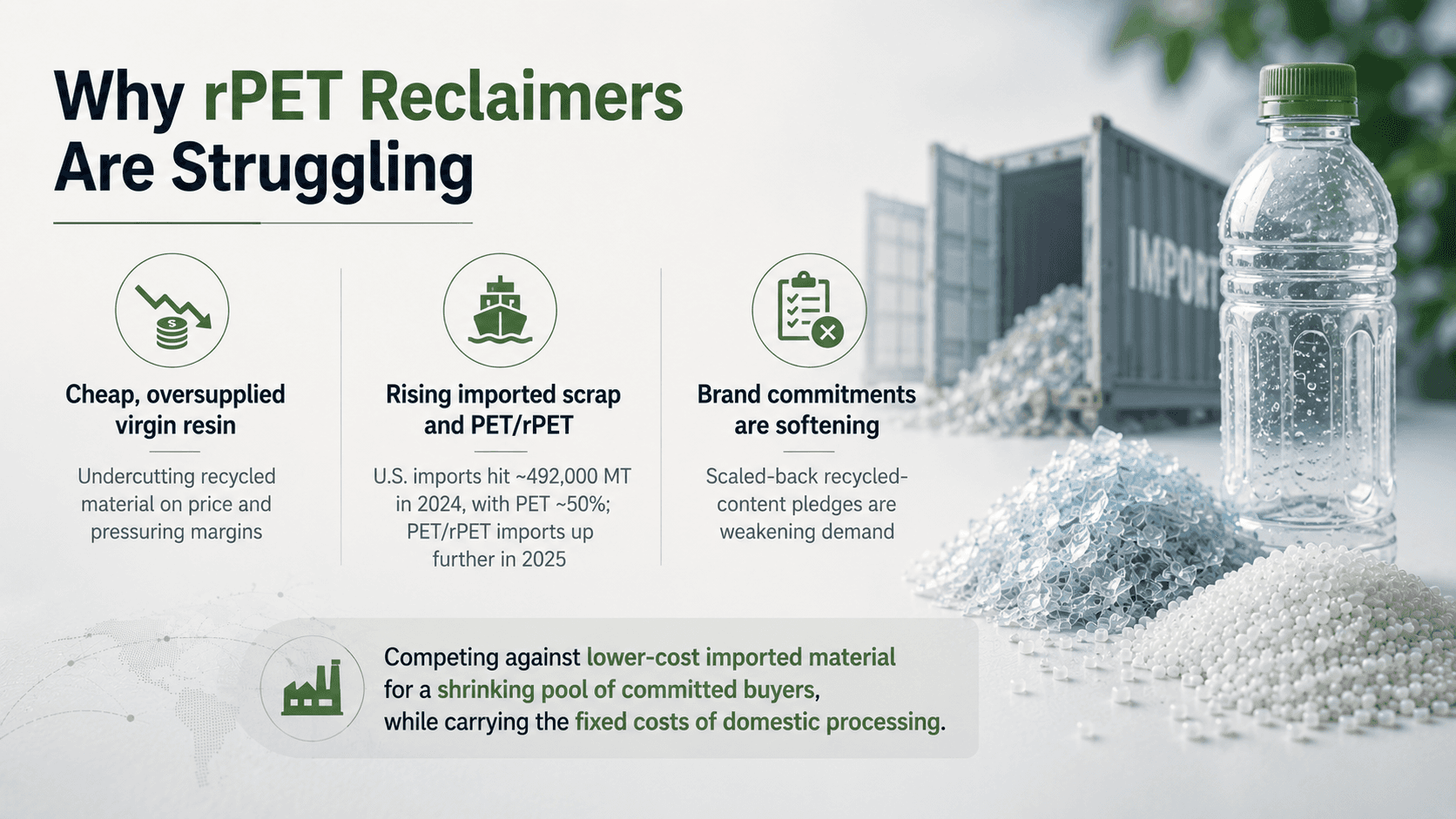
Three forces are compounding at once. Cheap, oversupplied virgin resin is undercutting recycled material on price, which pressures reclaimers' margins even as collection volumes hold steady. At the same time, imported scrap and finished PET/rPET have been rising: per Packaging Dive's reporting on ICIS data, U.S. scrap plastic imports reached roughly 492,000 metric tons in 2024, with PET accounting for nearly half of that volume, and PET/rPET import volumes climbed further through 2025 on a year-over-year basis. Layered on top of that, several brands have quietly scaled back voluntary recycled-content commitments as they wait to see how state EPR and recycled-content mandates ultimately shake out — softening domestic demand right when reclaimers need it most.
The result is a market where U.S. reclaimers are competing against lower-cost imported material for a shrinking pool of committed buyers, while carrying the fixed costs of domestic processing infrastructure.
Why This Is a Diversification Signal, Not Just a PET Story
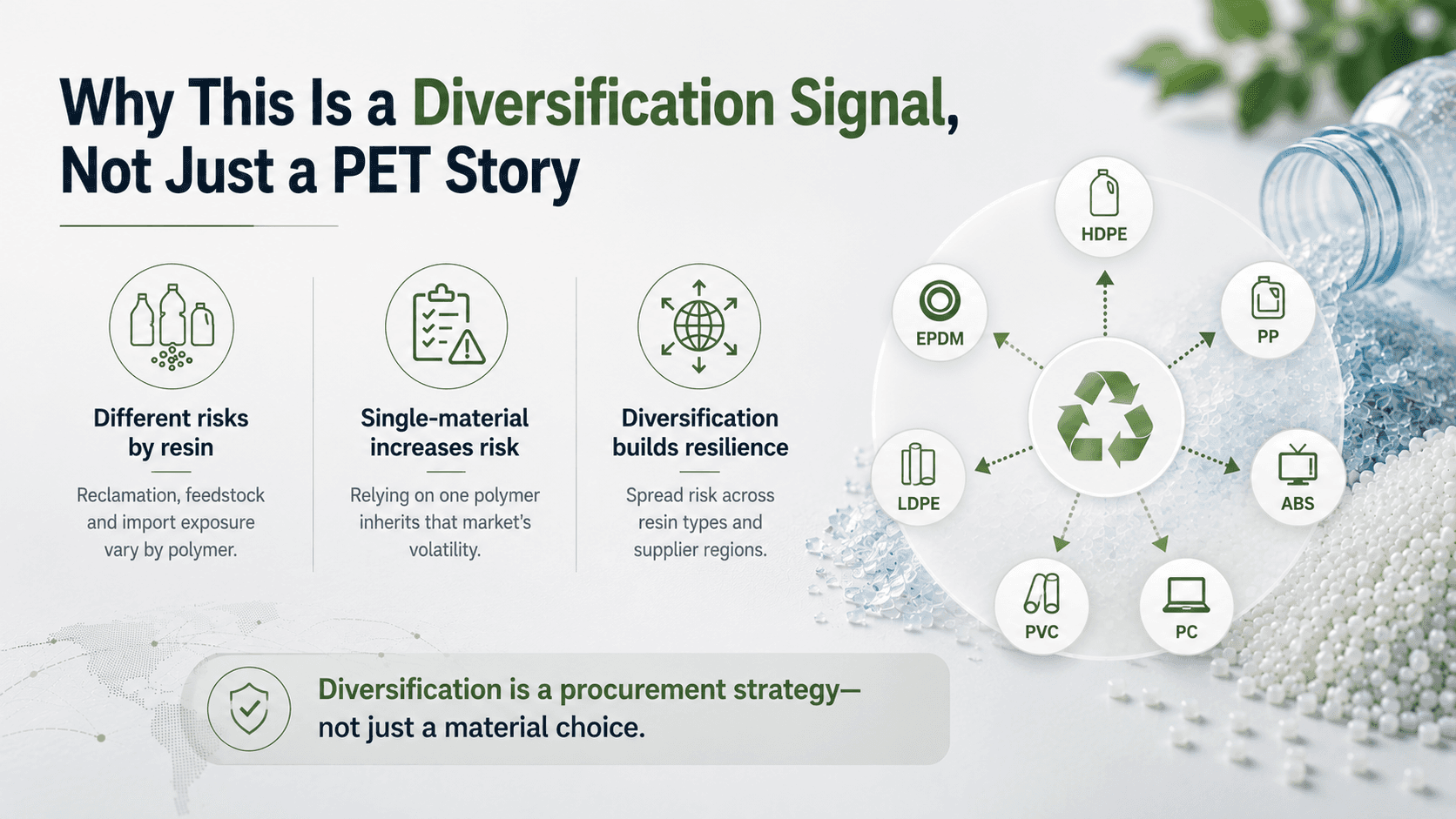
The specifics here are about PET, but the underlying lesson applies across recycled polymers: reclamation capacity, feedstock availability, and import exposure vary resin by resin, and they can shift quickly. A procurement strategy anchored to a single recycled material inherits all of that material's supply volatility.
That's part of why buyers who source recycled HDPE, PP, ABS, PVC, and other engineering-grade resins are increasingly treating multi-polymer sourcing as a hedge, not just a specifications question. Diversifying across resin types and supplier regions spreads exposure to any one reclaimer closure, tariff shift, or demand swing — the same dynamics now playing out acutely in the rPET space. Regenport's own catalog, spanning recycled HDPE, LDPE, PP, ABS, PC, PVC, EPDM, and more from South Korea-based post-consumer and post-industrial streams, reflects that same logic: consistent specs and traceable feedstock across a range of materials, rather than dependence on any single resin's market conditions.
What Procurement Teams Should Take From This
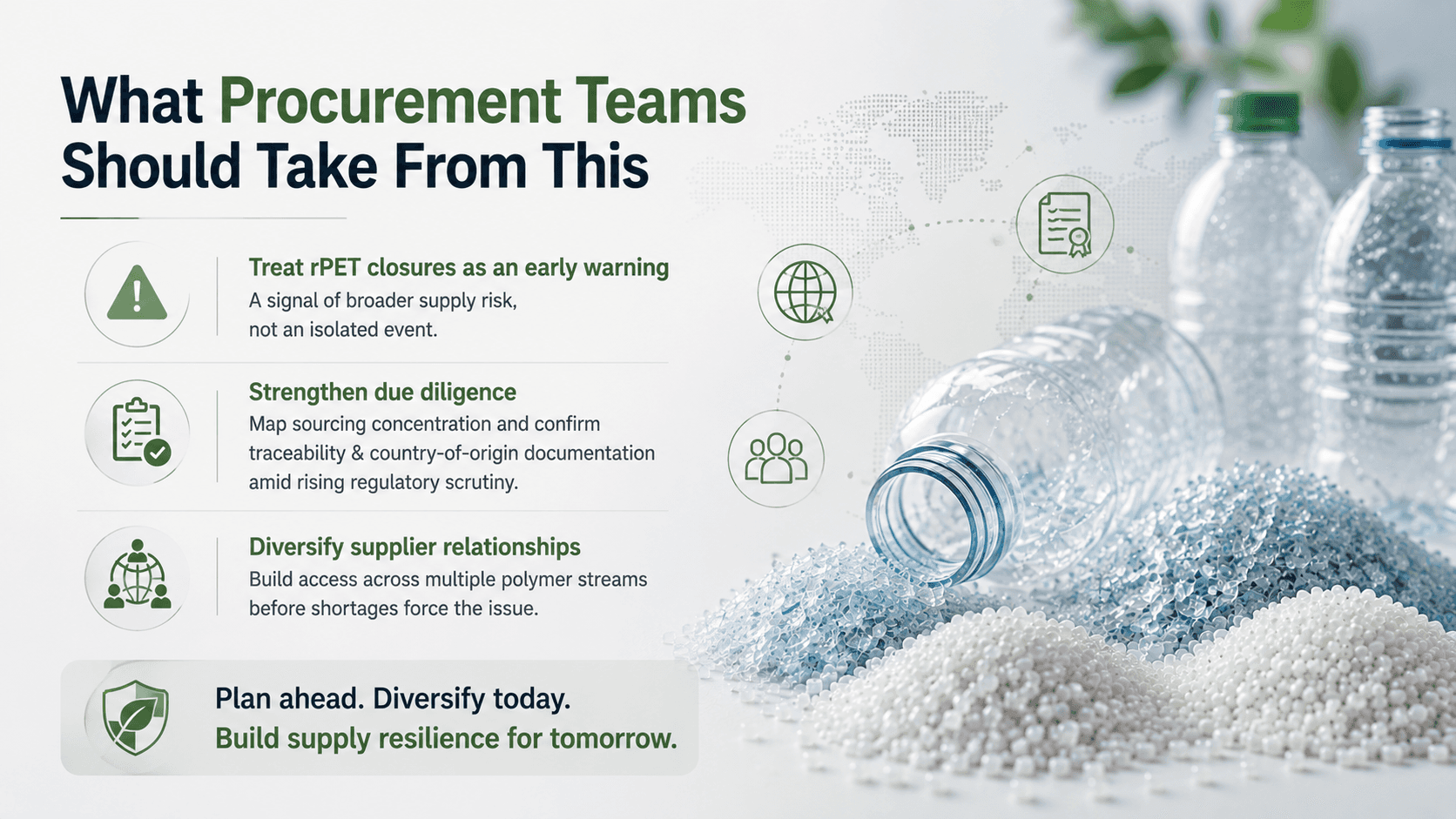
For teams sourcing recycled content, the rPET closures are worth treating as an early warning rather than an isolated event. It's worth mapping how concentrated current sourcing is in any one resin, confirming reclaimers' traceability and country-of-origin documentation given the growing regulatory scrutiny on imported PCR, and building relationships with suppliers across multiple polymer streams before a shortage forces the issue.
Market Takeaway
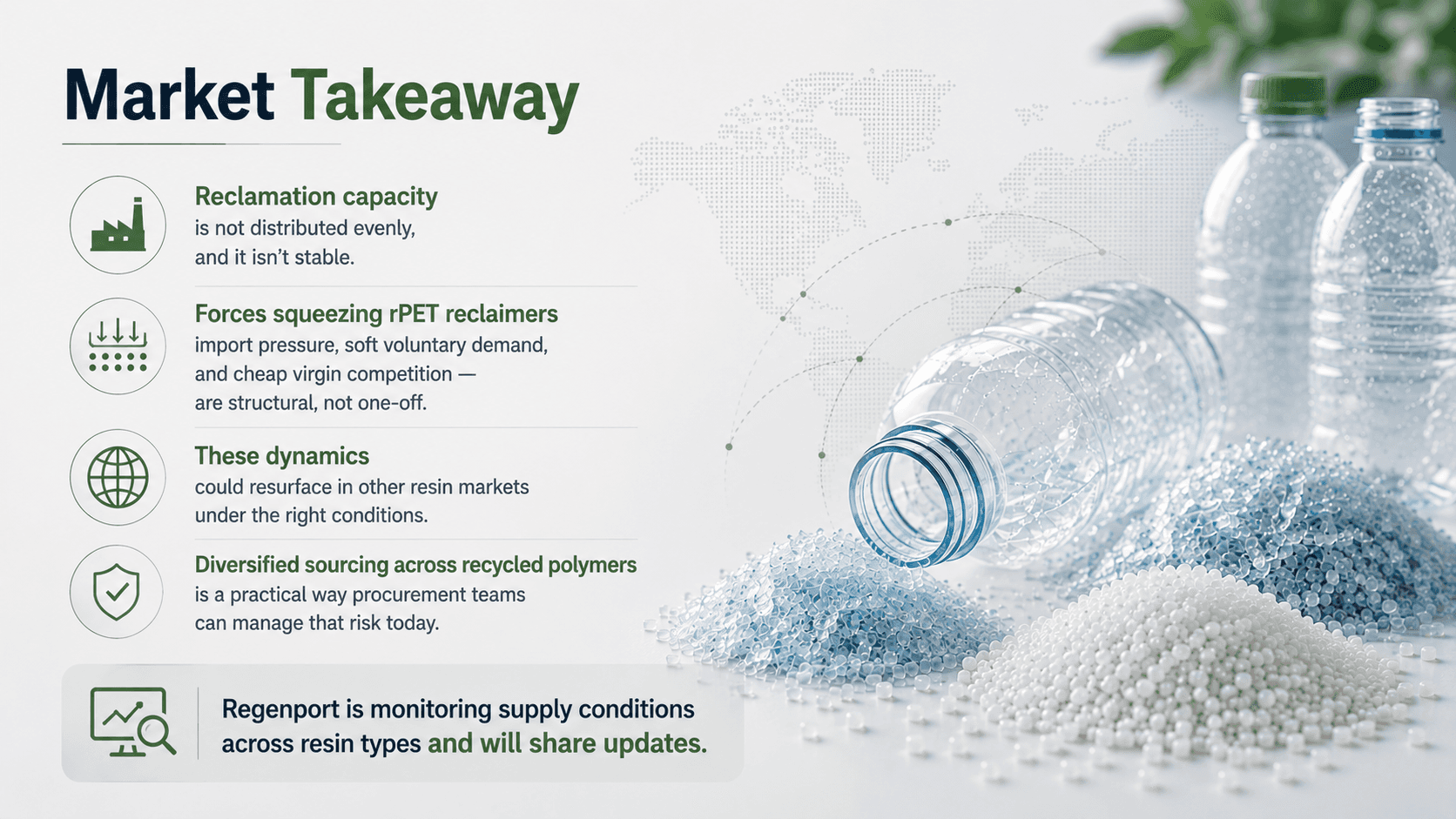
Reclamation capacity is not distributed evenly, and it isn't stable. The forces squeezing rPET reclaimers today — import pressure, soft voluntary demand, and cheap virgin competition — are structural, not one-off, and could resurface in other resin markets under the right conditions. Diversified sourcing across recycled polymers is one of the more practical ways procurement teams can manage that risk today. Regenport will continue monitoring supply conditions across resin types and sharing updates as the picture develops.

Frequently Asked Questions
Is the rPET reclamation crisis affecting all recycled plastics equally? No. The pressure from import competition and reclaimer closures has been most acute in rPET specifically. Other recycled polymer markets, including HDPE and PP, face their own distinct supply and demand dynamics.
Why are U.S. PET reclaimers closing? A combination of rising imported PET and rPET volumes, oversupplied and cheap virgin resin, and softening voluntary demand from brands has squeezed reclaimer margins, leading to a wave of closures in 2025 and into 2026.
How can buyers reduce exposure to reclaimer closures like these? Diversifying sourcing across multiple recycled resin types and suppliers, rather than concentrating volume in a single material, reduces dependence on any one reclaimer or resin market's stability.
Image generated with ChatGPT
Sources
Marissa Heffernan, Packaging Dive, "Plastic scrap imports add to 'perfect storm' hitting domestic PCR" → Read the Source
Chris Voloschuk, Recycling Today, "2026 Plastics Recycling Conference: The growing need for systemwide change" → Read the Source
According to Packaging Dive's recent reporting on the U.S. postconsumer resin market, the U.S. recycled PET (rPET) market has lost roughly a quarter of its reclamation capacity over the past 12 to 18 months — a figure industry stakeholders also raised at this year's Plastics Recycling Conference. Per Packaging Dive, at least four U.S. PET reclaimers shut down operations in 2025 alone — including Evergreen Recycling's Riverside, California facility and rPlanet Earth, which by some estimates held close to 4% of total U.S. rPET processing capacity — with at least one more closure already announced in 2026. At that same conference, one panelist described the situation for recycled PET bottles and thermoformed packaging as a "crisis," according to Recycling Today's coverage of the event.
For buyers who built sourcing strategies around a single resin, the closures are a reminder that reclamation capacity can shrink faster than demand adjusts — and that supply risk in recycled plastics is rarely evenly distributed across materials.
The market diagnosis above draws on reporting from Packaging Dive and the Plastics Recycling Conference sessions covered by Recycling Today. The analysis in the sections below is Regenport's own reading of what these trends mean for procurement teams, not a claim made by either source.
Why rPET Reclaimers Are Struggling
Three forces are compounding at once. Cheap, oversupplied virgin resin is undercutting recycled material on price, which pressures reclaimers' margins even as collection volumes hold steady. At the same time, imported scrap and finished PET/rPET have been rising: per Packaging Dive's reporting on ICIS data, U.S. scrap plastic imports reached roughly 492,000 metric tons in 2024, with PET accounting for nearly half of that volume, and PET/rPET import volumes climbed further through 2025 on a year-over-year basis. Layered on top of that, several brands have quietly scaled back voluntary recycled-content commitments as they wait to see how state EPR and recycled-content mandates ultimately shake out — softening domestic demand right when reclaimers need it most.
The result is a market where U.S. reclaimers are competing against lower-cost imported material for a shrinking pool of committed buyers, while carrying the fixed costs of domestic processing infrastructure.
Why This Is a Diversification Signal, Not Just a PET Story
The specifics here are about PET, but the underlying lesson applies across recycled polymers: reclamation capacity, feedstock availability, and import exposure vary resin by resin, and they can shift quickly. A procurement strategy anchored to a single recycled material inherits all of that material's supply volatility.
That's part of why buyers who source recycled HDPE, PP, ABS, PVC, and other engineering-grade resins are increasingly treating multi-polymer sourcing as a hedge, not just a specifications question. Diversifying across resin types and supplier regions spreads exposure to any one reclaimer closure, tariff shift, or demand swing — the same dynamics now playing out acutely in the rPET space. Regenport's own catalog, spanning recycled HDPE, LDPE, PP, ABS, PC, PVC, EPDM, and more from South Korea-based post-consumer and post-industrial streams, reflects that same logic: consistent specs and traceable feedstock across a range of materials, rather than dependence on any single resin's market conditions.
What Procurement Teams Should Take From This
For teams sourcing recycled content, the rPET closures are worth treating as an early warning rather than an isolated event. It's worth mapping how concentrated current sourcing is in any one resin, confirming reclaimers' traceability and country-of-origin documentation given the growing regulatory scrutiny on imported PCR, and building relationships with suppliers across multiple polymer streams before a shortage forces the issue.
Market Takeaway
Reclamation capacity is not distributed evenly, and it isn't stable. The forces squeezing rPET reclaimers today — import pressure, soft voluntary demand, and cheap virgin competition — are structural, not one-off, and could resurface in other resin markets under the right conditions. Diversified sourcing across recycled polymers is one of the more practical ways procurement teams can manage that risk today. Regenport will continue monitoring supply conditions across resin types and sharing updates as the picture develops.
Frequently Asked Questions
Is the rPET reclamation crisis affecting all recycled plastics equally? No. The pressure from import competition and reclaimer closures has been most acute in rPET specifically. Other recycled polymer markets, including HDPE and PP, face their own distinct supply and demand dynamics.
Why are U.S. PET reclaimers closing? A combination of rising imported PET and rPET volumes, oversupplied and cheap virgin resin, and softening voluntary demand from brands has squeezed reclaimer margins, leading to a wave of closures in 2025 and into 2026.
How can buyers reduce exposure to reclaimer closures like these? Diversifying sourcing across multiple recycled resin types and suppliers, rather than concentrating volume in a single material, reduces dependence on any one reclaimer or resin market's stability.
Image generated with ChatGPT
Sources
Marissa Heffernan, Packaging Dive, "Plastic scrap imports add to 'perfect storm' hitting domestic PCR" → Read the Source
Chris Voloschuk, Recycling Today, "2026 Plastics Recycling Conference: The growing need for systemwide change" → Read the Source
Diversifying Into rHDPE
Grades • Specs • Availability
Browse rHDPE →
Diversifying Into rHDPE
Diversifying Into rHDPE
Review rHDPE grades by feedstock, properties, stock and MOQ.
Review rHDPE grades by feedstock, properties, stock and MOQ.
Browse rHDPE →
Browse rHDPE →
Looking for samples or ready to source? Submit your request for pricing, availability, and technical information.
Looking for samples or ready to source? Submit your request for pricing, availability, and technical information.
Request a Quote →
Request a Quote →
Posted by REGENPORT
REGENPORT is a global platform connecting buyers and suppliers in the recycled materials and sustainable packaging industries.