CATEGORY
CATEGORY
Regulation
Regulation
Regulation
UN Global Plastics Treaty: Key Implications for the Recycling Supply Chain
UN Global Plastics Treaty: Key Implications for the Recycling Supply Chain
UN Global Plastics Treaty: Key Implications for the Recycling Supply Chain
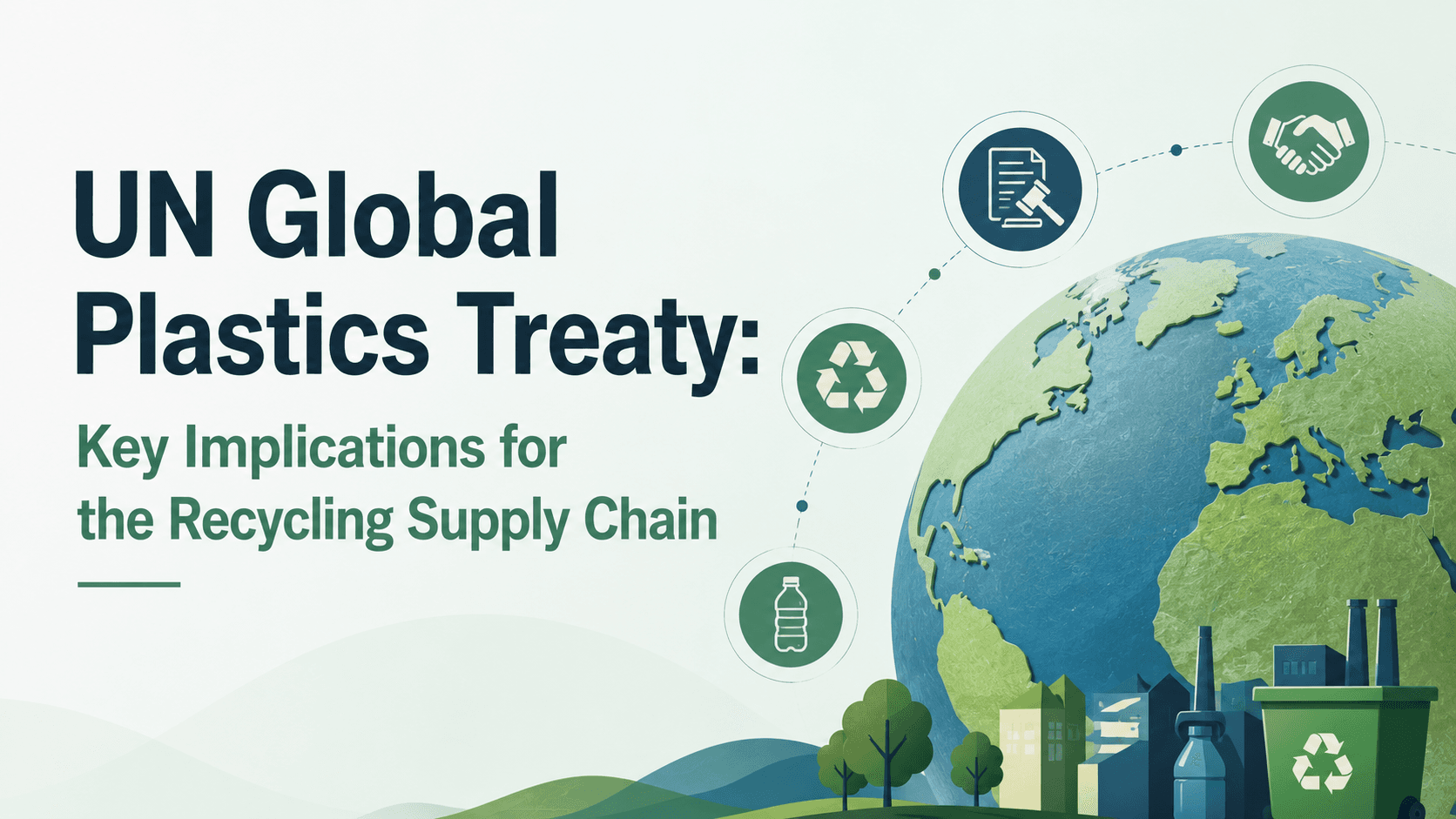
Explore the key implications of the UN Global Plastics Treaty for recycling supply chains — from upstream polymer restrictions and eco-design requirements to EPR schemes, PCR demand, and traceability obligations.
In 2022, the United Nations Environment Assembly (UNEA) passed a landmark resolution: negotiate a legally binding global agreement to end plastic pollution. What began as a high-level political commitment is now entering a critica
l phase of negotiation — and for procurement professionals and recycling industry stakeholders, the implications are anything but abstract.
This post breaks down what the UN Global Plastics Treaty process means for recycling markets, PCR resin supply chains, and the companies that depend on them.
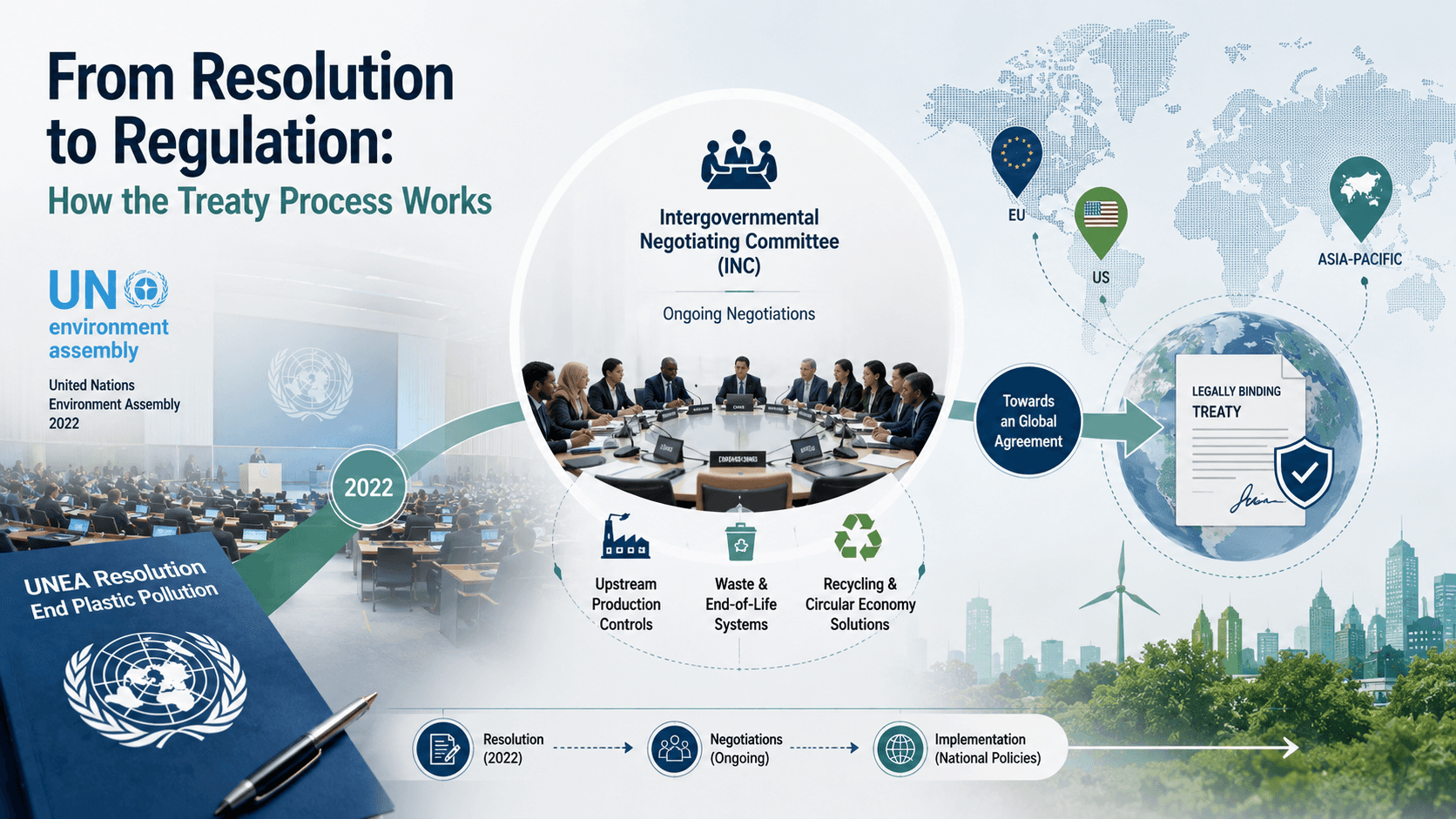
From Resolution to Regulation: How the Treaty Process Works
What UNEA Agreed to in 2022
The UNEA resolution set a mandate to develop an international legally binding instrument addressing plastic pollution across the full life cycle of plastics — from production and product design to waste management and recycling systems. Unlike voluntary industry initiatives, this treaty is designed to create enforceable global standards.
Current Status of Negotiations
Negotiations are ongoing across multiple sessions of the Intergovernmental Negotiating Committee (INC). Key areas of debate include how far the treaty should reach upstream (toward production controls) versus focusing primarily on waste and end-of-life systems. A final agreement is anticipated in the near term, though specific timelines remain subject to geopolitical dynamics and member state positions.
Key point: Even before a treaty is finalized, the negotiation process is already influencing national policy discussions in the EU, US, and Asia-Pacific — signaling the direction of regulatory travel for years ahead.
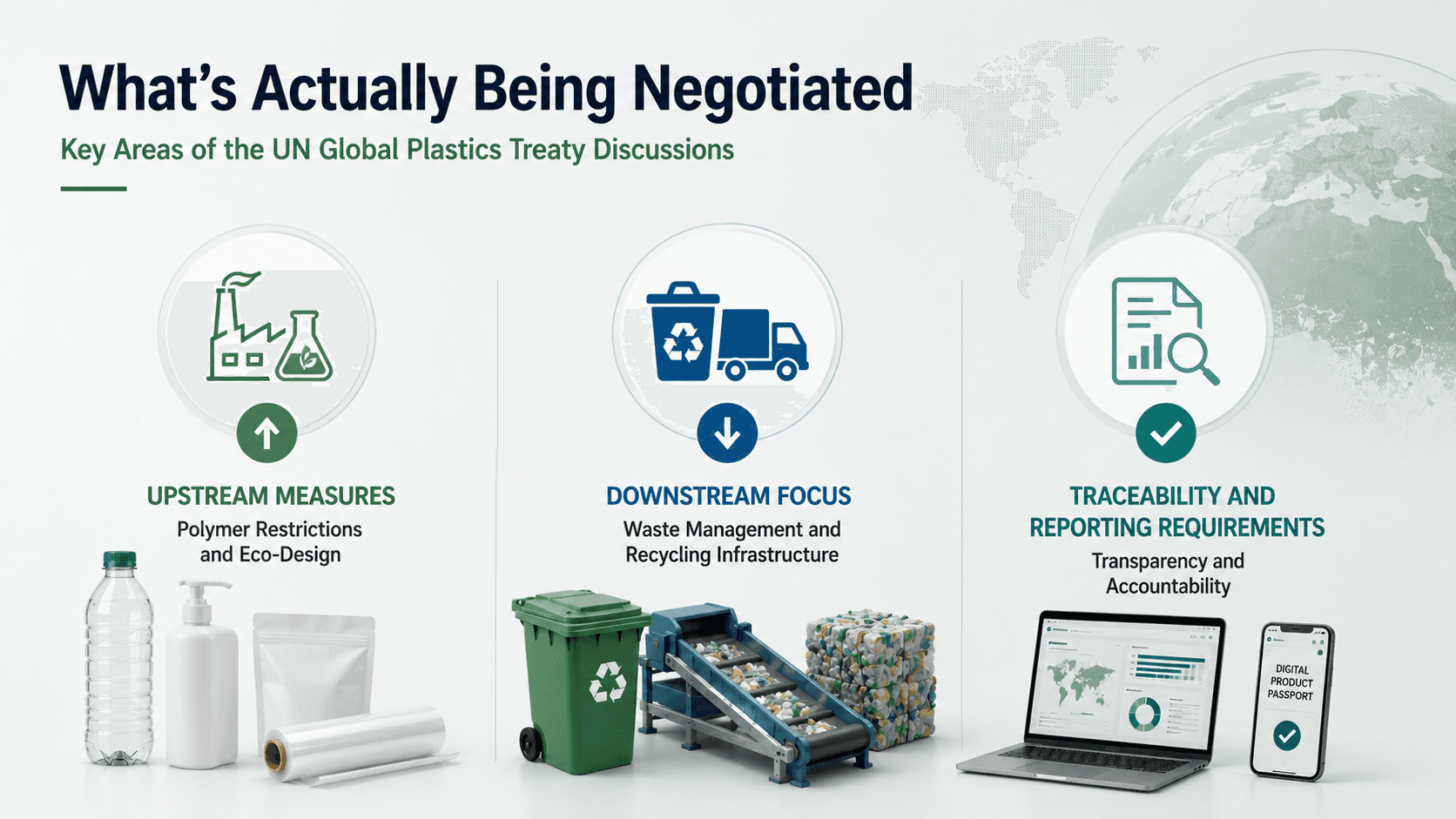
What's Actually Being Negotiated
Upstream Measures: Polymer Restrictions and Eco-Design
One of the most consequential aspects of the treaty discussions involves upstream intervention — specifically, restrictions on certain polymers or chemical additives deemed problematic for recyclability or human health. Eco-design requirements, which would mandate that products be designed with end-of-life recyclability in mind, are also under active discussion.
For packaging converters and material producers, this could mean mandatory redesign of existing product portfolios. Multilayer films and complex laminate structures — widely used today — may face particular scrutiny.
Downstream Focus: Waste Management and Recycling Infrastructure
On the downstream side, the treaty is expected to strengthen requirements around waste collection, sorting, and material recovery. Extended Producer Responsibility (EPR) schemes — which place financial or operational responsibility for end-of-life management on producers — are likely to be encouraged or mandated at the national level as part of treaty implementation.
For recyclers and PCR resin suppliers, improved collection infrastructure could translate into greater feedstock availability over time. However, quality consistency remains a structural challenge that policy alone cannot resolve.
Traceability and Reporting Requirements
Companies may face increased obligations to disclose material composition, recycled content usage, and end-of-life outcomes. Discussions around digital product passports — standardized records of a product's material makeup and recyclability — are gaining traction in parallel policy environments, and similar mechanisms could be reflected in treaty implementation frameworks.
What this means in practice: Higher compliance costs and system investment for many companies in the near term, but potentially a more level playing field for those already operating to high standards.
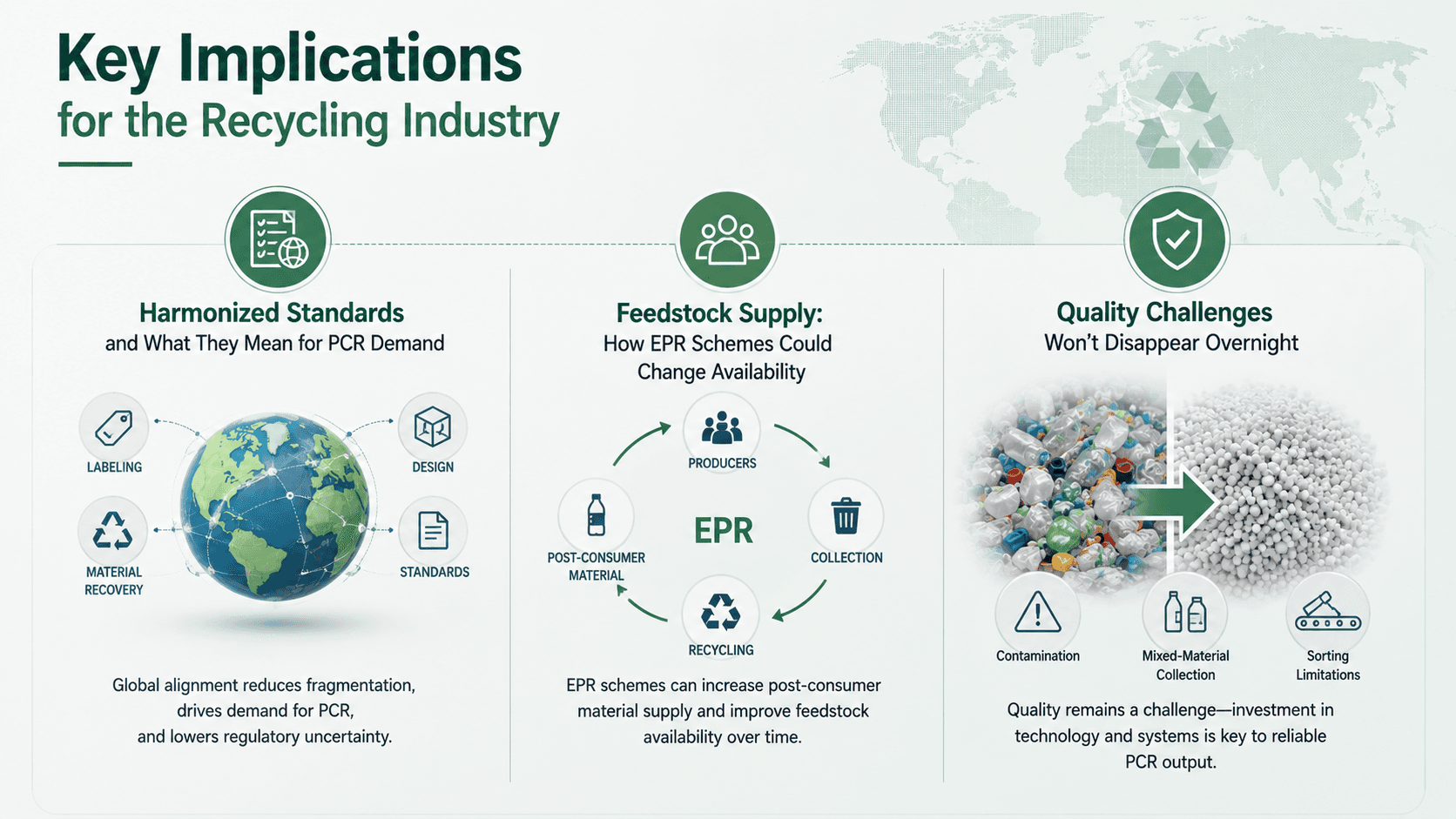
Key Implications for the Recycling Industry
Harmonized Standards and What They Mean for PCR Demand
Currently, recycling markets are highly fragmented. Definitions of recyclability vary by country, collection systems are inconsistent, and recycled content requirements differ widely across jurisdictions. A globally coordinated treaty could reduce this fragmentation by promoting harmonized standards for product design, labeling, and material recovery.
For PCR resin suppliers, a more predictable and harmonized demand environment would reduce regulatory uncertainty in export markets — a significant operational benefit for companies operating across multiple geographies.
Feedstock Supply: How EPR Schemes Could Change Availability
Policy-driven EPR programs have demonstrated the ability to significantly increase the volume of post-consumer material entering the recycling stream. If the treaty accelerates EPR adoption globally, feedstock availability for recyclers could improve meaningfully over the medium term — though this will vary substantially by region and implementation quality.
Quality Challenges Won't Disappear Overnight
Increased feedstock volume does not automatically translate to better quality. Contamination, mixed-material collection, and inconsistent sorting infrastructure remain persistent challenges. Treaty-driven policy improvements will need to be accompanied by investment in processing technology and quality assurance systems to deliver reliable PCR output at scale.
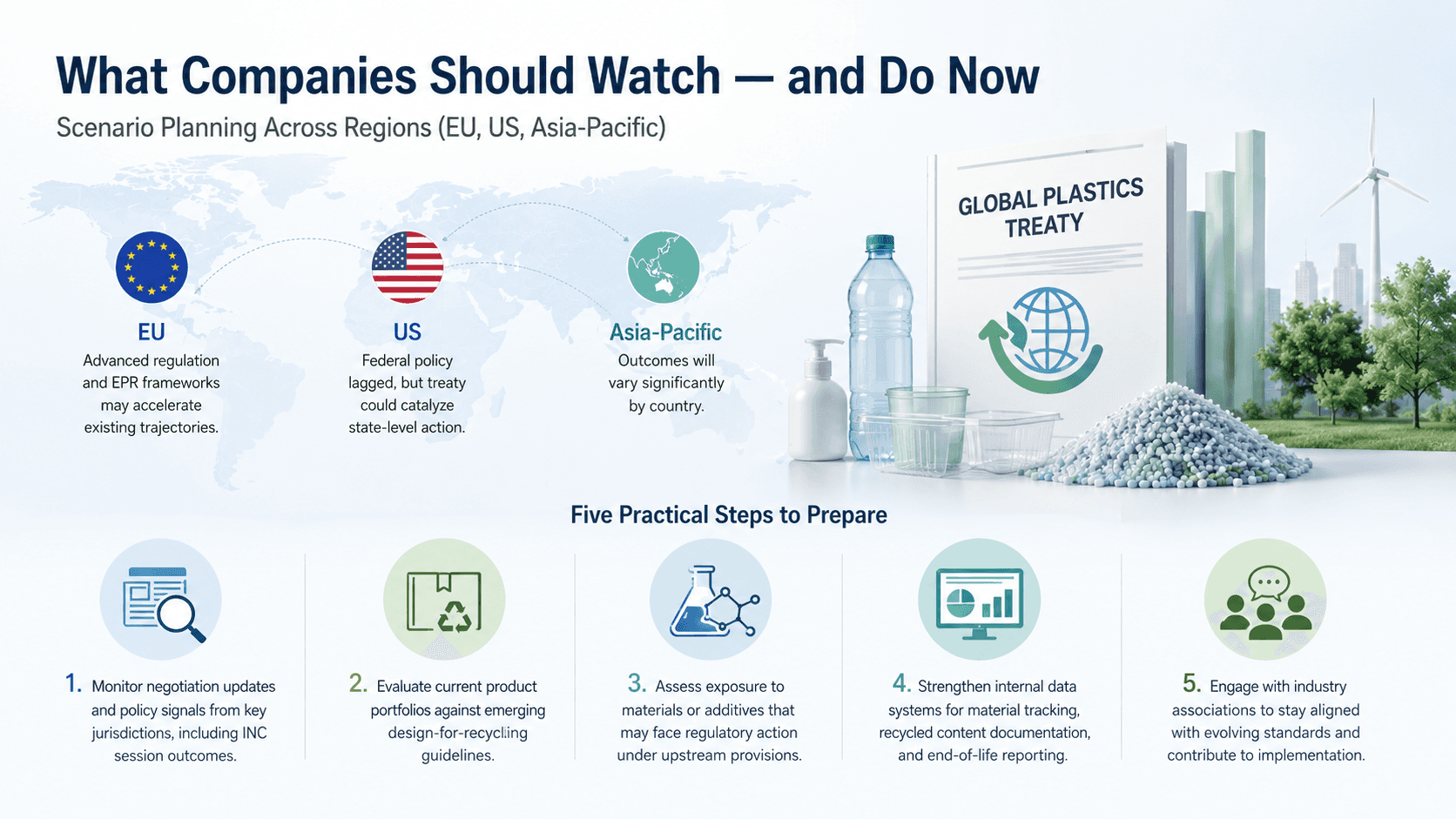
What Companies Should Watch — and Do Now
Scenario Planning Across Regions (EU, US, Asia-Pacific)
The treaty is likely to allow flexibility in national implementation, meaning regional differences will persist even under a global framework. Companies operating across multiple markets should resist the temptation to plan for a single uniform outcome. Instead, scenario analysis — mapping potential regulatory pathways in each key region — is the more resilient approach.
In the EU, where plastic packaging regulation and EPR frameworks are already advanced, treaty implementation may accelerate existing trajectories. In the US, where federal policy has lagged, the treaty could catalyze state-level action. In Asia-Pacific markets, outcomes will vary significantly by country.
Five Practical Steps to Prepare
Monitor negotiation updates and policy signals from key jurisdictions, including INC session outcomes.
Evaluate current product portfolios against emerging design-for-recycling guidelines, particularly for packaging formats at risk of future restriction.
Assess exposure to materials or additives that may face regulatory action under upstream treaty provisions.
Strengthen internal data systems for material tracking, recycled content documentation, and end-of-life reporting.
Engage with industry associations to stay aligned with evolving standards and contribute to shaping implementation frameworks.
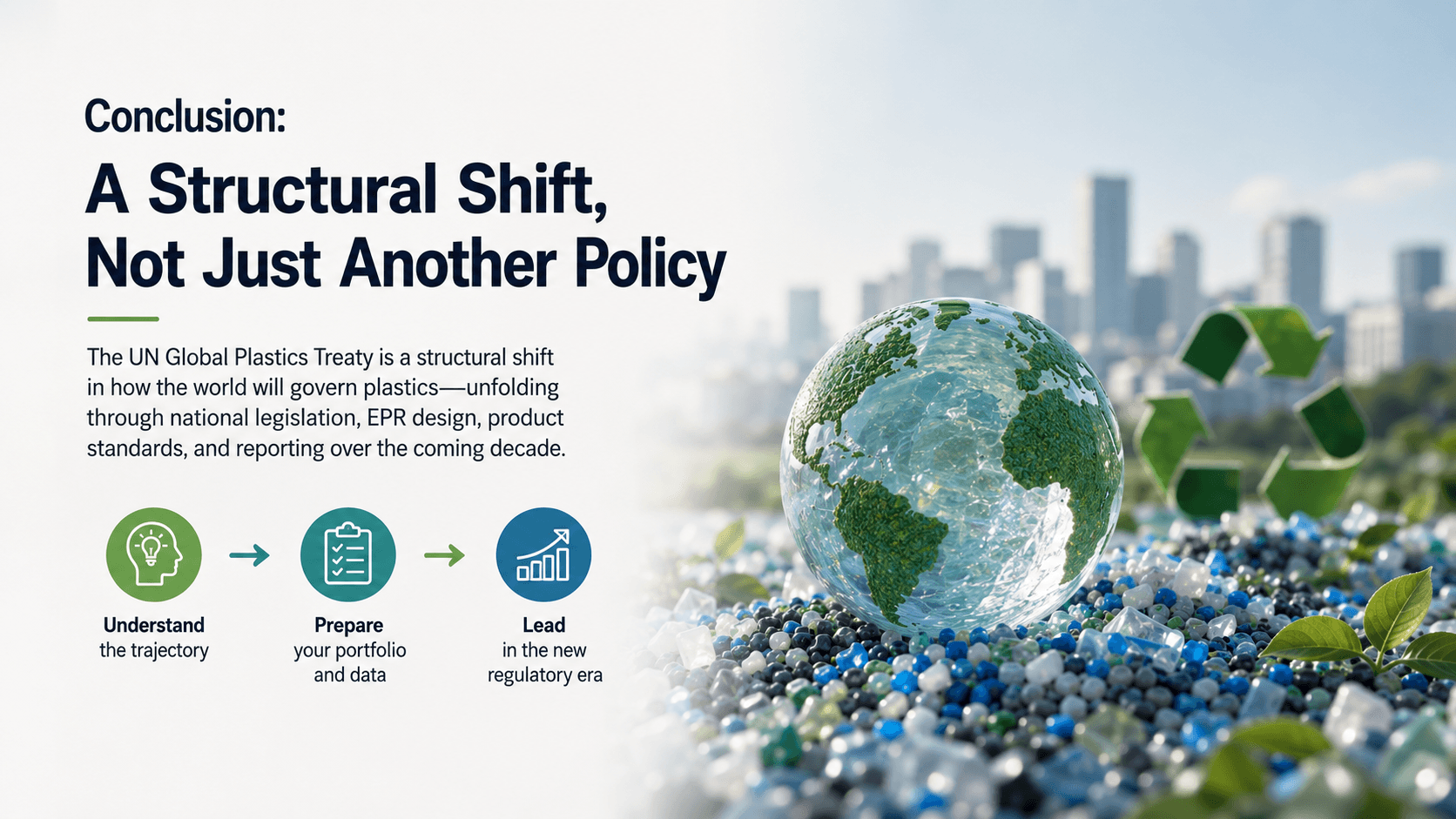
Conclusion: A Structural Shift, Not Just Another Policy
The UN Global Plastics Treaty is not a single regulation with a fixed compliance date. It is a structural shift in how the world intends to govern plastics — one that will unfold through national legislation, EPR design, product standards, and reporting requirements over the coming decade.
For procurement professionals and supply chain managers in the recycled materials space, early understanding of this trajectory is a competitive advantage. Those who begin scenario planning, portfolio assessment, and data infrastructure investment now will be better positioned to adapt as the regulatory landscape crystallizes.
Image generated with ChatGPT
Source
UN News, "The world is demanding action over plastic pollution" → Read the Source
UN News, "Plastic pollution treaty negotiations adjourn in Busan" → Read the Source
In 2022, the United Nations Environment Assembly (UNEA) passed a landmark resolution: negotiate a legally binding global agreement to end plastic pollution. What began as a high-level political commitment is now entering a critica
l phase of negotiation — and for procurement professionals and recycling industry stakeholders, the implications are anything but abstract.
This post breaks down what the UN Global Plastics Treaty process means for recycling markets, PCR resin supply chains, and the companies that depend on them.
From Resolution to Regulation: How the Treaty Process Works
What UNEA Agreed to in 2022
The UNEA resolution set a mandate to develop an international legally binding instrument addressing plastic pollution across the full life cycle of plastics — from production and product design to waste management and recycling systems. Unlike voluntary industry initiatives, this treaty is designed to create enforceable global standards.
Current Status of Negotiations
Negotiations are ongoing across multiple sessions of the Intergovernmental Negotiating Committee (INC). Key areas of debate include how far the treaty should reach upstream (toward production controls) versus focusing primarily on waste and end-of-life systems. A final agreement is anticipated in the near term, though specific timelines remain subject to geopolitical dynamics and member state positions.
Key point: Even before a treaty is finalized, the negotiation process is already influencing national policy discussions in the EU, US, and Asia-Pacific — signaling the direction of regulatory travel for years ahead.
What's Actually Being Negotiated
Upstream Measures: Polymer Restrictions and Eco-Design
One of the most consequential aspects of the treaty discussions involves upstream intervention — specifically, restrictions on certain polymers or chemical additives deemed problematic for recyclability or human health. Eco-design requirements, which would mandate that products be designed with end-of-life recyclability in mind, are also under active discussion.
For packaging converters and material producers, this could mean mandatory redesign of existing product portfolios. Multilayer films and complex laminate structures — widely used today — may face particular scrutiny.
Downstream Focus: Waste Management and Recycling Infrastructure
On the downstream side, the treaty is expected to strengthen requirements around waste collection, sorting, and material recovery. Extended Producer Responsibility (EPR) schemes — which place financial or operational responsibility for end-of-life management on producers — are likely to be encouraged or mandated at the national level as part of treaty implementation.
For recyclers and PCR resin suppliers, improved collection infrastructure could translate into greater feedstock availability over time. However, quality consistency remains a structural challenge that policy alone cannot resolve.
Traceability and Reporting Requirements
Companies may face increased obligations to disclose material composition, recycled content usage, and end-of-life outcomes. Discussions around digital product passports — standardized records of a product's material makeup and recyclability — are gaining traction in parallel policy environments, and similar mechanisms could be reflected in treaty implementation frameworks.
What this means in practice: Higher compliance costs and system investment for many companies in the near term, but potentially a more level playing field for those already operating to high standards.
Key Implications for the Recycling Industry
Harmonized Standards and What They Mean for PCR Demand
Currently, recycling markets are highly fragmented. Definitions of recyclability vary by country, collection systems are inconsistent, and recycled content requirements differ widely across jurisdictions. A globally coordinated treaty could reduce this fragmentation by promoting harmonized standards for product design, labeling, and material recovery.
For PCR resin suppliers, a more predictable and harmonized demand environment would reduce regulatory uncertainty in export markets — a significant operational benefit for companies operating across multiple geographies.
Feedstock Supply: How EPR Schemes Could Change Availability
Policy-driven EPR programs have demonstrated the ability to significantly increase the volume of post-consumer material entering the recycling stream. If the treaty accelerates EPR adoption globally, feedstock availability for recyclers could improve meaningfully over the medium term — though this will vary substantially by region and implementation quality.
Quality Challenges Won't Disappear Overnight
Increased feedstock volume does not automatically translate to better quality. Contamination, mixed-material collection, and inconsistent sorting infrastructure remain persistent challenges. Treaty-driven policy improvements will need to be accompanied by investment in processing technology and quality assurance systems to deliver reliable PCR output at scale.
What Companies Should Watch — and Do Now
Scenario Planning Across Regions (EU, US, Asia-Pacific)
The treaty is likely to allow flexibility in national implementation, meaning regional differences will persist even under a global framework. Companies operating across multiple markets should resist the temptation to plan for a single uniform outcome. Instead, scenario analysis — mapping potential regulatory pathways in each key region — is the more resilient approach.
In the EU, where plastic packaging regulation and EPR frameworks are already advanced, treaty implementation may accelerate existing trajectories. In the US, where federal policy has lagged, the treaty could catalyze state-level action. In Asia-Pacific markets, outcomes will vary significantly by country.
Five Practical Steps to Prepare
Monitor negotiation updates and policy signals from key jurisdictions, including INC session outcomes.
Evaluate current product portfolios against emerging design-for-recycling guidelines, particularly for packaging formats at risk of future restriction.
Assess exposure to materials or additives that may face regulatory action under upstream treaty provisions.
Strengthen internal data systems for material tracking, recycled content documentation, and end-of-life reporting.
Engage with industry associations to stay aligned with evolving standards and contribute to shaping implementation frameworks.
Conclusion: A Structural Shift, Not Just Another Policy
The UN Global Plastics Treaty is not a single regulation with a fixed compliance date. It is a structural shift in how the world intends to govern plastics — one that will unfold through national legislation, EPR design, product standards, and reporting requirements over the coming decade.
For procurement professionals and supply chain managers in the recycled materials space, early understanding of this trajectory is a competitive advantage. Those who begin scenario planning, portfolio assessment, and data infrastructure investment now will be better positioned to adapt as the regulatory landscape crystallizes.
Image generated with ChatGPT
Source
UN News, "The world is demanding action over plastic pollution" → Read the Source
UN News, "Plastic pollution treaty negotiations adjourn in Busan" → Read the Source
Sourcing Ahead of the Treaty
Grades • Specs • Availability
Browse rPP →
Sourcing Ahead of the Treaty
Sourcing Ahead of the Treaty
Compare rPP grades by feedstock, properties, certification, stock and MOQ.
Compare rPP grades by feedstock, properties, certification, stock and MOQ.
Browse rPP →
Browse rPP →
Looking for samples or ready to source? Submit your request for pricing, availability, and technical information.
Looking for samples or ready to source? Submit your request for pricing, availability, and technical information.
Request a Quote →
Request a Quote →
Posted by REGENPORT
REGENPORT is a global platform connecting buyers and suppliers in the recycled materials and sustainable packaging industries.