CATEGORY
CATEGORY
Our Materials
Our Materials
Our Materials
Grey rLLDPE PIR Pellet from Film Scrap: What Film-to-Film Reprocessing Requires
Grey rLLDPE PIR Pellet from Film Scrap: What Film-to-Film Reprocessing Requires
Grey rLLDPE PIR Pellet from Film Scrap: What Film-to-Film Reprocessing Requires

Film scrap reprocessed into grey rLLDPE pellets, then offered back to film extrusion — listed as PIR, 30 MT/month from South Korea, no third-party certification on the sheet.
Most recycled polyethylene grades leave the product category they came from: bottle material becomes pipe, packaging film becomes a construction sheet. This Regenport grade is listed against the same category on both sides. The product sheet lists film as the feedstock and film / extrusion as the application — a grey linear low-density polyethylene (LLDPE) pellet classified as post-industrial recycled (PIR), offered back to the process type that generated it.
The listing identifies the material as recycled LLDPE and reports a melt flow index (MFI) of 2.6 g/10 min and a density of 0.92 g/cm³. These figures are relevant to a film-extrusion evaluation, but actual suitability should be confirmed through trial processing and lot-specific technical data. The pellets are listed as grey. The grey color indicates that the grade is intended for applications where a grey or opaque appearance is acceptable; the cause of the color should be confirmed with the supplier. That reads differently against where the demand actually sits: our recent look at recycled PE film demand found the largest modeled volumes in applications that tolerate color variation and cosmetic defects — industrial liners, construction membranes, and dark trash bags.
Processing Performance and Application Potential
Film is among the least forgiving destinations for a recycled pellet. In a thin-gauge film — 20–50 µm, for example — a single gel or unmelted particle does not average out in a property table; it can show up as a visible defect or break the bubble on a blown line. For thin-gauge work, gel count and how it is measured, unmelt content, filtration performance, and bubble stability should therefore be reviewed alongside MFI. The same demand analysis makes the point from the other side: because tolerance for gels favors thicker sections, a thin-gauge application can face a tighter supply than a heavy-gauge one.
Two things are not on the listing, and both are questions for the supplier rather than assumptions to draw from the feedstock description. The first is the comonomer — butene, hexene, or octene — which is closely associated with a film's impact and tear behavior, so a converter comparing this against its current resin would ask for it directly. The second is what else is in the feedstock: buyers should ask whether it is predominantly LLDPE, and whether printed or multilayer scrap is included. Ash, moisture, and a filtration report answer much of that, and are worth requesting with the sample.
The product sheet classifies the material as PIR — in general, material recovered from industrial or manufacturing operations before it reaches an end user. For this grade, the exact source and the way the scrap is separated should be confirmed with the supplier, along with the supplier's own definition of PIR where a recycled-content claim is involved. This matters because many recycled-content rules count post-consumer material specifically, so the definition behind a target should be checked first.
Material Data
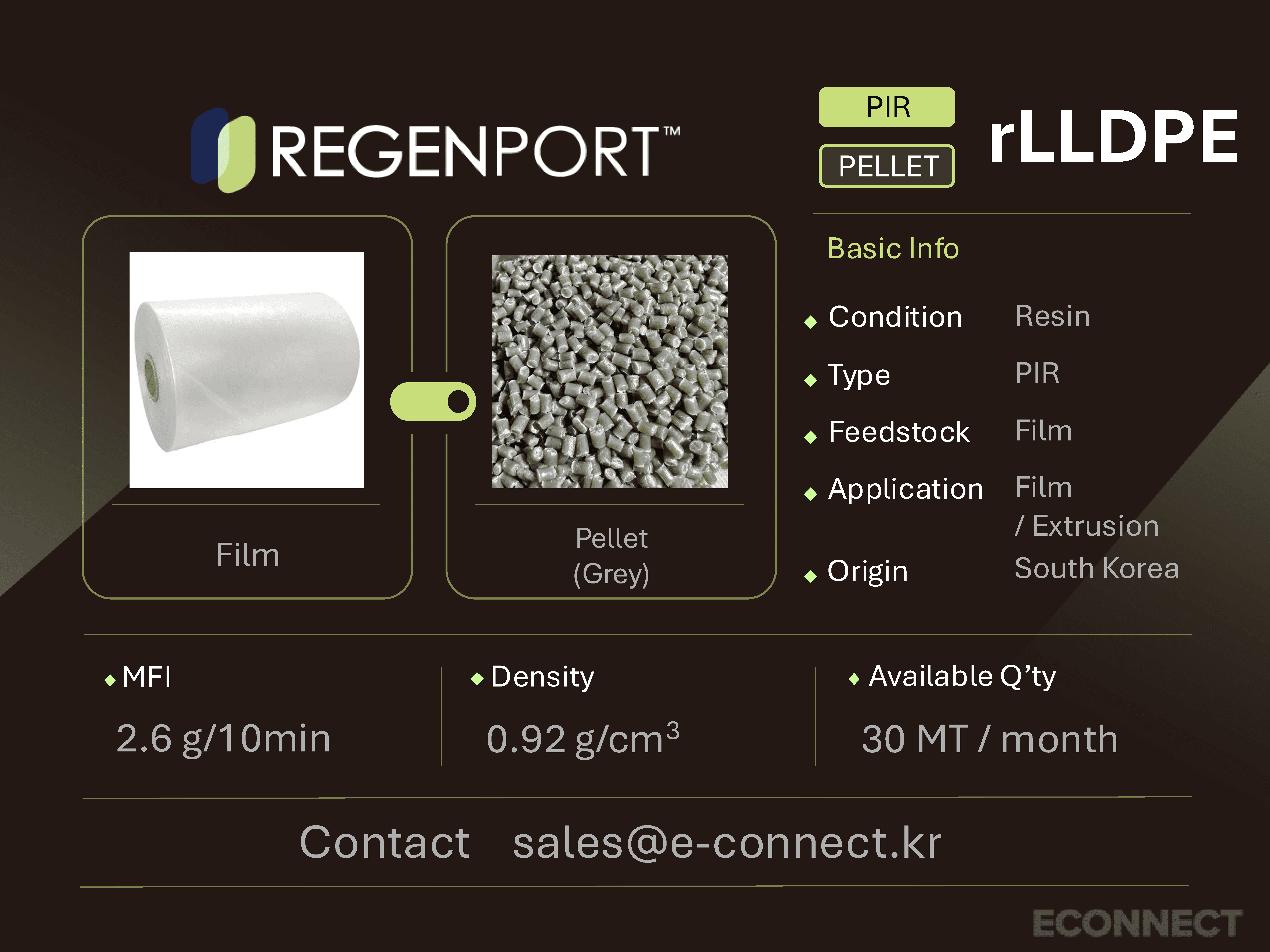
rLLDPE (Regenport material catalog #33) | |
|---|---|
CONDITION : | TYPE : |
FEEDSTOCK : | APPLICATION : |
MFI : | DENSITY : |
Supply from South Korea and the Documentation Behind a Content Claim
The listing shows 30 MT per month from South Korea. Post-industrial supply typically tracks the operations generating the scrap, so availability can move with their output as well as with reprocessing yield, existing contracted quantities, and shipping lead time. Allocation against a given specification and delivery schedule is set at contracting.
No third-party certification is identified on the current product sheet. Buyers requiring certified recycled content should ask whether the producing site holds the Global Recycled Standard (GRS) or another relevant certification, and whether the certificate covers this specific material and production site. If no third-party certification applies, buyers should request supplier documentation supporting the recycled-content claim, including feedstock records, production records, and any applicable chain-of-custody or mass-balance documentation.
A Practical PIR Option to Evaluate for Film Extrusion
This grade is a grey rLLDPE pellet listed at MFI 2.6 g/10 min and 0.92 g/cm³, classified as PIR, with 30 MT available per month, film as its listed feedstock and film / extrusion as its listed application. A film-derived input offered back to film extrusion is what makes it worth a review for extruders working recycled content into their mix — once the comonomer, composition, and filtration questions above are answered.
Sample quantities may be available for trial. Share your line configuration and target gauge, and we will confirm current lot data, filtration and ash figures, and lead time.
Frequently Asked Questions
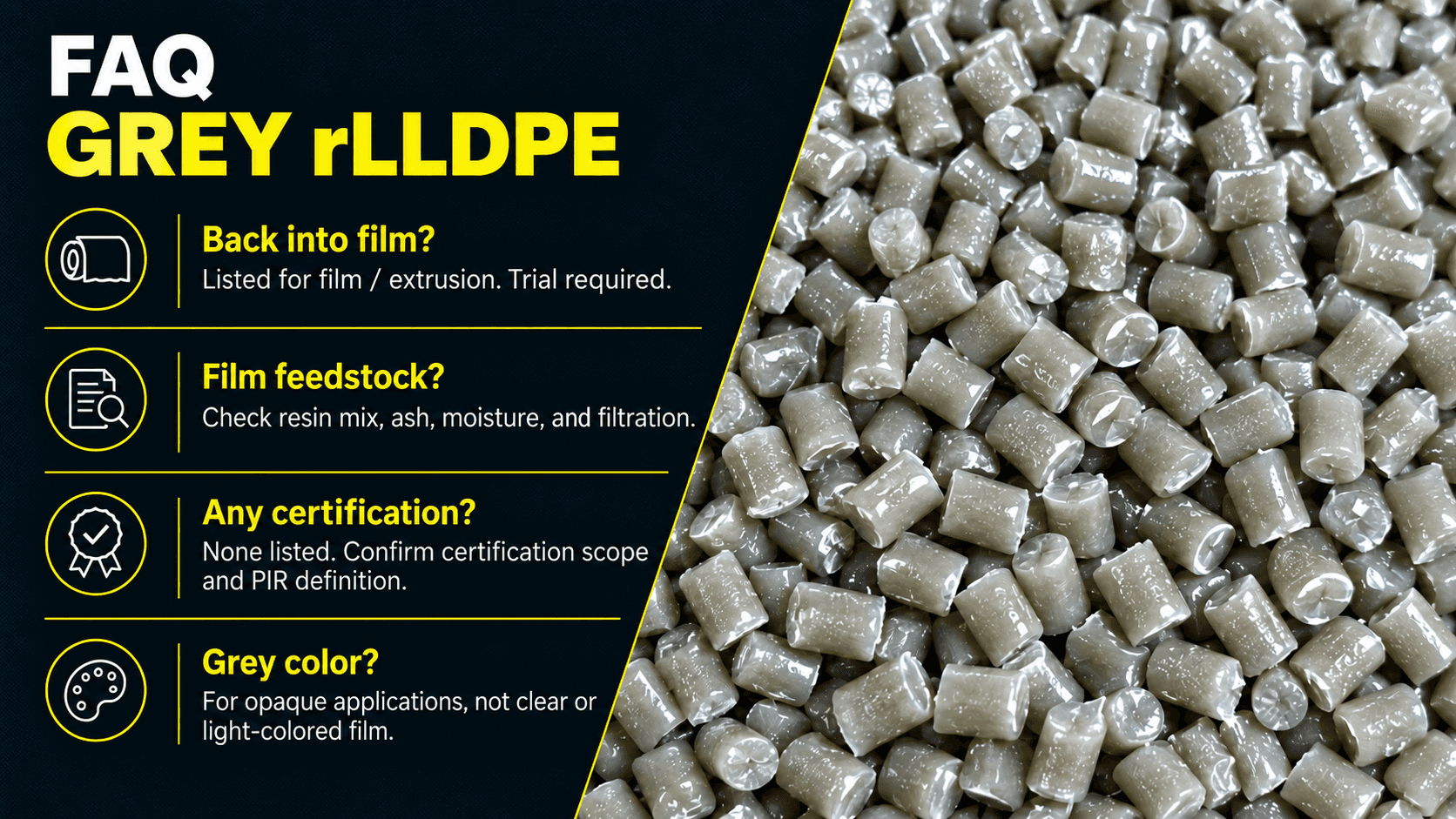
Can post-industrial recycled LLDPE be used back in film? Yes, it can be evaluated for film extrusion, and this product sheet lists film / extrusion as the application. Final suitability depends on the specific film structure, target gauge, gel and unmelt levels, filtration performance, and the required optical and mechanical properties.
What does a film feedstock mean for the pellet? The product sheet lists film as the feedstock but does not specify the exact composition. Post-industrial film scrap can be a single resin or a blend, so buyers should ask whether it is predominantly LLDPE or contains LDPE, metallocene grades, ethylene vinyl acetate (EVA), inks, tie layers, or adhesive residues, and should request ash, moisture, and a filtration report with the sample.
Is this grey rLLDPE grade certified? No third-party certification is identified on the current product sheet, which lists the grade as PIR. Buyers who require certified recycled content should confirm whether the producing site holds GRS or another relevant certification and whether its scope covers this material, and — where a formal recycled-content claim is involved — should also confirm the exact source of the scrap and the supplier's definition of PIR.
Why does the grey color matter for a film application? The pellets are listed as grey, which means the grade is intended for applications where a grey or opaque appearance is acceptable. A grey, opaque pellet does not suit transparent or light-colored film; it may suit uses where appearance is not specified, or a coextruded structure where the recycled layer sits inside — a decision for the converter's own specification. The cause of the color should be confirmed with the supplier.
Image generated with ChatGPT
Most recycled polyethylene grades leave the product category they came from: bottle material becomes pipe, packaging film becomes a construction sheet. This Regenport grade is listed against the same category on both sides. The product sheet lists film as the feedstock and film / extrusion as the application — a grey linear low-density polyethylene (LLDPE) pellet classified as post-industrial recycled (PIR), offered back to the process type that generated it.
The listing identifies the material as recycled LLDPE and reports a melt flow index (MFI) of 2.6 g/10 min and a density of 0.92 g/cm³. These figures are relevant to a film-extrusion evaluation, but actual suitability should be confirmed through trial processing and lot-specific technical data. The pellets are listed as grey. The grey color indicates that the grade is intended for applications where a grey or opaque appearance is acceptable; the cause of the color should be confirmed with the supplier. That reads differently against where the demand actually sits: our recent look at recycled PE film demand found the largest modeled volumes in applications that tolerate color variation and cosmetic defects — industrial liners, construction membranes, and dark trash bags.
Processing Performance and Application Potential
Film is among the least forgiving destinations for a recycled pellet. In a thin-gauge film — 20–50 µm, for example — a single gel or unmelted particle does not average out in a property table; it can show up as a visible defect or break the bubble on a blown line. For thin-gauge work, gel count and how it is measured, unmelt content, filtration performance, and bubble stability should therefore be reviewed alongside MFI. The same demand analysis makes the point from the other side: because tolerance for gels favors thicker sections, a thin-gauge application can face a tighter supply than a heavy-gauge one.
Two things are not on the listing, and both are questions for the supplier rather than assumptions to draw from the feedstock description. The first is the comonomer — butene, hexene, or octene — which is closely associated with a film's impact and tear behavior, so a converter comparing this against its current resin would ask for it directly. The second is what else is in the feedstock: buyers should ask whether it is predominantly LLDPE, and whether printed or multilayer scrap is included. Ash, moisture, and a filtration report answer much of that, and are worth requesting with the sample.
The product sheet classifies the material as PIR — in general, material recovered from industrial or manufacturing operations before it reaches an end user. For this grade, the exact source and the way the scrap is separated should be confirmed with the supplier, along with the supplier's own definition of PIR where a recycled-content claim is involved. This matters because many recycled-content rules count post-consumer material specifically, so the definition behind a target should be checked first.
Material Data
rLLDPE (Regenport material catalog #33) | |
|---|---|
CONDITION : | TYPE : |
FEEDSTOCK : | APPLICATION : |
MFI : | DENSITY : |
Supply from South Korea and the Documentation Behind a Content Claim
The listing shows 30 MT per month from South Korea. Post-industrial supply typically tracks the operations generating the scrap, so availability can move with their output as well as with reprocessing yield, existing contracted quantities, and shipping lead time. Allocation against a given specification and delivery schedule is set at contracting.
No third-party certification is identified on the current product sheet. Buyers requiring certified recycled content should ask whether the producing site holds the Global Recycled Standard (GRS) or another relevant certification, and whether the certificate covers this specific material and production site. If no third-party certification applies, buyers should request supplier documentation supporting the recycled-content claim, including feedstock records, production records, and any applicable chain-of-custody or mass-balance documentation.
A Practical PIR Option to Evaluate for Film Extrusion
This grade is a grey rLLDPE pellet listed at MFI 2.6 g/10 min and 0.92 g/cm³, classified as PIR, with 30 MT available per month, film as its listed feedstock and film / extrusion as its listed application. A film-derived input offered back to film extrusion is what makes it worth a review for extruders working recycled content into their mix — once the comonomer, composition, and filtration questions above are answered.
Sample quantities may be available for trial. Share your line configuration and target gauge, and we will confirm current lot data, filtration and ash figures, and lead time.
Frequently Asked Questions
Can post-industrial recycled LLDPE be used back in film? Yes, it can be evaluated for film extrusion, and this product sheet lists film / extrusion as the application. Final suitability depends on the specific film structure, target gauge, gel and unmelt levels, filtration performance, and the required optical and mechanical properties.
What does a film feedstock mean for the pellet? The product sheet lists film as the feedstock but does not specify the exact composition. Post-industrial film scrap can be a single resin or a blend, so buyers should ask whether it is predominantly LLDPE or contains LDPE, metallocene grades, ethylene vinyl acetate (EVA), inks, tie layers, or adhesive residues, and should request ash, moisture, and a filtration report with the sample.
Is this grey rLLDPE grade certified? No third-party certification is identified on the current product sheet, which lists the grade as PIR. Buyers who require certified recycled content should confirm whether the producing site holds GRS or another relevant certification and whether its scope covers this material, and — where a formal recycled-content claim is involved — should also confirm the exact source of the scrap and the supplier's definition of PIR.
Why does the grey color matter for a film application? The pellets are listed as grey, which means the grade is intended for applications where a grey or opaque appearance is acceptable. A grey, opaque pellet does not suit transparent or light-colored film; it may suit uses where appearance is not specified, or a coextruded structure where the recycled layer sits inside — a decision for the converter's own specification. The cause of the color should be confirmed with the supplier.
Image generated with ChatGPT
Grey rLLDPE
Grey rLLDPE
Looking for samples or ready to source? Submit your request for pricing, availability, and technical information.
Looking for samples or ready to source? Submit your request for pricing, availability, and technical information.
Request a Quote →
Request a Quote →
Posted by REGENPORT
REGENPORT is a global platform connecting buyers and suppliers in the recycled materials and sustainable packaging industries.