CATEGORY
CATEGORY
News
News
News
Recycled PE Film in 2026: Why Demand, Not Collection, Is the Bottleneck
Recycled PE Film in 2026: Why Demand, Not Collection, Is the Bottleneck
Recycled PE Film in 2026: Why Demand, Not Collection, Is the Bottleneck
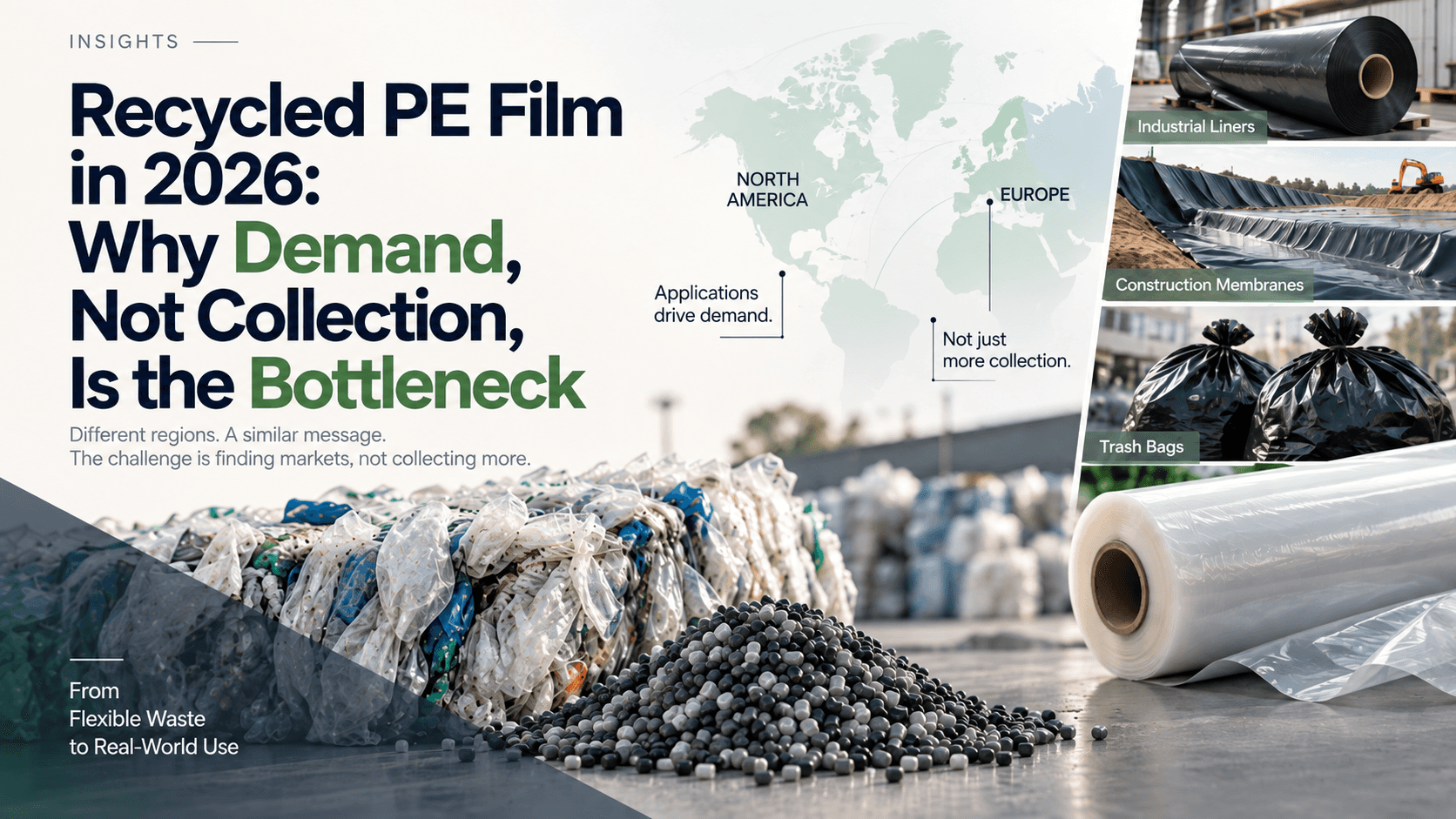
Less than 5% of California's flexible plastics are recycled — but two 2026 analyses put the constraint downstream, not at collection. A report from the nonprofit Delterra and the consultancy Eunomia models eight end uses as able to absorb roughly 800,000 tons of recycled household PE film a year in North America, three of them holding about 75%. For buyers, the question is which applications can take the material — and what they will accept.
Both Analyses Started From Demand, Not Supply
Delterra — an independent environmental nonprofit — and Eunomia, a sustainability consultancy, worked from the end use backwards to find where recycled household flexible plastics could be used in North America, screening more than 40 candidate applications down to eight. Their framing is explicit: "A circular economy isn't created by collecting more material — it's created when recycled materials become valuable inputs for new products." In Europe, CEFLEX — a collaborative initiative of more than 180 European companies, associations and organizations representing the flexible packaging value chain — published an interview with its end-markets lead on June 17, 2026 on how much flexible-packaging-derived post-consumer recycled (PCR) material the region will need through 2035, and which applications could take it.
In North America, Three Applications Hold Most of the Modeled Demand
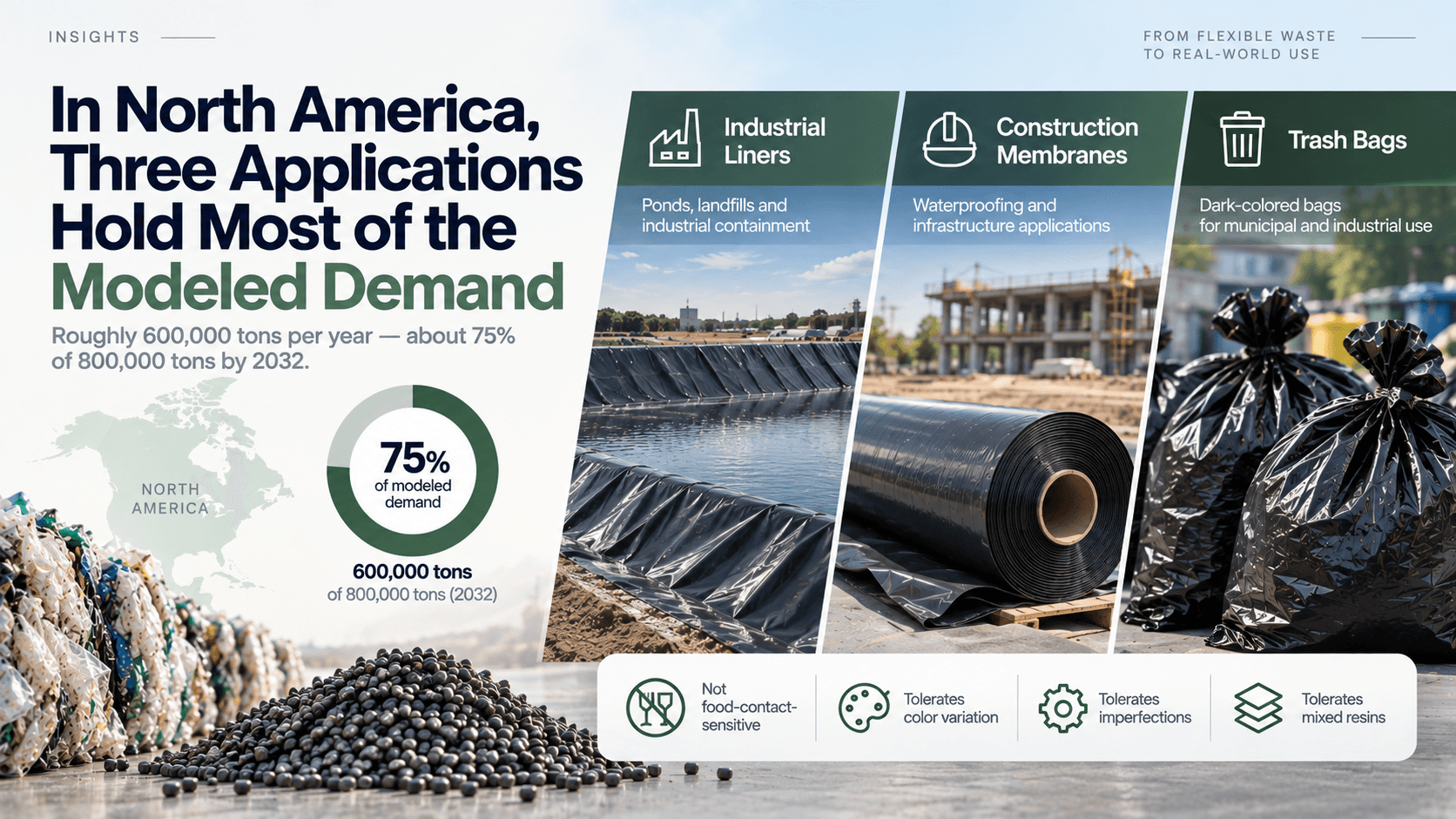
The eight applications split between injection-molded goods — horticulture pots, rigid houseware, pallets, rotational-molded items — and thicker-gauge films. Three of them account for roughly 600,000 tons per year — about 75% of the 800,000-ton annual absorption potential modeled for 2032 in North America: industrial liners, impermeable construction membranes, and dark-colored trash bags.
What those three have in common matters more than the list itself. The report describes the shared characteristics of the most promising applications as: not food-contact-sensitive; tolerant of color variation, which rules out transparent, white and light-colored uses; tolerant of imperfections such as gels and carbon, which favors thicker gauges; and tolerant of variable, uncertain resin composition, including mixed LDPE and LLDPE and potentially some HDPE. That is, in effect, a specification — and it runs in the opposite direction from how recycled-content requirements are usually written. Where demand is concentrated, the tolerances are wide; where tolerances are narrow, the absorbing volume is much smaller.
The figure carries limits worth stating plainly: it is a modeled absorption potential rather than a forecast of uptake, it assumes PCR incorporation rates from 5% to 70% depending on the application, and the report excluded end uses it considered already commercially viable, so the eight represent new headroom rather than the whole market.
That gap between potential and actual uptake is partly a pricing question, and the report does not expect price parity with virgin resin to close it on its own. It points instead to support from producer responsibility organizations (PROs) — the industry-funded bodies that collect and spend producer fees under extended producer responsibility (EPR) rules — as likely to be part of what these markets need to develop.

Europe's Numbers Point the Same Way
In the CEFLEX interview, End Markets Lead James Marshall described a conservative 2025 baseline of around 1.5 million tonnes of polyolefin flexible packaging PCR used per year in Europe, and said around 2.5 million tonnes will be required by 2030 to deliver the recycled-content targets under the EU Packaging and Packaging Waste Regulation (PPWR) in flexible packaging alone. Beyond packaging he described around 4.3 million tonnes of existing and potential 2030 demand across established secondary markets, and framed the 55% recycled-at-scale recycling rate target as effectively requiring outlets for 5.9 million tonnes by 2035.
The destinations he names for recycled polyethylene are stretch film, shrink film, refuse sacks, heavy-duty sacks and other PE bag applications; for recycled polypropylene, durable goods and rigid non-food applications such as crates, pallets, storage boxes and horticultural products. He also notes that around 80% of PP flexible packaging currently goes into contact-sensitive applications, part of why rPP from flexibles is harder to place. The overlap with the North American list is the point: on both continents, the applications expected to absorb the most material are the ones least sensitive to color and cosmetic variation.
The Route from Bale to Pellet Is Narrower Than the Demand
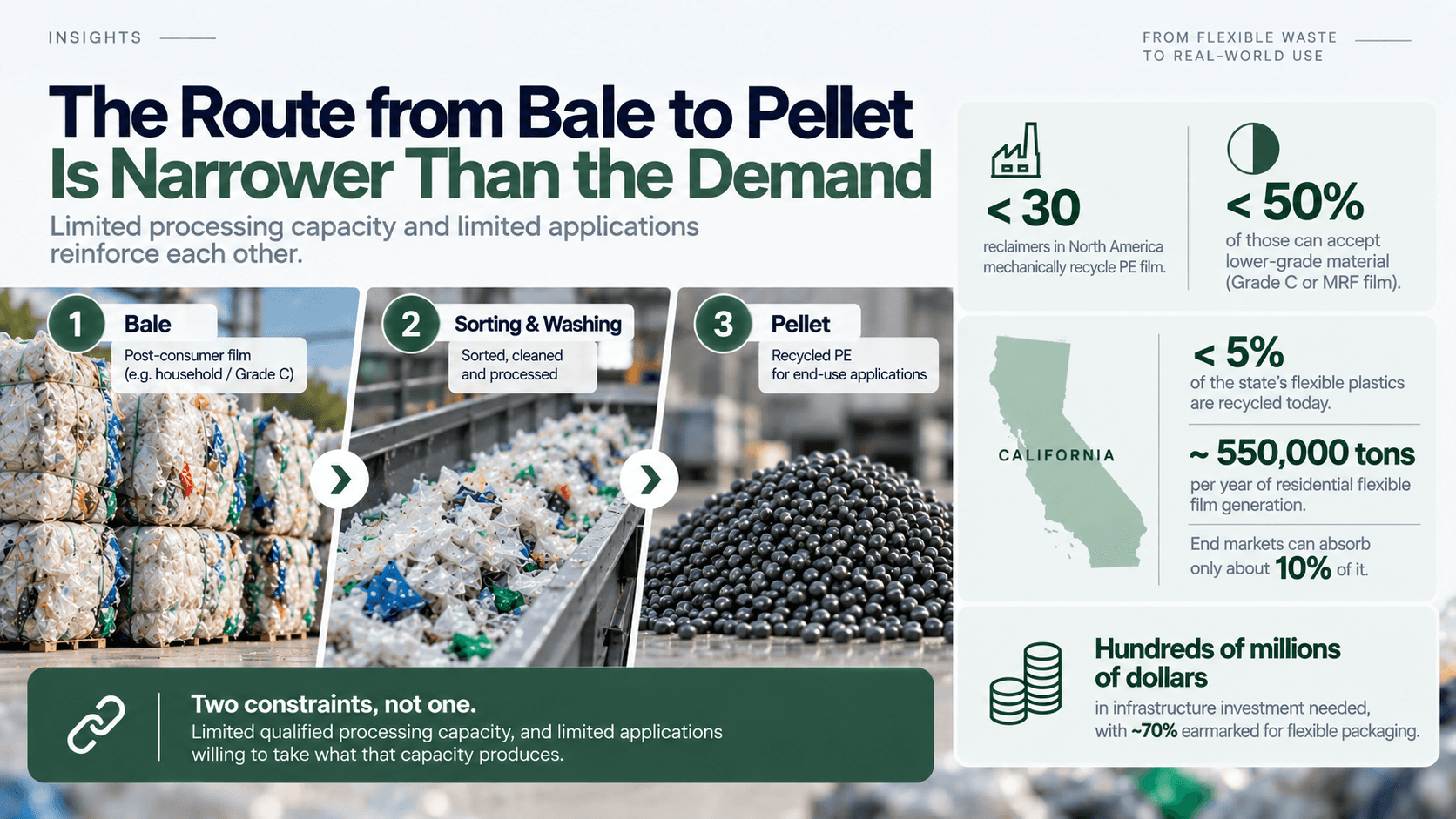
If the tolerant applications are the opportunity, processing capacity is the other half of the problem, and its width is measurable. Delterra and Eunomia report that fewer than 30 reclaimers in North America mechanically recycle polyethylene film, and that less than half of those can accept the lower-grade material sourced from households — Grade C or MRF film.
California is where the report measures that gap: less than 5% of the state's flexible plastics are recycled today, and, in the report's words, "North America's current recycling infrastructure is not yet equipped to bridge that gap." Reporting by Resource Recycling on September 4, 2026 cited Katherine Huded, director of circular ventures at The Recycling Partnership, putting the state's residential flexible film generation at approximately 550,000 tons per year against end markets able to absorb only about 10% of it. Separately in the same reporting, Patrick Keenan, a packaging engineer at General Mills who has served on the SB 54 advisory board, cited the state's infrastructure needs assessment as pointing to hundreds of millions of dollars in investment, with roughly 70% of that figure earmarked for flexible packaging.
Read together, these point to two constraints reinforcing each other rather than one bottleneck: limited qualified processing capacity, and limited applications willing to take what that capacity produces.
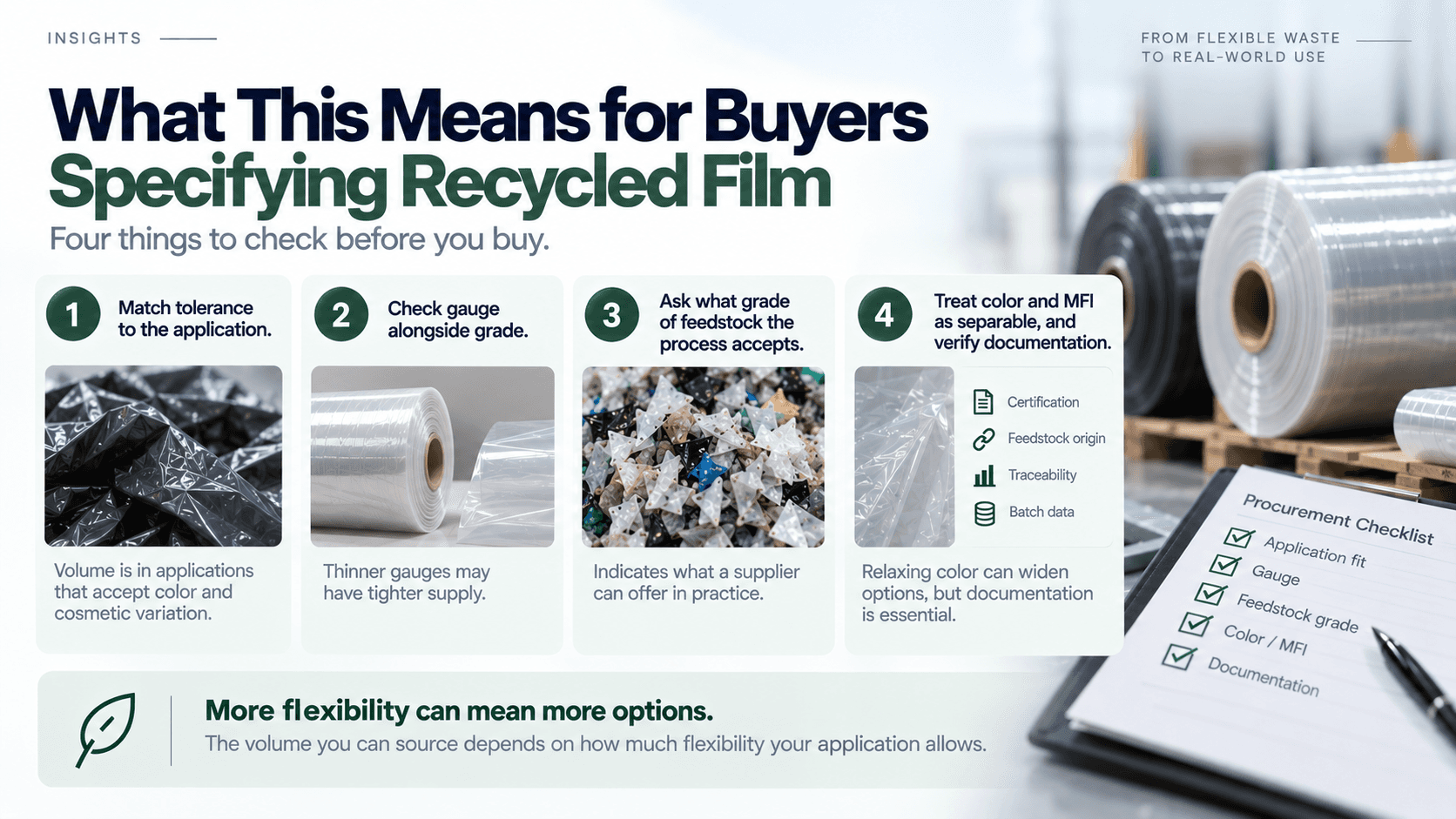
What This Means for Buyers Specifying Recycled Film
For procurement teams evaluating recycled LDPE, LLDPE or PP film grades, four things are worth checking rather than assuming:
Match tolerance to the application before price. Where the end use accepts color variation, cosmetic imperfections such as gels and carbon specks, and some variability in resin composition, both analyses put volume there. Where it cannot — a food-contact or fixed-color requirement — expect a much smaller qualified pool and plan lead times accordingly.
Check gauge alongside grade. Because tolerance for gels and carbon favors thicker sections, a thin-gauge application may face tighter supply than a heavy-gauge one at the same recycled-content level.
Ask what grade of feedstock a supplier's process accepts. Given how few reclaimers can run household-sourced film, this indicates what a supplier can offer more practically than a recycled-content percentage.
Treat color and MFI as separable, and verify documentation per grade. Relaxing color while holding melt flow and contamination limits can widen the set of grades available for evaluation; certification, feedstock origin, traceability and batch data still need review grade by grade, since these analyses describe market structure rather than any individual material.
Neither analysis indicates that recycled film supply is expanding or contracting on its own. What both suggest is that the volume a buyer can realistically source depends less on collection rates than on how much specification flexibility the application allows — the demand-side counterpart to the supplier-concentration questions covered here last week.
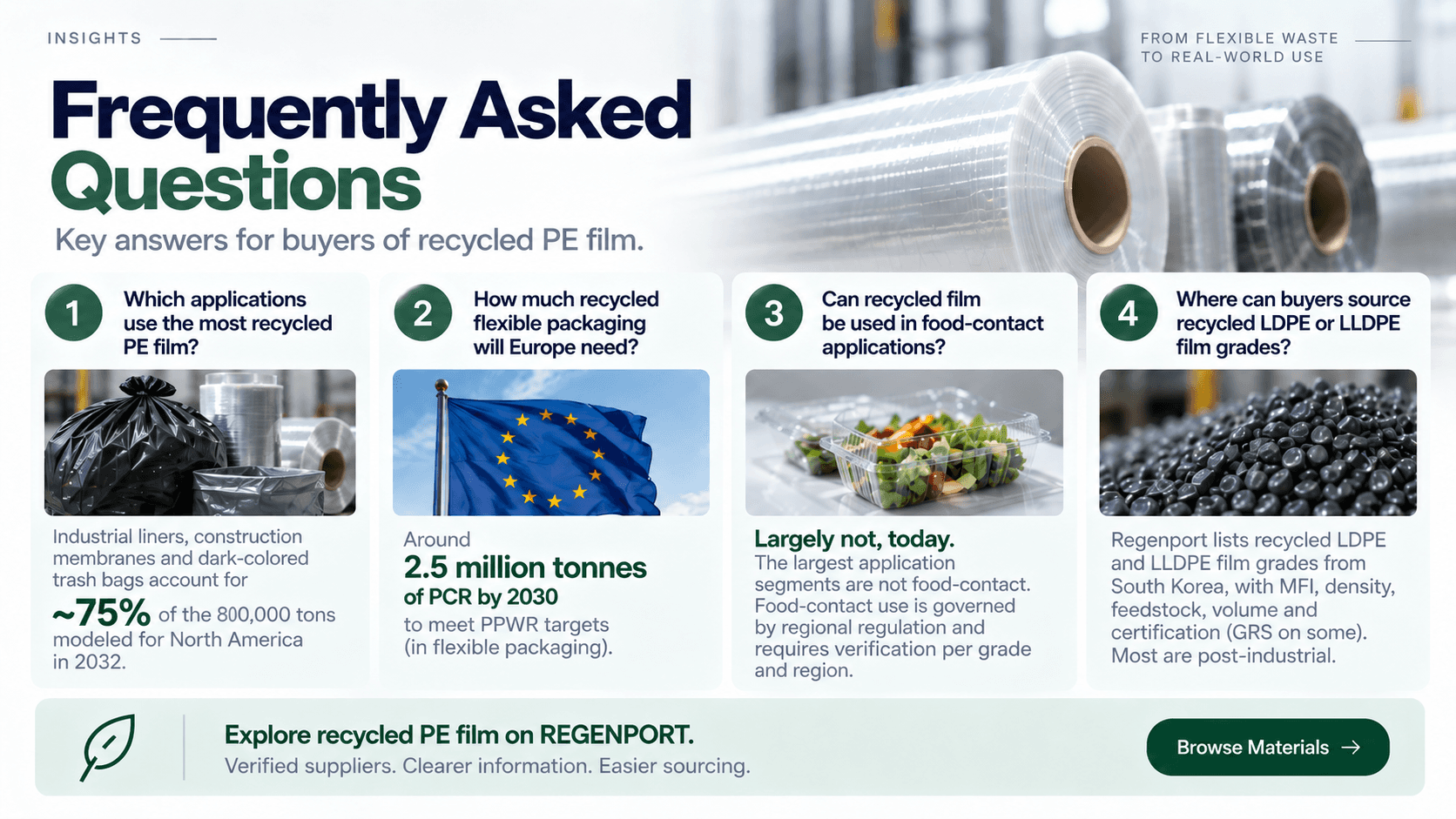
Frequently Asked Questions
Which applications use the most recycled PE film? In North America, the Delterra and Eunomia report identifies industrial liners, impermeable construction membranes and dark-colored trash bags as roughly 75% of the 800,000-ton annual absorption potential modeled for 2032. In Europe, CEFLEX names stretch film, shrink film, refuse sacks, heavy-duty sacks and other PE bag applications.
How much recycled flexible packaging will Europe need? CEFLEX puts it at around 2.5 million tonnes of flexible-packaging-derived PCR by 2030 to meet PPWR recycled-content targets in flexible packaging alone, with roughly 4.3 million tonnes of existing and potential demand in 2030 across secondary markets, and 5.9 million tonnes needing outlets by 2035 under the 55% recycled-at-scale target.
Can recycled film be used in food-contact applications? The applications identified as having the largest absorbing capacity are explicitly described as not food-contact-sensitive. Food-contact use is a separate question governed by regional regulation and requires verification per grade and per jurisdiction.
Where can buyers source recycled LDPE or LLDPE film grades?
Regenport lists recycled LDPE and LLDPE grades from South Korea, most of them film-derived — industrial and stretch film, vinyl, sugar-bag and diaper film. Melt flow index, density, feedstock, monthly volume (10–40 MT) and certification are stated per grade, with GRS on some. Most are post-industrial rather than household-collected, so buyers should verify each grade against their own application.
About This Article
Information is current as of September 8, 2026, based on "Building Markets for Recycled Household Flexible Plastics: Identifying the End Uses Needed to Meet EPR Goals" (Delterra and Eunomia, August 2026; funded with support from Amcor and Kraft Heinz), a June 17, 2026 CEFLEX interview with its End Markets Lead, and reporting by Resource Recycling. Figures are those sources' own estimates, models and projections, not Regenport's, and modeled absorption potential is not a forecast of actual demand. This article is informational and is not legal or investment advice. Buyers should verify grade specifications, certification status and availability directly with their suppliers.
Image generated with ChatGPT
Sources
Delterra and Eunomia, "Building Markets for Recycled Household Flexible Plastics: Identifying the End Uses Needed to Meet EPR Goals" → Read the Source
CEFLEX, "Understanding the Next Decade of End Markets for Flexible Packaging Derived PCR" (interview with James Marshall, CEFLEX End Markets Lead) → Read the Source
Resource Recycling, "SB 54 Unpacked: Can film catch up to cartons?" → Read the Source
Both Analyses Started From Demand, Not Supply
Delterra — an independent environmental nonprofit — and Eunomia, a sustainability consultancy, worked from the end use backwards to find where recycled household flexible plastics could be used in North America, screening more than 40 candidate applications down to eight. Their framing is explicit: "A circular economy isn't created by collecting more material — it's created when recycled materials become valuable inputs for new products." In Europe, CEFLEX — a collaborative initiative of more than 180 European companies, associations and organizations representing the flexible packaging value chain — published an interview with its end-markets lead on June 17, 2026 on how much flexible-packaging-derived post-consumer recycled (PCR) material the region will need through 2035, and which applications could take it.
In North America, Three Applications Hold Most of the Modeled Demand
The eight applications split between injection-molded goods — horticulture pots, rigid houseware, pallets, rotational-molded items — and thicker-gauge films. Three of them account for roughly 600,000 tons per year — about 75% of the 800,000-ton annual absorption potential modeled for 2032 in North America: industrial liners, impermeable construction membranes, and dark-colored trash bags.
What those three have in common matters more than the list itself. The report describes the shared characteristics of the most promising applications as: not food-contact-sensitive; tolerant of color variation, which rules out transparent, white and light-colored uses; tolerant of imperfections such as gels and carbon, which favors thicker gauges; and tolerant of variable, uncertain resin composition, including mixed LDPE and LLDPE and potentially some HDPE. That is, in effect, a specification — and it runs in the opposite direction from how recycled-content requirements are usually written. Where demand is concentrated, the tolerances are wide; where tolerances are narrow, the absorbing volume is much smaller.
The figure carries limits worth stating plainly: it is a modeled absorption potential rather than a forecast of uptake, it assumes PCR incorporation rates from 5% to 70% depending on the application, and the report excluded end uses it considered already commercially viable, so the eight represent new headroom rather than the whole market.
That gap between potential and actual uptake is partly a pricing question, and the report does not expect price parity with virgin resin to close it on its own. It points instead to support from producer responsibility organizations (PROs) — the industry-funded bodies that collect and spend producer fees under extended producer responsibility (EPR) rules — as likely to be part of what these markets need to develop.
Europe's Numbers Point the Same Way
In the CEFLEX interview, End Markets Lead James Marshall described a conservative 2025 baseline of around 1.5 million tonnes of polyolefin flexible packaging PCR used per year in Europe, and said around 2.5 million tonnes will be required by 2030 to deliver the recycled-content targets under the EU Packaging and Packaging Waste Regulation (PPWR) in flexible packaging alone. Beyond packaging he described around 4.3 million tonnes of existing and potential 2030 demand across established secondary markets, and framed the 55% recycled-at-scale recycling rate target as effectively requiring outlets for 5.9 million tonnes by 2035.
The destinations he names for recycled polyethylene are stretch film, shrink film, refuse sacks, heavy-duty sacks and other PE bag applications; for recycled polypropylene, durable goods and rigid non-food applications such as crates, pallets, storage boxes and horticultural products. He also notes that around 80% of PP flexible packaging currently goes into contact-sensitive applications, part of why rPP from flexibles is harder to place. The overlap with the North American list is the point: on both continents, the applications expected to absorb the most material are the ones least sensitive to color and cosmetic variation.
The Route from Bale to Pellet Is Narrower Than the Demand
If the tolerant applications are the opportunity, processing capacity is the other half of the problem, and its width is measurable. Delterra and Eunomia report that fewer than 30 reclaimers in North America mechanically recycle polyethylene film, and that less than half of those can accept the lower-grade material sourced from households — Grade C or MRF film.
California is where the report measures that gap: less than 5% of the state's flexible plastics are recycled today, and, in the report's words, "North America's current recycling infrastructure is not yet equipped to bridge that gap." Reporting by Resource Recycling on September 4, 2026 cited Katherine Huded, director of circular ventures at The Recycling Partnership, putting the state's residential flexible film generation at approximately 550,000 tons per year against end markets able to absorb only about 10% of it. Separately in the same reporting, Patrick Keenan, a packaging engineer at General Mills who has served on the SB 54 advisory board, cited the state's infrastructure needs assessment as pointing to hundreds of millions of dollars in investment, with roughly 70% of that figure earmarked for flexible packaging.
Read together, these point to two constraints reinforcing each other rather than one bottleneck: limited qualified processing capacity, and limited applications willing to take what that capacity produces.
What This Means for Buyers Specifying Recycled Film
For procurement teams evaluating recycled LDPE, LLDPE or PP film grades, four things are worth checking rather than assuming:
Match tolerance to the application before price. Where the end use accepts color variation, cosmetic imperfections such as gels and carbon specks, and some variability in resin composition, both analyses put volume there. Where it cannot — a food-contact or fixed-color requirement — expect a much smaller qualified pool and plan lead times accordingly.
Check gauge alongside grade. Because tolerance for gels and carbon favors thicker sections, a thin-gauge application may face tighter supply than a heavy-gauge one at the same recycled-content level.
Ask what grade of feedstock a supplier's process accepts. Given how few reclaimers can run household-sourced film, this indicates what a supplier can offer more practically than a recycled-content percentage.
Treat color and MFI as separable, and verify documentation per grade. Relaxing color while holding melt flow and contamination limits can widen the set of grades available for evaluation; certification, feedstock origin, traceability and batch data still need review grade by grade, since these analyses describe market structure rather than any individual material.
Neither analysis indicates that recycled film supply is expanding or contracting on its own. What both suggest is that the volume a buyer can realistically source depends less on collection rates than on how much specification flexibility the application allows — the demand-side counterpart to the supplier-concentration questions covered here last week.
Frequently Asked Questions
Which applications use the most recycled PE film? In North America, the Delterra and Eunomia report identifies industrial liners, impermeable construction membranes and dark-colored trash bags as roughly 75% of the 800,000-ton annual absorption potential modeled for 2032. In Europe, CEFLEX names stretch film, shrink film, refuse sacks, heavy-duty sacks and other PE bag applications.
How much recycled flexible packaging will Europe need? CEFLEX puts it at around 2.5 million tonnes of flexible-packaging-derived PCR by 2030 to meet PPWR recycled-content targets in flexible packaging alone, with roughly 4.3 million tonnes of existing and potential demand in 2030 across secondary markets, and 5.9 million tonnes needing outlets by 2035 under the 55% recycled-at-scale target.
Can recycled film be used in food-contact applications? The applications identified as having the largest absorbing capacity are explicitly described as not food-contact-sensitive. Food-contact use is a separate question governed by regional regulation and requires verification per grade and per jurisdiction.
Where can buyers source recycled LDPE or LLDPE film grades?
Regenport lists recycled LDPE and LLDPE grades from South Korea, most of them film-derived — industrial and stretch film, vinyl, sugar-bag and diaper film. Melt flow index, density, feedstock, monthly volume (10–40 MT) and certification are stated per grade, with GRS on some. Most are post-industrial rather than household-collected, so buyers should verify each grade against their own application.
About This Article
Information is current as of September 8, 2026, based on "Building Markets for Recycled Household Flexible Plastics: Identifying the End Uses Needed to Meet EPR Goals" (Delterra and Eunomia, August 2026; funded with support from Amcor and Kraft Heinz), a June 17, 2026 CEFLEX interview with its End Markets Lead, and reporting by Resource Recycling. Figures are those sources' own estimates, models and projections, not Regenport's, and modeled absorption potential is not a forecast of actual demand. This article is informational and is not legal or investment advice. Buyers should verify grade specifications, certification status and availability directly with their suppliers.
Image generated with ChatGPT
Sources
Delterra and Eunomia, "Building Markets for Recycled Household Flexible Plastics: Identifying the End Uses Needed to Meet EPR Goals" → Read the Source
CEFLEX, "Understanding the Next Decade of End Markets for Flexible Packaging Derived PCR" (interview with James Marshall, CEFLEX End Markets Lead) → Read the Source
Resource Recycling, "SB 54 Unpacked: Can film catch up to cartons?" → Read the Source
Where rLDPE Film Gets Used
Grades • Specs • Availability
Browse rLDPE →
Where rLDPE Film Gets Used
Where rLDPE Film Gets Used
Review rLDPE grades by feedstock, color, MFI, stock and MOQ.
Review rLDPE grades by feedstock, color, MFI, stock and MOQ.
Browse rLDPE →
Browse rLDPE →
Looking for samples or ready to source? Submit your request for pricing, availability, and technical information.
Looking for samples or ready to source? Submit your request for pricing, availability, and technical information.
Request a Quote →
Request a Quote →
Posted by REGENPORT
REGENPORT is a global platform connecting buyers and suppliers in the recycled materials and sustainable packaging industries.