CATEGORY
CATEGORY
Trend
Trend
Trend
August 2026 Recycled Plastics Market Review: Divergence Shifts from Grade to Region
August 2026 Recycled Plastics Market Review: Divergence Shifts from Grade to Region
August 2026 Recycled Plastics Market Review: Divergence Shifts from Grade to Region

Virgin PE and PP rallied through the first three weeks of August, then stalled and eased back from their peak. Most recycled grades barely moved — and where they did move, the reason was usually a region or a shipping lane rather than a polymer.
August 2026 in One Sentence
Virgin resin rallied and then stalled; recycled mostly stood still — and where it moved, geography moved it.
Last month's review described a market that had stopped moving as one market, with each recycled grade following its own direction. August took that a step further. This time the grades did not split from each other so much as go quiet together, and most of the price action that did appear was organised by location — Europe, Brazil, the Rhine, the Red Sea, Jeddah — rather than by polymer. For anyone pricing recycled material in August 2026, the more useful question was often where the cargo was coming from, not which grade it was.
Why It Happened
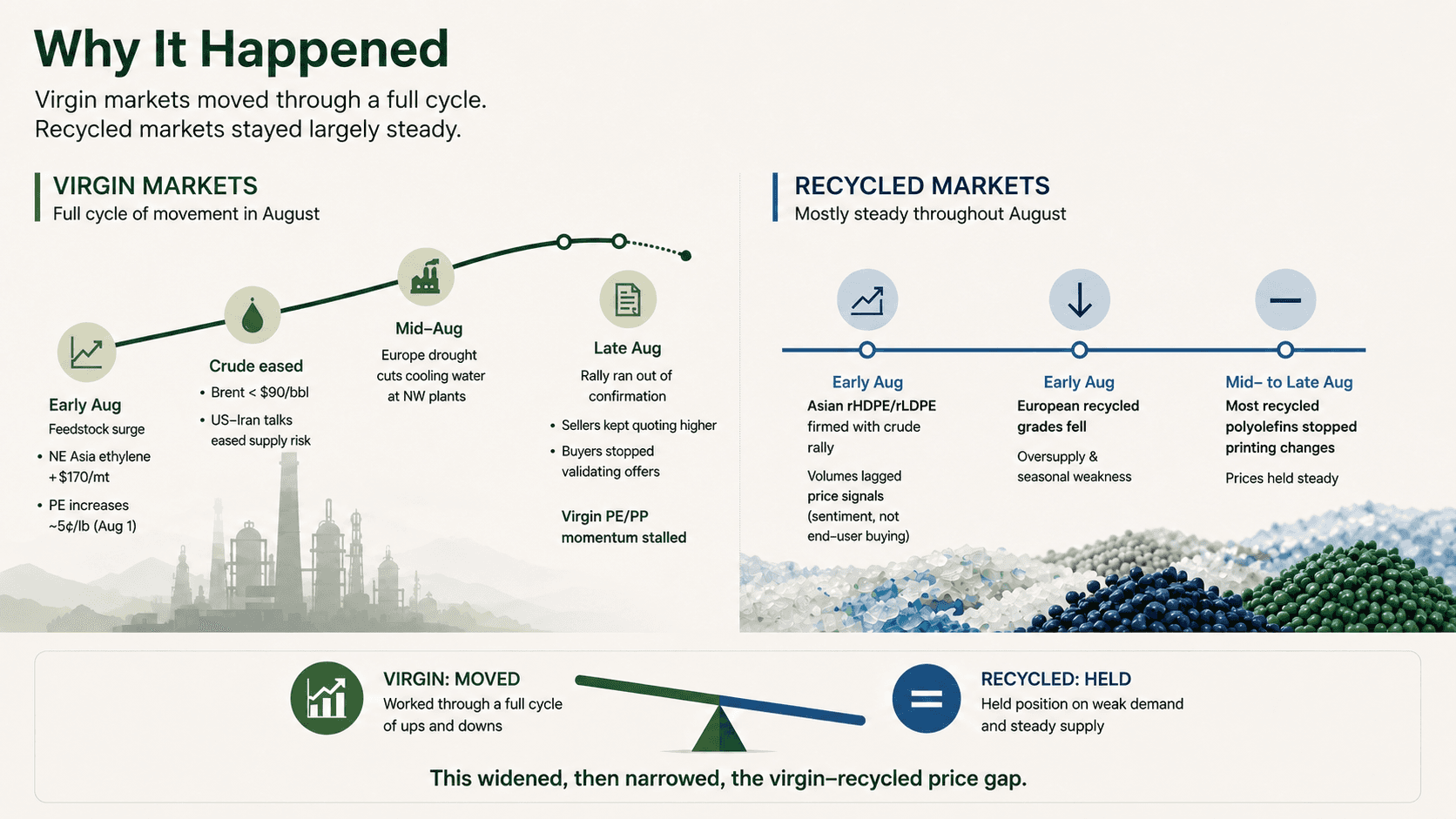
The virgin side had a full month of movement to work through. Early August opened with a feedstock surge: Northeast Asia ethylene had gained roughly USD 170/mt since the start of July, and North American producers pushed polyethylene increases of about 5 cents/lb effective August 1, with Equistar Chemicals, Dow, ExxonMobil and Nova Chemicals all confirming. Crude then went the other way — ICE Brent for September slipped below USD 90/barrel, and in the following week crude eased further as US–Iran talks advanced toward reopening the Strait of Hormuz. Europe added a supply-side constraint in the third week when drought cut cooling water at Northwest European polymerization plants. By the fourth week the rally had run out of confirmation: sellers kept quoting higher, buyers stopped validating those offers at the transaction level, and virgin PE and PP momentum stalled.
Recycled markets did comparatively little of that. Bale and pellet pricing responds mainly to domestic collection volumes and end-use demand rather than to monomer costs, and August's end-use demand was thin — European buyers were on summer holiday, and demand across the polyolefin chain stayed slow all month. There was one first-week exception: Asian recycled HDPE and LDPE firmed alongside the crude rally, though reported traded volumes stayed well behind the price signals, which points to sentiment rather than end-user buying. European recycled grades fell in the same week on oversupply and seasonal weakness. From mid-month onward, though, most recycled polyolefins simply stopped printing changes. That combination — a virgin market working through a full cycle, a recycled market holding position — is what widened the virgin–recycled gap in early August and narrowed it again by the end.
The Evidence: Three Things August Showed
Evidence 1 — The gap opened and closed with recycled doing little of the work
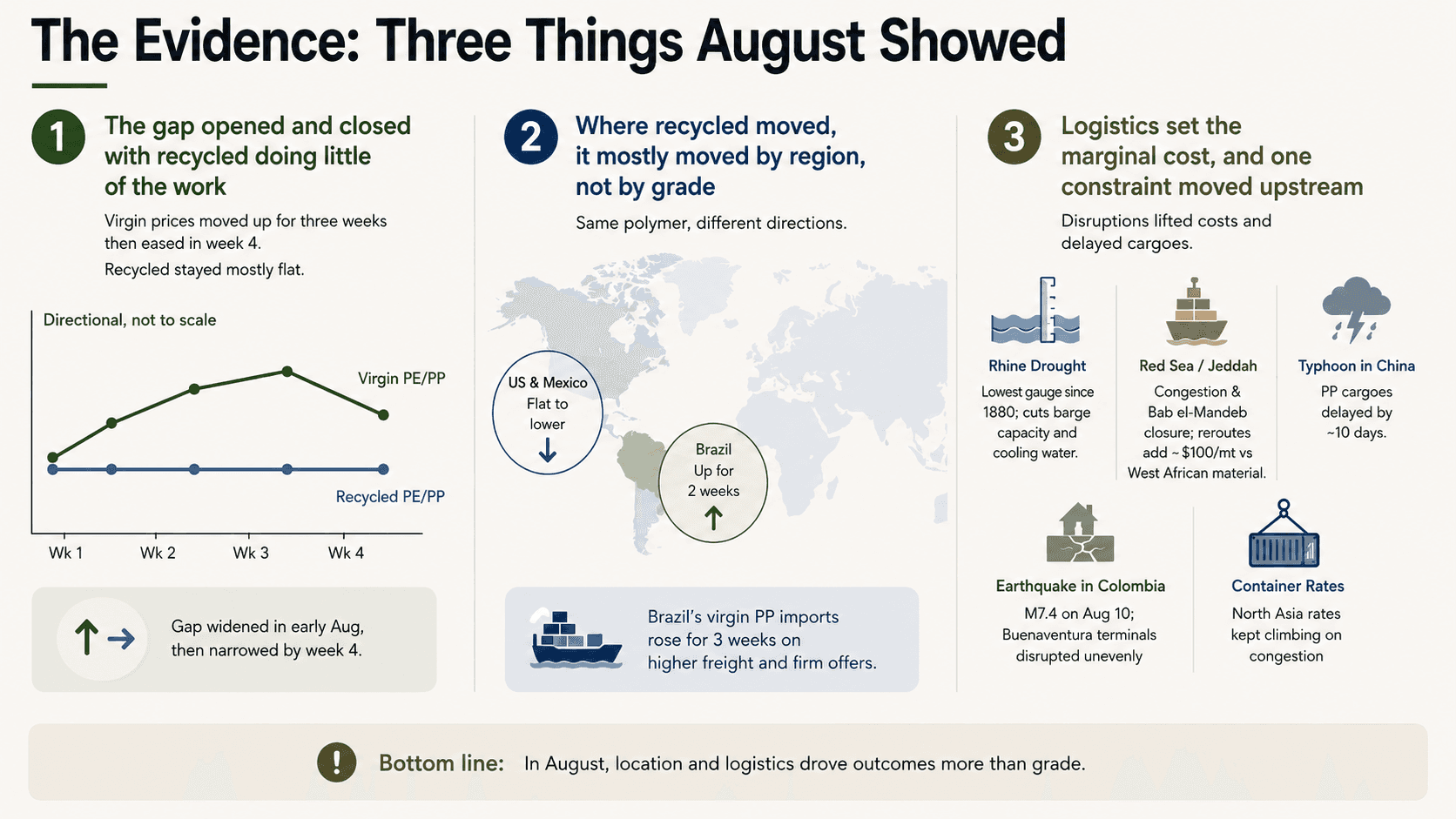
In the first week, virgin PE and PP climbed across Asia and North America on feedstock costs while European recycled HDPE natural pellets were reported down around EUR 50/mt and recycled PP natural pellets down around EUR 70/mt. In the following week the split ran inside a single polymer family in the US: post-consumer recycled HDPE bales and natural pellets fell in the same week that virgin HDPE rose across blow molding and injection/film grades, widening the cost gap in the buyer's favour. By the fourth week, with virgin momentum stalled and easing back from its peak, that same gap was narrowing again. Recycled polyolefin prices were close to where they had been on both occasions — most of the movement came from the virgin leg.
Evidence 2 — Where recycled moved, it mostly moved by region, not by grade
Recycled PET was the month's clearest example. Brazilian clear and green bottle bales and flakes rose for two consecutive weeks through mid-August while southern Brazil held steady. Over the same two weeks, US bales extended their decline across major cities in the first and were flat to easier in the second, with US clear flakes and food-grade pellets unchanged and Mexico broadly following the US. One polymer, two regional directions — Brazil up, the US and Mexico flat to lower. In the final week Brazil's rPET market slowed as feedstock bale prices began to decline, pulling pellet prices lower there and in the US. Brazil's virgin PP import market showed the same regional logic in reverse: it rose for a third consecutive week even as the global virgin complex rolled over, because Asia-to-Brazil freight climbed from roughly USD 6,500 to USD 7,500 per FEU over the course of August while offers from China and Egypt stayed firm. That was a freight and offer story, not a feedstock one.
Evidence 3 — Logistics set the marginal cost, and one constraint moved upstream
August brought several simultaneous disruptions. The Rhine gauge at Kaub fell to its lowest since records began in 1880, cutting how much each barge could carry and pushing European producers toward costlier rail and road; force majeure was declared at chemical sites in the region, so far in polyurethane feedstock rather than polyolefins. In the Middle East, congestion at Jeddah and the closure of the Bab el-Mandeb Strait led market participants to expect September loadings bound for Africa to slip into late October, and rerouting through Khor Fakkan and Sohar was reported to add roughly USD 100/mt to North African cargoes compared with West African material. A typhoon delayed one Chinese producer's polypropylene cargoes by about 10 days. A magnitude 7.4 earthquake in Colombia on August 10 disrupted Buenaventura terminals unevenly, with some suspending operations and others resuming after inspection. Container rates out of North Asia kept climbing on schedule disruption and congestion. For several weeks running, the freight line moved more than the resin line. The Rhine case is the one to separate out: because it restricted cooling water at polymerization plants and not only barge capacity, it became a production constraint, and production constraints tend to persist longer than logistics ones.
Context: Regulation and Company Moves
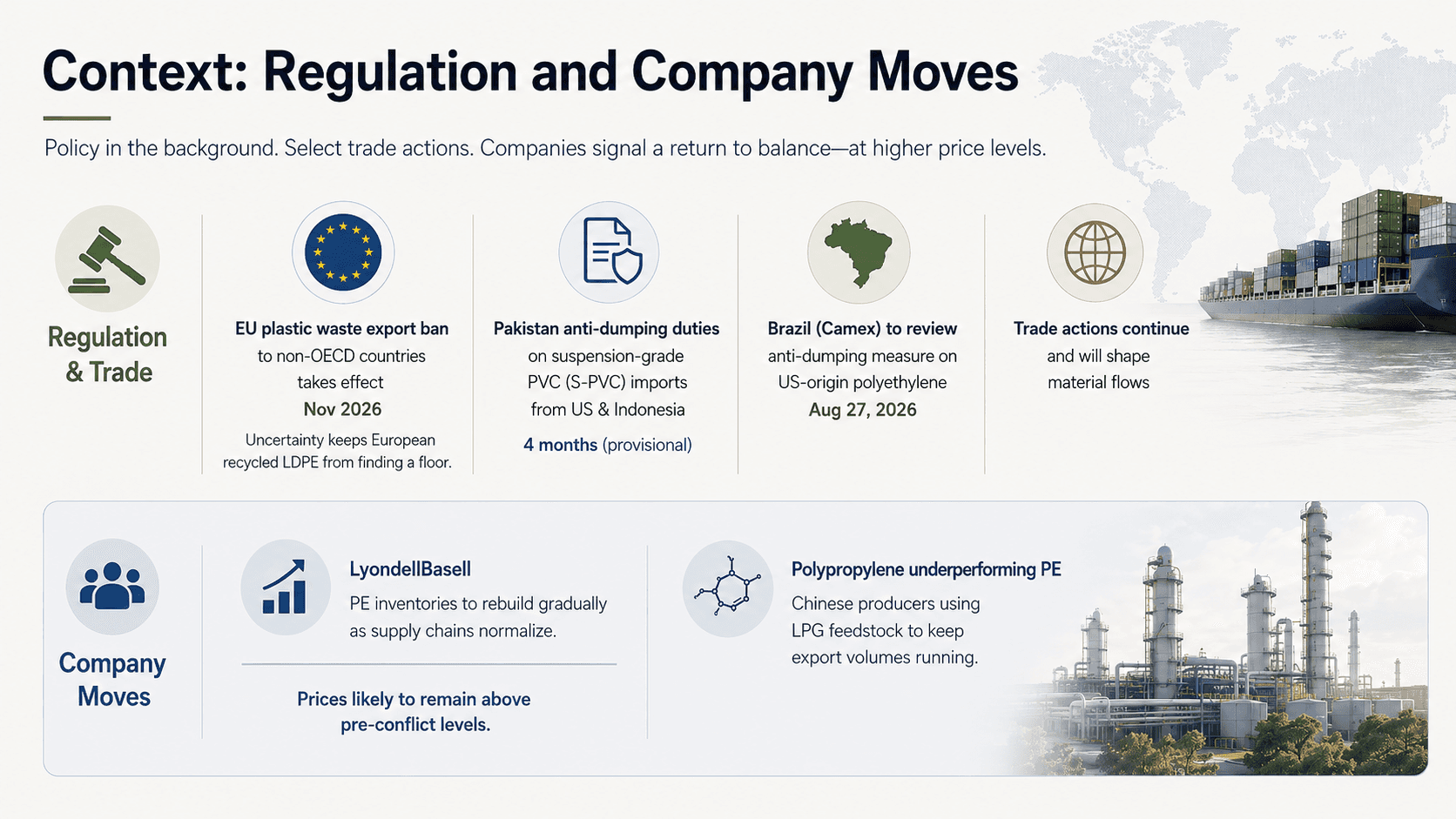
Policy sat in the background all month rather than driving prices. The EU's ban on plastic waste exports to non-OECD countries takes effect in November 2026, and that pending change was cited as a reason European recycled LDPE had yet to find a floor — buyers appear reluctant to commit ahead of a rule that will reshape bale flows. Trade actions continued elsewhere: Pakistan imposed provisional anti-dumping duties on suspension-grade PVC imports from the United States and Indonesia for four months, and Brazil's Foreign Trade Committee (Camex) was scheduled to review the anti-dumping measure on US-origin polyethylene on August 27. On the company side, LyondellBasell indicated that polyethylene inventories should rebuild gradually as supply chains normalise but that prices are likely to remain above pre-conflict levels, and noted polypropylene underperforming polyethylene as Chinese producers used liquefied petroleum gas (LPG) feedstock to keep export volumes running.
What to Watch in September
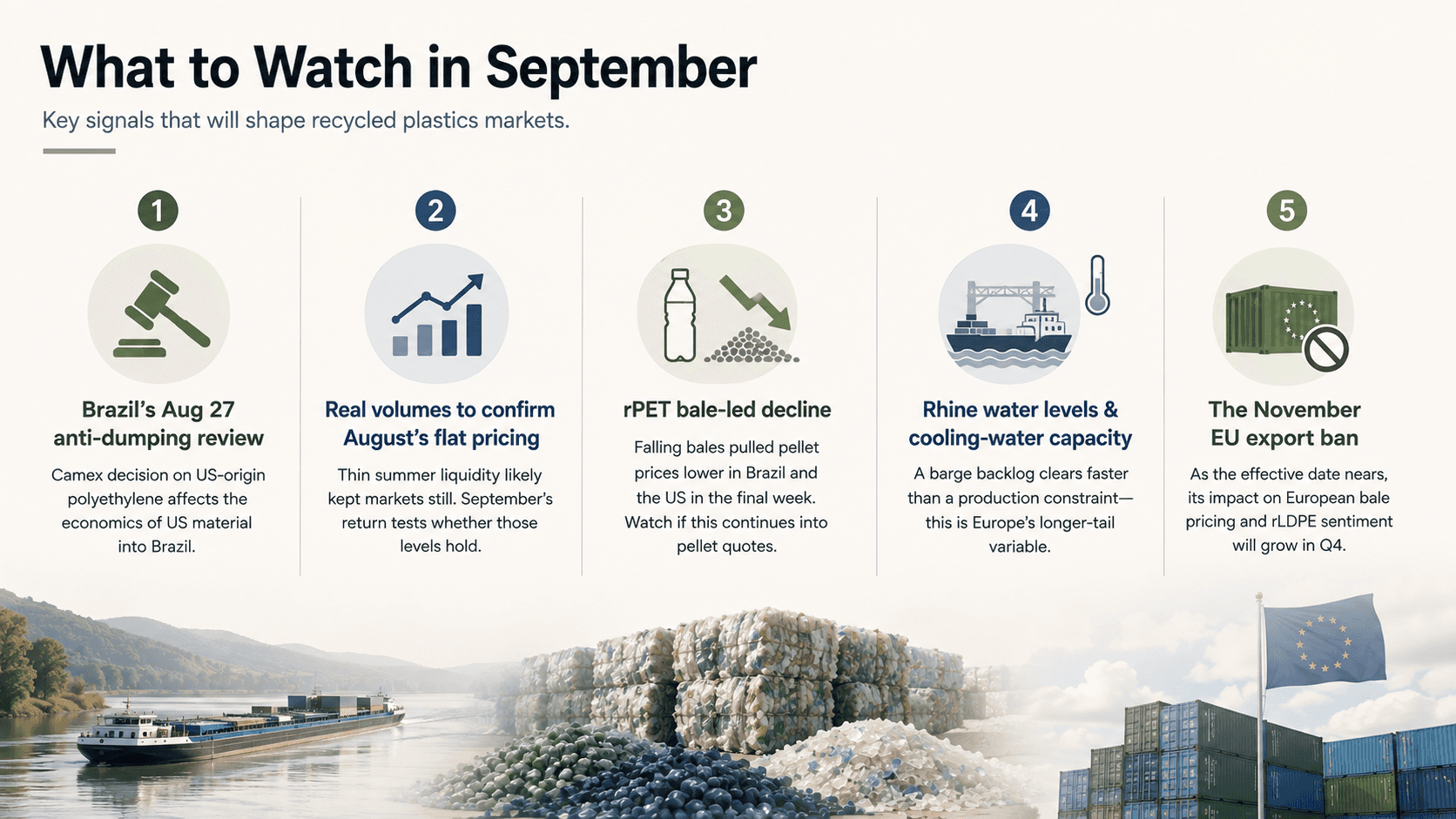
Brazil's August 27 anti-dumping review. The Camex decision on US-origin polyethylene directly affects the economics of US material into Brazil, in a market that has already been moving on its own freight-driven cycle.
Whether real volumes confirm August's flat pricing. Much of the month's stillness likely sat on thin summer liquidity while European buyers were away. September's return is the first test of whether those levels hold when transactions resume.
The rPET bale-led decline. Falling bales pulled pellet prices lower in the final week in both Brazil and the US. Whether that continues into pellet quotes is an early signal worth monitoring rather than a confirmed direction.
Rhine water levels and European cooling-water capacity. A barge backlog clears faster than a production constraint, so this is the European variable with the longer tail.
The November EU export ban. As the effective date approaches, its influence on European bale pricing and rLDPE sentiment is likely to grow through Q4.
Conclusion
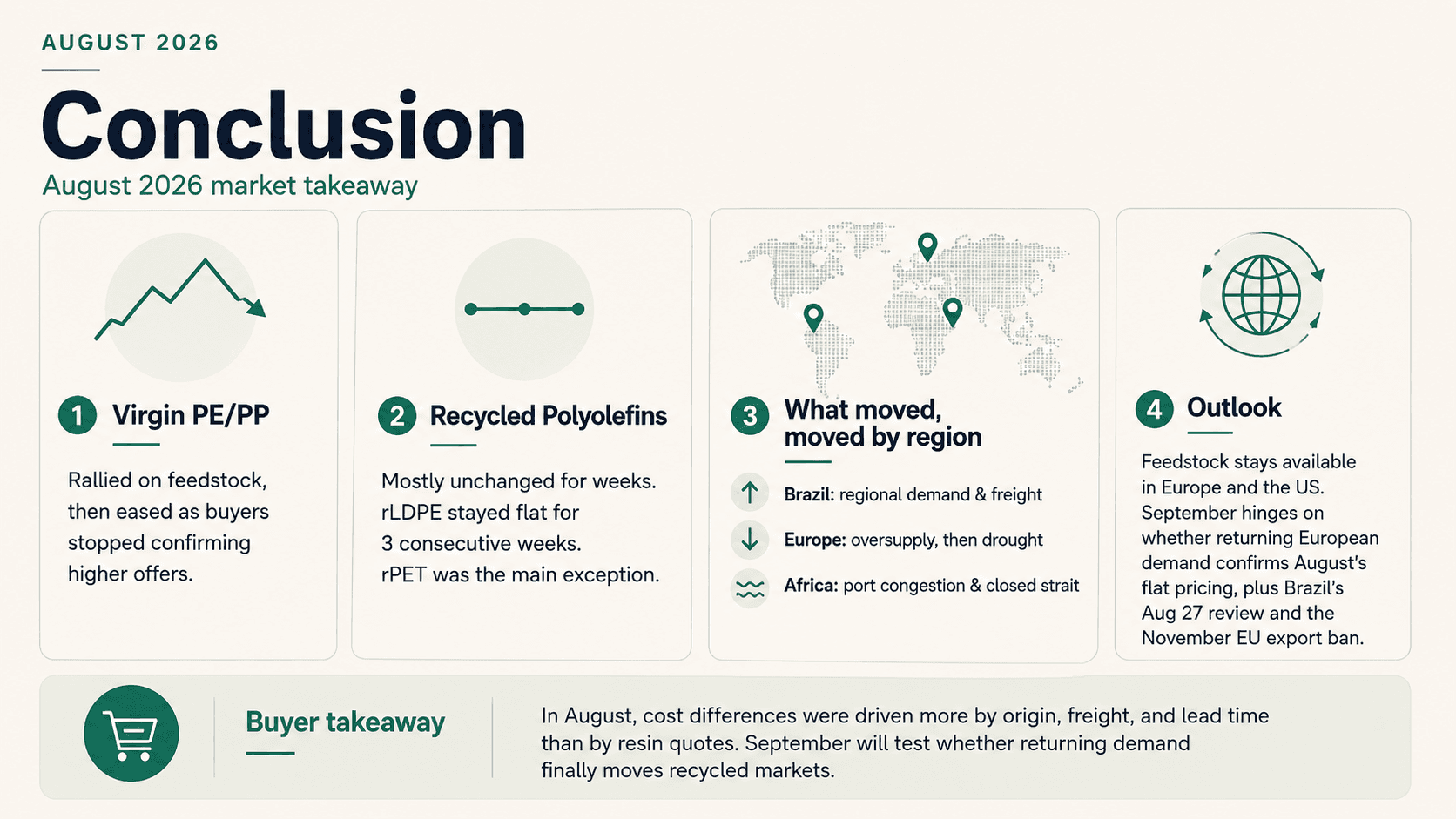
August 2026 was a month in which the recycled plastics market mostly declined to participate. Virgin PE and PP rallied on feedstock and then eased back from their peak once buyers stopped confirming higher offers; recycled polyolefins went weeks without a price change, with recycled LDPE unchanged for three consecutive weeks to month-end and recycled PET the main exception. What did move, largely moved because of where it was: Brazil on regional demand and freight, Europe on oversupply and then drought, Africa on port congestion and a closed strait. Read that way, August's lesson for buyers and suppliers is practical rather than directional — much of the month's cost difference sat in origin, freight and lead time rather than in the resin quote, and September's test is whether returning demand finally gives recycled markets a reason of their own to move.
Frequently Asked Questions
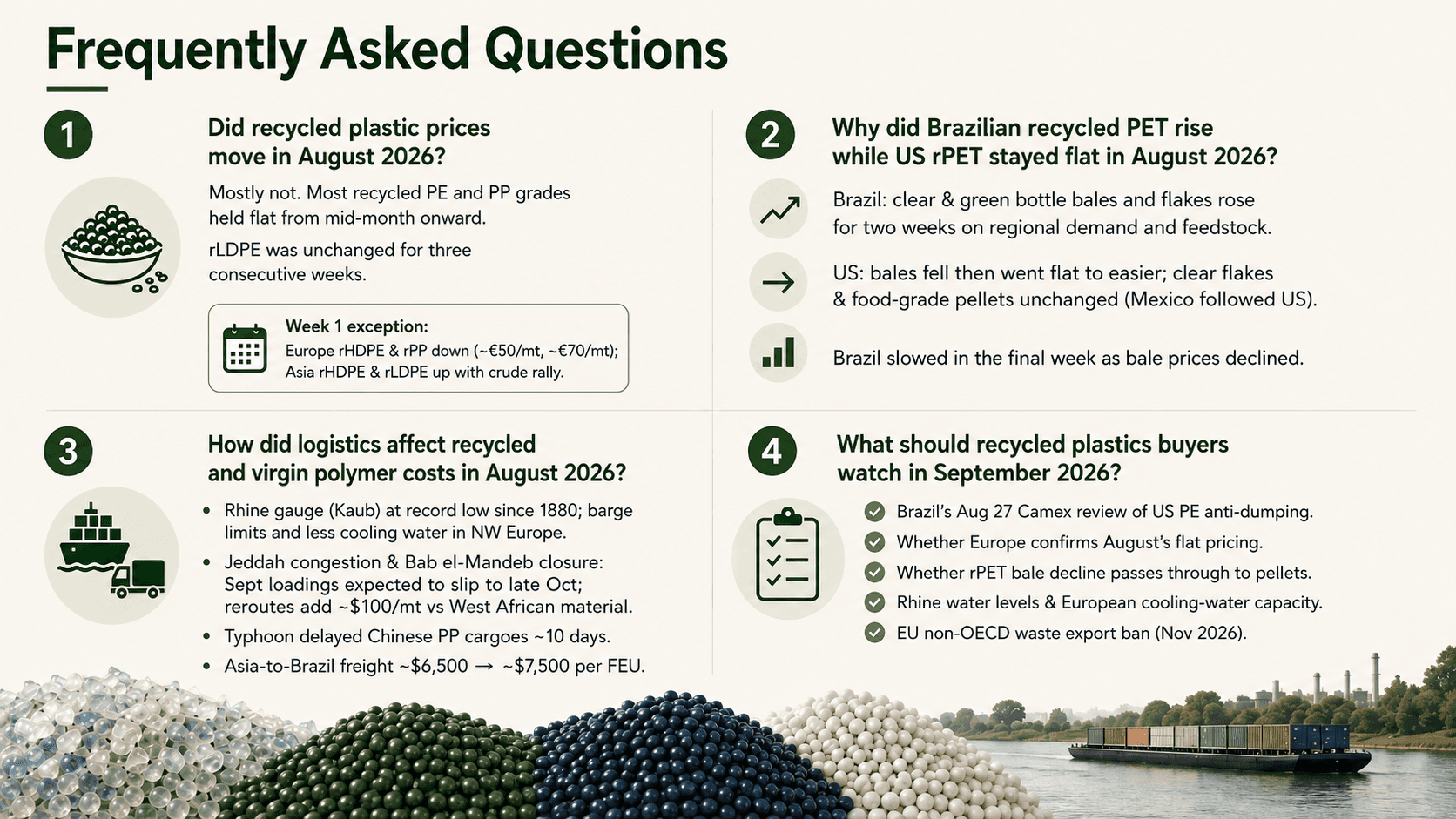
Did recycled plastic prices move in August 2026? Mostly not. Most recycled PE and PP grades held broadly flat from mid-month onward, and recycled LDPE went three consecutive weeks to month-end without a single price change. The first week was the exception in both directions: European recycled HDPE and PP were reported down around EUR 50/mt and EUR 70/mt respectively, while Asian recycled HDPE and LDPE firmed with the crude rally on traded volumes that stayed behind the price signals.
Why did Brazilian recycled PET rise while US rPET stayed flat in August 2026? The two markets moved on separate regional conditions. Brazilian clear and green bottle bales and flakes rose for two consecutive weeks on regional demand and feedstock conditions, while US bales extended a decline and then went flat to easier, with US clear flakes and food-grade pellets unchanged and Mexico broadly following the US. Brazil then slowed in the final week as bale prices began to decline.
How did logistics affect recycled and virgin polymer costs in August 2026? Several disruptions ran at once: the Rhine gauge at Kaub fell to its lowest since records began in 1880, restricting barge loads and cutting cooling water at Northwest European polymerization plants; Jeddah congestion and the Bab el-Mandeb closure led market participants to expect September loadings for Africa to slip into late October, with rerouting reported to add roughly USD 100/mt to North African cargoes compared with West African material; a typhoon delayed Chinese PP cargoes about 10 days; and Asia-to-Brazil freight rose from roughly USD 6,500 to USD 7,500 per FEU.
What should recycled plastics buyers watch in September 2026? Brazil's August 27 Camex review of the US polyethylene anti-dumping measure, whether returning European demand confirms August's flat pricing at transaction level, whether the rPET bale-led decline passes through to pellets, Rhine water levels and European cooling-water capacity, and the approach of the EU's November 2026 non-OECD waste export ban.
Image generated with ChatGPT
August 2026 in One Sentence
Virgin resin rallied and then stalled; recycled mostly stood still — and where it moved, geography moved it.
Last month's review described a market that had stopped moving as one market, with each recycled grade following its own direction. August took that a step further. This time the grades did not split from each other so much as go quiet together, and most of the price action that did appear was organised by location — Europe, Brazil, the Rhine, the Red Sea, Jeddah — rather than by polymer. For anyone pricing recycled material in August 2026, the more useful question was often where the cargo was coming from, not which grade it was.
Why It Happened
The virgin side had a full month of movement to work through. Early August opened with a feedstock surge: Northeast Asia ethylene had gained roughly USD 170/mt since the start of July, and North American producers pushed polyethylene increases of about 5 cents/lb effective August 1, with Equistar Chemicals, Dow, ExxonMobil and Nova Chemicals all confirming. Crude then went the other way — ICE Brent for September slipped below USD 90/barrel, and in the following week crude eased further as US–Iran talks advanced toward reopening the Strait of Hormuz. Europe added a supply-side constraint in the third week when drought cut cooling water at Northwest European polymerization plants. By the fourth week the rally had run out of confirmation: sellers kept quoting higher, buyers stopped validating those offers at the transaction level, and virgin PE and PP momentum stalled.
Recycled markets did comparatively little of that. Bale and pellet pricing responds mainly to domestic collection volumes and end-use demand rather than to monomer costs, and August's end-use demand was thin — European buyers were on summer holiday, and demand across the polyolefin chain stayed slow all month. There was one first-week exception: Asian recycled HDPE and LDPE firmed alongside the crude rally, though reported traded volumes stayed well behind the price signals, which points to sentiment rather than end-user buying. European recycled grades fell in the same week on oversupply and seasonal weakness. From mid-month onward, though, most recycled polyolefins simply stopped printing changes. That combination — a virgin market working through a full cycle, a recycled market holding position — is what widened the virgin–recycled gap in early August and narrowed it again by the end.
The Evidence: Three Things August Showed
Evidence 1 — The gap opened and closed with recycled doing little of the work
In the first week, virgin PE and PP climbed across Asia and North America on feedstock costs while European recycled HDPE natural pellets were reported down around EUR 50/mt and recycled PP natural pellets down around EUR 70/mt. In the following week the split ran inside a single polymer family in the US: post-consumer recycled HDPE bales and natural pellets fell in the same week that virgin HDPE rose across blow molding and injection/film grades, widening the cost gap in the buyer's favour. By the fourth week, with virgin momentum stalled and easing back from its peak, that same gap was narrowing again. Recycled polyolefin prices were close to where they had been on both occasions — most of the movement came from the virgin leg.
Evidence 2 — Where recycled moved, it mostly moved by region, not by grade
Recycled PET was the month's clearest example. Brazilian clear and green bottle bales and flakes rose for two consecutive weeks through mid-August while southern Brazil held steady. Over the same two weeks, US bales extended their decline across major cities in the first and were flat to easier in the second, with US clear flakes and food-grade pellets unchanged and Mexico broadly following the US. One polymer, two regional directions — Brazil up, the US and Mexico flat to lower. In the final week Brazil's rPET market slowed as feedstock bale prices began to decline, pulling pellet prices lower there and in the US. Brazil's virgin PP import market showed the same regional logic in reverse: it rose for a third consecutive week even as the global virgin complex rolled over, because Asia-to-Brazil freight climbed from roughly USD 6,500 to USD 7,500 per FEU over the course of August while offers from China and Egypt stayed firm. That was a freight and offer story, not a feedstock one.
Evidence 3 — Logistics set the marginal cost, and one constraint moved upstream
August brought several simultaneous disruptions. The Rhine gauge at Kaub fell to its lowest since records began in 1880, cutting how much each barge could carry and pushing European producers toward costlier rail and road; force majeure was declared at chemical sites in the region, so far in polyurethane feedstock rather than polyolefins. In the Middle East, congestion at Jeddah and the closure of the Bab el-Mandeb Strait led market participants to expect September loadings bound for Africa to slip into late October, and rerouting through Khor Fakkan and Sohar was reported to add roughly USD 100/mt to North African cargoes compared with West African material. A typhoon delayed one Chinese producer's polypropylene cargoes by about 10 days. A magnitude 7.4 earthquake in Colombia on August 10 disrupted Buenaventura terminals unevenly, with some suspending operations and others resuming after inspection. Container rates out of North Asia kept climbing on schedule disruption and congestion. For several weeks running, the freight line moved more than the resin line. The Rhine case is the one to separate out: because it restricted cooling water at polymerization plants and not only barge capacity, it became a production constraint, and production constraints tend to persist longer than logistics ones.
Context: Regulation and Company Moves
Policy sat in the background all month rather than driving prices. The EU's ban on plastic waste exports to non-OECD countries takes effect in November 2026, and that pending change was cited as a reason European recycled LDPE had yet to find a floor — buyers appear reluctant to commit ahead of a rule that will reshape bale flows. Trade actions continued elsewhere: Pakistan imposed provisional anti-dumping duties on suspension-grade PVC imports from the United States and Indonesia for four months, and Brazil's Foreign Trade Committee (Camex) was scheduled to review the anti-dumping measure on US-origin polyethylene on August 27. On the company side, LyondellBasell indicated that polyethylene inventories should rebuild gradually as supply chains normalise but that prices are likely to remain above pre-conflict levels, and noted polypropylene underperforming polyethylene as Chinese producers used liquefied petroleum gas (LPG) feedstock to keep export volumes running.
What to Watch in September
Brazil's August 27 anti-dumping review. The Camex decision on US-origin polyethylene directly affects the economics of US material into Brazil, in a market that has already been moving on its own freight-driven cycle.
Whether real volumes confirm August's flat pricing. Much of the month's stillness likely sat on thin summer liquidity while European buyers were away. September's return is the first test of whether those levels hold when transactions resume.
The rPET bale-led decline. Falling bales pulled pellet prices lower in the final week in both Brazil and the US. Whether that continues into pellet quotes is an early signal worth monitoring rather than a confirmed direction.
Rhine water levels and European cooling-water capacity. A barge backlog clears faster than a production constraint, so this is the European variable with the longer tail.
The November EU export ban. As the effective date approaches, its influence on European bale pricing and rLDPE sentiment is likely to grow through Q4.
Conclusion
August 2026 was a month in which the recycled plastics market mostly declined to participate. Virgin PE and PP rallied on feedstock and then eased back from their peak once buyers stopped confirming higher offers; recycled polyolefins went weeks without a price change, with recycled LDPE unchanged for three consecutive weeks to month-end and recycled PET the main exception. What did move, largely moved because of where it was: Brazil on regional demand and freight, Europe on oversupply and then drought, Africa on port congestion and a closed strait. Read that way, August's lesson for buyers and suppliers is practical rather than directional — much of the month's cost difference sat in origin, freight and lead time rather than in the resin quote, and September's test is whether returning demand finally gives recycled markets a reason of their own to move.
Frequently Asked Questions
Did recycled plastic prices move in August 2026? Mostly not. Most recycled PE and PP grades held broadly flat from mid-month onward, and recycled LDPE went three consecutive weeks to month-end without a single price change. The first week was the exception in both directions: European recycled HDPE and PP were reported down around EUR 50/mt and EUR 70/mt respectively, while Asian recycled HDPE and LDPE firmed with the crude rally on traded volumes that stayed behind the price signals.
Why did Brazilian recycled PET rise while US rPET stayed flat in August 2026? The two markets moved on separate regional conditions. Brazilian clear and green bottle bales and flakes rose for two consecutive weeks on regional demand and feedstock conditions, while US bales extended a decline and then went flat to easier, with US clear flakes and food-grade pellets unchanged and Mexico broadly following the US. Brazil then slowed in the final week as bale prices began to decline.
How did logistics affect recycled and virgin polymer costs in August 2026? Several disruptions ran at once: the Rhine gauge at Kaub fell to its lowest since records began in 1880, restricting barge loads and cutting cooling water at Northwest European polymerization plants; Jeddah congestion and the Bab el-Mandeb closure led market participants to expect September loadings for Africa to slip into late October, with rerouting reported to add roughly USD 100/mt to North African cargoes compared with West African material; a typhoon delayed Chinese PP cargoes about 10 days; and Asia-to-Brazil freight rose from roughly USD 6,500 to USD 7,500 per FEU.
What should recycled plastics buyers watch in September 2026? Brazil's August 27 Camex review of the US polyethylene anti-dumping measure, whether returning European demand confirms August's flat pricing at transaction level, whether the rPET bale-led decline passes through to pellets, Rhine water levels and European cooling-water capacity, and the approach of the EU's November 2026 non-OECD waste export ban.
Image generated with ChatGPT
August rLDPE Availability
Grades • Specs • Availability
Browse rLDPE →
August rLDPE Availability
August rLDPE Availability
Check the rLDPE grades listed by feedstock, MFI, stock and MOQ.
Check the rLDPE grades listed by feedstock, MFI, stock and MOQ.
Browse rLDPE →
Browse rLDPE →
Looking for samples or ready to source? Submit your request for pricing, availability, and technical information.
Looking for samples or ready to source? Submit your request for pricing, availability, and technical information.
Request a Quote →
Request a Quote →
Posted by REGENPORT
REGENPORT is a global platform connecting buyers and suppliers in the recycled materials and sustainable packaging industries.