CATEGORY
CATEGORY
Trend
Trend
Trend
July 2026 Recycled Plastics Market Review: Market Divergence Deepens
July 2026 Recycled Plastics Market Review: Market Divergence Deepens
July 2026 Recycled Plastics Market Review: Market Divergence Deepens

Virgin polymer prices whipsawed all month on Middle East geopolitics — but the more durable story was that recycled grades stopped moving together, or with virgin resin. July was the month divergence became the market's defining feature.
July 2026 in One Sentence
The recycled plastics market stopped moving as one market.
For most of the past year, recycled polymers could be read as a single trend line that loosely tracked virgin resin. July broke that. Even as virgin prices swung sharply, recycled grades held their own course — and, more importantly, split from each other. Some strengthened, some weakened, and some moved entirely on their own demand and policy drivers.
Why It Happened
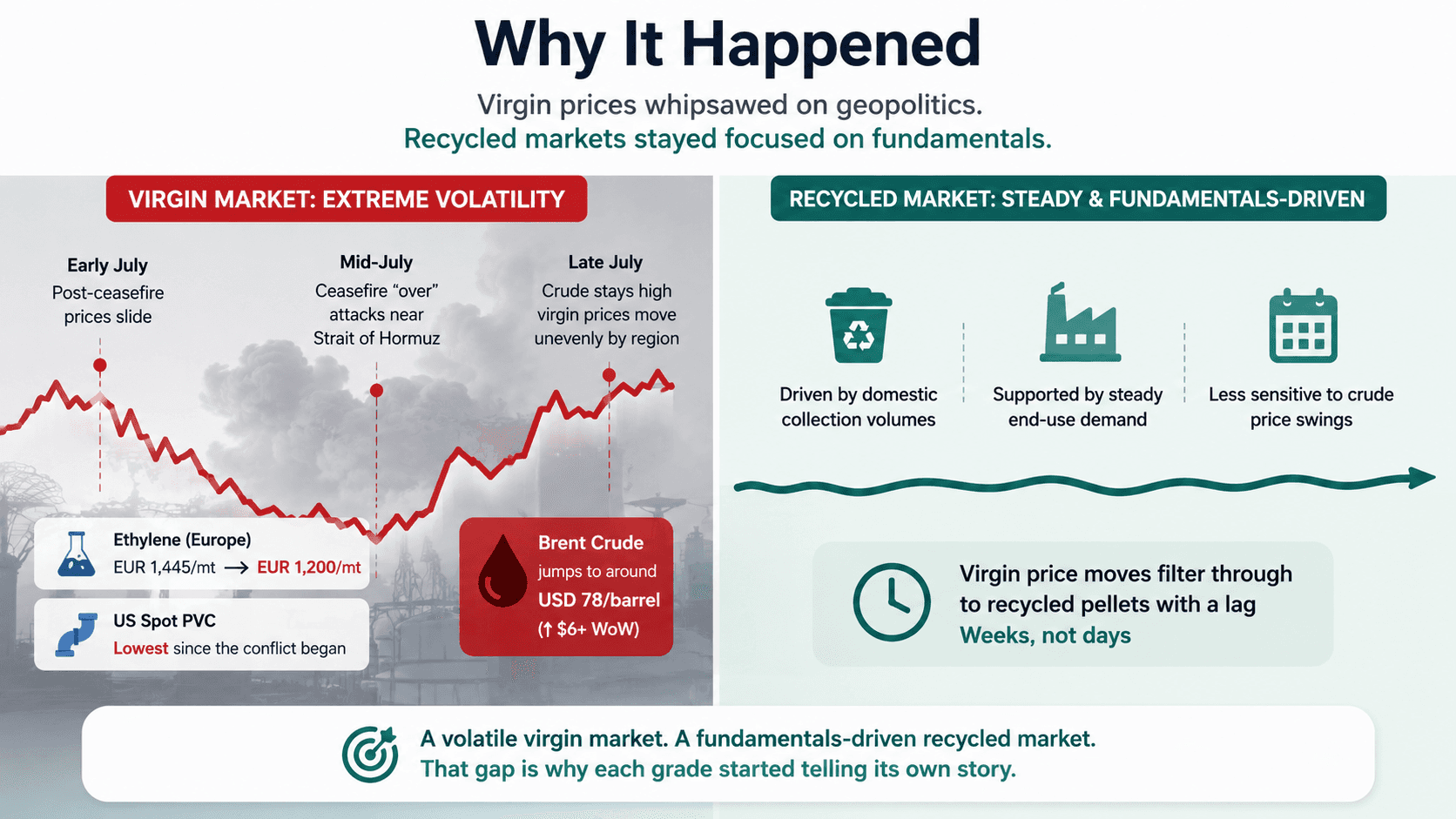
The month's backdrop was extreme virgin volatility. Prices opened July sliding back toward pre-war levels after the Middle East ceasefire — European ethylene eased from around EUR 1,445/mt in June toward EUR 1,200/mt, and US spot PVC hit its lowest since the conflict began. Sentiment then reversed hard: the US–Iran ceasefire was declared "over," drone strikes hit tankers near the Strait of Hormuz, and Brent crude jumped to around USD 78/barrel. Through the second half of July, crude stayed elevated and virgin resin moved unevenly by region.
Recycled markets largely ignored the noise. Because bale and pellet pricing is driven by domestic collection volumes and steady end-use demand rather than crude, recycled grades reacted far less to the swings — and the sharp early-July virgin PE decline only filtered through to recycled pellets weeks later. That gap between a volatile virgin market and a fundamentals-driven recycled market is exactly what let each grade start telling its own story.
The Evidence: Three Grades, Three Directions
Evidence 1 — rHDPE decoupled upward
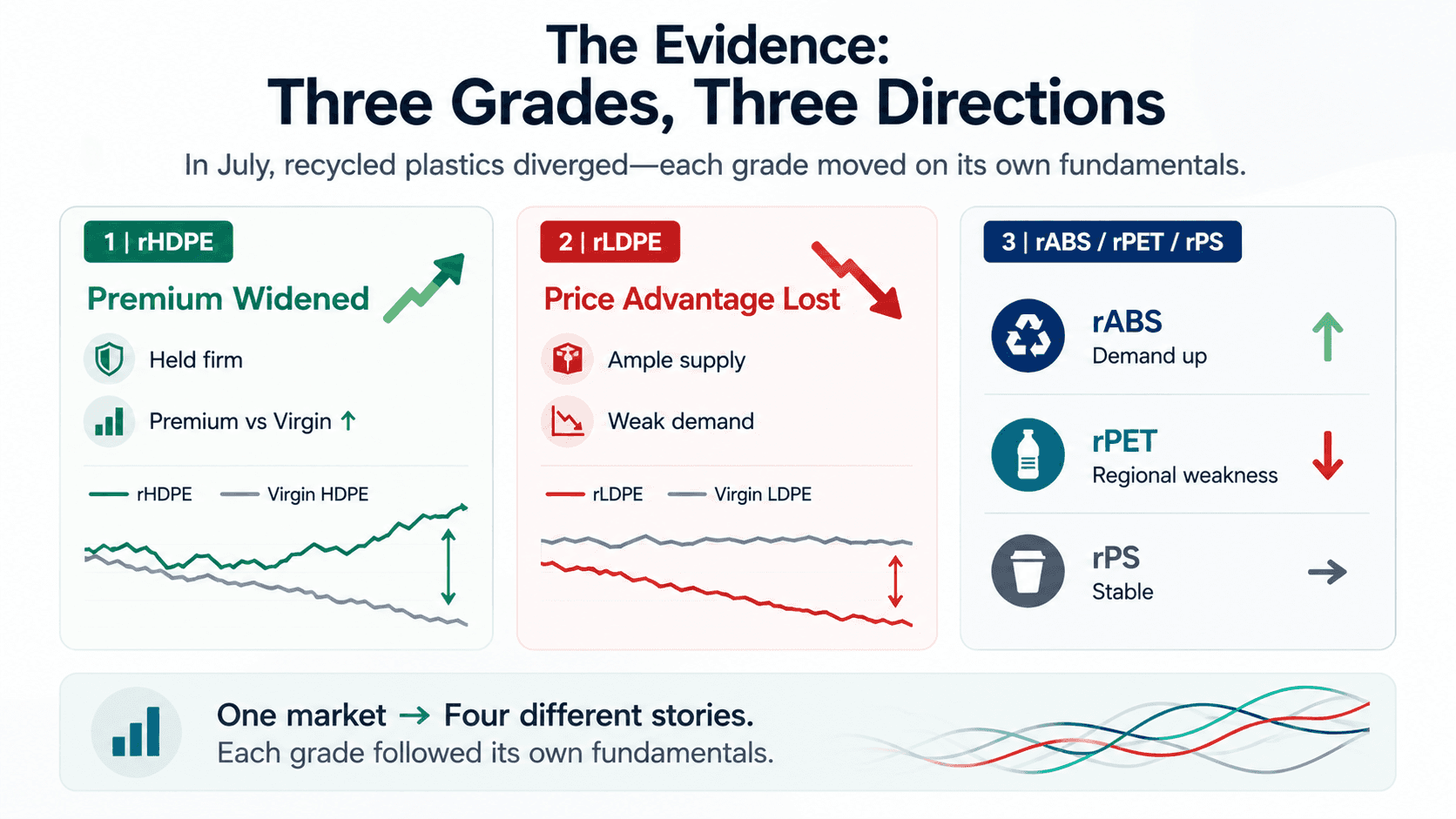
European natural pellets held firm even as virgin HDPE fell sharply through July, and by late month rHDPE's premium over virgin had widened back toward the war-level highs last seen in March. Distributors described earlier downward pressure as having "settled," with structural demand reportedly holding through November — pointing to limited room for further easing this quarter.
Evidence 2 — rLDPE decoupled downward
rLDPE moved the opposite way. Ample supply from multiple origins and weak downstream demand kept bale and pellet prices soft, and in the US competitive virgin pricing eroded recycled material's cost advantage. By late July, rLDPE had largely lost its usual price edge over virgin — the mirror image of rHDPE within the same polyolefin family.
Evidence 3 — rABS and rPET moved on their own drivers
rABS showed early signs of genuine, sustainability-led demand: European distributors reported brand owners actively requesting higher recycled content against limited ABS recycling capacity — a combination that could tighten supply if it holds. rPET, by contrast, was region-specific and softer: European food-grade and flake demand held relatively firm, but California premium bale prices kept sliding as Mexican buyers stayed on the sidelines, with US trade policy adding uncertainty. rPS stayed broadly stable across grades.

Context: Regulation and Company Moves
Trade actions added a cautious undertone: Thailand opened an anti-dumping investigation into PVC imports from China and Taiwan, and Korea advanced one into Chinese-origin PVC suspension resin. Kumho Petrochemical scheduled styrenics maintenance (GPPS down a month in August, HIPS from mid-July into early September). Braskem filed for out-of-court debt mediation and cut Brazilian PE/PP offers, while INEOS Styrolution confirmed the permanent closure of its Channahon, Illinois polystyrene plant by end-Q4 2026. On the demand side, Mars Inc. disclosed 2025 recycled content of 9.2% — well below its original 30% target, underscoring the persistent gap between brand-owner ambition and delivery that is now surfacing as real rABS demand.
What to Watch in August
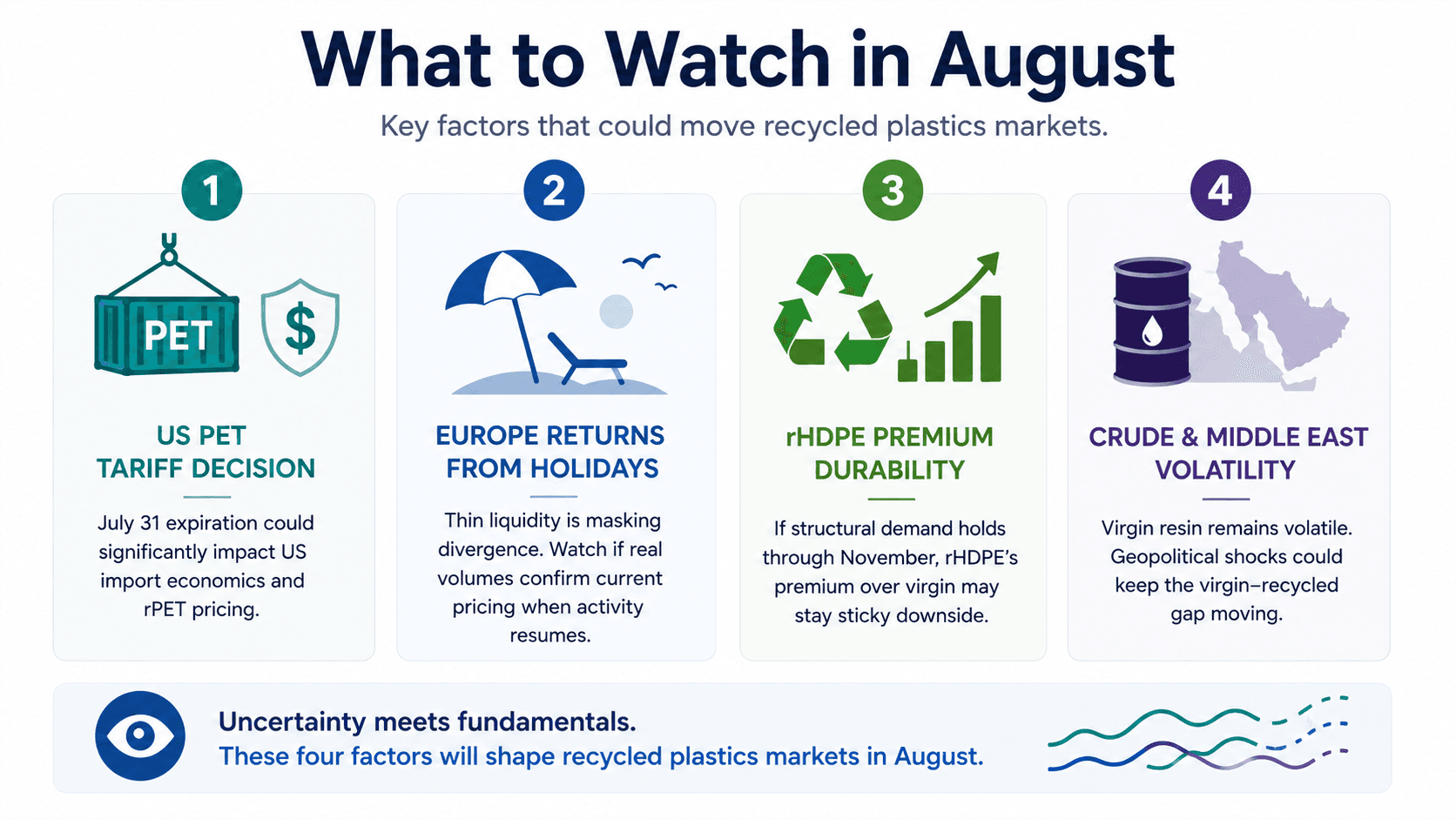
US PET tariff decision. The July 31 expiration of the 150-day US tariff suspension on imported PET and recycled PET is the single biggest swing factor for US import economics and rPET pricing into August.
Europe returns from summer holidays. With distributors reporting little to no transaction activity and buyers delaying to September, thin liquidity is masking rather than resolving the divergence. Watch whether real volumes confirm current pricing when activity resumes.
rHDPE premium durability. If structural demand really holds through November, rHDPE's premium over virgin has downside stickiness — a signal for anyone negotiating Q3/Q4 contracts.
Crude and Middle East volatility. Virgin resin remains the volatile leg. Renewed geopolitical shocks would keep the virgin–recycled gap moving, without necessarily reconverging the grades.
Conclusion
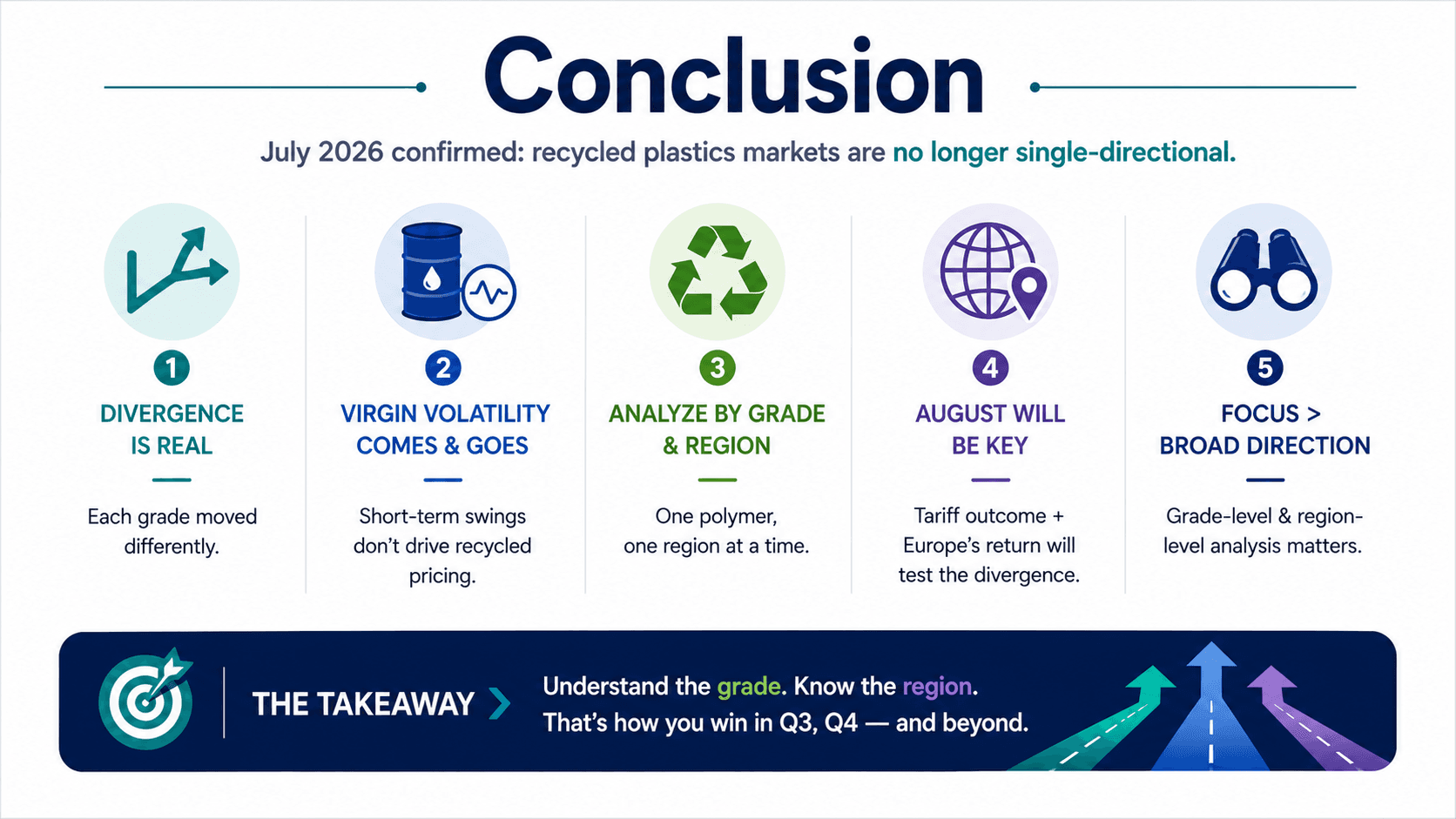
July 2026 confirmed a shift that had been building for months: the recycled plastics market is no longer single-directional. Virgin volatility came and went, but grade-by-grade divergence is the durable takeaway — a landscape now better read one polymer and one region at a time than as a single market trend. For buyers and suppliers, broad direction matters less than grade-level and region-level analysis, and August's tariff outcome plus Europe's return should show whether the divergence hardens into Q4.
Frequently Asked Questions
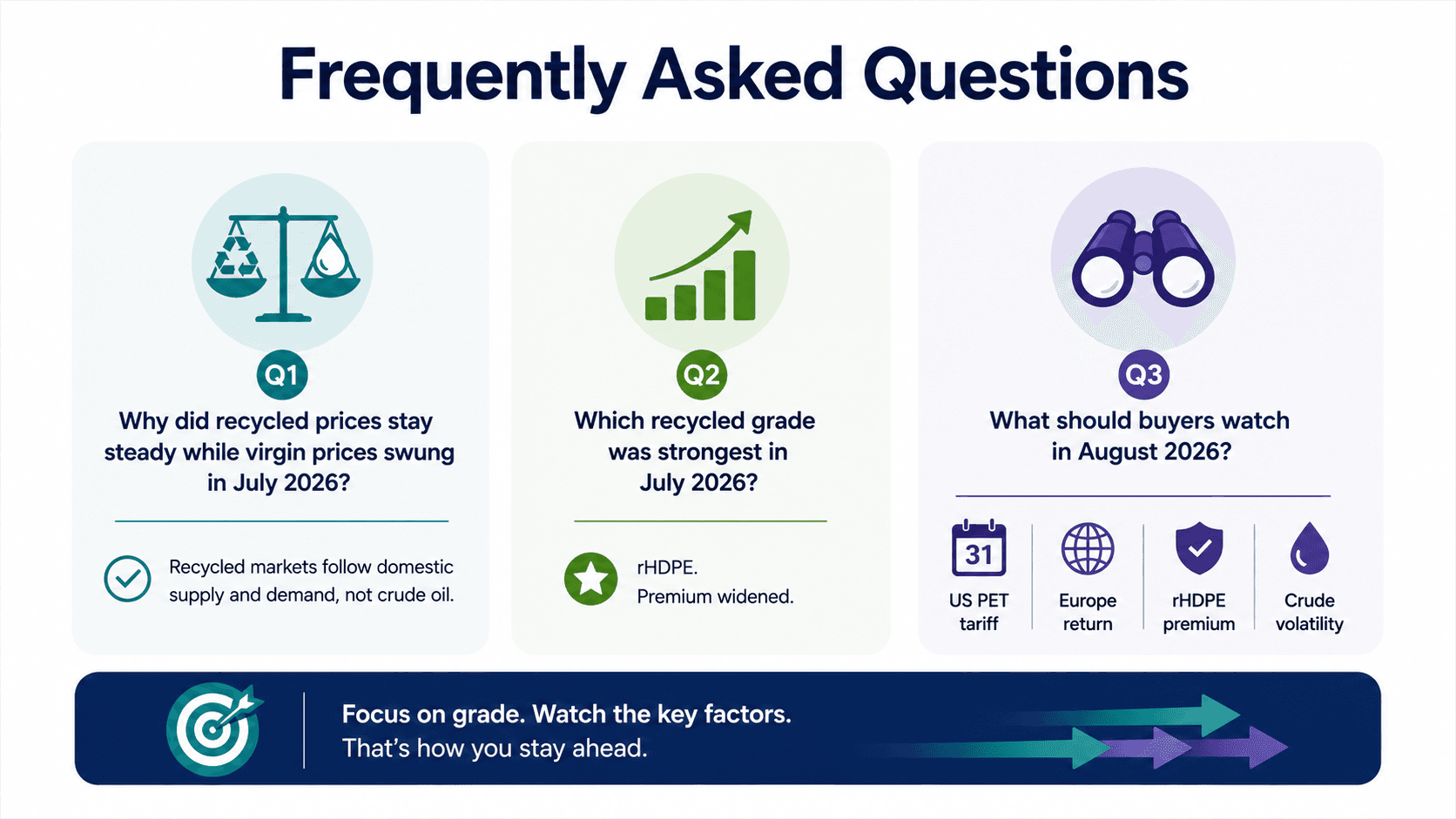
Why did recycled prices stay steady while virgin prices swung in July 2026? Recycled bale and pellet markets are driven mainly by domestic collection volumes and steady end-use demand rather than crude oil, so they reacted far less to the Middle East–driven swings in virgin PE, PP, and PVC through the month.
Which recycled grade was strongest in July 2026? rHDPE. European natural pellets held firm even as virgin HDPE fell, widening rHDPE's premium over virgin back toward the war-level highs last seen in March, with structural demand reportedly holding through November.
What should recycled plastics buyers watch in August 2026? The July 31 US PET tariff-suspension expiration, Europe's return from summer shutdown in September, whether rHDPE's premium over virgin holds, and continued crude volatility tied to Middle East risk.
Image generated with ChatGPT
July 2026 in One Sentence
The recycled plastics market stopped moving as one market.
For most of the past year, recycled polymers could be read as a single trend line that loosely tracked virgin resin. July broke that. Even as virgin prices swung sharply, recycled grades held their own course — and, more importantly, split from each other. Some strengthened, some weakened, and some moved entirely on their own demand and policy drivers.
Why It Happened
The month's backdrop was extreme virgin volatility. Prices opened July sliding back toward pre-war levels after the Middle East ceasefire — European ethylene eased from around EUR 1,445/mt in June toward EUR 1,200/mt, and US spot PVC hit its lowest since the conflict began. Sentiment then reversed hard: the US–Iran ceasefire was declared "over," drone strikes hit tankers near the Strait of Hormuz, and Brent crude jumped to around USD 78/barrel. Through the second half of July, crude stayed elevated and virgin resin moved unevenly by region.
Recycled markets largely ignored the noise. Because bale and pellet pricing is driven by domestic collection volumes and steady end-use demand rather than crude, recycled grades reacted far less to the swings — and the sharp early-July virgin PE decline only filtered through to recycled pellets weeks later. That gap between a volatile virgin market and a fundamentals-driven recycled market is exactly what let each grade start telling its own story.
The Evidence: Three Grades, Three Directions
Evidence 1 — rHDPE decoupled upward
European natural pellets held firm even as virgin HDPE fell sharply through July, and by late month rHDPE's premium over virgin had widened back toward the war-level highs last seen in March. Distributors described earlier downward pressure as having "settled," with structural demand reportedly holding through November — pointing to limited room for further easing this quarter.
Evidence 2 — rLDPE decoupled downward
rLDPE moved the opposite way. Ample supply from multiple origins and weak downstream demand kept bale and pellet prices soft, and in the US competitive virgin pricing eroded recycled material's cost advantage. By late July, rLDPE had largely lost its usual price edge over virgin — the mirror image of rHDPE within the same polyolefin family.
Evidence 3 — rABS and rPET moved on their own drivers
rABS showed early signs of genuine, sustainability-led demand: European distributors reported brand owners actively requesting higher recycled content against limited ABS recycling capacity — a combination that could tighten supply if it holds. rPET, by contrast, was region-specific and softer: European food-grade and flake demand held relatively firm, but California premium bale prices kept sliding as Mexican buyers stayed on the sidelines, with US trade policy adding uncertainty. rPS stayed broadly stable across grades.
Context: Regulation and Company Moves
Trade actions added a cautious undertone: Thailand opened an anti-dumping investigation into PVC imports from China and Taiwan, and Korea advanced one into Chinese-origin PVC suspension resin. Kumho Petrochemical scheduled styrenics maintenance (GPPS down a month in August, HIPS from mid-July into early September). Braskem filed for out-of-court debt mediation and cut Brazilian PE/PP offers, while INEOS Styrolution confirmed the permanent closure of its Channahon, Illinois polystyrene plant by end-Q4 2026. On the demand side, Mars Inc. disclosed 2025 recycled content of 9.2% — well below its original 30% target, underscoring the persistent gap between brand-owner ambition and delivery that is now surfacing as real rABS demand.
What to Watch in August
US PET tariff decision. The July 31 expiration of the 150-day US tariff suspension on imported PET and recycled PET is the single biggest swing factor for US import economics and rPET pricing into August.
Europe returns from summer holidays. With distributors reporting little to no transaction activity and buyers delaying to September, thin liquidity is masking rather than resolving the divergence. Watch whether real volumes confirm current pricing when activity resumes.
rHDPE premium durability. If structural demand really holds through November, rHDPE's premium over virgin has downside stickiness — a signal for anyone negotiating Q3/Q4 contracts.
Crude and Middle East volatility. Virgin resin remains the volatile leg. Renewed geopolitical shocks would keep the virgin–recycled gap moving, without necessarily reconverging the grades.
Conclusion
July 2026 confirmed a shift that had been building for months: the recycled plastics market is no longer single-directional. Virgin volatility came and went, but grade-by-grade divergence is the durable takeaway — a landscape now better read one polymer and one region at a time than as a single market trend. For buyers and suppliers, broad direction matters less than grade-level and region-level analysis, and August's tariff outcome plus Europe's return should show whether the divergence hardens into Q4.
Frequently Asked Questions
Why did recycled prices stay steady while virgin prices swung in July 2026? Recycled bale and pellet markets are driven mainly by domestic collection volumes and steady end-use demand rather than crude oil, so they reacted far less to the Middle East–driven swings in virgin PE, PP, and PVC through the month.
Which recycled grade was strongest in July 2026? rHDPE. European natural pellets held firm even as virgin HDPE fell, widening rHDPE's premium over virgin back toward the war-level highs last seen in March, with structural demand reportedly holding through November.
What should recycled plastics buyers watch in August 2026? The July 31 US PET tariff-suspension expiration, Europe's return from summer shutdown in September, whether rHDPE's premium over virgin holds, and continued crude volatility tied to Middle East risk.
Image generated with ChatGPT
July rHDPE Availability
Grades • Specs • Availability
Browse rHDPE →
July rHDPE Availability
July rHDPE Availability
Check the rHDPE grades listed by feedstock, MFI, stock and MOQ.
Check the rHDPE grades listed by feedstock, MFI, stock and MOQ.
Browse rHDPE →
Browse rHDPE →
Looking for samples or ready to source? Submit your request for pricing, availability, and technical information.
Looking for samples or ready to source? Submit your request for pricing, availability, and technical information.
Request a Quote →
Request a Quote →
Posted by REGENPORT
REGENPORT is a global platform connecting buyers and suppliers in the recycled materials and sustainable packaging industries.