CATEGORY
CATEGORY
Regulation
Regulation
Regulation
Korea Extends Food-Contact Recycling to PP in 2026: What the Approval Actually Requires
Korea Extends Food-Contact Recycling to PP in 2026: What the Approval Actually Requires
Korea Extends Food-Contact Recycling to PP in 2026: What the Approval Actually Requires
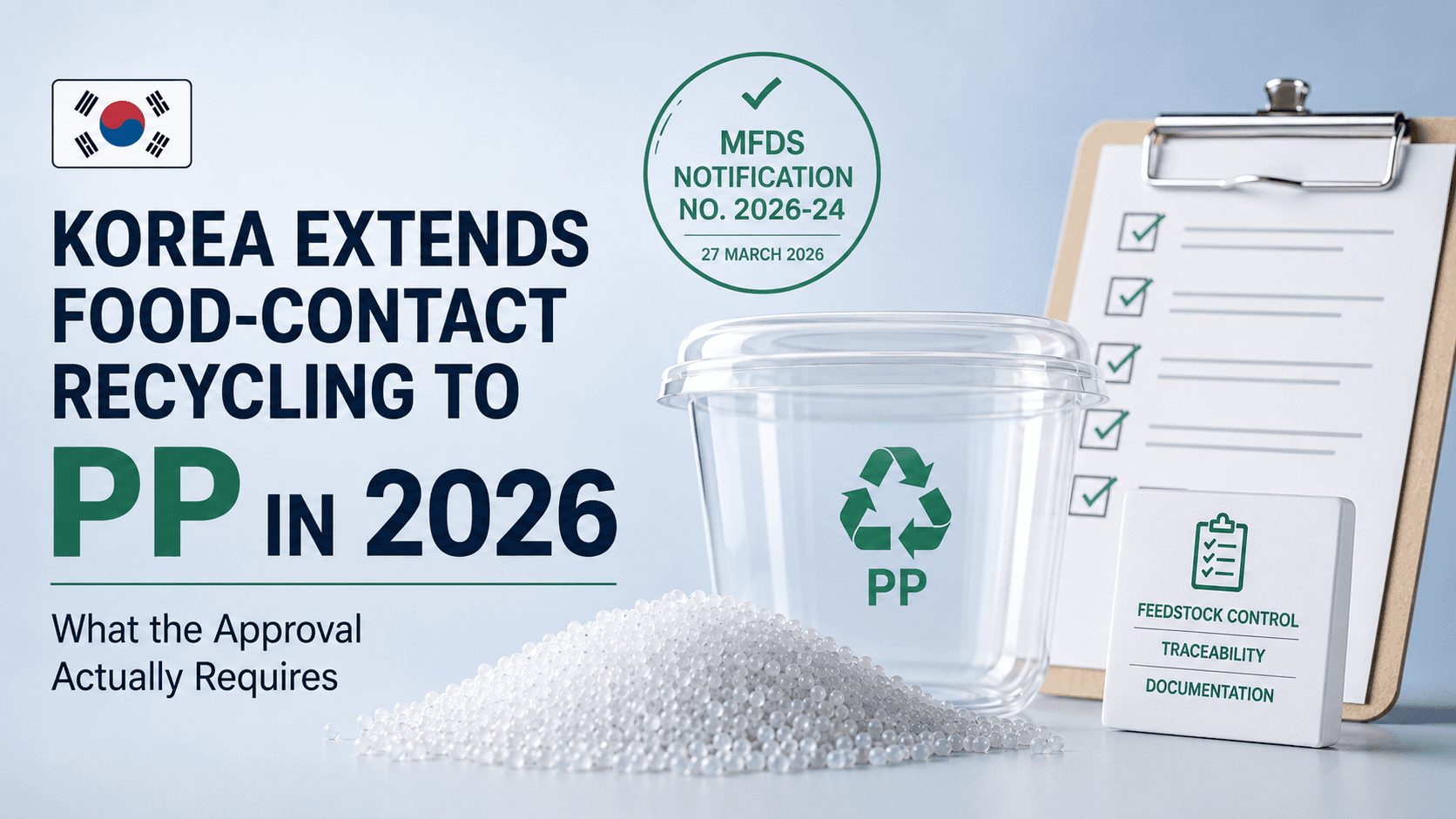
MFDS Notification No. 2026-24 (27 March 2026) extended food-contact approval for mechanically recycled plastics from PET only to PP. The conditions attached are about feedstock stream control and documentation, not a content percentage. First Regulation post covering South Korea.
South Korea's Ministry of Food and Drug Safety (MFDS) issued Notification No. 2026-24 on 27 March 2026, amending the Standards and Specifications for Utensils, Containers and Packages. Until that point, the only mechanically recycled plastic approved for food-contact use in Korea was polyethylene terephthalate (PET). The amendment extends that approval to polypropylene (PP) under defined conditions. This is our first Regulation post covering Korea, and it follows the same thread as our earlier pieces on EU PFAS limits and the EmpCo Directive: what regulators increasingly ask for is not a higher recycled percentage but evidence about where the material came from.
For buyers of recycled polypropylene, the practical significance is not that a new market opened overnight. It is that a national regulator has now written down, in enforceable form, what a qualifying recycled PP stream looks like.

What MFDS Notification No. 2026-24 changed
The amendment followed a public consultation, opened by MFDS as Notice No. 2026-009 on 8 January 2026 and closed on 9 March 2026. The final notification was announced on 27 March 2026 and took effect on that date.
Three changes sit in the same amendment. Terminology in the standards was clarified and restructured. Phthalate limits in polyvinyl chloride (PVC) were tightened — di(2-ethylhexyl) phthalate (DEHP) moved from a migration limit of 1.5 mg/L to "not detected", and di(2-ethylhexyl) adipate (DEHA) in plastic wrap moved to "not detected" while the general DEHA limit of 18 mg/L was retained. Those PVC specifications carry a twelve-month transition and become fully enforceable on 27 March 2027. The third change, and the one relevant to polyolefin buyers, is the recognition of mechanically recycled PP as a permitted food-contact material.
The conditions are about the stream, not the percentage
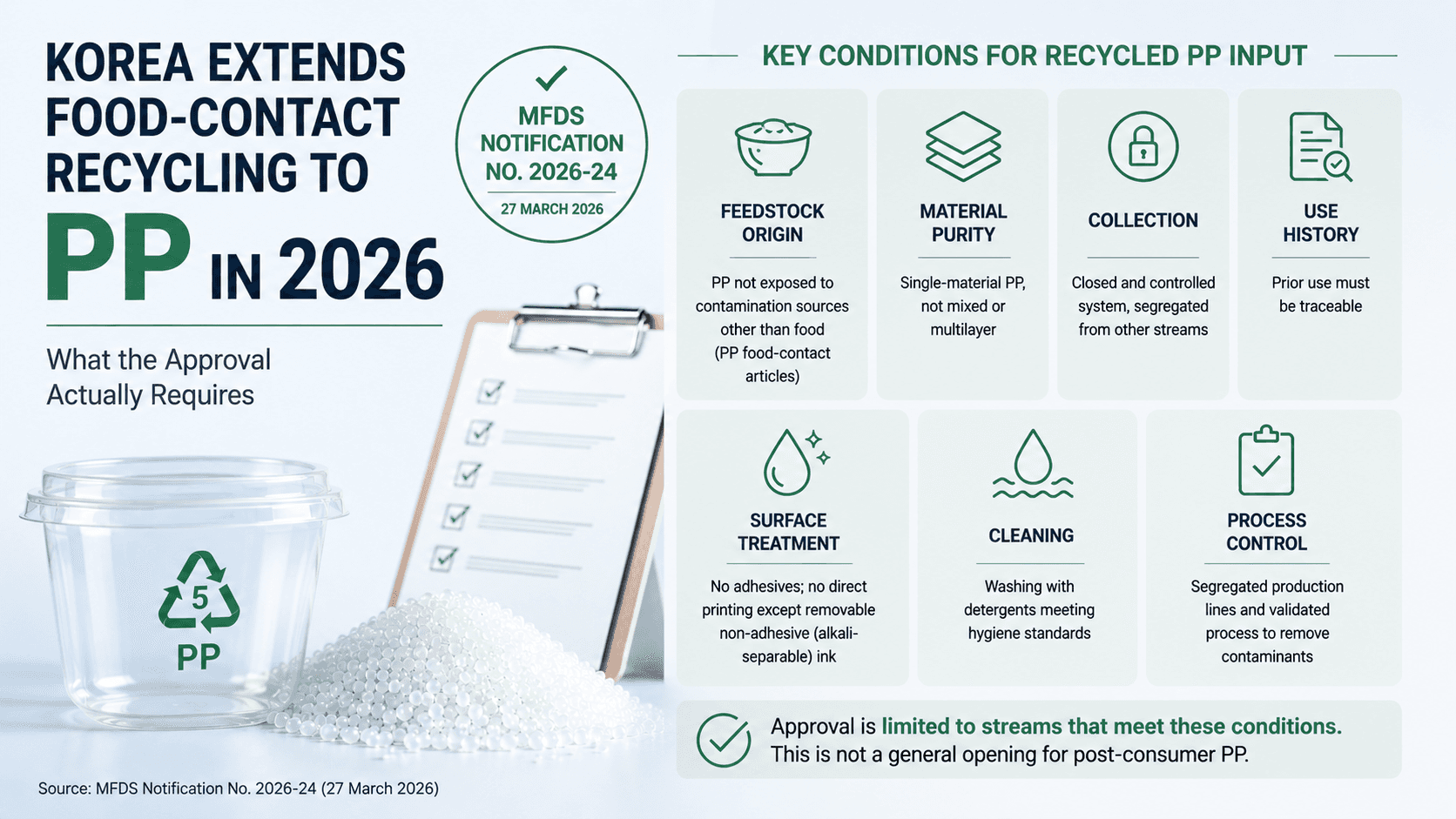
No recycled-content percentage appears in the PP provisions. What appears instead is a set of preconditions on the input material.
Requirement | What it asks for |
|---|---|
Feedstock origin | Input must be PP that has not been exposed to contamination sources other than food — in practice, PP food-contact articles |
Material purity | Input must be single-material PP rather than a mixed or multilayer stream |
Collection | Recovery through a closed and controlled system, kept segregated from other recycling streams |
Use history | The material's prior use must be traceable |
Surface treatment | No adhesives; no direct printing, except with removable non-adhesive (alkali-separable) ink |
Cleaning | Washing with detergents meeting hygiene standards |
Process control | Segregated production lines and documented process validation demonstrating contaminant removal |
The notification does not appear to name a specific container category. MFDS describes the new provision as establishing recognition criteria requiring, as input material, polypropylene "not exposed to contamination sources other than food, such that contamination through consumer use and disposal can be prevented." What narrows the scope, then, is the set of conditions rather than any stated product limit. In practice these conditions appear to point toward streams where an operator manages collection and washing at the container level — the profile of a managed reusable food-service or delivery container system — since traceable use history, closed and controlled collection, and the ban on direct printing and adhesives are difficult to satisfy otherwise. Open, mixed post-consumer PP would generally be difficult to justify under the criteria as written.
The distinction matters for sourcing. This is not a general opening of post-consumer PP to food-contact use, and it should not be read as one. It is a definition of the narrow conditions under which a recycled PP stream qualifies — which is precisely why the conditions, rather than any percentage, are the part worth studying. Buyers evaluating a specific grade should confirm current scope with MFDS or their regulatory counsel.
Why PP got conditions instead of a number
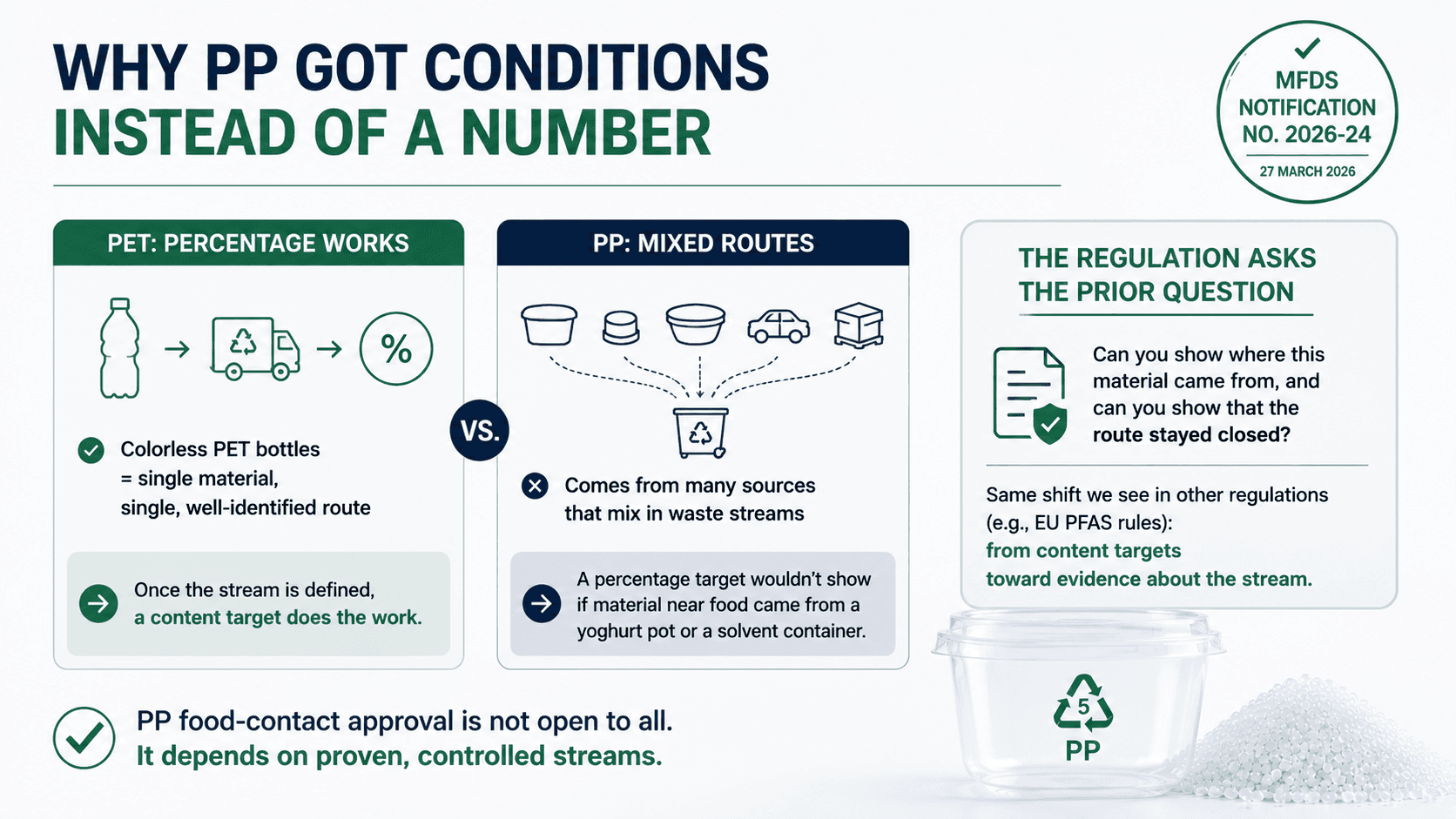
PET was straightforward to regulate by percentage. Colorless PET bottles are effectively a single material moving through a single, well-identified collection route, so once the stream is defined, a content target does the work.
PP is not that. Polypropylene reaches waste streams from food containers, caps and closures, housewares, automotive parts and industrial packaging, and those routes mix. A percentage target applied to that mixture would say nothing about whether the material near food came from a yoghurt pot or a solvent container. So the regulation asks the prior question instead: can you show where this material came from, and can you show that the route stayed closed?
This is the same logic we described in our post on EU PFAS limits in food-contact packaging, where the constraint was framed as what must not be present rather than how much recycled content must be included. Different jurisdiction, different mechanism, same underlying shift — from content targets toward evidence about the stream.

The mandatory-content track is moving separately
Korea's recycled-content mandate runs on its own track and has not yet reached polyolefins.
Since January 2026, a mandatory recycled-content requirement has applied to colorless PET bottles, starting at 10% and rising to 30% by 2030. It is the only recycled-content mandate currently in force for plastic packaging in Korea.
On 28 April 2026, the Ministry of Climate, Energy and Environment announced the Plastic-Free Circular Economy Transition Plan. It targets a reduction of more than 30% in newly produced plastic against projected levels by 2030, composed of one million tonnes of source reduction and two million tonnes replaced by recycled material. It confirms the PET bottle mandate rising from 10% to 30% by 2030. For PE and PP containers, the plan states that targets are still to be discussed — no percentage has been set.
That gap is the point. A buyer waiting for the PE and PP numbers to be published before acting will be waiting for the wrong signal. When those percentages arrive, what will be needed is not volume but documentation showing the volume qualifies, and documentation is not generated retroactively.
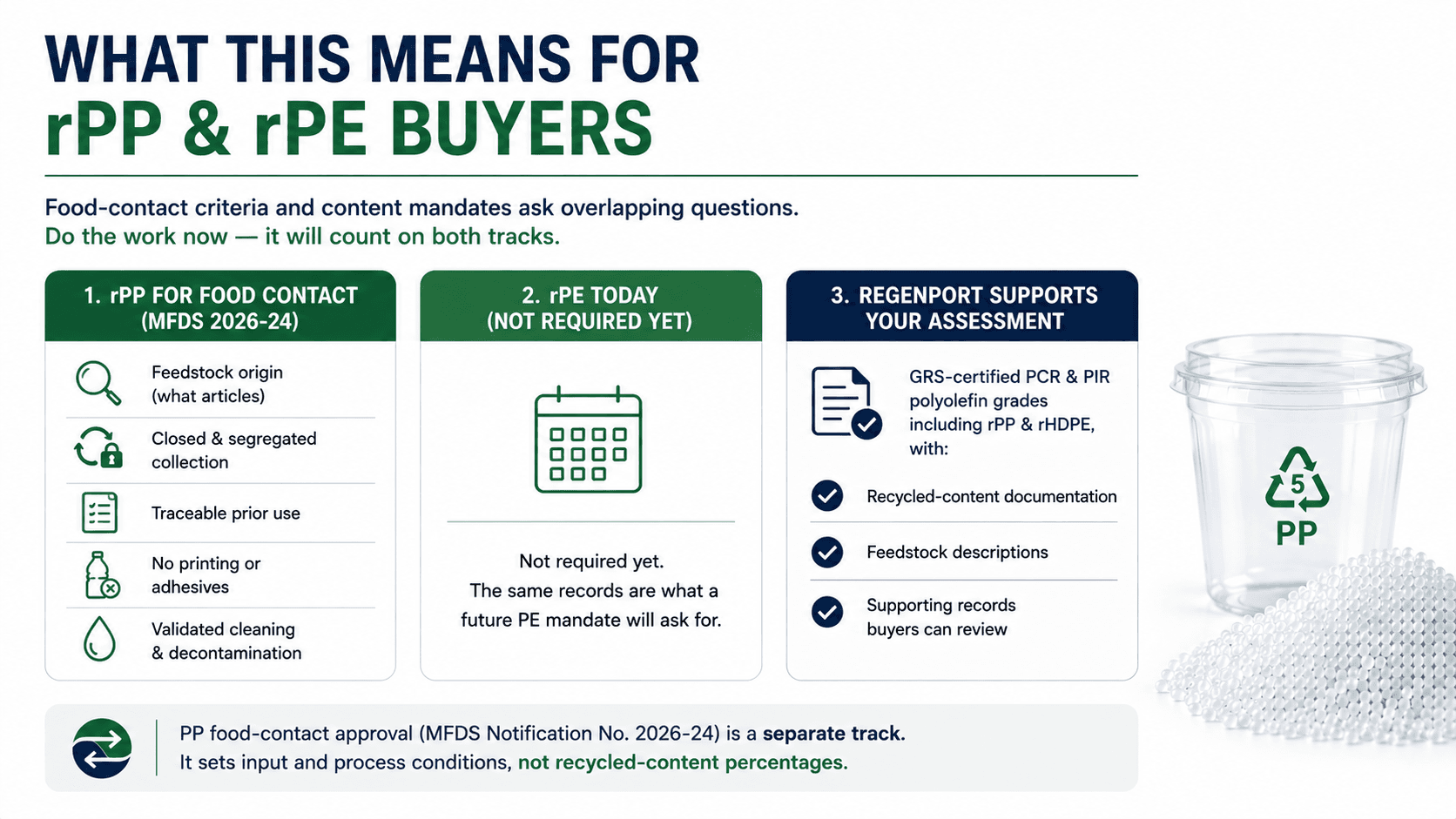
What this means for rPP and rPE buyers
The food-contact criteria and the coming content mandates ask overlapping questions, so the sourcing work is largely shared even though only one track is currently in force for polyolefins.
For any recycled PP grade being considered for food-contact use in Korea, the questions to put to a supplier follow the notification directly: what articles the feedstock came from, whether collection is closed and segregated, whether prior use is traceable, whether printing and adhesives were present, and whether decontamination has been validated and documented. For recycled PE grades, none of this is required yet — but the same records are what a future PE mandate would most plausibly ask for.
Regenport supplies GRS-certified PCR and PIR polyolefin grades, including rPP and rHDPE, with recycled-content documentation and feedstock descriptions that buyers can review as part of their own assessment. Whether a given grade's documentation satisfies the MFDS criteria for a specific food-contact application is a determination for the buyer and their regulatory advisors, not something certification alone establishes.
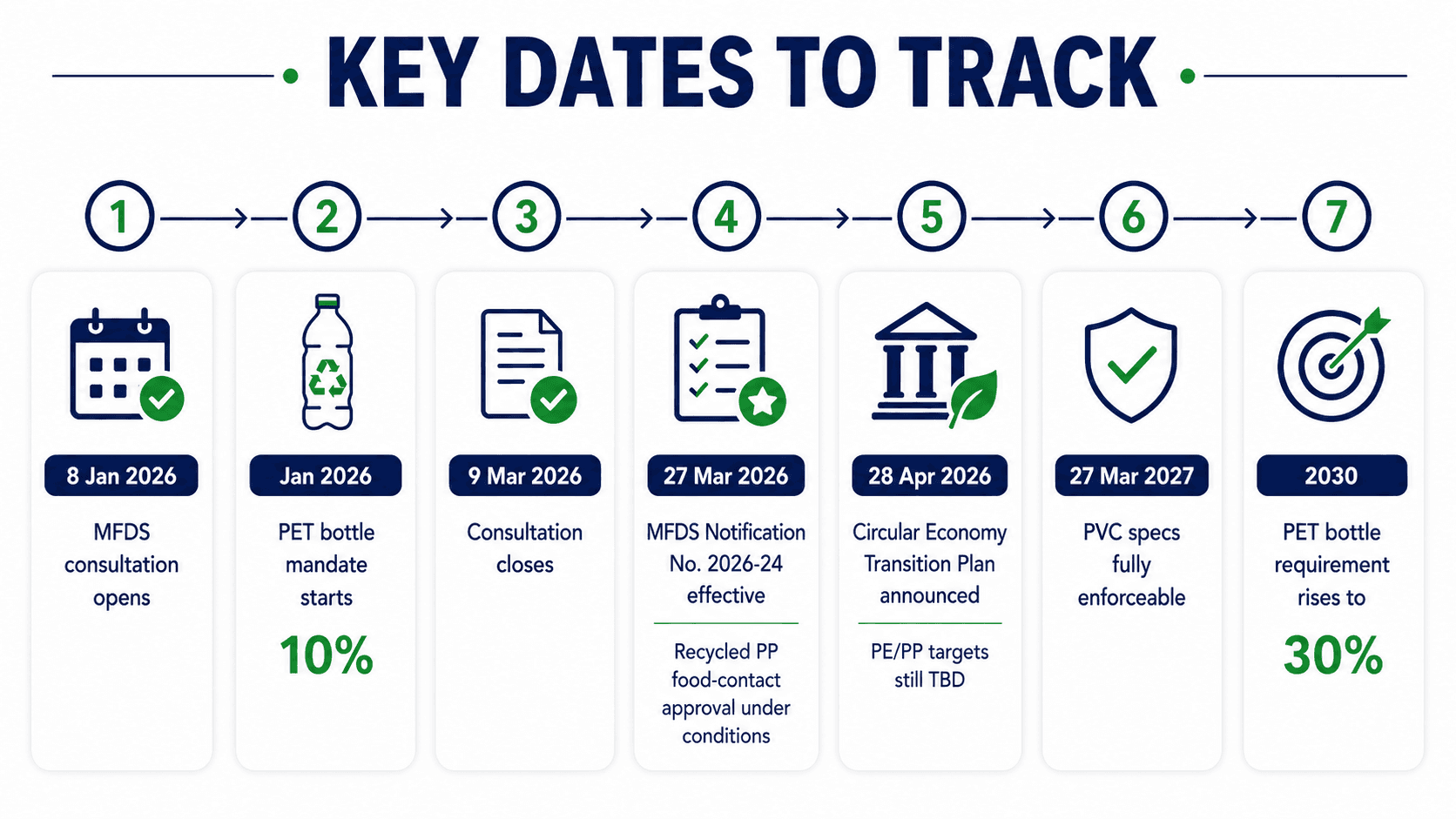
Key dates to track
As of August 2026:
8 January 2026 — MFDS Notice No. 2026-009 opens public consultation on the amended standards.
January 2026 — Mandatory 10% recycled content begins for colorless PET bottles.
9 March 2026 — Consultation on the MFDS amendment closes.
27 March 2026 — MFDS Notification No. 2026-24 announced and effective; mechanically recycled PP recognized for food-contact use under conditions.
28 April 2026 — Ministry of Climate, Energy and Environment announces the Plastic-Free Circular Economy Transition Plan; PE and PP container targets left to be discussed.
27 March 2027 — Tightened PVC specifications for DEHP and DEHA become fully enforceable.
2030 — PET bottle recycled-content requirement rises to 30%.
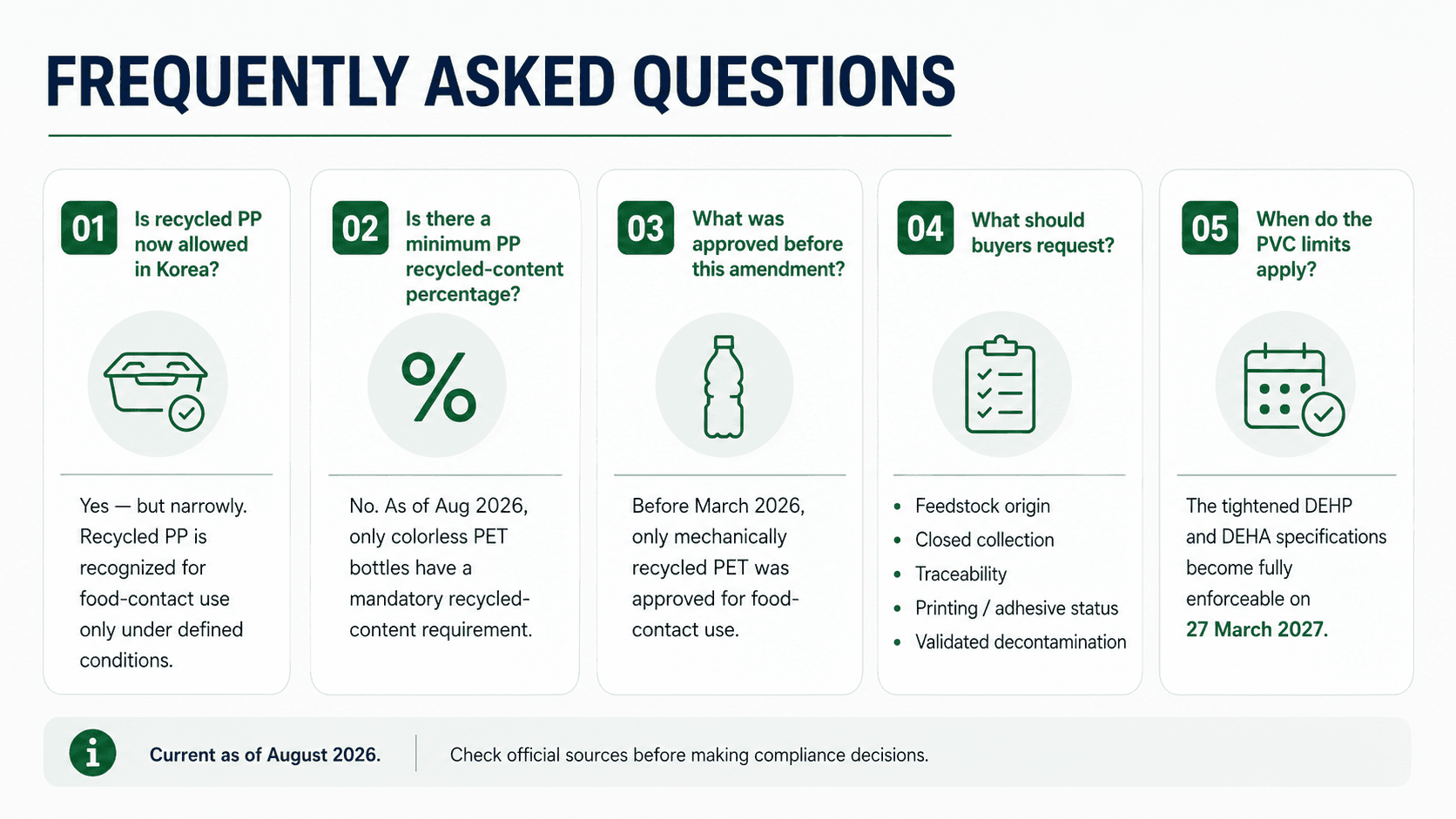
Frequently Asked Questions
Does Korea now allow recycled polypropylene in food packaging? Yes, but narrowly. MFDS Notification No. 2026-24, effective 27 March 2026, recognizes mechanically recycled PP for food-contact use where the input material meets defined criteria on feedstock origin, closed collection, traceability, surface treatment and validated decontamination. In practice those conditions appear to point toward managed reusable food-service and delivery container systems; open mixed post-consumer PP would generally be difficult to justify under them.
Is there a minimum recycled content percentage for PP in Korea? No. As of August 2026, the only recycled-content mandate in force applies to colorless PET bottles. The April 2026 Plastic-Free Circular Economy Transition Plan states that targets for PE and PP containers are still to be discussed.
What was approved for food contact before this amendment? Mechanically recycled PET was the only recycled plastic approved for food-contact use in Korea. The March 2026 amendment extended that approval to PP under conditions.
What documentation should a buyer request for recycled PP? Records that map to the notification's conditions: the articles the feedstock came from, evidence that collection was closed and segregated from other streams, traceability of prior use, confirmation on adhesives and direct printing, and documented process validation for contaminant removal.
When do the tightened PVC phthalate limits apply? The DEHP and DEHA specifications carry a twelve-month transition and become fully enforceable on 27 March 2027.
About This Guide
Information is current as of August 2026 and is provided for general information only. It is not legal advice. Regulatory texts and their interpretation change; buyers should verify current requirements with MFDS, the Ministry of Climate, Energy and Environment, or qualified regulatory counsel before making compliance decisions.
Image generated with ChatGPT
Sources
Ministry of Food and Drug Safety, "Standards and Specifications for Utensils, Containers and Packages", Notification No. 2026-24, 27 March 2026 → Read the Source
REACH24H, "Korea MFDS Revises FCM Standards: DEHP, DEHA & Recycled PP" → Read the Source
Jung Min-ho, The Korea Times, "Korea unveils sweeping plan to cut plastic use, curb oil dependence" → Read the Source
South Korea's Ministry of Food and Drug Safety (MFDS) issued Notification No. 2026-24 on 27 March 2026, amending the Standards and Specifications for Utensils, Containers and Packages. Until that point, the only mechanically recycled plastic approved for food-contact use in Korea was polyethylene terephthalate (PET). The amendment extends that approval to polypropylene (PP) under defined conditions. This is our first Regulation post covering Korea, and it follows the same thread as our earlier pieces on EU PFAS limits and the EmpCo Directive: what regulators increasingly ask for is not a higher recycled percentage but evidence about where the material came from.
For buyers of recycled polypropylene, the practical significance is not that a new market opened overnight. It is that a national regulator has now written down, in enforceable form, what a qualifying recycled PP stream looks like.
What MFDS Notification No. 2026-24 changed
The amendment followed a public consultation, opened by MFDS as Notice No. 2026-009 on 8 January 2026 and closed on 9 March 2026. The final notification was announced on 27 March 2026 and took effect on that date.
Three changes sit in the same amendment. Terminology in the standards was clarified and restructured. Phthalate limits in polyvinyl chloride (PVC) were tightened — di(2-ethylhexyl) phthalate (DEHP) moved from a migration limit of 1.5 mg/L to "not detected", and di(2-ethylhexyl) adipate (DEHA) in plastic wrap moved to "not detected" while the general DEHA limit of 18 mg/L was retained. Those PVC specifications carry a twelve-month transition and become fully enforceable on 27 March 2027. The third change, and the one relevant to polyolefin buyers, is the recognition of mechanically recycled PP as a permitted food-contact material.
The conditions are about the stream, not the percentage
No recycled-content percentage appears in the PP provisions. What appears instead is a set of preconditions on the input material.
Requirement | What it asks for |
|---|---|
Feedstock origin | Input must be PP that has not been exposed to contamination sources other than food — in practice, PP food-contact articles |
Material purity | Input must be single-material PP rather than a mixed or multilayer stream |
Collection | Recovery through a closed and controlled system, kept segregated from other recycling streams |
Use history | The material's prior use must be traceable |
Surface treatment | No adhesives; no direct printing, except with removable non-adhesive (alkali-separable) ink |
Cleaning | Washing with detergents meeting hygiene standards |
Process control | Segregated production lines and documented process validation demonstrating contaminant removal |
The notification does not appear to name a specific container category. MFDS describes the new provision as establishing recognition criteria requiring, as input material, polypropylene "not exposed to contamination sources other than food, such that contamination through consumer use and disposal can be prevented." What narrows the scope, then, is the set of conditions rather than any stated product limit. In practice these conditions appear to point toward streams where an operator manages collection and washing at the container level — the profile of a managed reusable food-service or delivery container system — since traceable use history, closed and controlled collection, and the ban on direct printing and adhesives are difficult to satisfy otherwise. Open, mixed post-consumer PP would generally be difficult to justify under the criteria as written.
The distinction matters for sourcing. This is not a general opening of post-consumer PP to food-contact use, and it should not be read as one. It is a definition of the narrow conditions under which a recycled PP stream qualifies — which is precisely why the conditions, rather than any percentage, are the part worth studying. Buyers evaluating a specific grade should confirm current scope with MFDS or their regulatory counsel.
Why PP got conditions instead of a number
PET was straightforward to regulate by percentage. Colorless PET bottles are effectively a single material moving through a single, well-identified collection route, so once the stream is defined, a content target does the work.
PP is not that. Polypropylene reaches waste streams from food containers, caps and closures, housewares, automotive parts and industrial packaging, and those routes mix. A percentage target applied to that mixture would say nothing about whether the material near food came from a yoghurt pot or a solvent container. So the regulation asks the prior question instead: can you show where this material came from, and can you show that the route stayed closed?
This is the same logic we described in our post on EU PFAS limits in food-contact packaging, where the constraint was framed as what must not be present rather than how much recycled content must be included. Different jurisdiction, different mechanism, same underlying shift — from content targets toward evidence about the stream.
The mandatory-content track is moving separately
Korea's recycled-content mandate runs on its own track and has not yet reached polyolefins.
Since January 2026, a mandatory recycled-content requirement has applied to colorless PET bottles, starting at 10% and rising to 30% by 2030. It is the only recycled-content mandate currently in force for plastic packaging in Korea.
On 28 April 2026, the Ministry of Climate, Energy and Environment announced the Plastic-Free Circular Economy Transition Plan. It targets a reduction of more than 30% in newly produced plastic against projected levels by 2030, composed of one million tonnes of source reduction and two million tonnes replaced by recycled material. It confirms the PET bottle mandate rising from 10% to 30% by 2030. For PE and PP containers, the plan states that targets are still to be discussed — no percentage has been set.
That gap is the point. A buyer waiting for the PE and PP numbers to be published before acting will be waiting for the wrong signal. When those percentages arrive, what will be needed is not volume but documentation showing the volume qualifies, and documentation is not generated retroactively.
What this means for rPP and rPE buyers
The food-contact criteria and the coming content mandates ask overlapping questions, so the sourcing work is largely shared even though only one track is currently in force for polyolefins.
For any recycled PP grade being considered for food-contact use in Korea, the questions to put to a supplier follow the notification directly: what articles the feedstock came from, whether collection is closed and segregated, whether prior use is traceable, whether printing and adhesives were present, and whether decontamination has been validated and documented. For recycled PE grades, none of this is required yet — but the same records are what a future PE mandate would most plausibly ask for.
Regenport supplies GRS-certified PCR and PIR polyolefin grades, including rPP and rHDPE, with recycled-content documentation and feedstock descriptions that buyers can review as part of their own assessment. Whether a given grade's documentation satisfies the MFDS criteria for a specific food-contact application is a determination for the buyer and their regulatory advisors, not something certification alone establishes.
Key dates to track
As of August 2026:
8 January 2026 — MFDS Notice No. 2026-009 opens public consultation on the amended standards.
January 2026 — Mandatory 10% recycled content begins for colorless PET bottles.
9 March 2026 — Consultation on the MFDS amendment closes.
27 March 2026 — MFDS Notification No. 2026-24 announced and effective; mechanically recycled PP recognized for food-contact use under conditions.
28 April 2026 — Ministry of Climate, Energy and Environment announces the Plastic-Free Circular Economy Transition Plan; PE and PP container targets left to be discussed.
27 March 2027 — Tightened PVC specifications for DEHP and DEHA become fully enforceable.
2030 — PET bottle recycled-content requirement rises to 30%.
Frequently Asked Questions
Does Korea now allow recycled polypropylene in food packaging? Yes, but narrowly. MFDS Notification No. 2026-24, effective 27 March 2026, recognizes mechanically recycled PP for food-contact use where the input material meets defined criteria on feedstock origin, closed collection, traceability, surface treatment and validated decontamination. In practice those conditions appear to point toward managed reusable food-service and delivery container systems; open mixed post-consumer PP would generally be difficult to justify under them.
Is there a minimum recycled content percentage for PP in Korea? No. As of August 2026, the only recycled-content mandate in force applies to colorless PET bottles. The April 2026 Plastic-Free Circular Economy Transition Plan states that targets for PE and PP containers are still to be discussed.
What was approved for food contact before this amendment? Mechanically recycled PET was the only recycled plastic approved for food-contact use in Korea. The March 2026 amendment extended that approval to PP under conditions.
What documentation should a buyer request for recycled PP? Records that map to the notification's conditions: the articles the feedstock came from, evidence that collection was closed and segregated from other streams, traceability of prior use, confirmation on adhesives and direct printing, and documented process validation for contaminant removal.
When do the tightened PVC phthalate limits apply? The DEHP and DEHA specifications carry a twelve-month transition and become fully enforceable on 27 March 2027.
About This Guide
Information is current as of August 2026 and is provided for general information only. It is not legal advice. Regulatory texts and their interpretation change; buyers should verify current requirements with MFDS, the Ministry of Climate, Energy and Environment, or qualified regulatory counsel before making compliance decisions.
Image generated with ChatGPT
Sources
Ministry of Food and Drug Safety, "Standards and Specifications for Utensils, Containers and Packages", Notification No. 2026-24, 27 March 2026 → Read the Source
REACH24H, "Korea MFDS Revises FCM Standards: DEHP, DEHA & Recycled PP" → Read the Source
Jung Min-ho, The Korea Times, "Korea unveils sweeping plan to cut plastic use, curb oil dependence" → Read the Source
Sourcing rPP From Korea
Grades • Specs • Availability
Browse rPP →
Sourcing rPP From Korea
Sourcing rPP From Korea
Review Korea-origin rPP grades by feedstock, properties, stock and MOQ.
Review Korea-origin rPP grades by feedstock, properties, stock and MOQ.
Browse rPP →
Browse rPP →
Looking for samples or ready to source? Submit your request for pricing, availability, and technical information.
Looking for samples or ready to source? Submit your request for pricing, availability, and technical information.
Request a Quote →
Request a Quote →
Posted by REGENPORT
REGENPORT is a global platform connecting buyers and suppliers in the recycled materials and sustainable packaging industries.