CATEGORY
CATEGORY
News
News
News
Chemical Recycling Moves from Bespoke Plants to a Standardized Product
Chemical Recycling Moves from Bespoke Plants to a Standardized Product
Chemical Recycling Moves from Bespoke Plants to a Standardized Product
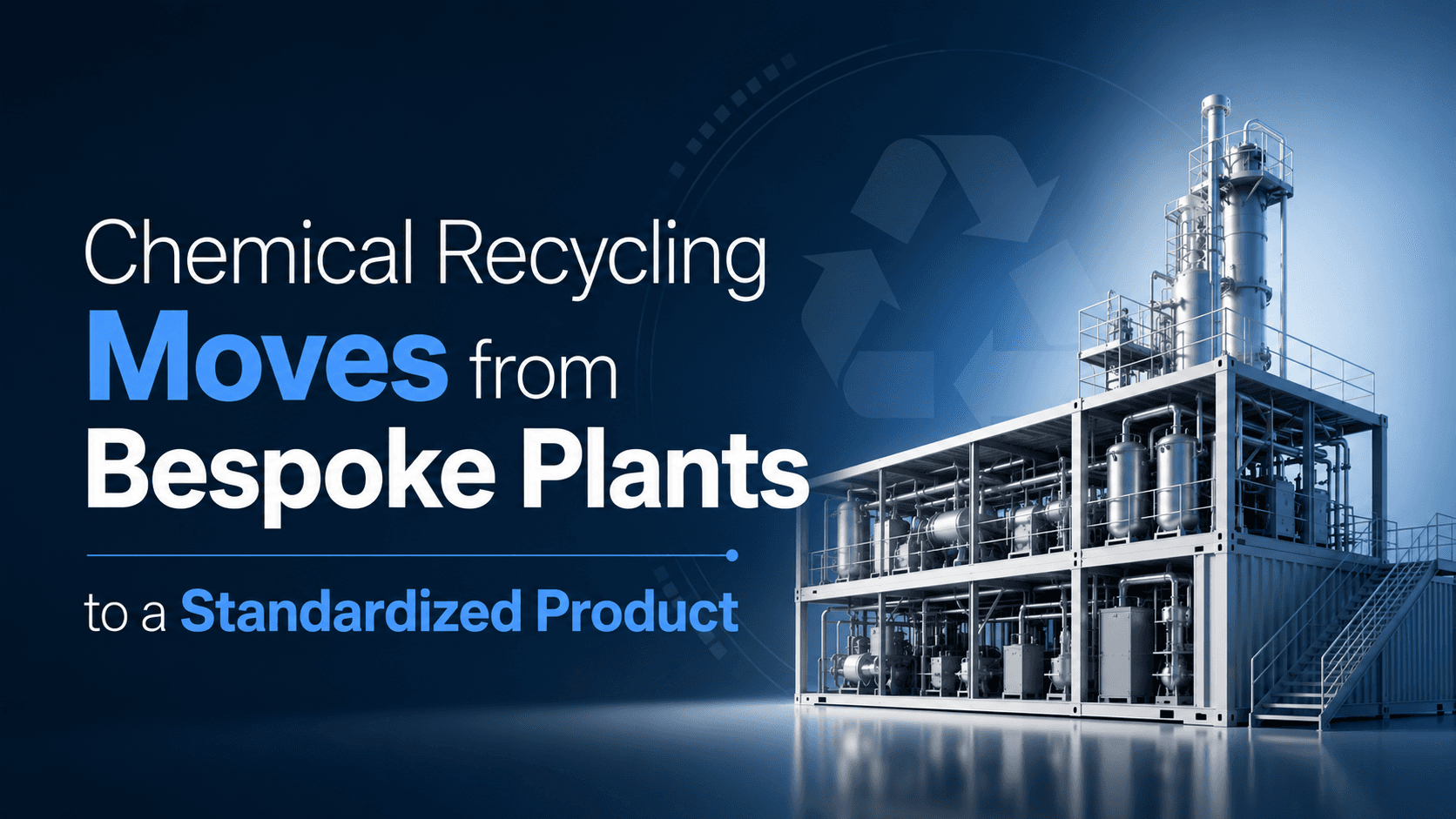
Technip Energies, Alterra, and Neste launched Nerea, a standardized, modular chemical recycling solution. Chemical recycling has been slow to scale because plants were built bespoke each time. Nerea aims to turn that into a repeatable, deployable product instead.
The technology to process hard-to-recycle plastics has existed for years. In chemical recycling plastic waste, the real bottleneck has not been the technology—but how plants are built.
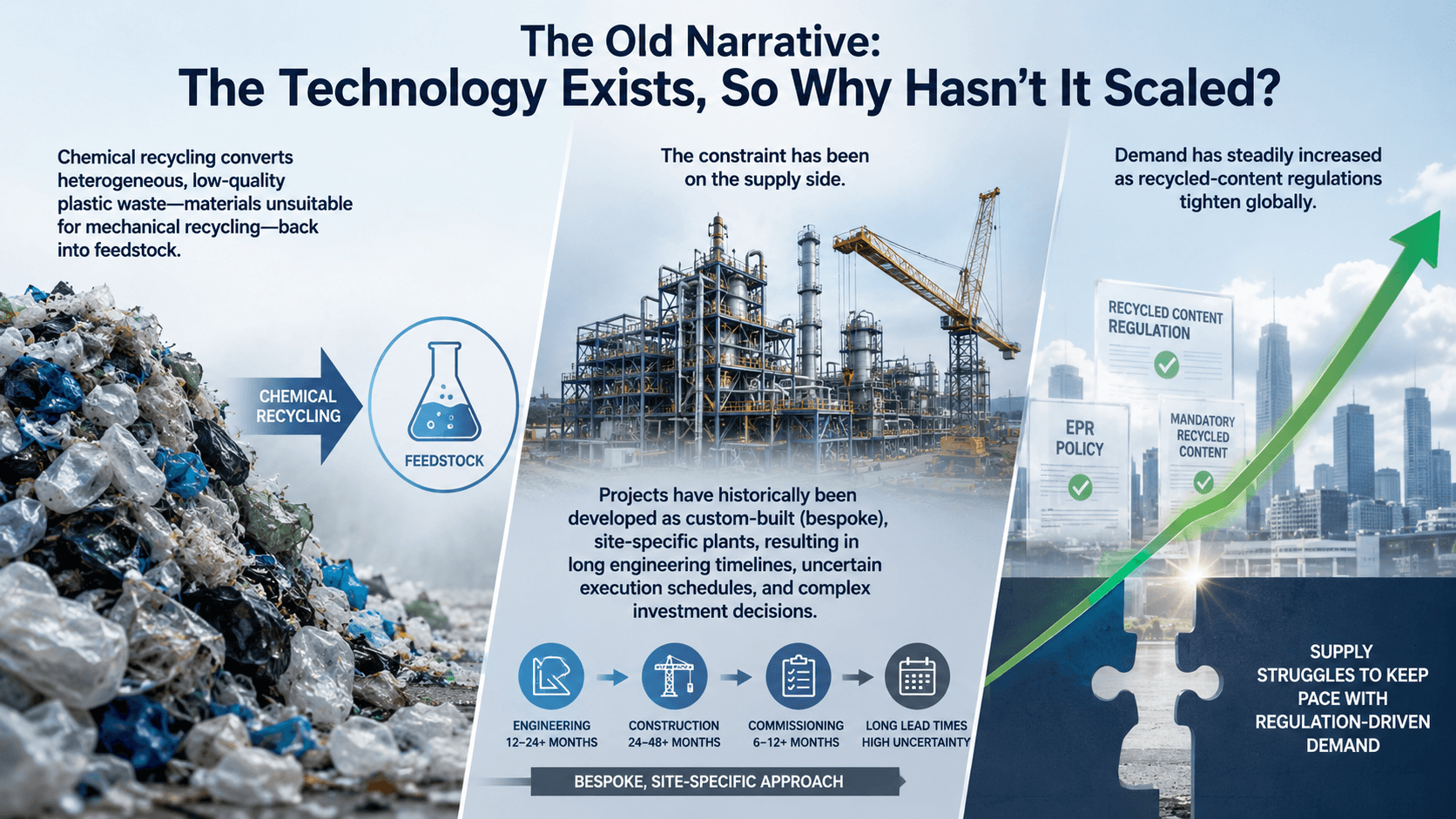
The Old Narrative: The Technology Exists, So Why Hasn't It Scaled?
Chemical recycling converts heterogeneous, low-quality plastic waste—materials unsuitable for mechanical recycling—back into feedstock. Demand has steadily increased as recycled-content regulations tighten globally.
The constraint has been on the supply side.
Projects have historically been developed as custom-built (bespoke), site-specific plants, resulting in long engineering timelines, uncertain execution schedules, and complex investment decisions.
As a result, supply has struggled to keep pace with regulation-driven demand.
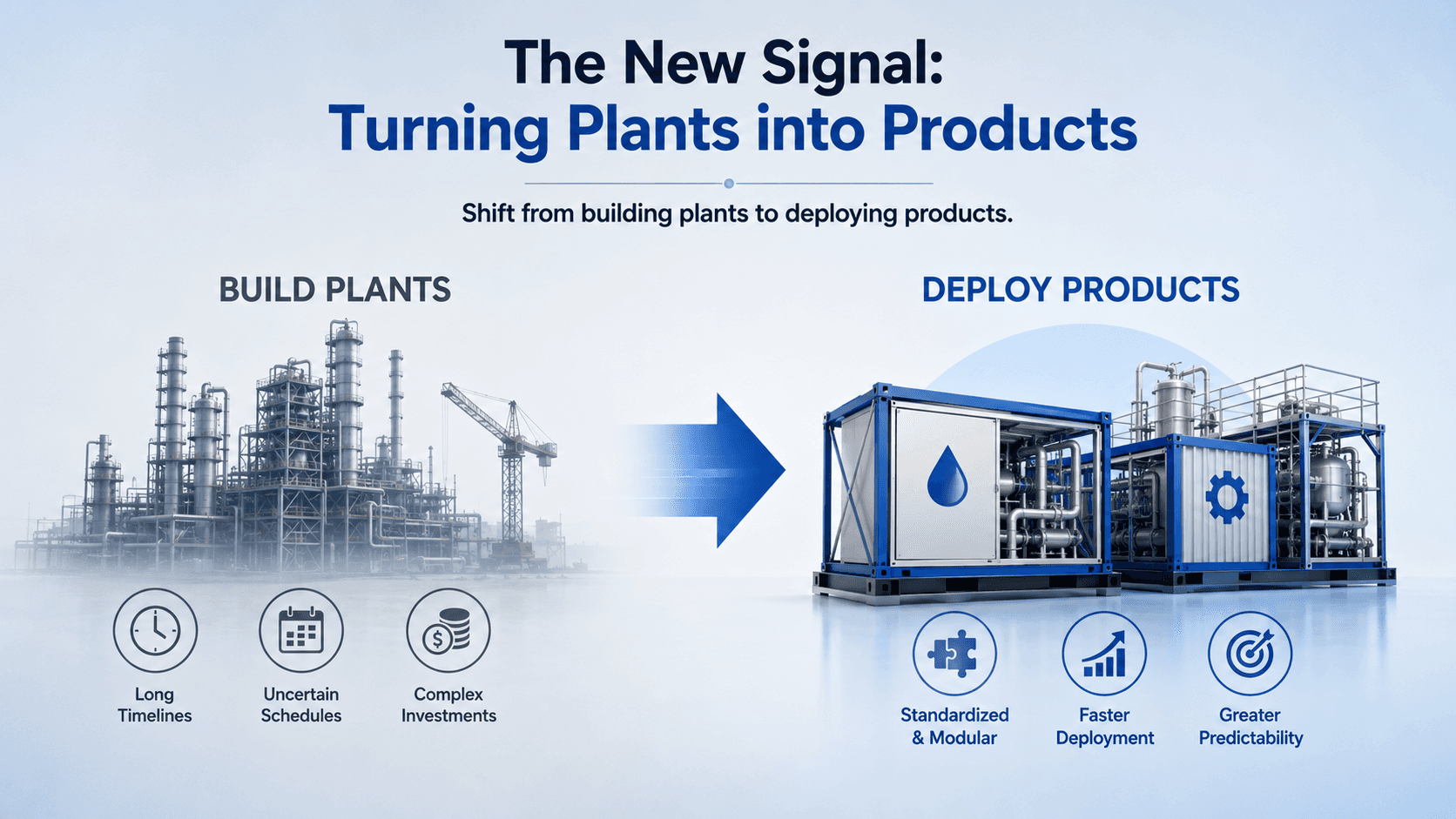
The New Signal: Turning Plants into Products
The core idea is simple:
Shift from building plants to deploying products.
On June 29, Technip Energies, Alterra, and Neste announced the commercial launch of Nerea™, directly targeting this bottleneck.
"Technip Energies, Alterra and Neste announce the commercial launch of Nerea™, a new type of industrial offering designed to accelerate the deployment of chemical recycling projects for plastic waste."
Nerea is the result of a November 2024 collaboration, combining Alterra's thermochemical liquefaction technology, Neste's operational expertise, and Technip Energies' engineering and modularization capabilities into a standardized, modular solution. Notably, Alterra's technology has already demonstrated over five years of continuous commercial operation on real-world plastic waste.
Julie Cranga of Technip Energies stated:
"With Nerea™, we combine proven technology, feedstock expertise, and industrial delivery into a standardized offering—providing greater predictability and performance across development, investment, and operations."

What Actually Changes
The shift is from bespoke infrastructure to a repeatable deployment model. If successful, this could lead to:
Shorter project lead times, easing supply bottlenecks
Lower barriers to entry for mid-sized waste operators and petrochemical players
Faster integration of recycled feedstock into existing refining value chains
Neste's involvement is particularly notable, signaling a direct pathway for chemical recycling outputs into established refining systems.
Implications for the Industry
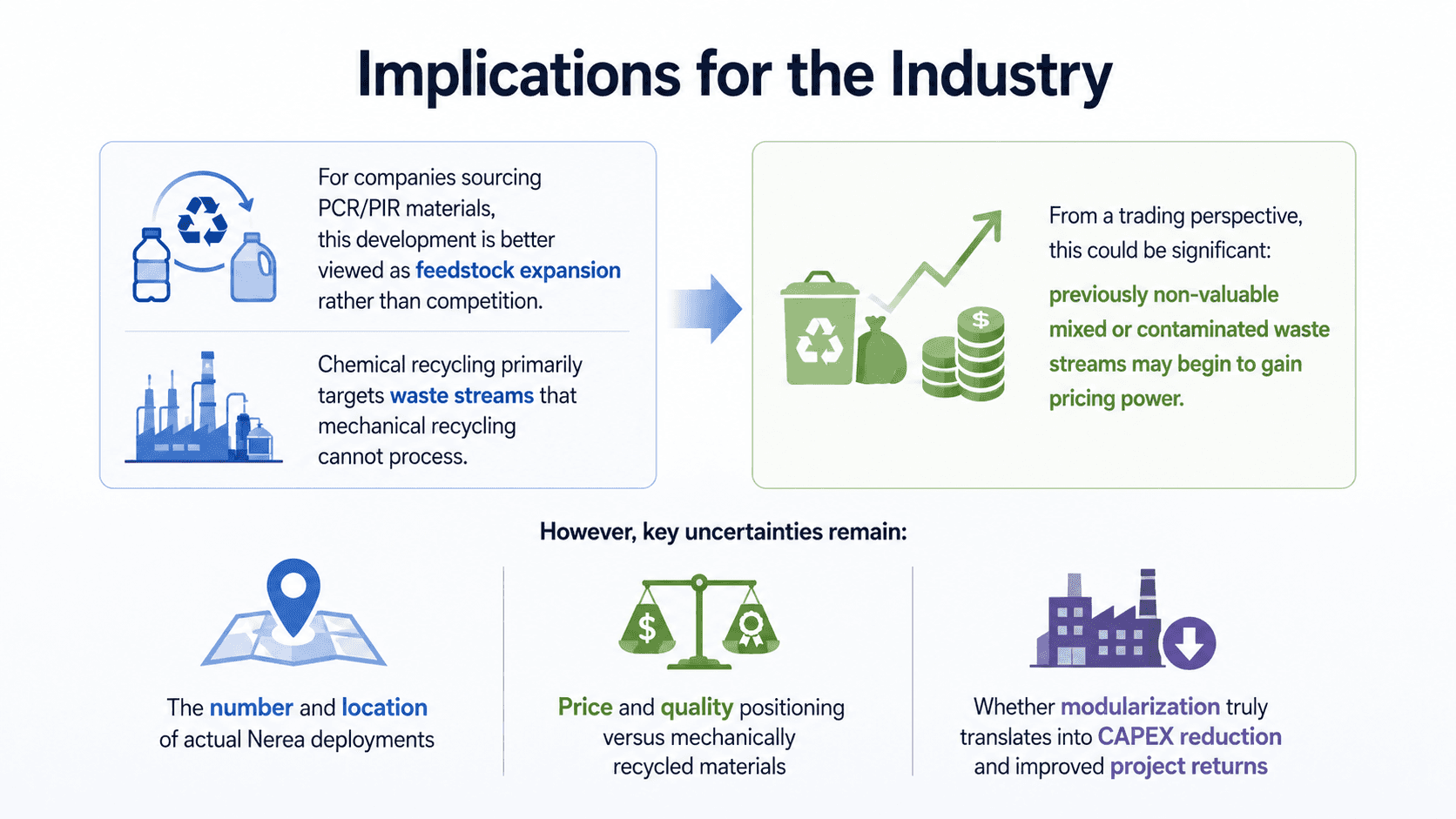
For companies sourcing PCR/PIR materials, this development is better viewed as feedstock expansion rather than competition. Chemical recycling primarily targets waste streams that mechanical recycling cannot process.
From a trading perspective, this could be significant: previously non-valuable mixed or contaminated waste streams may begin to gain pricing power.
However, key uncertainties remain:
The number and location of actual Nerea deployments
Price and quality positioning versus mechanically recycled materials
Whether modularization truly translates into CAPEX reduction and improved project returns
Conclusion
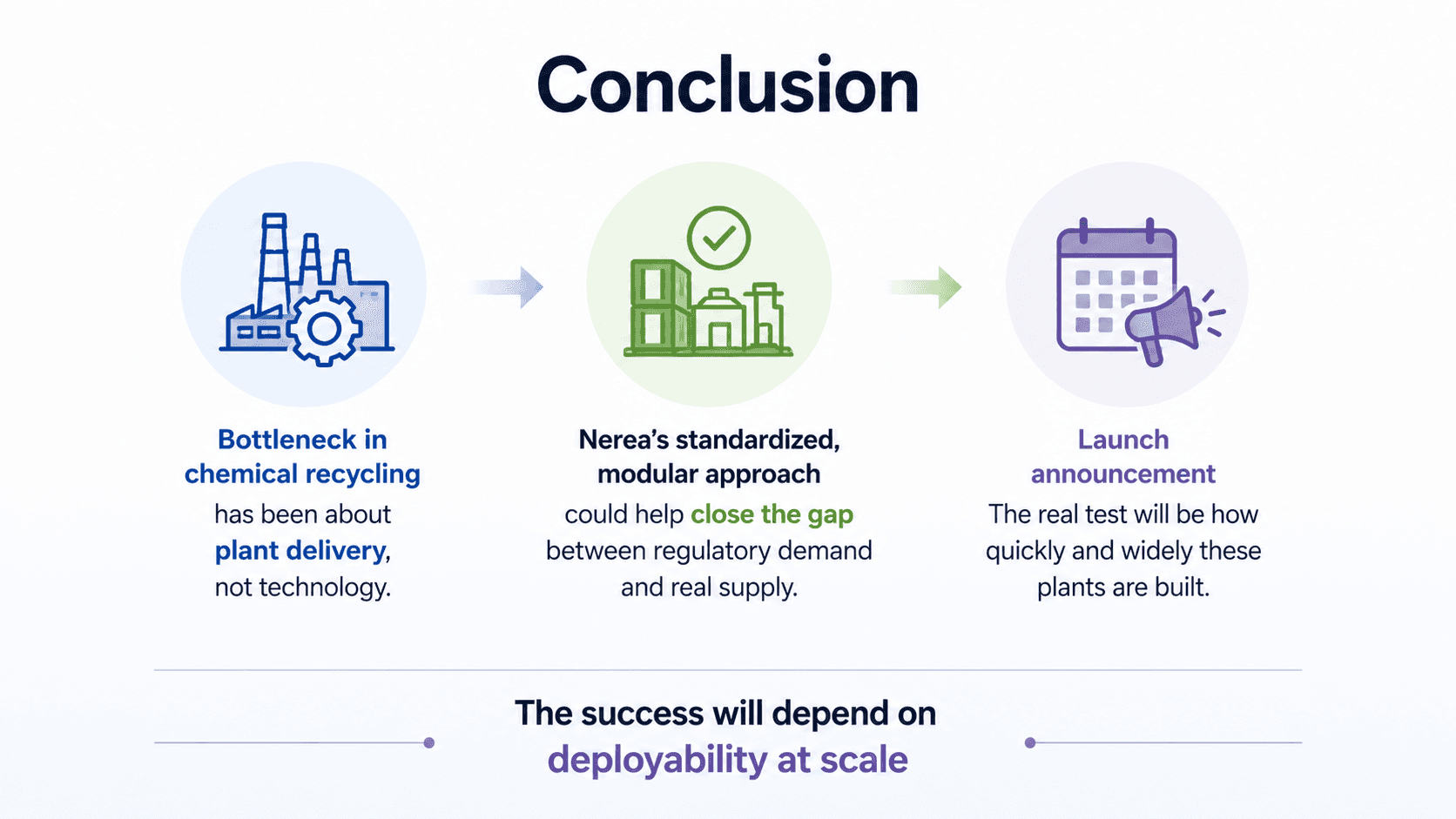
The core message is clear: the bottleneck in chemical recycling has been about plant delivery, not technology. If Nerea's standardized, modular approach proves deployable at scale, it could help close the gap between regulatory demand and real supply.
For now, this remains a launch announcement. The real test will be how quickly and widely these plants are actually built.
Image generated with ChatGPT
Source
Technip Energies, Alterra, Neste, "Technip Energies, Alterra and Neste launch Nerea, a standardized modular solution for plastic chemical recycling" → Read the Source
The technology to process hard-to-recycle plastics has existed for years. In chemical recycling plastic waste, the real bottleneck has not been the technology—but how plants are built.
The Old Narrative: The Technology Exists, So Why Hasn't It Scaled?
Chemical recycling converts heterogeneous, low-quality plastic waste—materials unsuitable for mechanical recycling—back into feedstock. Demand has steadily increased as recycled-content regulations tighten globally.
The constraint has been on the supply side.
Projects have historically been developed as custom-built (bespoke), site-specific plants, resulting in long engineering timelines, uncertain execution schedules, and complex investment decisions.
As a result, supply has struggled to keep pace with regulation-driven demand.
The New Signal: Turning Plants into Products
The core idea is simple:
Shift from building plants to deploying products.
On June 29, Technip Energies, Alterra, and Neste announced the commercial launch of Nerea™, directly targeting this bottleneck.
"Technip Energies, Alterra and Neste announce the commercial launch of Nerea™, a new type of industrial offering designed to accelerate the deployment of chemical recycling projects for plastic waste."
Nerea is the result of a November 2024 collaboration, combining Alterra's thermochemical liquefaction technology, Neste's operational expertise, and Technip Energies' engineering and modularization capabilities into a standardized, modular solution. Notably, Alterra's technology has already demonstrated over five years of continuous commercial operation on real-world plastic waste.
Julie Cranga of Technip Energies stated:
"With Nerea™, we combine proven technology, feedstock expertise, and industrial delivery into a standardized offering—providing greater predictability and performance across development, investment, and operations."
What Actually Changes
The shift is from bespoke infrastructure to a repeatable deployment model. If successful, this could lead to:
Shorter project lead times, easing supply bottlenecks
Lower barriers to entry for mid-sized waste operators and petrochemical players
Faster integration of recycled feedstock into existing refining value chains
Neste's involvement is particularly notable, signaling a direct pathway for chemical recycling outputs into established refining systems.
Implications for the Industry
For companies sourcing PCR/PIR materials, this development is better viewed as feedstock expansion rather than competition. Chemical recycling primarily targets waste streams that mechanical recycling cannot process.
From a trading perspective, this could be significant: previously non-valuable mixed or contaminated waste streams may begin to gain pricing power.
However, key uncertainties remain:
The number and location of actual Nerea deployments
Price and quality positioning versus mechanically recycled materials
Whether modularization truly translates into CAPEX reduction and improved project returns
Conclusion
The core message is clear: the bottleneck in chemical recycling has been about plant delivery, not technology. If Nerea's standardized, modular approach proves deployable at scale, it could help close the gap between regulatory demand and real supply.
For now, this remains a launch announcement. The real test will be how quickly and widely these plants are actually built.
Image generated with ChatGPT
Source
Technip Energies, Alterra, Neste, "Technip Energies, Alterra and Neste launch Nerea, a standardized modular solution for plastic chemical recycling" → Read the Source
Sourcing Mechanical rLDPE
Grades • Specs • Availability
Browse rLDPE →
Sourcing Mechanical rLDPE
Sourcing Mechanical rLDPE
Review rLDPE grades by feedstock, properties, stock and MOQ.
Review rLDPE grades by feedstock, properties, stock and MOQ.
Browse rLDPE →
Browse rLDPE →
Looking for samples or ready to source? Submit your request for pricing, availability, and technical information.
Looking for samples or ready to source? Submit your request for pricing, availability, and technical information.
Request a Quote →
Request a Quote →
Posted by REGENPORT
REGENPORT is a global platform connecting buyers and suppliers in the recycled materials and sustainable packaging industries.