CATEGORY
CATEGORY
News
News
News
UK Plastic Film Recycling Delays and Their Impact on rPE Resin Markets
UK Plastic Film Recycling Delays and Their Impact on rPE Resin Markets
UK Plastic Film Recycling Delays and Their Impact on rPE Resin Markets
A major UK policy shift is set to expand plastic film recycling — but the gap between collection and usable PE recycled resin is wider than it looks. Here's the global market impact.
Most English local authorities plan to introduce kerbside plastic film recycling by March 2027, but the system is still far from fully operational. Since most household plastic film is made from PE (polyethylene), this development has direct implications for the supply of PE recycled resin, both in the UK and globally.
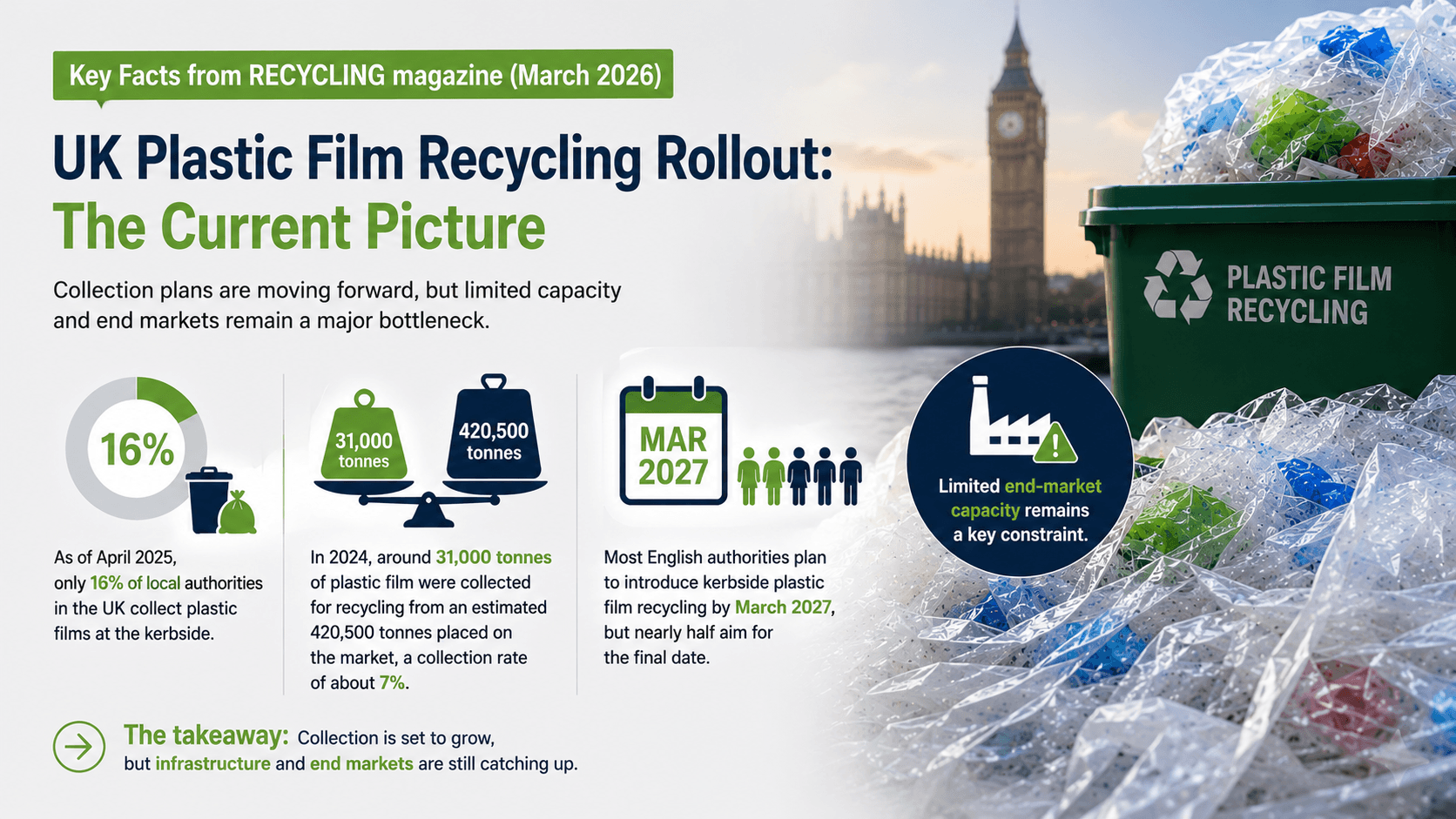
Key Facts from RECYCLING magazine (March 2026)
A March 2026 article in RECYCLING magazine titled "Delayed rollout of kerbside plastic film recycling" outlines the current state of plastic film collection in the UK:
As of April 2025, only 16% of local authorities in the UK reported collecting plastic films at the kerbside.
In 2024, around 31,000 tonnes of plastic film were collected for recycling from an estimated 420,500 tonnes placed on the market, equal to a collection rate of about 7%.
Most English authorities plan to introduce kerbside plastic film recycling by March 2027, but implementation is concentrated near the deadline, with nearly half aiming for the final date.
The development of kerbside plastic film recycling is constrained by limited end-market capacity for recycled plastic film.
These numbers show a clear gap: collection is planned to expand significantly, but current infrastructure and end markets are still limited.
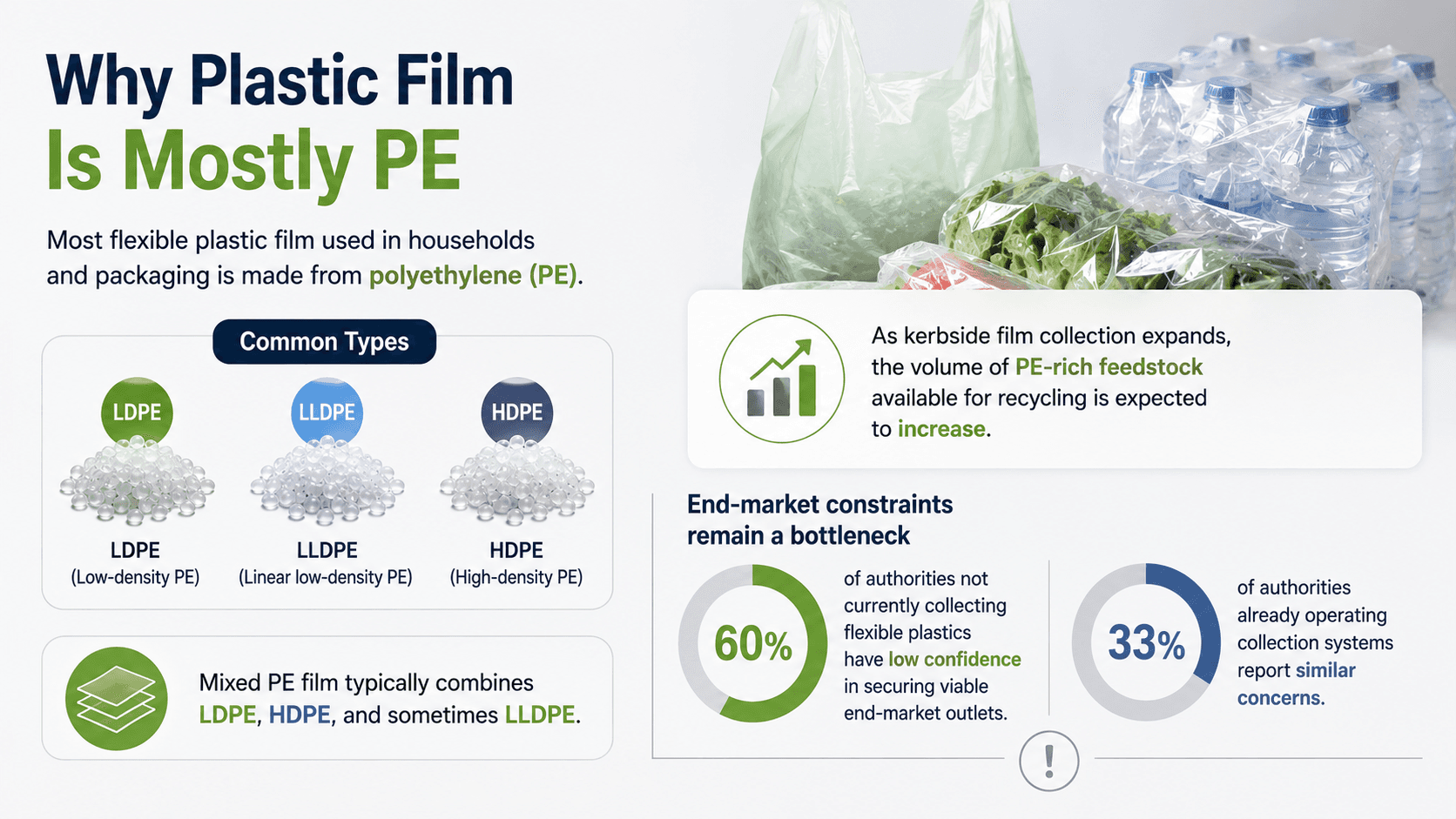
Why Plastic Film Is Mostly PE
Most flexible plastic film used in households and packaging—such as carrier bags, fresh-food wrappers, and multipack films—is made from polyethylene (PE):
Common types include LDPE (low-density PE) and LLDPE (linear low-density PE).
Mixed PE film typically combines LDPE, HDPE, and sometimes LLDPE.
This means that as kerbside film collection expands, the volume of PE-rich feedstock available for recycling is expected to increase. However, the article also notes that end-market constraints remain a bottleneck:
Around 60% of local authorities not currently collecting flexible plastics have low confidence in securing viable end-market outlets.
Nearly one third of authorities already operating collection systems report similar concerns.
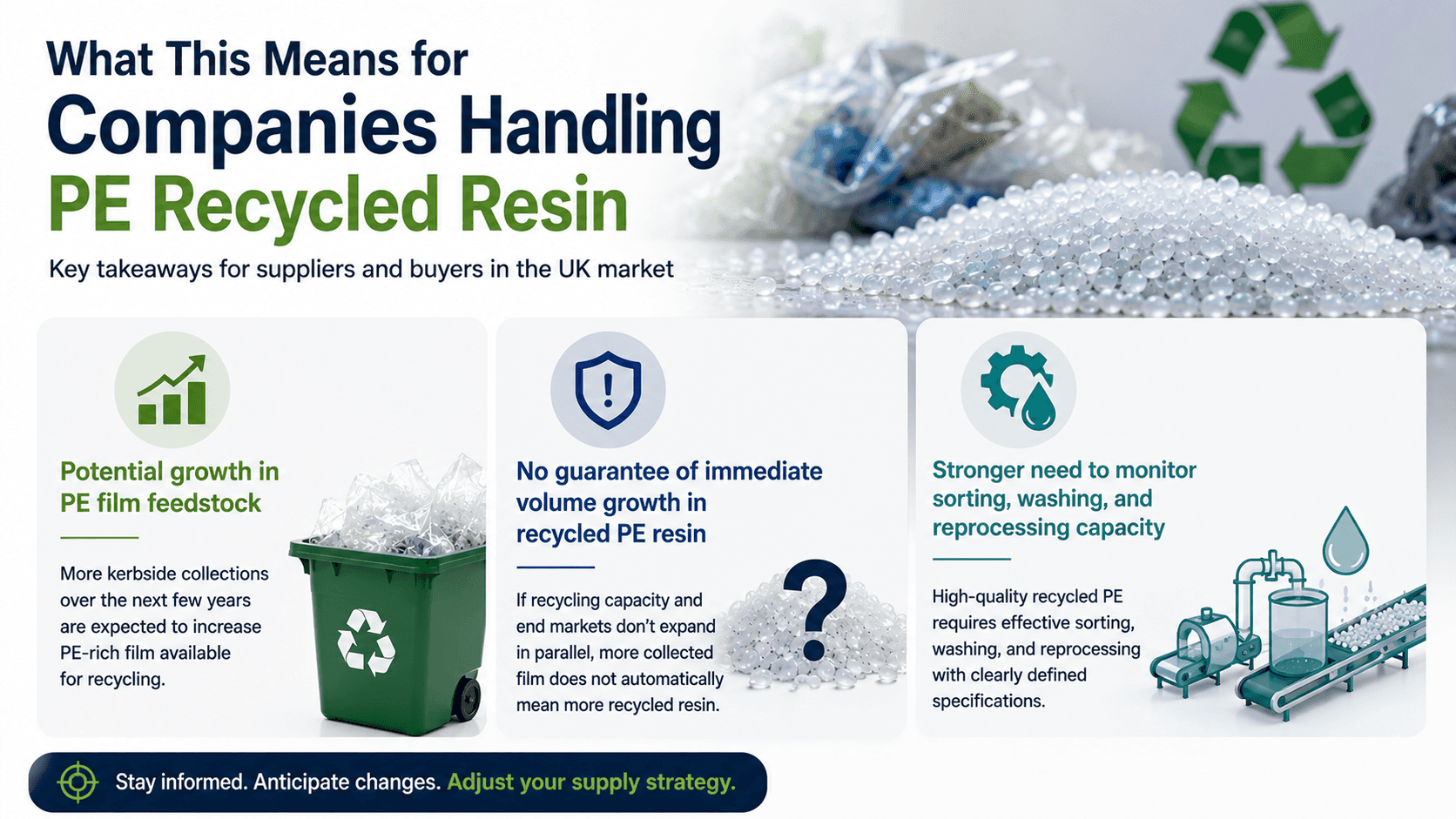
What This Means for Companies Handling PE Recycled Resin
For companies dealing in PE recycled resin, including suppliers and buyers, the UK situation highlights several practical points:
Potential growth in PE film feedstock
If more local authorities launch kerbside collection over the next few years, the amount of PE-rich film available for recycling is expected to rise.
No guarantee of immediate volume growth in recycled PE resin
If recycling capacity and end markets do not expand in parallel, the short-term increase in recycled PE resin volumes is not guaranteed.
More collected film does not automatically mean more recycled resin.
Stronger need to monitor sorting, washing, and reprocessing capacity
Flexible plastics require effective sorting, washing, and reprocessing to produce high-quality recycled resin.
Specifications for recycled PE from film streams (e.g., melt flow, contamination limits, odor, color) must be clearly defined and consistently met.
For PE recycled resin suppliers and buyers, tracking these developments helps to better anticipate supply changes and adjust sourcing or sales strategies accordingly.
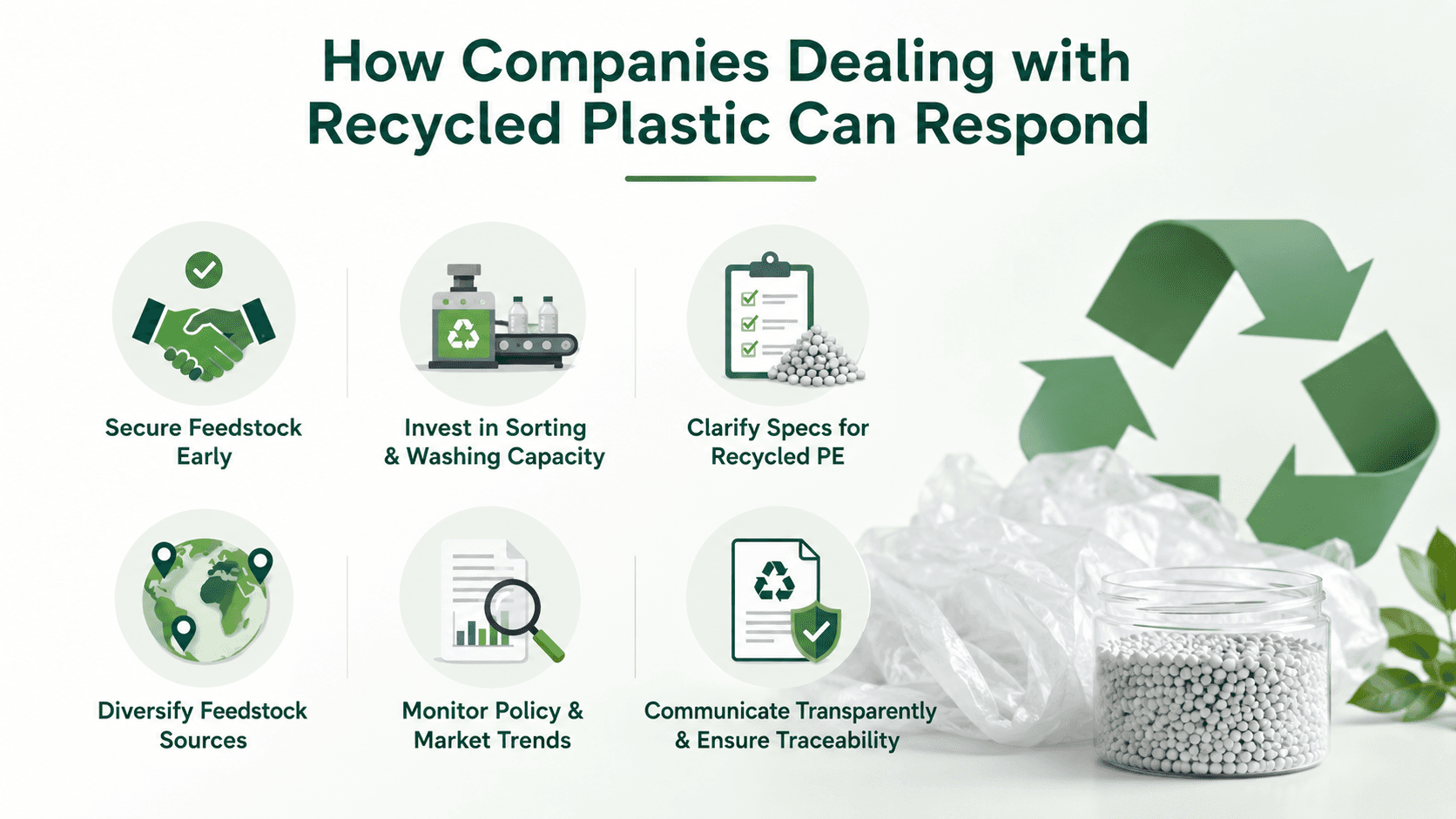
How Companies Dealing with Recycled Plastic Can Respond
In this environment, companies handling PE recycled resin and other recycled plastics can take several practical steps:
Secure flexible film feedstock early
Build relationships with local authorities, waste collectors, and sorting facilities that will handle expanded film streams.
Consider long-term offtake agreements for PE-rich film fractions where possible.
Invest in sorting and washing capacity for flexible plastics
Mixed PE film requires effective sorting (by resin type, color, and contamination level) and robust washing to produce high-quality recycled resin.
Upgrading pre-processing capacity can improve yield and consistency from film-derived feedstock.
Clarify specifications for recycled PE from film
Define clear quality standards for recycled PE from film streams (e.g., melt flow, contamination limits, odor, color).
Work closely with downstream converters to align recycled PE specs with their process requirements.
Diversify feedstock sources geographically
Relying on a single country or region for film-derived feedstock increases risk if local collection or recycling capacity lags.
A broader geographic base can help stabilize supply when one market faces delays or capacity constraints.
Monitor policy and end-market developments
Track implementation of schemes like the UK's Simpler Recycling and similar policies in other markets.
Watch for new regulations on recycled content in packaging, which can drive demand for PE recycled resin.
Communicate transparently about recycled content and traceability
As regulations and customer expectations tighten, clear documentation of recycled content and chain-of-custody becomes more important.
Transparent reporting can strengthen trust with buyers and support premium positioning for high-quality recycled PE.
By taking these actions, companies dealing in recycled plastic can better position themselves to benefit from expanding film collection while managing the risks of slower-than-expected capacity growth.
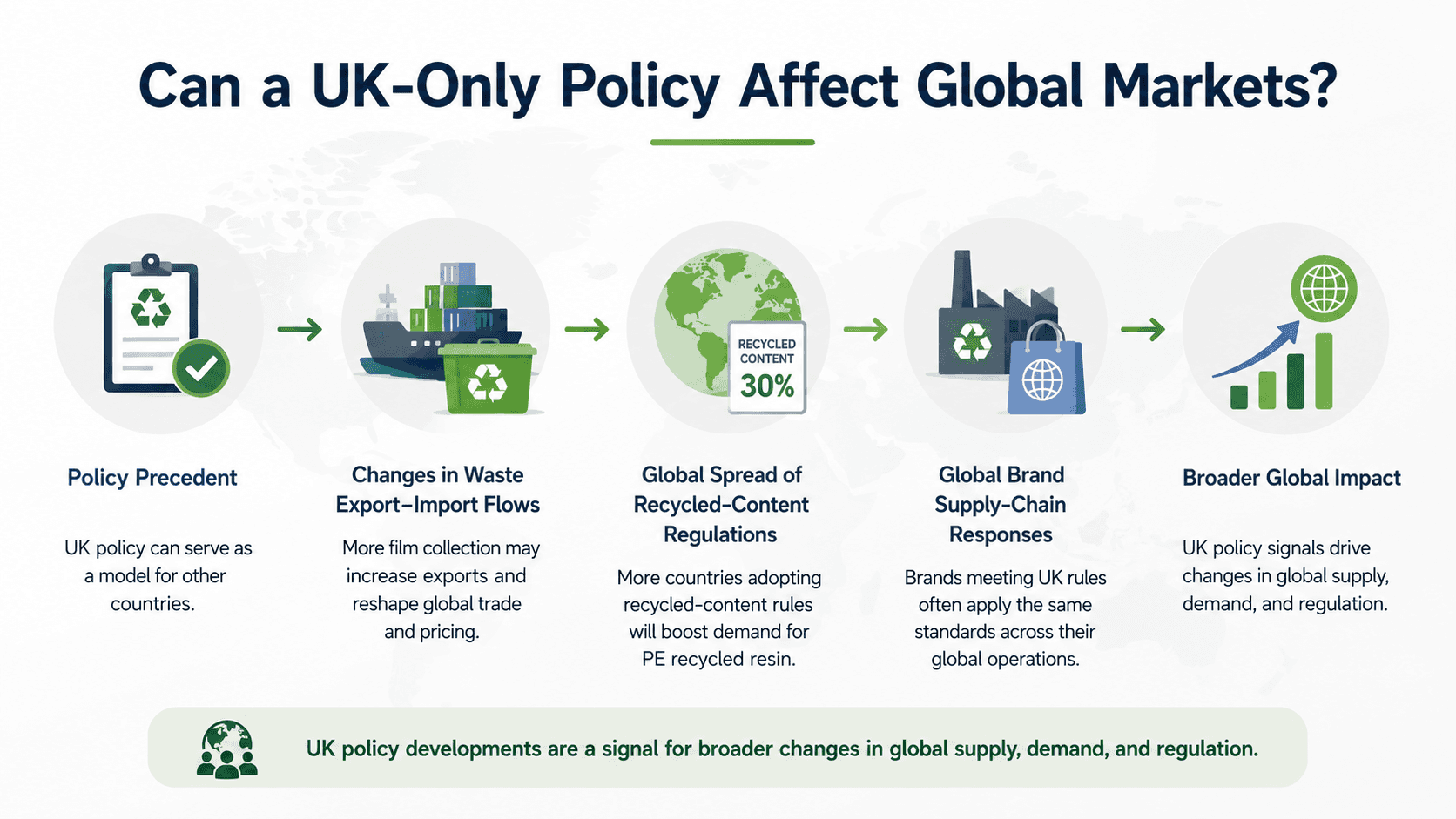
Can a UK-Only Policy Affect Global Markets?
Although the kerbside plastic film collection expansion is a UK-specific policy, it can influence global markets through several channels:
Policy precedent
The UK's Simpler Recycling and film collection rollout can serve as a model for other countries, especially those with similar recycling systems or strong trade ties with the UK.
If other countries introduce similar policies, global demand for recycled plastics, including PE, is likely to increase.
Changes in plastic waste export–import flows
The UK currently exports around half of its collected plastic waste to countries such as Turkey and Malaysia.
If more film is collected but domestic recycling capacity does not keep pace, export volumes may rise further, affecting global supply and pricing of plastic feedstock.
Importing countries may respond by tightening their own regulations on plastic waste imports, which can reshape global trade flows.
Global spread of recycled-content regulations
The UK's Plastic Packaging Tax (requiring 30% recycled content in plastic packaging) and similar policies are part of a broader global trend.
As more countries adopt recycled-content requirements, demand for PE recycled resin is expected to grow beyond the UK.
Global brand supply-chain responses
Multinational brands selling in the UK must comply with UK recycled-content rules, and they often apply similar standards across their global supply chains.
This can lead to increased demand for recycled plastic in markets outside the UK, including Asia.
For companies handling recycled plastic, this means that UK policy developments are not just a local issue, but a signal for broader changes in global supply, demand, and regulation.
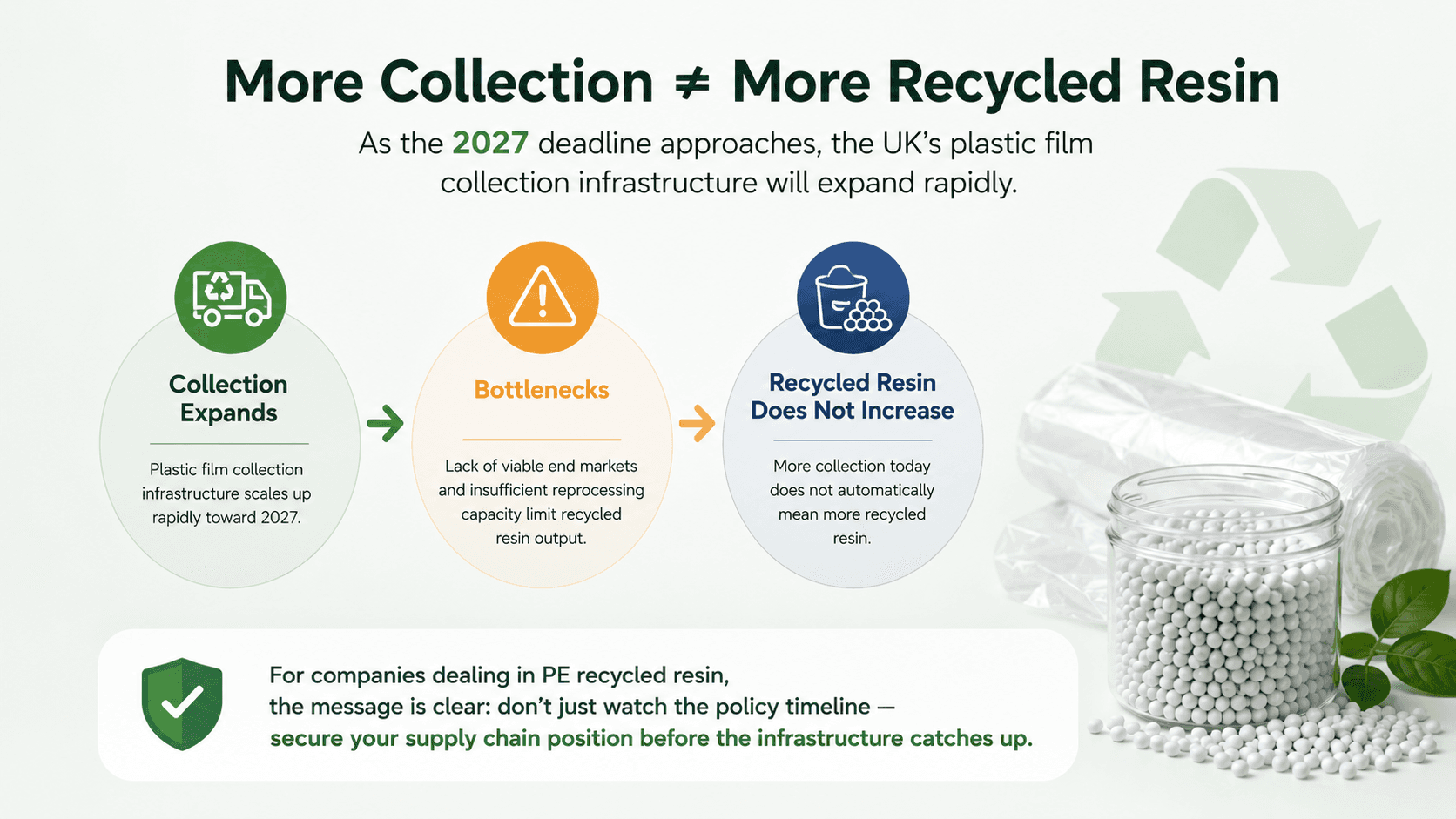
Takeaway
As the 2027 deadline approaches, the UK's plastic film collection infrastructure will expand rapidly — but more collection does not equal more recycled resin. In the short term, the absence of viable end markets and insufficient reprocessing capacity are likely to act as significant bottlenecks.
For companies dealing in PE recycled resin, the message is clear: don't just watch the policy timeline — secure your supply chain position before the infrastructure catches up.
Image generated with ChatGPT
Source: RECYCLING magazine, "Delayed rollout of kerbside plastic film recycling", 18 March 2026
Most English local authorities plan to introduce kerbside plastic film recycling by March 2027, but the system is still far from fully operational. Since most household plastic film is made from PE (polyethylene), this development has direct implications for the supply of PE recycled resin, both in the UK and globally.
Key Facts from RECYCLING magazine (March 2026)
A March 2026 article in RECYCLING magazine titled "Delayed rollout of kerbside plastic film recycling" outlines the current state of plastic film collection in the UK:
As of April 2025, only 16% of local authorities in the UK reported collecting plastic films at the kerbside.
In 2024, around 31,000 tonnes of plastic film were collected for recycling from an estimated 420,500 tonnes placed on the market, equal to a collection rate of about 7%.
Most English authorities plan to introduce kerbside plastic film recycling by March 2027, but implementation is concentrated near the deadline, with nearly half aiming for the final date.
The development of kerbside plastic film recycling is constrained by limited end-market capacity for recycled plastic film.
These numbers show a clear gap: collection is planned to expand significantly, but current infrastructure and end markets are still limited.
Why Plastic Film Is Mostly PE
Most flexible plastic film used in households and packaging—such as carrier bags, fresh-food wrappers, and multipack films—is made from polyethylene (PE):
Common types include LDPE (low-density PE) and LLDPE (linear low-density PE).
Mixed PE film typically combines LDPE, HDPE, and sometimes LLDPE.
This means that as kerbside film collection expands, the volume of PE-rich feedstock available for recycling is expected to increase. However, the article also notes that end-market constraints remain a bottleneck:
Around 60% of local authorities not currently collecting flexible plastics have low confidence in securing viable end-market outlets.
Nearly one third of authorities already operating collection systems report similar concerns.
What This Means for Companies Handling PE Recycled Resin
For companies dealing in PE recycled resin, including suppliers and buyers, the UK situation highlights several practical points:
Potential growth in PE film feedstock
If more local authorities launch kerbside collection over the next few years, the amount of PE-rich film available for recycling is expected to rise.
No guarantee of immediate volume growth in recycled PE resin
If recycling capacity and end markets do not expand in parallel, the short-term increase in recycled PE resin volumes is not guaranteed.
More collected film does not automatically mean more recycled resin.
Stronger need to monitor sorting, washing, and reprocessing capacity
Flexible plastics require effective sorting, washing, and reprocessing to produce high-quality recycled resin.
Specifications for recycled PE from film streams (e.g., melt flow, contamination limits, odor, color) must be clearly defined and consistently met.
For PE recycled resin suppliers and buyers, tracking these developments helps to better anticipate supply changes and adjust sourcing or sales strategies accordingly.
How Companies Dealing with Recycled Plastic Can Respond
In this environment, companies handling PE recycled resin and other recycled plastics can take several practical steps:
Secure flexible film feedstock early
Build relationships with local authorities, waste collectors, and sorting facilities that will handle expanded film streams.
Consider long-term offtake agreements for PE-rich film fractions where possible.
Invest in sorting and washing capacity for flexible plastics
Mixed PE film requires effective sorting (by resin type, color, and contamination level) and robust washing to produce high-quality recycled resin.
Upgrading pre-processing capacity can improve yield and consistency from film-derived feedstock.
Clarify specifications for recycled PE from film
Define clear quality standards for recycled PE from film streams (e.g., melt flow, contamination limits, odor, color).
Work closely with downstream converters to align recycled PE specs with their process requirements.
Diversify feedstock sources geographically
Relying on a single country or region for film-derived feedstock increases risk if local collection or recycling capacity lags.
A broader geographic base can help stabilize supply when one market faces delays or capacity constraints.
Monitor policy and end-market developments
Track implementation of schemes like the UK's Simpler Recycling and similar policies in other markets.
Watch for new regulations on recycled content in packaging, which can drive demand for PE recycled resin.
Communicate transparently about recycled content and traceability
As regulations and customer expectations tighten, clear documentation of recycled content and chain-of-custody becomes more important.
Transparent reporting can strengthen trust with buyers and support premium positioning for high-quality recycled PE.
By taking these actions, companies dealing in recycled plastic can better position themselves to benefit from expanding film collection while managing the risks of slower-than-expected capacity growth.
Can a UK-Only Policy Affect Global Markets?
Although the kerbside plastic film collection expansion is a UK-specific policy, it can influence global markets through several channels:
Policy precedent
The UK's Simpler Recycling and film collection rollout can serve as a model for other countries, especially those with similar recycling systems or strong trade ties with the UK.
If other countries introduce similar policies, global demand for recycled plastics, including PE, is likely to increase.
Changes in plastic waste export–import flows
The UK currently exports around half of its collected plastic waste to countries such as Turkey and Malaysia.
If more film is collected but domestic recycling capacity does not keep pace, export volumes may rise further, affecting global supply and pricing of plastic feedstock.
Importing countries may respond by tightening their own regulations on plastic waste imports, which can reshape global trade flows.
Global spread of recycled-content regulations
The UK's Plastic Packaging Tax (requiring 30% recycled content in plastic packaging) and similar policies are part of a broader global trend.
As more countries adopt recycled-content requirements, demand for PE recycled resin is expected to grow beyond the UK.
Global brand supply-chain responses
Multinational brands selling in the UK must comply with UK recycled-content rules, and they often apply similar standards across their global supply chains.
This can lead to increased demand for recycled plastic in markets outside the UK, including Asia.
For companies handling recycled plastic, this means that UK policy developments are not just a local issue, but a signal for broader changes in global supply, demand, and regulation.
Takeaway
As the 2027 deadline approaches, the UK's plastic film collection infrastructure will expand rapidly — but more collection does not equal more recycled resin. In the short term, the absence of viable end markets and insufficient reprocessing capacity are likely to act as significant bottlenecks.
For companies dealing in PE recycled resin, the message is clear: don't just watch the policy timeline — secure your supply chain position before the infrastructure catches up.
Image generated with ChatGPT
Source: RECYCLING magazine, "Delayed rollout of kerbside plastic film recycling", 18 March 2026
Sourcing rLDPE for Film
Grades • Specs • Availability
Browse rLDPE →
Sourcing rLDPE for Film
Sourcing rLDPE for Film
Review rLDPE grades by feedstock, MFI, stock and MOQ.
Review rLDPE grades by feedstock, MFI, stock and MOQ.
Browse rLDPE →
Browse rLDPE →
Looking for samples or ready to source? Submit your request for pricing, availability, and technical information.
Looking for samples or ready to source? Submit your request for pricing, availability, and technical information.
Request a Quote →
Request a Quote →
Posted by REGENPORT
REGENPORT is a global platform connecting buyers and suppliers in the recycled materials and sustainable packaging industries.