CATEGORY
CATEGORY
Regulation
Regulation
Regulation
US Packaging EPR in 2026: Why SB 54 Is No Longer the Whole Story
US Packaging EPR in 2026: Why SB 54 Is No Longer the Whole Story
US Packaging EPR in 2026: Why SB 54 Is No Longer the Whole Story

Seven US states now have packaging EPR laws. See where California, Oregon, and Maine actually stand in 2026 — and what it means for compliance.
California's SB 54 captured headlines, but by mid-2026 the defining development is the spread — and divergence — of packaging Extended Producer Responsibility (EPR) across seven US states. For brands, converters, and recyclers selling into several jurisdictions, compliance is now a state-by-state reality, not a single-law checkbox. Here's where each state actually stands, and why the gaps between them affect sourcing, design, and documentation.

What Packaging EPR Requires
EPR shifts the cost and operational burden of packaging waste from municipalities to producers: registering with a Producer Responsibility Organization (PRO), reporting annual packaging supply by material and format, and paying fees that fund collection and recycling. Many states also use eco-modulated fees that reduce charges for more recyclable or recycled-content packaging — a direct incentive to source better material.
Seven states have enacted packaging EPR laws, in order passed: Maine, Oregon, California, Colorado, Minnesota, Maryland, and Washington. Each is at a markedly different stage, as the table below shows.
Seven States, Seven Different Timelines
State | Law(Year) | PRO | 2026 Status | Full Compliance |
|---|---|---|---|---|
California | SB 54 (2022) | CAA | Regs effective May 1; Program Plan filed June 15 | Launch Jan. 1, 2027 |
Colorado | Producer Responsibility Act (2022) | CAA | Live since Jan. 1; fees now invoiced | Ongoing |
Oregon | RMA / SB 582 (2021) | CAA | In effect; NAW injunction since Feb. 6; trial held July 13–17 | Pending trial ruling |
Maine | First US EPR law (2021) | TBD — RFP issued June 15 | Registration expected later in 2026 | Targeted 2027 |
Maryland | Packaging EPR law (2024) | CAA | PRO registration due July 1 | Plans by 2027–2028 |
Minnesota | Packaging EPR law (2024) | TBD (2027–2028) | Limited registration only | Not until 2032 |
Washington | Recycling Reform Act (2025) | CAA | Producers join PRO in 2026 | Not until 2030 |
The spread is the story: Colorado producers are already paying fees, Maine hasn't even picked its PRO, and Minnesota's real obligations are six years out. "We comply with SB 54" no longer covers national exposure.
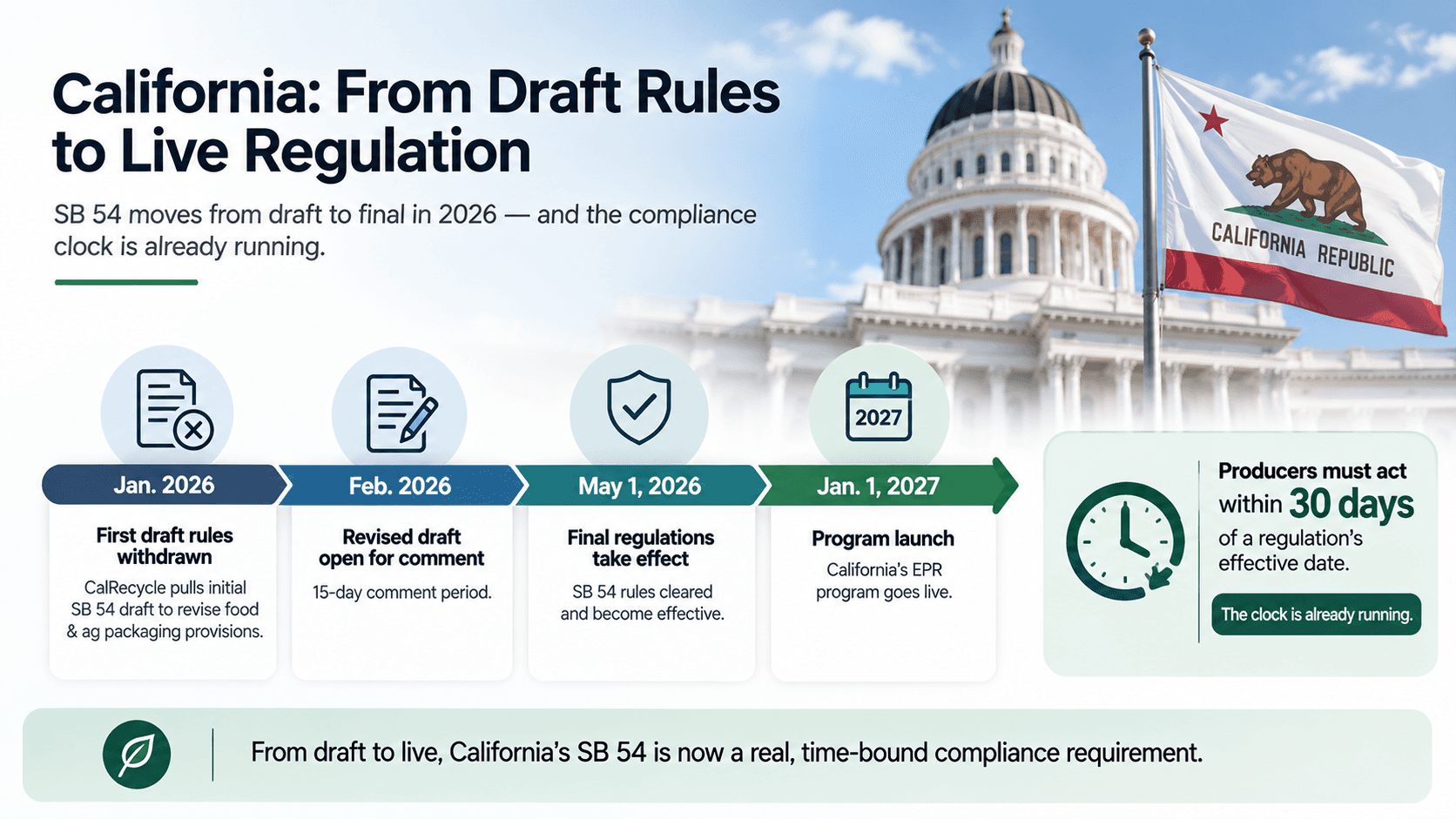
California: From Draft Rules to Live Regulation
California's regulatory path wasn't smooth — CalRecycle withdrew its first set of proposed SB 54 rules in January 2026 to revise food and agricultural packaging provisions before finalizing them in May (see timeline above). The practical catch for packaging teams: obligated producers must act within 30 days of a regulation's effective date, so that clock is already running.
Oregon: The Legal Stress Test
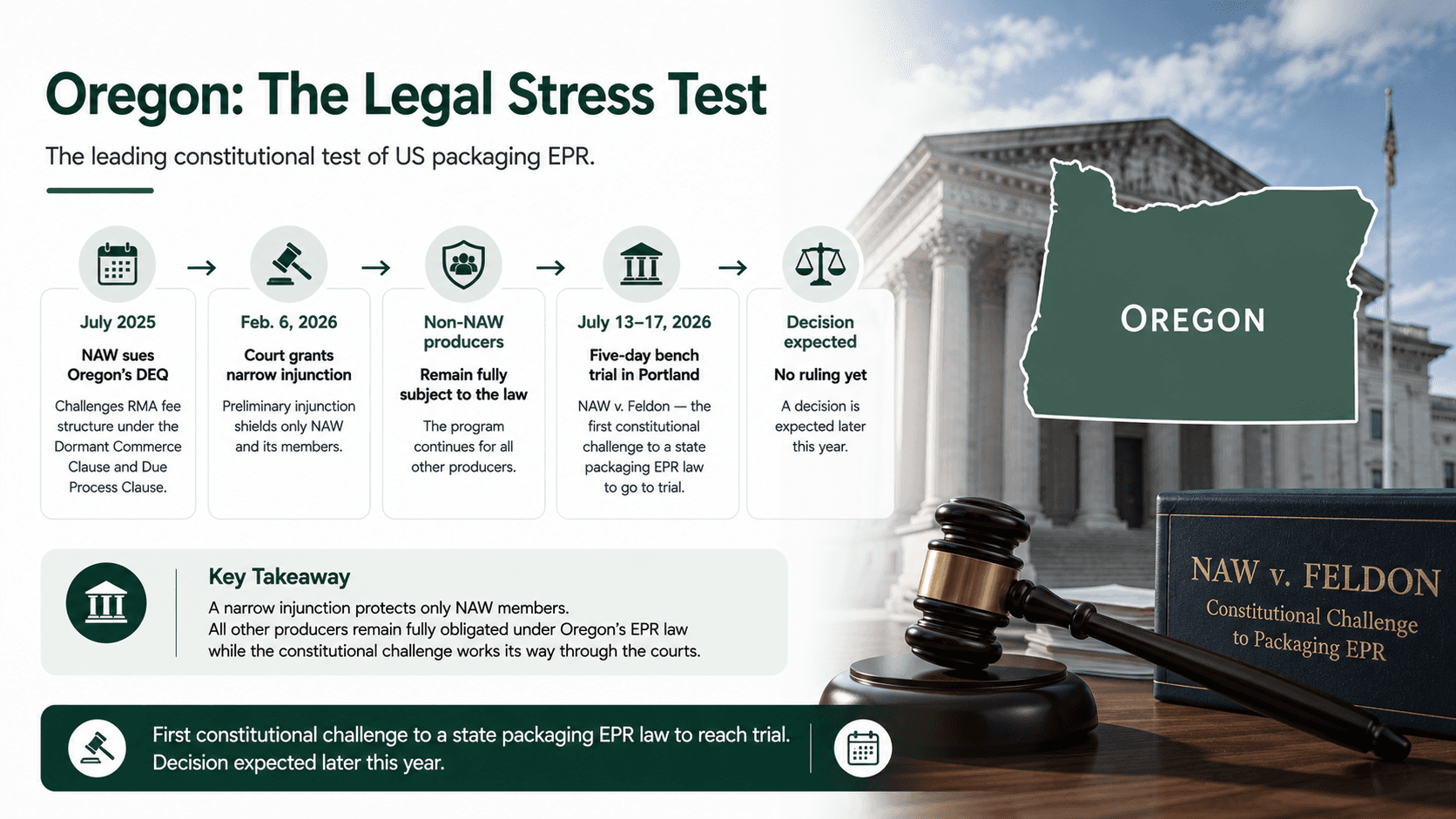
Oregon's program is the leading constitutional test of US packaging EPR. NAW sued Oregon's DEQ in July 2025, arguing the RMA's fee structure violates the Dormant Commerce Clause and Due Process Clause, and won a narrow injunction that shields only its own members — non-NAW producers remain fully subject to the law. The case, NAW v. Feldon, reached a five-day bench trial in Portland this month — the first such challenge to go to trial for any state packaging EPR law. No ruling has been issued yet; a decision is expected later this year.
Maine: Building, Not Idle
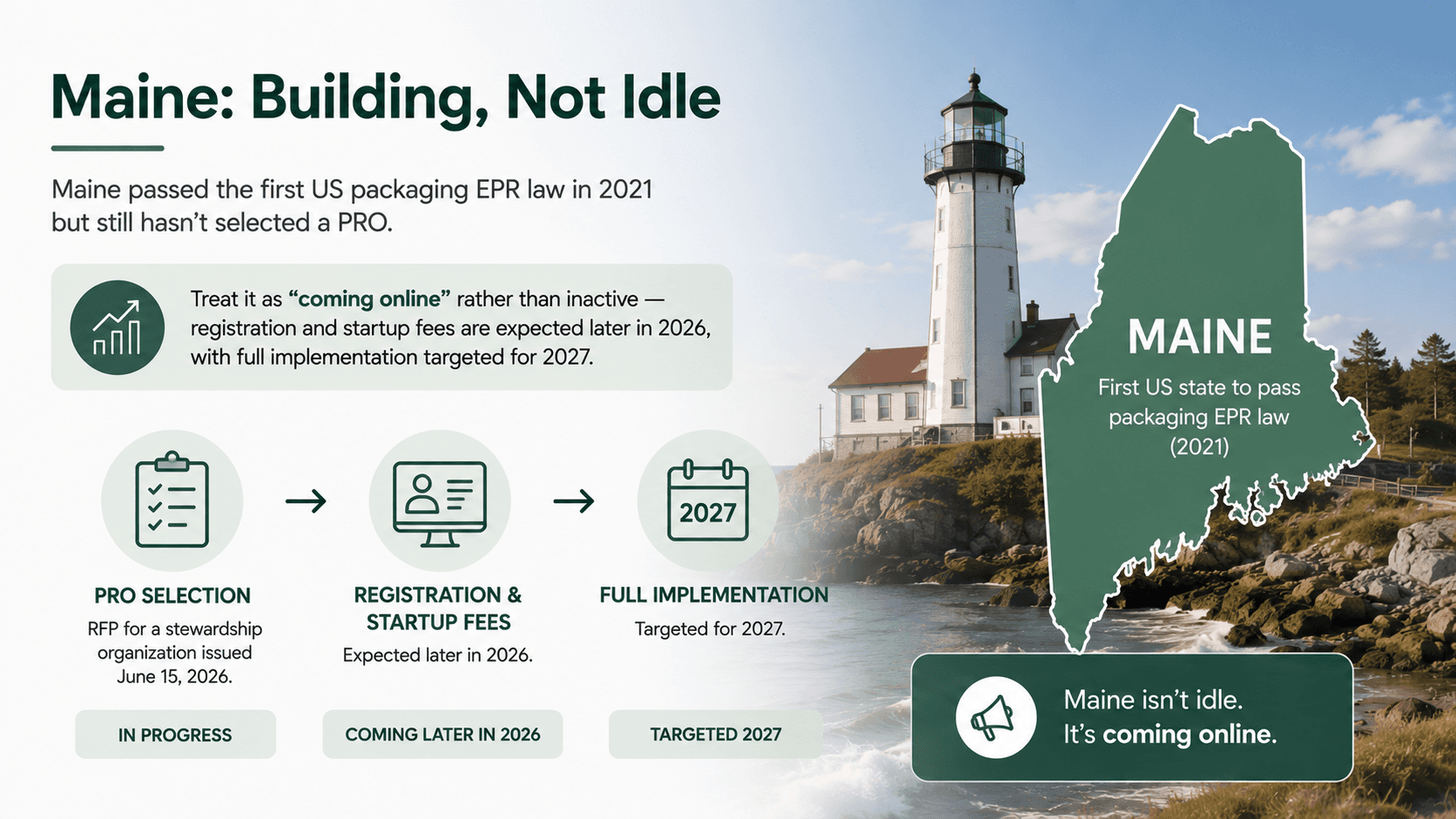
Maine passed the first US packaging EPR law back in 2021 but still hasn't selected a PRO. Treat it as "coming online" rather than inactive — registration and startup fees are expected later in 2026, with full implementation targeted for 2027.
Why This Matters for Recycled Material Buyers
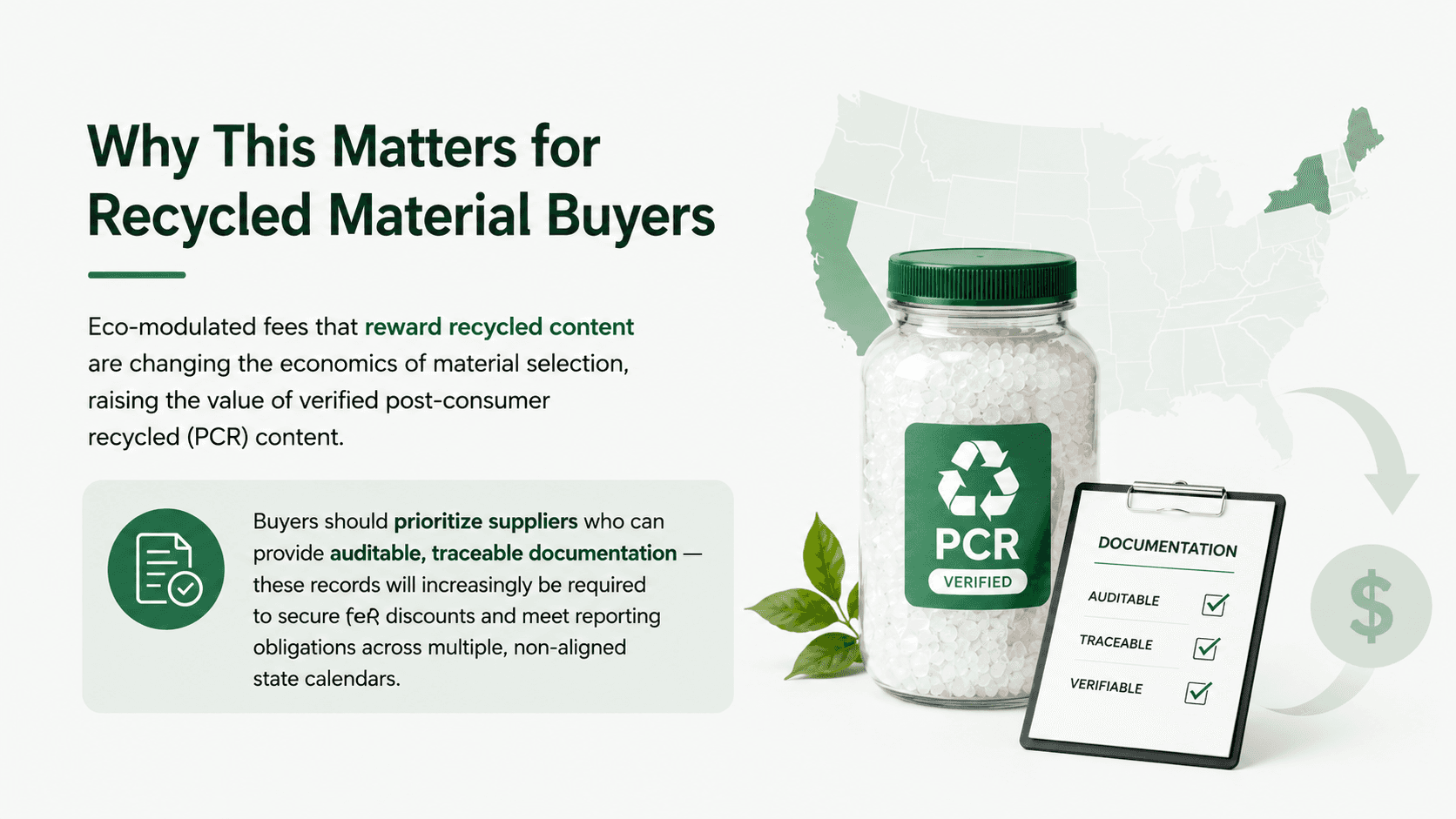
Eco-modulated fees that reward recycled content are changing the economics of material selection, raising the value of verified post-consumer recycled (PCR) content. Buyers should prioritize suppliers who can provide auditable, traceable documentation — these records will increasingly be required to secure fee discounts and meet reporting obligations across multiple, non-aligned state calendars.
Key Dates to Track
Date | State | Milestone |
|---|---|---|
Feb 6, 2026 | Oregon | Preliminary injunction granted (NAW members only) |
May 1, 2026 | California | SB 54 permanent regulations take effect |
May 31, 2026 | California, Colorado, Oregon | Annual packaging supply reports due to CAA |
May 31, 2026 | Maryland | Simplified 2025 supply report due |
June 15, 2026 | California | CAA submits draft Program Plan (comment open to Aug. 14) |
June 15, 2026 | Maine | RFP issued for stewardship organization |
July 1, 2026 | Maryland | Deadline for producers to register with approved PRO |
July 13–17, 2026 | Oregon | Bench trial held in NAW v. Feldon; ruling pending |
Jan 1, 2027 | California | Full program implementation begins |
Frequently Asked Questions
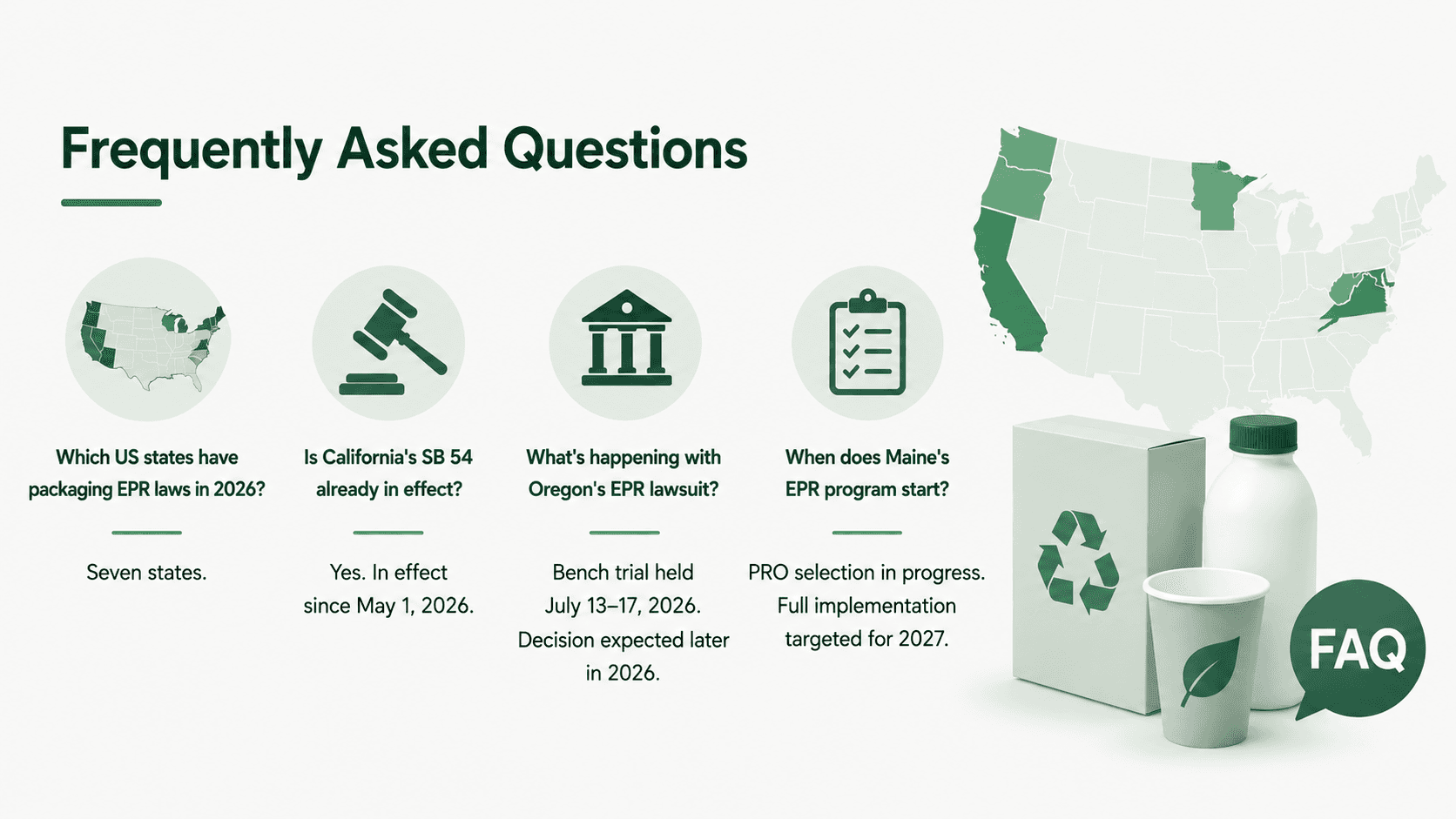
Which US states have packaging EPR laws in 2026? Seven: Maine, Oregon, California, Colorado, Minnesota, Maryland, and Washington — enacted in that order, but each running on a different implementation timeline.
Is California's SB 54 already in effect? Yes. CalRecycle's permanent SB 54 regulations were approved and took effect on May 1, 2026. CAA's draft California Program Plan followed on June 15, 2026, open for public comment through Aug. 14, 2026, ahead of a Jan. 1, 2027 program launch.
What's happening with Oregon's EPR lawsuit? A federal court granted a preliminary injunction on Feb. 6, 2026 blocking enforcement against NAW members only. The underlying constitutional challenge, NAW v. Feldon, went to a five-day bench trial in Portland from July 13–17, 2026. No ruling has been issued yet; a decision is expected later in 2026.
When does Maine's EPR program start? Maine hasn't yet selected a PRO — it issued an RFP for a stewardship organization on June 15, 2026. Registration and startup fees are expected later in 2026, with full implementation targeted for 2027.
About This Guide
This guide reflects publicly available information on US state packaging EPR laws as of July 2026. Litigation outcomes (notably in Oregon), fee schedules, and PRO selections continue to evolve. This content is intended for general informational purposes and does not constitute legal or compliance advice. Businesses should consult qualified legal counsel for guidance specific to their packaging portfolio and target states.
Image generated with ChatGPT
California's SB 54 captured headlines, but by mid-2026 the defining development is the spread — and divergence — of packaging Extended Producer Responsibility (EPR) across seven US states. For brands, converters, and recyclers selling into several jurisdictions, compliance is now a state-by-state reality, not a single-law checkbox. Here's where each state actually stands, and why the gaps between them affect sourcing, design, and documentation.
What Packaging EPR Requires
EPR shifts the cost and operational burden of packaging waste from municipalities to producers: registering with a Producer Responsibility Organization (PRO), reporting annual packaging supply by material and format, and paying fees that fund collection and recycling. Many states also use eco-modulated fees that reduce charges for more recyclable or recycled-content packaging — a direct incentive to source better material.
Seven states have enacted packaging EPR laws, in order passed: Maine, Oregon, California, Colorado, Minnesota, Maryland, and Washington. Each is at a markedly different stage, as the table below shows.
Seven States, Seven Different Timelines
State | Law(Year) | PRO | 2026 Status | Full Compliance |
|---|---|---|---|---|
California | SB 54 (2022) | CAA | Regs effective May 1; Program Plan filed June 15 | Launch Jan. 1, 2027 |
Colorado | Producer Responsibility Act (2022) | CAA | Live since Jan. 1; fees now invoiced | Ongoing |
Oregon | RMA / SB 582 (2021) | CAA | In effect; NAW injunction since Feb. 6; trial held July 13–17 | Pending trial ruling |
Maine | First US EPR law (2021) | TBD — RFP issued June 15 | Registration expected later in 2026 | Targeted 2027 |
Maryland | Packaging EPR law (2024) | CAA | PRO registration due July 1 | Plans by 2027–2028 |
Minnesota | Packaging EPR law (2024) | TBD (2027–2028) | Limited registration only | Not until 2032 |
Washington | Recycling Reform Act (2025) | CAA | Producers join PRO in 2026 | Not until 2030 |
The spread is the story: Colorado producers are already paying fees, Maine hasn't even picked its PRO, and Minnesota's real obligations are six years out. "We comply with SB 54" no longer covers national exposure.
California: From Draft Rules to Live Regulation
California's regulatory path wasn't smooth — CalRecycle withdrew its first set of proposed SB 54 rules in January 2026 to revise food and agricultural packaging provisions before finalizing them in May (see timeline above). The practical catch for packaging teams: obligated producers must act within 30 days of a regulation's effective date, so that clock is already running.
Oregon: The Legal Stress Test
Oregon's program is the leading constitutional test of US packaging EPR. NAW sued Oregon's DEQ in July 2025, arguing the RMA's fee structure violates the Dormant Commerce Clause and Due Process Clause, and won a narrow injunction that shields only its own members — non-NAW producers remain fully subject to the law. The case, NAW v. Feldon, reached a five-day bench trial in Portland this month — the first such challenge to go to trial for any state packaging EPR law. No ruling has been issued yet; a decision is expected later this year.
Maine: Building, Not Idle
Maine passed the first US packaging EPR law back in 2021 but still hasn't selected a PRO. Treat it as "coming online" rather than inactive — registration and startup fees are expected later in 2026, with full implementation targeted for 2027.
Why This Matters for Recycled Material Buyers
Eco-modulated fees that reward recycled content are changing the economics of material selection, raising the value of verified post-consumer recycled (PCR) content. Buyers should prioritize suppliers who can provide auditable, traceable documentation — these records will increasingly be required to secure fee discounts and meet reporting obligations across multiple, non-aligned state calendars.
Key Dates to Track
Date | State | Milestone |
|---|---|---|
Feb 6, 2026 | Oregon | Preliminary injunction granted (NAW members only) |
May 1, 2026 | California | SB 54 permanent regulations take effect |
May 31, 2026 | California, Colorado, Oregon | Annual packaging supply reports due to CAA |
May 31, 2026 | Maryland | Simplified 2025 supply report due |
June 15, 2026 | California | CAA submits draft Program Plan (comment open to Aug. 14) |
June 15, 2026 | Maine | RFP issued for stewardship organization |
July 1, 2026 | Maryland | Deadline for producers to register with approved PRO |
July 13–17, 2026 | Oregon | Bench trial held in NAW v. Feldon; ruling pending |
Jan 1, 2027 | California | Full program implementation begins |
Frequently Asked Questions
Which US states have packaging EPR laws in 2026? Seven: Maine, Oregon, California, Colorado, Minnesota, Maryland, and Washington — enacted in that order, but each running on a different implementation timeline.
Is California's SB 54 already in effect? Yes. CalRecycle's permanent SB 54 regulations were approved and took effect on May 1, 2026. CAA's draft California Program Plan followed on June 15, 2026, open for public comment through Aug. 14, 2026, ahead of a Jan. 1, 2027 program launch.
What's happening with Oregon's EPR lawsuit? A federal court granted a preliminary injunction on Feb. 6, 2026 blocking enforcement against NAW members only. The underlying constitutional challenge, NAW v. Feldon, went to a five-day bench trial in Portland from July 13–17, 2026. No ruling has been issued yet; a decision is expected later in 2026.
When does Maine's EPR program start? Maine hasn't yet selected a PRO — it issued an RFP for a stewardship organization on June 15, 2026. Registration and startup fees are expected later in 2026, with full implementation targeted for 2027.
About This Guide
This guide reflects publicly available information on US state packaging EPR laws as of July 2026. Litigation outcomes (notably in Oregon), fee schedules, and PRO selections continue to evolve. This content is intended for general informational purposes and does not constitute legal or compliance advice. Businesses should consult qualified legal counsel for guidance specific to their packaging portfolio and target states.
Image generated with ChatGPT
Sourcing Under State EPR
Grades • Specs • Availability
Browse rPP →
Sourcing Under State EPR
Sourcing Under State EPR
Compare rPP grades by feedstock, properties, certification, stock and MOQ.
Compare rPP grades by feedstock, properties, certification, stock and MOQ.
Browse rPP →
Browse rPP →
Looking for samples or ready to source? Submit your request for pricing, availability, and technical information.
Looking for samples or ready to source? Submit your request for pricing, availability, and technical information.
Request a Quote →
Request a Quote →
Posted by REGENPORT
REGENPORT is a global platform connecting buyers and suppliers in the recycled materials and sustainable packaging industries.