Industry News
PCR vs PIR vs OBP: Understanding Recycled Plastic Types Before You Source
PCR vs PIR vs OBP: Understanding Recycled Plastic Types Before You Source
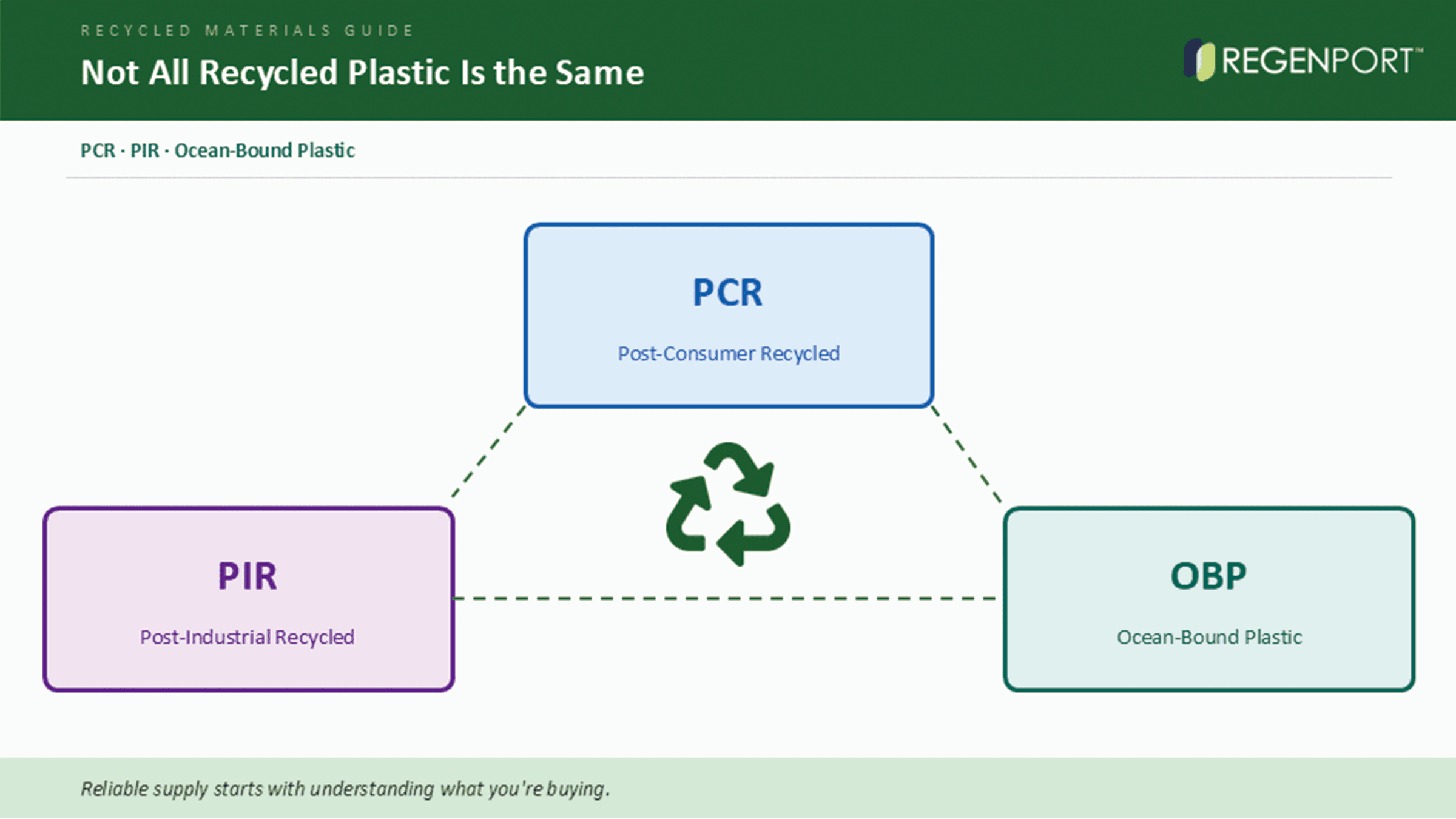
Not all recycled plastic is the same. A practical breakdown of PCR, PIR, and Ocean-Bound Plastic — covering origin, quality, environmental contribution, and compliance.
One of the most common mistakes in recycled plastic sourcing is treating PCR, PIR, and OBP as interchangeable. They are not. The source changes everything — quality stability, contamination risk, environmental contribution, and how regulators count it.
Reliable supply starts with understanding what you are actually buying.
Three Types, Three Origins
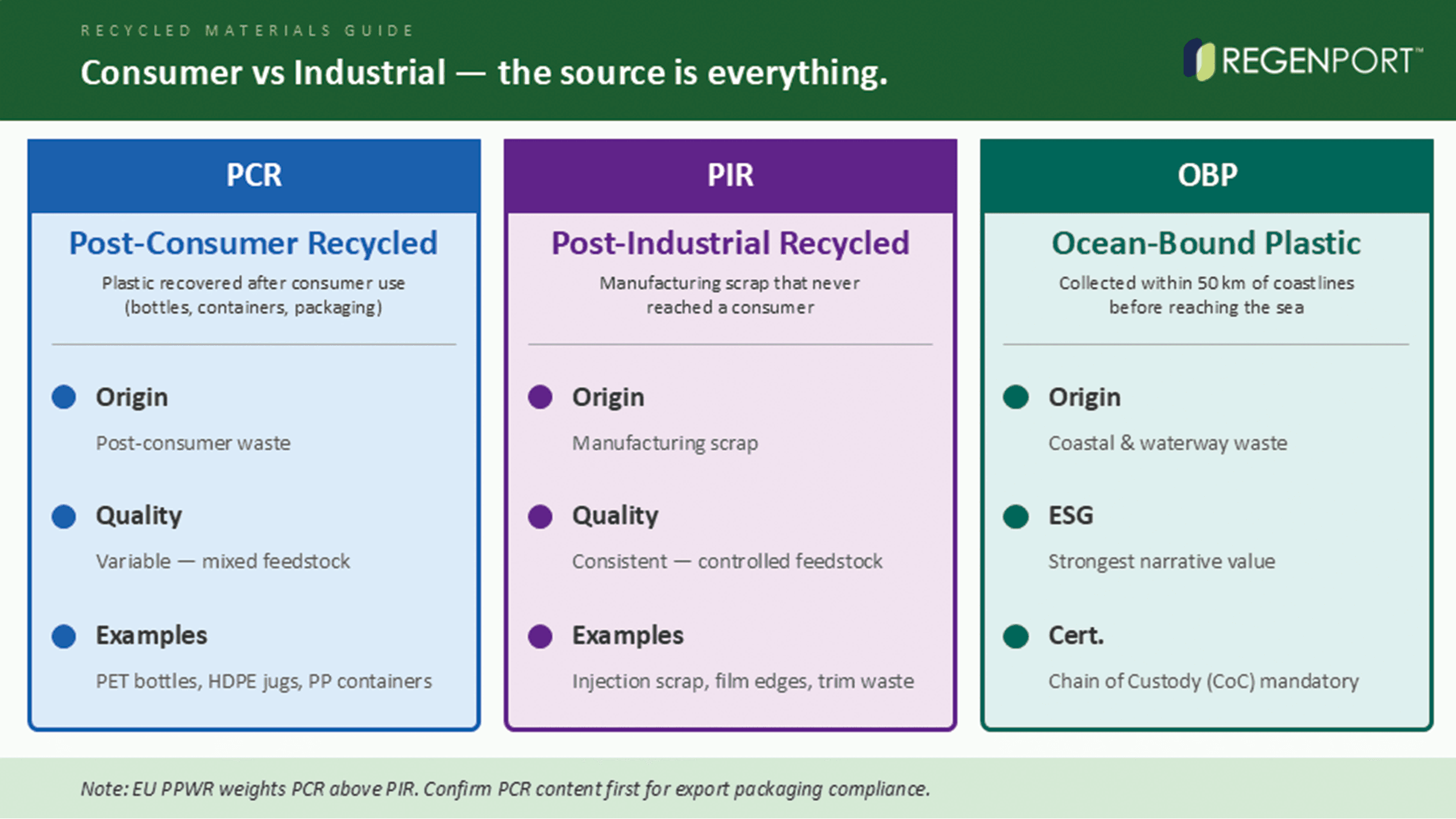
There are three distinct categories of recycled plastic in the market today: PCR (Post-Consumer Recycled), PIR (Post-Industrial Recycled), and OBP (Ocean-Bound Plastic). Each has a different origin, different quality profile, and different role in compliance and sustainability reporting.
PCR — Post-Consumer Recycled
PCR is plastic recovered after consumer use — bottles, food containers, and packaging. The material flow runs from consumer use → waste sorting → collection → recycling facility → recycled pellet production.
Common examples: PET bottles, HDPE jugs, PP containers.
Because PCR comes from mixed consumer waste streams, its feedstock is variable. Quality can shift between batches depending on how and where it was collected and sorted.
Regulatory note: EU PPWR weights PCR above PIR. For export packaging compliance, confirm PCR content first.
PIR — Post-Industrial Recycled
PIR is manufacturing scrap that never reached a consumer — offcuts, trimmings, and rejected parts generated during production. The material flow runs from manufacturing process → defective products / leftover materials → recycling → pellet production.
Common examples: injection scrap, film edges, trim waste.
Because PIR feedstock is controlled, it delivers consistent quality — making it well-suited for performance-sensitive applications.
OBP — Ocean-Bound Plastic
OBP is plastic collected within 50 km of coastlines or waterways before it can enter the sea. Key characteristics:
Recovered within 50 km of coastlines or waterways before marine entry
Strongest ESG narrative value — directly linked to ocean conservation
Chain of Custody (CoC) certification is mandatory
Favored by B2C brands for visible sustainability storytelling
Grade Comparison
PCR | PIR | OBP | |
|---|---|---|---|
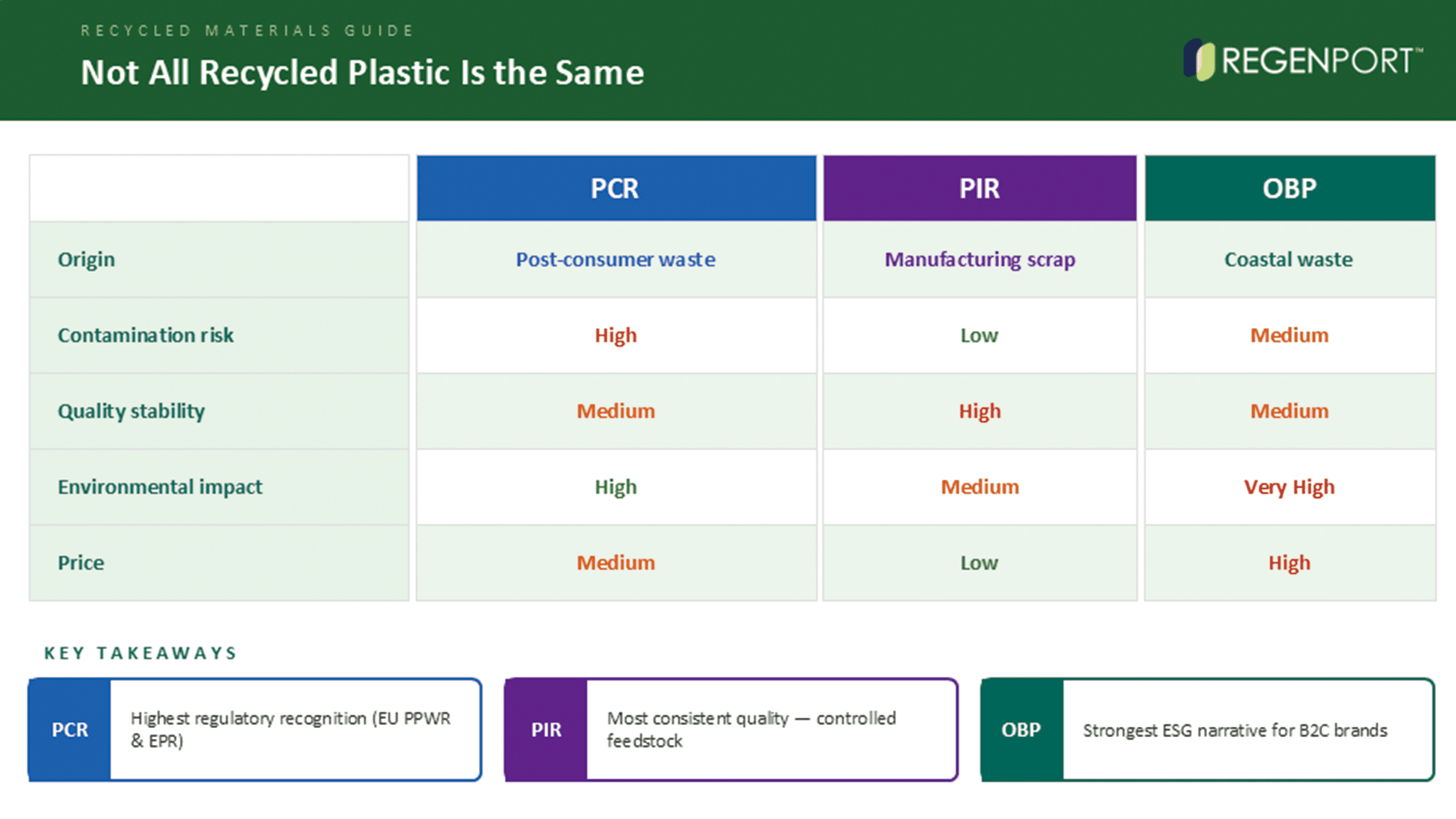
Origin | Post-Consumer waste | Manufacturing scrap | Coastal & waterway waste |
Contamination risk | High | Low | Medium |
Quality stability | Medium | High | Medium |
Environmental contribution | High | Medium | Very High |
Price | Medium | Low | High |
Key Takeaways
PCR — Highest regulatory recognition under EU PPWR & EPR (EU Packaging and Packaging Waste Regulation & Extended Producer Responsibility). Essential for export packaging compliance.
PIR — Most consistent quality from controlled feedstock. Best choice for performance-sensitive applications.
OBP — Strongest ESG narrative. Ideal for brands communicating visible environmental impact to consumers.
5 Checks Before You Source Recycled Resin
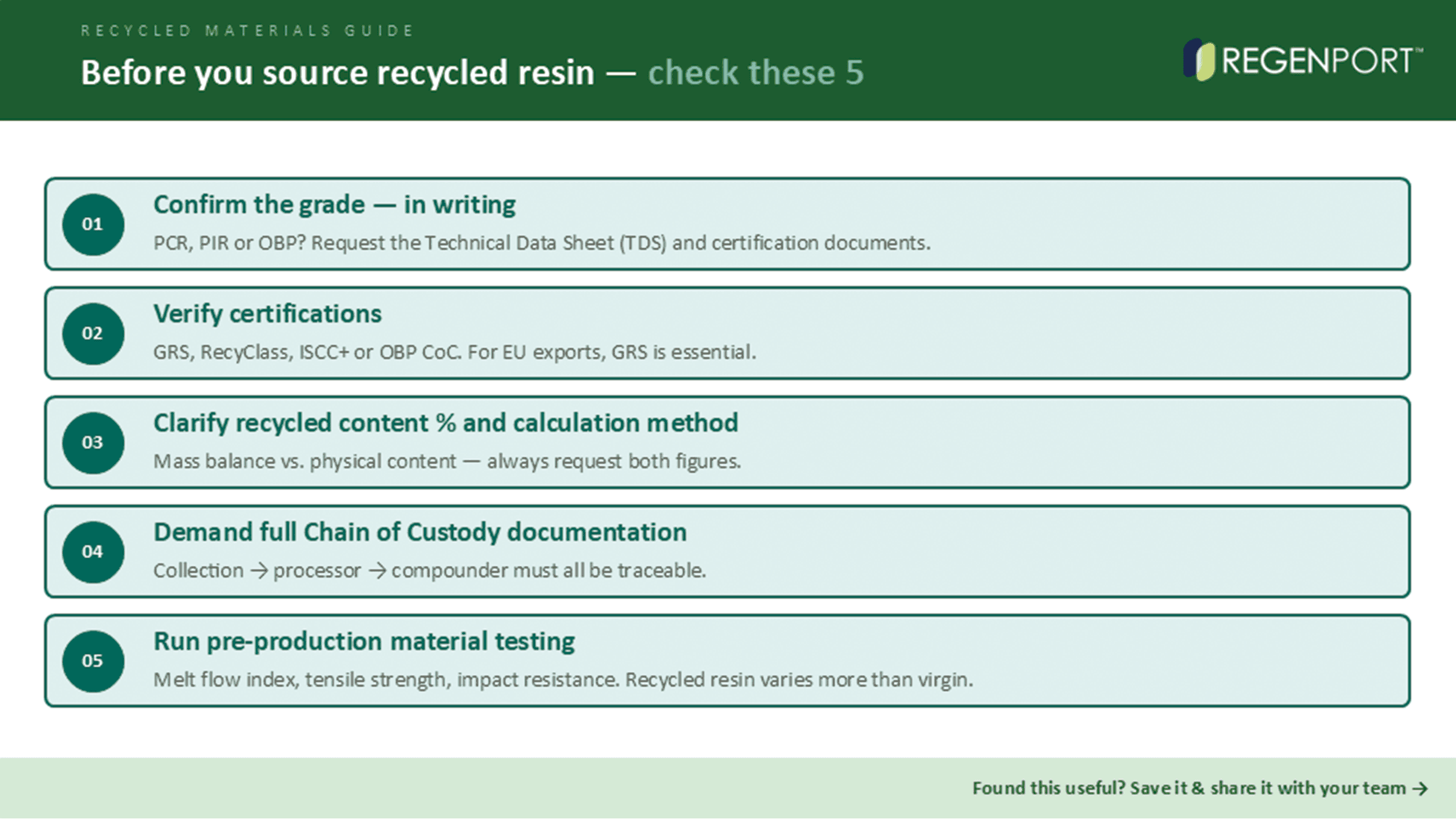
Confirm the grade — in writing PCR, PIR, or OBP? Verbal confirmation is not enough. Request the Technical Data Sheet (TDS) and certification documents.
Verify certifications GRS, RecyClass, ISCC+, or OBP CoC. For EU exports, GRS is essential. Food contact applications require EFSA compliance separately.
Clarify recycled content % and calculation method Mass balance vs. physical content — the method changes the number significantly. Always request both figures.
Demand full Chain of Custody documentation Collection region → intermediate processor → final compounder must all be traceable. Non-negotiable for compliance.
Run pre-production material testing Melt flow index, tensile strength, impact resistance. Recycled resin has more batch variation than virgin material.
One of the most common mistakes in recycled plastic sourcing is treating PCR, PIR, and OBP as interchangeable. They are not. The source changes everything — quality stability, contamination risk, environmental contribution, and how regulators count it.
Reliable supply starts with understanding what you are actually buying.
Three Types, Three Origins
There are three distinct categories of recycled plastic in the market today: PCR (Post-Consumer Recycled), PIR (Post-Industrial Recycled), and OBP (Ocean-Bound Plastic). Each has a different origin, different quality profile, and different role in compliance and sustainability reporting.
PCR — Post-Consumer Recycled
PCR is plastic recovered after consumer use — bottles, food containers, and packaging. The material flow runs from consumer use → waste sorting → collection → recycling facility → recycled pellet production.
Common examples: PET bottles, HDPE jugs, PP containers.
Because PCR comes from mixed consumer waste streams, its feedstock is variable. Quality can shift between batches depending on how and where it was collected and sorted.
Regulatory note: EU PPWR weights PCR above PIR. For export packaging compliance, confirm PCR content first.
PIR — Post-Industrial Recycled
PIR is manufacturing scrap that never reached a consumer — offcuts, trimmings, and rejected parts generated during production. The material flow runs from manufacturing process → defective products / leftover materials → recycling → pellet production.
Common examples: injection scrap, film edges, trim waste.
Because PIR feedstock is controlled, it delivers consistent quality — making it well-suited for performance-sensitive applications.
OBP — Ocean-Bound Plastic
OBP is plastic collected within 50 km of coastlines or waterways before it can enter the sea. Key characteristics:
Recovered within 50 km of coastlines or waterways before marine entry
Strongest ESG narrative value — directly linked to ocean conservation
Chain of Custody (CoC) certification is mandatory
Favored by B2C brands for visible sustainability storytelling
Grade Comparison
PCR | PIR | OBP | |
|---|---|---|---|
Origin | Post-Consumer waste | Manufacturing scrap | Coastal & waterway waste |
Contamination risk | High | Low | Medium |
Quality stability | Medium | High | Medium |
Environmental contribution | High | Medium | Very High |
Price | Medium | Low | High |
Key Takeaways
PCR — Highest regulatory recognition under EU PPWR & EPR (EU Packaging and Packaging Waste Regulation & Extended Producer Responsibility). Essential for export packaging compliance.
PIR — Most consistent quality from controlled feedstock. Best choice for performance-sensitive applications.
OBP — Strongest ESG narrative. Ideal for brands communicating visible environmental impact to consumers.
5 Checks Before You Source Recycled Resin
Confirm the grade — in writing PCR, PIR, or OBP? Verbal confirmation is not enough. Request the Technical Data Sheet (TDS) and certification documents.
Verify certifications GRS, RecyClass, ISCC+, or OBP CoC. For EU exports, GRS is essential. Food contact applications require EFSA compliance separately.
Clarify recycled content % and calculation method Mass balance vs. physical content — the method changes the number significantly. Always request both figures.
Demand full Chain of Custody documentation Collection region → intermediate processor → final compounder must all be traceable. Non-negotiable for compliance.
Run pre-production material testing Melt flow index, tensile strength, impact resistance. Recycled resin has more batch variation than virgin material.
Interested in samples or volume pricing?
Interested in samples or volume pricing?
sales@e-connect.kr
sales@e-connect.kr
PCR vs PIR vs OBP: Understanding Recycled Plastic Types Before You Source
PCR vs PIR vs OBP: Understanding Recycled Plastic Types Before You Source
Safety Nets, Recycled: A Sourcing Guide to PCR PP Pellets from South Korea
Safety Nets, Recycled: A Sourcing Guide to PCR PP Pellets from South Korea
How AI Is Improving Recycled Resin Sourcing — From the Production Floor to the Supply Chain
How AI Is Improving Recycled Resin Sourcing — From the Production Floor to the Supply Chain
Recycled cPP Pellets (PIR): Properties, Applications, and Sourcing Guide
Recycled cPP Pellets (PIR): Properties, Applications, and Sourcing Guide
What Is Recycled oPP Pellet? PIR Resin from Industrial Film Explained
What Is Recycled oPP Pellet? PIR Resin from Industrial Film Explained

CONTACT US
Fill out the form and we'll get back to you
within 1 business day.